
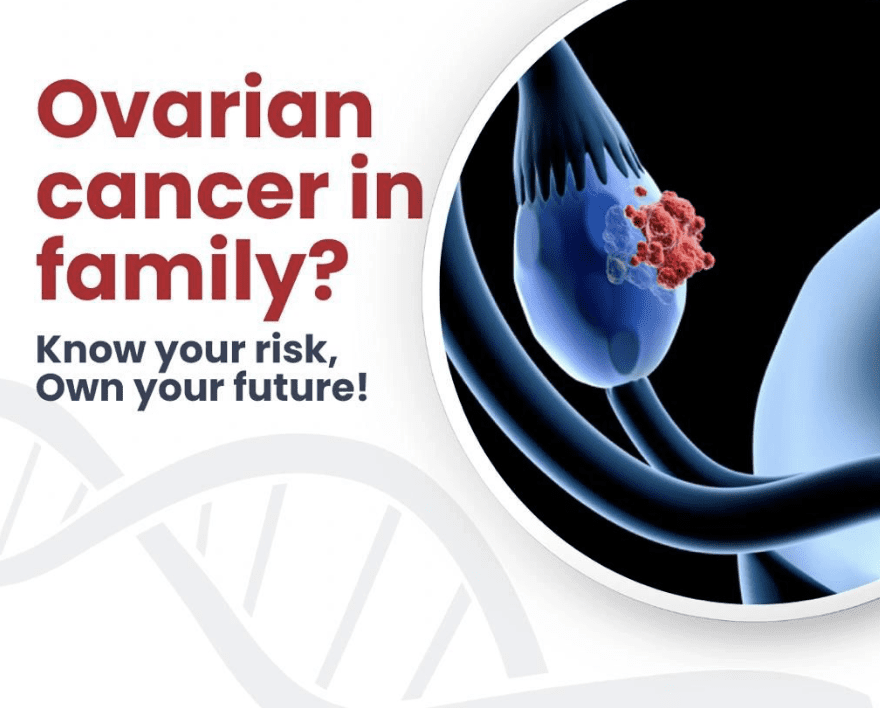
👩⚕️ A Question Many Women Ask
A 42-year-old woman came to my clinic saying, “My mother and aunt both had ovarian cancer. Am I next?”
It’s a question filled with fear — and one that deserves calm, clear answers.
While most ovarian cancers happen by chance, some are passed down through families. Knowing whether your family’s cancer risk is hereditary can literally change — and save — lives.
1️⃣ How Common Is Hereditary Ovarian Cancer?
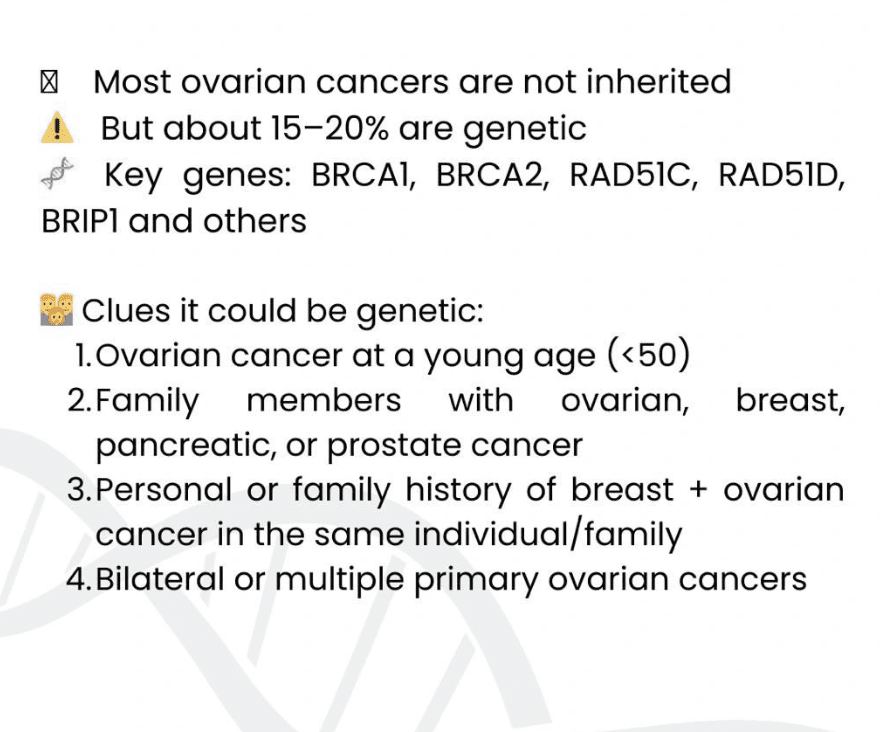
Most ovarian cancers are not inherited, but around 15–20% are caused by genetic mutations passed from parent to child.
The most important genes linked to hereditary ovarian cancer include:
-
BRCA1 and BRCA2 – the same genes that increase breast cancer risk.
-
RAD51C, RAD51D, and BRIP1 – genes that help repair DNA damage.
-
Lynch syndrome genes – such as MLH1, MSH2, MSH6, and PMS2, which raise the risk for ovarian, colon, and uterine cancers.
These genes normally protect your body from cancer. When one of them has a “spelling mistake” (mutation), the body’s repair system weakens, and abnormal cells can grow unchecked.
2️⃣ What Are the Warning Signs It Could Be Genetic?
Certain family patterns suggest a hereditary cause. Watch for these clues:
-
Ovarian cancer diagnosed at a young age (<50 years)
-
Multiple relatives with ovarian, breast, pancreatic, or prostate cancer
-
A person or family with both breast and ovarian cancer
-
Bilateral or multiple ovarian cancers in one person
-
A relative with male breast cancer
-
Ashkenazi Jewish ancestry, where BRCA changes are more common
If these patterns sound familiar, it’s worth consulting a clinical geneticist. You don’t need to wait until someone else in the family falls ill — early assessment can protect generations.
3️⃣ What Is Genetic Counseling and Why Start There?
Before testing, it’s important to talk to a genetic counselor or clinical geneticist.
They will:
-
Review your personal and family medical history
-
Explain what testing can (and can’t) tell you
-
Discuss emotional, practical, and medical aspects of results
Genetic counseling ensures that you make informed decisions, understand what results mean, and plan the next steps with confidence.
4️⃣ What Does Genetic Testing Involve?
Genetic testing is simple and painless — it uses a small blood sample or saliva.
The lab looks for specific changes in cancer-protecting genes such as BRCA1, BRCA2, RAD51C, RAD51D, BRIP1, and others.
There are three possible outcomes:
-
Positive – a harmful gene change is found
-
Negative – no harmful change detected
-
VUS (Variant of Uncertain Significance) – a change whose meaning is unclear for now
If a harmful mutation is found, you and the genetics doctor can take preventive or surveillance steps to stay ahead.
5️⃣ What If My Genetic Test Is Positive?
Testing positive means you have a higher risk, not a guarantee of developing cancer.
Here’s what typically follows:
-
More frequent surveillance: You may be advised to have pelvic exams, transvaginal ultrasound (TVUS), and CA-125 blood tests more regularly.
-
Preventive options: After completing your family, the genetics doctor might suggest a risk-reducing salpingo-oophorectomy — a surgery that removes ovaries and fallopian tubes before cancer can start.
-
Oral contraceptive pills (OCPs): Long-term use may slightly lower risk.
-
Lifestyle changes: Healthy diet, regular exercise, and maintaining ideal weight all help.
The goal is to detect cancer early — or prevent it altogether.
6️⃣ What If My Test Is Negative?
A “negative” test doesn’t always mean “no risk.”
It could mean that your family’s risk is due to an unknown gene not yet discovered.
If you have a strong family history, your genetic counselor might still recommend:
-
Regular screening
-
Discussion of preventive options
-
Testing of other affected family members
So even if your report is normal, you should stay alert and continue routine care.
7️⃣ What Can My Family Members Do If I Test Positive?
If you test positive, your close relatives — parents, siblings, and children — each have a 50% chance of carrying the same mutation.
Testing them can help:
-
Identify who’s at risk early
-
Guide preventive care for women (and sometimes men)
-
Reassure those who test negative
Family screening turns one person’s discovery into protection for the whole family.
8️⃣ What Are the Symptoms of Ovarian Cancer?
Ovarian cancer is often called a “silent killer” because symptoms are vague or appear late.
But early detection is possible if you know what to look for.
Common warning signs include:
-
Persistent bloating or abdominal swelling
-
Pelvic or stomach pain
-
Feeling full quickly or loss of appetite
-
Frequent urination or urgency
-
Fatigue, backache, or unexplained weight changes
If you notice these symptoms for more than 2–3 weeks, don’t ignore them — see your doctor.
9️⃣ Is There Reliable Screening for Ovarian Cancer?
Unlike breast or cervical cancer, no single reliable screening test exists yet for ovarian cancer.
TVUS and CA-125 can be used for high-risk women, but they are not perfect — sometimes they miss early disease or give false alarms.
That’s why genetic testing and preventive surgery are so important.
They target the root cause — before cancer begins.
🔟 Can Ovarian Cancer Be Prevented?
Yes — especially if you know your genetic risk early.
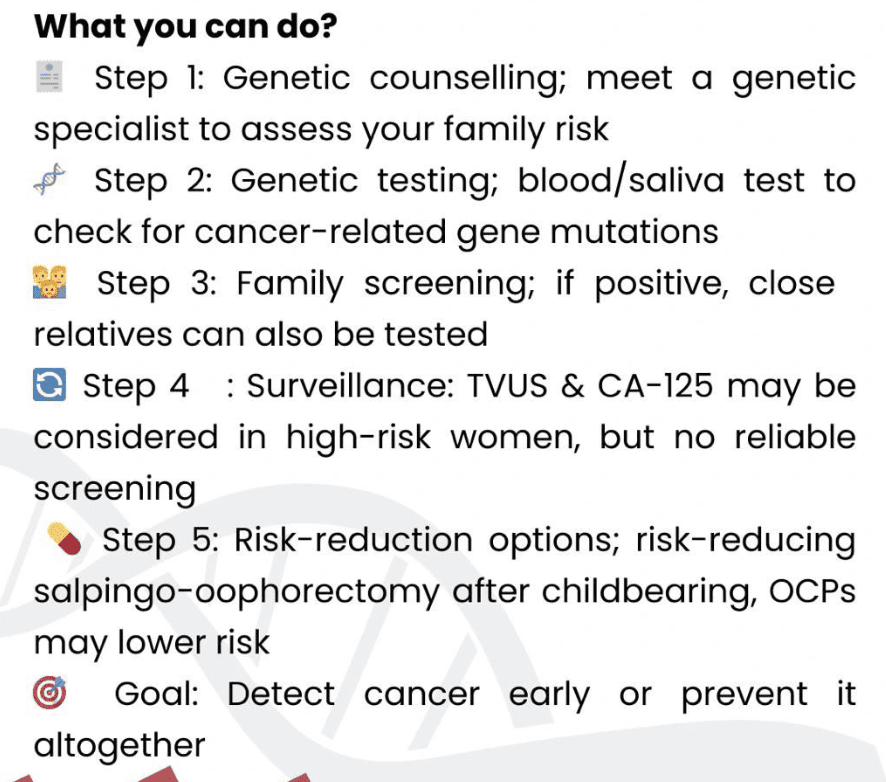
Here’s the stepwise prevention plan used by Genetidoc Genetic Clinic and DNA Testing Lab:
-
Genetic counseling – meet a specialist to assess your family risk
-
Genetic testing – blood or saliva test to look for cancer-related genes
-
Family screening – test close relatives if one person is positive
-
Surveillance – consider TVUS and CA-125 in high-risk women
-
Risk-reducing surgery – salpingo-oophorectomy after childbearing
-
Medication options – oral contraceptives may reduce risk
-
Goal – detect cancer early or prevent it altogether
Every step is individualized — you don’t have to do everything at once. Your genetic expert helps you plan what’s right for your health, age, and family.
🌸 Real-Life Example
A 38-year-old woman came to our clinic after her sister died of ovarian cancer at 45.
Genetic testing revealed a BRCA1 mutation. After finishing her family, she chose preventive surgery to remove her ovaries and fallopian tubes.
Her younger cousin also tested positive and started close monitoring.
Both women avoided late-stage cancer, and their daughters will now grow up with knowledge and preventive care from the start.
That’s the power of awareness — one family’s tragedy can become another’s protection.
💬 Frequently Asked Questions
Can men carry or pass on ovarian cancer genes?
Yes. Genes like BRCA1 and BRCA2 are not gender-specific.
A father can pass them to his daughters or sons — which means your father’s side of the family is just as important to consider.
If I have a BRCA mutation, do I also have breast cancer risk?
Yes. BRCA1 and BRCA2 increase the risk for both breast and ovarian cancer.
That’s why your genetic counselor may recommend early breast screening too.
At what age should I consider genetic testing?
Testing can be done anytime after 18 if there’s a strong family history, but is especially important by your late 20s or early 30s for high-risk families.
Can removing ovaries cause early menopause?
Yes, but the genetics doctor will discuss safe ways to manage symptoms, such as hormone replacement therapy (HRT), depending on your age and health.
Is there any diet or supplement to reduce ovarian cancer risk?
No single food prevents cancer, but a balanced diet, regular exercise, and avoiding smoking can all help maintain hormone balance and reduce inflammation.
🌼 Emotional Impact and Family Conversations
Genetic testing isn’t just a medical step — it’s an emotional one.
Women often feel fear, guilt, or anxiety about their results or about passing risks to their children.
It’s okay to feel that way.
Talking openly within the family — and with your genetic counselor — can transform that fear into empowerment.
Remember: Knowing is healing.
🌷 Awareness Saves Lives
When ovarian cancer runs in families, awareness can change the outcome.
In many hereditary cases, cancers are detected early or even prevented completely when women take proactive steps.
So if you have ovarian cancer in family, don’t wait.
Get your risk assessed — for yourself, your sisters, and your daughters.
💗 Take Action — Know Your Risk, Own Your Future
Genetic counseling and testing can turn fear into control.
It’s not about predicting destiny — it’s about preventing disease.