
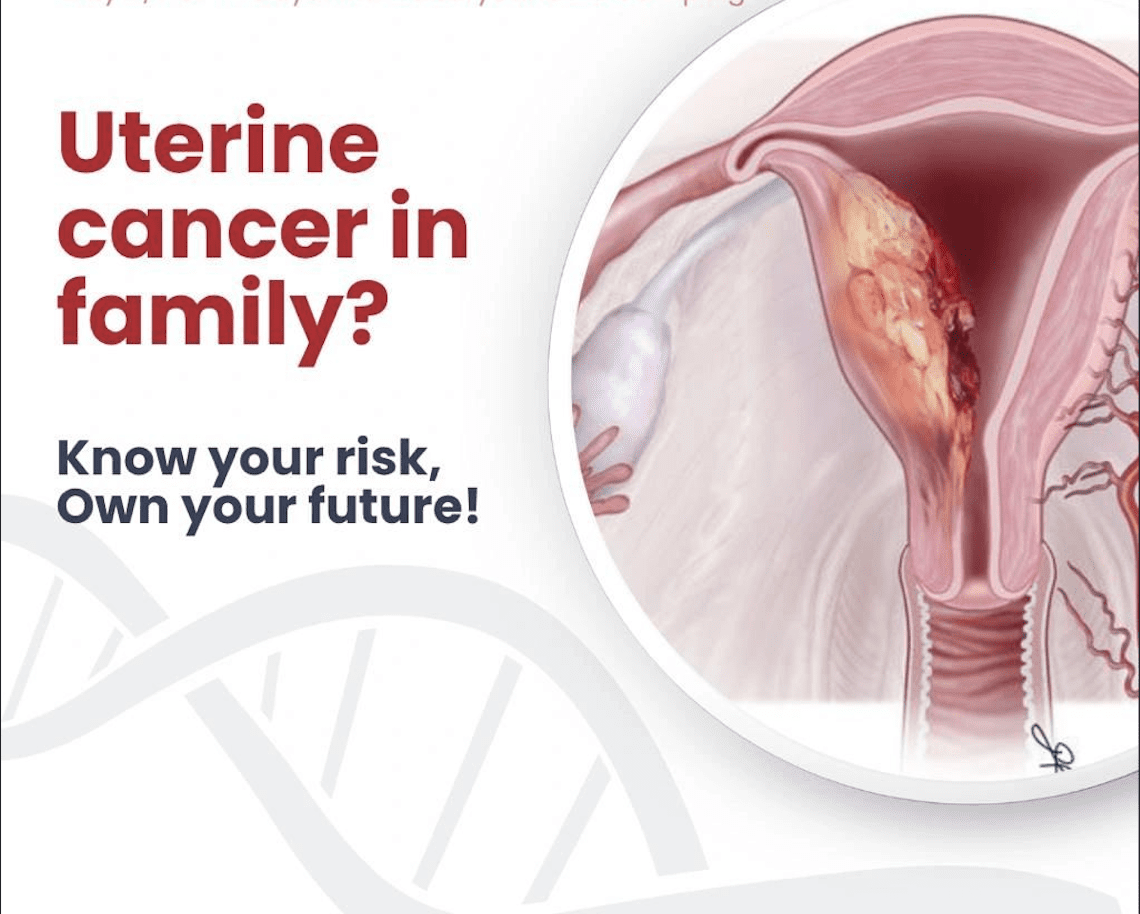
👩⚕️ When Family History Raises Questions
A 45-year-old woman visited my clinic saying, “My mother and aunt both had uterine cancer before menopause. Should I be worried?”
It’s a genuine and important concern. While many uterine (endometrial) cancers are sporadic, some arise from inherited genetic changes, especially those linked to Lynch syndrome (also called Hereditary Non-Polyposis Colorectal Cancer— HNPCC).
Understanding whether your family’s risk is hereditary can lead to early detection and even prevention.
1️⃣ How Often Is Uterine Cancer Genetic?
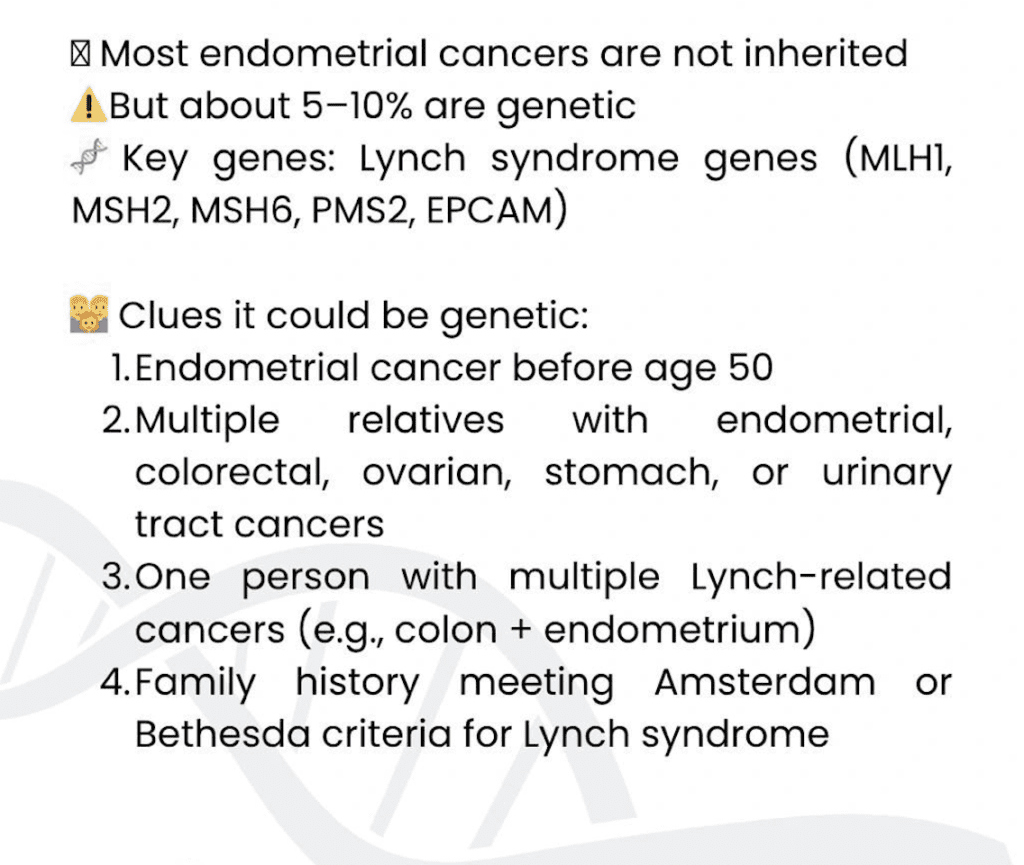
About 5–10 percent of all uterine cancers are hereditary.
The most common cause is Lynch syndrome, a condition caused by mutations in genes responsible for DNA repair:
-
MLH1
-
MSH2
-
MSH6
-
PMS2
-
EPCAM
When these “spell-check” genes stop working properly, errors accumulate in the DNA, increasing the risk for several cancers — especially uterine and colon cancer.
2️⃣ What Are the Signs That Uterine Cancer Might Be Hereditary?
Certain patterns in your family or personal history can hint at Lynch syndrome:
-
Uterine (endometrial) cancer before age 50
-
Multiple relatives with uterine, colon, ovarian, stomach, or urinary-tract cancers
-
One person with two or more Lynch-related cancers (for example, colon + uterine)
-
Family meeting Amsterdam or Bethesda criteria for Lynch syndrome
If any of these sound familiar, a genetic counseling session is strongly advised.
3️⃣ What Exactly Is Lynch Syndrome?
Lynch syndrome is an inherited condition that increases the risk of several cancers, most commonly:
-
Colorectal cancer
-
Uterine (endometrial) cancer
-
Ovarian cancer
-
Stomach, small-bowel, urinary-tract, and certain skin cancers
A person with Lynch syndrome has up to a 40–60% lifetime risk of developing uterine cancer.
Because the same genes affect multiple organs, families often see a combination of these cancers across generations.
4️⃣ What Is Genetic Counseling and Why Start There?
Before any test, you’ll meet a genetic counselor or clinical geneticist.
They will:
-
Review your personal and family medical history
-
Estimate your risk for hereditary cancer
-
Explain the pros and cons of genetic testing
-
Prepare you emotionally and practically for the results
This session helps you make an informed choice, rather than a fearful one.
5️⃣ What Does Genetic Testing Involve?
Genetic testing is simple — a blood or saliva sample is collected and sent to a specialized laboratory.
The lab checks your DNA for changes in the Lynch syndrome genes listed above.
Possible results:
-
Positive – a harmful mutation is found; your risk is higher.
-
Negative – no harmful mutation detected.
-
VUS (Variant of Uncertain Significance) – a change whose meaning isn’t yet known.
Testing is not about predicting doom; it’s about knowing your starting point and planning accordingly.
6️⃣ What Happens If the Test Is Positive?
A positive result doesn’t mean you have cancer — it means you’re at increased risk.
Your doctor will create a personalized surveillance and prevention plan. It may include:
-
Regular endometrial screening: annual or biennial endometrial biopsy.
-
Pelvic ultrasound (TVS) to check uterine lining thickness.
-
Colonoscopy every 1–2 years starting early.
-
Risk-reducing surgery: preventive hysterectomy (removal of uterus) with or without oophorectomy (removal of ovaries) after childbearing.
-
Aspirin therapy, which some studies suggest may reduce Lynch-related cancer risk.
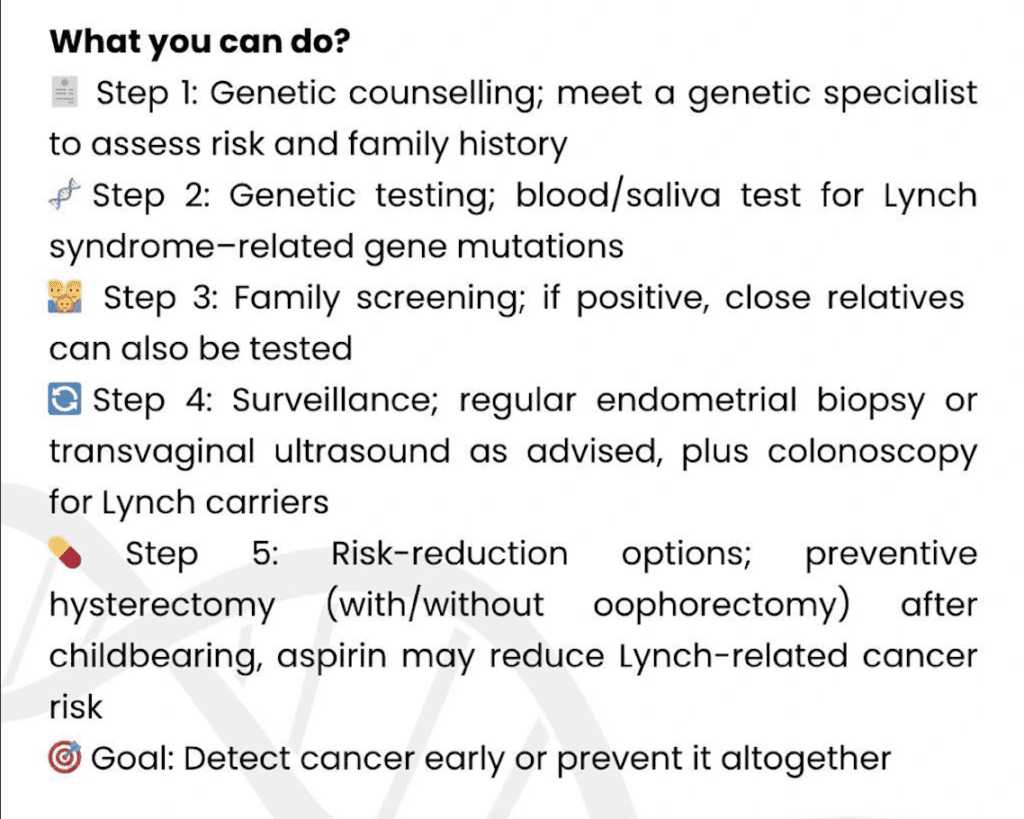
🎯 Goal: Detect cancer early or prevent it altogether.
7️⃣ What If My Test Is Negative?
A negative result can be reassuring — but if your family history is strong, your doctor might still recommend enhanced surveillance.
Why? Because there could be other undiscovered genes or shared environmental factors increasing risk.
Even without a known mutation, maintaining a healthy weight, regular exercise, and timely gynecologic check-upsremain key.
8️⃣ How Can My Relatives Benefit?
If you test positive, each of your first-degree relatives (parents, siblings, children) has a 50% chance of carrying the same mutation.
Testing them helps identify who truly needs frequent screening — and who can relax.
Family testing turns fear into clarity and empowers everyone with the right plan.
9️⃣ What Are the Symptoms of Uterine (Endometrial) Cancer?
Early-stage symptoms are often ignored.
Be alert for:
-
Abnormal bleeding (especially after menopause)
-
Irregular periods or spotting between cycles
-
Pelvic pain or pressure
-
Unexplained weight loss
-
Change in bowel habits
If these persist, consult your gynecologist immediately. Early diagnosis saves lives.
🔟 Can Uterine Cancer Be Prevented?
Yes — especially in families with hereditary risk.
Here’s the five-step plan used at Genetidoc Genetic Clinic and DNA Testing Lab:
-
Genetic counseling – assess family risk
-
Genetic testing – blood/saliva test for Lynch-related mutations
-
Family screening – test close relatives if one is positive
-
Surveillance – periodic endometrial biopsy or transvaginal ultrasound, plus colonoscopy
-
Risk-reduction options – preventive hysterectomy after childbearing; aspirin therapy may help
💡 The earlier you act, the more you can control your future.
🌷 Real-Life Example
A 37-year-old woman came to our clinic after her mother developed both colon and uterine cancer in her 40s.
Genetic testing showed an MSH2 mutation — confirming Lynch syndrome.
She began colonoscopies every 18 months and underwent a preventive hysterectomy after completing her family.
Today, she remains healthy, and her two sisters are also being monitored.
One family’s awareness turned into multi-generation protection.
💬 Frequently Asked Questions
Is Lynch syndrome only inherited from the mother’s side?
No. It can be passed from either parent, so both sides of the family matter.
If I already had colon cancer, should I still test for Lynch syndrome?
Yes. It may affect follow-up care and help family members know their own risks.
Does birth control lower uterine cancer risk?
Long-term use of oral contraceptive pills (OCPs) can slightly reduce risk in some women.
Can men have Lynch syndrome?
Absolutely. Men can inherit and pass on the same genes and have higher risks for colon, stomach, or urinary-tract cancers.
When should I start screening if my mother had endometrial cancer before 50?
Usually 5–10 years before the youngest diagnosis in your family, or by your 30s if there’s strong history.
🌼 Emotional and Family Aspects
Discovering a genetic risk can stir fear, guilt, or confusion.
But knowledge replaces uncertainty with power.
Many women find comfort in knowing they can act — not simply wait.
Talking openly with your doctor, counselor, and relatives creates a shared shield of protection.
🌸 Awareness Saves Lives
Hereditary uterine cancer is preventable — if detected early.
Every test, every counseling session, every conversation could spare a loved one tomorrow.
If uterine or endometrial cancer runs in your family, this is your sign to act today.
💗 Take Action — Know Your Risk, Own Your Future
Don’t wait for symptoms.
A single conversation with a genetic expert can give you clarity, options, and peace of mind.