
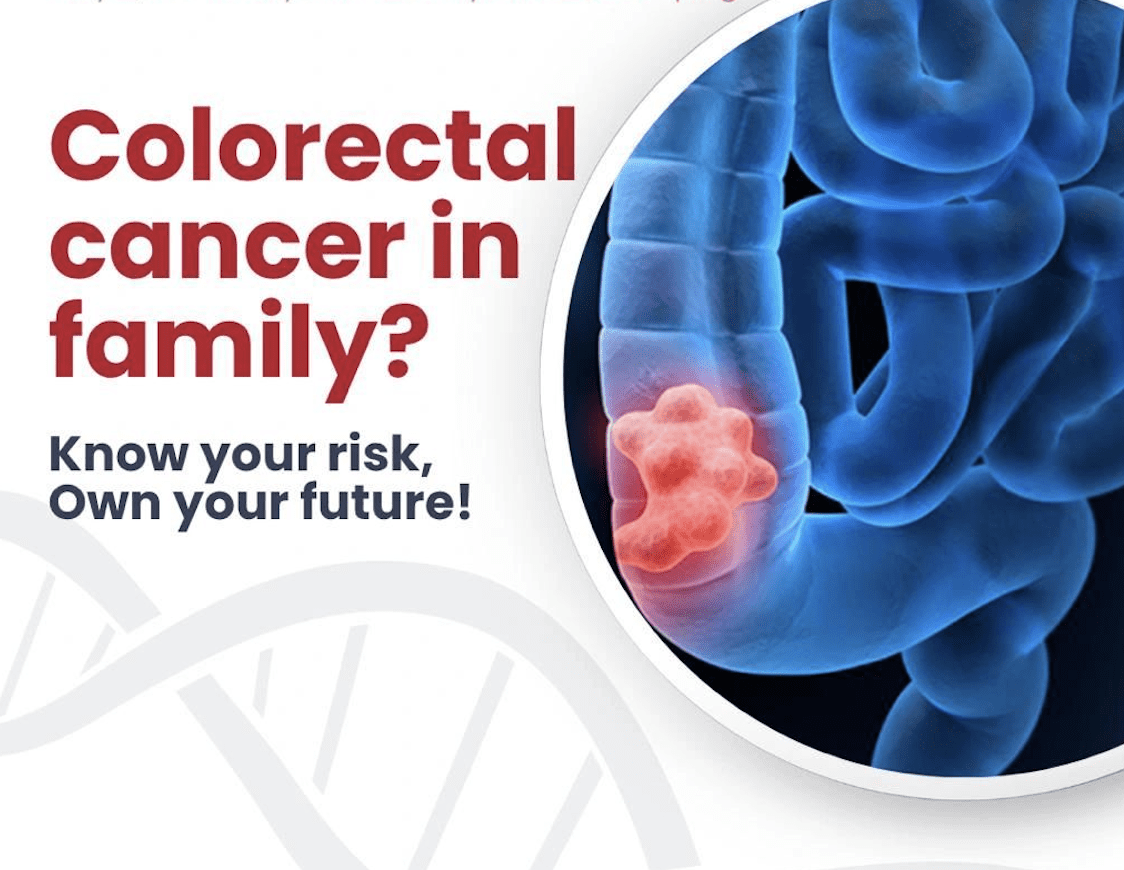
👨⚕️ “Doctor, My Father Had Colon Cancer. Am I at Risk?”
A 38-year-old man came to my clinic worried because his father was diagnosed with colon cancer at 46.
He asked, “Should I get tested too?”
This is one of the most important questions families can ask — because while most colon cancers happen by chance, about 5–10% are hereditary.
These inherited forms can appear younger, spread faster, and affect multiple relatives — but the good news is, they can be detected early and even prevented.
1️⃣ How Common Is Hereditary Colorectal Cancer?
While the majority of colon and rectal cancers are sporadic, about 1 in 10 cases arise due to inherited genetic changes.
The two main hereditary syndromes are:
-
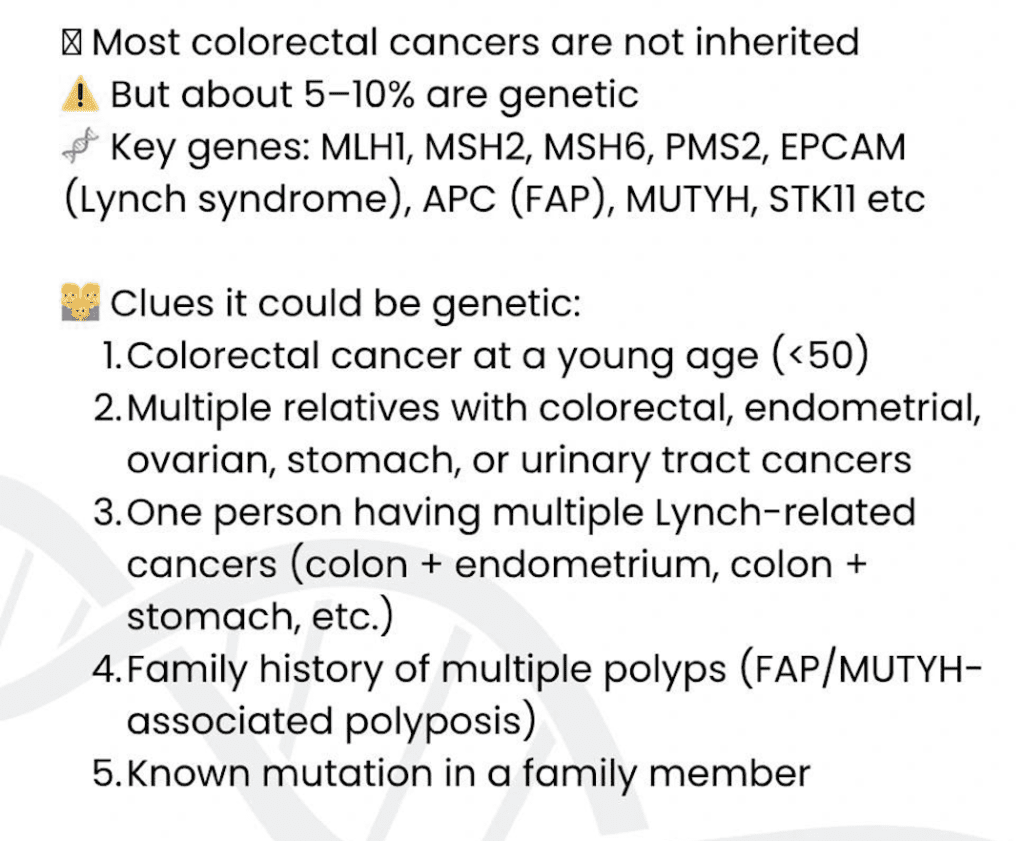
Lynch syndrome (HNPCC) – the most common, caused by defects in DNA repair genes such as MLH1, MSH2, MSH6, PMS2, and EPCAM.
-
Familial Adenomatous Polyposis (FAP) – caused by a mutation in the APC gene, leading to hundreds of polyps in the colon from a young age.
Other rare syndromes include MUTYH-associated polyposis (MAP) and Peutz-Jeghers syndrome (STK11 gene).
2️⃣ What Are the Signs It Could Be Genetic?
There are clear red flags suggesting inherited risk:
-
Colorectal cancer before age 50
-
Multiple relatives with colorectal, endometrial, ovarian, or stomach cancer
-
Same person with two cancers, like colon + endometrial
-
Family history of numerous colon polyps
-
Known mutation in a family member
If your family fits any of these, consult a genetic counselor to assess your risk.
3️⃣ Understanding Lynch Syndrome
Lynch syndrome, also called Hereditary Non-Polyposis Colorectal Cancer (HNPCC), is the most common hereditary cause.
It’s due to mutations in “DNA spell-check” genes — MLH1, MSH2, MSH6, PMS2, EPCAM — that normally repair genetic errors. When these genes stop working, abnormal cells can multiply, increasing cancer risk.
People with Lynch syndrome have higher chances of:
-
Colon or rectal cancer (up to 80% lifetime risk)
-
Endometrial cancer (30–60%)
-
Ovarian, stomach, urinary-tract, and skin cancers
These cancers often occur younger and faster, which is why early testing saves lives.
4️⃣ What Is Familial Adenomatous Polyposis (FAP)?
FAP is caused by a mutation in the APC gene.
People with FAP can develop hundreds of small polyps in the colon and rectum — sometimes during teenage years.
Without preventive surgery, the chance of developing colon cancer is nearly 100% by age 40.
There’s also a milder version called Attenuated FAP, where fewer polyps appear later in life.
Regular colonoscopy and preventive surgery can eliminate risk almost entirely.
5️⃣ What Does Genetic Counseling Involve?
Before testing, you’ll meet a genetic counselor or clinical geneticist who will:
-
Review your personal and family history
-
Explain how testing works and what it can reveal
-
Discuss possible results and what they mean
-
Help you decide if testing is right for you
This conversation provides clarity — not fear — and guides the next steps for both you and your relatives.
6️⃣ What Does Genetic Testing Show?
Genetic testing uses blood or saliva to analyze your DNA for cancer-related mutations.
It looks for defects in genes like MLH1, MSH2, MSH6, PMS2, EPCAM, APC, MUTYH, STK11, and others.
Results can be:
-
Positive – a known mutation is found; your risk is higher.
-
Negative – no harmful mutation detected.
-
Uncertain (VUS) – a change whose significance is still unclear.
A positive result allows your doctor to build a personalized prevention plan — including colonoscopy schedules and possible preventive surgery.
7️⃣ What Happens If I Test Positive?
A positive result doesn’t mean you already have cancer — it means you’re at increased risk and need closer surveillance.
Your plan may include:
-
Regular colonoscopy every 1–2 years starting at a younger age (20–25 years for Lynch, teens for FAP).
-
Endometrial or ovarian screening for women with Lynch syndrome.
-
Preventive surgery: colectomy in high-risk FAP; removal of uterus / ovaries in some Lynch carriers after childbearing.
-
Aspirin therapy, which may reduce the risk of Lynch-related cancers.
🎯 Goal: Detect cancer early — or prevent it altogether.
8️⃣ What If My Test Is Negative?
A negative test is reassuring, but not an “all clear.”
If your family history is strong, your doctor may still suggest regular colonoscopy or surveillance because:
-
Other genes may yet be undiscovered.
-
Environmental factors (diet, lifestyle) can still contribute.
So, even with a normal test, screening and healthy habits remain essential.
9️⃣ How Can My Family Benefit?
If you carry a mutation, each first-degree relative (parents, siblings, children) has a 50% chance of carrying it too.
Family screening can:
-
Identify who truly needs frequent colonoscopy
-
Reassure relatives who test negative
-
Enable early, sometimes life-saving, interventions
Testing one person can protect an entire family tree.
🔟 Can Hereditary Colon Cancer Be Prevented?
Yes — prevention is absolutely possible with awareness, testing, and timely intervention.
At Genetidoc Genetic Clinic and DNA Testing Lab, we follow a step-wise approach:
-
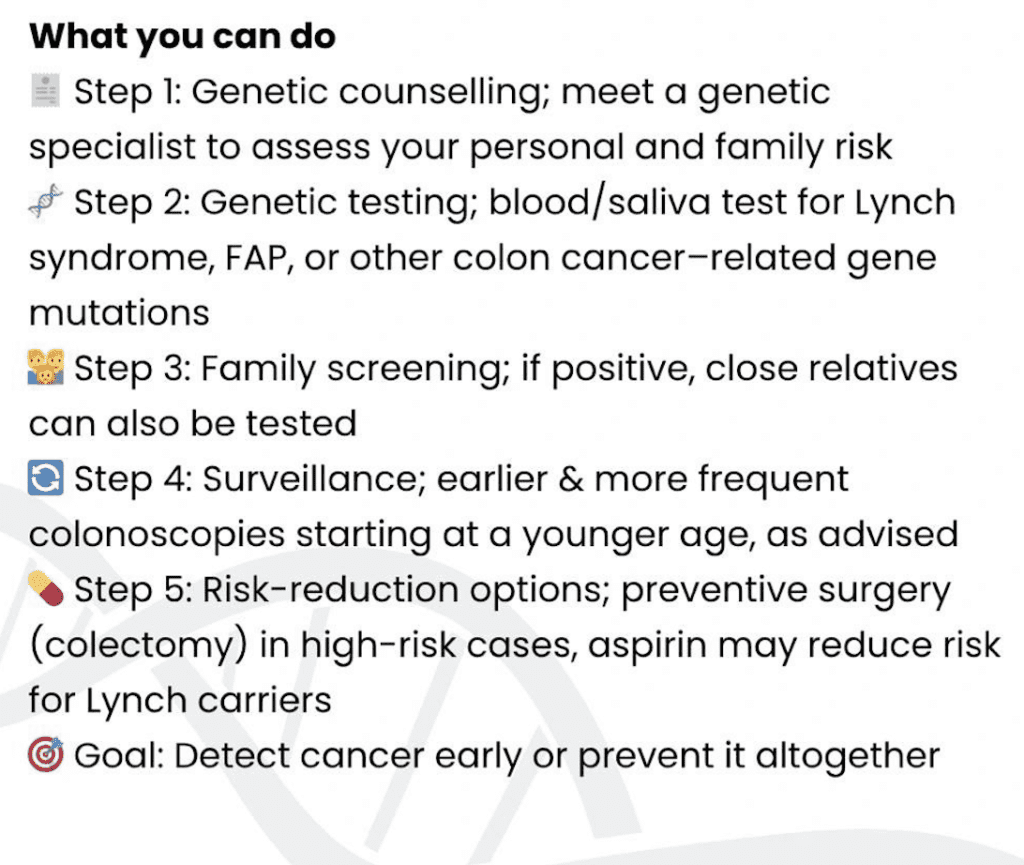
Genetic counseling – assess personal and family history
-
Genetic testing – for Lynch syndrome, FAP, or other related genes
-
Family screening – test close relatives if positive
-
Surveillance – early and frequent colonoscopy for high-risk individuals
-
Risk-reduction options – preventive surgery (colectomy) + aspirin therapy
💡 Early action turns fear into prevention.
🌷 Real-World Example
A 35-year-old man with multiple relatives affected by colon and uterine cancer underwent genetic testing and was found to carry an MSH6 mutation (Lynch syndrome).
He started colonoscopy every 18 months, and at 37, a small precancerous polyp was removed.
His sister was also tested — she carried the same gene and chose regular screening.
Today, both remain healthy, and their children will grow up protected by awareness.
That’s the power of proactive genetics.
💬 Frequently Asked Questions
Can hereditary colon cancer come from the father’s side?
Yes. Inherited genes can come from either parent. Both sides of the family matter.
Is colonoscopy painful?
No. It’s usually done under light sedation and takes less than an hour. It’s the most reliable test for early detection.
Can lifestyle still play a role if my risk is genetic?
Absolutely. Diet rich in fiber, regular exercise, maintaining healthy weight, and avoiding tobacco / alcohol can reduce risk
What about aspirin?
Some studies show that long-term low-dose aspirin may reduce Lynch-related cancer risk — discuss this with your doctor.
At what age should I start screening?
-
For Lynch syndrome: 20–25 years or 2–5 years before the earliest diagnosis in the family.
-
For FAP: even earlier, sometimes in adolescence.
🌼 Emotional Impact and Family Conversations
Learning that you have a hereditary cancer risk can bring mixed emotions — fear, guilt, confusion.
But families who face it together often find strength in knowledge.
Talking openly with relatives and seeking professional counseling helps transform anxiety into action.
Remember — knowing your risk doesn’t change your fate; it changes your plan.
🌸 Awareness Saves Lives
Hereditary colorectal cancer is one of the most preventable forms of cancer when detected early.
Each colonoscopy, each genetic test, each conversation brings you closer to prevention.
If colon or rectal cancer runs in your family, take the next step today.
💗 Take Action — Know Your Risk, Own Your Future
Genetic counseling and testing can protect you and generations after you.
A few drops of blood or saliva could reveal life-changing information.