
You have been through it more than once. The hope. The positive test. The heartbreak that follows.
If you have had two or more pregnancy losses, you already know that the pain is not just physical. It is exhausting in a way that is very hard to describe to someone who has not lived it.
What you may not know is this: in many cases, there is an answer. A biological reason. And finding that reason can change everything.
Genetic testing is one of the most powerful tools available today to understand why recurrent pregnancy loss happens — and what to do next.
This article will walk you through everything you need to know, in plain language.
What Is Recurrent Pregnancy Loss?
Recurrent pregnancy loss (RPL) is defined as two or more pregnancy losses. These losses usually happen in the first trimester (before 12 weeks), but they can also occur later.
It affects roughly 1–2% of couples who are trying to have a baby. That number is small in percentage terms, but it represents an enormous number of families in India and around the world who are silently suffering and searching for answers.
“Ideally, we would like to see couples after their second miscarriage — and even better, immediately after the second loss, before the pregnancy tissue is gone. Every loss that happens without investigation is a missed opportunity for an answer.”
— Dr. Roshan Daniel, Clinical Geneticist, Genetidoc Genetic Clinic and DNA Testing Lab
The causes of recurrent pregnancy loss fall into several broad categories:
- Genetic causes (chromosomal or single-gene problems)
- Uterine structural problems (abnormal shape of the womb)
- Hormonal imbalances (thyroid, insulin, progesterone)
- Blood clotting disorders (thrombophilia)
- Immune factors
- Male factors (including sperm DNA damage)
- Unexplained causes
Of all these, genetic causes are among the most important to identify — because they are specific, testable, and often lead to clear management options.
The Biggest Misconception About Recurrent Pregnancy Loss
When couples walk into a genetics clinic after multiple losses, one pattern comes up again and again.
They believe it is a “female problem.”
They believe genetics only matters if there is a family history of a known condition. They have been to gynaecologists, tried different supplements, changed their diet, reduced stress — and yet the losses continue.
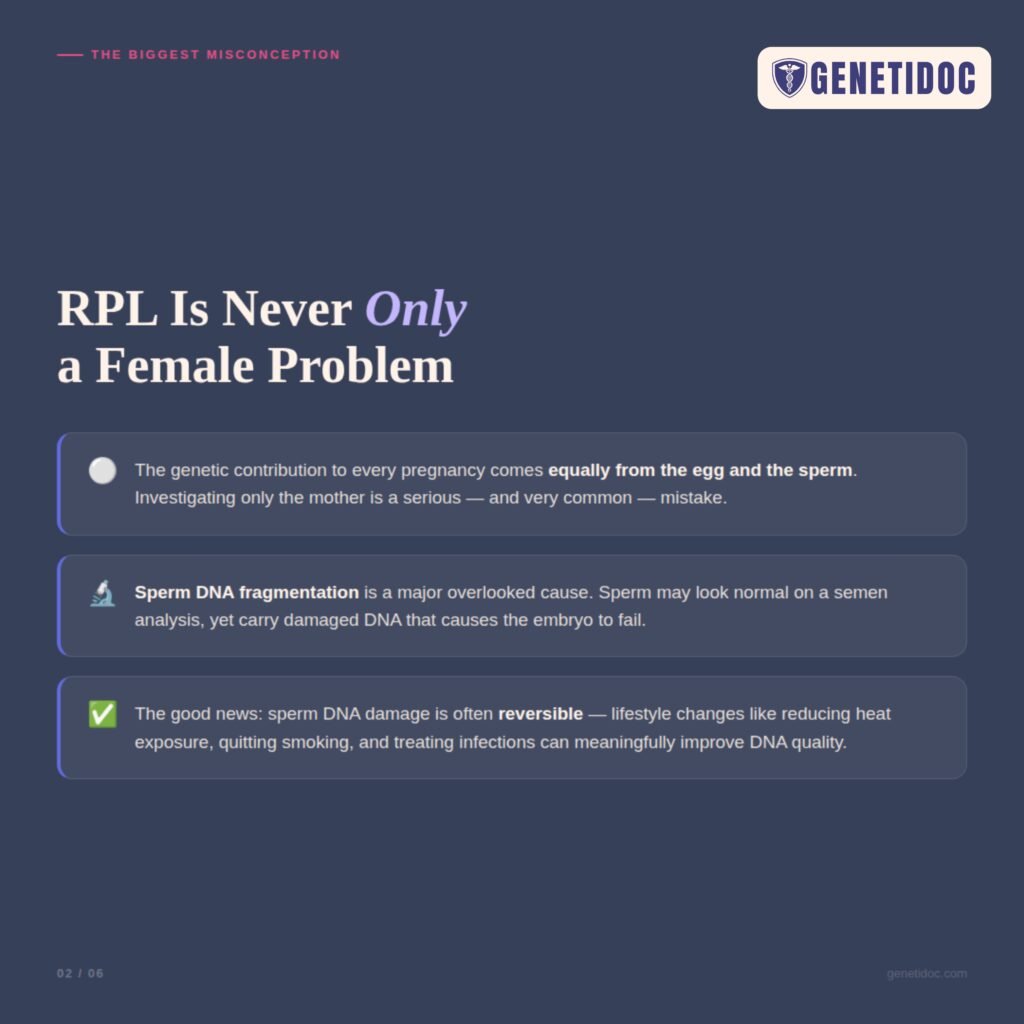
“One of the most important things I tell families is that recurrent pregnancy loss is never just a female problem. The genetic contribution comes equally from both partners — from the egg and from the sperm. Investigating only the mother and ignoring the father is a serious and very common mistake.”
— Dr. Roshan Daniel, Genetidoc Genetic Clinic and DNA Testing Lab
Male factors — including sperm DNA fragmentation — play a significant and often overlooked role in repeated miscarriages. Sperm that carries damaged DNA may fertilise the egg normally, and the pregnancy may even implant successfully. But the embryo cannot develop properly, and the pregnancy is lost.
The good news: sperm DNA fragmentation is a reversible condition in many cases. Lifestyle changes — reducing heat exposure, quitting smoking, reducing alcohol, losing weight, and treating infections — can meaningfully improve sperm DNA quality.
When Should You See a Genetic Specialist?
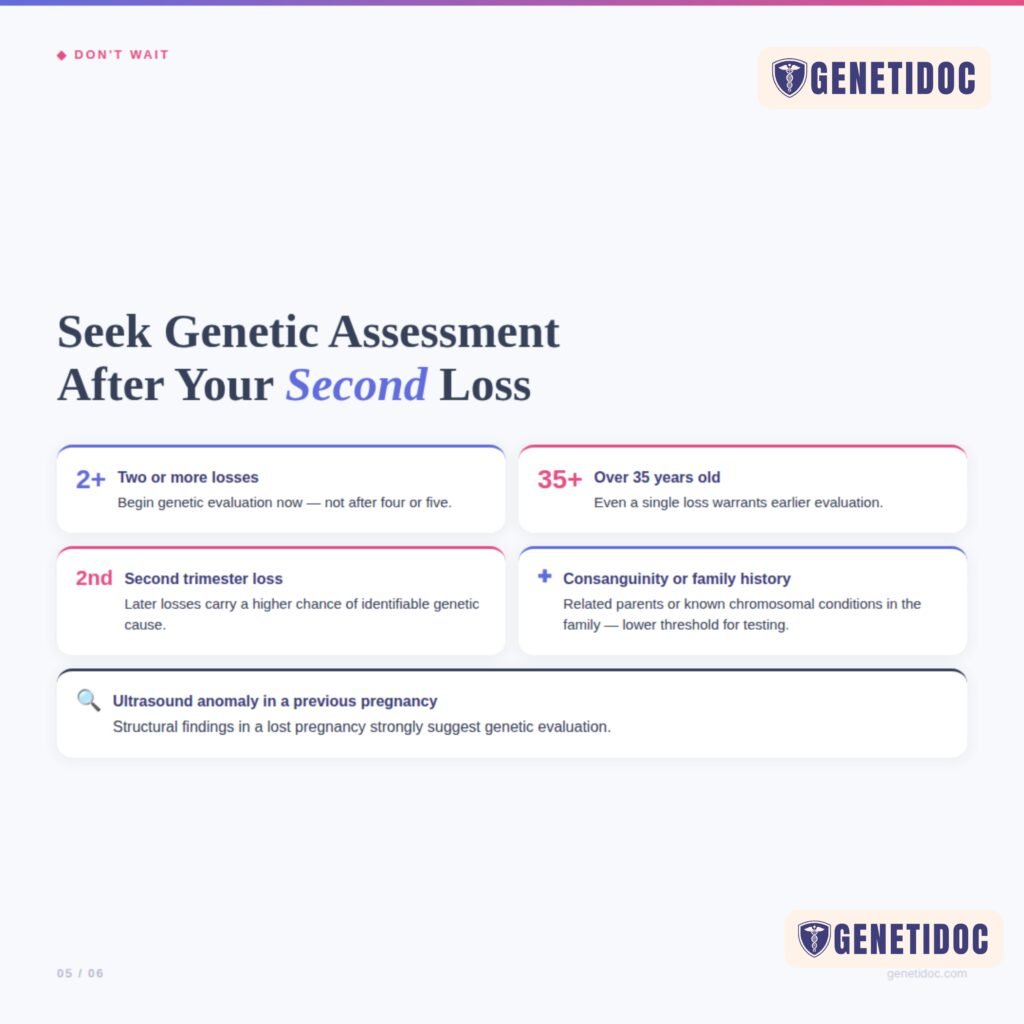
The current international recommendation is to investigate after two or more pregnancy losses. However, there are situations where earlier evaluation makes sense:
- A woman over 35 years of age who has had even a single loss
- A loss at a later stage of pregnancy (second trimester or beyond)
- An ultrasound in the pregnancy showing features that suggest a structural or genetic problem in the baby
- A known family history of chromosomal problems, genetic disorders, or consanguinity (marriage between relatives)
- A previous pregnancy affected by a chromosomal condition
“Many couples come to us after four or five losses. By that point, they have spent years in heartbreak, spent enormous amounts of money on treatments that did not work, and put their bodies through tremendous stress. Had they come after the second loss, we could have identified the cause much earlier and changed course.”
— Dr. Roshan Daniel, Genetidoc Genetic Clinic and DNA Testing Lab
Time matters. Every loss without investigation is a missed chance to find an answer.
The Genetic Causes of Recurrent Pregnancy Loss
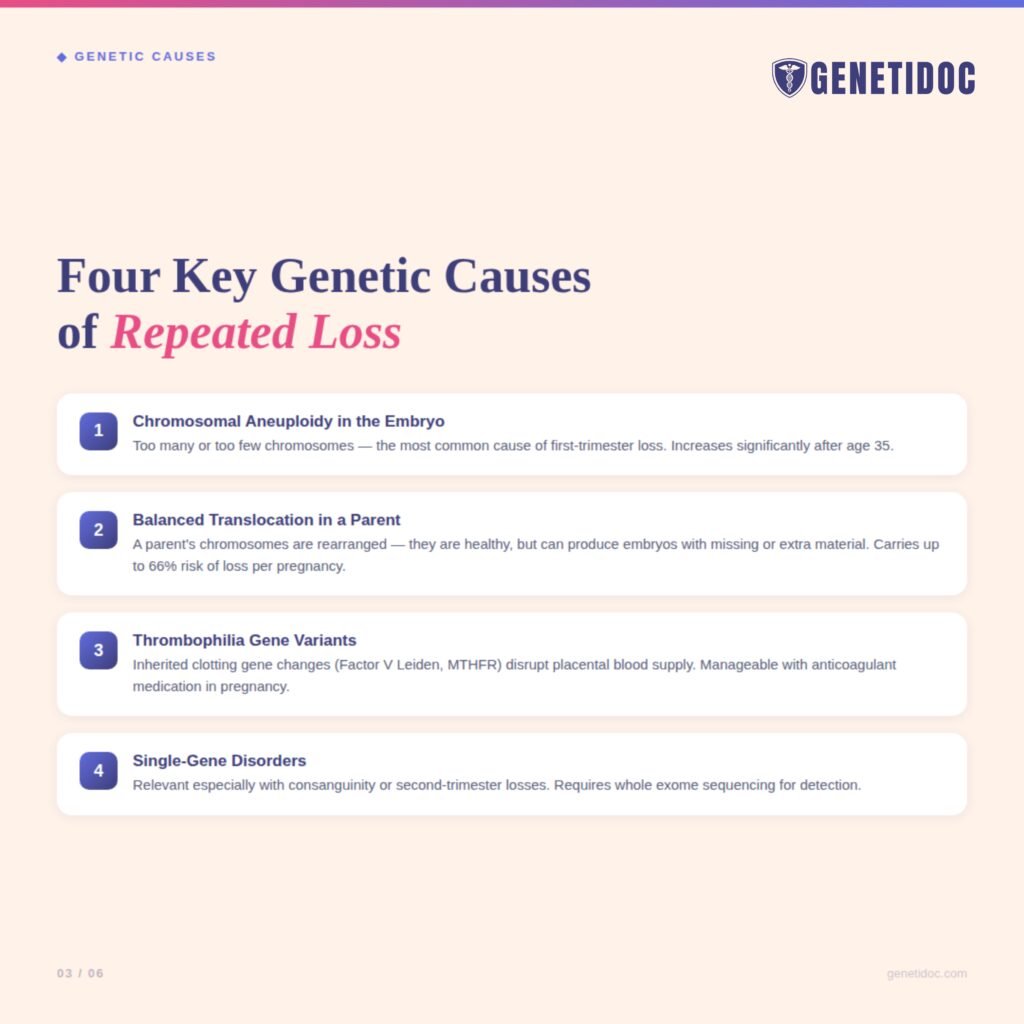
1. Chromosomal Problems in the Embryo
The most common genetic cause of pregnancy loss is a chromosomal problem in the embryo itself. This means the baby had too many or too few chromosomes — a situation called aneuploidy.
This is not inherited from either parent in most cases. It happens by chance during the formation of the egg or sperm, or during the early cell divisions of the embryo.
Common examples include:
- Trisomy (an extra chromosome) — the most frequent cause of first-trimester loss
- Monosomy (a missing chromosome)
- Triploidy (three complete sets of chromosomes instead of two)
Chromosomal aneuploidy becomes more frequent as a woman ages, which is why pregnancy loss is more common in women over 35.
2. Balanced Chromosomal Translocations in a Parent
This is one of the most important genetic causes of recurrent pregnancy loss — and one of the most commonly identified findings in genetic clinics.
A balanced translocation means that a person’s chromosomes have rearranged themselves in a way that does not affect the person personally. They are healthy. They look completely normal. But when their cells produce eggs or sperm, the chromosomes can be distributed unevenly.
This leads to embryos with missing or extra genetic material — and pregnancy loss.
“A balanced translocation carrier has up to a 66% risk of pregnancy loss or an affected baby with each pregnancy, depending on the type. It is not a fault. It is a near-normal chromosomal variation that can happen to anyone. We see it frequently in Indian families, and importantly, it is not limited to any specific community. We do, however, see it associated with consanguinity — marriages between relatives — more commonly.”
— Dr. Roshan Daniel, Genetidoc Genetic Clinic and DNA Testing Lab
The critical point: this only shows up on a chromosomal test (karyotype) of the couple. It will not be detected by routine blood tests, hormone panels, or ultrasounds.
3. Single-Gene Disorders
In some cases — especially where there are features on ultrasound suggesting a structural problem in the baby, or where losses happen in the second trimester, or where there is consanguinity — the cause may be a mutation in a single gene passed down from both parents.
This type of cause requires more advanced testing, such as whole exome sequencing (WES) of the couple or the pregnancy tissue.
4. Thrombophilia Genes
Certain inherited blood clotting conditions increase the risk of miscarriage by forming clots in the placenta and disrupting blood supply to the baby. The most important of these include:
- Factor V Leiden mutation
- Prothrombin gene mutation (Factor II)
- MTHFR gene variants
Factor V Leiden in particular is important because it is not detected by routine blood tests — it requires specific genetic testing.
The good news: thrombophilia-related losses are usually manageable. With the right anticoagulant (blood-thinning) medication during pregnancy, many couples who carry these variants go on to have successful pregnancies.
5. Sperm DNA Fragmentation
This deserves special mention because it is so frequently missed.
A standard semen analysis tells you about sperm count, motility, and shape. It does not tell you about the quality of the genetic material inside the sperm.
High sperm DNA fragmentation means that the DNA within the sperm is damaged. Even if sperm appear normal on a standard test, damaged DNA can lead to embryos that fail to develop properly — resulting in early pregnancy loss.
Testing for sperm DNA fragmentation is a critical part of the complete RPL workup and should not be skipped.
The Complete Genetic Workup for Recurrent Pregnancy Loss
A thorough genetic evaluation for RPL includes several components. The exact tests recommended for each couple depend on their specific history, the stage at which losses occur, and other clinical findings.
Step 1: Rule Out Non-Genetic Causes First
Before genetic testing, your doctor should evaluate:
- Uterine anatomy (by ultrasound or hysteroscopy)
- Hormonal profile (thyroid, prolactin, insulin resistance, progesterone)
- Semen analysis (as a basic starting point)
Genetic testing is most informative after these are assessed or ruled out.
Step 2: Genetic Tests for the Couple
| Test | What It Detects | When It Is Ordered |
|---|---|---|
| Karyotype (chromosomal analysis) of both partners | Balanced translocations, inversions, chromosomal rearrangements | Routinely in all RPL couples |
| Sperm DNA Fragmentation Index | DNA damage in sperm | All couples with RPL — male partner |
| Thrombophilia gene panel (Factor V Leiden, Prothrombin, MTHFR) | Inherited blood clotting gene variants | All RPL couples |
| Couple Exome Sequencing (WES) | Single-gene mutations that can cause embryo loss | Normal karyotype + consanguinity, second-trimester losses, ultrasound anomalies in previous pregnancy |
Step 3: Testing the Pregnancy Tissue (POC Testing)
This is the single most powerful test available in recurrent pregnancy loss — and one of the most underutilised in India.
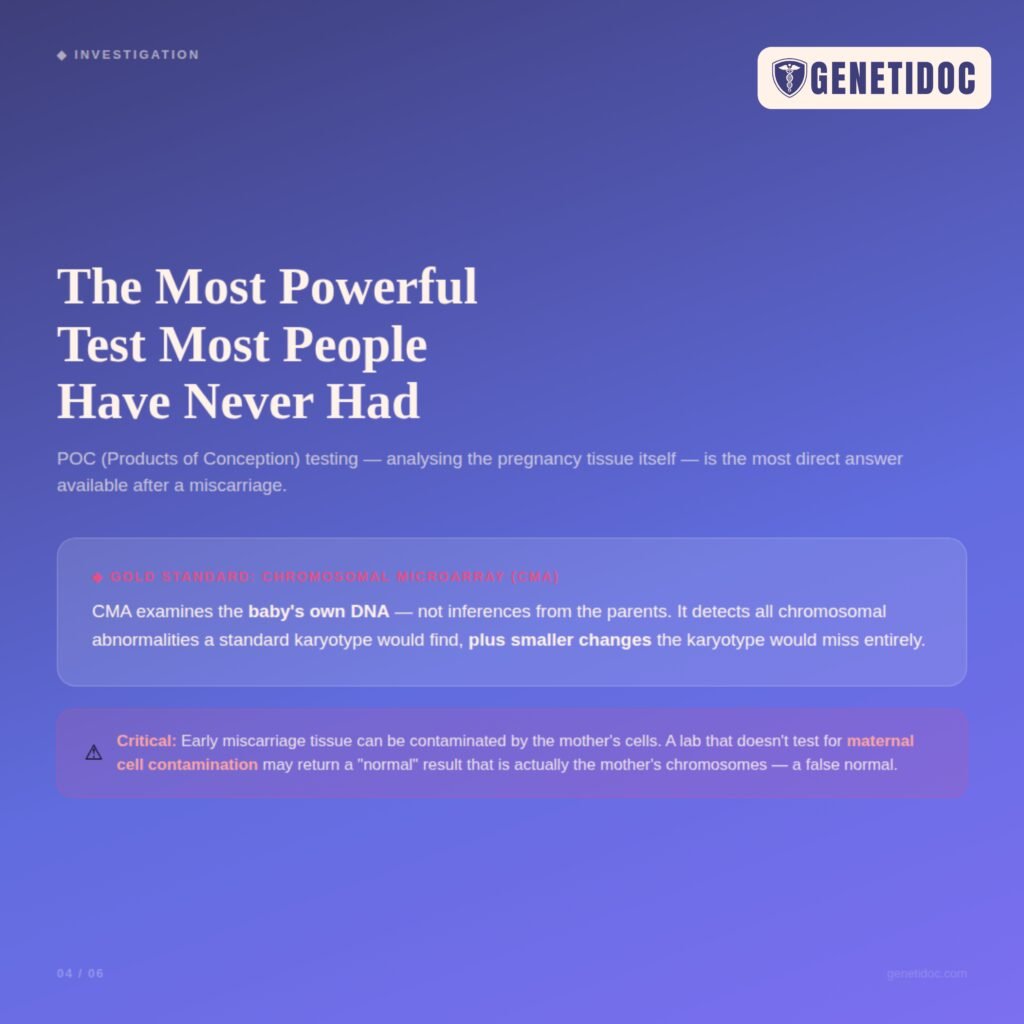
POC stands for Products of Conception. This is the pregnancy tissue that is passed or removed during a miscarriage. When this tissue is sent for genetic analysis, we are looking directly at the baby’s DNA — not guessing based on the parents’ genetics.
“When we test the pregnancy tissue, we are seeing exactly what happened in that specific pregnancy. We are not making inferences or educated guesses. It is the most direct answer we can get. Couple testing is important, but POC testing tells us what actually went wrong in that particular pregnancy.”
— Dr. Roshan Daniel, Genetidoc Genetic Clinic and DNA Testing Lab
The ideal test for POC is Chromosomal Microarray (CMA). CMA has replaced the older karyotype as the gold standard for POC testing because:
- It detects all chromosomal abnormalities that karyotype detects
- It also detects smaller gains and losses of chromosomal material (called copy number variants or CNVs) that karyotype would miss completely
- It provides far more information with a single test
The Critical Problem: Maternal Cell Contamination
There is an important technical challenge with POC testing, especially in early losses.
In miscarriages that occur before 10 weeks, the pregnancy tissue is very small and often mixed with the mother’s cells. If the laboratory processes this incorrectly, the test ends up reading the mother’s chromosomes — not the baby’s. This is called maternal cell contamination (MCC).
When MCC occurs, the result appears normal — because the mother’s chromosomes are normal. But this is a false normal. The baby’s chromosomal status remains unknown.
“Maternal cell contamination is a very real and very common problem in POC testing for early miscarriages. A ‘normal’ POC result means nothing if you cannot be certain the result is from the baby and not from the mother. This is why choosing the right laboratory — one that tests for MCC — is critical.”
— Dr. Roshan Daniel, Genetidoc Genetic Clinic and DNA Testing Lab
If MCC is detected or suspected, POC testing becomes unreliable. In these cases, couple karyotyping and exome sequencing become the primary investigations.
What Happens When a Genetic Cause Is Found?
If a Balanced Translocation Is Identified
Finding a balanced translocation in one partner is significant news — but it is also actionable news. There are three main reproductive options available, each with different advantages, costs, and trade-offs.
| Option | How It Works | Approximate Cost (India) | Advantages | Disadvantages |
|---|---|---|---|---|
| Natural Conception + Prenatal Diagnosis | Conceive naturally. If pregnancy continues, test the baby by CVS (chorionic villus sampling) at ~11 weeks or amniocentesis at ~16 weeks. Continue or terminate based on result. | Under ₹50,000 | Lowest cost. No fertility treatment required. Uses couple’s own eggs and sperm. | Risk of reaching 5 months before a result and needing late termination. Emotionally very difficult. Recurrence risk remains with each pregnancy. |
| IVF with Donor Gamete | Use donor eggs (if mother is the translocation carrier) or donor sperm (if father is the carrier). Donor is anonymous. Embryos created using IVF and transferred. | Under ₹2,00,000 | Avoids passing on the translocation from the affected parent. Simpler than PGT. No implantation failure issue from genetic selection. | One parent’s genetics not represented in the child. Donor involvement required. |
| IVF with PGT-SR (Preimplantation Genetic Testing for Structural Rearrangements) | Create embryos via IVF using couple’s own eggs and sperm. Test each embryo for the translocation before transfer. Only chromosomally balanced embryos are transferred. | Under ₹6,00,000 | Best chance of a genetically own, unaffected child. Avoids pregnancy loss from translocation. Avoids late termination. | Highest cost. Implantation may not always succeed. Fewer embryos may be available after testing. Multiple IVF cycles may be needed. |
“There is no single right answer for every family. Each option has real advantages and real trade-offs. Our job is to make sure couples understand all three paths clearly — with costs, timelines, and emotional implications — so they can make the decision that is right for them. That is what pretest counselling is for.”
— Dr. Roshan Daniel, Genetidoc Genetic Clinic and DNA Testing Lab
If Thrombophilia Genes Are Found
This is one of the more treatable findings in RPL genetics. Blood-thinning medication (anticoagulants such as low-molecular-weight heparin) during pregnancy can significantly reduce the risk of placental clotting and pregnancy loss. Management is relatively straightforward and the outcome for many couples is very good.
If High Sperm DNA Fragmentation Is Found
The approach depends on the severity. For mild-to-moderate fragmentation, lifestyle modification — quitting smoking, reducing alcohol, addressing varicocele if present, improving diet and reducing scrotal heat — can produce meaningful improvement over 3–6 months.
For severe fragmentation or cases where lifestyle changes are insufficient, IVF using ICSI (intracytoplasmic sperm injection) with sperm retrieved directly from the testis (surgical sperm retrieval) often yields better results, since testicular sperm has lower fragmentation than ejaculated sperm.
What If All Tests Come Back Normal?
This is one of the most difficult scenarios — and one of the most common questions in an RPL consultation.
A normal result is, simultaneously, good news and frustrating news.
“I always explain it this way: a normal result means there is no chromosomal translocation hiding in your genes — no structural rearrangement that carries a 66% risk of loss or an affected baby with every pregnancy. That is genuinely reassuring. It means you are not facing the most serious genetic risks. But it also means we do not yet have a specific answer to point to. We try again, and if losses continue, we discuss IVF with a donor embryo as a next step.”
— Dr. Roshan Daniel, Genetidoc Genetic Clinic and DNA Testing Lab
A completely normal genetic evaluation is not a failure. It narrows the field and genuinely rules out the most serious inherited genetic risks. Many couples with normal results go on to have successful pregnancies with expectant management or supportive care.
The Hidden Problem: Low-Quality Testing and Misinterpretation
One of the most serious and underappreciated problems in genetic testing in India today is not the absence of testing — it is poor-quality testing and incorrect interpretation of results.
Variants of Uncertain Significance (VUS): A Common Pitfall
With advanced genetic testing like chromosomal microarray, it is possible to find changes in the DNA whose significance is not yet clearly understood. These are called Variants of Uncertain Significance (VUS).
A VUS is not the same as an abnormal finding. It means the variant exists — but current evidence cannot say whether it caused the problem or is simply a harmless variation.
The danger: some families have been counselled that a VUS in the fetus was the definitive cause of their loss — and have been directed toward unnecessary interventions, including use of donor embryos, based on this incorrect interpretation. This is not just a medical error. It is a deeply harmful one that puts families through unnecessary procedures, expenses, and emotional suffering.
“A report is just data. The interpretation of that data — understanding what a variant actually means for that specific family, in that specific clinical context — is where the real expertise lies. Getting a genetic test done is not enough. Getting it interpreted correctly by a qualified specialist is everything.”
— Dr. Roshan Daniel, Genetidoc Genetic Clinic and DNA Testing Lab
Why Laboratory Choice Matters
Not all laboratories that offer genetic tests are equally equipped to handle the clinical and interpretive complexity of RPL genetics. Key factors that distinguish a quality laboratory and clinical setup include:
- Testing for maternal cell contamination in POC samples
- Using chromosomal microarray (not just karyotype) for POC analysis
- Providing clinical interpretation by a trained clinical geneticist — not just a lab report
- Offering pre-test and post-test genetic counselling
- Correlation of laboratory findings with the patient’s actual clinical history
A cheap test with no interpretation is not just unhelpful. In some cases, it leads families down the wrong path entirely.
The Role of Genetic Counselling
Genetic counselling is not a luxury. In the context of recurrent pregnancy loss, it is essential.
Pretest counselling — a conversation before tests are ordered — serves a purpose that is easy to underestimate: it prepares the couple for every possible result. If a balanced translocation is found in the husband, the couple has already discussed what that means before they are sitting in a room with a piece of paper that tells them so. The shock is smaller. The blaming is reduced. The decision-making is clearer.
“We discuss all possibilities before we even draw blood. If the test comes back showing a balanced translocation, the couple already knows what it is, what it means for their fertility, what their options are, and that it is not anyone’s fault. Pre-test counselling prevents a great deal of unnecessary guilt and relationship strain.”
— Dr. Roshan Daniel, Genetidoc Genetic Clinic and DNA Testing Lab
Post-test counselling ensures that results are understood correctly — that a VUS is not treated as a diagnosis, that a normal result is not dismissed as meaningless, and that the path forward is planned thoughtfully.
A Patient Story
Consider this couple — let us call them Priya and Arjun — who came to out clinic after their fourth pregnancy loss. All four losses had occurred before 10 weeks. Their gynaecologist had evaluated Priya thoroughly: her uterus was normal, her hormones were fine, her clotting tests were normal. Everything pointed to unexplained RPL.
Arjun had a semen analysis done once, years ago. It was “normal.” No one had checked further.
At Genetidoc Genetic Clinic and DNA Testing Lab, the couple underwent a complete workup. Arjun’s sperm DNA fragmentation index came back significantly elevated. Priya’s karyotype was normal. Arjun’s karyotype showed a balanced chromosomal translocation — a finding he had no idea he carried.
Suddenly, the entire clinical picture made sense. Two contributing genetic factors in the couple — had been missed for years.
They were counselled on their three reproductive options. They chose IVF with PGT-SR. Their first embryo transfer resulted in a successful pregnancy. Their daughter is now two years old.
Four years of losses. One comprehensive evaluation. One clear answer. One family.
Frequently Asked Questions
1. How many miscarriages do I need to have before getting genetic testing?
The current recommendation is to begin investigation after two pregnancy losses. You do not need to wait for three or more. If you are over 35, evaluation after a single loss is reasonable. The earlier you investigate, the sooner you can get answers and change your outcome.
2. Is recurrent pregnancy loss always a genetic problem?
No. Genetic causes account for approximately 30% of cases where no other cause is found. Other causes include uterine abnormalities, hormonal problems, blood clotting issues, and immune factors. A thorough evaluation looks at all of these together.
3. Does recurrent pregnancy loss run in families?
It can, particularly when the cause is an inherited chromosomal rearrangement like a balanced translocation, or an inherited thrombophilia gene variant. If one family member has had recurrent losses, others in the family may benefit from evaluation too.
4. What is a balanced translocation and should I be worried?
A balanced translocation is a rearrangement of chromosomes that does not affect the person who carries it — they are completely healthy. However, when they produce eggs or sperm, the chromosomes may be distributed unevenly, leading to pregnancy loss or an affected baby. It is not a disease. It is manageable with the right reproductive plan.
5. Can we test the pregnancy tissue after a miscarriage?
Yes, and this is one of the most valuable tests available. Testing the products of conception (POC) tells you what genetic problem occurred in that specific pregnancy. However, it must be done using chromosomal microarray, the sample must be collected correctly, and the laboratory must test for maternal cell contamination. Timing and sample handling are critical.
6. My husband’s semen analysis was normal. Do we still need sperm DNA fragmentation testing?
Yes. A standard semen analysis does not measure DNA quality inside the sperm. Sperm can look perfectly normal and still carry significant DNA damage that causes embryo failure and pregnancy loss. Sperm DNA fragmentation testing is a separate, essential part of the RPL workup.
7. What does a “variant of uncertain significance” mean in my genetic report?
A VUS means that a genetic change was found, but current scientific evidence cannot yet clearly say whether it caused the problem or is simply a harmless variation. A VUS is not the same as a diagnosis. Do not make major reproductive decisions — including use of donor embryos — based on a VUS alone without review by a qualified clinical geneticist.
8. Is IVF with PGT the only option if we find a genetic cause?
No. There are three reproductive options for couples with a balanced translocation: natural conception with prenatal testing (CVS or amniocentesis), IVF with donor gametes, or IVF with PGT-SR. Each has different costs, implications, and emotional journeys. The right choice depends on your specific situation, values, and priorities.
9. How much does genetic testing for recurrent pregnancy loss cost in India?
Costs vary depending on which tests are needed. Couple karyotyping, thrombophilia gene panels, and sperm DNA fragmentation tests together typically range from ₹10,000–₹30,000. POC chromosomal microarray adds another ₹15,000–₹25,000. Whole exome sequencing for the couple is more comprehensive and costs more. Always consult a genetics specialist to determine which tests are genuinely necessary for your case — unnecessary testing adds cost without adding value.
10. What if all our genetic tests are normal?
A normal result is genuinely good news — it rules out the most serious inherited genetic risks, including balanced translocations. Many couples with normal results go on to have successful pregnancies. If losses continue, IVF with a donor embryo is a reasonable next step that many couples pursue successfully.
11. Can consanguinity (marrying a relative) increase the risk of recurrent pregnancy loss?
Yes. When both parents are related, there is a higher chance that both carry the same recessive gene mutation. This can lead to embryos that inherit two copies of that mutation and are unable to develop. Couples with consanguinity and RPL should have a lower threshold for comprehensive genetic evaluation, including exome sequencing.
12. Does maternal age affect the risk of pregnancy loss due to genetic causes?
Yes, significantly. As a woman ages, the eggs she produces are more likely to have chromosomal errors (aneuploidy). This is why pregnancy loss becomes more common after age 35. However, aneuploidy in embryos is not inherited — it occurs by chance. It does not mean the mother carries a genetic problem. Testing the POC can confirm whether aneuploidy was the cause.
Key Takeaways
- Recurrent pregnancy loss affects 1–2% of couples and has identifiable genetic causes in up to 30% of cases where no other cause is found.
- Genetic evaluation should begin after the second pregnancy loss — not after four or five.
- RPL is never only a female problem. Both partners must be evaluated, including sperm DNA fragmentation testing.
- Products of conception (POC) testing using chromosomal microarray is the most direct way to find the cause of a specific pregnancy loss.
- Maternal cell contamination can invalidate POC results — always use a laboratory that screens for this.
- Balanced translocations are a common finding in Indian patients and are manageable with three clear reproductive options.
- A “normal” genetic result is not a failure — it rules out serious inherited risks and is genuinely reassuring.
- A genetic report is just data. Expert interpretation changes everything. Variants of uncertain significance (VUS) should not drive major reproductive decisions.
- Genetic counselling before and after testing reduces guilt, miscommunication, and unnecessary interventions.
What Should You Do Next?
If you have had two or more pregnancy losses — or even one loss with risk factors such as advanced maternal age, consanguinity, or a previous pregnancy with an ultrasound anomaly — a comprehensive genetic evaluation is the single most important step you can take.
Not more supplements. Not another round of the same treatments. A proper answer.
At Genetidoc Genetic Clinic and DNA Testing Lab, every couple with recurrent pregnancy loss receives a thorough evaluation led by Dr. Roshan Daniel — including pre-test genetic counselling, the right combination of tests for their specific situation, expert interpretation of results, and a clear, personalised path forward.
Because an answer — whatever it is — is always better than not knowing.
Book your RPL Genetic Consultation at Genetidoc Genetic Clinic and DNA Testing Lab today. Bring your previous reports, your pregnancy history, and your questions. We will help you find the answers you deserve.
References
- Practice Committee of the American Society for Reproductive Medicine (ASRM). Evaluation and treatment of recurrent pregnancy loss: a committee opinion. Fertility and Sterility. 2012;98(5):1103–1111.
- ESHRE Early Pregnancy Guideline Development Group. Recurrent Pregnancy Loss: Guideline of the European Society of Human Reproduction and Embryology. ESHRE; 2022.
- Fryns JP, Van Buggenhout G. Structural chromosome rearrangements in couples with recurrent fetal wastage. European Journal of Obstetrics & Gynecology and Reproductive Biology. 1998;81(2):171–176.
- Rajcan-Separovic E. Chromosome microarrays in human reproduction. Human Reproduction Update. 2012;18(5):555–567.
- Daher S, et al. Chromosome abnormalities and recurrent pregnancy loss. Journal of Reproductive Immunology. 2012;93(1):1–5.
- Practice Committee of the ASRM. Sperm DNA testing: a committee opinion. Fertility and Sterility. 2013;99(3):673–677.
- Bick D, Dimmock D. Whole exome and whole genome sequencing. Current Opinion in Pediatrics. 2011;23(6):594–600.
- Middeldorp S. Inherited thrombophilia: a double-edged sword. Hematology. American Society of Hematology Education Program. 2016;2016(1):1–9.
- Stephenson MD, et al. Cytogenetic analysis of miscarriages from couples with recurrent miscarriage: a case-control study. Human Reproduction. 2002;17(2):446–451.
- Quenby S, et al. Recurrent pregnancy loss: evidence-based evaluation, diagnosis and treatment. Human Reproduction Open. 2021;2021(2):hoab 025.