
A geneticist’s perspective on why families spend years searching for a name for their child’s condition — and what finally ends the search.
A mother brings her three-year-old to a fourth specialist. The child isn’t walking the way other toddlers walk. His muscles feel stiffer than they should. Two doctors have already used the words “cerebral palsy.” A third wasn’t sure. She isn’t looking for a fifth opinion. She’s looking for someone who will actually find out why.
This scene repeats itself across India every day. It has a name: the diagnostic odyssey — the long, exhausting journey between when symptoms first appear and when a family finally gets a real answer.
In India, that journey takes an average of seven years. Along the way, most families will hear two or three incorrect diagnoses before they hear the right one.
This article explains why that happens, what it looks like from a geneticist’s chair, and what actually shortens the road to an answer.
What Is a “Diagnostic Odyssey”?
A diagnostic odyssey is the period between when a person first shows symptoms of a rare or genetic condition and when they finally receive an accurate diagnosis. Along the way, patients typically see multiple specialists, undergo repeated tests, and often receive one or more incorrect diagnoses before reaching the right one.
The term isn’t dramatic language. It’s a recognized pattern in rare disease care worldwide — and in India, it tends to last longer than in many other countries.
The Diagnostic Odyssey in India: Quick Facts
| Average time to diagnosis | ~7 years from symptom onset |
| Typical misdiagnoses before the correct one | 2–3 |
| Estimated people living with a rare disease in India | 70–96 million |
| Rare diseases documented in the Indian population | ~450 of ~10,000 known globally |
| States/UTs with approved rare disease diagnostic centres | Only 12 states + 4 UTs |
Sources: National Policy for Rare Diseases (NPRD) 2021, Ministry of Health and Family Welfare; Indian Council of Medical Research (ICMR) National Registry for Rare Diseases.
Seven years is not just a statistic. It’s a childhood spent without the right support. It’s parents planning a second pregnancy without knowing their real risk. It’s years of tests, second opinions, and a growing sense that no one believes them.
Why the Journey Takes So Long: What Actually Happens
Families often assume rare disease diagnosis is slow because the conditions are hard to detect. That’s only part of the story. In clinical practice, a few specific, repeatable patterns drive most of the delay.
“Especially in pediatric rare diseases, children present in ways that get misunderstood as something common. A child with motor abnormalities and spasticity may actually have a genetic condition, but gets labeled as cerebral palsy. A child with genuine developmental regression gets labeled as autism. A child with multiple organ involvement gets called a ‘nonsyndromic’ case. This continues until either a new complication forces re-evaluation, or the family reaches someone with genetics awareness — and very often, it’s a subsequent pregnancy that finally triggers proper evaluation.”— Dr. Roshan Daniel, Founder, Genetidoc Genetic Clinic
That last point deserves attention. It is common for a family’s first child to go undiagnosed for years — and for the real evaluation to only begin when the parents are expecting again and want to understand their risk for the next child. By then, the odyssey has often already cost the first child years of missed intervention.
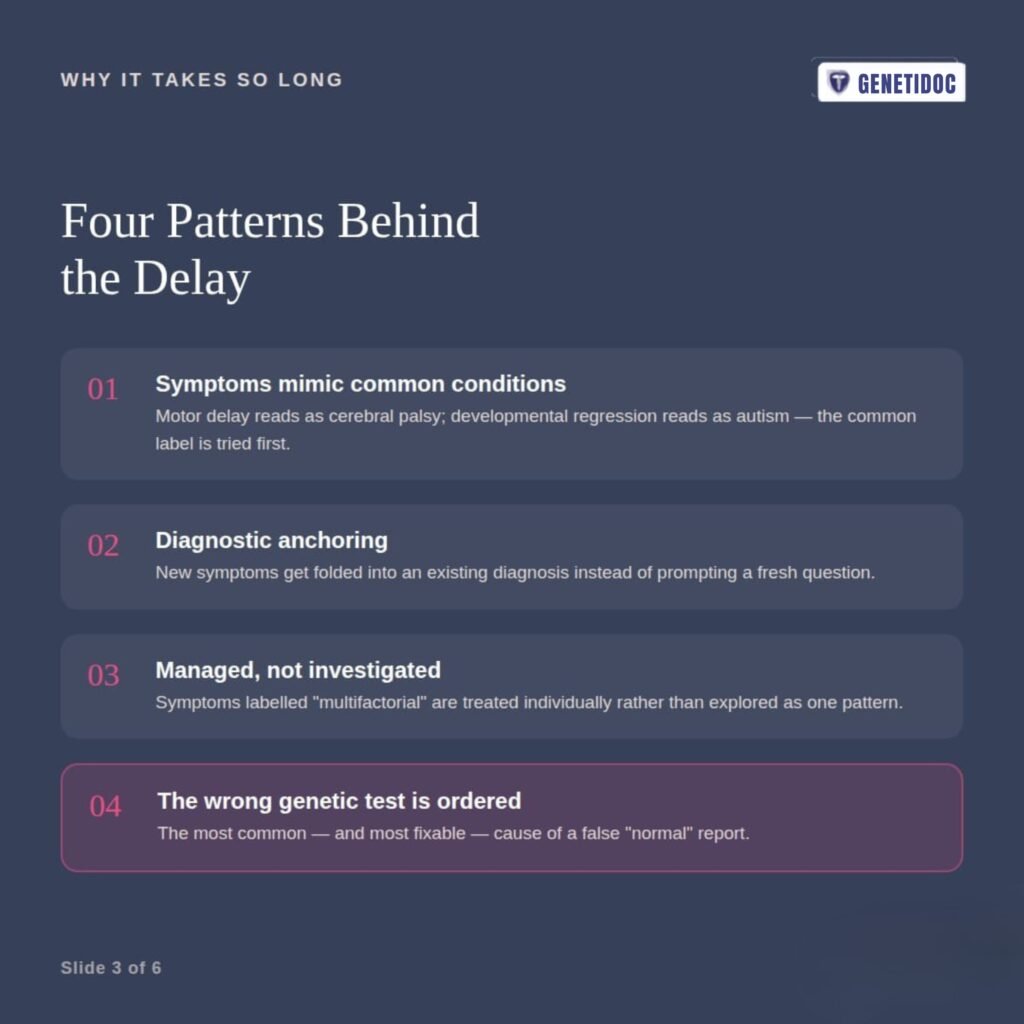
Broken down, the delay usually comes from four overlapping causes:
-
Symptoms That Look Like Something More Common
Many genetic conditions share features with far more common diagnoses. Motor delay and stiffness can look like cerebral palsy. Social and communication differences alongside developmental regression can look like autism. Because the common explanation is considered first — reasonably — the rarer, correct explanation can take years to surface.
-
Diagnostic Anchoring
Once a working diagnosis is in place, new or unrelated symptoms sometimes get folded into that existing label rather than questioned on their own. A symptom that doesn’t quite fit gets explained away instead of investigated — delaying the moment someone asks, “could this be something else entirely?”
-
Symptoms Labeled “Multifactorial” and Managed, Not Investigated
Some children are treated symptomatically — medication for a specific issue, with the expectation that it will resolve on its own as part of a general or “multifactorial” picture. When it doesn’t resolve, it often produces additional symptoms rather than triggering deeper investigation, quietly adding more years to the timeline.
-
The Wrong Genetic Test Being Ordered
This is one of the least understood — and most fixable — causes of delay, and it’s worth explaining properly, because most patient-facing content skips it entirely.
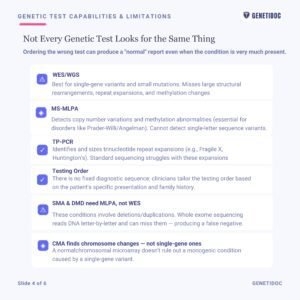
Not every genetic test looks for the same kind of change in DNA. Ordering the wrong one can produce a “normal” or negative report even when the condition is very much present. Two examples come up often:
- Spinal Muscular Atrophy (SMA) and Duchenne Muscular Dystrophy (DMD): these conditions are typically caused by deletions or duplications of genetic material, which are detected using a technique called MLPA (multiplex ligation-dependent probe amplification). Whole exome sequencing (WES) reads the sequence of DNA letter by letter — but it is not designed to reliably detect large deletions or duplications. If WES is ordered instead of MLPA for suspected SMA or DMD, the report can come back non-diagnostic, even though the condition is present. The family is then told “genetics didn’t find anything,” which isn’t the same as “you don’t have a genetic condition.”
- Suspected single-gene (monogenic) conditions: some children are tested with chromosomal microarray (CMA), which is built to detect missing or extra chromosome material and large chromosomal changes — not single-gene sequence variants. If the underlying condition is caused by a change within a single gene, CMA is the wrong tool for the job, and a normal CMA result doesn’t rule out a monogenic cause.
“For a child with developmental delay along with intellectual disability, the correct sequence usually starts with chromosomal microarray. If that comes back negative, whole exome sequencing is the appropriate next step — not a substitute for the first test, and not skipped altogether. Some families stop after a negative microarray and don’t move forward, which can leave the real answer undiscovered.”— Team Genetidoc
This is the heart of why genetic testing isn’t a single, interchangeable product. The right test has to match the clinical picture — and that decision is exactly where an experienced clinical geneticist adds value that a generic lab order form cannot.
A Composite Patient Journey
The following is an anonymized, composite case built from patterns seen across multiple patients — not a single real individual.
A boy is noticed to be behind on motor milestones around 18 months. His pediatrician reassures the family — some children are simply slower to walk. By age three, the delay is more obvious, and a neurologist gives a working diagnosis of cerebral palsy, based on the stiffness and motor pattern observed.
Over the next few years, the family sees an orthopedist for muscle tightness, a physiotherapist for mobility, and a developmental pediatrician when speech doesn’t progress as expected. Each specialist treats their piece of the picture. No one is wrong to do so — but no one is looking at the whole pattern together.
Around age seven, a new symptom appears that doesn’t fit the cerebral palsy picture cleanly. A doctor, this time, pauses and asks a different question: “could this be genetic?” The family is referred to a geneticist for the first time — five to six years after the first symptoms appeared.
After a detailed history, examination, and the appropriate genetic test — chosen specifically for the pattern of features present — a diagnosis is finally reached. It is a genetic condition, not cerebral palsy. The family finally has a name, an explanation for the specific pattern of symptoms, and — critically — accurate information for their next pregnancy.
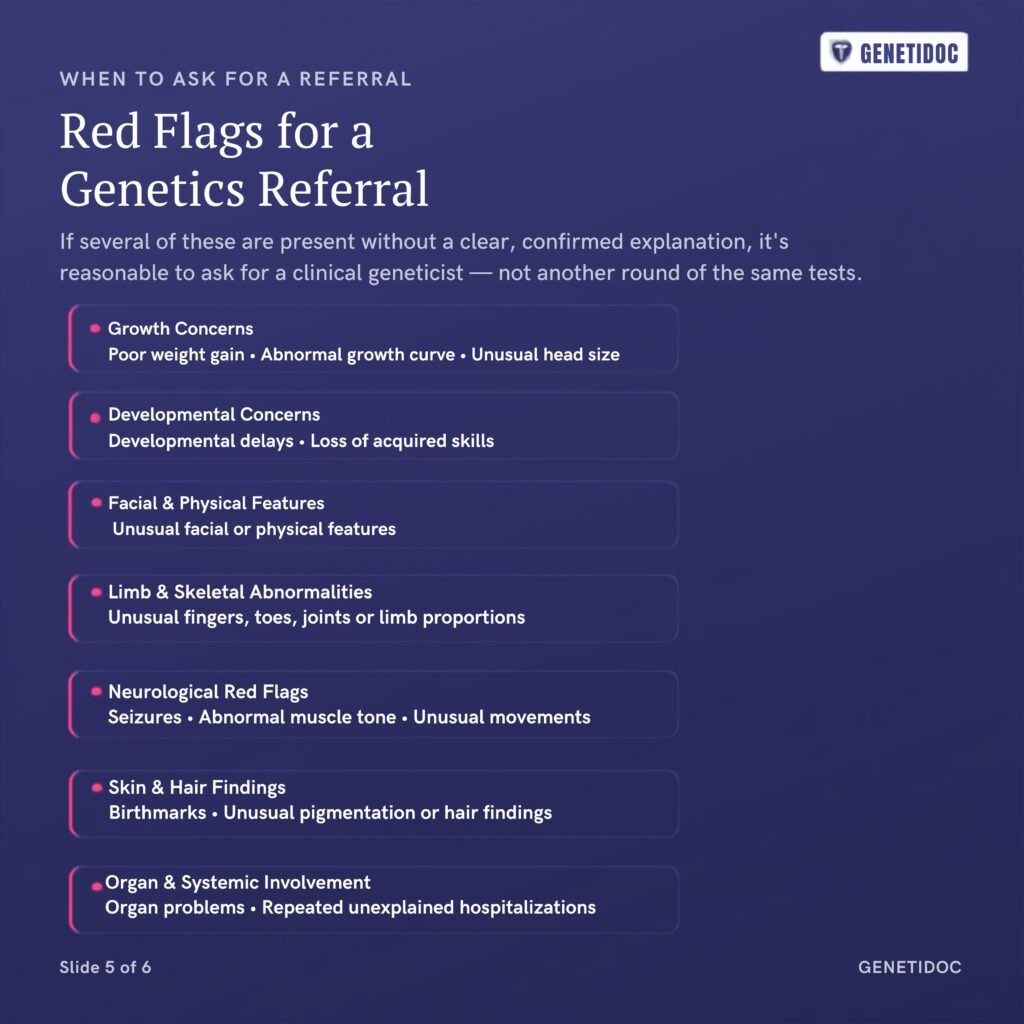
Red Flags That Should Prompt a Genetics Referral
There’s no single checklist that fits every rare disease — the right red flags depend on which features and organ systems are involved. But certain patterns consistently deserve a genetics opinion rather than continued “wait and see” management:
- Developmental delay — a child not reaching expected milestones within the typical window.
- Intellectual disability of unclear cause.
- Seizures, especially when new symptoms or loss of previously gained skills follow a seizure episode (developmental regression).
- Involvement of multiple organ systems that don’t fit neatly under one common diagnosis.
- Condition-specific motor changes — for example, in suspected muscular dystrophy, difficulty climbing stairs, difficulty swallowing, difficulty running, or frequent falling while running.
If several of these are present and a clear, confirmed explanation hasn’t been reached, that’s a reasonable moment to specifically ask for a referral to a clinical geneticist — rather than another round of the same tests.
What Happens Once a Family Finally Reaches a Geneticist
The first genetics consultation isn’t just about ordering a test. It starts with a complete history and examination, followed by an honest conversation about what to expect.
“It’s important to set correct expectations first. Even when we do find a diagnosis, many times there isn’t a complete cure. The testing and diagnostic process can be long, results can be ambiguous, and testing can be expensive. We lay out the advantages and disadvantages honestly — we should never over-promise.”— Dr. Roshan Daniel
This honesty matters. Families arriving after a long odyssey have often been let down before. A geneticist’s job at this stage is to choose the test that matches the clinical picture — not simply the most advanced or most expensive one — and to be clear about what a result can and cannot offer.
When Exome Sequencing Doesn’t Find the Answer
Even comprehensive testing doesn’t always end the search on the first attempt. When exome sequencing comes back inconclusive, there are still meaningful next steps:
- Reanalysis after a period of time. New genes are continually linked to disease. A case that was inconclusive today may be solvable when the same data is reanalyzed a year or two later, against an updated knowledge base.
- Genome sequencing. A broader test than exome sequencing, sometimes able to identify changes that exome sequencing’s more limited scope misses.
- Research program referrals. When families can’t afford further testing independently, connecting them to research studies or institutes offering testing on a research basis can keep the search alive without additional cost to the family.
The Kerala and South India Picture
Regional context matters here. In Dr. Roshan Daniel’s clinical experience, patients in Kerala and South India generally reach a diagnosis faster than the national average, for a few concrete reasons:
- Greater physician awareness of genetic conditions and when to refer.
- A comparatively stronger referral pathway between primary specialists and genetics services.
- Patients who are more open to genetic testing once it’s suggested, rather than resistant to it.
- Comparatively better financial access to testing for many families in the region.
That said, real gaps remain. Even in a relatively better-positioned region, literacy gaps, general awareness gaps, and social stigma around genetic conditions continue to slow diagnosis for some families — a reminder that regional advantage isn’t the same as a solved problem.
Why Cost and Access Barriers Keep the Odyssey Going
Beyond clinical complexity, practical barriers extend the timeline for many Indian families:
- Affordability. Comprehensive genetic testing such as genome sequencing is often out of reach for families to fund on their own.
- Limited insurance coverage. Genetic testing is typically not covered by standard health insurance in India.
- Low awareness of what’s available. Many families simply don’t know genetic testing exists for their situation, or don’t understand what a diagnosis would actually give them.
That last point is worth addressing directly, because it’s one of the most common misconceptions families raise: “If it’s genetic, what’s the point — there’s no cure anyway.” Even without a cure, a confirmed diagnosis provides real, practical value: informed planning, appropriate symptomatic management that can prevent the condition from worsening, clarity for future pregnancies, and access to the right specialists and support systems going forward.
The Emotional Weight of the Undiagnosed Years
The medical delay is only half the story. Families living through a diagnostic odyssey carry a heavy emotional load — one that rarely gets discussed in clinical settings.
Self-doubt is common. So is self-blame, and sometimes blame directed at other family members. Years of testing without answers lead to real caregiver and patient exhaustion. And after enough negative or inconclusive results, some families begin to distrust doctors and the healthcare system altogether — every prior interaction has ended the same way, with no resolution.
When a family who has been dismissed or told “nothing is wrong” for years finally receives a diagnosis, the moment carries weight beyond the medical facts.
“After all this time, we finally have an answer for the condition we’ve observed — and we acknowledge that their concerns and fears throughout this journey were correct. That acknowledgment comes first, before anything else.”— Team Genetidoc
Interestingly, the reaction to finally receiving a diagnosis isn’t always relief. Some families show little visible reaction at all — particularly when the diagnosis doesn’t come with a treatment or cure. Many families have already, quietly, accepted that a cure may not exist. But others are still hoping for one, and learning there isn’t a treatment available can be devastating even after years of searching for exactly this answer.
This is why how the news is delivered matters as much as the news itself. The conversation typically shifts toward what symptomatic management can achieve — how appropriately managing symptoms can meaningfully improve prognosis and prevent the condition from worsening, even without a cure for the underlying cause.
Common Mistakes That Extend the Odyssey
Two patterns come up repeatedly, and both are avoidable with the right guidance:
- Choosing a lower-cost, lower-quality WES. Not all exome sequencing is equal. A less comprehensive version may not sequence all necessary regions, or may miss splicing regions that affect how a gene is read — producing a false negative report that wrongly suggests genetics isn’t the cause.
- Stopping after one negative test. For a child with developmental delay or intellectual disability, a negative chromosomal microarray doesn’t rule out a genetic cause — it simply means the next appropriate test, typically WES, hasn’t been tried yet. Some families stop here, unintentionally ending the search one step too early.
A third, quieter issue: families often don’t have access to their child’s previous test reports and records from earlier specialists. Without that history, later evaluations can end up repeating tests that have already been done — costing more time and money along the way.
Practical Advice If You’re Living This Right Now
“Rare diseases being rare means they are commonly missed at first — but getting the right expertise for proper evaluation and confirmation can lead to better outcomes, better prognosis, and prevention planning for future pregnancies. People should not get disheartened. We have multiple ways to reach a genetic diagnosis now, and reaching one can meaningfully improve quality of life for both the patient and the caregiver.”— Dr. Roshan Daniel
If you or your child has been navigating an unexplained condition for a long time, a few practical steps can help:
- Keep every test report and medical record together, even from specialists that didn’t provide answers — an evaluating geneticist needs this full history.
- If your child has developmental delay or intellectual disability and testing stopped after a chromosomal microarray, ask specifically whether whole exome sequencing is the appropriate next step.
- Ask what technique a proposed genetic test actually detects, and whether it matches the condition being considered — sequence changes, deletions/duplications, and chromosomal changes are not interchangeable.
- Seek an evaluation from a clinical geneticist specifically, rather than relying only on a lab report ordered without genetics input.
- If cost is a barrier, ask about research study options — some institutes offer advanced testing on a research basis for eligible cases.
Why the Right Test — and the Right Lab — Matter More Than Testing Alone
A recurring theme throughout this article is that genetic testing isn’t a single, uniform product. The same clinical picture can call for MLPA, chromosomal microarray, exome sequencing, or genome sequencing — and choosing incorrectly doesn’t just waste time, it can produce a false reassurance that closes the door on further investigation.
This is also why interpretation matters as much as the test itself. A report showing “no pathogenic variant found” means something different depending on which regions of the genome the test actually covered, and how carefully the result was reviewed against the person’s specific clinical features. A NABL/CAP accredited lab working alongside genetic counselling built into the process helps ensure results are interpreted correctly, in context — not just generated and handed over.
To learn more about rare genetic diseases
Frequently Asked Questions
-
What is a diagnostic odyssey?
It’s the period between when symptoms of a rare or genetic condition first appear and when a person finally receives an accurate diagnosis — often involving multiple specialists and, in many cases, incorrect diagnoses along the way.
-
Why does rare disease diagnosis take so long in India?
Common reasons include symptom overlap with more familiar conditions, diagnostic anchoring to an existing label, symptoms managed as “multifactorial” rather than investigated, and the wrong genetic test being ordered for the clinical picture.
-
My child has been labeled with cerebral palsy or autism — could it actually be genetic?
It’s possible. Some genetic conditions closely resemble cerebral palsy or autism in their early presentation. If the diagnosis doesn’t fully explain every feature your child has, or if new symptoms keep appearing, a genetics evaluation is reasonable to pursue.
-
What’s the difference between chromosomal microarray, MLPA, and whole exome sequencing?
Chromosomal microarray detects missing or extra chromosome material. MLPA detects specific deletions or duplications within a gene (used for conditions like SMA and DMD). Whole exome sequencing reads the DNA sequence itself, letter by letter, but doesn’t reliably detect large deletions, duplications, or chromosomal changes. The right test depends on what the suspected condition actually involves.
-
If a genetic test comes back “negative,” does that rule out a genetic cause?
Not necessarily. A negative result only rules out what that specific test was designed to detect. If the wrong test was chosen, or if the test didn’t cover certain regions of the genome, the actual cause can still be present.
-
What should I do if my child’s chromosomal microarray came back normal?
For developmental delay or intellectual disability, a normal microarray typically means the next step — usually whole exome sequencing — should be considered, not that genetic testing is finished.
-
Is there a cure once a rare genetic condition is diagnosed?
Often, no complete cure exists. But a diagnosis still enables symptomatic management that can improve prognosis and quality of life, informed planning for the family, and accurate risk information for future pregnancies.
-
Does insurance in India cover genetic testing?
Typically, no — genetic testing is generally not covered by standard health insurance in India, which is one of the practical barriers families face.
-
What happens if exome sequencing doesn’t find an answer?
Options include reanalyzing the existing data after a period of time as scientific knowledge grows, moving to genome sequencing, or connecting with research programs that may offer further testing.
-
Are rare disease patients in Kerala diagnosed faster than the rest of India?
Generally, yes — due to stronger physician awareness, better referral pathways, and greater openness to testing in the region, though gaps in awareness and stigma still exist.
-
What red flags suggest I should ask for a genetics referral?
Developmental delay, intellectual disability, seizures accompanied by loss of previously gained skills, involvement of multiple organ systems, and condition-specific signs like difficulty climbing stairs or frequent falling can all warrant a genetics opinion.
-
Why does the specific lab I choose for genetic testing matter?
Test quality varies. A lower-cost test may not sequence all necessary regions or may miss important areas like splicing regions, producing a false negative. Accredited labs with genetic counselling built into the process help ensure the right test is chosen and the result is interpreted correctly.
Key Takeaways
- Rare disease diagnosis in India takes an average of seven years, with 2–3 misdiagnoses typical along the way.
- Delays usually come from symptom overlap, diagnostic anchoring, symptoms managed instead of investigated, and — very often — the wrong genetic test being ordered.
- Not all genetic tests detect the same kind of change; matching the test to the clinical picture is critical.
- A “negative” genetic test doesn’t always mean a genetic cause is ruled out.
- Even without a cure, a diagnosis enables better symptomatic management, informed family planning, and access to the right support.
Still Searching for a Diagnosis?
If your family has spent years without a clear answer, a focused evaluation by a clinical geneticist — with the right test chosen for your specific situation — can be the step that finally ends the search. Genetidoc’s team combines clinical genetics expertise with NABL/CAP accredited testing and genetic counselling built into every result.
Book genetic consultation today with us.
References
- National Policy for Rare Diseases (NPRD), 2021. Ministry of Health and Family Welfare, Government of India.
- Indian Council of Medical Research (ICMR). National Registry for Rare Diseases / National Registry for Rare and Other Inherited Disorders (NRROID).
- Global Commission to End the Diagnostic Odyssey for Children with a Rare Disease, Rare Diseases International.
- GeneReviews, University of Washington, Seattle — condition-specific testing guidance for SMA, DMD, and related disorders.
- American College of Medical Genetics and Genomics (ACMG) — guidance on genetic test selection and variant interpretation.
Related Reading
- Your Ultrasound Showed a “Soft Marker” — Should You Panic?
- Amniocentesis vs. NIPT: Which Test Do You Actually Need?
- Post all your genetic related queries