
A simple blood test. No needles into the womb. No risk to the baby. And meaningful information about your baby’s chromosomes available as early as the tenth week of pregnancy.
Non-Invasive Prenatal Testing, commonly called NIPT, has changed prenatal care significantly over the last decade. It is now one of the most widely recommended prenatal screening tests in the world, and increasingly in India as well.
But there is a problem. Most patients who come in for NIPT do not fully understand what the test can do, and more importantly, what it cannot do. They assume a reassuring result means their baby is completely healthy. They assume a high-risk result means their baby definitely has a condition. Neither assumption is correct.
NIPT is a powerful, highly accurate screening tool. Understanding precisely what that means, and knowing what happens next depending on your result, is what this article is about.
| “Every pregnant woman who comes to us for NIPT has one underlying question: is my baby going to be okay? NIPT helps answer part of that question, specifically whether your baby is at risk for certain chromosomal conditions. But it is not the complete picture, and helping families understand that difference is one of the most important things we do.”
— Team Genetidoc |
What Is NIPT?
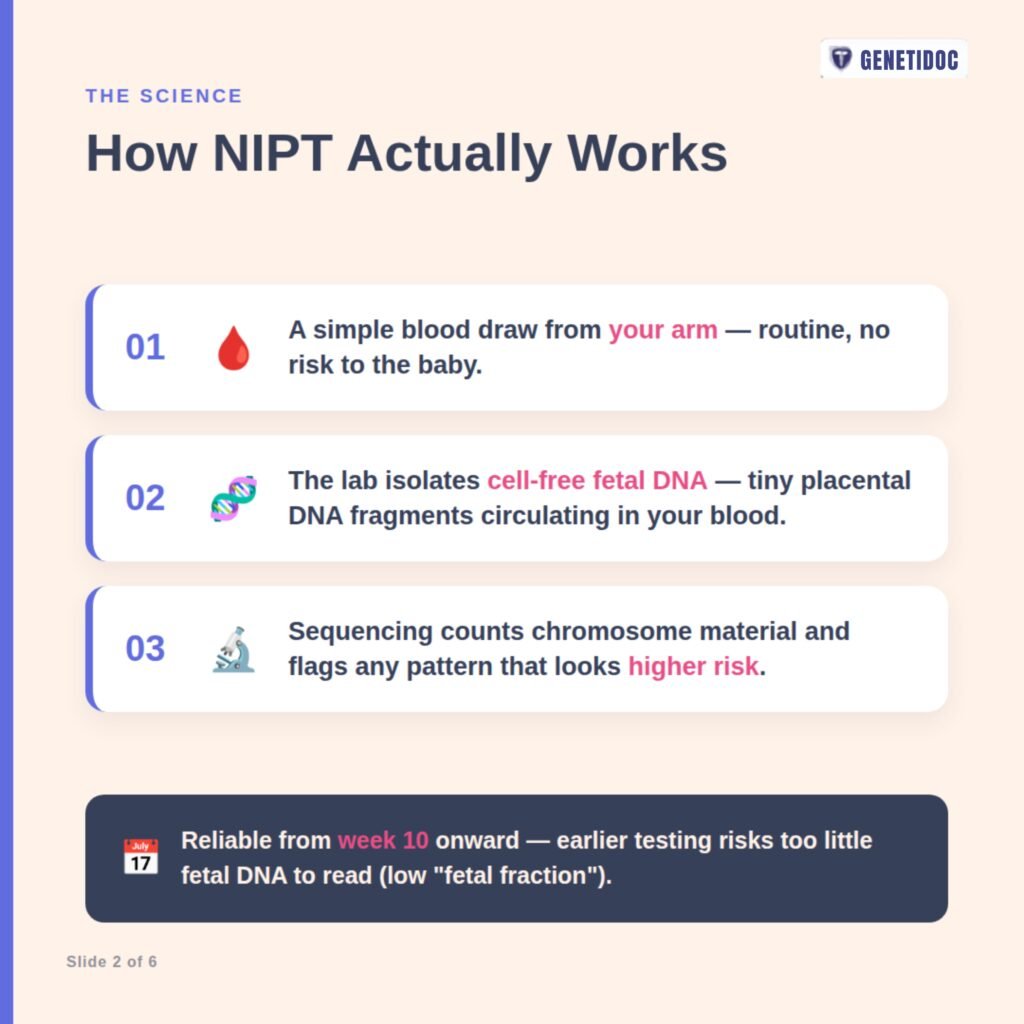
NIPT is a blood test performed on the mother during pregnancy. It screens for chromosomal conditions in the baby by analysing small fragments of the baby’s DNA that naturally circulate in the mother’s bloodstream.
During pregnancy, the placenta continuously releases tiny fragments of the baby’s DNA into the mother’s blood. These fragments are called cell-free fetal DNA. By collecting a maternal blood sample and isolating these fragments, a laboratory can examine the baby’s chromosomal make-up without touching the baby or the pregnancy at all.
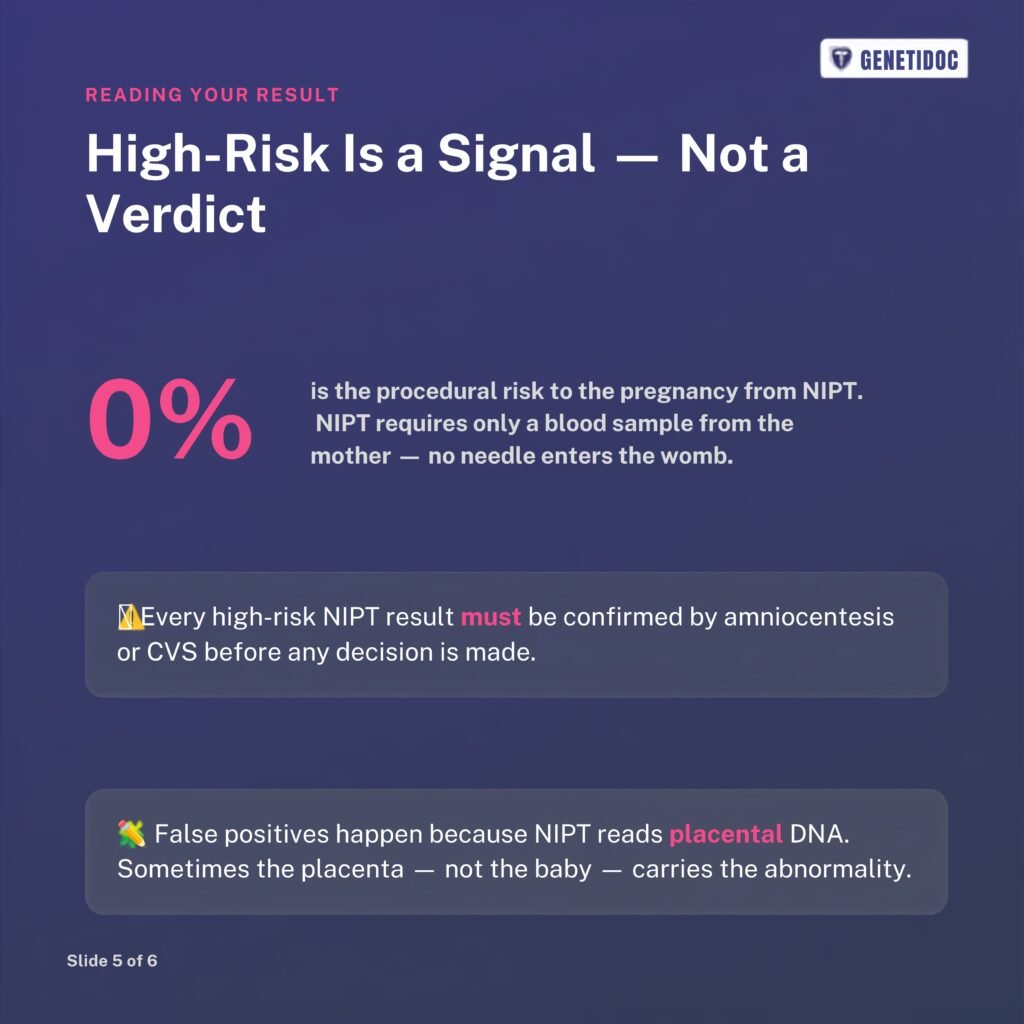
This is what makes NIPT genuinely significant: it provides meaningful chromosomal screening information with zero procedural risk to the pregnancy, because it requires only a blood draw from the mother’s arm.
NIPT does not diagnose conditions. It assesses the risk that a chromosomal condition may be present. This distinction is fundamental, and we will explain it in detail throughout this article.
What Does NIPT Screen For?
At Genetidoc, two levels of NIPT are available, depending on how comprehensive a screen you need.
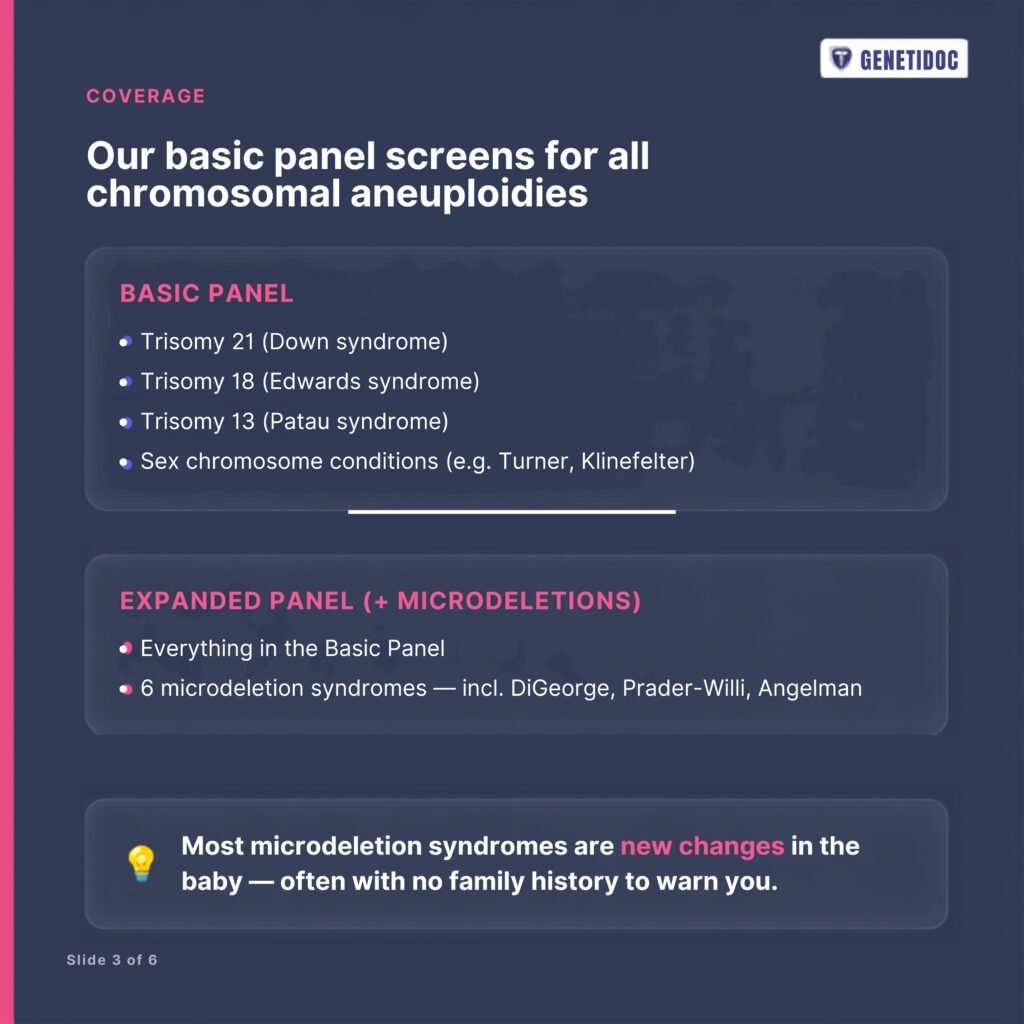
Basic NIPT Panel screens for aneuploidies — meaning abnormal chromosome numbers — across all 23 pairs of human chromosomes. The most clinically significant aneuploidies are:
- Trisomy 21 (Down syndrome): an extra copy of chromosome 21, the most common chromosomal aneuploidy compatible with life
- Trisomy 18 (Edwards syndrome): an extra copy of chromosome 18, associated with severe developmental problems
- Trisomy 13 (Patau syndrome): an extra copy of chromosome 13, associated with serious physical and intellectual disabilities
The basic panel also screens for sex chromosome aneuploidies, such as Turner syndrome (45,X) and Klinefelter syndrome (47,XXY), and aneuploidies involving other chromosomes.
Expanded NIPT Panel (NIPT-Microdeletion) includes everything in the basic panel, and additionally screens for six common microdeletion and microduplication syndromes. These are conditions caused not by an extra or missing whole chromosome, but by very small missing or duplicated segments within a chromosome. The six conditions screened are:
- DiGeorge syndrome (22q11.2 deletion syndrome): associated with congenital heart defects, immune problems, low calcium levels, learning difficulties, and increased risk of psychiatric conditions
- Prader-Willi syndrome: associated with poor muscle tone in infancy, developmental delays, and severe appetite dysregulation in childhood
- Angelman syndrome: associated with severe intellectual disability, limited speech, seizures, and movement difficulties
- Cri-du-chat syndrome (5p deletion): associated with a distinctive high-pitched cry in infancy, intellectual disability, delayed development, and behavioural challenges
- Wolf-Hirschhorn syndrome (4p deletion): associated with growth delay, intellectual disability, distinctive facial features, and seizures
- 1p36 deletion syndrome: one of the more common microdeletion syndromes, associated with intellectual disability, behavioural problems, seizures, and heart defects
None of these conditions would be detected on the basic NIPT panel, as they involve small chromosomal segments rather than whole chromosome number changes.
| “The expanded panel matters because microdeletion syndromes like DiGeorge can have significant developmental, cardiac, and immune implications that a standard chromosomal count would completely miss. The earlier a family has this information, the better prepared they can be for what lies ahead.”
— Team Genetidoc |
How Does NIPT Work? A Plain-Language Explanation
Here is what actually happens, from blood draw to result.
When you are pregnant, the placenta sheds tiny fragments of DNA into your bloodstream constantly. These fragments come from placental cells, which carry the same chromosomal make-up as the baby. By the tenth week of pregnancy, enough of these fragments are present in the blood to analyse reliably.
When you come in for NIPT, a blood sample is drawn from your arm, exactly like any routine blood test. The sample is sent to the laboratory, where it is processed to isolate the cell-free fetal DNA fragments mixed within the maternal blood.
The laboratory then uses a technology called next-generation sequencing to read and count the chromosomal material present. If there is a slightly higher proportion of DNA from a particular chromosome than expected, the software flags this as a high risk for an aneuploidy involving that chromosome. For example, if there is slightly more chromosome 21 material than expected, the test reports a high risk for trisomy 21 (Down syndrome).
The result is not a yes or a no. It is a risk estimate: either high risk or low risk for each condition screened. Think of it as a highly sensitive early warning system, not a confirmation.
What Is Fetal Fraction and Why Does It Matter?
Fetal fraction refers to the percentage of cell-free fetal DNA within the total DNA in the mother’s blood sample. For NIPT to produce a reliable result, the fetal fraction generally needs to be at least four percent.
If the fetal fraction is too low, the laboratory cannot confidently analyse the chromosomal signal, and a repeat blood sample is required. A low fetal fraction result is not a failed test; it simply means the sample did not have enough fetal material to work with on that draw.
Several factors can reduce fetal fraction:
- High maternal body weight or obesity: more maternal DNA dilutes the fetal fraction
- Testing before ten weeks: the placenta has not yet shed enough fragments for reliable analysis
- Twin pregnancies: fetal DNA from two babies is split between them, reducing each individual fraction
- Certain placental conditions: problems with placental function can reduce DNA release
This is a key reason Genetidoc recommends performing NIPT after ten weeks of gestation. At this point, fetal fraction is reliably sufficient in the large majority of pregnancies.
When Should NIPT Be Done?
NIPT is recommended from ten weeks of gestation onwards. Testing before ten weeks carries a meaningful risk of an insufficient fetal fraction, which leads to an inconclusive result and the need to repeat the blood draw.
Many patients come to Genetidoc earlier in their pregnancy, sometimes as early as five or six weeks. This is entirely understandable. Early pregnancy brings anxiety, and the desire to have answers as soon as possible is completely natural.
When patients present early, the Genetidoc team uses the time well. Rather than simply telling them to come back at ten weeks, the consultation becomes an opportunity for thorough pre-test counseling: what NIPT screens for, what it does not screen for, what a high-risk result would mean, what the next steps would involve, and what other screening options exist alongside NIPT. By the time ten weeks arrives and the blood is drawn, the patient is already fully informed.
| “Coming in early is never a problem. It gives us more time to counsel properly. By the time the test is done, families already understand exactly what the result will mean. They are not hearing the explanations for the first time when they are anxious about a result in their hands.”
— Team Genetidoc |
Who Should Consider NIPT?
NIPT can be considered by any pregnant woman, regardless of age. Current international guidelines support offering NIPT as a screening option to all pregnant women, not just those considered high risk.
There are specific situations where NIPT is particularly recommended or strongly advisable:
- Advanced maternal age: women aged 35 or older at the time of delivery have a higher baseline risk for chromosomal aneuploidies. The risk of having a baby with Down syndrome, for example, increases with maternal age.
- Abnormal first-trimester combined screening: if your blood tests or nuchal translucency ultrasound scan have flagged a raised risk for a chromosomal condition, NIPT provides a more accurate follow-up screen before proceeding to invasive testing.
- Previous pregnancy or child affected by a chromosomal aneuploidy: having had a previous pregnancy affected by trisomy 21, 18, or 13 increases the risk in subsequent pregnancies.
- Parental chromosomal rearrangements: where one parent carries a structural chromosomal change such as a balanced translocation, the risk of the baby being affected is higher.
- Personal choice and reassurance: many couples with no specific risk factors choose NIPT for the reassurance of knowing their baby’s chromosomal risk has been screened early and non-invasively.
At Genetidoc, patients come from both urban centres and rural backgrounds across India. The most common reason they seek NIPT is a desire to rule out chromosomal conditions. Most have already researched the test before their appointment.
Understanding Your NIPT Result: What High Risk and Low Risk Actually Mean
This is the section most patients wish they had read before receiving their result.
NIPT does not give a definitive answer. It gives a risk estimate for each condition it screens for. The result will say either high risk or low risk, not yes or no, not affected or unaffected.
What a Low-Risk Result Means
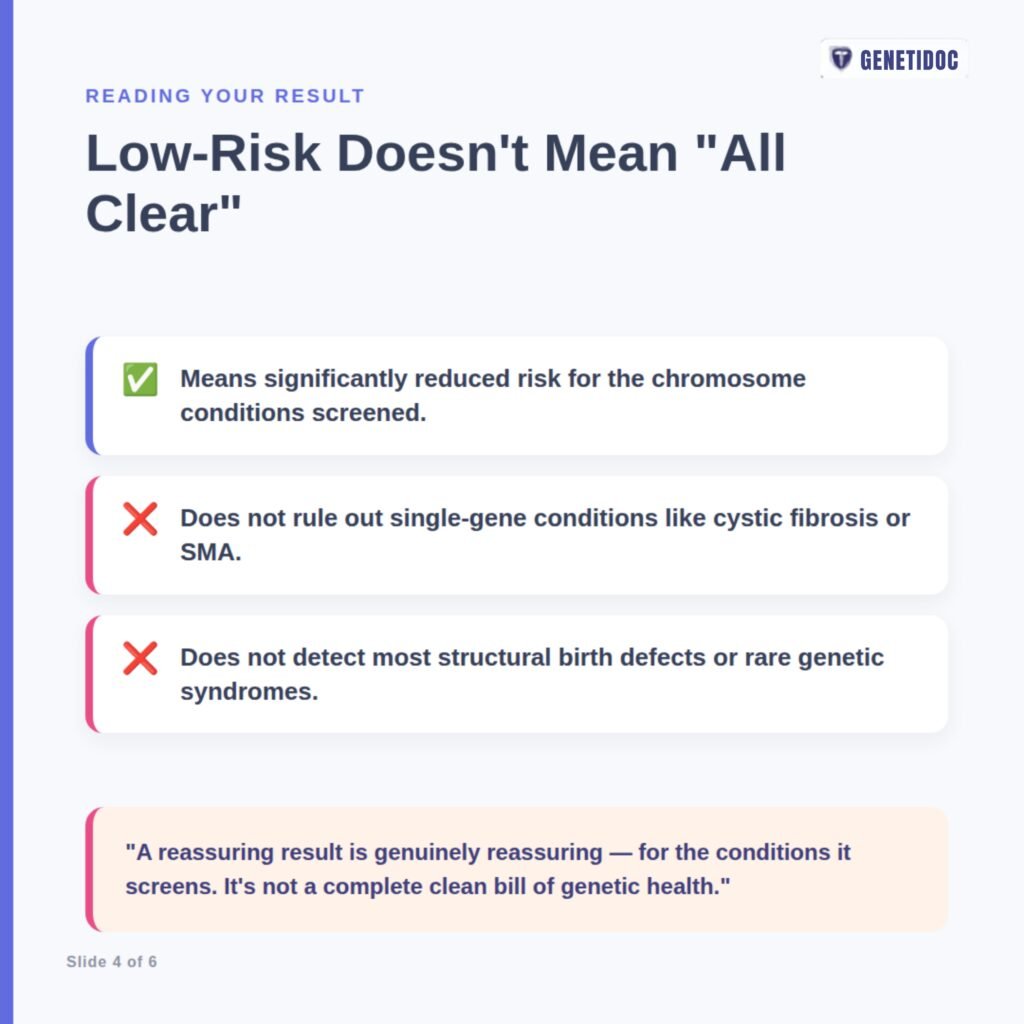
A low-risk NIPT result is genuinely reassuring. It means the test has not detected a chromosomal signal pattern associated with the conditions it screens for, and your baby’s risk for those specific conditions is significantly reduced.
However, a low-risk result does not mean your baby has no genetic conditions at all. NIPT screens only for chromosomal aneuploidies and, in the expanded panel, specified conditions. It does not screen for:
- Single-gene (monogenic) conditions such as cystic fibrosis, spinal muscular atrophy, or sickle cell disease
- Structural birth defects detectable on ultrasound
- The large majority of rare genetic syndromes
- Chromosomal duplications or deletions not covered by the panel chosen
A low-risk result gives you reassurance about chromosomal aneuploidies. It does not give your baby a complete clean bill of genetic health. Understanding this distinction prevents the false sense of complete security that some patients incorrectly take from a low-risk result.
| “NIPT screens a specific section of genetic conditions. A reassuring result is genuinely reassuring for those conditions. But it does not mean the baby has no genetic concerns at all. That is not a limitation of the test; it is simply what the test was designed to do. Our job is to make sure families understand exactly what they have been reassured about.”
— Team Genetidoc |
What a High-Risk Result Means
A high-risk NIPT result means the test has detected a chromosomal signal pattern that is associated with an elevated probability of a specific condition. It is an alert, not a diagnosis.
NIPT carries a false-positive rate. This means that some high-risk results occur in pregnancies where the baby does not actually have the flagged condition. This happens for biological reasons explained in the limitations section below, including a phenomenon called confined placental mosaicism.
A high-risk result must always be followed by confirmatory diagnostic testing through amniocentesis or chorionic villus sampling before any clinical or reproductive decision is made. No decision, of any kind, should be based on a high-risk NIPT result alone.
The emotional impact of a high-risk result is significant. Anxiety, fear, and distress are the most common immediate responses. The team at Genetidoc approaches these conversations with clarity and without rushing. Families are given time to process, ask questions, and understand their options before any decisions are discussed.
| “When a high-risk result comes in, the first thing we do is slow the conversation down. Families are often already imagining the worst. Our role is to be clear: this result means there is a raised risk, not a confirmed diagnosis. The next step is a confirmatory test, and we walk through that together.”
— Team Genetidoc |
NIPT vs. Diagnostic Testing: Understanding the Difference
The single most important concept in prenatal genetic testing is the difference between screening and diagnosis. Getting this wrong leads to the most consequential misunderstandings in prenatal care.
Screening tells you whether your risk is high or low. Diagnosis tells you whether a condition is present or absent. These are fundamentally different questions, answered by fundamentally different tests.
| Feature | NIPT (Screening) | Amniocentesis / CVS (Diagnostic) |
| What it does | Estimates risk | Provides definitive diagnosis |
| Result type | High risk or low risk | Affected or unaffected (definitive) |
| Procedure | Maternal blood draw only | Needle into amniotic sac or placenta under ultrasound guidance |
| Risk to pregnancy | None | Approximately 0.1% miscarriage risk |
| Timing | From 10 weeks onwards | CVS from 11–13 weeks; amniocentesis from 15–16 weeks |
| Can it replace the other? | No | Yes, for definitive diagnosis |
| Best used for | Early risk stratification without procedural risk | Confirming or ruling out a condition with certainty |
NIPT and amniocentesis or chorionic villus sampling are not competing tests. They answer different clinical questions and are used at different points in the same pathway. NIPT identifies who is at elevated risk. Amniocentesis or chorionic villus sampling provides the definitive diagnosis for those who need one.
A high-risk NIPT result without confirmatory diagnostic testing is never sufficient to make a clinical decision. Amniocentesis or chorionic villus sampling is the only test that provides a definitive answer.
When Is Diagnostic Testing Recommended Directly, Without NIPT?
NIPT is not always the right starting point. There are specific clinical situations where the Genetidoc team recommends proceeding directly to diagnostic testing, bypassing NIPT entirely:
- Known family history of a specific genetic condition: if both parents are confirmed carriers of a single-gene condition such as spinal muscular atrophy or thalassemia, NIPT cannot screen for those conditions. Targeted diagnostic testing for that specific condition is the appropriate route.
- Previous child or pregnancy affected by a specific genetic condition: where the condition causing the previous pregnancy’s problem is already identified, a targeted diagnostic test for that condition is more clinically meaningful than a general chromosomal screen.
- Advanced gestational age with a closing window for invasive testing: if the pregnancy is approaching the gestational age limits for chorionic villus sampling or amniocentesis, or if the legal limit for termination of pregnancy is approaching, adding a NIPT screening step first would consume time that is clinically critical. Proceeding directly to diagnostic testing is the appropriate choice.
- Prenatal screening findings strongly pointing to a genetic condition NIPT cannot detect: if first-trimester combined screening results or ultrasound findings strongly suggest a condition caused by a chromosomal microarray-detectable variant, a structural rearrangement, or a single-gene disorder, NIPT would not screen for these. Chromosomal microarray analysis or exome sequencing on an invasively obtained sample is the correct next step.
- Ultrasound findings strongly pointing toward a specific genetic condition: when the clinical picture from imaging already suggests a high probability of a genetic condition of monogenic or chromosomal copy number origin, adding a NIPT screening layer first adds delay without adding diagnostic clarity. Amniocentesis or chorionic villus sampling followed by chromosomal microarray analysis or targeted gene sequencing is the appropriate path.
| “Choosing the right test for the right clinical situation is where clinical genetics expertise matters most. NIPT is an excellent screening tool, but it is not the right first step in every pregnancy. Part of our role is helping families understand which test actually answers their specific clinical question.”
— Team Genetidoc |
The Limitations of NIPT: What Every Patient Must Understand
NIPT is among the most accurate prenatal screening tests available. But it has important biological and technical limitations that every patient must understand before ordering the test.
1. Confined Placental Mosaicism
This is the most important biological limitation of NIPT, and one that patients rarely understand until it is explained to them.
To understand confined placental mosaicism, you need to know that NIPT does not analyse DNA directly from the baby. It analyses DNA from the placenta, specifically the fragments of placental DNA floating in the mother’s blood. In most pregnancies, the placenta and the baby carry the same chromosomal make-up. But in some cases, the placenta develops its own chromosomal abnormality that is not present in the baby’s own cells. Here, the placenta is affected, not the baby.
When this happens, NIPT can return a high-risk result even though the baby itself is chromosomally normal. This is called a false positive. It is one of the primary reasons a high-risk NIPT result must always be confirmed by amniocentesis or chorionic villus sampling, which directly samples the baby’s cells rather than placental fragments.
This is not a flaw in the test design. It is a biological reality of what NIPT is actually measuring. Understanding it prevents families from making irreversible decisions based on an unconfirmed NIPT result.
2. Vanishing Twin Syndrome
Some pregnancies begin as twins, but one twin is lost very early, often before it is detected on ultrasound. This is called a vanishing twin. However, the DNA from the lost twin can persist in the mother’s bloodstream for weeks after the loss. If NIPT is performed while the vanishing twin’s DNA is still present, the test may pick up chromosomal signals from the lost twin and return a false-positive result for the surviving twin.
3. Maternal Chromosomal Mosaicism
In rare cases, the mother herself carries a chromosomal abnormality at a low level in her own cells, often undetected and clinically silent throughout her life. When this occurs, her own DNA can contribute an abnormal chromosomal signal to the NIPT sample, potentially leading to a false-positive result unrelated to the baby’s chromosomes.
4. Low Fetal Fraction
A fetal fraction below four percent means there is insufficient fetal DNA in the sample to analyse reliably. Trisomy 18 and Trisomy 13 are particularly associated with reduced placental DNA release, which means false-negative results are more likely for these specific conditions when fetal fraction is borderline. A low fetal fraction result is not ignored; a repeat sample is requested.
5. What NIPT Does Not Screen For
NIPT does not detect single-gene conditions. It does not detect most structural birth defects. It does not detect the large majority of rare genetic syndromes. A completely reassuring NIPT result accounts for only one category of genetic risk.
| “Understanding the limitations of NIPT is not meant to cause alarm. It is meant to empower families to make the right decisions. When you know exactly what a test can and cannot do, you can plan appropriately, ask the right questions, and know when additional evaluation is needed.”
— Team Genetidoc |
Microdeletion Syndromes: Why the Expanded Panel Matters
The expanded NIPT panel covers six common microdeletion and microduplication syndromes. These are conditions caused by very small segments of a chromosome being missing or duplicated, too small to be detected by standard chromosomal counting but large enough to cause significant medical and developmental problems.
The six conditions are listed in full in the panel comparison section above. What makes these conditions particularly important to screen for prenatally is that many of them are not inherited from a parent with the same condition. They arise as new changes in the baby, meaning there may be no family history to alert the parents or their obstetrician to the possibility.
Awareness of microdeletion panel testing is growing among Indian obstetricians, though it remains less universally known than awareness of trisomy screening. Patients seeking the most comprehensive non-invasive chromosomal screen available should discuss the expanded panel with their genetic counselor before deciding which level of NIPT to proceed with.
What Happens When You Refuse Invasive Testing After a High-Risk Result?
This situation arises in clinical practice, and the Genetidoc team handles it with both honesty and respect. Families decline diagnostic testing after a high-risk NIPT result for various reasons: anxiety about the small miscarriage risk of amniocentesis or chorionic villus sampling, religious beliefs, personal values, or simply not feeling ready to face a definitive answer.
The approach at Genetidoc begins with understanding. The team first asks the family to share their concerns and reasons. Every concern is addressed individually and without judgment.
For families worried about the miscarriage risk of invasive testing: the risk is approximately one in one thousand, or 0.1%. This figure is put in honest clinical context against the risk suggested by the NIPT result. In most cases where NIPT has flagged a high risk, the probability of the baby being affected is substantially higher than the procedural risk of the confirmatory test. This comparison is explained clearly, not to pressure the family, but to ensure they are making an informed decision rather than one based on misplaced fear.
For families with religious or deeply personal reasons for declining: the team listens, answers questions, and shares all relevant clinical information. It does not pressure or direct. Informed consent is central to the practice of clinical genetics. The final decision always belongs to the family.
| “We never pressure a family. But we do make absolutely sure that whatever decision they make, they are making it with complete and accurate information. Not out of fear. Not based on a misunderstanding. In the end, this is their pregnancy and their family, and we respect that fully.”
— Team Genetidoc |
NIPT in India: Cost, Access, and Turnaround Time
Cost
NIPT costs in India vary significantly across providers. At Genetidoc, the basic panel covering all chromosome aneuploidies is available at a mid-range price point that includes post-test genetic counseling as standard. The expanded microdeletion panel, which adds screening for six common microdeletion and duplication syndromes, is priced higher to reflect its broader scope and the additional laboratory analysis involved. For current pricing, please contact the Genetidoc team directly.
It is important to understand what these prices include: expert post-test genetic counseling by a clinical geneticist as standard. This is not consistently included when NIPT is ordered through other channels. A low-cost NIPT report without interpretation and counseling can leave a family more confused than informed, particularly when results are not straightforward.
Turnaround Time
Results at Genetidoc are typically available within ten to fifteen working days from the date of sample collection.
Insurance
NIPT is not consistently covered by health insurance plans in India and is largely an out-of-pocket expense. Patients are advised to check directly with their insurer regarding their specific policy.
| “The cost of the test is only part of the equation. What you are actually paying for is the interpretation, the counseling, and the clinical decision-making that follows. A report without those things is just a number on a page. It does not tell you what to do next, and in prenatal genetics, knowing what to do next is everything.”
— Team Genetidoc |
Why Expert Genetic Counseling Is Not Optional
NIPT results, whether high risk, low risk, or inconclusive, do not interpret themselves. The same result can mean something very different depending on the patient’s gestational age, family history, ultrasound findings, and personal circumstances.
At Genetidoc, post-test genetic counseling is included as standard with every NIPT order. Pre-test counseling is equally important and available at consultation. This is what that counseling actually provides:
- Your result is interpreted in the full context of your clinical picture, not in isolation
- You are told clearly what the result means, what it does not mean, and what your realistic options are
- If the result is high risk, you receive a clear explanation of confirmatory testing, what the procedure involves, its risks, and what comes after
- If the result is low risk, you understand exactly which conditions have been screened and which conditions fall outside what NIPT covers
- If the result is inconclusive or the fetal fraction is low, you understand why and what the next step is
Genetic counseling is not a formality. In prenatal testing, it is the step that turns a laboratory result into an actionable clinical understanding. Without it, patients are left to interpret technical reports in the middle of one of the most emotionally significant periods of their lives.
Illustrative Clinical Scenarios
Scenario 1: The Low-Risk Result That Did Not Mean Everything Was Fine
A 29-year-old woman in her fourteenth week of pregnancy had received a low-risk NIPT result from a provider outside Genetidoc. She came to the clinic because her anomaly scan had flagged a small structural finding in the baby’s heart. She was confused, and a little reassured, because she assumed the low-risk NIPT result meant her baby had no genetic issues.
During the counseling session, the team explained that NIPT does not screen for structural heart defects or the single-gene conditions that can cause them. Conditions like Holt-Oram syndrome, which can cause heart and limb abnormalities, are caused by changes in single genes that NIPT is not designed to detect. The low-risk result was genuinely reassuring for chromosomal aneuploidies. It said nothing about the cause of the cardiac finding.
Further evaluation was recommended: a fetal echocardiogram to characterise the cardiac finding in detail, and specialist genetic review to consider whether targeted single-gene testing or chromosomal microarray analysis on an invasively obtained sample was appropriate.
This case illustrates why results must be interpreted in clinical context, and why a reassuring NIPT result does not close the conversation when other clinical findings remain unexplained.
Scenario 2: A High-Risk Result, Confirmation, and a Normal Baby
A 38-year-old woman received a high-risk NIPT result flagging a high risk for trisomy 21. She was already researching termination options before her counseling appointment at Genetidoc. She was understandably distraught, and had told her family the baby had Down syndrome.
The counseling team began by gently correcting the framing: the NIPT result had not diagnosed Down syndrome. It had flagged a high risk. The team explained confined placental mosaicism: the NIPT had detected an abnormal chromosomal signal in placental DNA, but placental DNA does not always perfectly match the baby’s own chromosomes. A false-positive result was genuinely possible.
The woman agreed to amniocentesis. The result from the baby’s own cells was normal. The baby did not have trisomy 21. The family, who had spent two weeks believing their baby was affected, received news that required its own careful counseling to process.
This case is the clearest possible illustration of why a high-risk NIPT result is never a diagnosis, and why no irreversible decision should ever be made on the basis of NIPT alone.
Scenario 3: Knowing When NIPT Was Not the Right Test
A couple came for counseling after their second child was born with a severe metabolic disorder. Genetic testing of the affected child had identified the specific gene mutation responsible. Both parents were confirmed carriers. They were now expecting their third child and wanted prenatal testing.
The team explained that NIPT could not help them. The condition affecting their children was caused by a single-gene mutation, not a chromosomal aneuploidy. NIPT does not screen for this category of conditions. The appropriate test was targeted prenatal diagnostic testing for the specific mutation identified in their affected child, obtained through amniocentesis or chorionic villus sampling.
They proceeded with targeted diagnostic testing and received a definitive answer about whether their third child was affected, was a carrier, or was unaffected entirely. This is what the right test, chosen for the right clinical reason, actually delivers.
Frequently Asked Questions About NIPT
1. Is NIPT safe for my baby?
Yes. NIPT is completely safe for both mother and baby. It requires only a blood draw from the mother’s arm and carries no risk of miscarriage or harm to the pregnancy whatsoever.
2. When is the best time to do NIPT?
NIPT is recommended from ten weeks of gestation onwards. Testing before ten weeks risks an insufficient fetal fraction, which may lead to an inconclusive result and the need to repeat the blood draw.
3. Can NIPT detect all genetic conditions?
No. NIPT screens for chromosomal aneuploidies and, in the expanded panel, selected microdeletion syndromes. It does not screen for single-gene conditions, most structural birth defects, or the large majority of rare genetic disorders.
4. If my NIPT result is low risk, does that mean my baby is completely healthy?
Not entirely. A low-risk result means your baby has a significantly reduced chance of having the chromosomal conditions screened by the test. It does not rule out single-gene conditions, structural defects, or the many genetic conditions that fall outside the scope of NIPT.
5. What happens if I get a high-risk NIPT result?
A high-risk result means there is an increased probability that your baby may have a particular chromosomal condition. It is not a diagnosis. Confirmatory diagnostic testing through amniocentesis or chorionic villus sampling is required before any clinical decision is made. No decision should be based on a high-risk NIPT result alone.
6. What is the difference between NIPT and amniocentesis?
NIPT is a screening test. It estimates the risk of a chromosomal condition being present. Amniocentesis is a diagnostic test. It examines the baby’s own chromosomes directly and gives a definitive confirmed or ruled-out answer. A high-risk NIPT result should always be followed by amniocentesis or chorionic villus sampling before any decision is made.
7. What is fetal fraction and why does it matter?
Fetal fraction is the percentage of the baby’s DNA in the mother’s blood sample. A minimum of approximately four percent is needed for a reliable NIPT result. Low fetal fraction can occur with high maternal body weight, early testing, or twin pregnancies, and may require a repeat blood sample.
8. Does NIPT reveal the sex of my baby?
No. Genetidoc does not report fetal sex from NIPT results. Prenatal sex determination is prohibited under India’s Pre-Conception and Pre-Natal Diagnostic Techniques Act except where there is a clinical indication related to sex-linked genetic conditions.
9. What is confined placental mosaicism and how does it affect NIPT?
Confined placental mosaicism is a condition where the placenta carries a chromosomal abnormality that is not present in the baby’s own cells. Since NIPT analyses placental DNA rather than the baby’s DNA directly, this can produce a high-risk result even when the baby is chromosomally normal. This is called a false positive and is the primary reason a high-risk NIPT result must always be confirmed by amniocentesis or chorionic villus sampling.
10. What is the difference between the basic and expanded NIPT panel?
The basic panel screens for abnormal chromosome numbers across all 23 chromosome pairs, including Down syndrome, Edwards syndrome, and Patau syndrome. The expanded panel additionally screens for six common microdeletion and microduplication syndromes, which are caused by small missing or duplicated segments within chromosomes and would not be detected by the basic panel.
11. How long does it take to get NIPT results?
At Genetidoc, results are typically available within ten to fifteen working days from the date of sample collection.
12. Do I need a referral from my obstetrician to access NIPT at Genetidoc?
A formal referral is not required to book with Genetidoc directly. However, keeping your obstetrician informed is advisable so that your prenatal care remains coordinated. At Genetidoc, pre-test and post-test counseling are included as standard, so you receive complete clinical support alongside the test itself.
Conclusion: What Every Pregnant Woman Should Know About NIPT
NIPT is one of the most significant advances in prenatal screening of the last decade. It is safe, non-invasive, and provides meaningful chromosomal risk information earlier in pregnancy than was previously possible. For many families, it offers genuine and well-founded reassurance.
But its value depends entirely on how well it is understood, and on the quality of counseling surrounding it.
Here are the key points every patient should take away:
- NIPT is a screening test, not a diagnostic test. It estimates risk. It does not confirm or rule out any condition with certainty.
- A low-risk result is reassuring for chromosomal aneuploidies, but it does not mean the baby is free of all genetic conditions. It covers only what the panel screened for.
- A high-risk result requires confirmatory diagnostic testing before any decision is made. It is not a diagnosis and must never be treated as one.
- NIPT does not screen for single-gene conditions, most structural defects, or the majority of rare genetic syndromes.
- The expanded microdeletion panel provides meaningful additional coverage for conditions the basic panel cannot detect.
- In certain clinical situations, diagnostic testing is the right first step, and NIPT may not be the appropriate test at all.
- Expert genetic counseling before and after NIPT is not optional. It is the step that turns a laboratory number into an informed, actionable clinical understanding.
| Have Questions About NIPT or Your Prenatal Screening Options?
Whether you are considering NIPT for the first time, trying to understand a result you have already received, or unsure whether NIPT is the right test for your specific situation, a genetic counseling consultation with the Genetidoc team will give you the clarity you need. Every NIPT ordered through Genetidoc includes pre-test and post-test counseling with a clinical geneticist. You will know what your result means, what it does not mean, and exactly what your next steps are. |
References
- American College of Obstetricians and Gynecologists. Practice Bulletin No. 226: Screening for Fetal Chromosomal Abnormalities. Obstetrics and Gynecology. 2020;136(4):e48-e69.
- Society for Maternal-Fetal Medicine. Cell-free DNA screening for fetal aneuploidy. American Journal of Obstetrics and Gynecology. 2015;212(6):711-716.
- International Society for Prenatal Diagnosis. Updated Position Statement from the ISPD on cell-free DNA prenatal testing for fetal aneuploidies and copy number variants. Prenatal Diagnosis. 2023.
- Gregg AR, Skotko BG, Benkendorf JL, et al. Noninvasive prenatal screening for fetal aneuploidy, 2016 update: a position statement of the American College of Medical Genetics and Genomics. Genetics in Medicine. 2016;18(10):1056-1065.
- Norton ME, Jacobsson B, Swamy GK, et al. Cell-free DNA analysis for noninvasive examination of trisomy. New England Journal of Medicine. 2015;372(17):1589-1597.
- Gil MM, Accurti V, Santacruz B, Plana MN, Nicolaides KH. Analysis of cell-free DNA in maternal blood in screening for aneuploidies: updated meta-analysis. Ultrasound in Obstetrics and Gynecology. 2017;50(3):302-314.
- Pertile MD. Genome-wide cell-free DNA-based prenatal testing for rare autosomal trisomies and chromosomal abnormalities. Genetics in Medicine. 2020.
- Indian Council of Medical Research. Guidelines for Prenatal Genetic Testing. New Delhi: Indian Council of Medical Research; 2022.