
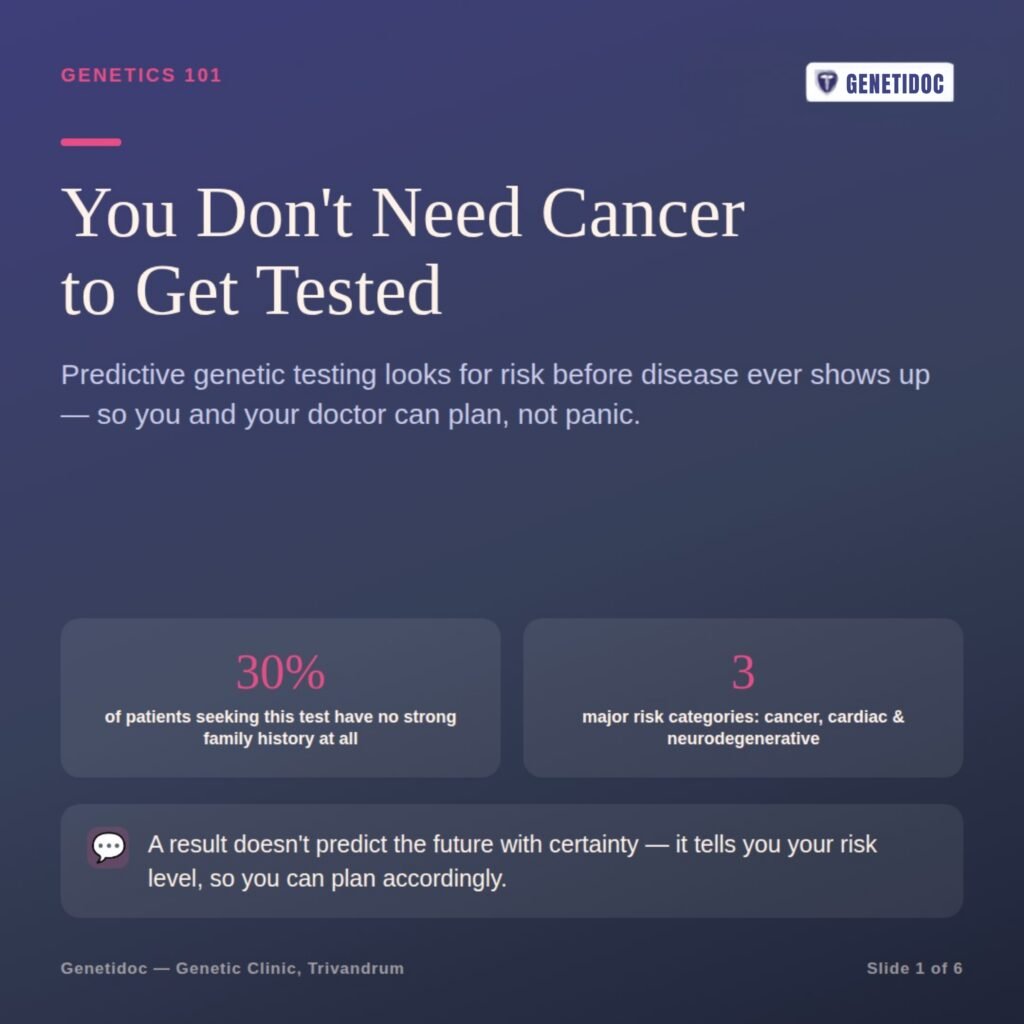
If a genetic test can’t cure cancer, why get one before you’re sick? Because knowing your risk early is what lets you catch disease before it becomes an emergency — or avoid needless worry altogether.
Quick answer: Predictive genetic testing looks for gene changes linked to disease risk in people who are currently healthy. It’s most useful if you have a family history of cancer, heart disease, or certain neurological conditions — but it can also help people with no known family history who simply want clarity. A result doesn’t predict the future with certainty. It tells you your risk level, so you and your doctor can plan accordingly.
What Is Predictive Genetic Testing?
Predictive genetic testing looks for inherited gene changes — called pathogenic variants or mutations — that are known to raise a person’s risk of developing a disease later in life. Unlike diagnostic testing, which is done after someone already has symptoms, predictive testing is done in people who are currently healthy.
The idea isn’t to predict destiny. It’s to identify risk early enough that something useful can be done about it — more frequent screening, earlier interventions, or simply a clearer picture for family planning and peace of mind.
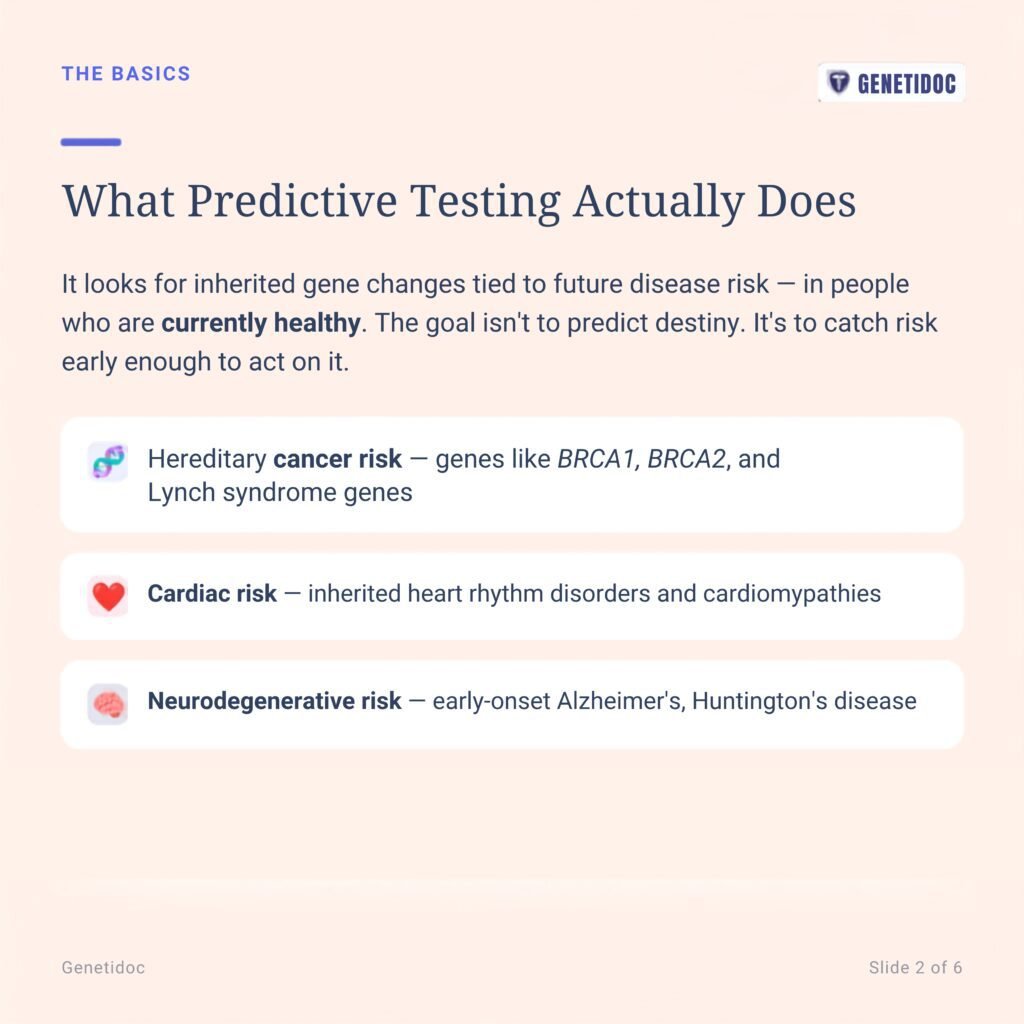
Most predictive testing today focuses on three broad categories:
- Hereditary cancer risk — genes like BRCA1, BRCA2, and mismatch repair genes linked to Lynch syndrome
- Cardiac risk — genes linked to inherited heart rhythm disorders and cardiomyopathies
- Neurodegenerative risk — conditions like early-onset Alzheimer’s disease or Huntington’s disease
Predictive Testing vs. Other Types of Genetic Testing
Patients often confuse predictive testing — also called presymptomatic testing — with other categories of genetic testing. Here’s how they differ:
| Test Type | Who It’s For | What It Answers |
| Predictive | Healthy person with personal/family risk concern | “What is my future risk of developing this condition?” |
| Diagnostic | Person with active symptoms or an existing diagnosis | “Does a genetic cause explain what’s happening to me now?” |
| Carrier screening | Couples planning a pregnancy | “Could our child inherit a recessive condition?” |
| DTC wellness kit | General consumers, no clinical oversight | Broad ancestry/wellness traits — limited, non-diagnostic-grade disease markers |
Who Should Consider Predictive Genetic Testing?
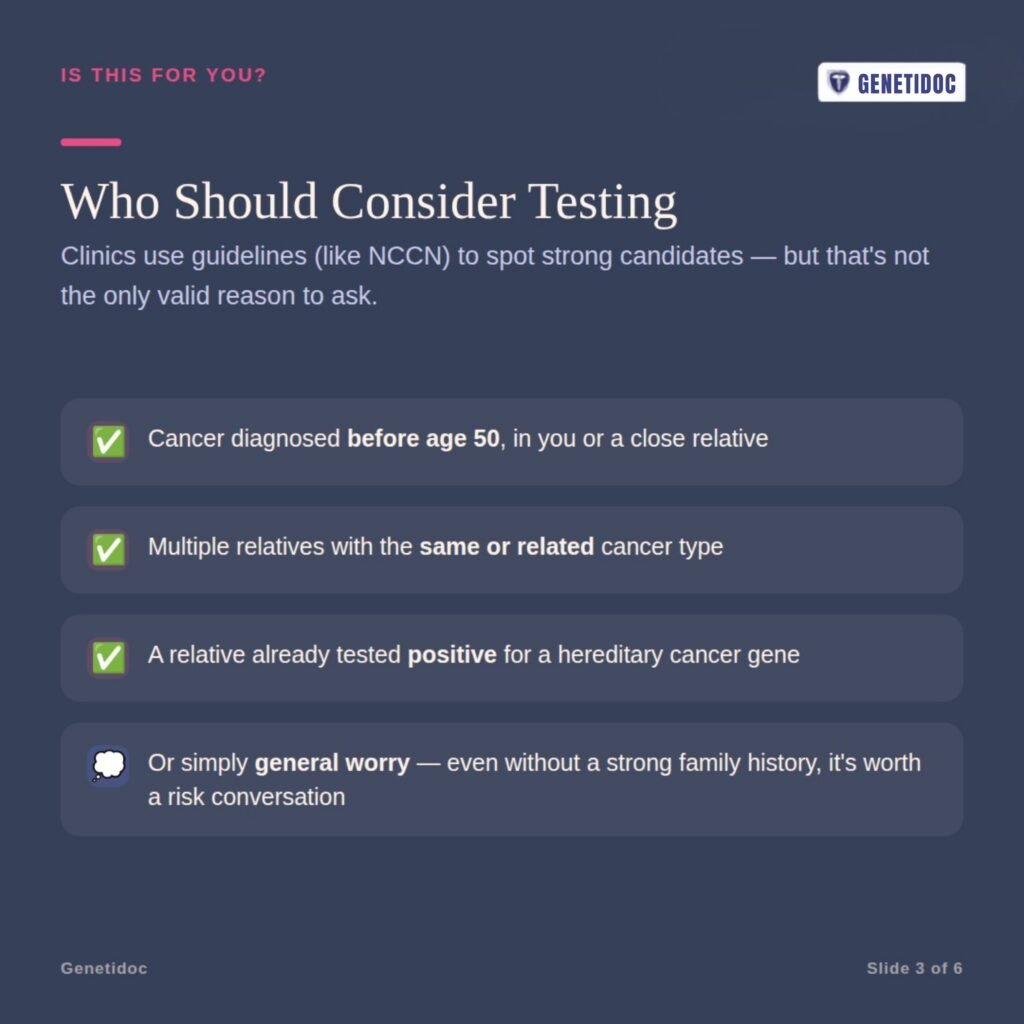
Genetic clinics use established clinical guidelines — most commonly from the National Comprehensive Cancer Network (NCCN) — to decide who is a strong candidate for predictive testing. You may be a candidate if:
- You or a close family member was diagnosed with cancer before age 50
- Multiple family members on the same side of the family have had the same or related type of cancer
- A family member has already tested positive for a known hereditary cancer gene
- Your family history fits a recognized hereditary cancer syndrome pattern (for example, breast and ovarian cancer appearing together, or colon and endometrial cancer appearing together)
- You have a personal or family history of a rare cancer type strongly linked to inherited syndromes (such as certain kidney or adrenal cancers)
- You belong to a population or family line with a known recurring (“founder”) variant
But clinical criteria aren’t the only valid reason to seek testing. At Genetidoc, roughly 30% of patients seeking predictive testing have no strong family history at all — they’re motivated by general worry or a desire to understand their personal risk. This is a legitimate reason to have a counseling conversation, even if a test doesn’t ultimately end up being the right next step for everyone in that group.
“Even without a strong family history, small families today often simply don’t have enough relatives to reveal a hereditary pattern. A worry that feels vague isn’t automatically a worry that’s unfounded — it’s worth a proper risk conversation before we decide whether testing is the right next step.”
— Dr. Roshan Daniel, Founder, Genetidoc Genetic Clinic
Who Actually Seeks Predictive Testing? A Look at Real Patient Patterns
Patients arrive at predictive genetic testing from a few distinct starting points. Understanding these patterns helps explain why the first step is never simply “order the test”:
| Patient Group | Approx. Share | What They Usually Need First |
| Family history of cancer | 50–60% | Pedigree review against NCCN criteria; likely candidates for panel testing |
| General worry / curious about personal risk, no strong history | ~30% | Risk assessment counseling; testing only if criteria are actually met |
| Arrive holding a DTC wellness-kit report | <2% | Interpretation of what the kit actually covers, and confirmatory clinical testing if flagged |
Team Genetidoc notes that the conditions patients most often ask about, in order, are hereditary cancers, inherited cardiac conditions, and neurodegenerative diseases such as Alzheimer’s.
What Actually Happens in a Predictive Testing Consultation
A good predictive testing pathway is never “walk in, get swabbed, get a report.” It’s a structured process, and the first step often has nothing to do with a lab at all.
Step 1: Settling the worry itself
Many patients arrive anxious — sometimes more anxious than their actual risk level warrants. Team Genetidoc’s first move is simply to help the patient calm down enough to think clearly. Decisions about genetic testing made from a place of panic tend to go badly; decisions made with a clear head go well.
Step 2: Genetic counseling and risk assessment
Once the patient is settled, a genetic counseling session maps out personal and family history in detail, often using a family tree (pedigree). This is where the team checks the history against established criteria — not to gatekeep testing, but to make sure the right test (or no test at all) is being recommended.
Step 3: Explaining options, utility, cost, and limitations
If testing is appropriate, the counseling session covers what the test can and can’t tell the patient, what a positive or negative result would actually mean for their life, the cost involved, and the practical limitations of the technology. Nothing is presented as a foregone conclusion.
Step 4: Shared decision-making
The final call belongs to the patient. Genetic testing is never something done to a patient — it’s a decision made with them, once they have enough information to choose confidently.
Choosing the Right Test: Single Gene, Panel, or Comprehensive?
Not every patient needs the biggest, most expensive test available. Test selection depends on how specific the family history pattern is:
- Single-gene testing: Used when family history points clearly to one specific gene known to cause a particular hereditary syndrome — for example, testing the APC gene when a family’s pattern strongly matches a syndrome known to arise from that gene alone.
- Multi-gene panel: Used when the cancer pattern in the family fits a broader category known to arise from several possible genes, rather than one specific gene.
- Comprehensive panel: Used when the family history or presentation spans multiple possible cancer syndromes at once, and a broader net is clinically justified.
This tiered approach matters for a practical reason: bigger isn’t automatically better. A wider panel also returns more variants of uncertain significance (VUS) — findings that are harder to interpret and can create more confusion than clarity if ordered without a clear clinical reason.
Understanding Your Result: What “Positive” and “Negative” Actually Mean
This is the part almost every patient gets wrong at first — and it’s the single most important concept in predictive testing.
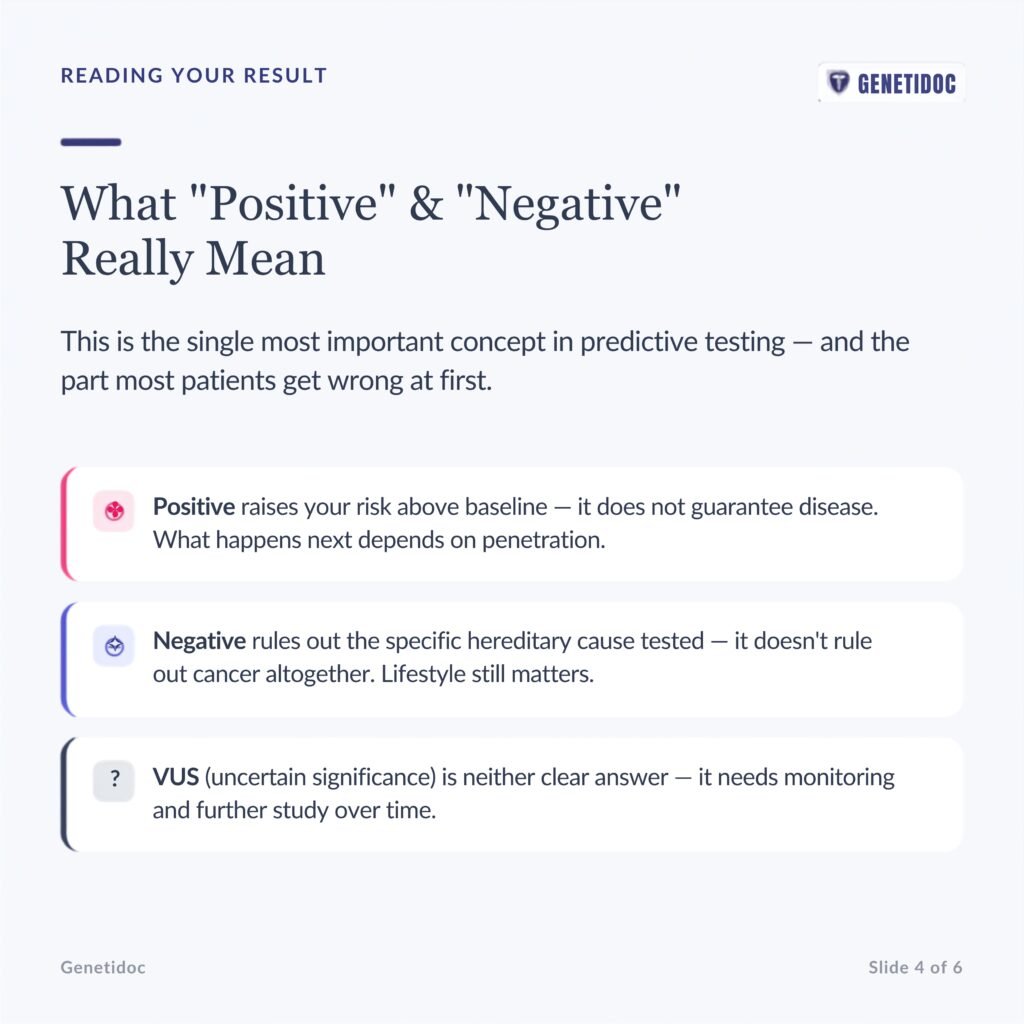
A positive result does not mean you will definitely develop the disease. It means you carry a variant that raises your risk above the general population’s baseline risk. Whether that risk becomes disease depends on penetrance — how many people who carry a given variant actually go on to develop the condition. Some carriers of the very same variant never develop the disease at all.
During pre-test counseling, Team Genetidoc walks patients through the actual penetrance figures for the specific variant found — not just “you’re at risk,” but concretely, how many carriers of that exact variant tend to manifest disease over their lifetime. That number changes what enhanced screening looks like, and it changes how a patient should feel about the result.
The opposite misconception is just as common: patients read a negative result as “I will never get cancer.” That isn’t accurate either. Cancer risk isn’t determined by genetics alone — lifestyle factors such as smoking, and other environmental or health-related exposures, still contribute. A negative genetic result rules out the specific hereditary cause the family carries; it doesn’t rule out cancer altogether.
How Patients React to Different Results
| Result | Common Reaction | What Counseling Focuses On |
| Positive | Eagerness to know next steps | Surveillance plan, cascade testing for relatives |
| Negative | Relief | Clarifying that the majority — not all — known genetic causes have been ruled out |
| VUS (uncertain significance) | Confusion | Answering every question in detail until the uncertainty itself is understood |
Real Patient Stories From Genetidoc
The following are anonymized, composite examples shared by Team Genetidoc to illustrate how predictive testing plays out in real cases. No identifying details are included.
Case 1: A Daughter’s Relief Through Cascade Testing
A family came to Genetidoc with multiple relatives affected by breast cancer. The mother, who had been diagnosed with breast cancer, was tested first. The result showed a BRCA1 variant — one that Team Genetidoc has identified as a recurring variant among patients of Maldivian descent in their caseload. Since the mother tested positive, cascade testing was offered to her daughter, who had come in worried about her own risk.
The daughter’s result came back negative for the family’s specific variant. With proper counseling, she and her family understood exactly what that meant: her personal risk tied to that inherited variant was ruled out, meaningfully easing her anxiety.
Case 2: An Unexpected Finding With No Family History At All
A patient with no family history of cancer underwent a routine health checkup, which incidentally detected a renal mass. A partial nephrectomy was performed, and the biopsy confirmed clear cell renal cell carcinoma. To rule out an inherited cancer predisposition, genetic testing was carried out — and it revealed a mutation in the VHL gene, associated with a hereditary cancer syndrome that neither the patient nor the family had any reason to expect.
This finding changed the patient’s care plan directly: instead of routine follow-up, the patient is now on a structured surveillance schedule designed to catch and treat any future VHL-related tumors early — before they become dangerous.
What Happens If You Test Positive?
A positive result for an actionable variant, in a patient with no current disease, sets several things in motion:
- A structured surveillance plan based on established clinical guidelines (such as NCCN criteria) for that specific gene and syndrome
- Cascade testing offered to first-degree relatives, since they now share an elevated risk of carrying the same variant
- Clear counseling on what carrier status means practically — what changes starting now, in terms of screening frequency, specialist referrals, and monitoring
The goal is always the same: turn a risk finding into a concrete, manageable plan — not a source of open-ended fear.
DTC Wellness Kits vs. Clinical-Grade Genetic Testing
Direct-to-consumer (DTC) genetic kits have become widely available, and a small but important group of patients arrive at Genetidoc holding a DTC report they don’t know how to interpret.
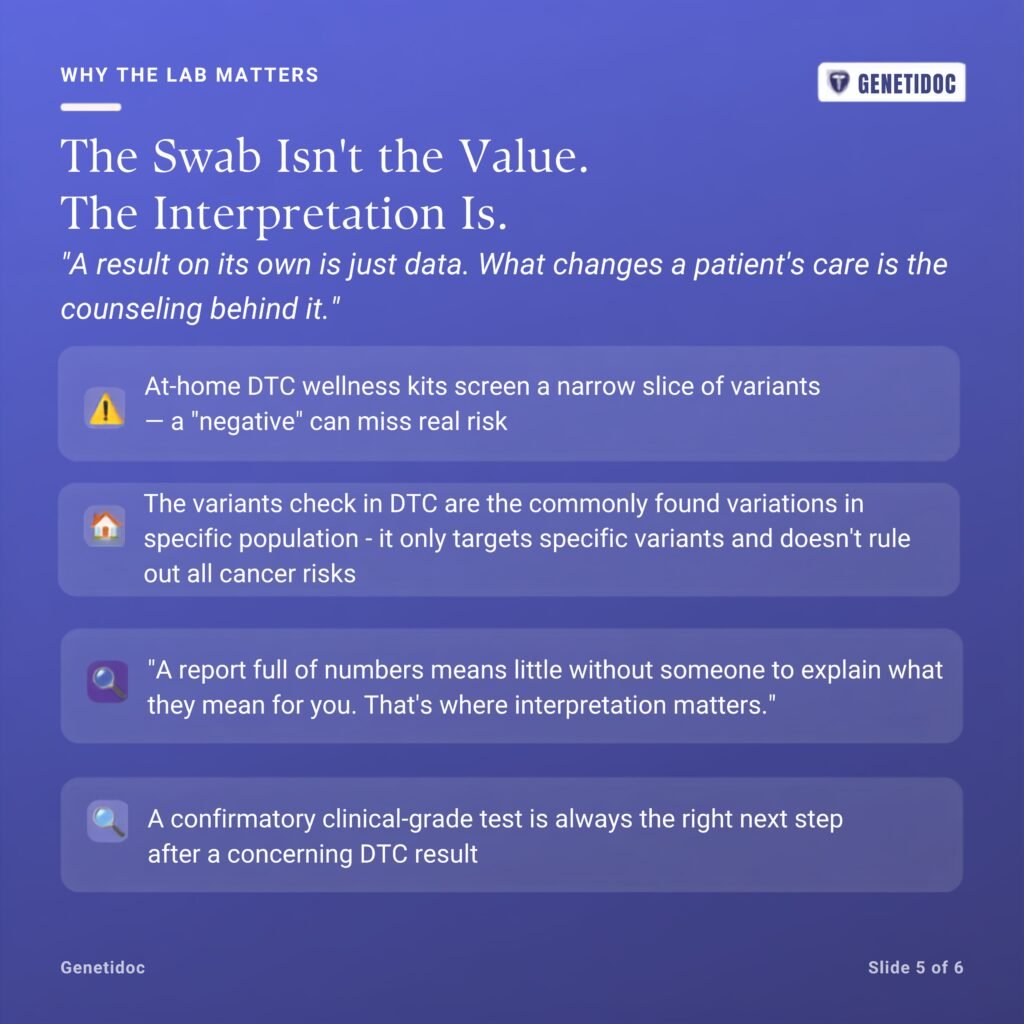
Team Genetidoc’s approach in these cases starts with education: explaining exactly what the DTC kit tested for, and just as importantly, what it likely didn’t test for. Consumer wellness kits typically screen a narrow slice of known variants and are not built or validated to the same clinical standard as diagnostic-grade panels — meaning a “negative” DTC result can miss real risk.
- If the DTC report flags a high-risk variant, Genetidoc proceeds with confirmatory clinical-grade testing before any decisions are made.
- If the DTC result is negative but there’s still a genuine clinical concern (family history, personal symptoms), the patient is offered the appropriate clinical panel for their actual concern — rather than relying on the DTC result as reassurance.
This is a good moment to underline something true across all genetic testing, not just DTC kits: the value of a genetic test isn’t the swab or the sequencing — it’s the interpretation. The same raw variant can mean something very different depending on the quality of the lab’s classification pipeline, the counseling given alongside it, and how carefully it’s correlated with the patient’s actual clinical picture. This is why predictive testing is best done through a genetic clinic that pairs laboratory testing with clinical support, not a lab report alone.
Cost and Turnaround Time in India
Pricing for predictive genetic testing varies significantly based on scope — a single-gene test costs far less than a comprehensive multi-gene panel, and appropriately so, since they answer very different clinical questions.
| Test Type | Approx. Cost Range (INR) | Typical Turnaround |
| Targeted / cascade testing (known family variant) | Lower tier, from around ₹10,000 | ~1 week |
| Comprehensive multi-syndrome panel | Up to ₹50,000–60,000 | 3–4 weeks |
Exact pricing depends on the scope and depth of the panel chosen. Speak with Genetidoc directly for a quote specific to your situation.
Access Gaps in Kerala and South India
India faces a significant shortage of trained genetic counselors relative to its population — the genetic counseling profession in India was only formally established in 2007, and as of recent estimates, only around 76 certified genetic counselors serve a population of over 1.3 billion. Access to genetic counseling and testing remains concentrated in urban tertiary centres, limited further by cost, infrastructure, and workforce shortages, with rural and underserved populations facing the largest gaps.
Kerala presents an interesting pattern within this national picture. Cancer symptom awareness in the state is generally high, but a state-level survey found that specific knowledge about preventive measures — including genetic testing — lags behind, and actual screening uptake remains low even where awareness exists. In other words, the gap in Kerala isn’t primarily that people haven’t heard of cancer risk — it’s that awareness hasn’t yet translated into people knowing that genetic risk assessment is an option available to them, or acting on it.
Insurance, Employment, and Family Considerations
Beyond the medical questions, patients often worry about practical consequences of testing. Here’s what typically comes up in counseling:
- Insurance: Coverage for predictive genetic testing varies by policy and insurer. Patients are advised to check directly with their insurance provider before testing, since blanket assumptions about coverage aren’t reliable.
- Employment: In most cases, genetic test results do not affect a person’s work environment, and legal protections exist against this kind of discrimination.
- Family dynamics: This is the most variable factor of the three. Some families respond to a result with support and openness; others find it harder to process or accept, particularly in joint-family settings where a result can affect how relatives are viewed or treated. Genetic counseling addresses this directly, rather than leaving patients to navigate family conversations alone.
Why the Laboratory You Choose Matters
“A genetic test result on its own is just data. What makes it useful — what actually changes a patient’s care — is the interpretation behind it, and the counseling that helps a family understand what to do next. That’s the part that can’t be shortcut.”
— Dr. Roshan Daniel, Founder, Genetidoc Genetic Clinic
Low-cost genetic testing without clinical support is a growing concern globally, and predictive testing is a category where the risk of getting it wrong is especially high. A variant classified incorrectly, or a result delivered without proper counseling, can lead to a patient either living with unnecessary fear or — just as dangerously — false reassurance. This is why Genetidoc pairs NABL/CAP accredited laboratory testing with genetic counseling built into every result, rather than treating the lab report as the end of the process.
Frequently Asked Questions
- Do I need a cancer diagnosis to get genetic testing?
No. Predictive genetic testing is specifically designed for healthy people who want to understand their future risk, often because of family history or general concern.
- What is the difference between predictive and diagnostic genetic testing?
Predictive testing is done before any disease symptoms appear, to assess future risk. Diagnostic testing is done after symptoms or a diagnosis, to find a genetic cause for what’s already happening.
- Does a positive predictive test mean I will definitely get cancer?
No. A positive result means your risk is higher than the general population’s, not that disease is guaranteed. Whether it develops depends on penetrance and other factors.
- Does a negative result mean I’m completely safe?
It means the specific hereditary cause tested for has been ruled out. It doesn’t eliminate all cancer risk, since lifestyle and environmental factors also play a role.
- What is a VUS (variant of uncertain significance)?
A VUS is a gene change found during testing whose effect on disease risk isn’t yet clearly established. It’s neither a clear “positive” nor a clear “negative,” and usually needs further monitoring or family studies over time.
- Are DTC (direct-to-consumer) genetic kits the same as clinical genetic testing?
No. DTC wellness kits typically screen a narrow set of variants and aren’t validated to clinical diagnostic standards. A concerning DTC result should be confirmed with clinical-grade testing before acting on it.
- How much does predictive genetic testing cost in India?
Costs vary by scope — targeted single-variant testing starts lower, while comprehensive multi-gene panels cost more, reflecting the depth of testing involved. Speak with a genetic clinic for pricing specific to your situation.
- How long does it take to get results?
Turnaround depends on test type: roughly a week for targeted/cascade testing, and three to four weeks for a comprehensive panel.
- Will a genetic test affect my insurance or job?
Employment is generally protected by law regardless of genetic test results. Insurance coverage for testing itself varies by policy, so it’s worth checking directly with your insurer.
- If I test positive, does that mean my children or siblings need testing too?
Often, yes — this is called cascade testing. First-degree relatives of someone with a positive actionable result are typically offered testing, since they share an elevated risk of carrying the same variant.
- I have no family history of cancer at all — should I still consider testing?
Possibly. Small families sometimes don’t have enough relatives to reveal a hereditary pattern, and incidental findings do happen. A risk-assessment counseling conversation can help you decide, even without a strong family history.
Key Takeaways
- Predictive genetic testing is for healthy people assessing future risk — not a diagnostic tool for existing symptoms.
- A positive result raises your risk; it does not guarantee disease. A negative result rules out a specific cause; it doesn’t guarantee safety.
- The right test (single-gene, panel, or comprehensive) depends on how specific your family history pattern is — bigger isn’t always better.
- DTC wellness kits are not a substitute for clinical-grade testing, especially when results are concerning.
- Interpretation and genetic counseling — not the lab swab itself — are what turn a result into a usable care plan.
A result doesn’t decide your future — it decides what to watch for. Whatever we find, there’s always a next step that helps you.
Wondering if your family history warrants a closer look?
A genetic counseling session can help you understand your actual risk level — before you decide whether testing is the right next step.
Book your free consultation with best free genetics clinic in India.
Related Reading on the Genetidoc Blog
- Breast Cancer Before 50: When Should You Consider Genetic Testing?
- Is It Genetic? A Parent’s Guide to Recognising Signs Worth Investigating
- Undiagnosed for Years: Why Rare Disease Patients in India Wait
- Still have questions you can ask directly in our cancer forum
- Still have questions ask in our FAQ forum
References
- National Comprehensive Cancer Network (NCCN) Guidelines for Genetic/Familial High-Risk Assessment
- Ulhaq E, et al. Narrative review on genetic counseling for hereditary cancers. Cancer Res Stat Treat 2023.
- Abacan M, et al. The global state of the genetic counseling profession. Eur J Hum Genet 2019.
- ClinGen — Clinical Genome Resource, variant classification standards
- American College of Medical Genetics and Genomics (ACMG) guidance on genetic testing and counseling
This article is for educational purposes and does not replace individualized medical advice. Speak with a qualified genetic counselor or clinical geneticist to discuss your personal risk.