
Quick Answer
New born screening in India checks a newborn’s blood sample for a limited list of treatable, high-impact conditions — mainly hormonal and metabolic disorders like congenital hypothyroidism, congenital adrenal hyperplasia, and a small set of metabolic diseases. It does not test a baby’s DNA, and it does not screen for most genetic conditions, including spinal muscular atrophy (SMA), most inherited hearing loss, and many inherited cardiac conditions. A “normal” report means the baby is negative for the specific conditions on that panel — not that the baby has no genetic conditions at all.
Every new parent remembers the newborn screening heel prick. A nurse pricks the baby’s heel, collects a few drops of blood on a card, and a few days later, a report arrives. For most families, that report says “normal,” everyone breathes a sigh of relief, and life moves on.
But here’s what almost nobody explains clearly at the time: a normal newborn screening report does not mean your baby has no genetic conditions. It means your baby tested negative for a specific, limited list of conditions — usually somewhere between 6 and 50, depending on which panel was used. Thousands of other genetic conditions were never checked at all, because newborn screening was never designed to check for them.
This is one of the most common points of confusion the clinical team at Genetidoc sees. Many parents read a normal newborn screening report as proof that their child doesn’t have any diseases, rather than understanding it as a negative result for a specific list of conditions that were tested. Newborn screening is not a definitive diagnosis — it’s an estimate of risk. If something comes back abnormal, or if something is missed because it simply wasn’t on the panel, that doesn’t mean the system failed. It means the test did exactly what it was designed to do — no more, no less.
This article walks through exactly what newborn screening tests for in India — through both government and private programs — what it deliberately leaves out, why it’s built that way, and when a family should consider genetic testing that goes beyond the standard panel.
Newborn Screening vs. Genetic Testing: They Are Not the Same Thing
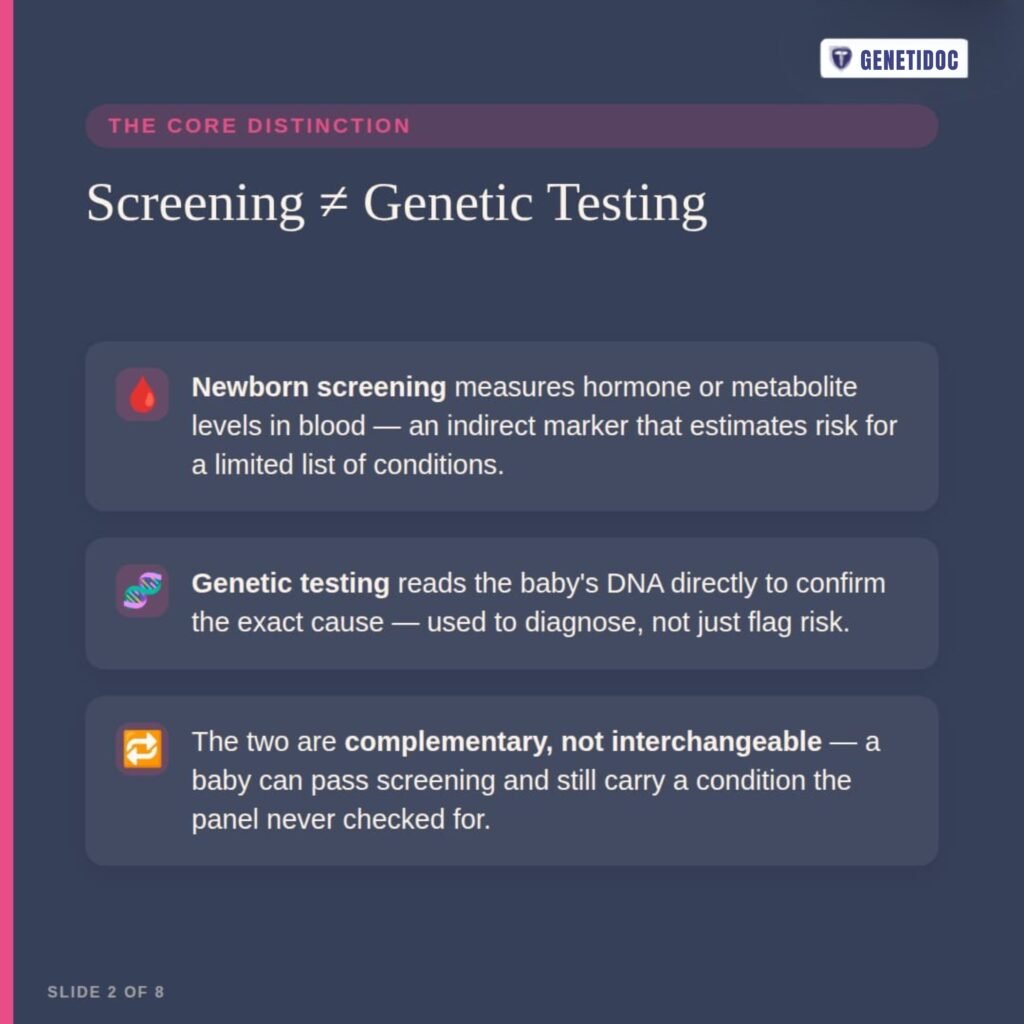
Newborn screening is a blood-based test that measures biochemical or hormonal levels in a baby’s blood — for example, TSH (thyroid-stimulating hormone) for thyroid function, or a panel of metabolites measured using a technique called tandem mass spectrometry (MS/MS). These levels act as indirect markers that a baby might have one of a defined list of conditions. It is a screening test, which means it estimates risk — it does not diagnose disease.
Genetic testing looks directly at a baby’s DNA to identify the exact genetic variant causing a condition. It’s used to confirm a diagnosis after an abnormal screen, to investigate a condition that isn’t on the standard panel, or to understand exactly what a variant means for the child’s future health and treatment.
The two are complementary, not interchangeable. A baby can have a completely normal newborn screening report and still be found, years later, to carry a genetic condition that simply was never part of the test.
Why “Normal” Doesn’t Mean “No Genetic Conditions”
It’s not uncommon for genetic clinics to see patients present later in life — sometimes as older children, sometimes as adults — with a suspected genetic condition, only for the family to discover that the condition was never something newborn screening could have caught in the first place. Not because the test was faulty. Not because of a lab error. Simply because the condition wasn’t on the panel used at the time.
This is one of the hardest things for families to hear, and one of the most important things a genetics team can explain clearly: newborn screening has a defined scope, and that scope is intentional.
Why Newborn Screening Panels Are Built the Way They Are
Newborn screening programs anywhere in the world — India included — are not designed to catch every possible genetic condition. They’re built around a specific, deliberate principle: a condition is included on a screening panel only if two things are true.
- Early detection changes the outcome. There has to be an effective treatment or management strategy that works better when started early — ideally in the first days or weeks of life.
- The condition occurs often enough in the population to justify testing every baby, rather than only babies with a known risk factor.
This logic traces back to internationally recognized public health screening criteria (the Wilson-Jungner principles), and it explains something parents often find counterintuitive: a rare, severe genetic condition that currently has no effective treatment is often deliberately left off standard newborn screening panels — not because it isn’t serious, but because a screening result the family can’t act on doesn’t serve the purpose screening is meant to serve.
This is exactly why a condition like severe combined immunodeficiency or congenital hypothyroidism, both highly treatable if caught early, made it onto screening panels internationally, while many complex genetic syndromes without a clear early intervention have not.
What Government Newborn Screening Covers in Kerala
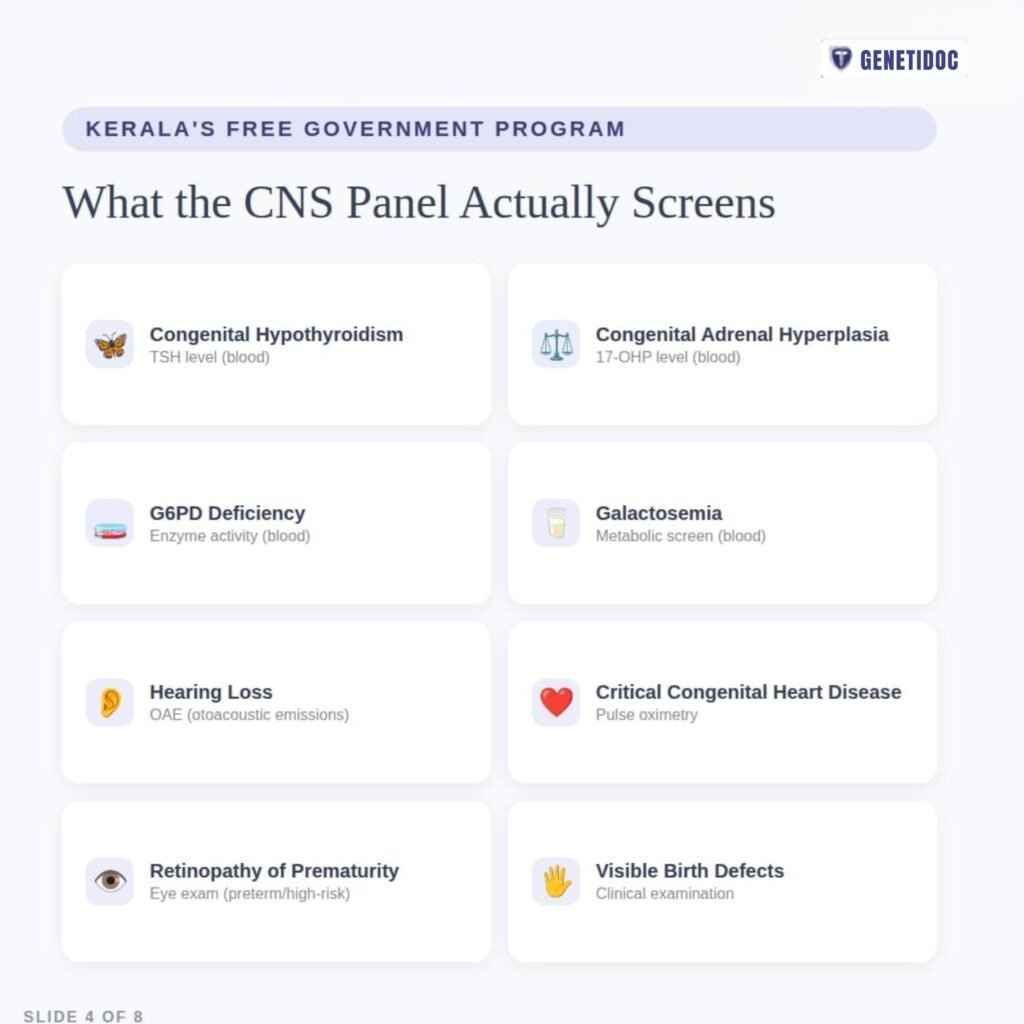
Kerala was the first state in India to pilot a public newborn screening program, and it remains one of the most advanced in the country through its Comprehensive Newborn Screening (CNS) initiative. Every baby born in a public health facility in Kerala is eligible for screening covering the following:
Other Indian states run their own public screening initiatives too — Chandigarh and Goa have long-running government programs, and Punjab also offers newborn and genetic screening services through its state health system, alongside dedicated thalassemia screening and prevention efforts given the state’s higher regional burden of the condition. Program scope and the exact conditions covered vary by state, so it’s worth checking with your local government hospital for specifics.
| Condition | Method
|
| Congenital Hypothyroidism | TSH level (blood) |
| Congenital Adrenal Hyperplasia | 17-OHP level (blood) |
| G6PD Deficiency | Enzyme activity (blood) |
| Galactosemia | Metabolic screen (blood) |
| Hearing Loss | OAE (otoacoustic emissions) |
| Critical Congenital Heart Disease | Pulse oximetry |
| Retinopathy of Prematurity (preterm/high-risk babies) | Eye examination |
| Visible Birth Defects (e.g. clubfoot, cleft lip/palate) | Clinical examination |
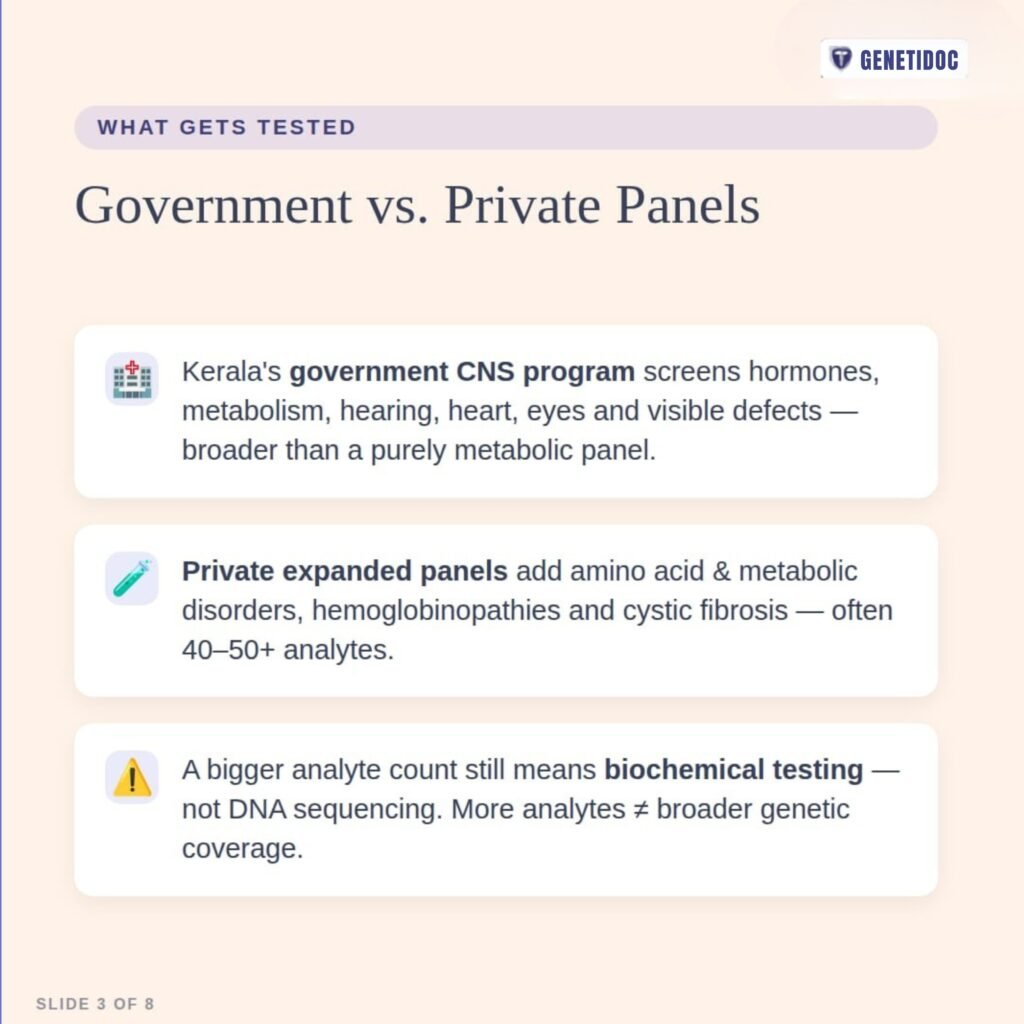
Notice that this list mixes biochemical/hormonal screening with physical and functional screening (hearing, heart, eyes, visible defects) — Kerala’s program is broader than a purely metabolic panel, which is a genuine public health strength. Awareness of the CNS program among the general public, however, remains limited — many families are unaware this comprehensive government program exists, even though access through hospitals is widely available across both public and private facilities.
What Private Expanded Panels Add
Private hospitals and diagnostic labs across Kerala and South India typically offer expanded panels — often marketed by the number of “analytes” or conditions covered (commonly 40 to 50+). These panels add:
- Amino acid and metabolic disorders — including Phenylketonuria (PKU), Maple Syrup Urine Disease (MSUD), and organic acid disorders, using tandem mass spectrometry (MS/MS or TMS)
- Hemoglobinopathies — including Sickle Cell Disease and other hemoglobin variants, which is a routine inclusion in most private panels in Kerala and South India specifically because of regional prevalence (more on this below)
- Cystic Fibrosis and biotinidase deficiency
- Hearing screening — usually OAE or AABR (automated auditory brainstem response), often via the hospital’s ENT department
- Critical Congenital Heart Disease — pulse oximetry, similar to the government program
Government vs. Private Newborn Screening: A Side-by-Side Comparison
| Category | Kerala Government (CNS) | Typical Private Panel
|
| Endocrine | CH, CAH | CH, CAH |
| Metabolic/amino acid | Galactosemia only | PKU, Galactosemia, MSUD, biotinidase deficiency |
| Hemoglobin disorders | Not routinely included | Sickle cell disease, variant traits — routine |
| Enzyme | G6PD deficiency | G6PD deficiency |
| Cystic fibrosis | Not routine | Included |
| Hearing | OAE | OAE/AABR via ENT |
| Heart | Pulse oximetry (CCHD) | Pulse oximetry (CCHD) |
| Vision/prematurity | ROP screening included | Not typically included |
| Structural defects | Clinical exam included | Clinical exam included |
| SMA (neuromuscular) | Not offered | Available at select institutes via QF-PCR/qPCR — not routine |
Interestingly, the government program’s inclusion of ROP screening and structural birth-defect examination means it covers ground that many private “expanded” panels — which lean heavily metabolic — don’t automatically include. Neither program is simply “more complete” than the other; they’re built around different priorities.
Important:
A bigger analyte count on a private panel does not mean broader genetic coverage. Both government and private newborn screening in India are overwhelmingly biochemical or hormonal tests — they measure metabolite and hormone levels, not DNA sequence. A “48-analyte” panel is still checking a defined set of metabolic pathways, not scanning your baby’s genome. Conditions caused by gene mutations that don’t produce a detectable metabolic signature — like most inherited hearing loss genes, SMA, or many inherited cardiac conditions — fall outside what any biochemical panel, however expanded, is built to catch.
What Newborn Screening in India Typically Doesn’t Cover
A few specific gaps come up repeatedly in clinical practice:
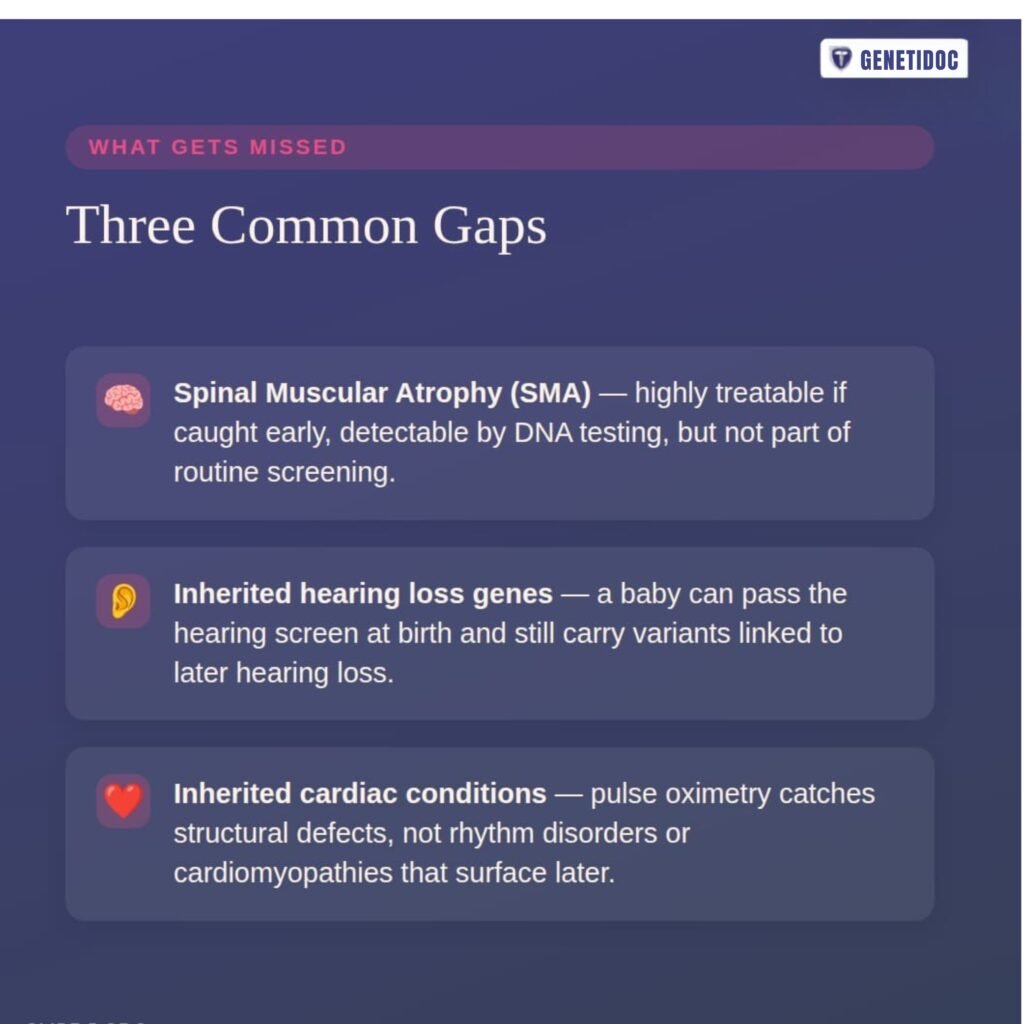
Spinal Muscular Atrophy (SMA)
SMA is a genetic neuromuscular condition that, left undiagnosed, can be life-threatening in its most severe form — but it responds dramatically well to early treatment. It’s detectable through DNA-based testing (QF-PCR or qPCR), and while it is not part of routine government or standard private newborn screening in India, it is available as an add-on test at select institutes. This makes it one of the clearest examples of “screening that exists and works, but isn’t yet standard practice” in the Indian context.
Inherited Hearing Loss Genes
Standard OAE hearing screening checks whether a baby’s ears respond to sound — it does not look at the genetic cause behind hearing loss. This matters especially in Kerala, where a specific mutation in the GJB2 gene (connexin-26, the W24X variant) has been found at a carrier frequency of roughly 3.6% in the general population, one of the highest reported founder-effect frequencies for this mutation anywhere in India. A baby can pass a hearing screen at birth and still carry two copies of this variant relevant to later or progressive hearing loss — this requires targeted genetic testing, not OAE alone, to identify.
Specific Inherited Cardiomyopathies and Cardiac Channelopathies
Pulse oximetry screening catches structural heart problems that affect a baby’s oxygen levels at birth. It does not catch inherited heart rhythm disorders or cardiomyopathies that may not show up until later in infancy or childhood, and that require a family-history-driven or symptom-driven genetic workup.
Conditions Screened Internationally but Not Yet Standard in India
Newborn screening panels evolve over time as treatments improve. In the United States, conditions like SMA, X-linked adrenoleukodystrophy, Pompe disease, and certain mucopolysaccharidoses were added to the national recommended panel only within the last decade, once effective early treatments became available. Some countries, including the UK, are also piloting whole genome or whole exome sequencing for newborns — even asymptomatic ones — as a research and clinical initiative. In India, standard government and most private panels haven’t yet incorporated these additions, though whole genome or whole exome sequencing is available in India as an elective, direct-access option for families who want it, outside of routine newborn screening.
Real Cases: Where Testing Beyond the Standard Panel Mattered
Two anonymized cases from clinical practice illustrate both sides of what genetic testing adds to newborn screening.
Case 1: A False Alarm, Resolved by Genetic Testing
A newborn’s screening report flagged a positive result for biotinidase deficiency, a metabolic condition that can be severe if untreated. Because the condition is serious, treatment with biotin was started immediately as a precaution. Follow-up testing — including a serum biotinidase level and genetic testing — showed the baby was only a carrier, with enzyme activity just over 30%, not an affected child. Once carrier status was confirmed, the family was counselled, and the baby was safely taken off medication. This case shows genetic testing’s value in preventing unnecessary treatment, not just catching missed disease.
Case 2: Early Action Prevented a Metabolic Crisis
A newborn screening result raised suspicion of Maple Syrup Urine Disease (MSUD), a serious metabolic condition. The baby’s diet was changed immediately, based on the screening flag, while exome sequencing was sent to confirm the diagnosis — a result came back in around 12 days, confirming MSUD. The baby is currently on a specialized diet and developing normally. Without that first-week intervention, the likely outcome would have been severe developmental delay or a life-threatening metabolic crisis.
The value of newborn screening isn’t just in catching disease — it’s in acting fast enough that the condition never gets the chance to cause damage. That window is often measured in days, not months.
South India’s Genetic Landscape: Why Regional Data Matters
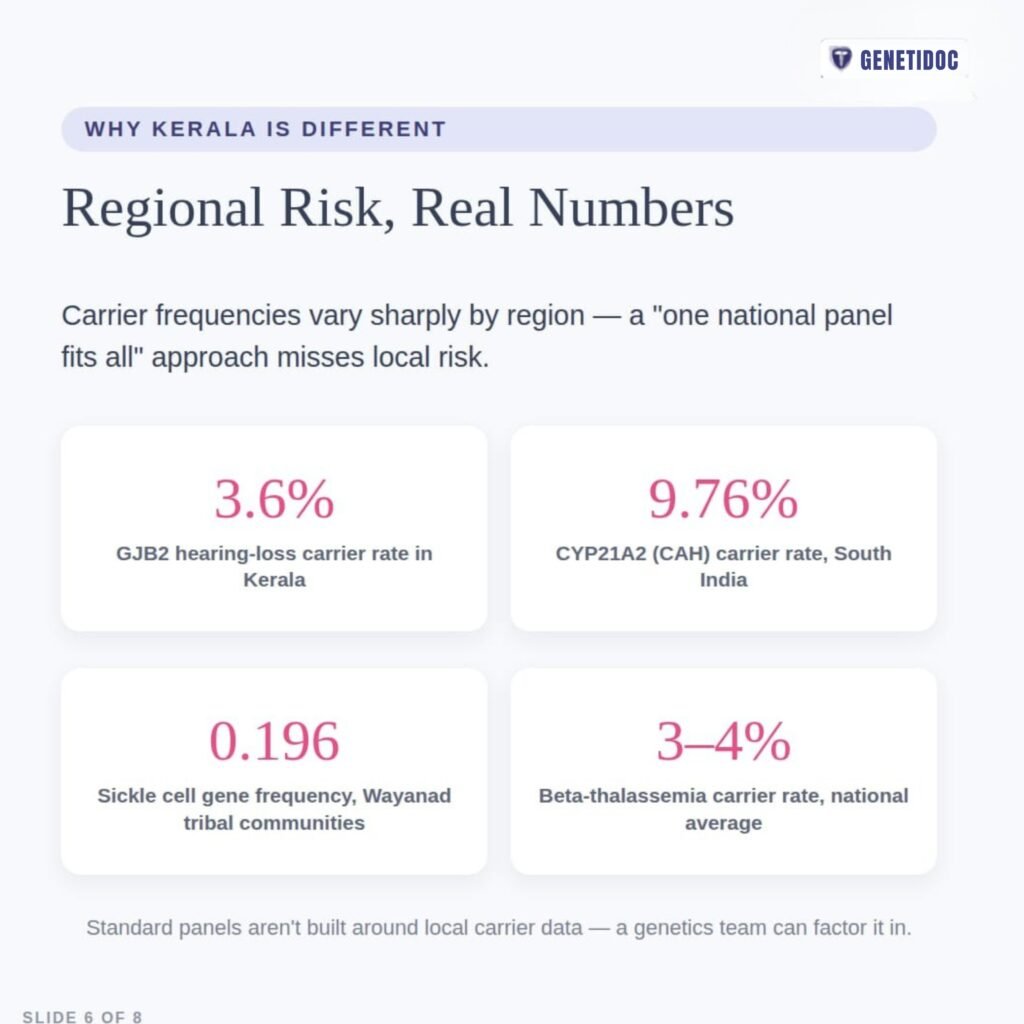
Carrier frequencies for certain inherited conditions vary sharply by region and community across India — which is exactly why a “one national panel fits all” approach misses important local risk patterns.
| Condition | Regional Data Point
|
| GJB2 (connexin-26) hearing loss | ~3.6% carrier frequency for the W24X variant in Kerala’s general population — a well-documented founder effect |
| Congenital Adrenal Hyperplasia (CYP21A2) | ~9.76% carrier frequency across a South Indian cohort — notably higher than many global estimates |
| Sickle Cell Disease (HbS) | Gene frequency as high as 0.196 among Wayanadan Chetti and tribal communities in Wayanad district, Kerala — among the highest reported in the state |
| Beta-Thalassemia | India’s national carrier rate is estimated at roughly 3–4%; Kerala-specific published data is limited, but the condition remains a meaningful concern statewide, consistent with the broader Indian pattern |
These numbers are one of the strongest arguments for genetic counseling before and during pregnancy in families with regional, tribal, or community-specific risk factors — standard newborn screening panels are not built around local carrier data, but a genetics team can factor it in.
What Happens If a Screening Result Comes Back Abnormal
An abnormal newborn screening result understandably alarms parents. Here’s the actual clinical pathway that follows:
- Immediate flagging. Testing labs flag abnormal results and notify the referring hospital or clinician right away — this isn’t left to sit in a routine report queue.
- Treatment starts where relevant, immediately. For time-sensitive conditions, treatment for the suspected condition often begins right away, without waiting for full genetic confirmation — because for many of these conditions, the first days matter most.
- Genetic counseling for the parents. Families are walked through what the abnormal result means, what it does and doesn’t confirm, and what happens next.
- Confirmatory diagnostic testing. This is where genetic testing — not another screening test — establishes an actual diagnosis.
When parents hear their baby’s screen is abnormal, the first wave of fear is almost universal. What helps most is explaining clearly, right away, that the condition flagged is manageable and treatable — that there’s already a known path forward. Once that lands, the anxiety usually eases quickly. What’s harder to correct is the opposite misunderstanding — parents assuming a positive flag means the worst, when in fact most conditions on these panels were chosen specifically because they respond well to early treatment.
When to Consider Genetic Testing Beyond Standard Newborn Screening
Standard newborn screening is enough for most families. But certain situations call for a broader conversation:
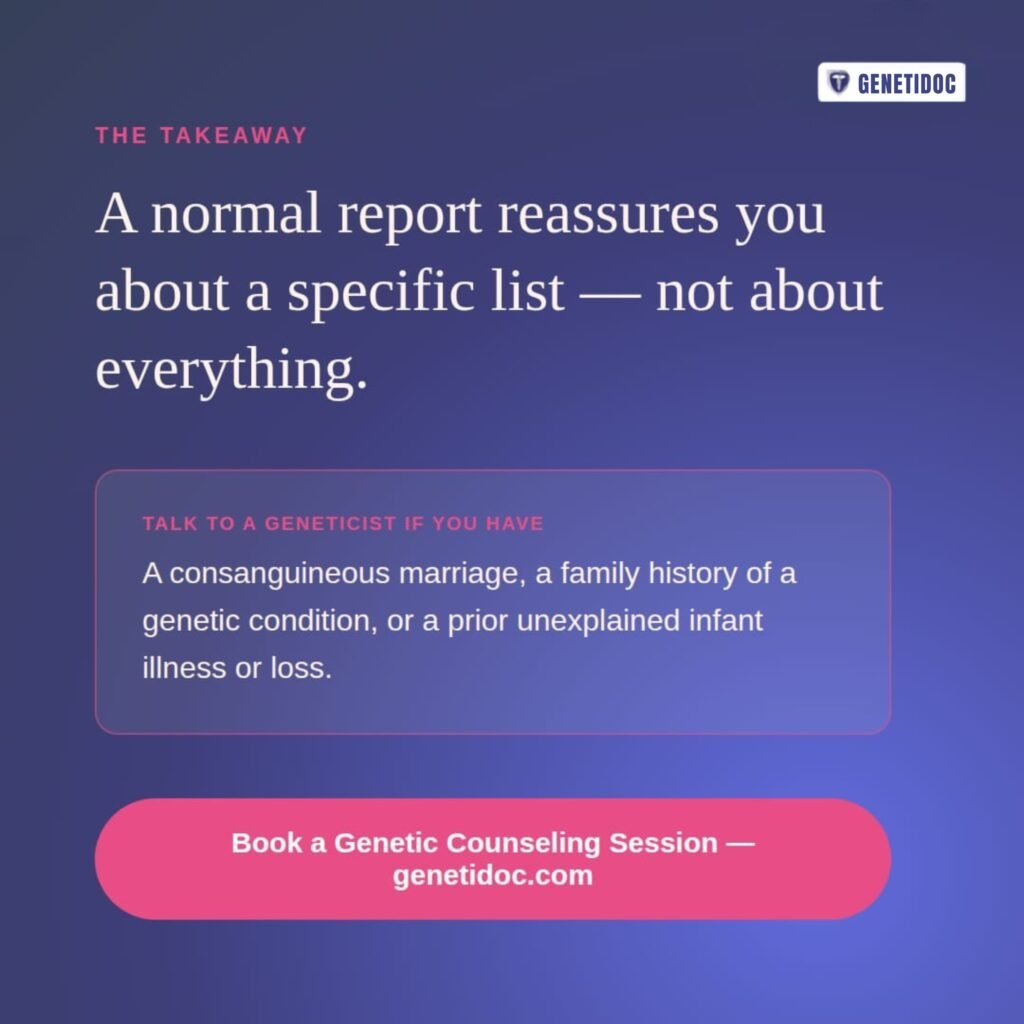
- Consanguineous marriage. Couples who are blood relatives carry a higher chance of both partners carrying the same recessive gene variant. Carrier screening for the couple — done before or during pregnancy — can estimate this risk directly, rather than waiting to see what a limited newborn panel picks up.
- A family history of a genetic condition. Where possible, testing the affected family member first helps identify the exact genetic cause, which then allows precise risk estimation and testing options for the couple and future children.
- A prior unexplained infant illness or loss, without a confirmed diagnosis. This is one of the most emotionally difficult scenarios families bring to a genetics clinic. Without a confirmed diagnosis for what happened to a previous child, that condition can’t be definitively ruled out for a future pregnancy. What can help: reviewing the previous child’s presentation carefully, offering carrier screening to the parents to estimate their own risk, and — if a likely diagnosis is identified before a future pregnancy — offering prenatal testing. If a firm diagnosis isn’t reached beforehand, the family can still check whether the suspected condition happens to fall within the newborn screening panel being used. Newborn screening does not rule out every condition, and families in this situation need to understand its limits clearly, not just its reassurance value.
Choosing Between Government and Private Screening
For most families, the deciding factor isn’t which option is “better” in the abstract — it’s whether the family wants coverage for conditions that fall outside the free government panel, weighed against cost and accessibility.
| Test Type | Typical Turnaround Time
|
| Standard newborn screening (government or basic private) | About 1 week; faster for screen-positive results, which are prioritized |
| Expanded panel (TMS/MS-MS based) | Roughly 3–4 weeks |
| Confirmatory genetic testing (after an abnormal flag) | Variable — can range from about 12 days for targeted testing to longer for broader sequencing; treatment for the flagged condition typically starts before this result arrives |
Private expanded panels in India generally range from around ₹1,500 to ₹15,000 depending on the lab and the number of conditions covered — cost typically scales with panel breadth and the technology used.
Common Mistakes to Avoid
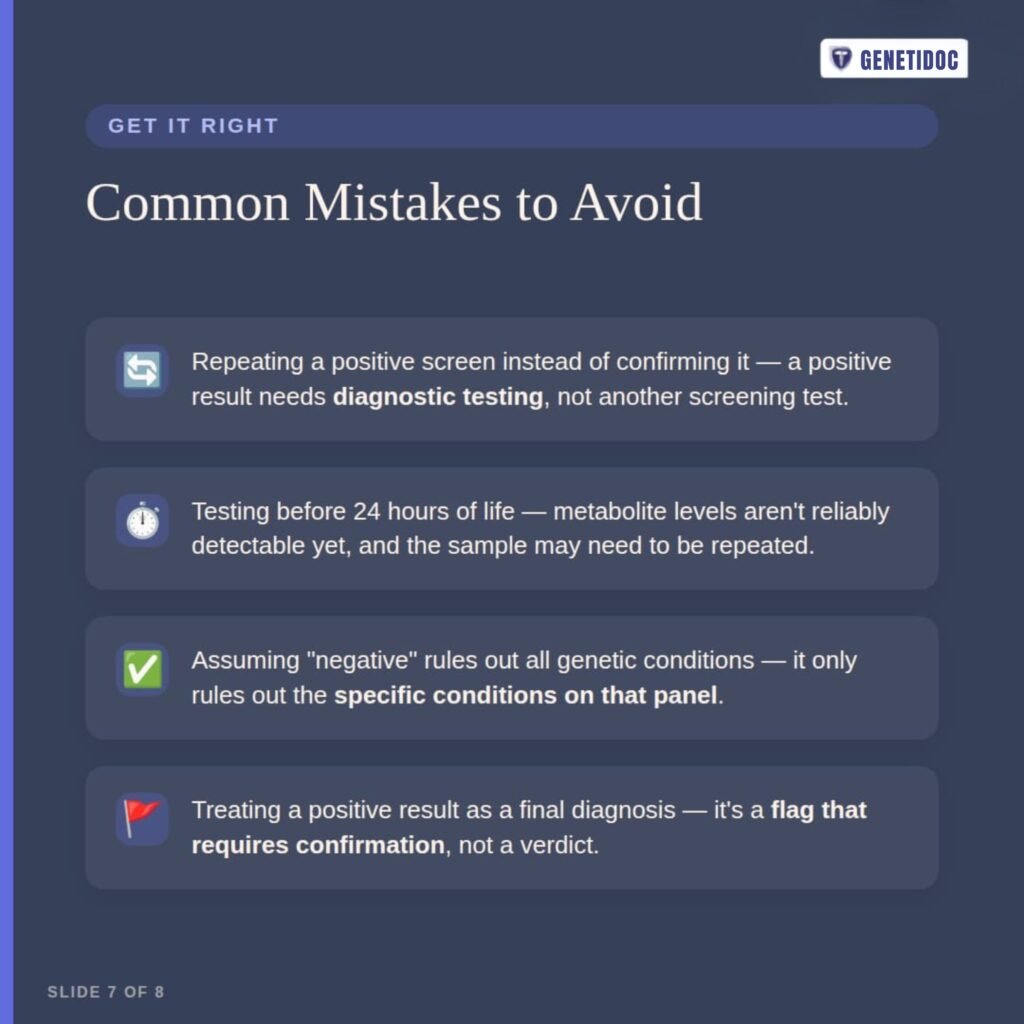
- Repeating a positive screen instead of confirming it. Some referring doctors ask families to simply repeat the screening test a few months later when a result is positive. This defeats the purpose of screening — a positive screen needs confirmatory diagnostic testing, not a second screening test down the line.
- Testing too early. Newborn screening relies on metabolite levels that only become reliably detectable once feeding has started. A sample collected before 24 hours of life can miss certain conditions and often needs to be repeated after the 24-hour mark to be valid.
- Assuming a negative result rules out all genetic conditions. It only rules out the specific conditions on that particular panel.
- Assuming a positive result is a final diagnosis. It’s a flag that requires confirmation — not a verdict.
Why Interpretation and Genetic Counseling Matter
A screening report is only as useful as the explanation that comes with it. Without proper counseling, parents commonly land on one of two mistaken conclusions: that a negative result means their baby will never have any health condition at all, or that a positive result means the outlook is hopeless.
Neither is accurate. Most conditions actually included on a newborn screening panel were chosen specifically because they respond well to early treatment — with proper management and timely intervention, many affected children go on to live near-normal lives. That’s the entire premise behind including them on a population-wide screening panel in the first place.
This is where genetic counseling — explaining not just the result, but what it does and doesn’t mean, and what happens next — makes the difference between a report that reassures or alarms a family accurately, and one that leaves them with the wrong impression entirely.
Book your genetic counseling today.
Have a specific question about your baby’s newborn screening report that isn’t covered here? You can post it on the our rare genetics forum for further guidance.
Frequently Asked Questions
Is newborn screening mandatory in India?
There is no single national mandate requiring newborn screening across all of India. Coverage and requirements vary by state. Kerala has one of the more advanced public programs, offering screening to every baby born in a public health facility through its Comprehensive Newborn Screening initiative.
Is newborn screening free in India?
Yes — in Kerala, standard newborn screening through government facilities is offered free of cost as part of the state’s public health program. Other states with public newborn screening initiatives, including Chandigarh, Goa, and Punjab, also offer free or low-cost screening through government hospitals, though the exact conditions covered and program scope vary by state. Private hospitals and labs charge for both standard and expanded panels, generally ranging from about ₹1,500 to ₹15,000 depending on the panel.
What is the difference between newborn screening and genetic testing?
Newborn screening measures biochemical or hormonal markers in blood to estimate the risk of specific treatable conditions. Genetic testing examines a baby’s DNA directly to identify or confirm the exact genetic cause of a condition. Screening estimates risk; genetic testing confirms diagnosis.
How many conditions does newborn screening cover in India?
It depends on the program. Kerala’s government CNS program covers around 8 categories, including hormonal, metabolic, hearing, cardiac, and structural screening. Private expanded panels commonly cover 40 to 50+ metabolic and genetic analytes, though the exact list varies by lab.
Can newborn screening detect all genetic conditions?
No. Newborn screening covers a defined list of conditions chosen because they are both treatable with early intervention and occur frequently enough to justify population-wide testing. Thousands of other genetic conditions, including SMA, most inherited hearing loss, and many inherited heart conditions, are not part of standard screening panels in India.
What happens if my baby’s newborn screening result is abnormal?
The lab flags the result immediately and notifies your hospital or doctor. For time-sensitive conditions, treatment may start right away, alongside genetic counseling and confirmatory diagnostic testing to establish a definitive diagnosis.
Does newborn screening test for SMA (Spinal Muscular Atrophy)?
Not routinely. SMA is not part of standard government or most private newborn screening panels in India, though it can be tested for using DNA-based methods (QF-PCR/qPCR) as an add-on at select institutes.
Should I get expanded newborn screening if I had a normal government screening?
It depends on your family’s specific risk factors — consanguinity, family history of a genetic condition, or a prior unexplained infant illness are good reasons to discuss expanded or genetic testing with a clinical geneticist, rather than relying on a bigger panel alone.
Why did my baby’s newborn screening not detect a condition diagnosed later?
This usually happens because the condition simply wasn’t included on the screening panel used — not because of a testing error. Newborn screening only checks for a defined, limited list of conditions.
What’s the earliest a newborn screening test can be done?
Generally after 24 hours of life, once feeding has started. Testing done too early can miss conditions because relevant metabolite levels aren’t yet reliably detectable, and may need to be repeated.
How long does it take to get newborn screening results in India?
Standard screening results are typically available within about a week, faster if the result is positive. Expanded metabolic (TMS/MS-MS) panels usually take 3–4 weeks. Confirmatory genetic testing timelines vary depending on the specific test.
Key Takeaways
- Newborn screening tests for a defined, limited list of treatable conditions — it is not a genetic test and does not rule out all genetic conditions.
- Government and private panels differ meaningfully in what they cover; neither is universally more complete than the other.
- Conditions like SMA, inherited hearing loss genes, and many inherited cardiac conditions typically fall outside standard screening in India.
- Kerala and South India carry specific regional genetic risk patterns — from GJB2-related hearing loss to CAH to sickle cell disease in certain communities — that are worth discussing with a genetics specialist.
- Families with consanguinity, a family history of genetic conditions, or a prior unexplained infant illness or loss should have a dedicated conversation about testing beyond the standard panel.
- Interpretation and genetic counseling — not just the raw report — are what turn a screening result into something a family can actually act on.
Wondering What Your Baby’s Newborn Screening Report Really Covers?
If your family has a history of consanguinity, a genetic condition, or an unexplained infant illness, a genetic counseling session can help you understand exactly what standard screening does and doesn’t tell you — and what additional testing options make sense for your situation.
Book a genetic counseling today
Related Reading
- Your Ultrasound Showed a “Soft Marker” — Should You Panic?
- Amniocentesis vs. NIPT: Which Test Do You Actually Need?
- Your Ultrasound Showed a “Soft Marker” — Should You Panic?
- Post all your genetic related doubts here
References
- Joseph J, Joseph AY. Carrier frequency of Connexin26 W24X mutation in the population of Kerala, India. Indian J Otol. 2021;27(4):222–224.
- High frequency of connexin26 (GJB2) mutations associated with nonsyndromic hearing loss in the population of Kerala, India. Int J Pediatr Otorhinolaryngol.
- High carrier frequency of CYP21A2 gene mutations in Southern India — underscoring the need for genetic testing in Congenital Adrenal Hyperplasia. Endocrine. 2024.
- Feroze M, Aravindan K. Sickle cell disease in Wayanad, Kerala: Gene frequencies and disease characteristics. Natl Med J India. 2001;14:267–270.
- Sickle cell disease in tribal populations in India. Indian J Med Res.
- Frequency of β-thalassemia trait and other hemoglobinopathies in northern and western India. National study data.
- National Health Mission (NHM), Government of India. Guidelines on Hemoglobinopathies in India.
- Recommended Uniform Screening Panel (RUSP) updates, 2010–2022, Health Resources and Services Administration (HRSA), USA.
- GeneReviews and ACMG resources on newborn screening principles and Wilson-Jungner screening criteria.
- Government of Kerala public health program documentation on Comprehensive Newborn Screening (CNS).
This article is for educational purposes and does not replace individualized medical advice. Every family’s situation is different — please consult a qualified clinical geneticist or genetic counsellor to discuss your baby’s specific screening results or risk factors.