
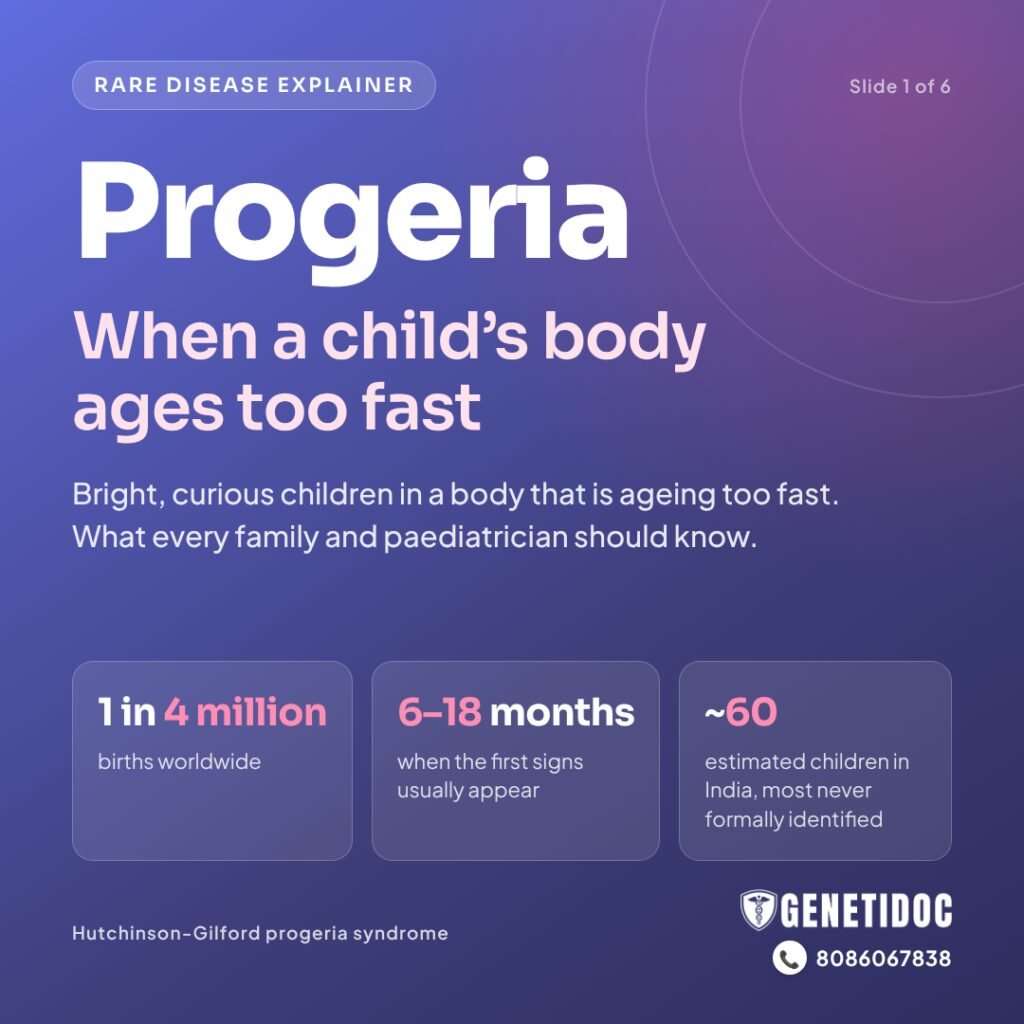
Imagine a toddler who is bright, curious and full of mischief, but who is not growing, is losing their hair, and whose skin is becoming tight and thin. Many parents in this situation spend months being told their child is “just a poor eater” before anyone mentions a genetic cause.
That condition may be progeria. It is one of the rarest genetic conditions in the world. Its name comes from Greek words meaning “prematurely old”.
In this guide, our clinical geneticists explain what progeria is, what causes it and how it is diagnosed. We also cover what treatment is available today, including access in India, and what a diagnosis means for the rest of the family.
Quick answer: What is progeria?Progeria (Hutchinson-Gilford progeria syndrome) is a very rare genetic condition that makes parts of a child’s body age much faster than normal. Babies usually look healthy at birth. Signs such as poor growth, hair loss and tight skin appear in the first two years. It is caused by a change in the LMNA gene, which almost always happens for the first time in the child and is not inherited from the parents. Children with progeria usually have normal intelligence. |
Progeria at a Glance: Key Facts
- How rare is it? About 1 in 4 million births worldwide. About 1 in 20 million people alive today have it.
- What causes it? A single-letter change in the LMNA This change is found in about 90% of children with classic progeria.
- Is it inherited? Almost always no. The change usually happens for the first time in the child.
- When do signs start? Usually between 6 and 18 months of age.
- Does it affect intelligence? Brain development and learning are usually normal.
- What is the main health risk? Hardening of the blood vessels, which can lead to heart attacks and strokes in childhood.
- Is there treatment? A medicine called lonafarnib has been shown to help children live longer. It is not a cure.
- How many children in India? Experts estimate about 60 Indian children have progeria, but most have never been formally identified.
What Is Progeria?
Progeria is a genetic condition in which some parts of the body age at a dramatically fast rate. The medical name is Hutchinson-Gilford progeria syndrome, after the two British doctors who first described it, Jonathan Hutchinson and Hastings Gilford.
It affects boys and girls equally. It is seen in families of every background and every country, including India.
Is progeria the same as normal ageing?
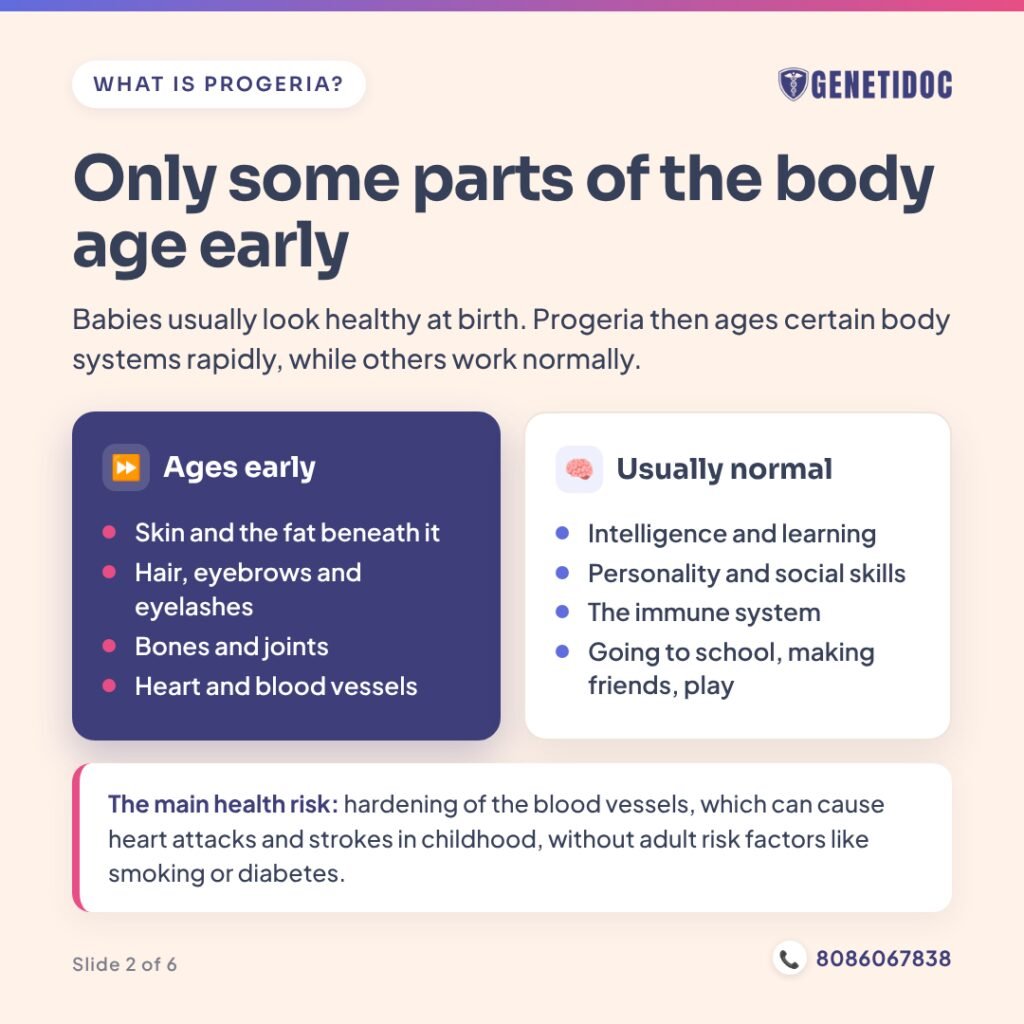
Not exactly. Doctors describe progeria as “segmental” ageing. This means only some parts of the body age early, mainly:
- The skin and the fat layer under the skin
- The hair
- The bones and joints
- The heart and blood vessels
Other systems, including the brain and the immune system, generally work normally. A child with progeria thinks, learns, laughs and makes friends like any other child of their age.
“Children with progeria are bright, curious children living in a body that is ageing too fast. Our job is to protect their heart and brain while letting them be children: at school, with friends and at play.”
— Dr. Roshan Daniel, Clinical Geneticist and Founder, Genetidoc
What Causes Progeria?
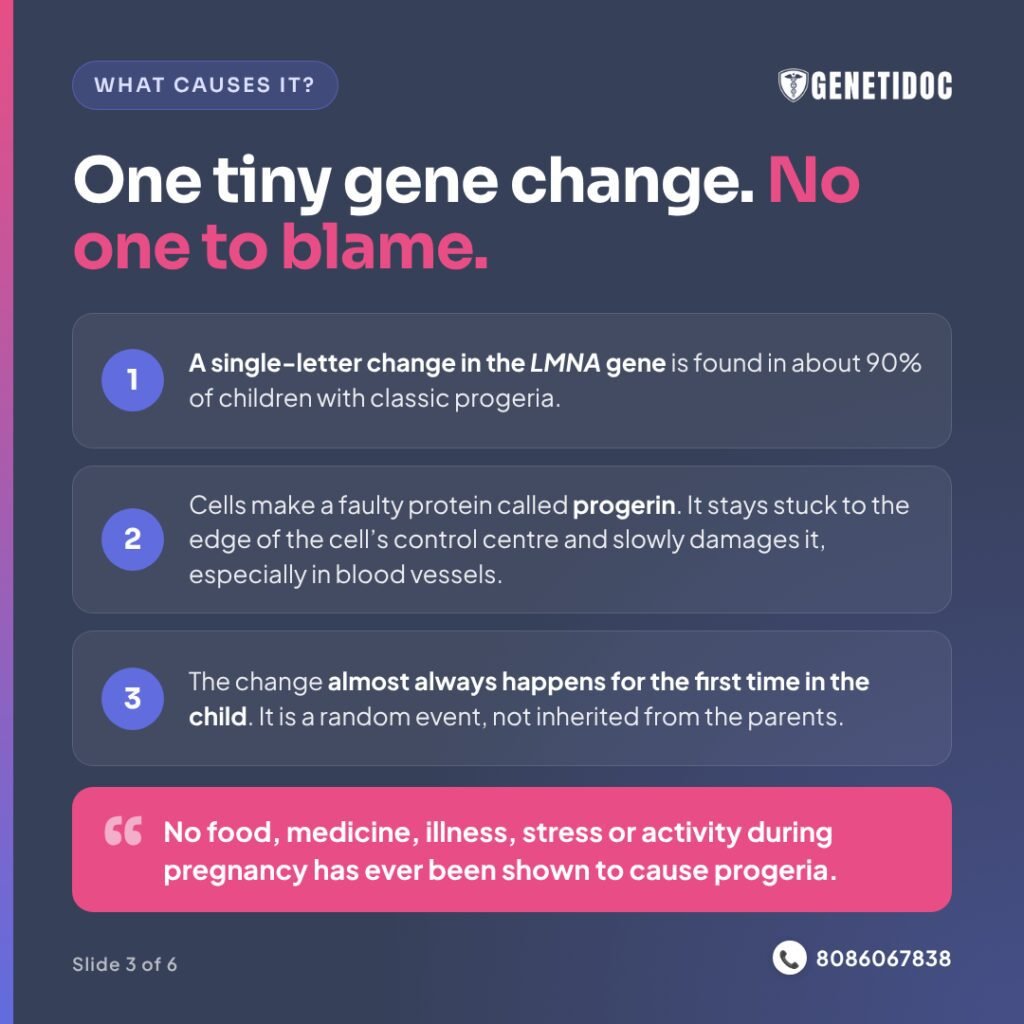
Progeria is caused by a change, called a variant, in a gene named LMNA. This gene carries the instructions for making a protein called lamin A.
Lamin A acts like scaffolding inside the nucleus, the control centre of every cell. It keeps the nucleus strong and well shaped.
How a tiny spelling change causes a big problem
In classic progeria, a single “letter” of the LMNA gene is changed. Doctors write this change as c.1824C>T.
This tiny change causes the cell to cut out a small section of the lamin A instructions. The result is a faulty, shortened protein called progerin.
Progerin keeps a sticky chemical tag (called a farnesyl group) that normal lamin A loses. Because of this tag, progerin stays stuck to the edge of the nucleus. Over time, it damages the cell’s shape and function. Blood vessel cells are especially vulnerable. This is why heart disease and stroke are the main health risks in progeria.
Is progeria inherited from parents?
In almost every case, no. The LMNA change happens for the first time in the child. Doctors call this a de novo change, meaning “new”.
Research shows this new change usually arises in the father’s sperm cell and is linked with older age of the father at conception. However, this is a random event. It is not something any parent can predict, control or prevent.
Did something in pregnancy cause it?
No. No food, medicine, illness, stress or activity during pregnancy has ever been shown to cause progeria.
“Nothing a mother ate, did or felt during pregnancy causes progeria. Parents need to hear that clearly, and often more than once.”
— Dr. Roshan Daniel
Early Signs and Symptoms of Progeria
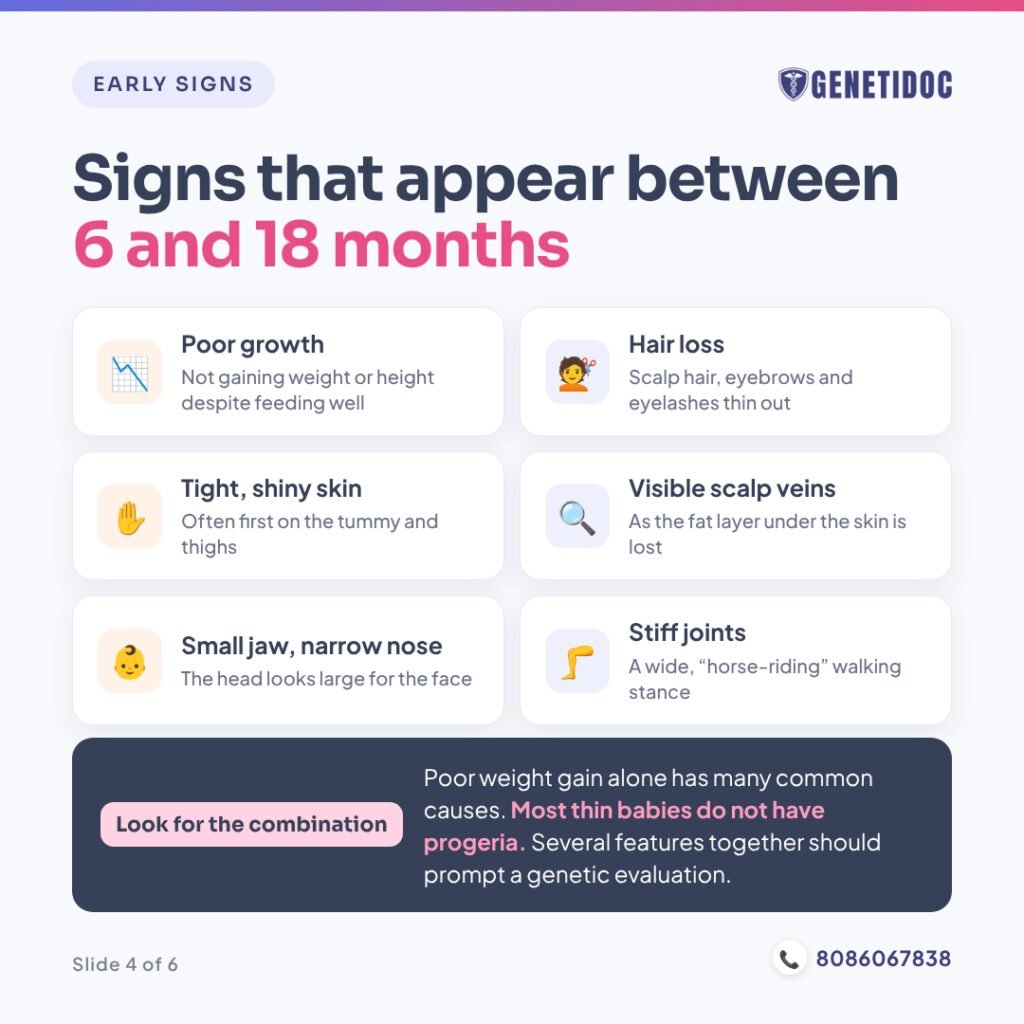
Most babies with progeria look completely healthy at birth. Signs usually begin to appear between 6 and 18 months of age and become clearer over time.
Early signs of progeria in babies and toddlers
- Poor growth despite feeding well: the child stops gaining weight and height as expected.
- Hair loss: scalp hair, eyebrows and eyelashes thin out and fall.
- Tight, hardened or shiny skin: often first on the tummy and thighs.
- Loss of the fat layer under the skin: veins on the scalp become easy to see.
- A small jaw and a narrow, beaked nose: the head looks large compared with the face.
- Late or crowded teeth: baby teeth come in late or grow in an unusual pattern.
- Stiff joints: the child may walk with a wide “horse-riding” stance.
- A thin, high-pitched voice.
- Eyes that do not fully close during sleep.
As children grow older, other features may appear. These include mild hearing loss, hip problems, thin bones and abnormal nails. Puberty often does not develop fully.
What usually stays normal
- Intelligence and learning
- Personality and social skills
- The immune system (fighting infections)
When should parents seek a genetics opinion?
See your paediatrician, and ask about a referral to a clinical geneticist, if your child:
- Is not gaining weight or length even though they eat reasonably well, and
- Has one or more of these: unusual hair loss, tight or thin skin, visible scalp veins, a very small jaw or stiff joints.
Poor weight gain alone has many common causes, and most thin babies do not have progeria. It is the combination of features that should prompt a genetic evaluation.
“If a toddler is not growing despite eating, and is also losing hair or developing tight skin, please think of a genetic evaluation early. An early, accurate diagnosis gives the family time to plan and to access the right care.”
— Dr. Roshan Daniel, with a message for paediatricians
Not Every “Progeria-Like” Child Has Progeria
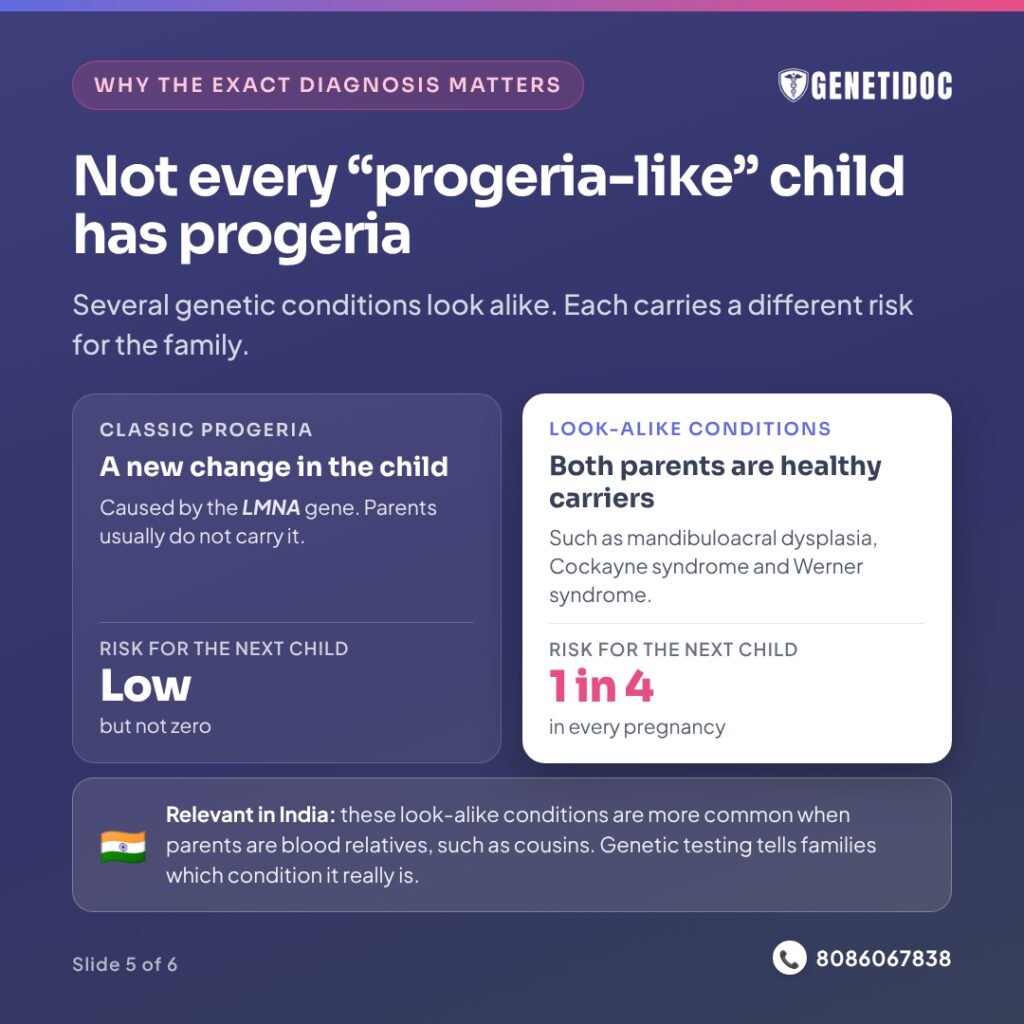
This is one of the most important points in this article. Several different genetic conditions can make a child look older than their age. Doctors call these progeroid syndromes, meaning “progeria-like” conditions.
In the global registry kept by The Progeria Research Foundation, there are 163 people with classic progeria. There are also 87 more people with related “progeroid laminopathies”, which are other conditions linked to the lamin proteins. Beyond these, there are look-alike conditions caused by entirely different genes.
Progeria vs look-alike conditions
| Condition | Usual age signs appear | How it is passed on | Risk for the next child |
| Classic progeria (LMNA) | 6–18 months | Almost always a new change in the child | Low, but not zero |
| Mandibuloacral dysplasia (LMNA or ZMPSTE24) | Childhood | Both parents are healthy carriers | 1 in 4 (25%) in each pregnancy |
| Wiedemann-Rautenstrauch syndrome (POLR3A) | At birth | Both parents are healthy carriers | 1 in 4 (25%) in each pregnancy |
| Cockayne syndrome (ERCC6, ERCC8) | Infancy or childhood | Both parents are healthy carriers | 1 in 4 (25%) in each pregnancy |
| Werner syndrome, “adult progeria” (WRN) | Teens to twenties | Both parents are healthy carriers | 1 in 4 (25%) in each pregnancy |
| Atypical Werner syndrome (LMNA) | Teens to twenties | One changed copy is enough | Depends on whether a parent carries it |
Some children with poor growth and loss of body fat have other genetic conditions, such as congenital lipodystrophy. Others have non-genetic causes such as severe malnutrition. A careful examination and the right test sort these apart.
Why this matters so much in India
Classic progeria is not linked to marriage between relatives. However, many of its look-alike conditions are recessive. This means a child is affected only when they inherit a changed copy of the gene from both parents.
Recessive conditions are more common when parents are blood relatives, such as cousins or an uncle and niece. Such marriages are common in many Indian communities. For these families, the exact diagnosis can change the risk for the next baby from “low” to “1 in 4”.
“When a child looks older than their age, the word ‘progeria’ is where the conversation begins, not where it ends. Different genetic conditions can look similar, and each one carries a different outlook for the child and a different risk for the family’s next pregnancy.”
— Dr. Roshan Daniel
| Illustrative scenario (not a real patient)
A 2-year-old girl is referred with poor growth, thin skin and a small jaw. Her parents are first cousins. A relative who saw her photos says she “looks like she has progeria”. Targeted testing for the classic progeria change is negative. A wider gene panel then finds that she has two changed copies of the ZMPSTE24 gene, one from each parent. This confirms mandibuloacral dysplasia, a different condition. The diagnosis changes her care plan. It also tells her parents that each future pregnancy has a 1 in 4 chance of being affected. With counseling, they learn about options for future pregnancies. Other relatives planning marriages within the family can also choose carrier testing. |
How Is Progeria Diagnosed?
Doctors may suspect progeria from a child’s features. However, international guidance recommends that a genetic test should always accompany a clinical diagnosis.
The diagnosis process, step by step
- Detailed history: growth charts, feeding, development and a three-generation family history, including whether parents are related.
- Clinical examination: a clinical geneticist looks carefully at the skin, hair, face, teeth, joints and growth. Photographs and records can often be reviewed in an online consultation first.
- Choosing the right genetic test: based on how closely the child’s features match classic progeria.
- Sample collection: usually a simple blood sample, which can often be collected from home.
- Expert interpretation: the result is reviewed against the child’s features to make sure it truly explains the picture.
- Post-test genetic counseling: the family learns what the result means for the child’s care, for siblings and for future pregnancies.
Which genetic test is used?
1. Targeted LMNA testing
If a child’s features strongly suggest classic progeria, the laboratory can check for the single c.1824C>T change first. This is the most focused and least expensive option.
2. A progeroid or laminopathy gene panel
If the features are less typical, a panel tests LMNA, ZMPSTE24 and other related genes together. This finds the cause efficiently. It also limits the number of uncertain results.
3. Whole exome sequencing
Whole exome sequencing reads the protein-making parts of about 20,000 genes. It is chosen when the child’s features overlap with many conditions and it is unclear which gene is involved.
How long do results take?
Turnaround times vary between laboratories. As a general guide:
- Single-gene testing: about 3 weeks
- Multi-gene panels: about 3 to 4 weeks
- Whole exome sequencing: about 1 to 2 months
Costs depend on the test chosen. A single-gene test is usually the least expensive, followed by panels, then exome sequencing. Your genetics team can explain the options for your child before testing.
Why the choice of test and laboratory matters
Not every genetic test looks at the same things. For example, some conditions are caused by deleted or duplicated pieces of a gene. Progeria is not one of them: it is caused by tiny spelling changes. That is why sequencing-based tests are the right tool here.
Choosing the wrong test can give a “normal” report that misses the real cause. Choosing an overly broad test without clear clinical reasoning can produce confusing results.
Quality also matters. An accredited laboratory, careful confirmation of findings, and review by a clinical geneticist who has examined the child all reduce the chance of a wrong or misleading result.
“A genetic report is only useful when someone explains what it means for this child and this family. The test gives us a result. Interpretation and counseling turn that result into a plan.”
— Dr. Roshan Daniel
When genetic testing may not be useful
- A thin but otherwise healthy child: a baby who is small but growing steadily along their own curve, with normal skin and hair, usually needs a paediatric assessment, not a progeria test.
- Testing healthy siblings for classic progeria: the condition shows itself clearly in early childhood, so testing a healthy older sibling adds little.
- Direct-to-consumer “ageing” DNA kits: these do not diagnose progeria or related conditions, and should not be used to rule them out.
What a negative result means
A negative result means no reportable change was found in the genes that were tested. It does not always mean the condition is not genetic. If a child’s features strongly suggest a progeroid syndrome and the first test is negative, the next step may be a wider test or a re-analysis of the data later, as scientific knowledge grows.
| Illustrative scenario (not a real patient)
A 15-month-old boy has stopped gaining weight, though he eats well. He is losing his hair, and his skin is becoming tight across his tummy. He is walking, babbling and playing normally. After an online consultation with photographs, the clinical geneticist recommends targeted LMNA testing. A blood sample is collected at home. The result confirms classic progeria. In post-test counseling, his parents learn that the change happened for the first time in him, and that nothing they did caused it. They are connected with a paediatric care team for heart, stroke and growth monitoring. They also receive information about lonafarnib treatment and international support programmes. |
Progeria Life Expectancy and Outlook
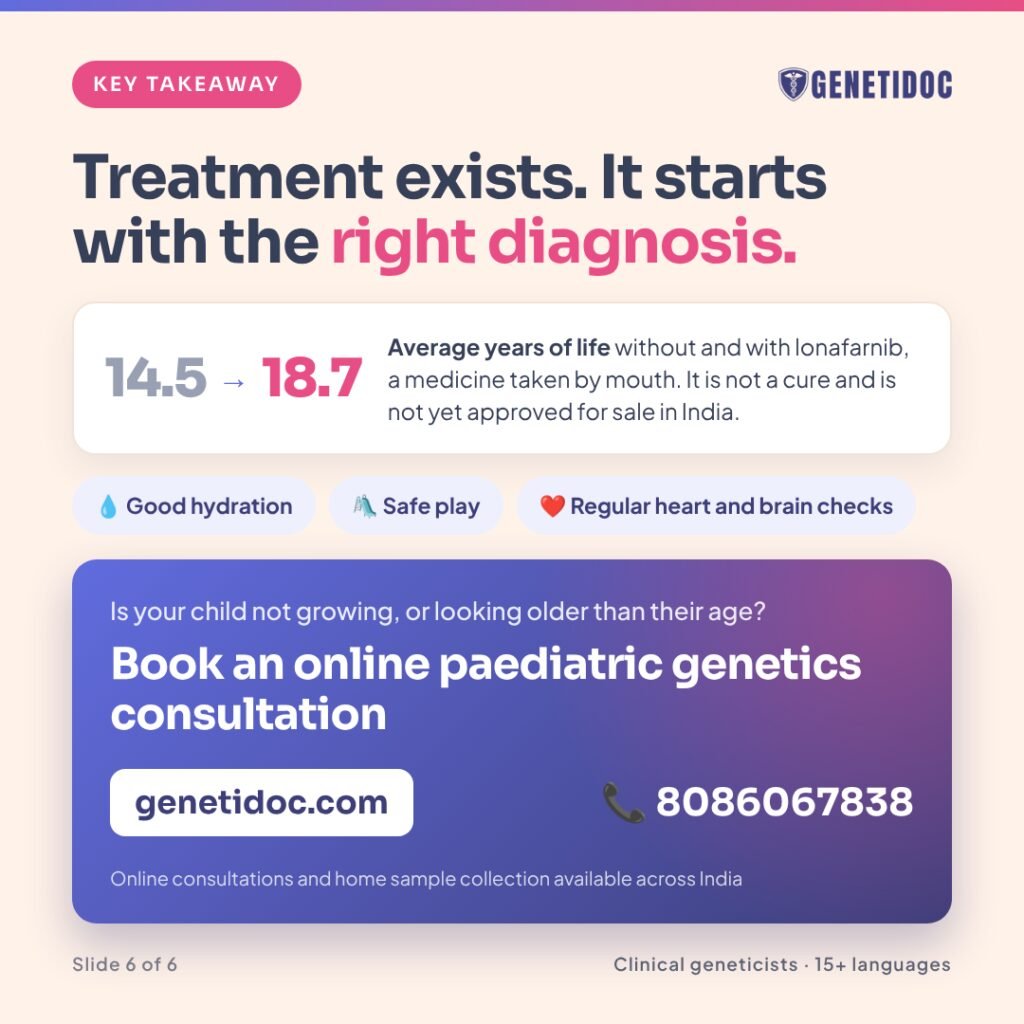
| Quick answer: Without treatment, children with progeria live to an average age of about 14.5 years (range 6 to 20 years). With lonafarnib treatment, average life span is extended to about 18.7 years. Every child is different, and these are averages, not predictions for one child. |
The main cause of serious illness is hardening and narrowing of the arteries (atherosclerosis). This is the same process that causes heart attacks and strokes in older adults, but it happens much earlier in children with progeria.
Importantly, children with progeria develop this blood vessel disease without the usual adult risk factors such as smoking or diabetes. This is why regular heart and brain monitoring is so important.
Is There Treatment for Progeria?
Yes. There is no cure yet, but there is now a treatment that targets the cause of the disease.
Lonafarnib (Zokinvy)
Lonafarnib is a medicine taken by mouth twice a day. It blocks the enzyme that attaches the sticky farnesyl tag to progerin. With less of this “stuck” progerin, cells are damaged more slowly.
In 2020, the United States Food and Drug Administration (FDA) approved lonafarnib under the brand name Zokinvy. It was the first approved treatment for progeria. It is approved for children aged 12 months and older with classic progeria and certain related laminopathies. It has since been approved in the European Union, Great Britain and Japan.
In a published study, children who took lonafarnib had a much lower death rate over about two years than similar untreated children. The most common side effects are stomach upset, such as vomiting, diarrhoea and nausea, along with reduced appetite and tiredness. The child’s doctors monitor these closely.
Can Indian families access lonafarnib?
As far as published sources show, lonafarnib is not yet approved for sale in India. Interestingly, the worldwide rights to the medicine now belong to Sentynl Therapeutics, a United States company owned by the Indian pharmaceutical group Zydus Lifesciences.
Families outside approved countries may be able to seek access through the manufacturer’s access programmes or with support from The Progeria Research Foundation. Your genetics and paediatric team can help you explore these routes. Access rules change, so always check the latest position.
New treatments being studied
- Progerinin: a medicine designed to reduce the harmful effects of progerin. A clinical trial began in 2025 and is studying it in children with progeria.
- Base-editing gene therapy: an advanced form of gene editing that aims to correct the LMNA change itself, so the cell stops making progerin. In mice with progeria, a single injection more than doubled survival. Studies in humans have not yet begun, and large-scale manufacturing partnerships were announced in 2026.
“For the first time, there is a treatment proven to help children with progeria live longer, and gene-editing research is moving forward. That is real hope. But every treatment and every trial depends on one thing first: an accurate genetic diagnosis.”
— Dr. Roshan Daniel
Families interested in research can follow updates on international trials through Genetidoc’s Genetic Trials Forum.
Caring for a Child With Progeria: Practical Advice
Good everyday care makes a real difference to comfort, safety and quality of life. The following points are based on international care guidelines. Your child’s own doctors will tailor them.
The care team
A child with progeria usually needs regular check-ups with several specialists:
- A paediatrician to coordinate care
- A paediatric cardiologist for the heart and blood vessels
- A neurologist, with periodic brain scans to check stroke risk
- An orthopaedic specialist and physiotherapist for the hips and joints
- A dentist, an eye specialist and a hearing specialist
- A dietitian to support growth
- A clinical geneticist and genetic counselor for diagnosis, family counseling and research updates
Everyday care tips for families in India
- Keep your child well hydrated. Stiffened blood vessels handle dehydration poorly. Offer water regularly, especially in Indian summers, during fevers and on long journeys or flights.
- Treat fevers promptly. High fever, dehydration and anaemia all put extra strain on the heart and brain.
- Offer small, frequent, energy-rich meals. A dietitian can help plan meals that support growth.
- Protect the skin. Use sunscreen on all exposed skin, including the head, and a cap outdoors.
- Choose safe play. Avoid trampolines and bouncy castles, which can dislocate the hips. Be careful in crowds with bigger children.
- Use soft, well-cushioned footwear. Loss of fat padding can make the feet sore.
- Follow medicines exactly as advised. Doctors often recommend low-dose aspirin to protect the heart and brain. Never start, stop or change any medicine without your child’s doctor.
- Always inform doctors before any procedure. Children with progeria have a small jaw and mouth, which makes anaesthesia and breathing tubes more difficult. The anaesthetist must know about the diagnosis in advance.
- Support regular schooling. Most children attend mainstream school with simple adaptations, such as a lower chair, easy-to-reach facilities and permission to drink water often.
Warning signs that need emergency care
Go to the nearest hospital immediately if your child has:
- Sudden weakness or numbness of the face, arm or leg
- Sudden trouble speaking, seeing or walking
- A severe headache or a seizure
- Chest pain, fainting or unusual breathlessness
Carry a short summary of your child’s diagnosis and medicines, so emergency doctors understand the condition quickly.
What a Diagnosis Means for the Family
Will our next baby have progeria?
For classic progeria, the chance of it happening again is low, because the change is usually new in the child. However, the chance is not zero.
Rarely, a parent who looks completely healthy carries the change in a small proportion of their egg or sperm cells. This is called germline mosaicism, and it has been reported in published families with progeria. A standard blood test on the parents cannot fully rule it out, because the change may be present only in egg or sperm cells.
Once the exact LMNA change in a child is known, couples planning another pregnancy have options:
- Prenatal diagnosis: testing the baby during pregnancy for the known change, arranged with a fetal medicine specialist.
- Preimplantation genetic testing: testing embryos created through IVF before pregnancy begins, so that only unaffected embryos are transferred.
A genetic counselor explains each option, including its benefits, limits and timing. The decision always belongs to the couple.
What about brothers, sisters and relatives?
- Classic progeria: healthy siblings do not usually need testing. Other relatives are not at increased risk.
- Recessive look-alike conditions: each brother or sister of the affected child has a 2 in 3 chance of being a healthy carrier. Adult siblings and relatives, especially in families where marriages between relatives are common, may wish to have carrier testing before planning their own families.
| Illustrative scenario (not a real patient)
A couple whose first child has classic progeria is planning a second pregnancy. They fear the condition will repeat. In counseling, they learn that the chance is low, but that it cannot be fully excluded. They are given options for testing in pregnancy for the known LMNA change. Understanding both the low risk and the available options helps them plan with confidence rather than fear. |
Common Myths About Progeria
Many Indian families first heard of progeria through the 2009 Hindi film Paa, in which the lead character has the condition. The film raised awareness. Real-life progeria still raises many questions. Here are facts to set some common myths straight.
- Myth: Progeria is contagious. Fact: It is a genetic condition. It cannot spread from one person to another.
- Myth: It happened because of something in pregnancy, a curse or past deeds. Fact: It is caused by a random change in one gene. No one is to blame.
- Myth: The child’s mind ages too. Fact: Intelligence and learning are usually normal.
- Myth: Nothing can be done. Fact: Treatment, careful monitoring and good daily care can extend life and improve its quality.
- Myth: Every child who looks older has progeria. Fact: Several different conditions look similar. Only genetic testing gives the exact diagnosis.
Emotional Support for Families
A diagnosis of progeria can bring grief, guilt, worry about the future and tiredness from explaining the condition to others. Families may also face staring and questions in public, and siblings may feel left out or anxious.
These feelings are normal. It helps to:
- Ask your genetic counselor to help you explain the condition to relatives, teachers and siblings
- Connect with other families through The Progeria Research Foundation’s family network and patient registry
- Reach out to Indian rare disease support organisations, such as the Organization for Rare Diseases India
- Look after your own mental health and accept help when it is offered
How a Clinical Genetics Team Can Help
Progeria and its look-alike conditions are so rare that most doctors may never see a case in their career. A clinical genetics team brings experience in recognising these patterns, choosing the right test and interpreting the result correctly.
At Genetidoc, our team of more than 17 clinical geneticists across over 12 Indian states offers counseling in more than 15 languages. Consultations are usually online, and samples can often be collected from home. In-person assessment is arranged when a physical examination is needed. Testing is done through accredited partner laboratories, and every result is explained through genetic counseling.
Families with questions can also join the conversation on the Genetidoc Rare Disease Forum
Key Takeaways
- Progeria is a very rare genetic condition that makes parts of a child’s body age rapidly, while intelligence usually stays normal.
- It is caused by a change in the LMNA gene that almost always happens for the first time in the child. No parent is to blame.
- Signs usually appear between 6 and 18 months: poor growth despite feeding, hair loss, tight skin and a small jaw.
- Many “progeria-like” children have a different condition. Some of these carry a 1 in 4 risk in every pregnancy, especially when parents are related.
- Genetic testing confirms the exact diagnosis. The right test, a quality laboratory and expert interpretation all matter.
- Lonafarnib helps children live longer, and new treatments are being studied.
- Good daily care, especially hydration, safe play and regular heart and brain monitoring, protects children’s health.
What to do next
- If your child shows several of the early signs, speak to your paediatrician and ask for a referral to a clinical geneticist.
- Bring growth charts, photographs, medical reports and your family history to the consultation.
- If your child already has a diagnosis, ask about lonafarnib access, a monitoring plan and family counseling.
- If you are planning another pregnancy, book genetic counseling before conceiving.
Worried Your Child Is Not Growing, or Looks Older Than Their Age?Genetidoc’s clinical geneticists can review your child’s growth, features and records, recommend the right genetic test, and explain what the result means for your child and your family. This includes clear guidance on future pregnancies.
|
Book a paediatric genetics consultation with Genetidoc
Frequently Asked Questions About Progeria
1. What is progeria in simple words?
Progeria is a very rare genetic condition that makes parts of a child’s body, such as the skin, hair, bones and blood vessels, age much faster than normal. Children usually have normal intelligence.
2. What is the life expectancy of a child with progeria?
Without treatment, the average life expectancy is about 14.5 years. With lonafarnib treatment, the average rises to about 18.7 years. Each child is different.
3. Is progeria inherited from parents?
Almost never. The gene change usually happens for the first time in the child. Very rarely, a healthy parent carries it in some egg or sperm cells, so the chance of it happening again is low but not zero.
4. At what age does progeria start?
Babies usually look healthy at birth. Signs such as poor growth, hair loss and tight skin generally appear between 6 and 18 months of age.
5. Can progeria be cured?
Not yet. Lonafarnib can extend life, and gene-editing treatments that aim to correct the cause are being researched.
6. Which genetic test confirms progeria?
A test of the LMNA gene confirms classic progeria. If the features are not typical, a gene panel or whole exome sequencing may be used to find the exact cause.
7. Can progeria be detected before birth?
Routine pregnancy scans and screening tests do not detect progeria. If a previous child has a known LMNA change, the baby can be tested for that change during pregnancy, or embryos can be tested during IVF.
8. Is lonafarnib available in India?
Lonafarnib is approved in the United States, European Union, Great Britain and Japan. As far as published sources show, it is not yet approved for sale in India. Families may explore access through the manufacturer or The Progeria Research Foundation.
9. Does progeria affect the brain or intelligence?
No. Children with progeria usually have normal intelligence, learning and personality. However, they are at risk of strokes, which is why regular monitoring is important.
10. Can adults get progeria?
Classic progeria begins in early childhood. Werner syndrome, sometimes called “adult progeria”, is a different genetic condition that usually shows signs in the teens or twenties.
11. Is progeria more common in children of consanguineous marriages?
Classic progeria is not. However, several look-alike progeroid conditions are recessive and are more common when parents are related, which is why an exact genetic diagnosis is important.
12. Can children with progeria go to school?
Yes. Most children attend regular school with simple adaptations, such as easy access to water, suitable seating and safe play arrangements.
Related Reading on Genetidoc
- Warfarin Dosing and Genetic Variability: Why the Same Dose Works Differently in Different People
- Hereditary Ataxia: Types, Symptoms and Genetic Testing
- Situs Inversus Explained: Clinical Significance and the Role of Genetic Testing
- Genetics and Obesity: Is It All in the Genes?
- Migraine and Genetics: Is It Hereditary?
References
- Gordon LB, Brown WT, Collins FS. Hutchinson-Gilford Progeria Syndrome. In: Adam MP, et al., editors. GeneReviews. Seattle (WA): University of Washington, Seattle; 2003, updated 19 October 2023.
- Gordon LB, Shappell H, Massaro J, et al. Association of lonafarnib treatment vs no treatment with mortality rate in patients with Hutchinson-Gilford progeria syndrome. JAMA. 2018;319(16):1687–1695.
- Gordon LB, Massaro J, D’Agostino RB Sr, et al. Impact of farnesylation inhibitors on survival in Hutchinson-Gilford progeria syndrome. Circulation. 2014;130(1):27–34.
- Merideth MA, Gordon LB, Clauss S, et al. Phenotype and course of Hutchinson-Gilford progeria syndrome. New England Journal of Medicine. 2008;358(6):592–604.
- Eriksson M, Brown WT, Gordon LB, et al. Recurrent de novo point mutations in lamin A cause Hutchinson-Gilford progeria syndrome. Nature. 2003;423(6937):293–298.
- Koblan LW, Erdos MR, Wilson C, et al. In vivo base editing rescues Hutchinson-Gilford progeria syndrome in mice. Nature. 2021;589(7843):608–614.
- Wuyts W, Biervliet M, Reyniers E, et al. Somatic and gonadal mosaicism in Hutchinson-Gilford progeria. American Journal of Medical Genetics Part A. 2005;135A(1):66–68.
- Dhillon S. Lonafarnib: first approval. Drugs. 2021;81(2):283–289.
- The Progeria Research Foundation. The Progeria Clinical Care Handbook: A Guide for Families and Health Care Providers of Children with Progeria. 2nd edition. 2019.
- The Progeria Research Foundation. Quick Facts, 30 June 2026, and Find the Children registry data, June 2026.
- The Progeria Research Foundation. Fall 2025 Newsletter: Progerinin clinical trial and gene editing updates. September 2025.
Medical disclaimer: This article is for general education and does not replace personal medical advice. Please consult a qualified clinical geneticist or your child’s doctor for advice about your child’s health.