
Maybe your father was diagnosed with Alzheimer’s disease last year. Maybe a wellness DNA kit told you that you carry “the Alzheimer’s gene.” Or maybe you simply read a headline and could not stop thinking about it.
Whichever way you arrived here, you are probably asking one question: Am I going to get Alzheimer’s?
The honest answer is that a single gene called APOE can raise or lower your risk, sometimes a great deal. But for the vast majority of people, it does not decide your future. This guide explains what APOE really does, what each result means, who should consider testing, and what you can do with the information.
Quick Answer: What Is the APOE Gene?
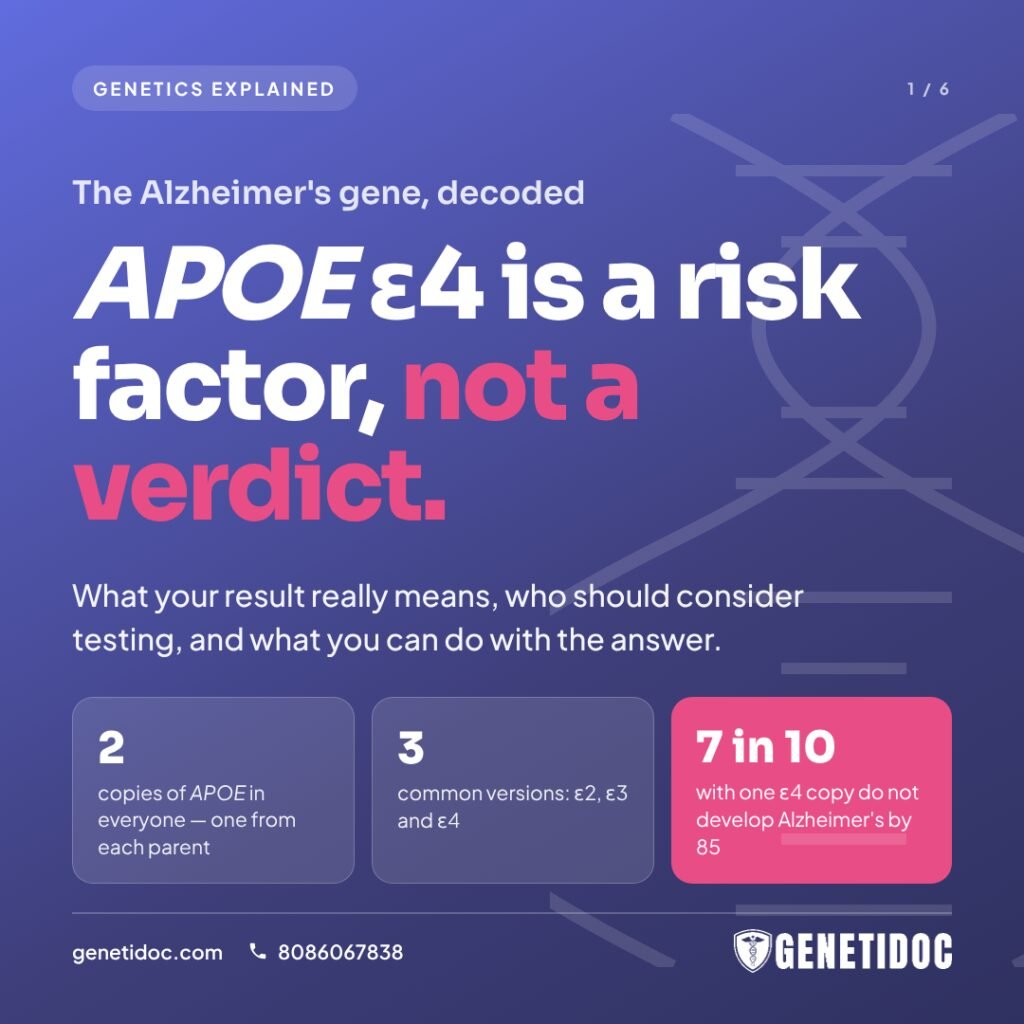
The APOE gene carries the instructions for making apolipoprotein E, a protein that carries fats such as cholesterol around the body and the brain. It comes in three common versions: ε2, ε3 and ε4 (read as “epsilon 2, 3 and 4”). Everyone inherits two copies, one from each parent. Carrying one ε4 copy raises the risk of late-onset Alzheimer’s disease. Carrying two copies raises it more. But ε4 is a risk factor, not a diagnosis. Many people with ε4 never develop Alzheimer’s, and many people without it do.
Why APOE Causes So Much Fear
Alzheimer’s disease is the most common cause of dementia. In India, dementia already affects an estimated 8.8 million people, and that number is projected to rise to nearly 16.9 million by 2036 as our population ages.
Most families have watched someone they love lose their memory. So when people hear that a gene is linked to Alzheimer’s, the fear is understandable.
That fear is often made worse by how the information arrives. A result on a phone app, with no doctor to explain it, can feel like a verdict. It is not.
Misconceptions we hear often
- “I have the Alzheimer’s gene.” Everyone has two copies of the APOE What differs is which versions you carry, and ε4 changes risk rather than deciding the outcome.
- “My children will definitely get it.” Each child inherits only one of your two copies, and even inheriting ε4 does not mean they will develop the disease.
- “My test was negative, so I am safe.” Not carrying ε4 lowers one risk factor. It does not remove all risk.
- “If it is genetic, nothing can be done.” Many of the factors that influence dementia, such as blood pressure, diabetes and hearing loss, can be treated.
- “Forgetting names at 50 means Alzheimer’s is starting.” Occasional forgetfulness is common and has many causes. Persistent or worsening changes deserve a proper medical assessment rather than a genetic test.
To understand why APOE is not a verdict, we need to separate two very different kinds of Alzheimer’s genetics.
Two Very Different Kinds of “Alzheimer’s Genes”
This is the single most important distinction in this article. Patients confuse these two groups all the time.
1. Genes that directly cause Alzheimer’s (rare)
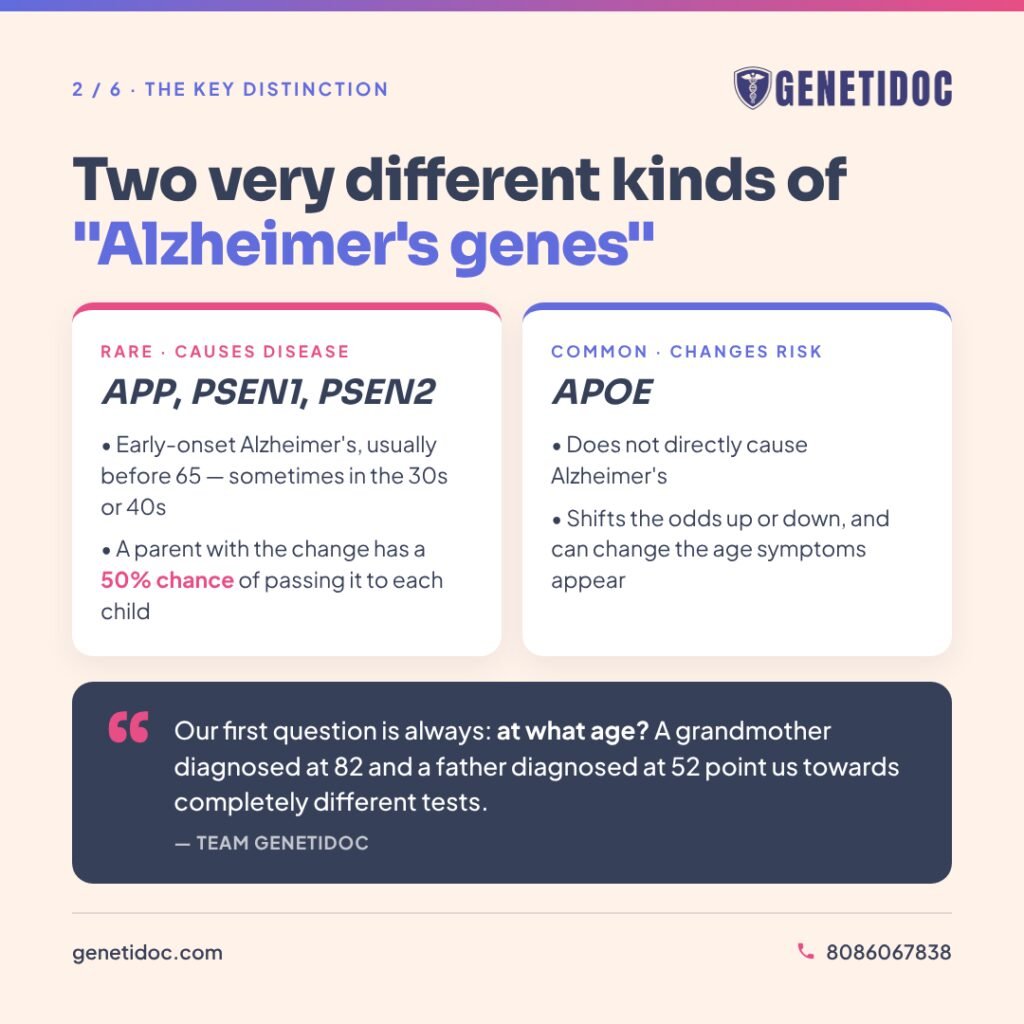
Changes in three genes, APP, PSEN1 and PSEN2, can directly cause a rare, early-onset form of Alzheimer’s disease. Symptoms usually begin before age 65, sometimes as early as the 30s or 40s.
These follow a pattern called autosomal dominant inheritance. This means a parent with the change has a 50% chance of passing it to each child, and a person who inherits it is very likely to develop the disease. These families are uncommon and account for only a small fraction of all Alzheimer’s cases.
2. Genes that change your risk (common)
APOE belongs here. It does not directly cause Alzheimer’s. Instead, it shifts the odds up or down and can change the age at which symptoms appear. Many other genes also nudge risk slightly, but APOE has by far the strongest effect of the common risk genes.
Why this matters for you: If several relatives across generations developed Alzheimer’s in their 40s or 50s, the right test is usually for the causative genes, not just APOE. If your relatives developed it in their late 70s or 80s, APOE is more likely to be part of the picture, and the result is about probability, not certainty.
“When a family tells us Alzheimer’s runs in the family, our first question is always: at what age? A grandmother diagnosed at 82 and a father diagnosed at 52 point us towards completely different tests.”
— Team Genetidoc
Illustrative example (composite, not a real patient): A 38-year-old woman’s father and his sister were both diagnosed with Alzheimer’s in their early 50s. She had bought an APOE test online, and it showed no ε4, which falsely reassured her. In counseling, the family pattern pointed instead towards the early-onset genes. The usual first step in a situation like this is to test an affected relative, if a sample is available, for APP, PSEN1 and PSEN2. If a change is found, unaffected relatives can then choose whether to be tested for that one specific change, with counseling before and after.
Her APOE result had answered the wrong question.
Understanding Your APOE Result: The Six Genotypes
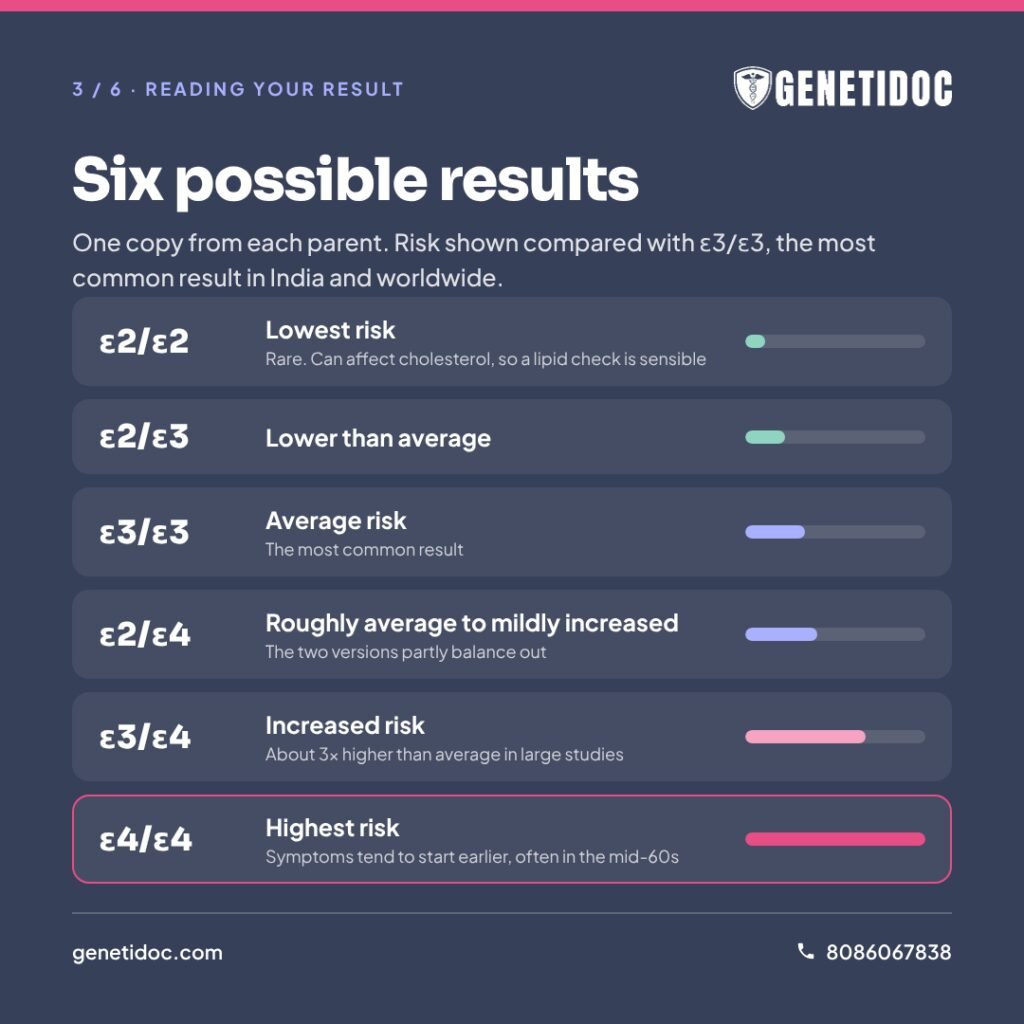
Because you inherit one copy of APOE from each parent, there are six possible combinations, called genotypes. Here is what each one generally means, compared with ε3/ε3, the most common genotype.
| Genotype | What it generally means |
| ε2/ε2 | Lowest Alzheimer’s risk. Rare. Can be linked to a cholesterol and triglyceride disorder, so a lipid check is sensible. |
| ε2/ε3 | Lower than average risk. |
| ε3/ε3 | Average risk. The most common genotype in India and worldwide. |
| ε2/ε4 | Roughly average to mildly increased risk; the two versions partly balance each other. |
| ε3/ε4 | Increased risk, about three times higher than ε3/ε3 in large studies. |
| ε4/ε4 | Highest risk, and symptoms tend to start earlier, often in the mid-60s. |
What “three times the risk” actually means
Relative risk figures sound frightening on their own. What matters more is absolute risk: your actual chance of developing the disease by a certain age.
A large European study estimated the lifetime risk of Alzheimer’s disease by age 85:
- Average person (any genotype): about 11% for men and 14% for women
- One ε4 copy (ε3/ε4): about 23% for men and 30% for women
- Two ε4 copies (ε4/ε4): about 51% for men and 60% for women
Read those numbers again from the other direction. Even with one ε4 copy, roughly seven in ten people do not develop Alzheimer’s by 85. Even with two copies, a large share do not.
These estimates come mainly from people of European ancestry. Indian research has found that ε4 is linked to Alzheimer’s with similar strength in Indian and American groups, while overall Alzheimer’s rates in the Indian communities studied were lower. Exact Indian risk figures are not yet available, which is one reason a counselor’s interpretation matters more than a single number.
How common is APOE ε4 in India?
This varies far more than most people realise. A 2026 study of more than 9,500 people from 83 Indian population groups found that the share of ε4 copies ranged from under 3% in some communities to over 36% in others, with a middle value of about 11%.
India’s genetic diversity is the reason. Your community, region and family history all shape what your result means, so a figure copied from a Western website may not apply to you.
The 2024 Research That Changed the Conversation
In 2024, researchers published a large study in the journal Nature Medicine looking at people with two ε4 copies. By age 65, almost all of them showed the brain changes of Alzheimer’s on biological tests, and symptoms began at an average age of about 65.
Based on this, the researchers proposed that carrying two ε4 copies should be seen as a distinct genetic form of Alzheimer’s disease, rather than just a risk factor.
How to read this without panic
- It applies to ε4/ε4 only, about 2–3% of people in Western studies. It does not change the outlook for people with one copy.
- Brain changes are not the same as dementia. The study looked mainly at biological markers. Many people with these changes live for years without significant symptoms, and not everyone develops dementia.
- The goal of the research is prevention. The authors argue that this group needs earlier, individualised prevention and dedicated research studies, not that their future is fixed.
“A two-copy result is significant, and we never play it down. But significant is not the same as certain. Our job is to turn that result into a plan for prevention and monitoring, not a countdown.”
— Team Genetidoc
Why APOE Testing Now Matters for Alzheimer’s Treatment in India
Until recently, APOE testing rarely changed treatment. That has started to shift.
In 2026, donanemab was launched in India under the brand name Lormalzi after approval by the Central Drugs Standard Control Organisation (CDSCO). It is the country’s first approved medicine that targets amyloid, the protein that builds up as plaques in the Alzheimer’s brain. It is meant for people with mild cognitive impairment or mild dementia due to Alzheimer’s.
These medicines can cause a side effect called amyloid-related imaging abnormalities (ARIA). These are areas of brain swelling or tiny bleeds that show up on magnetic resonance imaging (MRI) scans. Most cases cause no symptoms, but some can be serious.
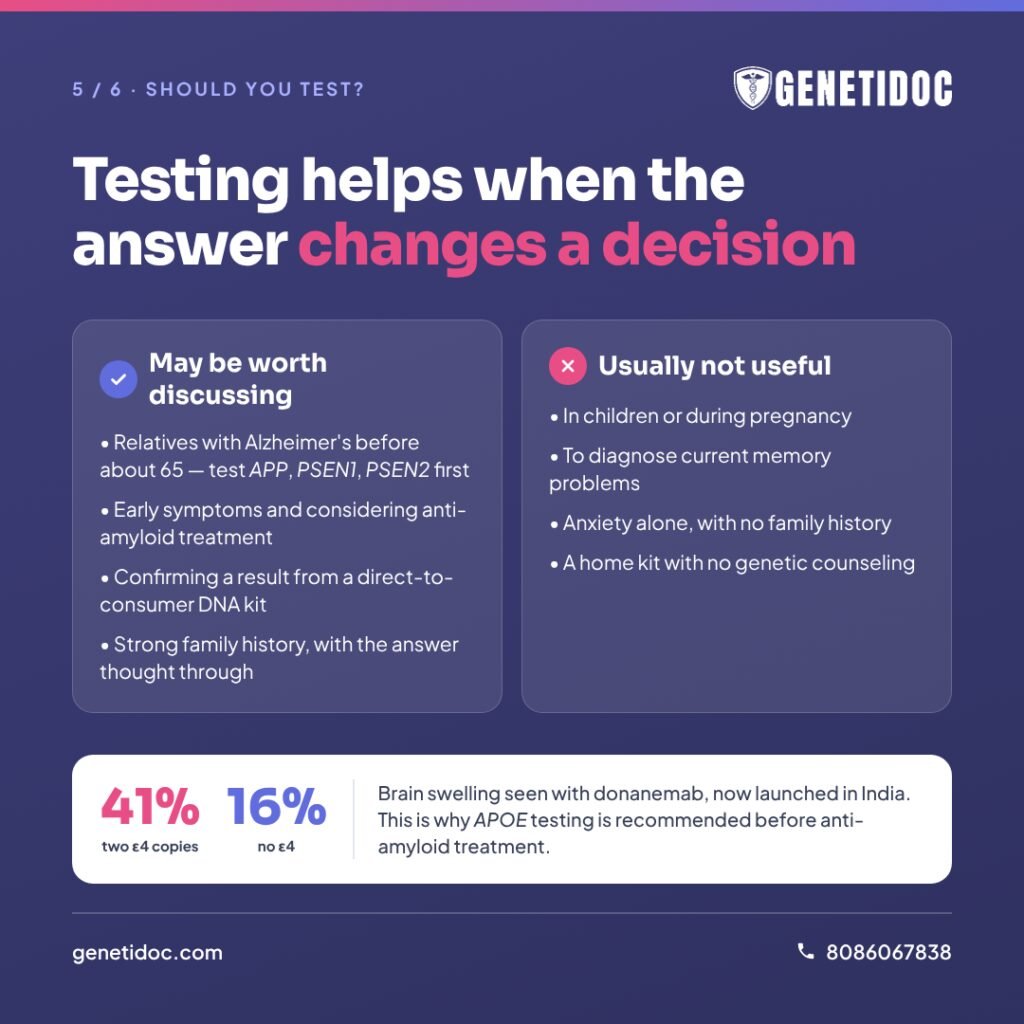
The risk of ARIA rises with each ε4 copy. In the main donanemab trial, brain swelling occurred in about 41% of treated people with two ε4 copies, compared with about 16% of people with no ε4. A gentler starting dose schedule has since been shown to lower this risk. US prescribing information therefore recommends APOE testing before treatment begins.
So for someone with early Alzheimer’s symptoms who is considering this treatment, an APOE result now feeds directly into a safety discussion with their neurologist. Keep in mind that the benefit of these medicines is modest and still debated among experts. They are only for early, confirmed disease and require specialist monitoring. They are not a reason for healthy people to get tested.
When a neurologist is considering this treatment, Genetidoc can arrange APOE genotyping along with counseling. Counseling matters here because the result also carries information for the patient’s children and siblings.
Who Should Consider APOE or Alzheimer’s Genetic Testing?
Genetic testing for Alzheimer’s is a personal choice, not a routine test. International guidance from the American College of Medical Genetics and Genomics (ACMG) and the National Society of Genetic Counselors (NSGC) says it should only happen alongside genetic counseling.
Testing is most useful when the answer will change a real decision. Situations where it may be worth discussing include:
- A family pattern of early-onset dementia. One or more relatives developed Alzheimer’s before about 65, especially across generations. Here, testing for the causative genes (APP, PSEN1, PSEN2) is usually the priority.
- A person with early symptoms considering anti-amyloid treatment. APOE status helps the neurologist assess ARIA risk.
- A healthy adult with a strong family history who wants a clearer picture of their own risk, and has thought through how they will handle the answer. At Genetidoc, rather than offering open-ended whole genome sequencing out of curiosity, we take a detailed personal and family history and may offer a focused Alzheimer’s risk-assessment panel where it fits. This looks at APOE alongside the early-onset genes APP, PSEN1 and PSEN2.
- Someone who received an APOE result from a direct-to-consumer (DTC) kit and needs it confirmed and properly explained.
- A person interested in prevention research studies, some of which select participants by APOE
When testing may not be useful
- In children or before birth. International guidance does not recommend Alzheimer’s genetic testing for children or in pregnancy. A child should be able to make this choice for themselves as an adult.
- When you have no family history and simply feel anxious. A result is unlikely to change what you should do, which is to look after your heart and brain health, and it can add worry.
- To diagnose memory problems. An APOE result cannot tell you whether someone’s current symptoms are due to Alzheimer’s. That needs a clinical assessment, and sometimes brain imaging or spinal fluid tests.
- Through a home kit without counseling. The same guidance specifically advises against at-home APOE testing because of its limited predictive value.
“My DNA Kit Says I Have APOE4.” What Now?
This is becoming a common worry. Here is what we want you to know.
The result needs confirming
Consumer kits are designed for screening, not diagnosis. Any concerning finding should be confirmed through an accredited clinical laboratory before you make decisions based on it. Some kits also report only whether ε4 is present, without your full genotype, which leaves out useful information such as whether you also carry protective ε2.
The result needs context
Your APOE result means something different depending on your age, family history and community background. A report on an app cannot weigh those factors. A clinical geneticist can.
Your privacy matters
Many consumer DNA companies store your data, and breaches do happen. In 2023, a security breach at 23andMe exposed data linked to about 6.9 million users. India also does not yet have a dedicated law that stops genetic information being used against people, for example in insurance decisions. That is one reason we recommend thinking carefully, and speaking to a professional, before testing.
Illustrative example (composite, not a real patient): A 45-year-old man in Bengaluru opened his wellness DNA app and saw “APOE4 detected.” He spent weeks searching online and became convinced he would develop dementia in his 60s.
Clinical confirmation showed one ε4 copy (ε3/ε4). His counselor walked him through what that means in absolute terms: most people with this genotype do not develop Alzheimer’s by 85. Together they built a practical plan: treat his borderline blood pressure, check his cholesterol, test his hearing, and see a neurologist if memory changes ever appear. He also learned there was no reason to test his teenage children.

What an APOE Result Changes in Real Life
If you carry one or two ε4 copies
There is no medicine proven to prevent Alzheimer’s in healthy ε4 carriers. But there is strong evidence that general brain and heart health matters for everyone, carriers included.
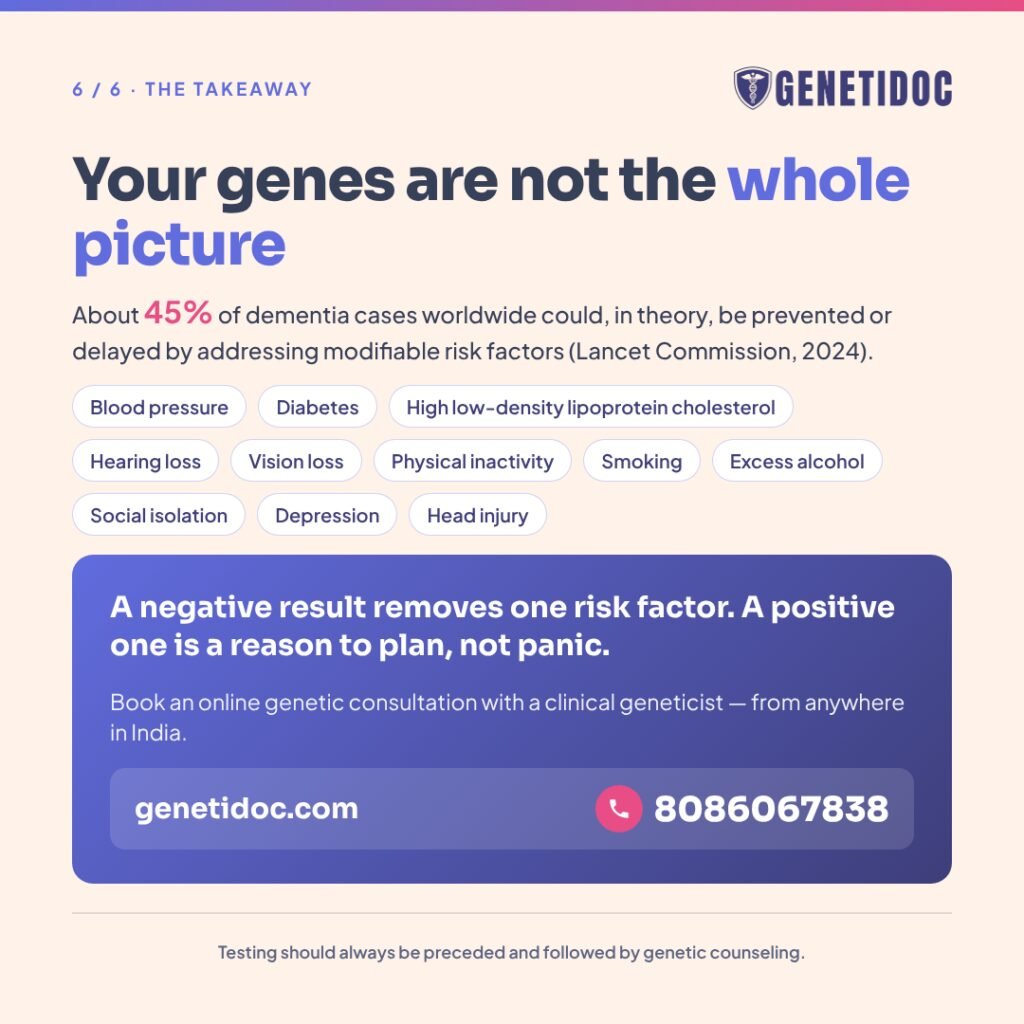
The 2024 Lancet Commission on dementia estimated that about 45% of dementia cases worldwide could, in theory, be prevented or delayed by addressing 14 modifiable risk factors. The Commission said the potential may be even higher in low- and middle-income countries such as India.
The 14 modifiable risk factors for dementia
- Lower levels of education
- Hearing loss
- High low-density lipoprotein (LDL) cholesterol
- Depression
- Traumatic brain injury
- Physical inactivity
- Diabetes
- Smoking
- High blood pressure
- Obesity
- Excessive alcohol use
- Social isolation
- Air pollution
- Untreated vision loss
For an ε4 carrier, practical steps usually include:
- Getting blood pressure, blood sugar and cholesterol checked and treated where needed. APOE ε4 also affects cholesterol, so a lipid profile is especially useful.
- Having hearing and vision tested, and using hearing aids or glasses if needed.
- Staying physically active and socially connected.
- Not smoking and limiting alcohol.
- Protecting your head during sport, cycling and two-wheeler travel.
- Seeing a neurologist promptly if memory or thinking changes appear, so that any problem is assessed early.
None of this is unique to ε4 carriers. What a result can do is give some people the motivation to act on these steps earlier and more consistently.
If you do not carry ε4
This is reassuring, but it is not a guarantee. Many people who develop Alzheimer’s have no ε4 at all. A negative result means only that this particular risk factor was not found. It does not mean you will never develop the condition. If you have a strong family history, especially of early-onset dementia, other tests may still be appropriate.
“One of the most common misunderstandings we correct is ‘my test was negative, so I’m safe.’ A negative APOE result removes one risk factor from the picture. It does not remove the picture.”
— Team Genetidoc
Prevention research studies
Some international research studies focus specifically on people who carry ε4, especially two copies. Very few currently recruit in India. A genetic counselor can help you understand whether any study is realistically open to you. You can also follow new trial listings on Genetidoc’s Genetic Trials Forum.
What Your Result Means for Your Family
Genetic results are never only about one person. If you carry ε4, each of your children has a chance of inheriting it, and your brothers and sisters may carry it too. Your result can reveal information about relatives who may not want to know.
This is one of the most sensitive parts of APOE testing. Some practical principles:
- Each adult decides for themselves. Your sibling or adult child may choose not to be tested, and that choice deserves respect.
- Children should not be tested for Alzheimer’s risk. The decision belongs to them once they are adults.
- Talking about it is your choice. At Genetidoc, after a consultation, patients receive a written summary of what was discussed, which some find helpful when speaking to family. If you prefer not to tell a relative yourself, we can offer that relative a private counseling session. We will not share your result with them unless you agree.
Managing the Emotional Side
Learning your APOE status can bring relief, worry, or both. That is normal.
Research offers some reassurance here. In a well-known American study called REVEAL, adults with a parent who had Alzheimer’s received their APOE results along with genetic counseling. Overall, learning the result did not cause significant short-term anxiety, depression or distress compared with people who were not told.
The key words are with counseling. That is why we recommend that anyone considering this test have a conversation before deciding, not just after the result arrives. Good pre-test counseling explores why you want to know, how you might feel about each possible result, and what you would do differently.
Sometimes the most helpful outcome of that conversation is deciding not to test, and that is a valid choice. The decision is always yours.
“Some of our most useful counseling sessions end with the person deciding not to test. If that is the right decision for them, it is a good outcome.”
— Team Genetidoc
Illustrative example (composite, not a real patient): A 50-year-old woman came in after her mother was diagnosed with Alzheimer’s at 80. She wanted an APOE test “just to know.”
During counseling she realised that neither result would change what she planned to do. She was already managing her diabetes and walking daily, and she worried a positive result would weigh on her. She chose not to test, and left with a clear risk-reduction plan and the reassurance that she could revisit testing at any time.
When people do choose to test, results are explained in a follow-up session, not left in a report. They are always welcome to come back with new questions later.
Why Expert Interpretation Matters More Than the Test Itself
The APOE test itself is technically simple. The hard part is knowing what the result means for you.
A meaningful assessment brings together:
- Your age and current health
- Your detailed family history, including ages at diagnosis
- Whether the pattern suggests the rare causative genes rather than APOE
- Your community and background, given India’s genetic diversity
- Your personal reasons for testing and what you would do with the answer
This is why Genetidoc builds genetic counseling into every result, and why we work with accredited partner laboratories. Most of our consultations happen online by video, so you can speak with a clinical geneticist from home, often in your preferred Indian language. Samples can usually be collected through home sample pickup.
APOE genotyping is a focused test, and results usually take about 1–2 weeks. A broader dementia gene panel takes longer, typically about 3–4 weeks. Your counselor will explain the expected timeline and costs for the test that fits your situation.
The value of genetics comes not from a report alone, but from understanding it well enough to make good decisions.
Frequently Asked Questions
1. If I have APOE4, will I definitely get Alzheimer’s?
No. APOE ε4 raises risk but does not guarantee the disease. Most people with one ε4 copy do not develop Alzheimer’s by age 85, and some people with two copies never develop dementia.
2. Is Alzheimer’s disease hereditary?
A small number of families have a directly inherited, early-onset form caused by the APP, PSEN1 or PSEN2 genes. Most Alzheimer’s is late-onset and results from a mix of genes such as APOE, age, and health and lifestyle factors.
3. What does APOE e3/e4 mean?
It means you inherited one ε4 copy and one ε3 copy. Your Alzheimer’s risk is higher than average, about three times that of ε3/ε3 in large studies, but most people with this genotype do not develop the disease.
4. What does APOE e4/e4 mean?
It means you inherited two ε4 copies, one from each parent. This carries the highest risk and an earlier average age of onset. It is uncommon, and it calls for careful counseling and attention to prevention.
5. Does APOE e2 protect against Alzheimer’s?
ε2 is linked to lower Alzheimer’s risk, but not zero risk. Two ε2 copies can be associated with a cholesterol disorder, so a lipid profile is worthwhile.
6. Should I get tested if my parent has Alzheimer’s?
It depends on when your parent developed symptoms, your wider family history, and what you would do with the result. A genetic counseling session helps you decide whether testing is right for you.
7. Can my APOE result diagnose memory problems?
No. APOE testing shows risk, not diagnosis. Memory problems need a clinical assessment by a neurologist or memory specialist.
8. Is APOE testing needed before Alzheimer’s treatment?
For anti-amyloid medicines such as donanemab, APOE testing is recommended before treatment because ε4 carriers, especially those with two copies, have a higher risk of brain swelling or bleeding side effects.
9. Can lifestyle changes lower my risk if I carry APOE4?
Addressing risk factors such as blood pressure, diabetes, cholesterol, hearing loss, inactivity and smoking is recommended for everyone, including ε4 carriers. Experts estimate that tackling these factors could prevent or delay many dementia cases.
10. Are home DNA kits reliable for APOE?
They may detect ε4, but results should be confirmed by an accredited clinical laboratory and explained by a genetics professional. International guidance advises against home APOE testing without counseling.
11. Should my children be tested for APOE?
No. Alzheimer’s genetic testing is not recommended for children. They can make their own decision as adults.
12. Can an APOE result affect my insurance in India?
India does not yet have a dedicated law that prevents genetic information from being used in insurance decisions. Discuss this with a genetic counselor before testing.
13. How long does an APOE test take?
Focused APOE genotyping usually takes about 1–2 weeks. Broader dementia gene panels take around 3–4 weeks.
Key Takeaways
- APOE ε4 is the strongest common genetic risk factor for late-onset Alzheimer’s, but it is a risk factor, not a verdict.
- The rare genes that directly cause early-onset Alzheimer’s (APP, PSEN1, PSEN2) are a different question with a different test.
- Absolute risk matters more than “times higher” figures. Most people with one ε4 copy never develop Alzheimer’s.
- ε4 frequency varies widely across Indian communities, so context matters.
- APOE status now affects safety decisions for anti-amyloid treatment in India.
- Heart and brain health measures help everyone, whatever their genotype.
- Testing should always be preceded and followed by genetic counseling.
Worried About Alzheimer’s in Your Family, or Unsure About an APOE Result?
Whether a parent has been diagnosed, dementia started early in your family, or a DNA kit has flagged APOE4, a conversation with a clinical geneticist can turn worry into a clear plan. We will review your family history, help you decide whether testing makes sense, and explain any result in plain language.
Book an Alzheimer’s genetic risk consultation with Genetidoc
Have a question about APOE or predictive testing? Ask it in our Predictive Genetic Testing forum.
Related Reading
- GM1 Gangliosidosis: Why Early Diagnosis Matters
- What Defines a Rare Genetic Disease? A Clear Guide
- Genetic Mosaicism: What It Means When Your Report Says “Mosaic”
- Genetic Conditions: Why Timing of Onset Varies
- Consanguineous Marriage and Your Child’s Genetic Risk
- Tuberous Sclerosis Complex: A Guide to Testing and Care in India
References
- Goldman JS, Hahn SE, Catania JW, et al. Genetic counseling and testing for Alzheimer disease: joint practice guidelines of the American College of Medical Genetics and the National Society of Genetic Counselors. Genetics in Medicine. 2011;13(6):597–605.
- Genin E, Hannequin D, Wallon D, et al. APOE and Alzheimer disease: a major gene with semi-dominant inheritance. Molecular Psychiatry. 2011;16(9):903–907.
- Farrer LA, Cupples LA, Haines JL, et al. Effects of age, sex, and ethnicity on the association between apolipoprotein E genotype and Alzheimer disease: a meta-analysis. JAMA. 1997;278(16):1349–1356.
- Fortea J, Pegueroles J, Alcolea D, et al. APOE4 homozygozity represents a distinct genetic form of Alzheimer’s disease. Nature Medicine. 2024;30(5):1284–1291.
- Livingston G, Huntley J, Liu KY, et al. Dementia prevention, intervention, and care: 2024 report of the Lancet standing Commission. The Lancet. 2024;404(10452):572–628.
- Ganguli M, Chandra V, Kamboh MI, et al. Apolipoprotein E polymorphism and Alzheimer disease: the Indo-US Cross-National Dementia Study. Archives of Neurology. 2000;57(6):824–830.
- Ramdas S, et al. APOE ε4 allele frequencies in 9,524 individuals from 83 Indian populations. PubMed-indexed, April 2026.
- Green RC, Roberts JS, Cupples LA, et al. Disclosure of APOE genotype for risk of Alzheimer’s disease. New England Journal of Medicine. 2009;361(3):245–254.
- Sims JR, Zimmer JA, Evans CD, et al. Donanemab in early symptomatic Alzheimer disease: the TRAILBLAZER-ALZ 2 randomized clinical trial. JAMA. 2023;330(6):512–527.
- Eli Lilly and Company. Kisunla (donanemab) Prescribing Information and APOE ε4 testing guidance.
- Business Today. Lilly launches Alzheimer’s therapy Lormalzi in India as dementia burden rises. May 13, 2026.
This article is for education only and does not replace personal medical advice. Please consult a qualified clinical geneticist or genetic counselor before making decisions about genetic testing.