
| Quick answer
The most common genetic cause of recurrent IVF failure is a chromosome problem in the embryo, usually linked to the woman’s age. Less often, one partner carries a balanced chromosome rearrangement, such as a translocation. That person is healthy, but many of their embryos may have missing or extra genetic material. The key tests are a karyotype (chromosome test) for both partners and, in selected couples, embryo testing. Many popular add-on gene tests have little proof of benefit. Genetic counseling helps you choose the tests that can actually change your next step. |
You did everything right. You took the injections, attended every scan and waited through every two-week wait. The embryos looked good. Yet the pregnancy test was negative again.
If this is your story, you are not alone. Many couples in India reach a point where they ask: “Is something in our genes stopping this from working?”
It is a fair question, and an important one. Sometimes the answer really is genetic, and finding it changes the whole plan. Often the answer is not genetic, and knowing that saves you from expensive tests that won’t help.
This guide explains what genetic causes actually matter in repeated IVF failure. It also covers which tests are worth doing, which are not, and what happens after a diagnosis.
What Is Recurrent Implantation Failure?
Recurrent implantation failure (RIF) means that good-quality embryos have been transferred into the uterus several times, but a pregnancy has not started. “Implantation” is the moment the embryo attaches to the lining of the uterus and begins to grow.
Many clinics use a simple rule of thumb: no pregnancy after about three embryo transfers with good-quality embryos. But international experts now say a fixed number is too crude.
- The European Society of Human Reproduction and Embryology (ESHRE), in its 2023 good practice recommendations, suggests investigating once a couple’s expected cumulative chance of success has passed about 60% without a pregnancy. That expected chance depends on the woman’s age, embryo quality and number of embryos transferred.
- The American Society for Reproductive Medicine (ASRM), in its 2026 committee opinion, sets a stricter bar. It defines recurrent implantation failure as failed transfer of enough good-quality blastocysts (day 5–6 embryos) to have given a 95% cumulative chance of a positive pregnancy test. For chromosomally tested embryos, that usually means three to six failed transfers.
Why does this matter to you? The definition is used very loosely. A 2025 review in Human Reproduction Open found more than 500 different definitions in published research. That makes it easy for couples to be labelled “recurrent failure” after one or two unlucky attempts and then sold tests they don’t need.
| “Two failed transfers can simply be bad luck, especially when embryos were not tested. Before we label a couple, we look at the woman’s age, how many embryos were transferred and their quality. The question is not ‘how many times did it fail?’ but ‘how many times should it have worked by now?'”
— Dr. Roshan Daniel, Clinical Geneticist, Genetidoc |
How Often Is Genetics the Cause?
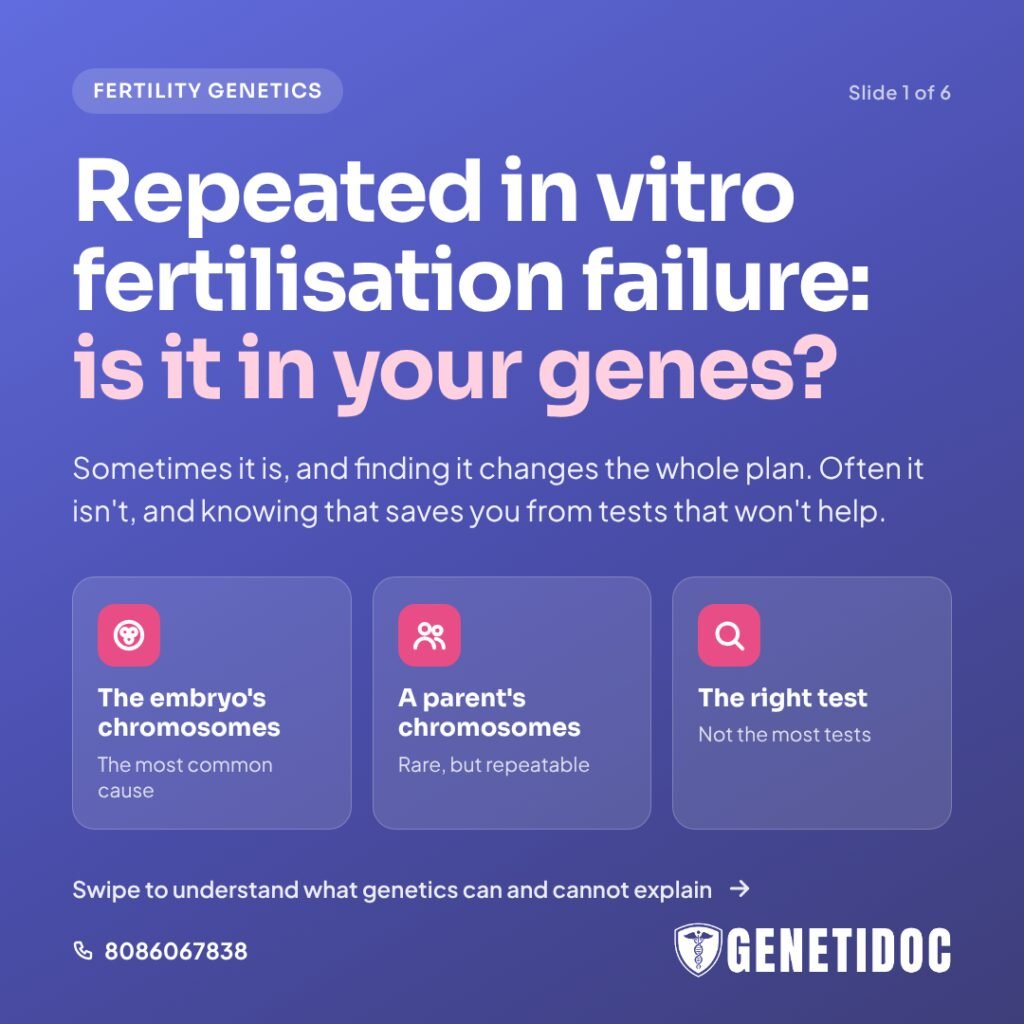
Genetics can be involved in two different places, and it helps to keep them separate:
- The embryo’s chromosomes. This is the most common reason any embryo fails to implant. It usually happens by chance while the egg or sperm is forming, and it becomes more common as the woman gets older.
- The parents’ chromosomes. Rarely, one partner carries a chromosome change that makes abnormal embryos more likely in every cycle. This is a repeatable cause, and it is the one couples most need to rule out.
Here is the reassuring part. Large studies show that when women transfer embryos already confirmed to have the normal number of chromosomes, most achieve a pregnancy within a few attempts.
- A 2021 study in Fertility and Sterility found a 95% cumulative implantation rate after up to three such transfers.
- A 2024 study of nearly 124,000 patients found that, without an obvious cause, true unexplained recurrent implantation failure affected fewer than 2% of women.
In other words, “true” recurrent implantation failure is uncommon. When it does happen, a careful search for a specific cause, genetic or otherwise, is worth the effort.
The Main Genetic Causes of Recurrent IVF Failure
1. Chromosome Errors in the Embryo (Aneuploidy)
Aneuploidy means an embryo has too many or too few chromosomes. Chromosomes are the packages that hold our DNA. A healthy embryo has 46, in 23 pairs.
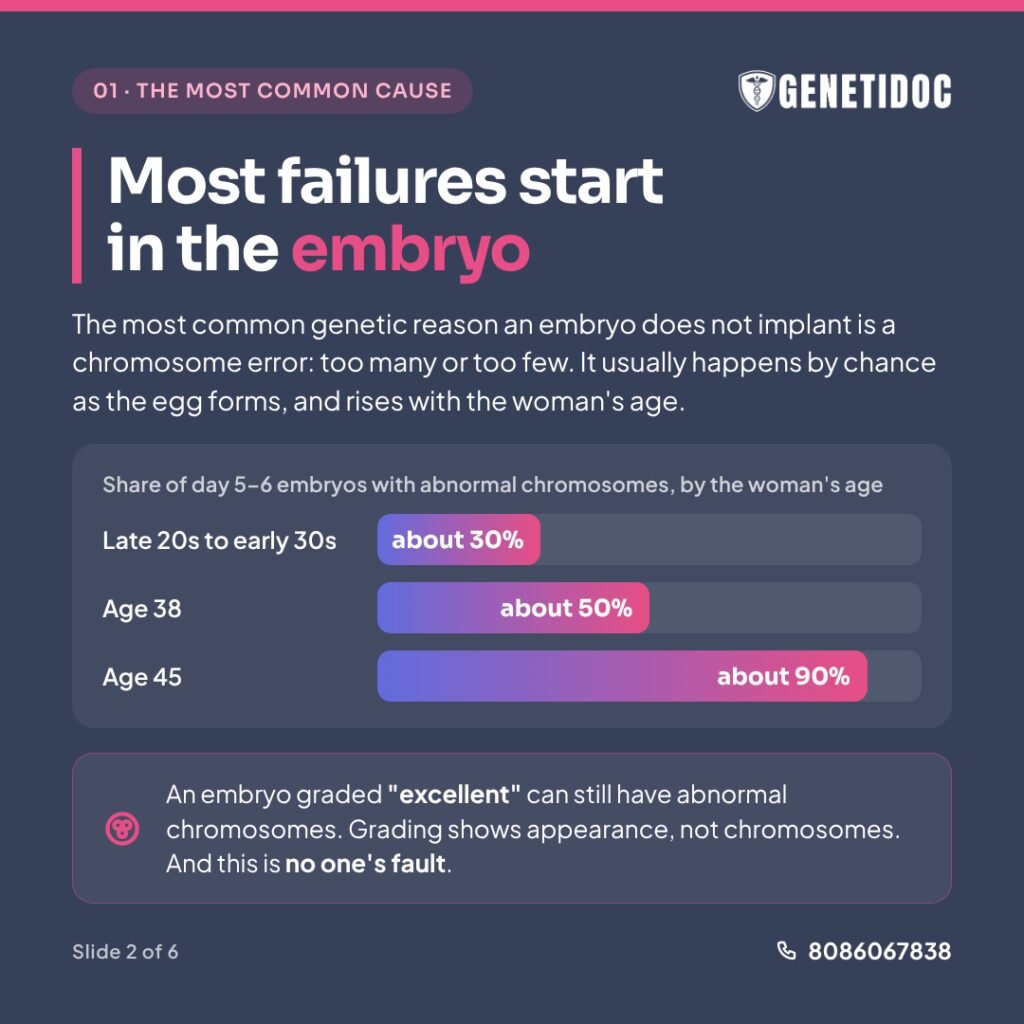
Most aneuploid embryos either never implant or are lost very early. A microscope cannot detect this, so an embryo graded “excellent” can still be chromosomally abnormal.
The risk rises steadily with the woman’s age, because eggs age along with her. According to the ASRM 2026 committee opinion, roughly:
- about 30% of blastocysts are aneuploid in women in their late twenties and early thirties
- about 50% at age 38
- about 90% at age 45
The ASRM considers age-related aneuploidy the main cause of implantation failure overall. This is usually not something either partner “carries”, and it is not anyone’s fault.
2. Balanced Translocations in One Partner
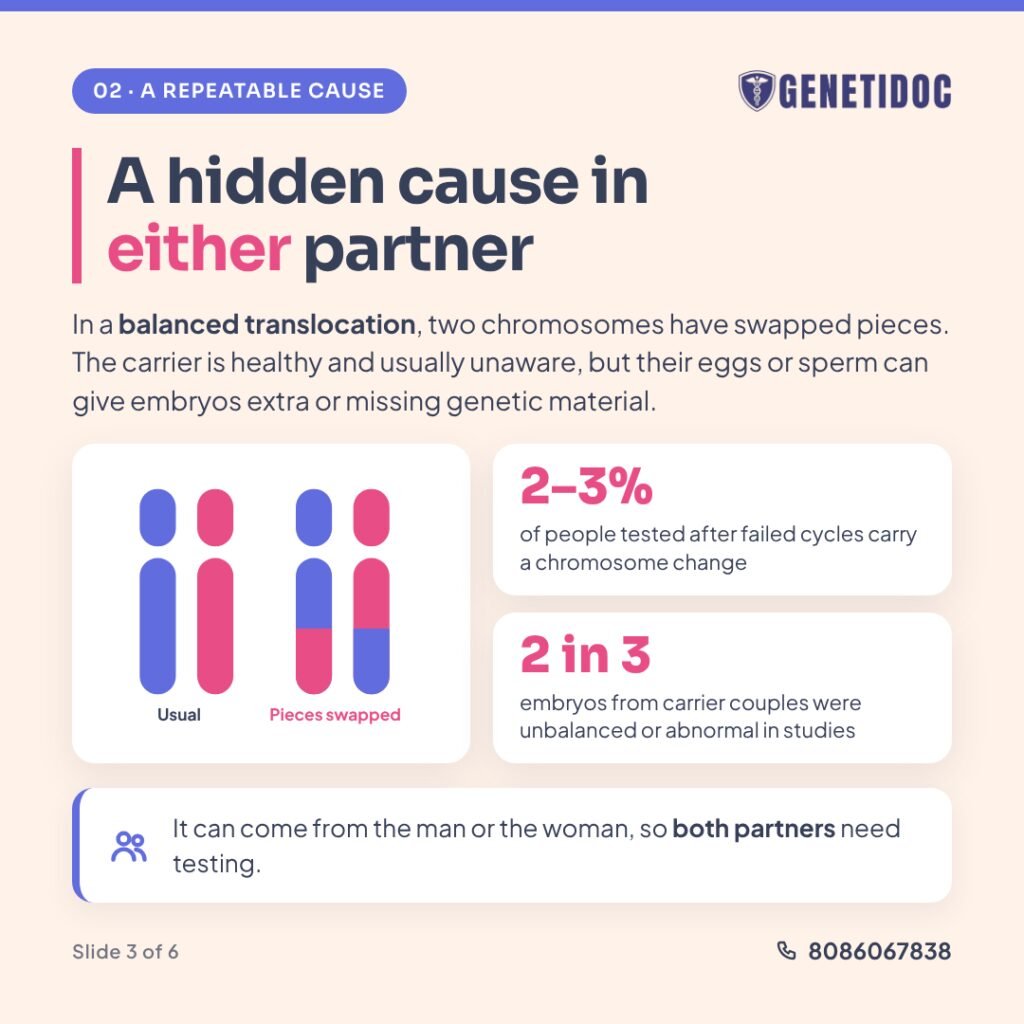
A balanced translocation means two chromosomes have swapped pieces. All the genetic material is still present, just rearranged. The person carrying it is usually completely healthy and has no idea.
The problem appears when that person makes eggs or sperm. Each egg or sperm may receive an uneven share of the swapped pieces. The resulting embryo then has extra or missing genetic material and often cannot implant or grow.
There are two main types:
- Reciprocal translocation: pieces swapped between two different chromosomes.
- Robertsonian translocation: two particular chromosomes joined end to end. The carrier has 45 chromosomes instead of 46 but is still healthy.
How common is this in couples with failed IVF? Recent studies summarised by the ASRM found a chromosome change in about 2–3% of people tested. One older study found 15% among couples with a very high number of failed cycles. The number is small, but the impact is large. In published embryo testing studies of carrier couples, about two-thirds of embryos were unbalanced or otherwise aneuploid.
| Illustrative scenario (composite example, not a real patient)
A couple in their early thirties has had four transfers of good-quality embryos at two different IVF centres. Each cycle was changed: new medicines, a new protocol, a different lab. No one has tested their chromosomes. A karyotype shows the husband carries a balanced reciprocal translocation. He is healthy, but it explains why so many embryos failed. With this answer, the couple can plan embryo testing designed for his specific rearrangement instead of simply repeating the same cycle. |
3. Inversions and Other Structural Changes
An inversion means a piece of a chromosome has flipped upside down. Some inversions can lead to unbalanced embryos in the same way as translocations. Others are harmless (see the section on normal variants below). Interpreting which type you have is a specialist task.
4. Sex Chromosome Changes and Mosaicism
Some people have a small proportion of cells with a different number of X or Y chromosomes. This is called mosaicism, meaning a mix of cell types in one body. Low-level mosaicism can be associated with reduced fertility and is occasionally found in couples with repeated failure. Finding it reliably depends on how many cells the laboratory examines.
5. Genetic Factors in the Male Partner
Too often, the woman is examined repeatedly while the man has had only a basic semen test. Genetics in the male partner matters most when sperm counts are very low or absent:
- Karyotype: can show a translocation or a condition such as Klinefelter syndrome (an extra X chromosome).
- Y chromosome microdeletion test: looks for missing pieces of the Y chromosome that affect sperm production.
These conditions mainly affect sperm production rather than implantation itself. Still, a male partner’s chromosome rearrangement can directly cause abnormal embryos, which is why karyotyping both partners matters.
What about sperm DNA fragmentation? This test measures damage to the DNA inside sperm. It can be useful in some situations, such as recurrent miscarriage. But for implantation failure specifically, both ESHRE (2023) and ASRM (2026) do not recommend it routinely. In both cases the reason is the same: studies have not shown that acting on the result improves the chance of a baby. Team Genetidoc also does not recommend embryo chromosome testing based on a high fragmentation result alone.
6. Gene “Polymorphisms” and Other Research Findings
You may read that common gene variants are linked to implantation failure. These variants (called polymorphisms) include genes involved in immunity, blood clotting and blood-vessel growth.
These findings come mostly from small association studies. No such gene has been proven to cause implantation failure or to guide treatment. A 2024 review of the genetics of implantation failure concluded that no well-defined genes have yet been established. We discuss what this means for tests like MTHFR below.
Genetic Tests After Repeated IVF Failure: What Helps and What Doesn’t
| Test | Who it is for | What it can find | Evidence in RIF |
| Karyotype (both partners) | Couples with repeated failure | Translocations, inversions, sex chromosome changes | Can be considered (ESHRE, ASRM) |
| PGT-A (embryo chromosome screening) | Selected couples with untested embryos | Embryos with abnormal chromosome numbers | Can be considered; no proven rise in live birth |
| PGT-SR (embryo test for rearrangements) | A partner with a known translocation or inversion | Unbalanced embryos from the rearrangement | Recommended after a diagnosis, with counseling |
| Y microdeletion | Men with no sperm or very low counts | Missing Y chromosome regions | Useful for male infertility, not RIF alone |
| MTHFR, HLA, KIR, natural killer cell tests | Not routinely recommended | Common variants of unclear meaning | Not recommended by major guidelines |
Karyotype: The Foundation Test
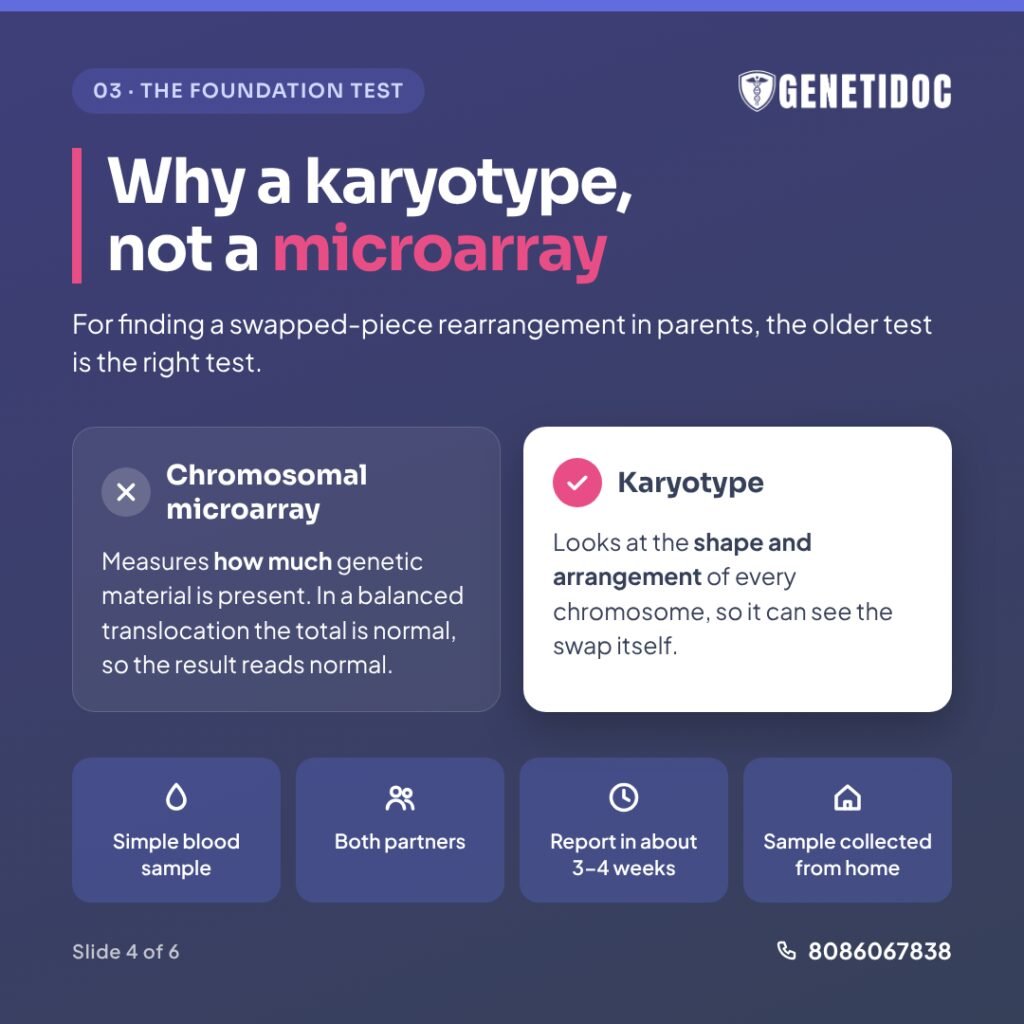
A karyotype is a picture of all your chromosomes, arranged in pairs and examined under a microscope. It needs a simple blood sample. In couples with repeated failure, both partners should usually be tested.
At Genetidoc, a karyotype report usually takes about three to four weeks, because the blood cells must first be grown in the laboratory. Samples can be collected from home, so there is often no need to travel to a clinic for the blood test.
Why a Chromosomal Microarray Cannot Replace a Karyotype Here
Many couples assume a “more advanced” DNA test will find more. In this situation, that is not true.
A chromosomal microarray measures how much genetic material is present. It is excellent at finding small extra or missing pieces. But in a balanced translocation, nothing is extra and nothing is missing. The pieces are just in the wrong place. The total amount is normal, so the microarray reads normal.
A karyotype looks at the shape and arrangement of each chromosome, so it can see the swap. For finding balanced rearrangements in parents, the older test is the right test.
| “Newer is not always better in genetics. For couples with repeated failure, a good-quality karyotype of both partners often answers more than an expensive gene panel. The right test depends on the question you are asking.”
— Dr. Roshan Daniel, Clinical Geneticist, Genetidoc |
Normal Chromosome Variants That Are Often Blamed
Some karyotype reports mention findings such as “inversion 9” or a larger or smaller “heterochromatin” region. Heterochromatin is a tightly packed part of a chromosome that carries few active genes. Many such findings are common, harmless differences found in healthy, fertile people.
Couples are sometimes told these variants caused their failed cycles, which can lead to unnecessary worry and costly embryo testing. A clinical geneticist can tell you whether a reported finding is a true rearrangement or a normal variant.
Does PGT-A Help After Failed IVF?
Preimplantation genetic testing for aneuploidy (PGT-A) checks embryos for abnormal chromosome numbers before transfer. A few cells are taken from the outer layer of a day 5–6 embryo, which is the part that later forms the placenta. Those cells are then tested.
This is one of the most heavily marketed tests in Indian IVF today. Here is a balanced picture.
What PGT-A can do:
- Help avoid transferring embryos that are very unlikely to work, which may mean fewer failed transfers.
- Show whether embryo chromosomes are a likely explanation for past failures.
- Help couples decide whether to keep trying with their own eggs, especially as age increases.
What PGT-A cannot do:
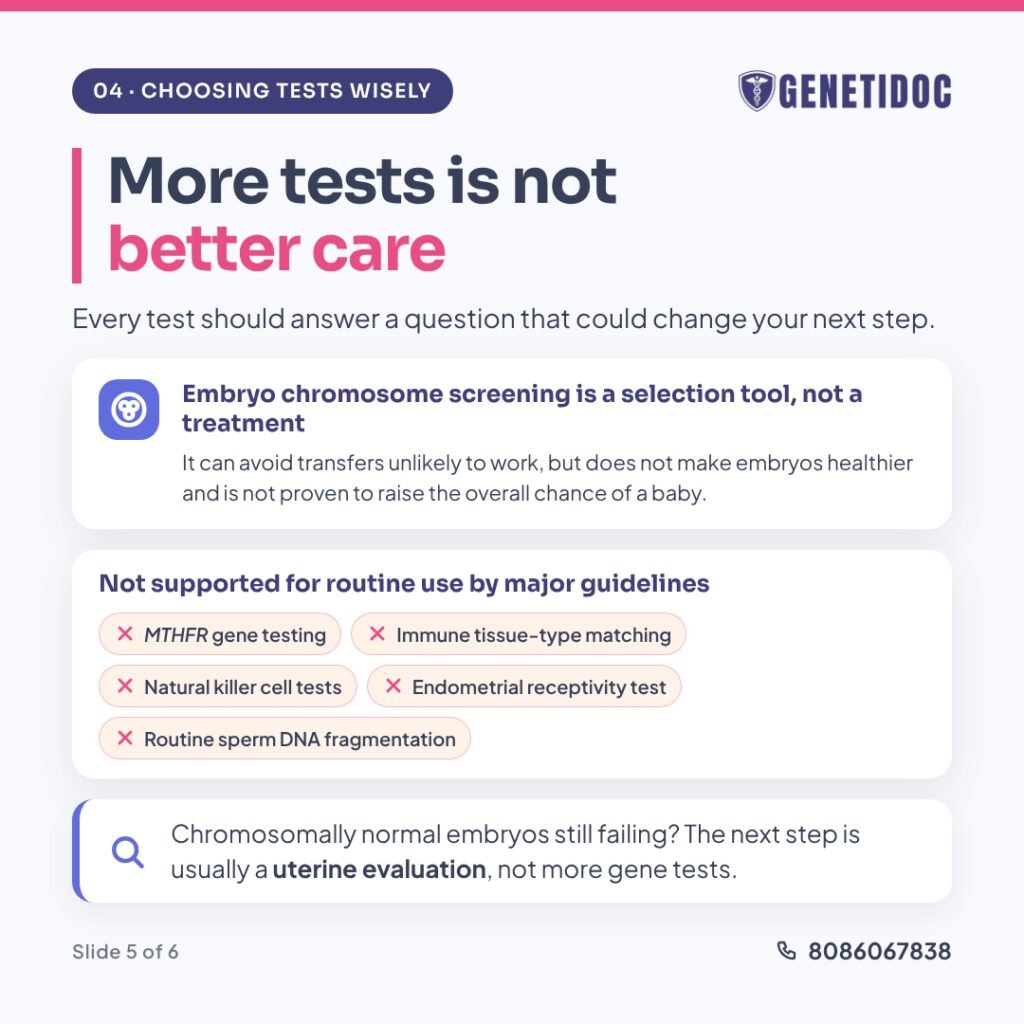
- It does not improve an embryo or create more normal embryos. It only selects among the ones you have.
- It has not been proven to increase the overall chance of a baby. ESHRE (2023) says PGT-A “can be considered” in recurrent implantation failure. The ASRM (2026) states there is no evidence it raises the live birth rate for these patients.
- It cannot fix a problem in the uterus, hormones or immune system.
- It sometimes gives a “mosaic” result, meaning the sample contained both normal and abnormal cells. These results need careful counseling before any decision about that embryo.
- If few embryos are available, there may be none left to transfer after testing.
| “PGT-A is a selection tool, not a treatment. It can save a couple time and heartbreak by avoiding transfers that were never going to work. But it does not make your embryos healthier, and it should not be offered as a guarantee.”
— Dr. Roshan Daniel, Clinical Geneticist, Genetidoc |
When a Partner Carries a Rearrangement: PGT-SR
If a karyotype shows a translocation or inversion, a related test called preimplantation genetic testing for structural rearrangements (PGT-SR) can identify embryos with a balanced or normal chromosome set. Both ESHRE and ASRM advise genetic counseling first, and then PGT-SR where relevant.
Embryo biopsy and PGT are carried out at IVF centres and their partner laboratories. A genetic counselor helps you understand your specific rearrangement, the realistic chances, and the results when they come back.
What If Chromosomally Normal Embryos Still Fail?
This is one of the most painful situations. If two or three embryos with normal chromosomes have failed, embryo chromosomes are unlikely to be the explanation.
The search should then move away from more genetic testing. It turns toward the uterus and the transfer process, which your IVF specialist assesses. The ASRM’s 2026 opinion lists the factors worth checking:
- Uterine cavity: polyps, fibroids that bulge into the cavity, scarring or a septum (a dividing wall), often checked by hysteroscopy (a camera passed into the uterus).
- Hydrosalpinx: a blocked tube filled with fluid.
- Chronic endometritis: long-term, low-grade inflammation of the uterine lining.
- Adenomyosis and endometriosis
- Transfer technique
What about the endometrial receptivity test? This test, widely sold in India, reads the activity of a few hundred genes in the uterine lining to estimate the best day for transfer. It is a gene-activity test, not a test of your inherited DNA. A large randomised trial published in JAMA in 2022 found that timing transfers this way did not improve live birth rates. The ASRM does not support its routine use in recurrent implantation failure.
| Illustrative scenario (composite example, not a real patient)
A 36-year-old woman has had three chromosomally normal embryos fail. She has been offered a long list of further gene tests. Her karyotype and her husband’s are normal. Genetic counseling helps the couple understand that genetics has now been reasonably ruled out. More gene tests are unlikely to add anything, and the next useful step is a focused uterine evaluation with their IVF specialist. The couple saves money and time and redirects their energy toward the investigation most likely to help. |
Tests Indian Couples Are Often Offered That Have Little Evidence
Many couples arrive at a genetics consultation with a file full of results. Some of these tests have little proven value in implantation failure:
- MTHFR gene testing: Variants in this gene are extremely common in healthy people. The American College of Medical Genetics and Genomics (ACMG) advised in 2013 against MTHFR testing for recurrent pregnancy loss or clotting risk, because the result does not guide useful treatment.
- Inherited clotting gene panels (such as factor V Leiden and prothrombin): ESHRE’s 2022 recurrent pregnancy loss guideline advises against routine screening unless there are other clotting risk factors. Examples include a personal or family history of blood clots.
- HLA and KIR tissue-type matching, and natural killer cell tests: These immune tests are not recommended by ESHRE (2023) for recurrent implantation failure. Treatments based on them, such as intralipid or immunoglobulin infusions, are also not supported by current evidence.
This does not mean every one of these tests is always wrong. A woman with a personal history of blood clots needs a proper clotting evaluation. The point is that these tests should be ordered for a clear reason, not as a routine bundle.
| “We often see couples who have done a dozen tests but never a simple karyotype. More testing is not the same as better testing. Every test should answer a question that could change what you do next.”
— Dr. Roshan Daniel, Clinical Geneticist, Genetidoc |
If a Genetic Cause Is Found: What Happens Next?
Being told you carry a chromosome rearrangement can feel frightening. Please remember three things.
- You are healthy. A balanced carrier has all their genetic material. The finding affects reproduction, not your own health.
- You did nothing to cause it. Most carriers inherited it from a parent without knowing. Sometimes it arose for the first time in that person.
- Many carriers have healthy children. The path may take more planning, but it is very often possible.
Reproductive Options Discussed in Counseling
- IVF with PGT-SR to select embryos with a balanced or normal chromosome set.
- Trying to conceive naturally or with standard IVF, with prenatal diagnostic testing in pregnancy through your obstetric team. Some couples choose this, depending on their rearrangement and history.
- Donor eggs or donor sperm in place of the carrier partner’s eggs or sperm.
There is no single right answer. Your genetic counselor explains each option and its realistic chances. The decision remains entirely yours as a couple.
What It Means for Your Family
If one partner carries a translocation, their parents, brothers and sisters may carry it too. Those relatives may face the same difficulties when planning a family. A simple karyotype can tell them where they stand.
Many Indian families share results readily. The challenge is often relatives not following through with testing. Genetidoc gives each couple a written summary of the consultation, which can make these family conversations easier.
| Illustrative scenario (composite example, not a real patient)
After repeated failed cycles, a woman is found to carry a balanced translocation. Her younger sister, newly married, also gets tested and turns out to carry the same change. Because she knows early, she can plan her first pregnancy with counseling and suitable testing, rather than discovering it after years of failure. |
When Genetic Testing May Not Be Useful
Honest advice includes knowing when not to test. Genetic testing is less likely to help when:
- There has been only one failed transfer, or two failed transfers of untested embryos. Chance alone often explains these.
- Failures are already well explained by the woman’s age and embryo numbers.
- Both partners have a normal, good-quality karyotype and chromosomally normal embryos have failed. The next questions here are usually not genetic.
- The test being offered has no proven link to implantation, such as routine MTHFR or HLA panels.
The ASRM goes further. If a detailed review finds no clear, correctable cause, it says extensive testing is unnecessary and further transfers are reasonable, because many couples eventually succeed.
The Indian Context: Why This Matters Here
- Repeated cycles are costly. Most IVF in India is paid out of pocket. Identifying or ruling out a genetic cause early can prevent cycle after cycle being repeated unchanged.
- Women are often blamed. In many families, the woman bears the pressure. Genetics frequently shows a shared or male-partner factor, and it shows that no one is at fault.
- Couples change clinics often. Records get lost, and basic tests like a karyotype may never be done. A single genetic review can bring the whole history together.
- Embryo testing is regulated. Under the Assisted Reproductive Technology (Regulation) Act, 2021 and the Pre-Conception and Pre-Natal Diagnostic Techniques (PCPNDT) Act, 1994, embryo testing cannot be used to select a baby’s sex.
- Consanguinity (marriage between relatives) is common in some communities. It matters mainly for inherited single-gene conditions and later pregnancy outcomes rather than implantation itself. If it applies to you, it is worth discussing in the same consultation.
Why the Right Laboratory and Expert Interpretation Matter
Not all chromosome tests are equal. Quality makes a real difference:
- Resolution: A higher-quality karyotype shows finer detail and can reveal small rearrangements that a low-quality study may miss.
- Number of cells examined: Detecting low-level mosaicism requires counting more cells. Fewer cells can miss it entirely.
- Interpretation: Calling a harmless variant “abnormal”, or missing a true rearrangement, can send a couple down the wrong path for years.
- Accreditation: Accredited laboratories follow defined quality standards and are checked regularly.
| “A report is only the beginning. The real value lies in connecting that result to the couple’s history and explaining what it means for their next cycle. That is where genetic counseling makes the difference.”
— Dr. Roshan Daniel, Clinical Geneticist, Genetidoc |
What Happens in a Genetic Counseling Session for Failed IVF?
- Full history review: your IVF cycles, embryo grades, any embryo test results, previous pregnancies and miscarriages, and the family history of both partners.
- Review of tests already done: which ones are useful, which can be set aside, and what is missing.
- Test selection: usually starting with karyotypes for both partners, adding other tests only where your history points to them.
- Result explanation: what a finding means, what it does not mean, and the realistic chances with each option.
- Planning with your IVF team: clear recommendations you can take back to your fertility specialist.
Most Genetidoc consultations take place online by video. Both partners can join from different cities, so neither has to relay information to the other secondhand. Consultations are available in many Indian languages.
Common Misconceptions About IVF Failure and Genetics
- “A good-looking embryo is a healthy embryo.” Not necessarily. Embryo grading measures appearance, not chromosomes.
- “It must be the woman’s problem.” Chromosome rearrangements can come from either partner.
- “A genetic finding means we can never have a baby.” Most carriers have options, and many have healthy children.
- “PGT-A guarantees success.” It improves selection, not embryo quality, and does not guarantee a pregnancy.
- “More tests mean better care.” Unfocused testing adds cost and confusion without improving results.
- “A new clinic will fix it.” Without understanding why earlier cycles failed, changing clinics often repeats the same outcome.
Questions to Ask Your Fertility Specialist
- By our age and embryo quality, have we actually reached the point of recurrent implantation failure?
- Have both of us had a karyotype? Was it a good-quality study?
- Were our embryos tested? If not, would PGT-A realistically help in our situation?
- If chromosomally normal embryos failed, what uterine evaluation is planned?
- Which of the tests we have done actually change our treatment?
- Should we see a clinical geneticist before the next cycle?
Key Takeaways
| • The most common genetic reason for IVF failure is chromosome errors in the embryo, linked to the woman’s age.
• A smaller group of couples has a repeatable cause: a balanced chromosome rearrangement in one partner. • A karyotype of both partners is the key test for rearrangements. A chromosomal microarray cannot find balanced translocations. • PGT-A helps select embryos but has not been proven to increase the overall chance of a baby. • When chromosomally normal embryos keep failing, the search should move to the uterus, not to more gene tests. • Routine MTHFR, HLA, natural killer cell and endometrial receptivity tests are not supported by major guidelines. • Expert interpretation and genetic counseling turn results into a clear, personal plan. |
What You Should Do Next
- Gather all your records: every IVF cycle summary, embryo grades and any test reports.
- Check whether both partners have had a karyotype.
- Before paying for another cycle or more add-on tests, ask for a genetic review of your history.
- Take the genetic counselor’s written recommendations back to your IVF specialist and plan the next step together.
Had two or more failed IVF cycles? Get a genetic review before your next transfer.Genetidoc’s clinical geneticists review your cycles, embryo results and family history. We tell you which genetic tests are worth doing, and which ones you can skip. Both partners can join the same video consultation from anywhere in India, and blood samples can be collected from your home. You will leave with a written, personalised plan to share with your IVF specialist.
|
Book a Failed IVF Genetic Consultation
Have a question about embryo testing or chromosome reports? Join the discussion in the genetidoc rare genetic diseases forum

Frequently Asked Questions
Can genetic problems cause IVF failure?
Yes. The most common genetic cause is abnormal chromosomes in the embryo, which becomes more frequent with age. Less often, one partner carries a balanced chromosome rearrangement that leads to many abnormal embryos.
How many failed IVF cycles before genetic testing?
There is no single number. Experts now consider age, embryo quality and how many embryos were transferred. Many specialists suggest a genetic review after two or three failed transfers of good-quality embryos.
Which genetic test is done after repeated IVF failure?
The main test is a karyotype for both partners, which looks for chromosome rearrangements. Embryo testing (PGT-A or PGT-SR) may be considered depending on your history and results.
Can the husband’s genes cause IVF failure?
Yes. A male partner can carry a balanced translocation or other chromosome change that leads to abnormal embryos. This is why both partners should be karyotyped, not just the woman.
Does PGT-A improve IVF success after failed cycles?
PGT-A can help avoid transferring chromosomally abnormal embryos and may reduce failed transfers. However, it has not been proven to increase the overall chance of a live birth in recurrent implantation failure.
Why did my chromosomally normal embryo not implant?
Even normal embryos implant about half to three-quarters of the time, so one failure can be chance. Repeated failures with normal embryos point toward the uterus or transfer process rather than genetics.
Can a balanced translocation carrier have a healthy baby?
Yes. Many carriers have healthy children, either naturally with prenatal testing or through IVF with PGT-SR. Genetic counseling explains the chances for your specific rearrangement.
Is MTHFR testing useful after failed IVF?
Generally no. MTHFR variants are very common in healthy people. The American College of Medical Genetics and Genomics does not recommend this test for pregnancy loss or clotting risk.
Can a microarray test detect a balanced translocation?
No. A microarray measures the amount of genetic material, which is normal in a balanced translocation. A karyotype is needed to see the rearrangement.
How long does a karyotype test take?
At Genetidoc, a karyotype report usually takes about three to four weeks. The blood cells must be grown in the laboratory before the chromosomes can be studied.
Is sperm DNA fragmentation testing needed after failed IVF?
Not routinely. Current ESHRE and ASRM guidance does not recommend it for implantation failure, because acting on the result has not been shown to improve live birth rates.
Does a genetic finding mean it is my fault?
No. Chromosome rearrangements are usually inherited unknowingly or arise by chance, and embryo chromosome errors are a natural part of reproduction. No one is to blame.
Related Reading on Genetidoc
- Genetics and Obesity: Is It All in the Genes?
- Hypertrichosis: The Genetics Behind Excess Hair Growth
- Frontotemporal Dementia and Its Genetic Links: What Indian Families Need to Know
- Migraine and Genetics: Is It Hereditary?
- Seizures in Infancy: When Genetic Testing Helps
- Mucopolysaccharidosis: Signs Parents Should Not Ignore
References
- ESHRE Working Group on Recurrent Implantation Failure; Cimadomo D, et al. ESHRE good practice recommendations on recurrent implantation failure. Human Reproduction Open. 2023;2023(3):hoad023.
- Practice Committee of the American Society for Reproductive Medicine. Recurrent implantation failure: a committee opinion. Fertility and Sterility. 2026;126:277–293.
- Pirtea P, et al. Rate of true recurrent implantation failure is low: results of three successive frozen euploid single embryo transfers. Fertility and Sterility. 2021;115:45–53.
- Gill P, et al. Does recurrent implantation failure exist? Prevalence and outcomes of five consecutive euploid blastocyst transfers in 123 987 patients. Human Reproduction. 2024;39:974–980.
- Ata B. Why does the recurrent implantation failure literature need to be rewritten? Human Reproduction Open. 2025;hoaf035.
- De Sutter P, et al. Prevalence of chromosomal abnormalities and timing of karyotype analysis in patients with recurrent implantation failure following assisted reproduction. Facts, Views and Vision in ObGyn. 2012;4:59–65.
- Franasiak JM, et al. The nature of aneuploidy with increasing age of the female partner. Fertility and Sterility. 2014;101:656–663.
- Doyle N, et al. Effect of timing by endometrial receptivity testing vs standard timing of frozen embryo transfer on live birth. JAMA. 2022;328:2117–2125.
- Hickey SE, Curry CJ, Toriello HV. ACMG Practice Guideline: lack of evidence for MTHFR polymorphism testing. Genetics in Medicine. 2013;15:153–156.
- ESHRE Guideline Group on Recurrent Pregnancy Loss; Bender Atik R, et al. ESHRE guideline: recurrent pregnancy loss: an update in 2022. Human Reproduction Open. 2023;hoad002.
- Gomes FG, et al. From bench to in silico and backwards: what have we done on genetics of recurrent pregnancy loss and implantation failure and where should we go next? Genetics and Molecular Biology. 2024. doi:10.1590/1678-4685-GMB-2023-0127.
- Government of India. The Assisted Reproductive Technology (Regulation) Act, 2021; The Pre-Conception and Pre-Natal Diagnostic Techniques (Prohibition of Sex Selection) Act, 1994.
This article is for educational purposes and does not replace individual medical advice. Please discuss your situation with your fertility specialist and a clinical geneticist.