

Your baby has had two hernia operations. He snores loudly and gets one ear infection after another. Now you have noticed a small hump in his lower back. Each doctor has treated one problem at a time, and each problem looked “common.”
Sometimes these everyday problems are pieces of one bigger picture. That picture may be mucopolysaccharidosis, a group of rare inherited conditions that are often missed for years.
This guide is written by the clinical genetics team at Genetidoc. It explains the signs parents should not ignore, how the condition is tested in India, and what a diagnosis can change for your child and your family.
Quick answer: what are the signs of mucopolysaccharidosis?
Early signs of mucopolysaccharidosis include repeated hernias, noisy breathing or snoring, frequent ear and chest infections, a large head, a swollen tummy from a big liver or spleen, a hump in the lower back, stiff joints, and a slowly coarsening face. Some types first show as speech delay, hyperactivity and poor sleep. One sign alone is usually not worrying. Several signs together should prompt a referral to a clinical geneticist.
What Is Mucopolysaccharidosis?
Mucopolysaccharidosis (MPS) is a group of inherited conditions in which the body cannot break down long sugar chains called glycosaminoglycans. These sugar chains are normal building materials in bones, skin, joints, eyes and blood vessels. The body constantly builds them up and breaks them down.
Breaking them down happens inside tiny compartments in every cell called lysosomes. Think of lysosomes as the cell’s recycling bins. Each bin needs specific enzymes, which are proteins that act like scissors, to cut the sugar chains into small pieces.
In MPS, one of these enzymes is missing or does not work well. This happens because of a change in the gene that carries the instructions for that enzyme. The sugar chains pile up inside cells, and over time this build-up damages many organs. For this reason, MPS belongs to a larger family called lysosomal storage disorders.
There are several types of MPS. Each is linked to a different missing enzyme. All of them are progressive, which means they get worse over time. That is exactly why noticing the signs early matters so much.
“Most babies with MPS look completely normal at birth. The changes come slowly, one small problem at a time. Parents are often the first to sense that something does not add up, and that instinct deserves to be taken seriously.”
— Dr. Roshan Daniel, Clinical Geneticist and Founder, Genetidoc
Why MPS Is So Often Missed
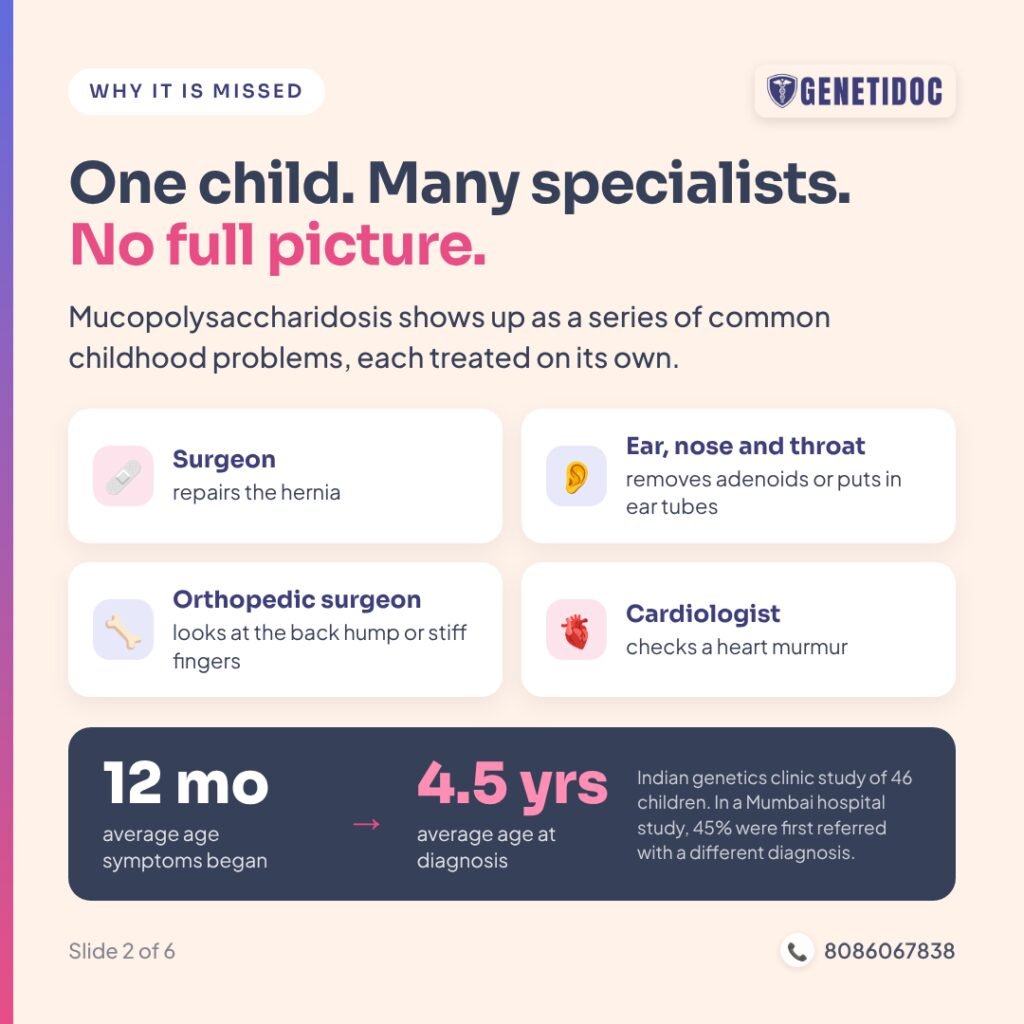
MPS rarely announces itself with one dramatic symptom. Instead, it shows up as a series of common childhood problems. Each one gets treated separately by a different specialist:
- The surgeon repairs the hernia.
- The ENT (ear, nose and throat) specialist removes the adenoids or puts in ear tubes.
- The orthopedic surgeon looks at the back hump or stiff fingers.
- The cardiologist checks a heart murmur.
Nobody sees the full picture, so the diagnosis is delayed.
Indian research shows how large this delay can be. In one Indian genetics clinic study of 46 children with MPS, symptoms began at an average age of 12 months, but the diagnosis came at an average age of 4.5 years. A study from a Mumbai public hospital found that 45% of children with confirmed MPS had first been referred with a different diagnosis.
International experts agree on the main lesson. A few early signs, such as a hump in the spine, are quite typical of MPS. Most others, such as hernias, airway infections and an enlarged liver, are common on their own. It is the combination of several common signs that should make a doctor search for one underlying cause.
“In MPS, the clue is not any single sign. It is the pattern. A hernia, snoring and frequent ear infections can each be ordinary. Together, in the same child, they are asking a question that someone needs to answer.”
— Dr. Roshan Daniel
12 Signs of Mucopolysaccharidosis Parents Should Not Ignore
Not every child with MPS has all of these signs. The type of MPS and how severe it is decide which signs appear and when. Use this list to notice patterns, not to diagnose your child at home.
- Hernias that keep coming back. A bulge near the belly button (umbilical hernia) or in the groin (inguinal hernia) is common in babies. A hernia that returns after surgery, or hernias on both sides, deserve a closer look.
- Noisy breathing, loud snoring or pauses in breathing during sleep. Stored material thickens the tissues of the nose, throat and airway. Many children have a constantly runny or blocked nose from early infancy.
- Frequent ear infections, “glue ear” and hearing loss. Repeated ear infections, especially those needing ear tubes, are among the most common early complaints.
- Frequent chest infections. The child seems to catch every cold and takes a long time to recover.
- A large head. The head may grow faster than expected in the first year.
- A swollen tummy. This often comes from an enlarged liver and spleen, which doctors call hepatosplenomegaly.
- A hump in the lower back. A sharp, angled hump where the upper and lower back meet is called a gibbus. It is one of the more specific early signs of MPS and is often noticed when the baby starts sitting.
- Stiff joints that are not painful or swollen. The child may be unable to raise their arms fully, or their fingers may curl and stiffen into a “claw hand.” Unlike childhood arthritis, the joints are usually not red, hot or painful. (In Morquio syndrome the opposite happens: joints can be unusually loose.)
- Facial features that slowly coarsen. Over months to years the face may become fuller, with thick lips, a large tongue, a broad nose and thick eyebrows. Parents often notice this only when they compare older photographs.
- Cloudy eyes. The clear front window of the eye (the cornea) can become hazy in several MPS types. The child may squint in bright light.
- Growth that slows down. Many children grow normally or even fast at first, then fall behind in height after the age of two or three.
- Speech delay, hyperactivity, poor sleep or loss of skills. This is the main early pattern in Sanfilippo syndrome (MPS III). It is covered in more detail below.
Other signs doctors look for include a heart murmur from thickened heart valves, frequent loose stools, and large bluish birthmarks (often called Mongolian spots) that are more widespread than usual.
A carpal tunnel problem in a child is another clue. This is pressure on a nerve at the wrist, and it is very unusual in childhood. A child may struggle with buttons or wake at night shaking their hands.
Signs by Age: When Parents Usually Notice
In the first year
- Hernias
- Constant runny or blocked nose
- Noisy breathing
- Repeated ear infections
- A large head
- A big tummy
- A back hump appearing when the baby starts to sit
In severe MPS I (Hurler syndrome), the first signs usually appear in the first months of life.
Between one and three years
- Stiffening joints
- Slower growth
- Coarsening face
- Snoring with breathing pauses
- Heart murmur
- Development that starts to lag
In Hurler syndrome, developmental delay is often apparent between 12 and 24 months. Signs of MPS II (Hunter syndrome) usually appear a little later than in MPS I.
Pre-school and school years
- Behavior problems
- Speech delay
- Sleep problems
- Loss of skills in Sanfilippo syndrome
- Skeletal changes such as knock knees and a short trunk in Morquio syndrome
- Joint stiffness and short height in milder forms of MPS I, II and VI
When Should You Worry? Patterns That Should Prompt a Genetics Referral
Ask your pediatrician about a referral to a clinical geneticist if your child has any of these combinations:
- Hernia (especially recurrent or on both sides) plus noisy breathing or frequent ear infections
- A back hump plus any other item from the list above
- Stiff, painless joints or “claw hands” in a young child
- Enlarged liver or spleen plus coarse facial features or slowing growth
- Speech delay with hyperactivity and severe sleep problems, especially if the child is losing skills they once had
- Short trunk, knock knees and a prominent breastbone with normal intelligence (possible Morquio syndrome)
- A brother, sister or cousin already diagnosed with MPS or another storage disorder
- Parents who are blood relatives (for example, cousins) and a child with several of the signs above
When MPS Testing May Not Be Needed

Testing is not useful for every child with one common problem. These on their own are usually not reasons for MPS testing:
- A single umbilical hernia in an otherwise healthy, growing baby
- Snoring from enlarged adenoids in a child who is developing well
- A child who is short like their parents but growing steadily
- Occasional colds and ear infections, which most young children get
A clinical geneticist can examine your child and decide whether the overall picture fits MPS. This avoids both unnecessary testing and false reassurance.
Types of MPS at a Glance
Each type of MPS is caused by a different missing enzyme and a different gene. The common names come from the doctors who first described them. Severity varies a lot even within one type. Each type has a severe form and a milder (attenuated) form, depending on how much enzyme activity remains.
| Type | Common name | Gene | Typical early signs |
| MPS I | Hurler (severe); Hurler-Scheie and Scheie (milder) | IDUA | Hernias, noisy breathing, back hump, cloudy corneas, stiff joints, developmental delay in severe form |
| MPS II | Hunter | IDS | Similar to MPS I but usually clear corneas; mainly affects boys |
| MPS III (A–D) | Sanfilippo | SGSH, NAGLU, HGSNAT, GNS | Speech delay, hyperactivity, sleep problems, later loss of skills; few physical signs |
| MPS IV (A, B) | Morquio | GALNS, GLB1 | Short trunk, knock knees, prominent breastbone, loose joints; intelligence usually normal |
| MPS VI | Maroteaux-Lamy | ARSB | Stiff joints, short stature, cloudy corneas, heart valve disease; intelligence usually normal |
| MPS VII | Sly | GUSB | Very variable; severe cases may show fluid build-up before birth |
Indian clinic data show MPS II as the most common type, followed by MPS I and MPS IVA.
Sanfilippo Syndrome: The Type That Can Look Like Autism
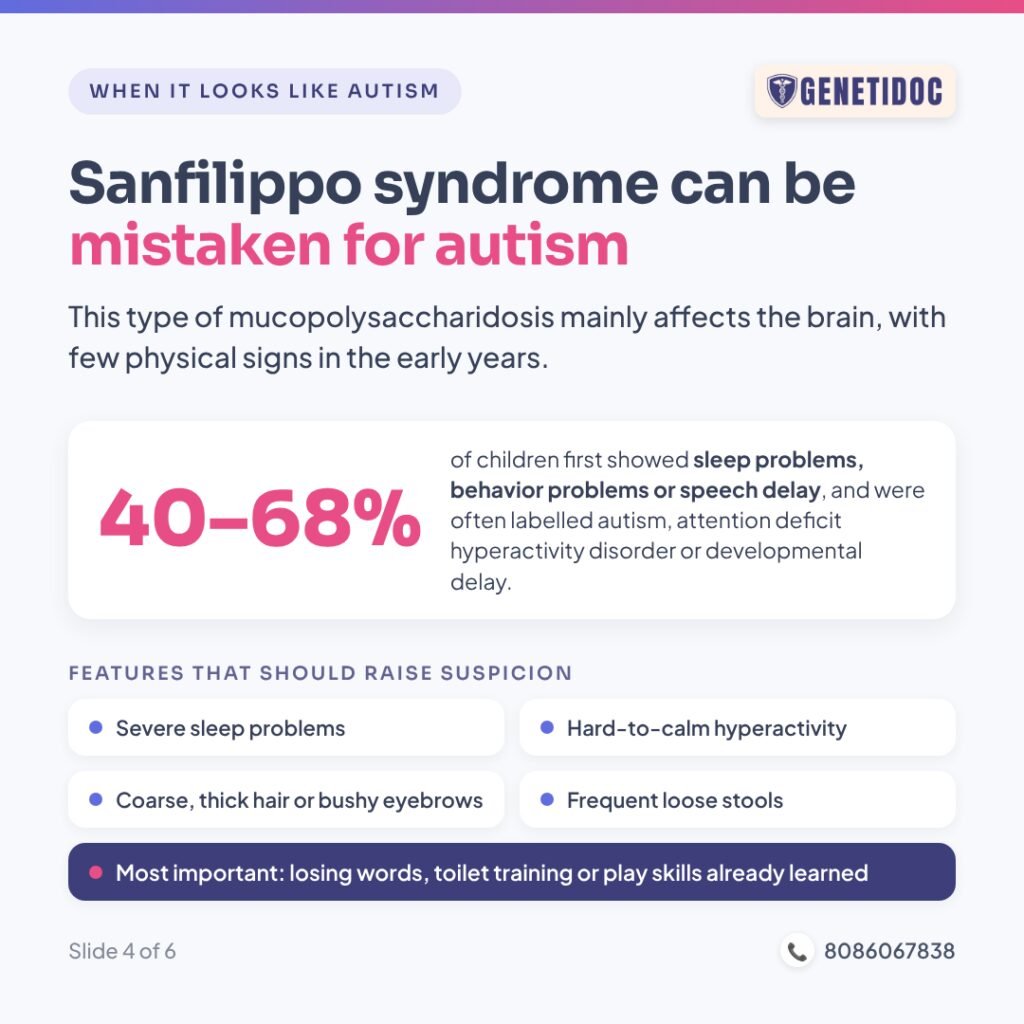
Sanfilippo syndrome (MPS III) mainly affects the brain. Children often have few physical signs in the early years. Studies of children with MPS III show that in 40% to 68% of cases, the first signs were sleep problems, behavior problems or speech delay. As a result, these children are often first labelled with autism, attention deficit hyperactivity disorder or “simple” developmental delay.
Features that should raise suspicion include:
- Severe sleep problems
- Restless, hard-to-calm hyperactivity
- Coarse, thick hair or bushy eyebrows
- Frequent loose stools
- Most importantly, losing skills such as words, toilet training or play that the child had already learned
Morquio Syndrome: Bones First, Brain Spared
Morquio syndrome (MPS IV) mainly affects the skeleton. Children usually have normal intelligence. Parents may notice:
- A short trunk
- Knock knees
- A breastbone that sticks out
- A waddling walk
- Unusually loose wrists
The bones of the neck can be unstable. This matters greatly during anesthesia and surgery, so an early diagnosis protects the child.
How Is MPS Inherited?
Understanding inheritance helps families make sense of how a condition can appear “out of nowhere.” It also explains why other family members may need testing.
Autosomal recessive types (MPS I, III, IV, VI, VII)
In these types, a child is affected only when they inherit a non-working copy of the gene from both parents. Each parent is a carrier. Carriers have one working and one non-working copy, so they are healthy and usually have no idea they carry the change. When both parents are carriers, each pregnancy has:
- a 1 in 4 (25%) chance of an affected child
- a 1 in 2 (50%) chance of a carrier child
- a 1 in 4 (25%) chance of a child who is neither affected nor a carrier
Indian context: Marriages between blood relatives, such as cousin marriages, are common in many Indian communities. Relatives are more likely to carry the same rare gene change, which raises the chance of recessive conditions such as MPS. This is not a reason for blame. It is a reason for awareness and, where appropriate, carrier testing before pregnancy.
X-linked type (MPS II, Hunter syndrome)
The IDS gene sits on the X chromosome. Boys have one X chromosome, so a single non-working copy causes the condition. That is why Hunter syndrome affects mostly boys.
A mother who carries the change has, in each pregnancy:
- a 50% chance of passing it on
- so, on average, half her sons may be affected
- and half her daughters may be carriers
Sometimes the gene change arises new in the child, and the mother is not a carrier. Testing the mother tells the family which situation applies. Her sisters and other female relatives may also wish to consider carrier testing.
“No parent causes MPS by anything they did or did not do during pregnancy. These are gene changes passed silently through generations. What families can do is use the diagnosis wisely, for their child and for future pregnancies.”
— Dr. Roshan Daniel
How Is MPS Diagnosed? Step by Step
A reliable MPS diagnosis is built in layers. Each step answers a different question.
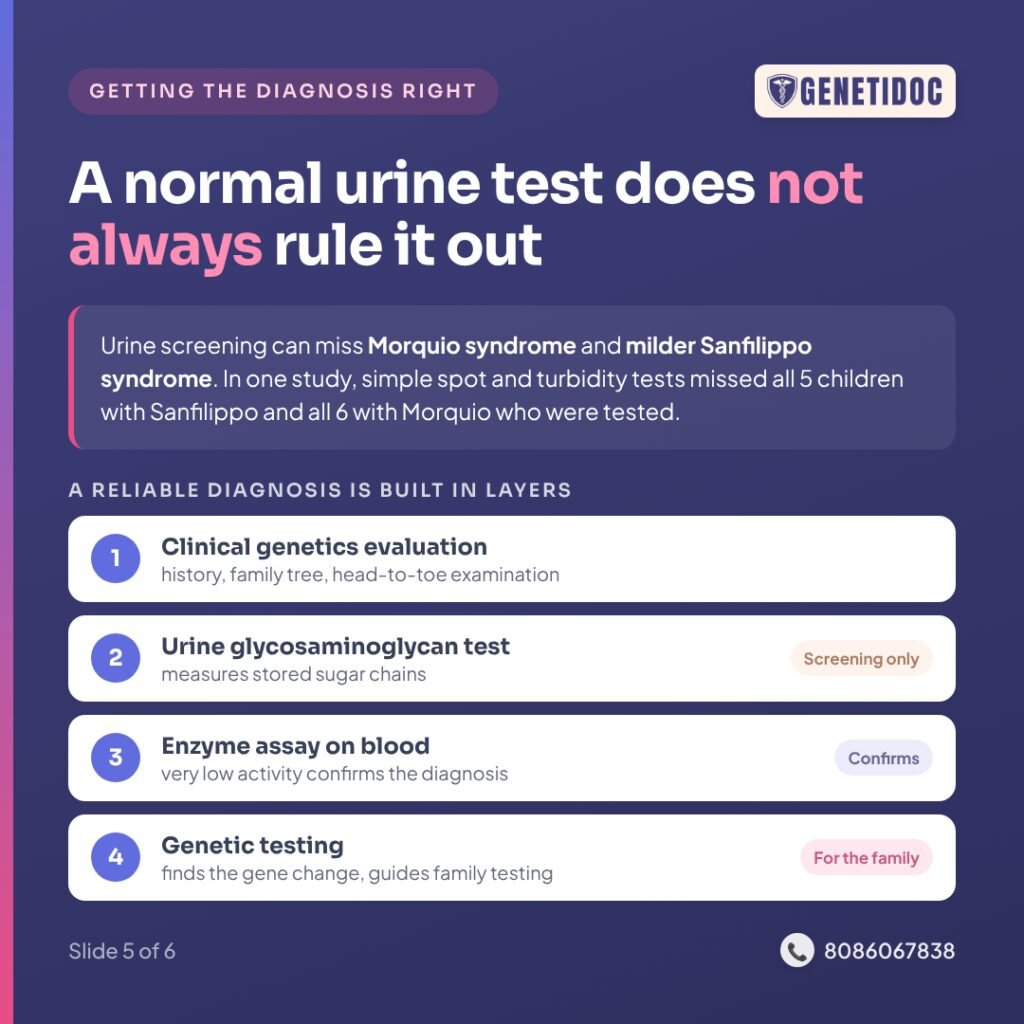
- Clinical evaluation by a clinical geneticist. A detailed history, family tree and head-to-toe examination. The geneticist asks whether the pattern fits MPS, which type is most likely, and what else could explain it.
- X-rays (skeletal survey). MPS causes a recognizable pattern of bone changes that doctors call dysostosis multiplex. It can support the suspicion.
- Urine glycosaminoglycan test. This measures the stored sugar chains in urine. A good laboratory checks both the amount and the pattern of these sugar chains, which hints at the type. This is a screening step only.
- Enzyme assay. This test measures the activity of the specific enzyme in a blood sample (white blood cells, plasma or a dried blood spot). Very low activity confirms the biochemical diagnosis. The enzyme assay remains central to diagnosing MPS.
- Genetic testing. This finds the gene change responsible. It confirms the diagnosis, can help predict severity in some types, and is essential for testing relatives and planning future pregnancies.
Sometimes, when the picture overlaps with other conditions, the geneticist may go straight to a broader enzyme panel or a multi-gene panel.
Why a Normal Urine Test Does Not Always Rule Out MPS
A “normal” urine screening report can falsely reassure a family. Here is why:
- Morquio syndrome (MPS IV) mainly stores a sugar chain called keratan sulfate. The common urine screening methods do not react with it well, so the total amount can look normal even when the child is affected.
- Milder Sanfilippo syndrome (MPS III) also has a relatively high rate of false-negative urine screens.
- Dilute urine or the method used can also affect results.
One study found that simple spot and turbidity screening tests missed all five children with Sanfilippo syndrome and all six with Morquio syndrome who were tested. Another Indian laboratory study found that measuring the amount of urine sugar chains alone would have missed 60 children with MPS who excreted only small amounts.
The opposite can also happen. Some children without MPS have high urine levels, which causes false alarms. Urine testing must always be followed by enzyme testing when the clinical suspicion is real.
Why Interpretation Matters as Much as the Test
An MPS report is not always straightforward. Experienced interpretation matters in situations like these:
- Some healthy people carry harmless gene variants that make an enzyme look low in the laboratory, even though it works well enough in the body. Without careful interpretation and genetic confirmation, this could lead to a wrong diagnosis.
- Look-alike conditions. Mucolipidosis and multiple sulfatase deficiency can mimic MPS. In multiple sulfatase deficiency, several enzymes are low at once, so a single low enzyme result can point to the wrong diagnosis. The laboratory must check related enzymes too.
- Variants of uncertain significance. Genetic testing may find a gene change whose effect is not yet known. Such a result needs to be weighed against the enzyme result and the child’s features. It is not a diagnosis by itself.
“A report is only as useful as the reasoning behind it. In MPS, choosing the right test in the right order, using a quality laboratory, and reading the result against the child in front of you is what turns a number on paper into a diagnosis a family can act on.”
— Dr. Roshan Daniel
Cost and Turnaround in India
Costs vary depending on which tests are needed and in what order:
- Urine screening is the simplest step.
- Enzyme assays are more specialized.
- Genetic testing costs depend on whether a single gene or a larger panel is tested.
Results for enzyme and genetic tests usually take a few weeks. Your genetic counselor will explain the expected costs and timelines for your child’s specific tests before anything is ordered.
Cheaper is not always better. A low-cost urine test done alone, without enzyme confirmation and expert interpretation, can delay the right diagnosis by months or years. In MPS, those months can matter for treatment.
Why Early Diagnosis Changes Everything
MPS cannot yet be cured. Even so, a timely diagnosis changes a great deal for the child and family.
1. It opens treatment windows that close with time
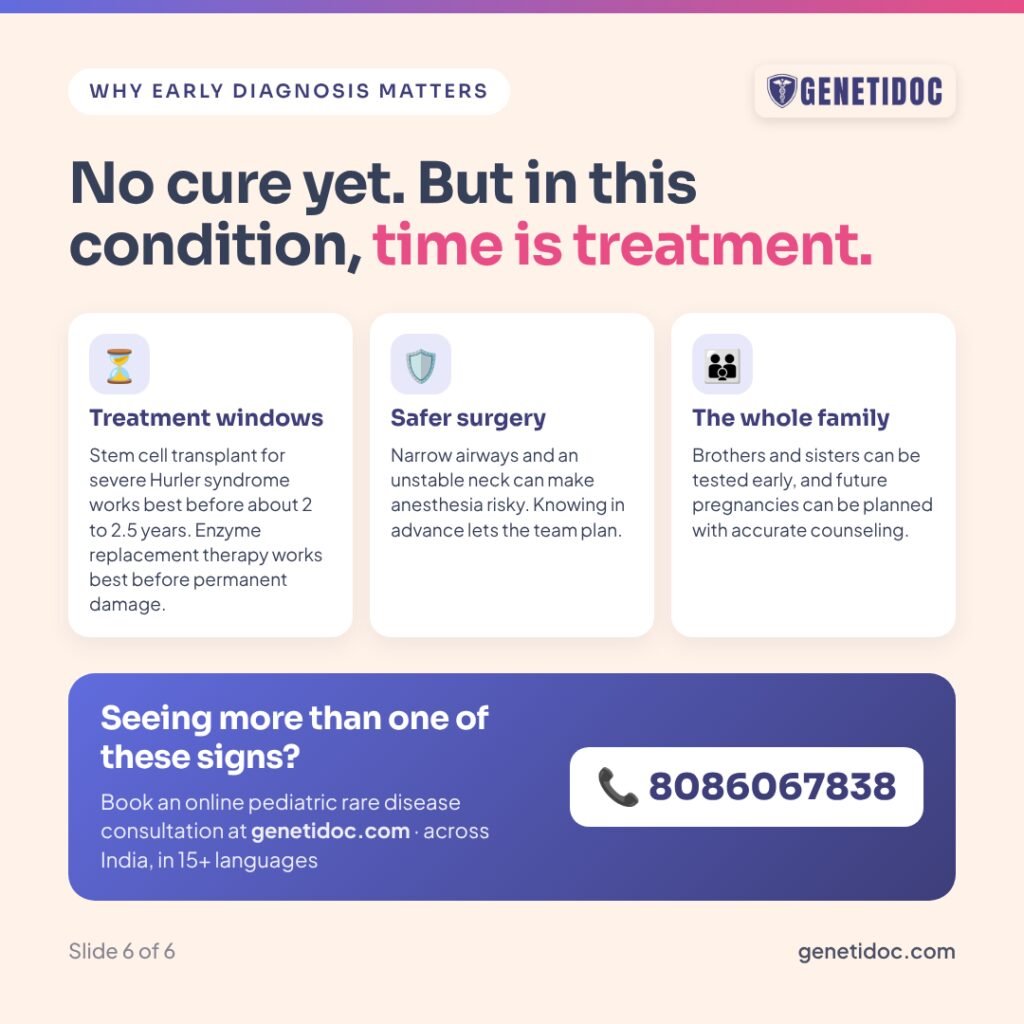
- Hematopoietic stem cell transplantation (HSCT), also called bone marrow transplant, is the preferred treatment for severe MPS I (Hurler syndrome). It works best when done before about 2 to 2.5 years of age, ideally before significant developmental delay sets in. Donor cells then make the missing enzyme for the rest of the child’s life. Diagnosis after that window can mean this option is no longer effective for protecting the brain.
- Enzyme replacement therapy (ERT) gives the missing enzyme through a drip into a vein, usually every week, for life. It is available for MPS I, II, IVA, VI and VII. ERT can improve breathing, liver and spleen size, walking ability and energy levels, and works best when started before permanent damage occurs. Current ERT does not reach the brain well, so it does not prevent the brain effects of severe forms.
2. It makes surgery and anesthesia safer
Children with MPS often have narrow, floppy airways, and some have an unstable neck. These children can be very difficult to put to sleep for surgery. Once doctors know a child has MPS, the anesthesia team can plan carefully in advance. Many children with undiagnosed MPS have already had hernia repairs or adenoid surgery without that knowledge.
3. It brings the right specialists together
MPS affects many organs, so care needs a team:
- Regular checks of hearing, vision, heart, breathing during sleep and the spine
- Physiotherapy for stiff joints
- Hearing aids
- Treatment for sleep apnea
- Timely surgery for carpal tunnel or spinal problems
Together, these improve comfort and daily function.
4. It gives honest answers about the future
Outlook depends on the type and severity. Untreated severe forms can shorten life significantly. Milder forms may allow adulthood, education and work, with ongoing medical care. A clear diagnosis lets families plan schooling, therapy and support realistically rather than waiting and wondering.
Treatment Access in India: The National Policy for Rare Diseases
ERT is very expensive. Because doses depend on body weight, it can cost many lakhs of rupees each year. Families in India can seek support under the National Policy for Rare Diseases, 2021, launched by the Ministry of Health and Family Welfare:
- Several types of MPS are listed under the policy, including MPS I, the attenuated form of MPS II, and MPS IVA and MPS VI before complications develop.
- Financial assistance of up to ₹50 lakh per patient is provided for treatment at notified Centres of Excellence.
- A government crowdfunding portal exists for patients whose treatment costs exceed this support.
Your geneticist can guide you on documentation and referral to the nearest Centre of Excellence.
For MPS III, no disease-specific treatment is widely available in India yet, although gene therapies and other approaches are being studied in clinical trials worldwide. Even so, diagnosis still matters. It ends the search for answers, guides supportive care for sleep and behavior, opens access to research studies, and allows accurate counseling for the family’s future pregnancies.
What an MPS Diagnosis Means for Your Family
An MPS diagnosis affects more than one child. Genetic counseling helps families understand and act on these implications:
- Brothers and sisters of the affected child may also be affected but too young to show signs. Testing them early can mean earlier treatment.
- Future pregnancies: Once the family’s gene change is known, parents can choose prenatal diagnosis in a future pregnancy. This uses chorionic villus sampling (a small sample of the placenta) or amniocentesis (a small sample of the fluid around the baby). Couples going through IVF can also consider preimplantation genetic testing, which tests embryos before transfer. Genetidoc counsels families on these options and coordinates referral to centres that perform these procedures.
- Extended family: In MPS II, the mother’s sisters and female cousins may be carriers. In recessive types, adult brothers and sisters of the parents may wish to consider carrier testing before planning their own families, particularly in communities where marriages between relatives are common.
Every decision remains the family’s own. The role of genetic counseling is to inform, never to direct.
Illustrative Examples
These scenarios are composites based on presentations commonly described in published literature. They do not describe individual patients.
Example 1: The hernia, the snoring and the back hump
A 13-month-old boy has had an umbilical hernia repaired, then a groin hernia on the other side. He snores loudly, has had four ear infections, and his parents notice a small hump in his lower back when he sits. An orthopedic surgeon suspects a spine problem and refers him to a clinical geneticist.
Urine testing, an enzyme assay and genetic testing confirm severe MPS I (Hurler syndrome). Because he is diagnosed before age two, he is referred for evaluation for stem cell transplantation while that window is still open. His parents are offered counseling about a 25% recurrence risk and prenatal diagnosis in future pregnancies.
Example 2: “Autism” that was something else
A four-year-old girl has delayed speech, severe hyperactivity and sleeps only a few hours a night. She was diagnosed with autism at three. Over the past year she has stopped using words she once knew. A clinical geneticist notices thick, coarse hair and a slightly enlarged liver.
Her earlier urine screening was reported as normal. Enzyme testing and genetic testing, however, confirm Sanfilippo syndrome (MPS III). The diagnosis changes her care plan, gives the family a clear explanation, and allows them to make informed choices about future pregnancies.
Example 3: One diagnosis, three families helped
A three-year-old boy is diagnosed with Hunter syndrome (MPS II) and starts enzyme replacement therapy. His mother is tested and found to be a carrier.
Her younger sister, who is planning a pregnancy, chooses carrier testing after counseling. Her cousin’s family, who have a son with unexplained hearing loss and stiff joints, seek an evaluation. A single diagnosis has given three branches of the family information they can act on.
Common Myths About MPS
- Myth: “He will grow out of it.” MPS is progressive. Waiting allows damage to build up and can close treatment windows.
- Myth: “The urine test was normal, so it is not MPS.” Urine screening can miss Morquio syndrome and milder Sanfilippo syndrome. Enzyme testing is needed when the clinical picture fits.
- Myth: “Nobody in our family has this, so it cannot be genetic.” Carrier parents are healthy. Recessive conditions often appear with no previous family history.
- Myth: “Something I ate or did in pregnancy caused this.” MPS is caused by inherited gene changes, not by anything during pregnancy.
- Myth: “If there is no cure, there is no point in testing.” Diagnosis enables treatment where available, safer surgery, better supportive care, accurate counseling and testing of relatives.
What to Do If You Are Worried About Your Child
- Write down what you have noticed and when. Note hernias, surgeries, infections, snoring, growth, development and behavior changes.
- Gather old photographs. Pictures from birth onwards help show slow changes in facial features and posture.
- Collect all previous reports. Bring X-rays, scan reports, hearing tests, echo reports and any urine or blood tests already done.
- Draw a simple family tree. Include relatives with similar problems, early childhood deaths, and whether the parents are related by blood.
- Ask your pediatrician directly: “Could these problems be connected? Should we see a clinical geneticist?”
- Before any planned surgery, tell the surgeon and anesthetist if MPS is suspected, even if it is not yet confirmed.
- Do not rely on a single low-cost screening test. Make sure an expert decides which tests are needed and interprets the results.
“I often tell parents: you do not need to be certain before you ask. If several of these signs feel familiar, an evaluation is the right step. In the best case you gain peace of mind. In the other case, you gain time, and in MPS, time is treatment.”
— Dr. Roshan Daniel
How Genetic Counseling Helps Families Facing MPS
A diagnosis of MPS can feel overwhelming. Parents often carry fear, guilt and many unanswered questions. Genetic counseling provides a structured space to understand:
- What the diagnosis means
- Which treatments fit their child’s type and age
- How to access support under the national policy
- What the condition means for brothers, sisters and relatives
- What choices exist for future pregnancies
At Genetidoc, every test is chosen and interpreted by clinical geneticists who are super-specialized in Medical Genetics. Counseling is built into every result, both before testing and after the report arrives. Consultations are available online across India in more than 15 languages, with home sample collection. This means families do not have to travel just to begin answering their questions. When a physical examination is needed, an in-person visit can be arranged.
Key Takeaways
- MPS is a group of rare, inherited, progressive conditions in which sugar chains build up in the body’s cells.
- Early signs are often common childhood problems: hernias, snoring, ear infections, a big tummy. The pattern matters more than any single sign.
- A back hump, stiff painless joints, cloudy eyes and slowing growth are stronger clues.
- Sanfilippo syndrome can look like autism or hyperactivity. Loss of skills is a red flag.
- A normal urine test does not always rule out MPS. Enzyme testing and genetic testing confirm the diagnosis.
- Early diagnosis opens treatment windows, makes surgery safer, and guides care, support and family planning.
- Indian families can seek treatment support under the National Policy for Rare Diseases, 2021.
Seeing more than one of these signs in your child?
If your child has had repeated hernias, noisy breathing, a back hump, stiffening joints, or speech and behavior changes that do not fit, a clinical geneticist can tell you whether MPS needs to be considered. They can also tell you which tests will give a reliable answer.
Frequently Asked Questions About Mucopolysaccharidosis
What is the first sign of mucopolysaccharidosis?
There is no single first sign. In many children, the earliest problems are hernias, a constantly blocked nose, noisy breathing and frequent ear infections in the first year. In Sanfilippo syndrome, the first signs are often speech delay, hyperactivity and sleep problems.
At what age does MPS show symptoms?
Severe forms usually show signs in the first months to two years of life. Milder forms may not be noticed until later childhood, adolescence or even adulthood. Most babies look normal at birth.
Is MPS curable?
There is no cure yet. Treatments such as enzyme replacement therapy and, for severe MPS I, stem cell transplantation can slow the disease and improve quality of life, especially when started early.
How is MPS diagnosed in India?
Diagnosis begins with an evaluation by a clinical geneticist, followed by a urine glycosaminoglycan test, an enzyme assay on blood, and genetic testing to confirm the gene change. Enzyme and genetic testing are both widely available in India.
Can a normal urine test rule out MPS?
No. Urine screening can miss Morquio syndrome and milder Sanfilippo syndrome. If the clinical signs suggest MPS, enzyme testing should be done even when the urine test is normal.
Is MPS the same as autism?
No. However, Sanfilippo syndrome (MPS III) can cause speech delay and behavior problems that look like autism or hyperactivity. Loss of previously learned skills, severe sleep problems and coarse hair are clues that suggest MPS III.
Is MPS inherited from the mother or the father?
Most types need a gene change from both parents, who are healthy carriers. Hunter syndrome (MPS II) is X-linked, so it is usually passed from a carrier mother to her son, although it can also arise as a new change.
What is the chance of MPS in our next baby?
For most types, when both parents are carriers, the chance is 1 in 4 (25%) in each pregnancy. For Hunter syndrome, a carrier mother has a 50% chance of passing the gene change to each child. Genetic counseling gives your family’s exact risk.
Can MPS be detected during pregnancy?
Yes, if the family’s gene change is already known. It can be tested through chorionic villus sampling or amniocentesis. Couples using IVF can also consider preimplantation genetic testing of embryos.
Is MPS treatment covered by the government in India?
Several MPS types are included in the National Policy for Rare Diseases, 2021. This provides financial assistance of up to ₹50 lakh per patient for treatment at notified Centres of Excellence.
Does cousin marriage increase the risk of MPS?
Yes. Most MPS types are recessive, and relatives are more likely to carry the same gene change. Couples who are related by blood can consider carrier testing before pregnancy.
Which doctor should I see if I suspect MPS?
Start with your pediatrician and ask for a referral to a clinical geneticist. A clinical geneticist can connect the different signs, choose the right tests, interpret the results and coordinate care with other specialists.
Join the Conversation
Have questions about rare genetic conditions or want to connect with other families? Visit the Genetidoc Rare Disease Forum at genetidoc.com/rarediseaseforum/.
Related Reading
- Genetic Causes of Intellectual Disability: A Complete Guide for Indian Families
- Seizures in Infancy: When Genetic Testing Helps
- Twin Pregnancy and Genetic Screening: A Complete Guide for Expecting Parents in India
- Chimerism: When One Person Carries Two Sets of DNA
- Male BRCA Carriers: An Overlooked Risk Group
References
- Galimberti C, Madeo A, Di Rocco M, Fiumara A. Mucopolysaccharidoses: early diagnostic signs in infants and children. Italian Journal of Pediatrics. 2018;44(Suppl 2). doi:10.1186/s13052-018-0550-5
- Swetha P, Panigrahi I, Saxena A, Kaur A, Thakur R. Clinical and Radiological Characterisation of Patients with Mucopolysaccharidosis in a Genetic Clinic. Journal of Inborn Errors of Metabolism and Screening. 2021;9. doi:10.1590/2326-4594-jiems-2020-0008
- Diagnosis is in the Eye of the Beholder: Barriers to Early Diagnosis of Mucopolysaccharidosis in Children in India. Journal of Pediatric Genetics (Thieme). PMCID: PMC8608481
- Algorithm for the Early Diagnosis of Mucopolysaccharidosis III. Journal of Inborn Errors of Metabolism and Screening.
- Filocamo M, Tomanin R, Bertola F, Morrone A. Biochemical and molecular analysis in mucopolysaccharidoses: what a paediatrician must know. Italian Journal of Pediatrics. 2018;44(Suppl 2). PMCID: PMC6238298
- MPS screening methods, the Berry spot and acid turbidity tests, cause a high incidence of false-negative results in Sanfilippo and Morquio syndromes. PMCID: PMC6808023
- Parini R, Deodato F, Di Rocco M, et al. Open issues in Mucopolysaccharidosis type I-Hurler. Orphanet Journal of Rare Diseases. 2017;12:112.
- Clarke LA, et al. Mucopolysaccharidosis Type I. In: GeneReviews®. University of Washington, Seattle.
- Scarpa M, et al. Mucopolysaccharidosis Type II. In: GeneReviews®. University of Washington, Seattle.
- Ministry of Health and Family Welfare, Government of India. Details of National Policy for Rare Diseases (press release, August 2024). mohfw.gov.in
This article is for educational purposes and does not replace a medical consultation. If you are concerned about your child’s health, please consult your pediatrician or a clinical geneticist.