
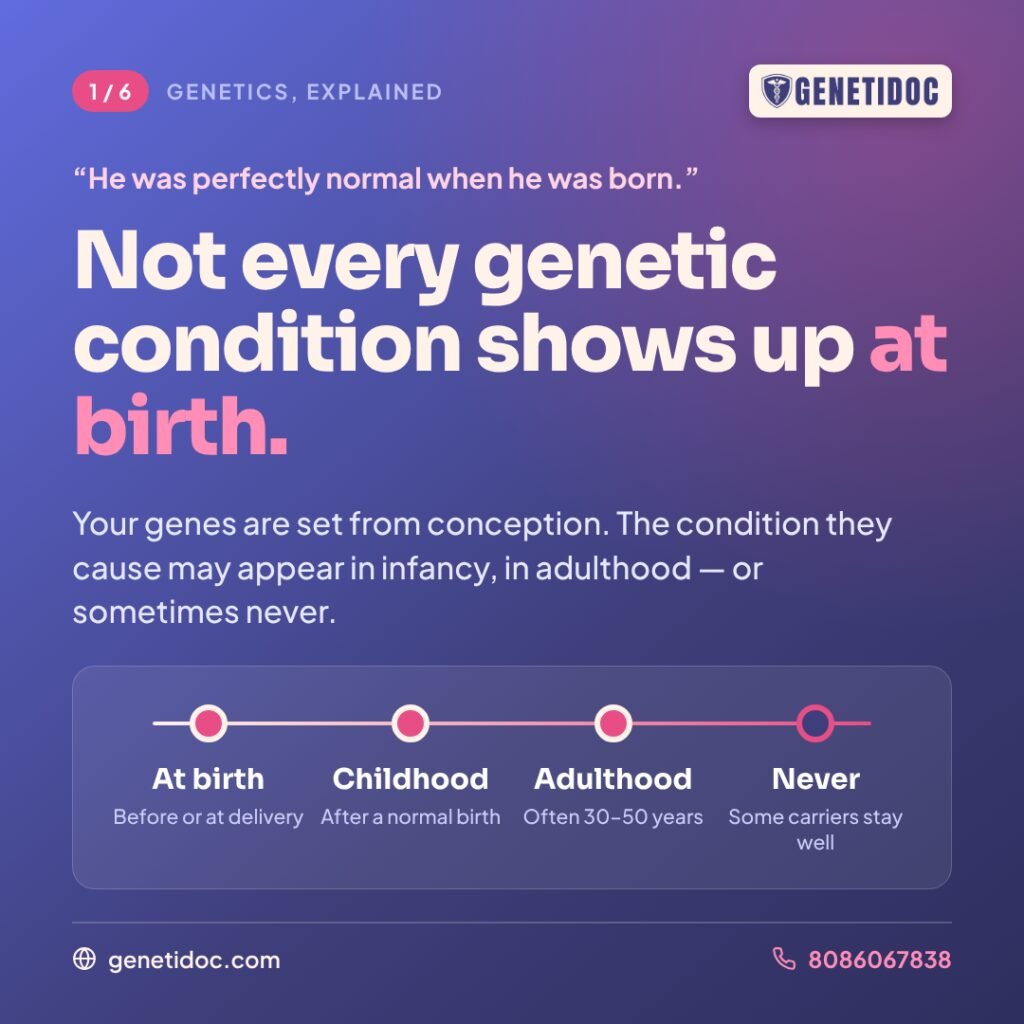
“He was perfectly normal when he was born.” “I’m 40 and I’ve never been ill.” “Nobody in our family had this.” These are some of the most common things families say when they first hear that a condition may be genetic.
It is a very natural assumption. If something is written in our genes, surely it should show from the first day of life?
The real picture is different, and understanding it can change how you think about your own health and your family’s. This article explains why many genetic conditions appear only later in life, the difference between “genetic”, “congenital” and “hereditary”, which conditions commonly appear in childhood or adulthood, and when genetic testing can help someone who is healthy today.
Quick answer
No. Not all genetic conditions are present from birth. Any genetic change you inherit is present from the moment of conception, but the condition it causes may appear at birth, in childhood, in adulthood, or sometimes never. Some genetic changes are not inherited at all and are acquired during life, which is how most cancers develop. A healthy childhood or a healthy adult life does not rule out a genetic condition.
Genetic, Congenital and Hereditary: Three Words That Mean Different Things
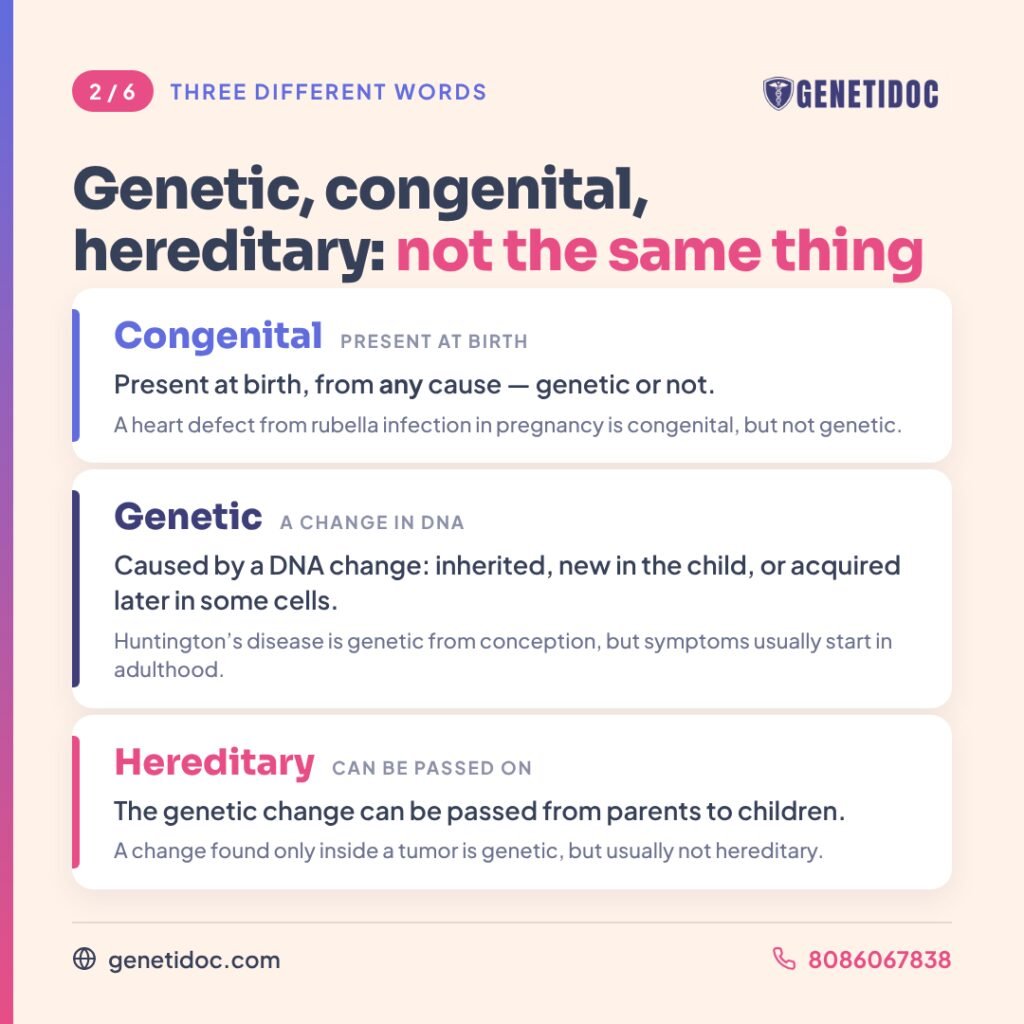
Much of the confusion comes from three words that are often used as if they mean the same thing. They do not.
- Congenital means present at birth. A congenital condition can have a genetic cause, such as Down syndrome, or a non-genetic cause, such as an infection during pregnancy or a problem with how the baby was positioned in the womb.
- Genetic means caused by a change in DNA. That change may be inherited from a parent, or it may have happened for the first time in the child (a de novo change). Some genetic changes also arise later in life in particular cells of the body.
- Hereditary (or inherited) means the genetic change can be passed from parents to children.
Putting these together:
- A condition can be genetic but not congenital. Huntington’s disease is caused by an inherited change present from conception, but symptoms usually begin in adulthood.
- A condition can be congenital but not genetic. A heart defect caused by rubella infection in pregnancy is present at birth but not caused by the baby’s genes.
- A condition can be genetic but not hereditary. A de novo change, or a change acquired in a tumor, may not have come from either parent.
Your Genes Are Set From Conception. Your Symptoms Are Not.
The DNA you inherit from your parents is in place from the very first cell. It does not switch on or off at a fixed birthday, and it does not “change” as you grow older. So why can a condition stay hidden for 5, 20 or even 50 years?
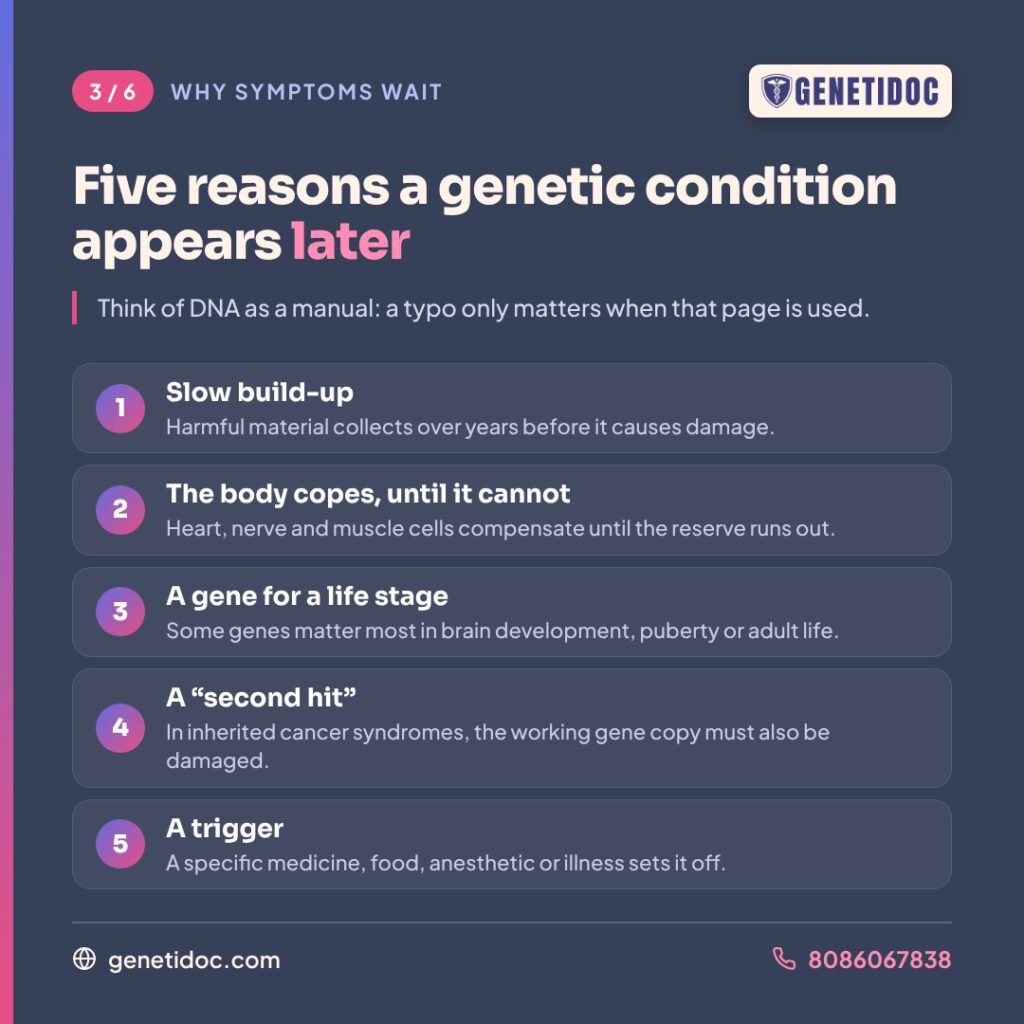
A simple way to think about it: your DNA is like an instruction manual. A typing error on a page only causes a problem when that page is actually used, or when the error has been repeated so many times that damage finally becomes visible.
5 reasons a genetic condition may appear later in life
- Slow build-up of damage. In some conditions, a faulty protein or a harmful substance builds up gradually. In Huntington’s disease, an abnormal protein slowly damages nerve cells over decades. In some metabolic conditions, such as mucopolysaccharidosis, undigested material collects in body tissues month by month after birth.
- The body copes, until it cannot. Heart muscle, nerve and muscle cells can often compensate for a genetic weakness for many years. Symptoms appear when that reserve is used up. This is common in inherited heart muscle conditions (cardiomyopathies).
- The gene matters at a particular stage of life. Some genes are most active during certain stages of development, such as early brain development, puberty or adult life. A problem in that gene shows itself when that stage arrives.
- A “second hit” is needed. In many hereditary cancer syndromes, a person is born with one faulty copy of a protective gene in every cell. Cancer develops only when the second, working copy is damaged in a particular cell during life. This idea, first described by Dr. Alfred Knudson in 1971, explains why people with an inherited cancer gene are born healthy but develop cancer earlier and more often than others.
- A trigger is needed. Some genetic conditions cause no problem at all until the body meets a specific trigger, such as a particular medicine, food, anesthetic or severe illness.
When Do Genetic Conditions Appear? Four Broad Timings
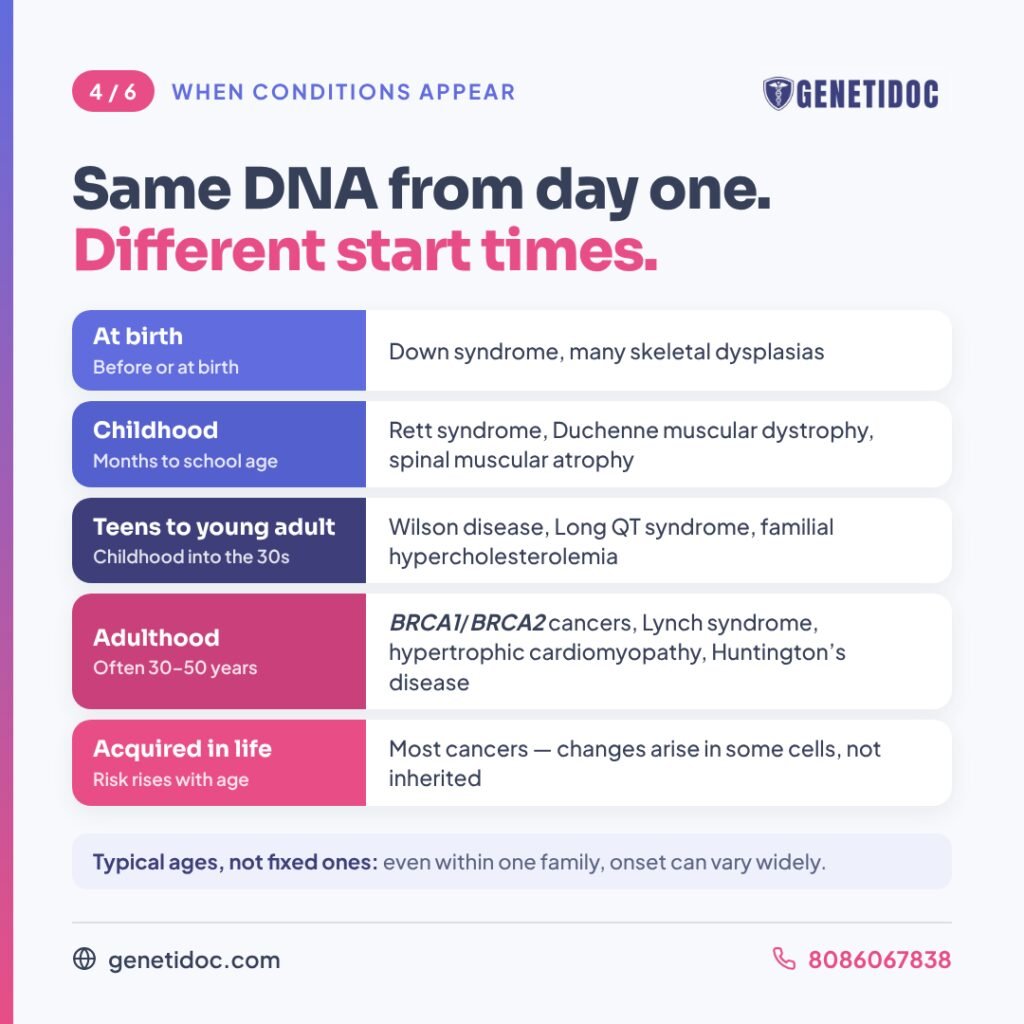
Genetic conditions can be grouped into four broad categories by when they usually become noticeable:
- Present at birth (congenital): visible at or before birth, often on pregnancy scans.
- Childhood-onset: the baby appears healthy, and symptoms develop in infancy or childhood.
- Adult-onset: symptoms usually begin in adulthood, sometimes in middle or older age.
- Acquired during life: the genetic change is not inherited but arises in some cells over time.
| Timing | Examples | Typical age symptoms appear |
| Present at birth | Down syndrome, many skeletal dysplasias, some congenital heart defects | Before or at birth |
| Infancy and childhood | Rett syndrome, Duchenne muscular dystrophy, mucopolysaccharidosis, spinal muscular atrophy types 1–3 | From a few months to early school age |
| Childhood to young adulthood | Wilson disease, Marfan syndrome complications, Long QT syndrome, familial hypercholesterolemia (raised cholesterol from childhood, heart disease later) | Variable, often from childhood into the 30s |
| Adulthood | Hereditary breast and ovarian cancer (BRCA1, BRCA2), Lynch syndrome, hypertrophic cardiomyopathy, Huntington’s disease, spinocerebellar ataxias, early-onset familial Alzheimer’s disease | Usually from the 20s onwards, often 30–50 years |
| Acquired during life | Most cancers, age-related changes in blood cells | Risk rises with age |
These ages are typical, not fixed. Even within one family, the same condition can begin at very different ages.
Genetic Conditions That Appear in Childhood
Many parents are surprised to learn that a baby who was healthy at birth can later develop a genetic condition. In these conditions, the genetic change was always there. The signs simply take time to appear.
- Rett syndrome: mostly affects girls. Development often seems normal for the first 6 to 18 months, followed by loss of speech and purposeful hand use.
- Duchenne muscular dystrophy: affects mainly boys. Signs such as late walking, frequent falls, difficulty climbing stairs or pushing on the thighs to stand up usually appear between 2 and 5 years of age.
- Mucopolysaccharidosis: babies often look normal at birth. Coarsening of facial features, a large liver or spleen, joint stiffness or slowing development usually appear in the first few years.
- Spinal muscular atrophy: the age of onset depends on the type. Type 1 begins before 6 months, type 2 between 6 and 18 months, type 3 after 18 months, and type 4 in adulthood.
- Wilson disease: a condition in which copper builds up in the liver and brain. Symptoms usually begin somewhere between childhood and early adulthood.
Illustrative example (not a real patient): A 4-year-old boy walked later than his cousins and now struggles to climb stairs. His parents had been told he was “just a little lazy”. A blood test shows a very high level of creatine kinase, a muscle enzyme, and genetic testing of the DMD gene confirms Duchenne muscular dystrophy. He was born with the condition, but it only became visible as his muscles were asked to do more.
Genetic Conditions That Appear in Adulthood
Adult-onset genetic conditions are where the “but I’m healthy” assumption is most often wrong. In our practice, two areas stand out.
Hereditary cancer syndromes
Conditions such as hereditary breast and ovarian cancer (linked to BRCA1 and BRCA2), Lynch syndrome and Li-Fraumeni syndrome are present from conception, but cancer usually develops in adulthood. People with these conditions have a higher lifetime risk, and cancers often appear at a younger age than usual. Most hereditary cancer conditions are adult-onset, which is why testing of children for them is usually deferred until 18.
Inherited heart conditions
Inherited heart rhythm conditions (channelopathies), such as Long QT syndrome and Brugada syndrome, and inherited heart muscle conditions, such as hypertrophic cardiomyopathy, can remain silent for years. Sometimes the first sign is a sudden collapse or sudden death in a young adult.
“One of the most common reasons families come to us is a history of young relatives who died suddenly, usually recorded as a ‘heart attack’. Many of these were sudden deaths that may have had an inherited cause. Many relatives also believe that a normal ECG means they are safe, and that is not always true.”
— Team Genetidoc
Illustrative example (not a real patient): A 38-year-old woman feels completely well. Her father died suddenly at 45, and the family always called it a heart attack. Her electrocardiogram (ECG) is normal. Genetic testing with a cardiac panel finds a disease-causing variant linked to hypertrophic cardiomyopathy. She is referred to a cardiologist for regular monitoring, and her brother and teenage son are offered targeted testing for the same variant at the appropriate age.
Familial hypercholesterolemia
Familial hypercholesterolemia is an inherited condition causing very high levels of “bad” cholesterol (low-density lipoprotein cholesterol) from birth. The person usually feels well, often for decades, but the risk of an early heart attack is much higher. Genetic testing is generally offered when this cholesterol is above 190 mg/dL in adults or above 160 mg/dL in children.
“We often hear, ‘I’m fit, so I can’t have a cholesterol problem.’ Familial hypercholesterolemia does not care how fit you are. It is inherited, it is present from birth, and diet alone usually cannot fix it.”
— Team Genetidoc
Neurological conditions in adults
Some genetic conditions affecting the brain and nerves usually begin in adulthood:
- Huntington’s disease: causes changes in movement, thinking and mood, usually beginning between the ages of 30 and 50.
- Spinocerebellar ataxias: a group of conditions affecting balance and coordination, often beginning in adulthood.
- Early-onset familial Alzheimer’s disease: a small proportion of Alzheimer’s disease is caused by single-gene changes that lead to dementia before the age of 65. Most Alzheimer’s disease is not caused this way.
Why the Same Condition Starts Earlier in Some Families
In some genetic conditions, a small section of DNA is repeated again and again, like a word typed several times in a row. This is called a repeat expansion. If the number of repeats grows longer when it is passed to the next generation, the condition can begin earlier and be more severe in children and grandchildren. This is called anticipation.
Anticipation is seen in conditions such as Huntington’s disease, myotonic dystrophy and several spinocerebellar ataxias. Families sometimes notice the pattern before any doctor does: “My grandfather was ill in his 60s, my father in his 40s, and now my brother at 30.”
Carrying a Genetic Change Does Not Always Mean Getting the Condition
Two more ideas explain why genetic conditions can look so different from person to person.
- Reduced penetrance: some people who carry a disease-causing variant never develop the condition. For example, not every woman with a BRCA1 variant develops breast or ovarian cancer, although her risk is much higher than average.
- Variable expressivity: people with the same variant can be affected very differently. In a family with Marfan syndrome, one person may need heart surgery for a widened aorta (the main blood vessel leaving the heart), while another person with the same variant may only have a dislocated lens in the eye.
“A positive genetic result is not a prediction of certain illness or certain death. We explain risk individually for each person, never as a single number, and we focus on what can be done to reduce it.”
— Team Genetidoc
Genetic Conditions That Need a Trigger
Some genetic conditions cause no symptoms at all, sometimes for a lifetime, until the body meets a specific trigger:
- G6PD deficiency: red blood cells can break down suddenly after certain medicines, fava beans or an infection. It is common in many communities across India and often goes unrecognized until such an episode.
- Malignant hyperthermia susceptibility: a dangerous reaction to certain anesthetic drugs, often linked to the RYR1 The person is usually completely well until surgery.
- Some metabolic conditions: certain inherited conditions affecting how the body uses fat or processes protein can first appear during fasting, high fever or a severe illness.
- Medicine response: inherited differences in how the body processes certain medicines can lead to side effects or poor response. Pharmacogenomic testing studies these differences.
Genetic Changes That Happen During Life
So far, we have talked about genetic changes that are present from conception in every cell. These are called germline changes, and they can be passed to children.
There is a second type. Somatic changes happen during life in particular cells, for example from ageing, random copying errors when cells divide, tobacco, or radiation. They are found only in the affected cells and are not passed to children.
Most cancers are caused mainly by somatic changes. According to the National Cancer Institute, only about 5 to 10 percent of cancers are thought to be caused mainly by an inherited genetic change. This is why a cancer patient with no family history may still have genetic changes in their tumor, and why a tumor report is not the same as an inherited (germline) genetic test.
“A genetic change found only in the tumor does not prove that the cancer was inherited. Testing the tumor and testing for inherited risk answer two different questions, and families often confuse the two.”
— Team Genetidoc
Somatic changes also build up in blood cells as people age, which is known as clonal hematopoiesis. Occasionally, a genetic change seen in a blood test is actually one of these age-related changes rather than an inherited one. When this is suspected, the result may need to be confirmed on another tissue, such as cultured skin cells. This is one of many reasons a genetic report should always be interpreted by a specialist.
Present From Birth, but Diagnosed in Adulthood
There is one more group that surprises people: conditions that have been present all along but are only discovered when an adult has a specific health concern.
- Klinefelter syndrome (47,XXY): men with an extra X chromosome may have few obvious signs and are often diagnosed only during an infertility evaluation.
- Y chromosome microdeletions: tiny missing pieces of the Y chromosome can cause very low or absent sperm count, usually found during infertility testing.
- Balanced chromosome rearrangements: a person can carry rearranged chromosomes with no health effects, but it may cause repeated miscarriages or difficulty conceiving. It is often found only when a couple is evaluated for these problems.
For couples with infertility, a chromosome test (karyotype) is part of our standard evaluation. Men with absent or very low sperm counts are also tested for Y chromosome microdeletions.
Illustrative example (not a real patient): A 32-year-old man and his wife have been trying to conceive for three years. His semen analysis shows no sperm. A karyotype shows 47,XXY, confirming Klinefelter syndrome. He was born with it, but it went unnoticed for three decades. With a diagnosis, the couple can be counseled about all their options, including assisted reproduction, donor sperm and adoption.
“Nobody in Our Family Had This.” Can It Still Be Genetic?
Yes. A genetic condition can appear without any known family history because:
- The change happened for the first time in that person (de novo)
- Relatives carried the change but never developed symptoms (reduced penetrance)
- Relatives had mild signs that were never recognized
- Relatives died young of other causes, before the condition could appear
- The family is small, or the family history is simply not known
- Both parents are healthy carriers of a recessive condition, which is more likely when parents are related by blood (consanguineous marriage)
“Parents often carry a lot of guilt and fear when a child is found to have an inherited condition. We make it clear that nobody chooses the genes they pass on. Understanding the condition is about planning care, not about blame.”
— Team Genetidoc
When Can Genetic Testing Help Someone Who Is Healthy Today?
Testing a healthy person for a condition that has not yet appeared is called predictive (or presymptomatic) genetic testing. It is most useful when there is a clear reason, not out of general curiosity.
Situations where testing is often useful
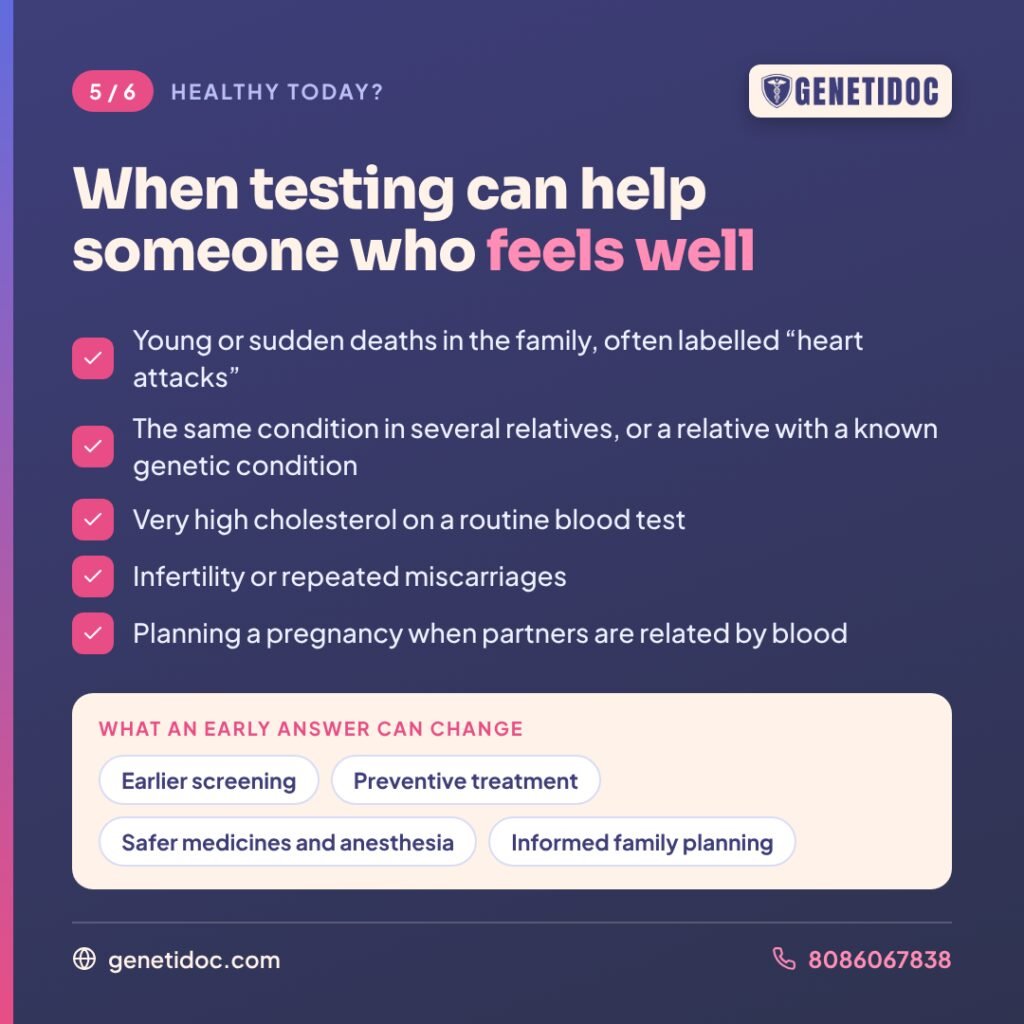
- A close relative has been diagnosed with a genetic condition and the family variant is known
- The same condition keeps appearing in several family members
- Young or sudden deaths in the family, especially those labelled “heart attacks”
- Very high cholesterol on a routine blood test
- Planning a pregnancy, especially when partners are related by blood or there is a known condition in the family
- Infertility or repeated miscarriages
Start with the affected family member, then test relatives for one variant
Where possible, the person in the family who is affected is tested first. If a disease-causing variant is found, healthy relatives can then be tested for that single variant. This is called cascade testing. It is targeted, faster (usually about 1 week) and easier to interpret than a large panel.
A broader panel is offered to a relative only if they have their own unexplained personal history, or if they specifically want wider testing. A variant of uncertain significance, which is a genetic change whose effect is not yet known, is not used to test healthy relatives.
Relatives who are not ready for genetic testing are still encouraged to have simpler screening tests, such as a lipid profile for familial hypercholesterolemia, or an ECG and echocardiogram with a cardiologist for inherited heart conditions.
What an early result can change
- Earlier and more frequent screening: for example, earlier colonoscopy in Lynch syndrome, MRI-based surveillance in Li-Fraumeni syndrome, or regular echocardiograms in Marfan syndrome.
- Preventive management: such as cholesterol-lowering treatment in familial hypercholesterolemia, or risk-reducing options in hereditary cancer syndromes.
- Lifestyle and activity advice: for example, avoiding heavy weightlifting and intense competitive sport in Marfan syndrome, or specific precautions in inherited heart rhythm conditions.
- Safer choices of medicines and anesthesia.
- Family planning: once a family variant is confirmed, couples can consider prenatal diagnosis or preimplantation genetic testing in future pregnancies.
- Peace of mind: a relative who tests negative for the known family variant is usually told their risk is very low and can follow general population screening.
When the condition has no treatment
Predictive testing needs special care for conditions such as Huntington’s disease, where there is currently no treatment that prevents or delays onset. International guidelines recommend a careful process:
- More than one pre-test counseling session, with time to think between sessions
- Bringing a trusted support person
- Receiving results in person, not by phone or message
- Psychological support and follow-up after the result
- The right to change your mind, or to choose not to know, at any stage
At Genetidoc, every genetic test is accompanied by pre-test and post-test genetic counseling, so the decision to test is always an informed one, and the decision belongs to the patient.
Should Children Be Tested for Adult-Onset Conditions?
Generally, no. For conditions that only appear in adulthood and where nothing needs to be done during childhood, testing is usually deferred until the child turns 18. This protects the child’s right to make their own decision as an adult. This approach is consistent with international professional guidance on genetic testing in children.
“For most hereditary cancer conditions, we offer testing to children only after they turn 18, because the condition is adult-onset. The exceptions are conditions where knowing early helps a child, such as Li-Fraumeni syndrome or Long QT syndrome.”
— Team Genetidoc
Testing in childhood is considered when early knowledge changes care during childhood, for example:
- Li-Fraumeni syndrome: childhood cancer surveillance may begin early
- Long QT syndrome and catecholaminergic polymorphic ventricular tachycardia: children may be tested early because precautions and treatment can prevent dangerous rhythm problems
- Hypertrophic cardiomyopathy: testing is usually offered from late childhood
- Marfan syndrome: children in affected families may be offered testing early, so heart and eye monitoring can begin
- Familial hypercholesterolemia: high cholesterol can be identified and managed from childhood
- Brugada syndrome: testing of children without symptoms is discussed individually, with ECG screening and fever precautions regardless
Limitations of Genetic Testing for Later-Onset Conditions
Genetic testing is powerful, but it is important to understand what it cannot do:
- A negative result is not a guarantee. It means no reportable finding was found in what was tested. It does not mean you will never develop the condition, because other genes, other types of genetic change, and non-genetic factors also matter.
- Not every test detects every type of change. Standard exome sequencing reads the protein-coding parts of genes but does not reliably detect repeat expansions. Conditions such as Huntington’s disease, myotonic dystrophy and fragile X syndrome need specific tests designed for them.
- Uncertain results can be hard to use. A variant of uncertain significance found in a healthy person with no family history usually cannot guide decisions on its own. Care is based on personal and family history instead.
- A positive result does not predict exactly when, or whether, symptoms will begin. Reduced penetrance and variable expressivity mean the timing and severity cannot be predicted precisely.
- Interpretation can change. As research grows, the meaning of some results may be updated. This is why follow-up and, in some cases, reanalysis of the data are advised.
“A negative report means there is no reportable finding in what was tested. It does not mean the person will never develop the condition. We spend time making sure families understand this, because many read a negative result as a lifetime guarantee.”
— Team Genetidoc
Common Misconceptions
Myth: “My child was normal at birth, so it can’t be genetic.”
Fact: Many genetic conditions, such as Rett syndrome, Duchenne muscular dystrophy and mucopolysaccharidosis, appear only months or years after birth.
Myth: “I’m an adult and healthy, so I don’t carry anything.”
Fact: Hereditary cancer syndromes, inherited heart conditions and familial hypercholesterolemia are often silent until adulthood.
Myth: “My DNA has changed as I’ve grown older.”
Fact: The DNA you inherit does not change. Some individual cells acquire changes over time, but these are different from inherited changes and are not passed to children.
Myth: “Genetic means nothing can be done.”
Fact: For many genetic conditions, early knowledge allows screening, preventive management, safer medicine choices and informed family planning.
Myth: “A positive result means I will definitely get the disease.”
Fact: Some people who carry a variant never develop the condition, and many risks can be reduced.
Myth: “A negative test means I’m safe forever.”
Fact: It means no reportable finding in what was tested, not a lifetime guarantee.
Why Expert Interpretation and Genetic Counseling Matter
With later-onset conditions, choosing the right test is half the work. The other half is understanding what the result means for you and your relatives.
- The right test: a known family variant needs targeted testing, a suspected repeat-expansion condition needs a specific test, and a broader history may need a panel. A wrong choice can produce a falsely reassuring result.
- The right laboratory: accredited laboratories with confirmation of reportable findings reduce the risk of errors.
- Clinical correlation: a clinical geneticist matches the result to your personal and family history, rather than reading the report in isolation.
- Genetic counseling: explains what the result means for screening, treatment and family members, and supports you through the emotional side of the decision.
A low-cost test without interpretation can leave families with a report they cannot act on, or with false reassurance. The real value of genetics lies in actionable answers that improve care.
Frequently Asked Questions
Are all genetic conditions present from birth?
No. Inherited genetic changes are present from conception, but the condition may appear at birth, in childhood, in adulthood or never. Some genetic changes are also acquired during life.
What is the difference between genetic and congenital?
Congenital means present at birth, from any cause. Genetic means caused by a change in DNA. A condition can be genetic without being congenital, and congenital without being genetic.
Can a genetic disease appear in adulthood?
Yes. Hereditary cancer syndromes, inherited heart conditions, Huntington’s disease and some forms of early-onset Alzheimer’s disease commonly begin in adulthood.
Why do some genetic conditions appear later in life?
Damage may build up slowly, the body may compensate for years, the gene may matter only at a certain life stage, a second genetic “hit” may be needed, or a trigger may be required.
Can my genes change during my life?
Your inherited DNA does not change. Individual cells can acquire changes over time, which is how most cancers develop, but these are not passed to children.
Can a child who was healthy at birth develop a genetic condition?
Yes. Conditions such as Rett syndrome, Duchenne muscular dystrophy and mucopolysaccharidosis typically appear months or years after a normal birth.
Is cancer a genetic condition?
All cancers involve genetic changes in cells, but only about 5 to 10 percent are caused mainly by an inherited change. Most result from changes acquired during life.
Can a genetic condition appear with no family history?
Yes. The change may be new in that person, relatives may carry it without symptoms, or both parents may be healthy carriers of a recessive condition.
Should I get tested if a relative has an adult-onset genetic condition?
It is worth discussing with a clinical geneticist. If the family variant is known, targeted testing for that one variant is usually quick and clear.
Should children be tested for adult-onset genetic conditions?
Usually testing is deferred until 18, unless early knowledge changes care in childhood, as in Li-Fraumeni syndrome, Long QT syndrome or familial hypercholesterolemia.
Does a negative genetic test mean I will never develop the condition?
No. It means no reportable finding in what was tested. Other genes, other types of genetic change and non-genetic factors can still play a role.
What is anticipation in genetics?
Anticipation is when a condition begins earlier or is more severe in each new generation, usually because a repeated DNA section grows longer as it is passed down.
Key Takeaways
- Not all genetic conditions are present from birth. Inherited changes are there from conception, but symptoms can appear at any age, or never.
- “Genetic”, “congenital” and “hereditary” mean different things.
- Many conditions appear in childhood after a normal birth, and many others, including hereditary cancer and inherited heart conditions, appear in adulthood.
- Most cancers come from genetic changes acquired during life, not inherited ones.
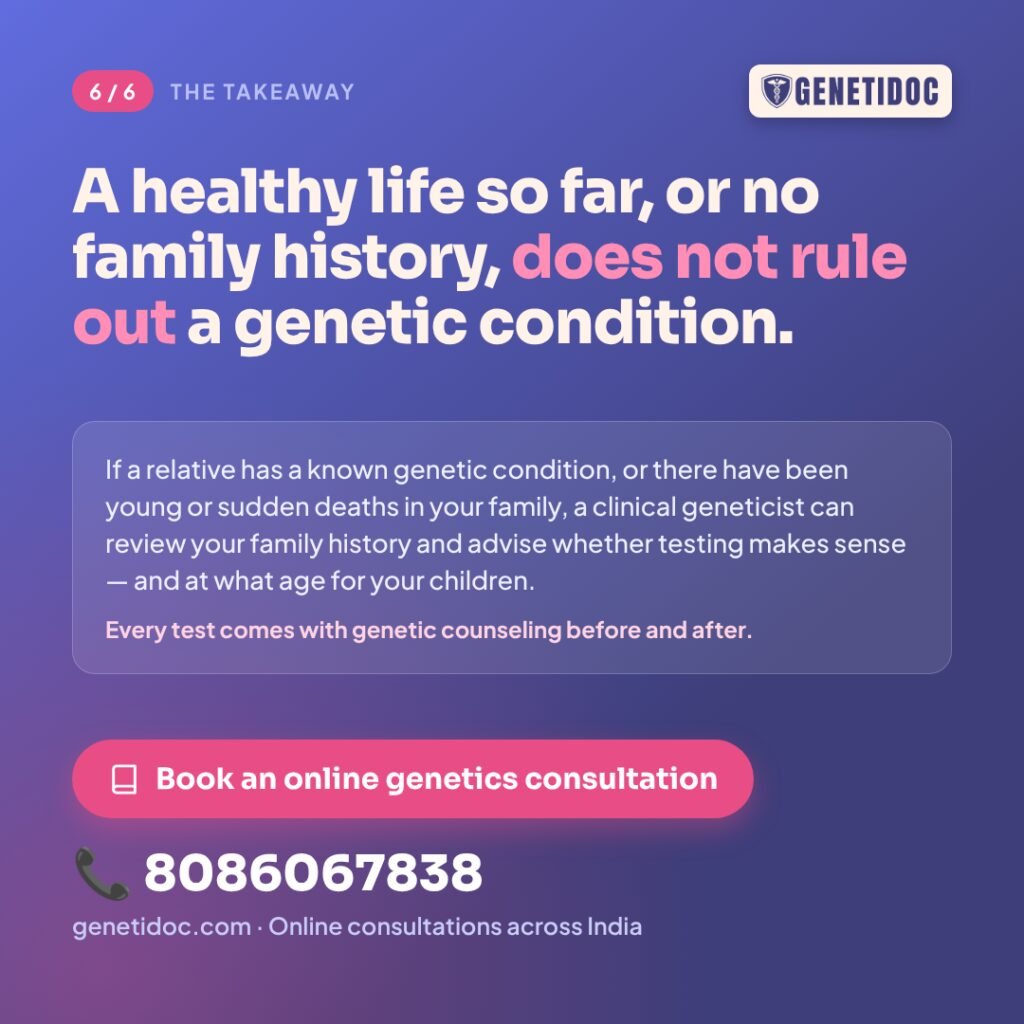
- A healthy life so far, or no family history, does not rule out a genetic condition.
- If a relative has a known genetic condition, targeted testing and genetic counseling can guide screening, prevention and family planning.
Healthy today, but worried about a condition that runs in your family?
If a relative has been diagnosed with a hereditary cancer, an inherited heart condition, very high cholesterol or another genetic condition, or if there have been young or sudden deaths in your family, our clinical geneticists can review your family history and advise whether predictive or cascade testing makes sense for you, and at what age for your children. Consultations are available online across India and in person in Thiruvananthapuram.
Book a family risk assessment consultation.
Join our rare disease forum
Join the Conversation
- Predictive Genetic Testing forum: questions about testing before symptoms appear
- Cascade Testing forum: questions about testing relatives for a known family variant
- Hereditary Cancer Syndrome forum: questions about inherited cancer risk
- Hypercholesterolemia forum: questions about inherited high cholesterol
- Klinefelter Syndrome forum: questions about diagnosis in adulthood and fertility
- Genetidoc Rare Disease Forum: connect with families and experts
Related Reading on Genetidoc
- Consanguineous Marriage and Your Child’s Genetic Risk
- Tuberous Sclerosis Complex: A Guide to Testing and Care in India
- Progeria: Understanding Accelerated Ageing in Children
- Hereditary Ataxia: Types, Symptoms and Genetic Testing
- Genetics and Obesity: Is It All in the Genes?
- Migraine and Genetics: Is It Hereditary?
References
- Knudson AG. Mutation and cancer: statistical study of retinoblastoma. Proceedings of the National Academy of Sciences USA. 1971;68(4):820–823.
- National Cancer Institute. The Genetics of Cancer. cancer.gov.
- MedlinePlus Genetics, National Library of Medicine. What are reduced penetrance and variable expressivity? medlineplus.gov/genetics.
- Caron NS, Wright GEB, Hayden MR. Huntington Disease. In: Adam MP, et al., editors. GeneReviews. University of Washington, Seattle.
- Darras BT, Urion DK, Ghosh PS. Dystrophinopathies. In: GeneReviews. University of Washington, Seattle.
- Prior TW, Leach ME, Finanger E. Spinal Muscular Atrophy. In: GeneReviews. University of Washington, Seattle.
- MacLeod R, Tibben A, Frontali M, et al. Recommendations for the predictive genetic test in Huntington’s disease. Clinical Genetics. 2013;83(3):221–231.
- Botkin JR, Belmont JW, Berg JS, et al. Points to consider: ethical, legal, and psychosocial implications of genetic testing in children and adolescents. American Journal of Human Genetics. 2015;97(1):6–21.
- Jaiswal S, Fontanillas P, Flannick J, et al. Age-related clonal hematopoiesis associated with adverse outcomes. New England Journal of Medicine. 2014;371(26):2488–2498.