
\MEDICALLY REVIEWED BY TEAM GENETIDOC
Quick answer
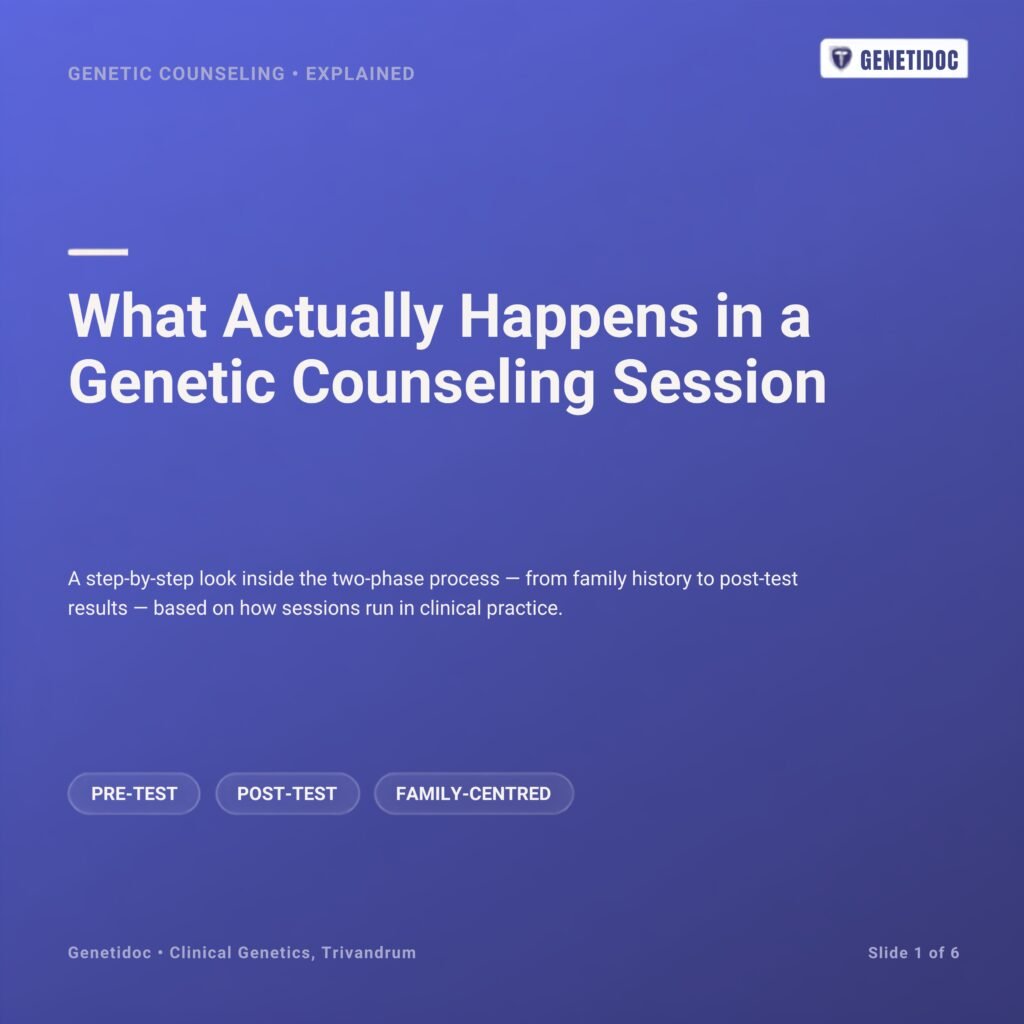
A genetic counseling session happens in two phases. Pre-test counseling reviews your personal and family medical history to work out whether a condition is likely genetic, then explains which test fits, what it costs, and what it can and cannot tell you. Post-test counseling happens once results are back — explaining the findings and, where a diagnosis is confirmed, outlining management, treatment options, prognosis, and the chance of the condition recurring in the family. Online sessions can often be booked for the same day if a slot is free; in-person visits typically take longer to schedule, since physical clinic visits run only once a week. Sessions are led directly by a geneticist rather than handed off to administrative staff.
If you’ve been referred for genetic testing — or you’re simply searching because a doctor mentioned “genetic counseling” and you’re not sure what that actually involves — the uncertainty itself can be the hardest part. Most people picture either a quick chat before a blood test, or something closer to a lab report handed over with no explanation. Neither is accurate.
A genetic counseling session is a structured, two-way clinical conversation. It exists specifically to make sure a test is the right one for your situation, and that whatever the result says, you understand exactly what it means for you and your family. This guide walks through exactly what happens, stage by stage, based on how sessions are actually run in clinical practice in India.
What Is Genetic Counseling, Exactly?
Genetic counseling is a clinical process that helps a person or family understand the medical and familial implications of a health condition that may have a genetic basis. It combines two things: a careful look at your personal and family medical history, and clear, non-directive guidance on what — if anything — should be done next.
“Non-directive” is the key word here. A genetic counselor’s or geneticist’s job is to lay out the options, the evidence, and the risks clearly. The decision about what to do with that information always stays with you.
“Patient autonomy is central to how we practice. Our role is to inform, not to direct. Whether it’s a couple deciding on prenatal testing or a family weighing predictive testing for an adult-onset condition, the final decision belongs to them — every time.”
— Team Genetidoc
The Two Phases of Genetic Counseling
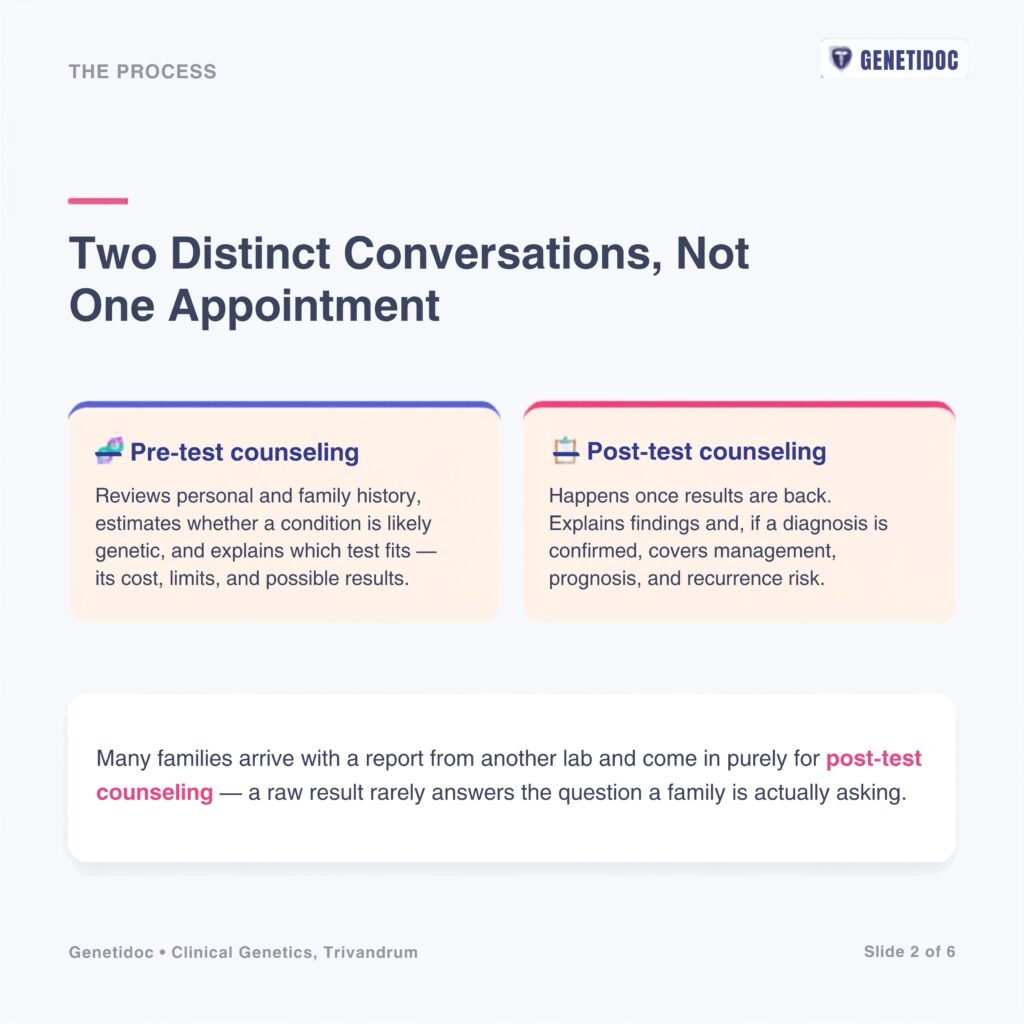
Every genetic counseling journey has two distinct stages, and it helps to understand them as separate conversations rather than one long appointment.
| Pre-test counseling | Post-test counseling |
| For families who haven’t tested yet. Reviews history, estimates whether a condition is likely genetic, and discusses test type, cost, limitations, and possible findings. | For families who already have a report — whether tested at Genetidoc or elsewhere. Explains what the result means, and outlines management, prognosis, and family implications. |
Not everyone goes through both in sequence. It’s common for a family to arrive with a report generated by another lab or hospital and come to Genetidoc purely for post-test counseling — help interpreting what the report actually means, since the raw result on its own rarely answers the question a family is actually asking.
Step 1: Before the History-Taking Even Begins
Walking into a genetic counseling session is rarely a neutral experience. Most people arrive carrying some fear — about a diagnosis, about what it means for a child, about what it says about the rest of the family. A well-run session accounts for that before asking a single clinical question.
“The first thing we do is acknowledge the fear and concerns the family is carrying — before we get into any history-taking. Something as simple as asking how they are, where they’re from, helps calm the nervousness in the room before we move into clinical territory.”
— Team Genetidoc
This isn’t small talk for its own sake. Body language and tone in these first few minutes shape whether a family feels safe enough to share the details that actually matter later — including sensitive information about consanguinity, past pregnancy losses, or family deaths they might otherwise hesitate to mention.
Step 2: Detailed History-Taking and Family Pedigree
This is the clinical core of pre-test counseling. The geneticist builds a detailed picture of:
- Your personal medical history, including symptom onset and progression
- For pediatric or childhood-onset conditions: antenatal development and history of the presenting illness, taken whenever possible, along with history from the age of disease onset
- A multi-generation family history — typically at least three generations — mapped as a pedigree chart
- Any known consanguinity in the family
To judge whether a condition is likely to have a genetic basis, the clinical team draws on pedigree charting, condition-specific diagnostic criteria and checklists, and clinical scoring systems — not guesswork. This is also the point where families sometimes reveal details they hadn’t connected to their original concern.
Case example
A family came in with a specific, narrow concern. But partway through the session, as the conversation moved into the individual’s prenatal development history, new details surfaced — features the family hadn’t thought to mention because they didn’t seem connected. Combined with the clinical history and presenting features, this narrowed the differential down to a specific condition, which was then tested for — and confirmed. Without the structured history-taking, that connection would likely have been missed entirely.
What patients often get wrong here: arriving without existing medical records or prior test reports. Missing information doesn’t just slow the session down — it can leave the family with more uncertainty rather than a clear path forward, because the geneticist is working with an incomplete picture.
Step 3: Choosing — or Reconsidering — the Right Test
A common assumption is that the test is decided before the session even starts. In practice, the session itself often determines — or changes — which test makes sense.
“If a patient comes in asking to test for something related to a family history of sudden cardiac death, we don’t just run the test they’ve asked for. We’d rather they go through a proper counseling session first, so we understand the family history in depth — what exactly should be tested for, and what kind of results they might realistically expect to see.”
— Team Genetidoc
Most patients who come in for pre-test counseling arrive already open to testing — the session mainly serves to clarify their questions rather than to talk them into or out of it. But there are genuine cases where, after a full history review, testing turns out not to be the right next step at all.
When a Patient Already Has a Specific Test in Mind
It’s increasingly common for patients to arrive having already decided — usually from something seen online or on social media — exactly which test they want. The approach here is to first understand why: what in their personal or family history led them to that conclusion. If the requested test genuinely fits, the team proceeds with it. If it doesn’t, the geneticist explains what that specific test actually detects, and why it isn’t the right fit for their situation — rather than simply declining the request without explanation.
Step 4: Discussing the Test Itself
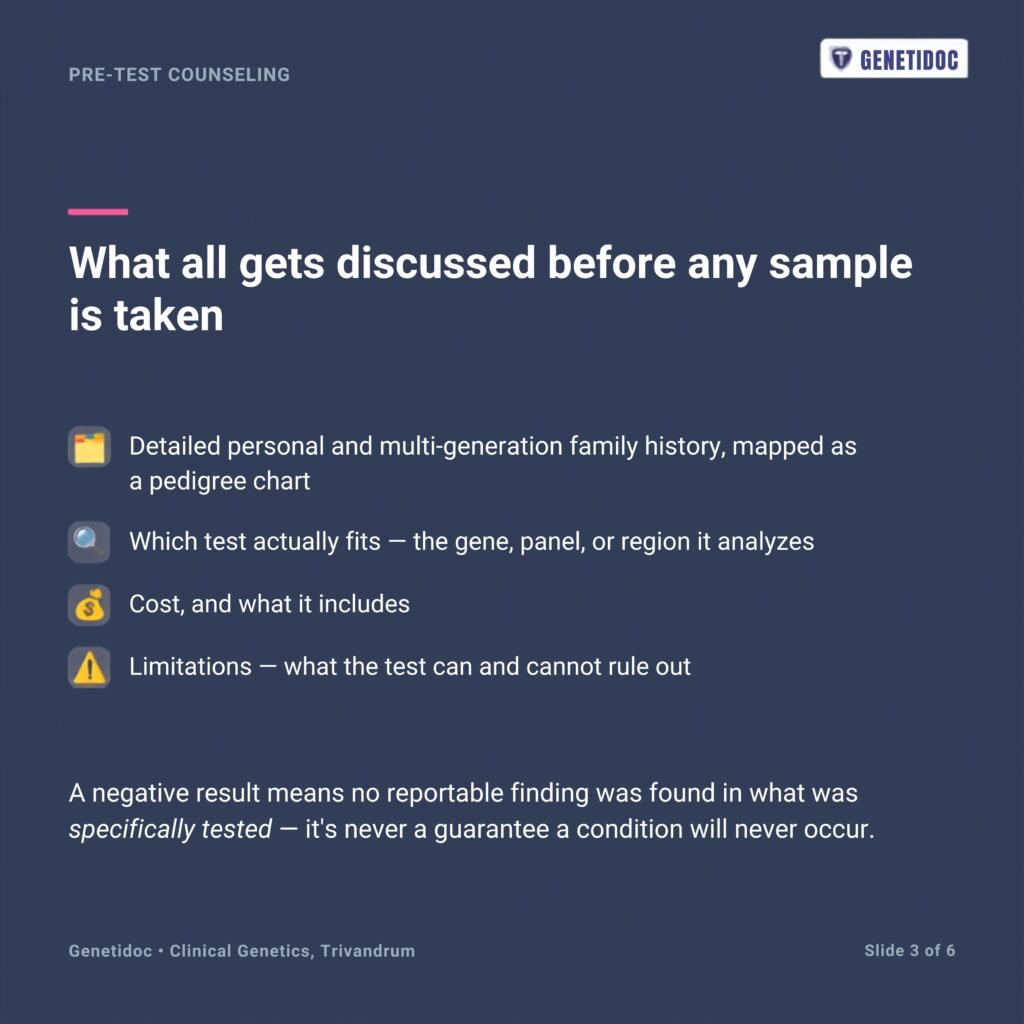
Before any sample is collected, pre-test counseling covers the practical side of the test being considered:
- What it looks for — the specific gene, panel, or region being analyzed
- What it costs, and what that includes
- Its limitations — what it can and cannot rule out
- Possible outcomes — a positive finding, a negative result, or a variant of uncertain significance, and what each would mean
- Whether the patient wants to be informed of medically actionable secondary findings unrelated to the original concern, discovered incidentally during testing
This last point matters more than it might seem. A negative result on a genetic test means no reportable finding was identified in what was actually tested — it is never a guarantee that the person or their child will never be affected by a genetic condition, since no single test screens for everything.
Who You’ll Actually Be Speaking To
During the consultation itself, you’ll be speaking with the geneticist — the session is led by them, not delegated to a counselor. A genetic counselor is who you’d speak to separately, on other occasions that don’t need a full consultation: they’re readily available on call, and patients can talk to them before or after a genetic consultation to clear up queries related to their condition.
It’s worth being clear about what this process is not: genetic counseling is not a directive session. No one is deciding anything on your behalf. It’s informational and emotional support for the family — the facts, laid out clearly, alongside someone present to help you process them.
How Long Does It Take?
There’s no fixed length for a session — it depends on the complexity of the condition and how much family history needs to be worked through. A straightforward carrier-screening consultation looks very different from a complex pediatric case involving multiple specialists’ notes.
Scheduling depends on the format you choose. Online video consultations can sometimes be booked for the same day, if the geneticist’s schedule has a free slot. In-person visits generally take longer — often 3–6 or 7 days — since the physical clinic runs on a weekly schedule rather than daily. If timing matters to you, online consultation is usually the faster route to a first appointment.
The Waiting Period: What Happens Between Sessions
If testing is recommended, there’s a gap between the pre-test and post-test sessions that corresponds to the test’s own turnaround time — which varies significantly depending on the test type, from a targeted panel to comprehensive sequencing. This is a good time to prepare questions for the follow-up session, rather than searching for answers online, since interpreting a genetic report without clinical context is where most confusion happens.
Step 5: Post-Test Counseling — When the Report Comes Back
This is where the second, often more emotionally significant, conversation happens. What it covers depends entirely on what the result shows.
If a Definitive Diagnosis Is Found
The session moves into a detailed discussion of:
- Management and treatment — what can actually be done, medically, going forward
- Prognosis — the expected course of the condition
- Natural history — how the condition typically progresses over time
- Recurrence risk — the chance of the condition occurring again in future children or other family members
- Preconception counseling, where relevant to future family planning
Case example — when a diagnosis changes the outcome
In a case of confirmed biotinidase deficiency — a condition where the body can’t properly process the vitamin biotin — testing led directly to biotin supplementation. Because biotinidase deficiency rarely manifests if supplementation is started early, giving the supplement before symptoms appear can mean the condition never manifests at all. The child goes on to live a near-normal, healthy life. This is a clear example of genetic testing changing a real-world outcome, not just providing information.
If the Result Is Inconclusive or Negative
Not every test produces a clear answer. When results are inconclusive, the session focuses on what that could imply, whether further testing is warranted, and what practical steps make sense for the family in the meantime — rather than leaving the family with an unexplained “normal” report and no next step.
The Emotional Side of Post-Test Counseling
Some of the most difficult moments in this entire process happen at this stage — particularly with predictive testing for adult-onset conditions.
“The hardest moments are usually during post-test counseling, when we find a diagnosis that’s known to reduce life expectancy or significantly change the course of someone’s life. With predictive testing — for something like Huntington’s disease, for example — an asymptomatic person learns they carry the mutation and will develop the disease later in life. Often they’ve already watched a parent or relative go through the same thing, so they know exactly what’s ahead. That can be deeply distressing psychologically. How the news is delivered matters enormously — it has to be broken in a way the family can actually process, not just stated clinically. A huge part of what eases that burden is simply being present, and listening.”
— Team Genetidoc
By the end of a session, most of the signal that it’s gone well comes through body language rather than words — a visible easing of tension. The team routinely checks whether the family has any remaining questions before closing; most of the time, families say they don’t, and the session ends with a simple acknowledgment that their concerns have been addressed.
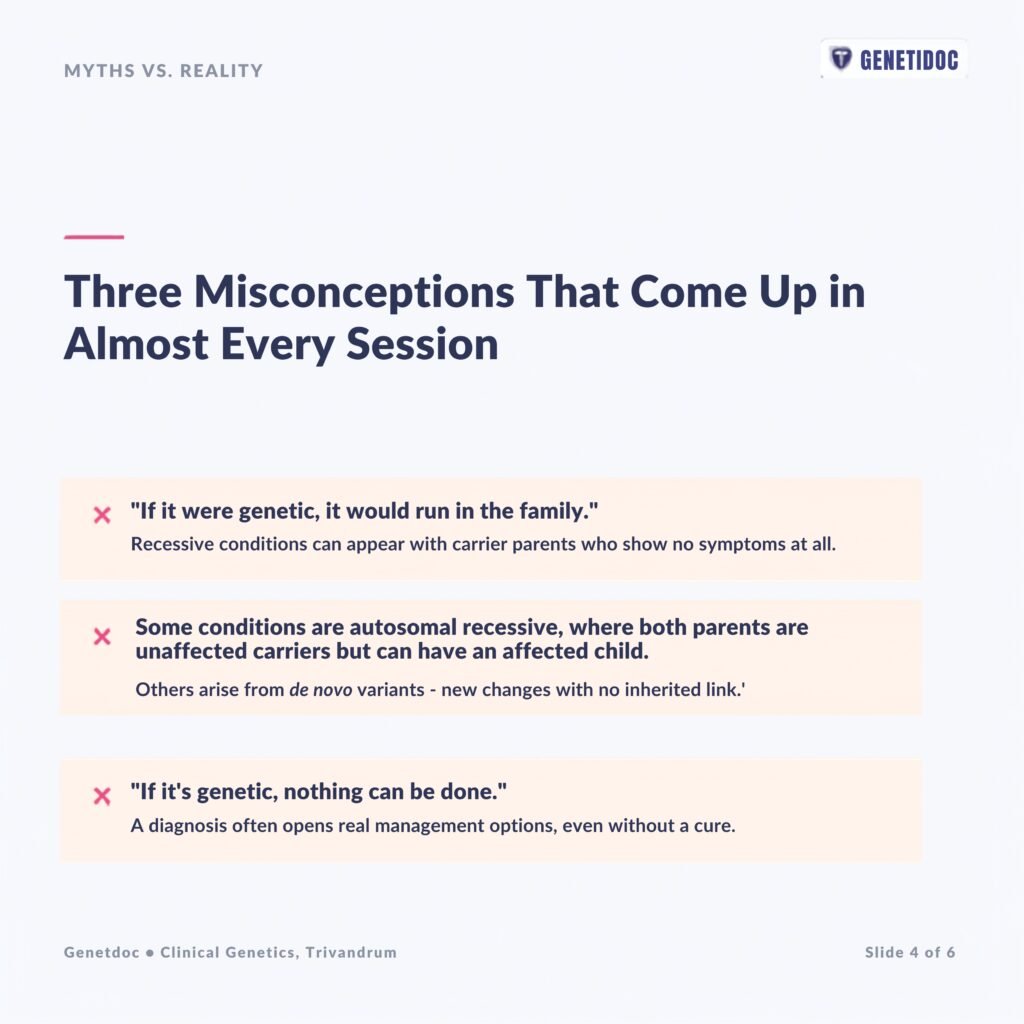
Three Misconceptions That Come Up in Almost Every Session
1. “If it were genetic, it would run in the family.”
Not necessarily true. For autosomal recessive conditions, both parents can be completely healthy carriers — showing no symptoms themselves — and still have a child affected by the condition. There may be no visible family history at all.
2. “There’s no family history, so it can’t be genetic.”
Some conditions arise from de novo changes — new genetic variants that occur for the first time in that individual, rather than being inherited from either parent. A child can be affected even when there is no family history whatsoever.
3. “If it’s genetic, there’s no point testing — nothing can be done.”
This is one of the most consequential misconceptions, because it can delay care for conditions that are genuinely manageable once identified — the biotinidase deficiency example above is a direct counter-example. A definitive diagnosis often opens up real management options, even for conditions that can’t be “cured” outright.
Genetic Counseling for Consanguineous Couples
Consanguineous marriage remains common in parts of South India, and it’s a recurring, sensitive topic in counseling sessions across the region.
“We don’t run a different protocol for consanguineous couples — the session structure stays the same. What matters is how it’s delivered: a neutral, compassionate expression, no visible reaction that could feel like judgment. No genetic counselor should ever discourage a couple from marrying. Our role stays purely informational.”
— Team Genetidoc
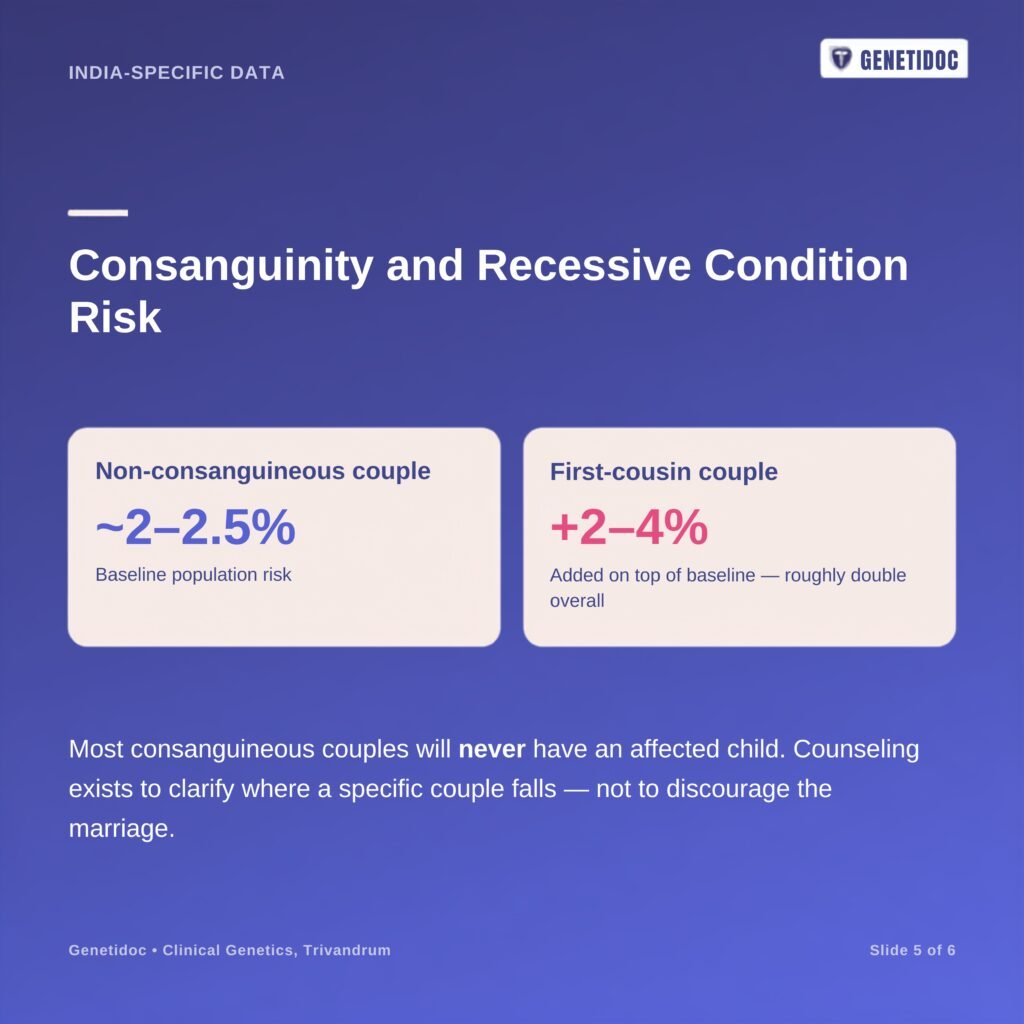
The underlying biology is straightforward: related couples are more likely to carry the same recessive genetic mutation, inherited from a shared ancestor, than unrelated couples. Published population genetics research puts this in context:
| Couple type | Approximate added risk of a child with a serious recessive/congenital condition |
| Non-consanguineous couple | Baseline population risk, roughly 2–2.5% |
| First-cousin couple | An additional 2–4% on top of baseline — roughly double the general population risk overall |
Figures drawn from published consanguinity and clinical genetics literature; individual risk varies by family history and should always be assessed in an actual counseling session rather than estimated from general population data alone.
Importantly, the large majority of consanguineous couples will never have an affected child — the increased risk is real but modest for most families, and counseling exists to clarify where a specific couple actually falls, not to discourage the marriage itself.
When the Extended Family Is Part of the Conversation
In many Indian households, genetic counseling isn’t a two-person conversation between the geneticist and the patient. Joint family and community structures often shape who’s actually in the room.
“When there’s a joint family or community involved, extended relatives — sometimes the head of the family — will often be present, and if the family wants them included, we include them. Our first approach is to communicate with the whole group and walk through the options together. But where possible, we also try to hold a separate, private session with just the parents, to talk through how the findings apply to them personally, away from the group dynamic.”
— Team Genetidoc
Regardless of who else is in the room, decision-making authority rests with the affected individual — or, for children and others unable to decide for themselves, their parents or caregiver.
Why the Lab — and the Counseling — Both Matter
A genetic test report is only as useful as the interpretation behind it. Two real patterns illustrate why skipping counseling, or choosing a test purely on price, carries risk:
No mediator between the lab and the patient
When testing happens through a direct-to-consumer service with no clinician involved in interpretation, patients often misread the report themselves — regardless of how clearly it’s written. Many don’t realize that direct-to-consumer panels typically screen for a limited set of founder mutations, often validated in populations outside India, and not specific to Indian genetic backgrounds.
Wrong test coverage
A family that had been recommended a specific test went elsewhere for a cheaper option. The report came back negative — but on review, the test hadn’t actually covered the genomic region relevant to the condition seen in the affected family member. The family had to be re-tested properly, this time with counseling guiding the test selection from the start.
This is the practical argument for genetic counseling being part of the process, not an optional add-on: choosing the right test, from the right lab, interpreted by someone who understands the clinical context, is what determines whether a result is actually useful.
How the Session Differs by Reason for Referral
Prenatal and reproductive counseling
These sessions operate under real time pressure — decisions about invasive testing or continuing a pregnancy often need to be made within days, not weeks. Non-directiveness is essential here. Patients frequently arrive straight from an abnormal ultrasound or screening result, so the geneticist has to acknowledge their current state of mind while breaking down complex risk figures clearly, staying neutral, and supporting the family’s own decision rather than steering it.
Cancer genetic counseling
Typically involves adults either currently living with cancer or evaluating their personal hereditary risk based on family history. These sessions are action-oriented, covering risk management, screening protocols, surgical prevention options, risk to immediate family members, and how findings intersect with an existing treatment plan.
Pediatric genetic counseling
Usually centers on a child with developmental delay, distinctive physical features, or complex medical needs — often after parents have already consulted multiple specialists without answers. A key part of the session is managing guilt: explaining inheritance patterns carefully, since this information can increase parental self-blame, while being honest that many pediatric genetic conditions involve variable severity or variants of uncertain significance — without stripping away hope, even where diagnostic answers remain incomplete.
What to Bring to Your First Session
- Any available medical records and past test reports
- Detailed family history — as many generations as you can gather
- For pediatric or childhood-onset conditions: antenatal, developmental, and childhood-period history
- A note of history from the point the condition or symptoms first appeared
- A written list of your questions — it’s easy to forget them once the conversation starts
What Genetic Counseling Costs in India
Pre-test counseling is charged as a standard consultation. If testing is done in-house at Genetidoc, the follow-up post-test counseling session carries no additional charge. If a patient comes for post-test counseling with a report from an external lab, it’s charged the same as a standard consultation, since the testing itself wasn’t done at Genetidoc.
Exact figures vary by clinic and by whether a session is combined with a specific test, so it’s worth confirming current pricing directly when booking rather than relying on figures found online — testing and counseling costs across India vary considerably depending on the lab, the test’s complexity, and the region.
Key Takeaways
- Genetic counseling happens in two phases: pre-test (history, test selection, what to expect) and post-test (results, management, family implications)
- The session is non-directive — the decision always stays with the patient or family
- A visible family history is not required for a condition to be genetic, and a genetic cause doesn’t always mean nothing can be done
- Online consultations can sometimes be booked the same day; in-person visits typically take longer, since physical clinics run weekly rather than daily
- Choosing the right test and lab — guided by counseling — matters as much as the testing itself
If a doctor has raised the possibility of a genetic condition — for you, your child, or your family history — the right first step is a counseling session, not a test you choose on your own.
Book a pre-test genetic counseling session with Genetidoc’s clinical team, available across India via video consultation or in person at our Trivandrum centre.
Book your free genetic consultation today.
Frequently Asked Questions
Is genetic counseling only for pregnant women?
No. Genetic counseling is relevant for prenatal and reproductive concerns, but equally for cancer risk assessment, pediatric developmental conditions, adult-onset predictive testing, and interpreting a genetic report from any point in life.
Do I need a doctor’s referral for genetic counseling?
Not necessarily — many patients book directly when they have a personal or family history concern, though a referral from your treating doctor can help the geneticist prepare in advance.
How long does a genetic counseling session take?
It varies by condition and how complex the family history is. There’s no fixed duration — simple consultations run shorter, while complex pediatric or multi-generational cases take longer.
What’s the difference between a genetic counselor and a geneticist?
A geneticist is a physician specializing in the diagnosis and management of genetic conditions. A genetic counselor is trained specifically in risk assessment communication and family history documentation. At Genetidoc, the geneticist leads the clinical conversation directly.
Can genetic counseling happen online?
Yes. Genetidoc offers pan-India video consultations alongside in-person visits at its Trivandrum centre.
Will I be pressured to get tested?
No. Genetic counseling is non-directive. The geneticist explains the options and the evidence; the decision to test — or not — stays with you.
What if there’s no family history of the condition — can it still be genetic?
Yes. Recessive conditions can appear with no visible family history because carrier parents show no symptoms, and some conditions arise from new (de novo) genetic changes with no inherited link at all.
Is genetic counseling only relevant for consanguineous couples?
No. While consanguineous couples do carry an increased chance of sharing the same recessive mutation, genetic conditions occur in non-consanguineous families too, and counseling is relevant for any personal or family history concern.
Can I bring a report from another lab for interpretation?
Yes. Post-test counseling for reports generated outside Genetidoc is a routine part of the service, charged as a standard consultation.
What happens if my test result is negative?
A negative result means no reportable finding was identified in what was specifically tested — it does not guarantee the condition will never occur, since no single test screens for every possibility. Your geneticist will explain what the negative result does and doesn’t rule out for your specific situation.
Does health insurance cover genetic counseling in India?
Coverage varies and is often limited, so most patients in India pay out of pocket for genetic counseling and testing. Confirm coverage with your specific insurer before booking.
Related Reading
- Check our genetics forum
- Biopsy Testing 101: How Doctors Choose the Right Cancer Treatment for You
- Non-Invasive Prenatal Testing (NIPT) in India: What Every Pregnant Woman Needs to Know
- Your Ultrasound Showed a “Soft Marker” — Should You Panic?
- Amniocentesis vs. NIPT: Which Test Do You Actually Need?
References
- American College of Medical Genetics and Genomics (ACMG) — professional guidelines on genetic counseling and secondary findings
- GeneReviews — condition-specific genetic counseling and testing information
- American College of Obstetricians and Gynecologists (ACOG) — prenatal genetic counseling guidance
- Geneva International Consanguinity Workshop Report, Genetics in Medicine — consanguinity risk data
- Sheridan E, et al. Consanguinity and its relevance to clinical genetics. Clinical Genetics / ScienceDirect
- ClinGen — variant classification and clinical validity resources