

👨⚕️ “My Father Had Prostate Cancer. Should I Worry Too?”
A 48-year-old man once asked me this question after his father and uncle were both diagnosed with prostate cancer in their early fifties.
His concern is one I hear often — and it’s an important one.
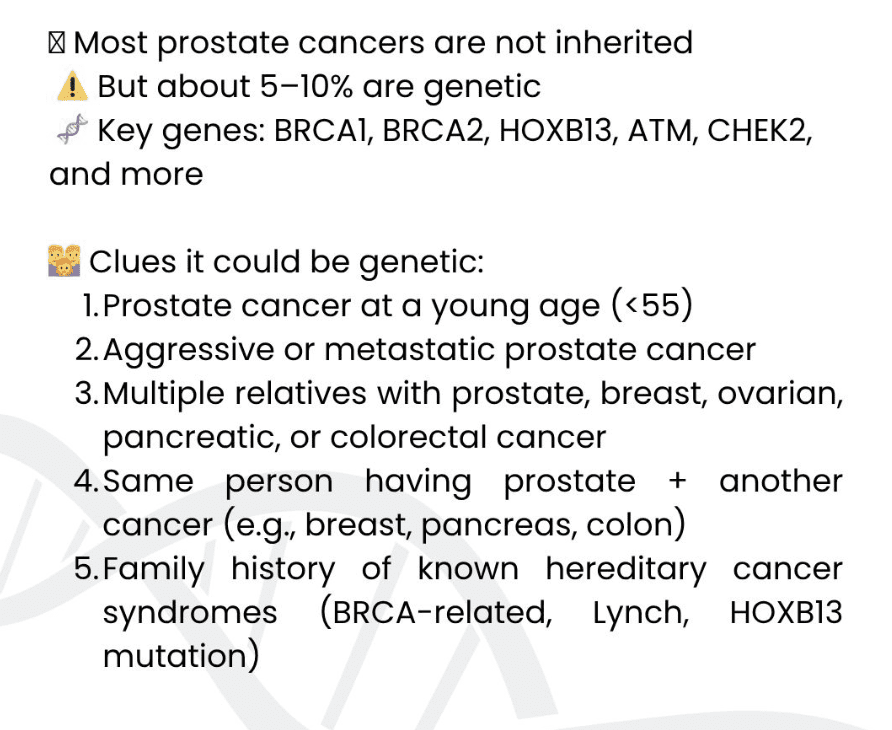
While most prostate cancers happen by chance, about 5–10% are hereditary, passed down through specific gene changes. Knowing your family risk can make the difference between late detection and early, curable disease.
1️⃣ How Common Is Hereditary Prostate Cancer?
Prostate cancer is the most common cancer in men worldwide.
Most cases are sporadic, but roughly 1 in 10 arise due to inherited gene mutations.
The key genes linked to hereditary prostate cancer include:
-
BRCA1 and BRCA2 – also linked to breast and ovarian cancers.
-
HOXB13 – a prostate-specific gene mutation seen in some families.
-
ATM and CHEK2 – DNA-repair genes that, when altered, increase cancer risk.
Men with these gene changes tend to develop cancer at a younger age and may have more aggressive or metastatic disease.
2️⃣ What Are the Warning Signs It Could Be Genetic?
Certain family patterns suggest hereditary risk:
-
Prostate cancer diagnosed before age 55
-
Aggressive or metastatic prostate cancer
-
Multiple relatives with prostate, breast, ovarian, pancreatic, or colorectal cancers
-
The same person having prostate plus another cancer (e.g., colon or pancreas)
-
A family history of known genetic mutations (e.g., BRCA or Lynch syndrome)
If these clues sound familiar, you should discuss genetic counseling with a clinical geneticist.
3️⃣ Why Genes Like BRCA1 and BRCA2 Matter for Men
Many people associate BRCA genes with breast or ovarian cancer in women, but these genes affect men too.
A man carrying a BRCA2 mutation can have up to a five-fold higher risk of developing prostate cancer.
These genes act like the body’s DNA repair system. When they malfunction, genetic “typos” build up, increasing the chance of cancer.
Men with BRCA mutations may also face higher risks of pancreatic cancer or melanoma — another reason family history must be reviewed carefully.
4️⃣ What Is Genetic Counseling and Why Start There?
Before jumping into a test, it’s important to talk to a genetic counselor or clinical geneticist.
They will:
-
Review your personal and family history of cancer
-
Estimate your inherited risk
-
Explain what genetic testing can reveal
-
Discuss the emotional and medical impact of different results
Genetic counseling turns uncertainty into understanding — helping you decide the right next step for your family.
5️⃣ What Does Genetic Testing Involve?
Testing is simple and painless — just a blood or saliva sample.
The lab checks for gene mutations linked to prostate cancer, such as BRCA1, BRCA2, HOXB13, ATM, and CHEK2.
You’ll typically receive one of three results:
-
Positive – a known harmful mutation is present.
-
Negative – no harmful change detected.
-
VUS (Variant of Uncertain Significance) – a gene change whose meaning is not yet clear.
If positive, your doctor will guide you through screening and risk-reduction options — often before symptoms appear.
6️⃣ What Happens If I Test Positive?
Testing positive means you carry a gene that increases risk, not that you already have cancer.
It allows doctors to create a personalized surveillance and prevention plan.
That may include:
-
Early PSA testing (as early as age 40)
-
Prostate MRI for detailed imaging
-
Regular physical exams and monitoring
-
Lifestyle measures – maintaining healthy weight, regular exercise, no smoking
-
Targeted therapies if cancer occurs (e.g., PARP inhibitors for BRCA-related cases)
-
Clinical trials for high-risk mutation carriers
🎯 Goal: Detect aggressive prostate cancer early — or prevent it entirely.
7️⃣ What If My Test Is Negative?
A negative test doesn’t mean you’re risk-free.
If you have a strong family history, you may still benefit from earlier or more frequent screening, since:
-
Some genetic mutations remain undiscovered.
-
Shared environmental and lifestyle factors can also contribute.
Your doctor may still recommend starting PSA tests at age 45 (or even earlier) if several relatives were affected.
8️⃣ How Does Genetic Testing Help With Treatment?
For men already diagnosed with prostate cancer, knowing your genetic status can guide treatment decisions.
For example:
-
BRCA-positive cancers often respond better to PARP inhibitors, a newer form of precision medicine.
-
If you have Lynch syndrome or ATM mutations, your oncologist might adjust chemotherapy or immunotherapy choices.
In short — testing doesn’t just predict risk; it personalizes treatment.
9️⃣ How Can My Family Benefit?
Genetic information doesn’t stop with one person.
If you test positive, your close relatives (parents, siblings, children) have a 50% chance of carrying the same mutation.
Testing them can:
-
Detect risk early
-
Guide screening for both men and women (since BRCA affects both sexes)
-
Offer reassurance for relatives who test negative
Family screening turns one person’s awareness into whole-family protection.
🔟 Can Hereditary Prostate Cancer Be Prevented?
Yes — or at least detected before it turns dangerous.
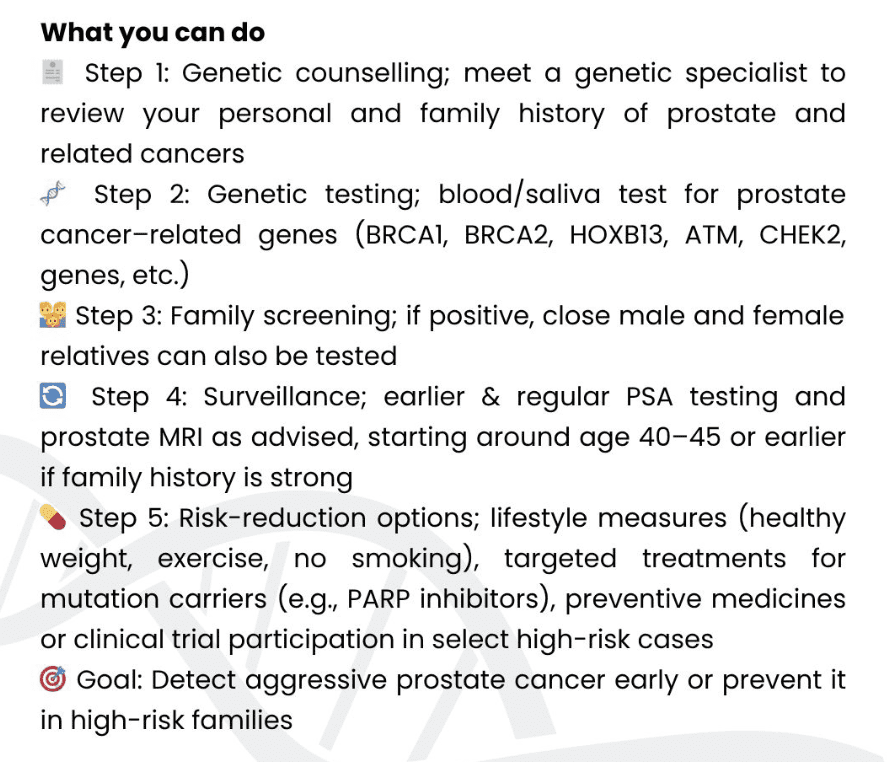
Here’s the 5-step prevention plan used at Genetidoc Genetic Clinic and DNA Testing Lab:
-
Genetic counseling – review family and personal history
-
Genetic testing – identify inherited mutations
-
Family screening – test close relatives if one member is positive
-
Surveillance – early PSA tests, MRI scans, and doctor visits starting around age 40–45
-
Risk-reduction options – lifestyle improvements, targeted treatments, or preventive medicines
🩺 Goal: Detect aggressive cancer early or prevent it in high-risk families.
🌷 Real-World Example
A 46-year-old man was diagnosed with prostate cancer. His brother had developed breast cancer (yes, men can get it too).
Genetic testing revealed a BRCA2 mutation.
Because of this discovery:
-
His sons began PSA monitoring at 35.
-
His sister underwent breast and ovarian cancer screening.
-
Treatment for the patient was tailored using targeted therapy.
That single genetic test changed the health trajectory of an entire family.
💬 Frequently Asked Questions
Can prostate cancer genes come from my mother’s side?
Yes. Genes like BRCA1 and BRCA2 can be passed from either parent, even if no men in your mother’s family had prostate cancer.
What age should I start screening?
If you have a family history or carry a mutation, begin PSA testing and prostate MRI around age 40, or 10 years earlier than the youngest diagnosis in your family.
Does lifestyle matter even with a genetic risk?
Absolutely. Maintaining a healthy weight, exercising regularly, limiting red meat, and avoiding smoking all reduce your overall cancer risk.
Can women in the family also be affected?
Yes. Female relatives who carry BRCA mutations have higher risks for breast and ovarian cancers — so family testing is vital.
Is genetic testing expensive?
Costs have fallen significantly. Many hospitals and programs now offer targeted panels for hereditary cancers at affordable rates.
🌼 The Emotional Side of Testing
For many men, genetic testing brings mixed emotions — anxiety, relief, even guilt.
But in most cases, awareness brings empowerment. It allows families to move from fear to action.
Support from genetic counselors, doctors, and family members helps make this journey easier — and more hopeful.
🌸 Awareness Saves Lives
Prostate cancer caught early is one of the most treatable cancers in men.
In families with a known hereditary risk, early action can prevent late-stage disease entirely.
If you’ve noticed prostate cancer in family, don’t ignore it. A simple test and consultation can make a lifelong difference.
💙 Take Action — Know Your Risk, Own Your Future
Your DNA holds powerful information.
Understanding it can protect you and your loved ones — not just from prostate cancer, but from related hereditary cancers too.