
If you have gone through this situation, you already know the particular loneliness because of it: from three three tests to a doctor telling you everything looks normal but everything normal ends up with a miscarriage. But normal isn’t the word most people expect to hear after this kind of grief. This normal sometimes can feel like being told to someone there’s no explanation for something that has completely happened to your life. Here at the genetidoc we never say it’s normal or simply sorry but we say why this happened in a plain language with solutions. At genetidoc we call what you go through as – recurrent pregnancy loss, or RPL – and there’s a real and well-studied medicine behind this. But that medicine has more limits than benefits, and understanding where those limits sits can make the uncertainty a little easier to live with.
What counts as recurrent pregnancy loss
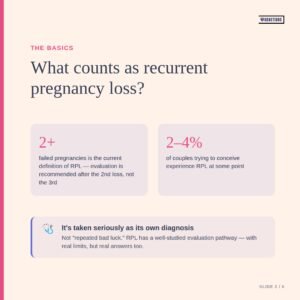
Most of the reproductive specialists define RPL as two or more failed pregnancies, and current guidance supports starting an evaluation after the second loss rather than waiting for a third. It affects a meaningful share of couples trying to conceive – around 2 to 4% experience it at some point. So while it feels isolating, it is not rare, and it is taken seriously as its own diagnosis, not just repeated bad luck.

What a genetic workup actually checks
When most people hear about “genetic testing” after a miscarriage, they often think of it as one test with one clear yes-or-no answer. In reality, there are several different tests and each of them looking at a different question:
Parental karyotyping.
Basically this is a blood test conducted on both the partners that looks at the structure of your chromosomes. This test is specially designed to catch a balanced translocation – a rearrangement where genetic material has moved between chromosomes but the total amount remains the same. A person carrying a balanced translocation is usually completely healthy themselves, but there is a high possibility that their eggs or sperm can end up with an unbalanced amount of genetic material, which is often incompatible with continuing a pregnancy. This shows up in roughly 2 to 5% of couples with recurrent loss.
Testing of the pregnancy tissue itself
Rather than testing on both the parents, this looks directly at the chromosomes of the miscarried pregnancy only. It’s increasingly emphasized in newer guidance, because it answers a more direct question: was this particular loss caused by a chromosomal error in the embryo? If the tissue shows a normal chromosome count, that shifts the search toward other causes. If it shows a random aneuploidy – an extra or missing chromosome – that’s often a one-off event rather than a sign of an underlying condition.
Antiphospholipid antibody testing
This testing is about to check for an autoimmune clotting disorder that’s one of the more common treatable causes of recurrent loss, and it’s tested for because a positive result actually changes management, typically with blood thinners in a future pregnancy.
Thyroid function, uterine anatomy, and metabolic screening
Miscarriage risk can also be affected by various other reasons as well such as thyroid hormone levels, the shape of the uterine cavity (fibroids, septum, scarring), and medical conditions like poorly controlled blood sugar. These are checked because they’re both detectable and, often, correctable.
Why the answer so often comes back “unexplained”
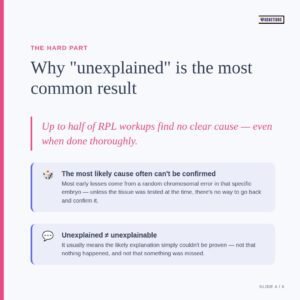
Here’s the part that’s hard to sit with: even after a complete, well-done workup, up to half of couples with recurrent pregnancy loss will not get a clear cause. That statistic hasn’t moved much in over a decade of research, and it isn’t a reflection of a poor workup or something being missed. It reflects a real biological pattern.
The most common reason a pregnancy ends in early loss – recurrent or not – is a random chromosomal error in that particular embryo, one that happened during egg or sperm formation or very early cell division after fusion of egg and sperm. These errors become more frequent with advancing maternal age, but they can happen at any age, and they’re generally not something that repeats for a predictable, testable reason. Unless the actual pregnancy tissue was tested at the time, there’s no way to go back and confirm this was the cause of any specific loss. The parents’ own chromosomes can be completely normal, and this can still happen three times in a row, simply because each pregnancy is, genetically speaking, its own independent event.
This is a meaningful distinction: “unexplained” usually doesn’t mean “unexplainable” in principle. It often means the most likely explanation – a one-time chromosomal error in that embryo – was never able to be confirmed, because testing the pregnancy tissue at the time of loss isn’t always done or possible.
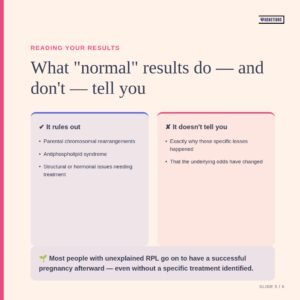
What normal test results don’t tell you
A clear genetic workup is genuinely reassuring in one specific way: it rules out a parental chromosomal rearrangement, antiphospholipid syndrome, and structural or hormonal issues that would specifically raise your risk and that would specifically call for treatment. What it doesn’t do is tell you why those three particular pregnancies ended, and it doesn’t erase the underlying odds. It’s also worth knowing that most people who experience unexplained recurrent loss go on to have a successful pregnancy afterward, even without a specific intervention — the odds are genuinely in your favor, even though that can be hard to feel in the moment.
Where the field is heading
Guidance in Genetics has shifted in recent years. There’s growing support for testing the pregnancy tissue itself earlier in the process – sometimes starting after the very first or second loss – rather than only working through the parents’ chromosomes. There’s also more explicit recognition that recurrent loss carries a real emotional toll, with formal recommendations that psychological support and counselling be offered as a standard part of care, not an afterthought.
If you’re in the middle of this,
A few things worth raising with your doctor or a genetic counselor if you haven’t already:
- Whether testing the tissue from a future loss (if it happens) is an option, since this often gives more specific information than parental testing alone
- Whether you’ve had the full panel – antiphospholipid antibodies, thyroid function, and an evaluation of the uterine cavity – not just karyotyping
- Whether a referral to a reproductive endocrinologist or genetic counselor makes sense for your specific history
And it’s worth naming directly: an “unexplained” result is not a verdict, and it’s not something you did. It’s a real limit of what current testing can see, layered on top of one of the harder things a person can go through. Both of those things can be true at once – the grief is real, and so is the fact that your body did nothing wrong here.

Take the next step
If you’ve had two or more losses and haven’t yet had a full recurrent pregnancy loss workup – or you’ve only had partial testing – don’t wait for a third. Book an appointment with a genetidoc Contact Us, India’s most trusted online genetic consultation and testing platform.
Frequently Asked Questions
-
How many miscarriages does it take before doctors call it “recurrent pregnancy loss”?
Most of the current guidelines define RPL as two or more failed clinical pregnancies, and recommend starting an evaluation after the second loss rather than waiting for a third.
-
Does a normal parental karyotype mean that the RPL is not due to a genetic cause?
Not necessarily. Parental karyotyping only catches balanced translocations and similar large structural rearrangements in the parents. It can’t detect a one-time chromosomal error that occurred in a specific embryo, which is actually the most common cause of any single miscarriage.
-
What’s the difference between testing the parents and testing the pregnancy tissue?
Parental karyotyping checks whether either partner carries a chromosomal rearrangement that could repeatedly cause unbalanced embryos. Testing the products of conception looks directly at that specific pregnancy’s chromosomes, which can show whether that particular loss was caused by a random aneuploidy rather than something inherited.
-
Why do so many recurrent pregnancy loss cases end up “unexplained”?
Because the most common cause of miscarriage — a random chromosomal error in that specific embryo — usually can’t be confirmed after the fact unless the tissue was tested at the time. Up to half of RPL workups don’t identify a clear cause, even when done thoroughly.
-
Is antiphospholipid syndrome something I should specifically ask to be tested for?
Yes. It’s one of the more common treatable causes of recurrent loss, and a positive result changes management (often blood thinners in a future pregnancy), so it’s a standard part of a full RPL workup.
-
Can uterine shape or fibroids cause repeat miscarriages?
Yes, structural issues like a uterine septum, fibroids, or scarring can contribute, which is why an evaluation of the uterine cavity is a standard part of the workup alongside genetic and hormonal testing.
7. Does age affect the chances of an unexplained loss being genetic?
Yes. The risk of chromosomal errors in the embryo rises with maternal age, so age-related aneuploidy becomes a more likely (though often unconfirmed) explanation as you get older, even when parental testing is normal.
-
If we get an unexplained result, what are our chances of having a successful pregnancy in the future?
Encouragingly good. Most people with unexplained recurrent pregnancy loss go on to have a successful pregnancy afterward, even without a specific treatment identified.
-
Should we consider genetic counseling even if our karyotypes are normal?
It can still be worthwhile. A genetic counselor can help interpret what “normal” results does and doesn’t rule out, discuss options like testing future pregnancy tissue, and talk through personalized risk going forward.
-
Is it normal to need emotional support after unexplained losses, not just medical answers?
Yes, and it’s now formally recommended as part of standard RPL care. The emotional toll of recurrent loss – including higher rates of anxiety, depression, and grief – is well recognized, and asking your care team for a referral to counseling is a legitimate, expected part of treatment, not an extra ask.