
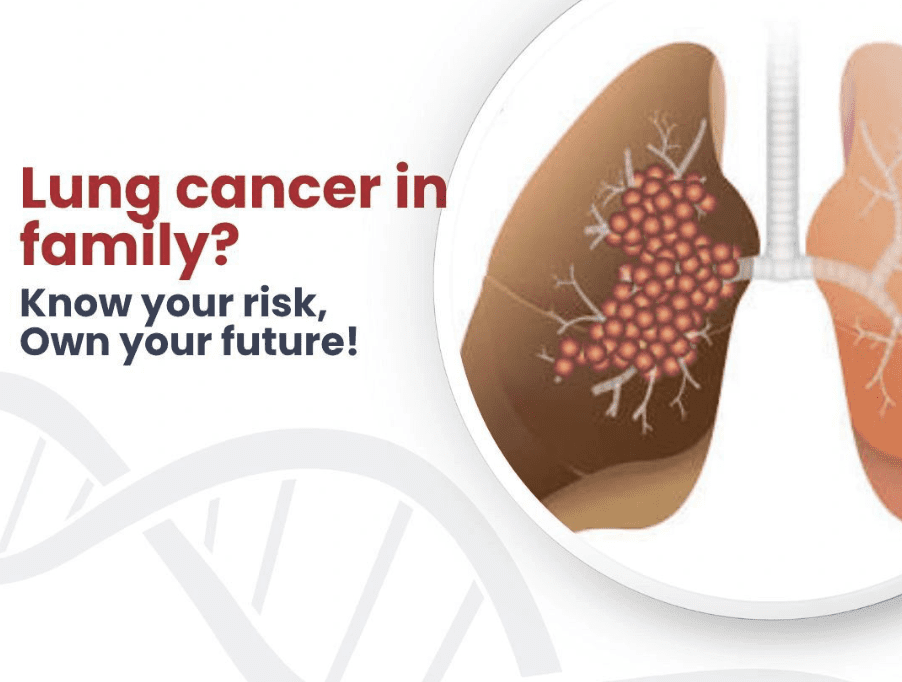
👩⚕️ “Doctor, My Mother Never Smoked Yet Got Lung Cancer. Could It Be in Our Genes?”
This is one of the most common and heartbreaking questions families ask.
While smoking is the leading cause of lung cancer, not all cases are caused by tobacco.
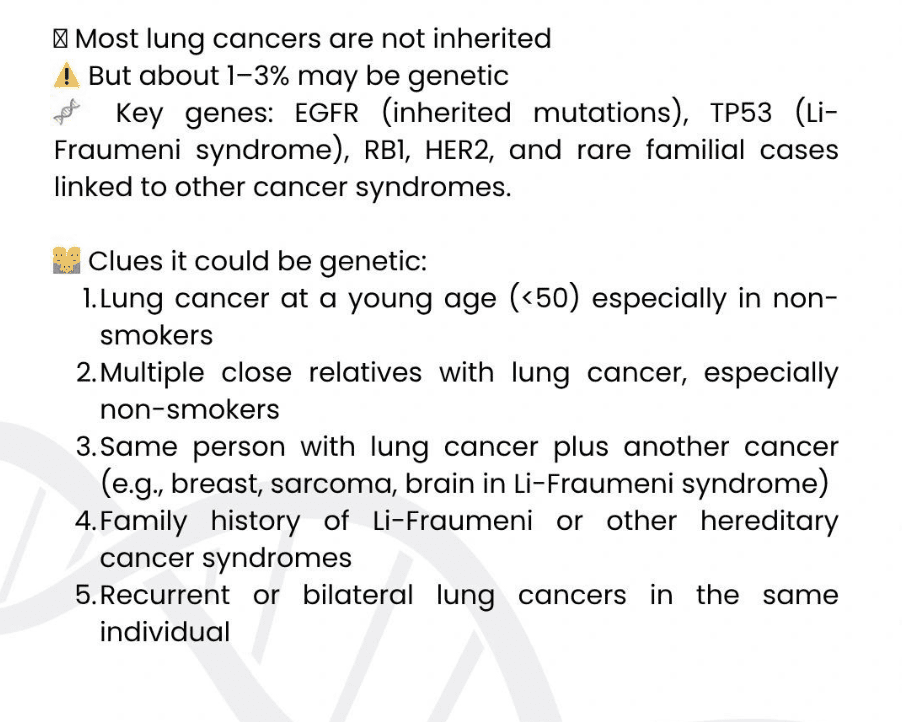
A small proportion — about 1–3% — are hereditary, meaning they’re linked to genetic mutations passed down in families.
For these families, understanding their genetic risk can change everything — from how early they screen to how doctors treat the disease.
1️⃣ How Common Is Hereditary Lung Cancer?
Most lung cancers are due to environmental factors such as smoking, secondhand smoke, air pollution, or occupational exposures.
However, studies show that about 1–3% of all cases are due to inherited genetic mutations.
These are especially seen in:
-
Non-smokers, particularly women
-
Younger individuals diagnosed before age 50
-
Families where multiple members have lung or related cancers
So while rare, hereditary lung cancer is real and important — especially when smoking history doesn’t explain the diagnosis.
2️⃣ What Causes Hereditary Lung Cancer?
Inherited gene changes affect how our body repairs DNA or controls cell growth.
The main genes linked to hereditary lung cancer include:
-
EGFR (epidermal growth factor receptor) germline mutations
-
TP53 (seen in Li-Fraumeni syndrome)
-
RB1, HER2, and BRCA2
-
Rare familial cases linked to multiple cancer syndromes
These genes act like “brakes” for cell growth — and when one is damaged, cells can grow uncontrollably and form tumors.
Unlike the somatic mutations found in most cancers (caused by smoking or toxins), germline mutations are inheritedand can appear in every cell of the body.
3️⃣ What Are the Warning Signs That It Could Be Genetic?
Consider a genetic cause if you or your family have any of the following:
-
Lung cancer before age 50, especially in non-smokers
-
Two or more close relatives with lung cancer, especially non-smokers
-
A person with lung cancer plus another cancer (e.g., breast, sarcoma, or brain tumors seen in Li-Fraumeni syndrome)
-
A family history of Li-Fraumeni or other hereditary cancer syndromes
-
Recurrent or bilateral lung cancers in the same individual
If any of these apply, talk to a genetic specialist about your risk.
4️⃣ What Is Li-Fraumeni Syndrome?
Li-Fraumeni syndrome (LFS) is one of the most well-known inherited cancer syndromes caused by TP53 gene mutations.
People with LFS have a very high lifetime risk of multiple cancers — including breast, brain, bone, sarcoma, and lung cancers — often appearing at younger ages.
In families with LFS, genetic counseling and regular imaging can catch cancers before symptoms appear, drastically improving survival.
5️⃣ What Is Genetic Counseling and Testing?
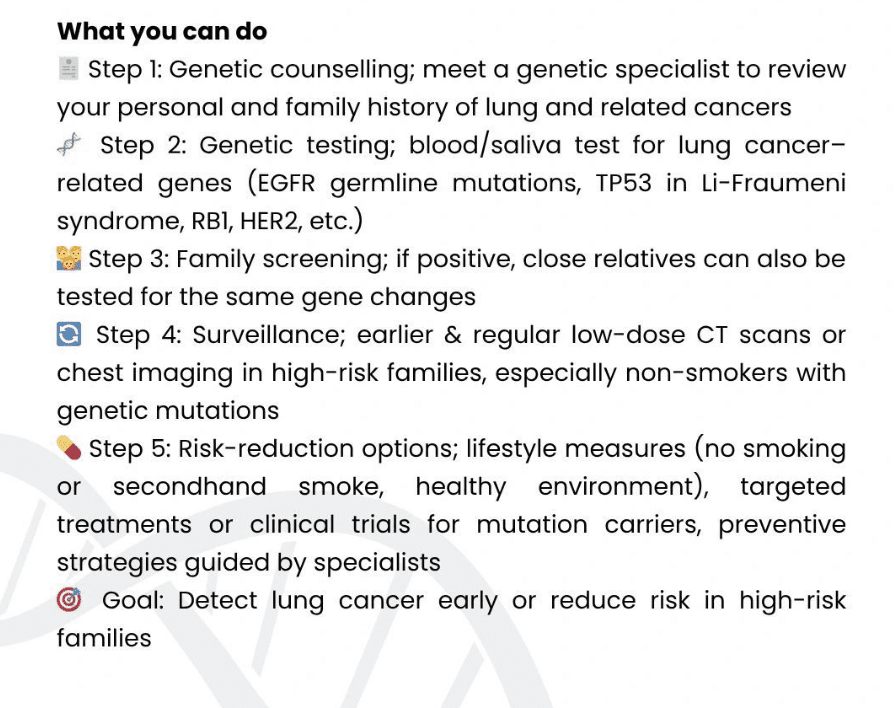
Before testing, you’ll meet a genetic counselor or clinical geneticist who will:
-
Review your personal and family cancer history
-
Explain how genetic testing works
-
Identify which genes are most relevant
-
Discuss the emotional and medical implications
Testing usually involves a simple blood or saliva sample, which is analyzed for mutations in genes such as EGFR, TP53, BRCA2, HER2, and RB1.
Results may be:
-
Positive – confirming a hereditary cause
-
Negative – no mutation found
-
Uncertain (VUS) – a change of unclear significance
A positive result helps your doctor design a personalized screening and prevention plan.
6️⃣ What If My Test Is Positive?
Testing positive means you carry a gene that increases your risk — not that you have cancer right now.
It allows you and your healthcare team to take proactive steps, such as:
-
Early and regular screening – with low-dose CT scans for early detection
-
Avoiding smoking and secondhand smoke completely
-
Genetic counseling for family members who may share the mutation
-
Targeted therapies – for example, lung cancers in EGFR mutation carriers often respond to specific EGFR inhibitors
-
Lifestyle measures – staying active, avoiding pollution, and maintaining lung health
🎯 Goal: Detect lung cancer early or reduce risk in high-risk families.
7️⃣ What If My Test Is Negative?
A negative test is reassuring, but it doesn’t mean zero risk.
There may still be undiscovered genes or environmental triggers.
If multiple family members are affected, your doctor may still advise periodic screening.
Lifestyle remains powerful — maintaining clean air at home, avoiding smoking, managing air pollution exposure, and eating a healthy diet all lower risk.
8️⃣ How Can My Family Benefit?
If you test positive for a lung cancer–related mutation, your parents, siblings, and children each have a 50% chance of carrying the same gene.
Testing them helps:
-
Identify high-risk family members
-
Reassure those who test negative
-
Enable early CT scan surveillance for those at risk
Family screening turns one person’s awareness into multi-generational prevention.
9️⃣ Can Hereditary Lung Cancer Be Prevented?
While we cannot prevent every case, early detection and lifestyle management make a tremendous difference.
At Genetidoc Genetic Clinic and DNA Testing Lab, our approach includes:
-
Genetic counseling – to assess personal and family history
-
Genetic testing – for relevant mutations
-
Family screening – to identify others at risk
-
Surveillance – regular low-dose CT scans or chest imaging
-
Risk reduction – avoiding smoke, maintaining healthy weight, minimizing pollution, and using targeted drugs in mutation carriers
🩺 Goal: Catch cancer before it spreads — or prevent it altogether.
🌷 Real-World Example
A 38-year-old woman, a non-smoker, was diagnosed with lung adenocarcinoma.
Her mother had died of the same cancer at 45, also a non-smoker.
Genetic testing revealed an EGFR germline mutation.
Her siblings were tested; one brother carried the same gene and began regular CT screening.
A tiny lesion was detected early and treated completely — before it could become invasive.
Genetic awareness turned what could have been tragedy into prevention.
💬 Frequently Asked Questions
Can I inherit lung cancer even if no one in my family smoked?
Yes. In hereditary cases, smoking isn’t necessary for cancer to develop. Non-smoker families with repeated lung cancer diagnoses should consider testing.
Is genetic testing only for those already diagnosed?
No. Testing is also recommended for people with strong family history or known mutations in relatives.
What’s the best screening for high-risk individuals?
A low-dose CT scan is currently the best tool for detecting lung cancer early in high-risk or mutation-carrying individuals.
Does air pollution affect hereditary cancer risk?
Yes. Environmental triggers can worsen genetic susceptibility. Protecting against pollution is especially important for mutation carriers.
Are there targeted treatments for hereditary lung cancers?
Yes. Certain mutations (e.g., EGFR, ALK, ROS1) respond to precision medicines that block the faulty signaling pathways.
🌼 The Emotional Side of Genetic Testing
Hearing that lung cancer could “run in the family” can feel frightening — but knowledge is strength.
Genetic counseling turns that fear into action by offering clear steps and hope.
Families who understand their genetic risk can prevent new cases and detect existing ones early, saving lives.
🌸 Awareness Saves Lives
Lung cancer doesn’t always come from cigarettes.
In some families, it’s written in their DNA — but that doesn’t mean it’s unchangeable.
Through awareness, testing, and early action, families can rewrite their story.
If lung cancer runs in your family, talk to a genetic specialist.
Knowing your risk today could save your life tomorrow.
💙 Take Action — Know Your Risk, Own Your Future
If you or a loved one has had lung cancer — especially at a young age or without smoking — it’s time to explore genetic evaluation.