
Autism Spectrum Disorder (ASD) is a neurodevelopmental condition that affects communication, behavior, learning patterns, and social interaction. Over the past decade, awareness about autism has increased significantly across India, leading many families to seek deeper answers beyond behavioral assessments alone. One of the most important advances in autism care today is genetic testing for autism.
Modern genetic testing can identify underlying chromosomal abnormalities, single-gene disorders, or molecular pathways associated with autism and developmental delay. While autism is highly heterogeneous and rarely caused by a single factor, identifying a genetic diagnosis can provide clarity, guide medical management, improve prognostic understanding, and help families make informed reproductive decisions.
For many parents, the question is no longer “Should we do genetic testing?” but rather “Which genetic test is the right one?”
Why Genetic Testing Matters in Autism
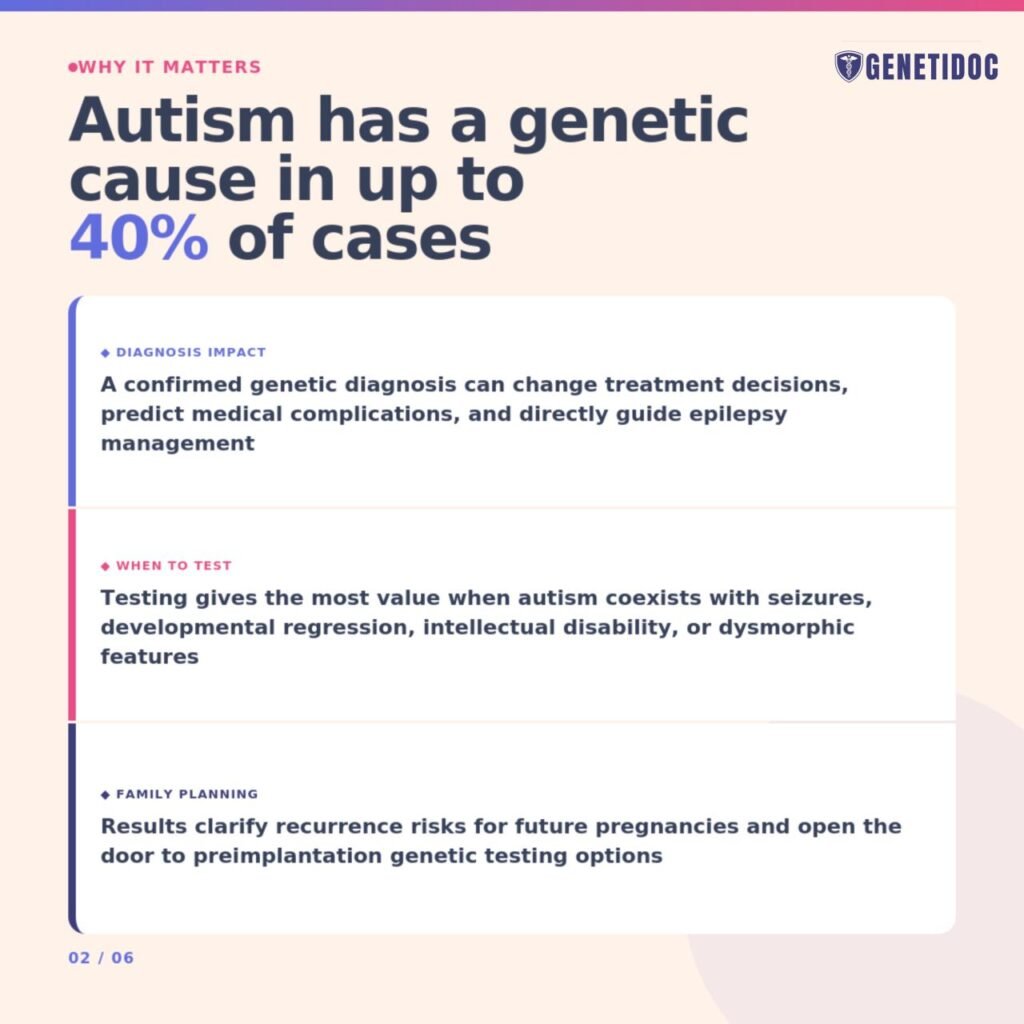
Autism is not a single disorder with a single cause. Instead, it represents a spectrum of hundreds of possible biological pathways. Research suggests that approximately 10–40% of individuals with autism may have an identifiable genetic etiology, especially when autism occurs alongside:
- Developmental delay
- Intellectual disability
- Speech delay
- Epilepsy
- Dysmorphic features
- Macrocephaly or microcephaly
- Congenital anomalies
- Regression
- Family history of neurodevelopmental disorders
In clinical practice, identifying the underlying genetic cause can significantly change management.
A confirmed diagnosis may:
- Predict associated medical complications
- Guide neurological monitoring
- Influence epilepsy treatment choices
- Identify treatable metabolic conditions
- Help with educational planning
- Provide recurrence risk counseling for future pregnancies
- Connect families with syndrome-specific support groups and clinical trials
Even when testing does not identify a definitive mutation, ruling out major chromosomal or syndromic conditions still provides valuable reassurance and direction.
“Many families spend years focusing only on therapies without understanding the underlying biological cause. A genetic diagnosis often changes management more than people expect.”
The Importance of Choosing the Right Genetic Test
One of the biggest misconceptions in India is that all autism genetic tests are the same. In reality, selecting the correct test depends heavily on the child’s clinical presentation.
This is where evaluation by a clinical geneticist becomes extremely important.
Different children may require completely different testing strategies depending on:
- Developmental profile
- Presence of seizures
- MRI findings
- Dysmorphism
- Family history
- Consanguinity
- Metabolic clues
- Regression patterns
- Growth abnormalities
In some cases, a Chromosomal Microarray (CMA) may be the best first step. In others, Whole Exome Sequencing (WES) or Fragile X testing may provide higher diagnostic yield.
Ordering the wrong test first can increase costs, delay diagnosis, and create confusion through poorly interpreted results.
“Genetic testing is not just about sending a sample to the lab. The real expertise lies in selecting the right test, interpreting the result correctly, and connecting it to the child’s clinical picture.”
The Three-Tier Approach to Genetic Testing in Autism
1. Chromosomal Microarray Analysis (CMA)
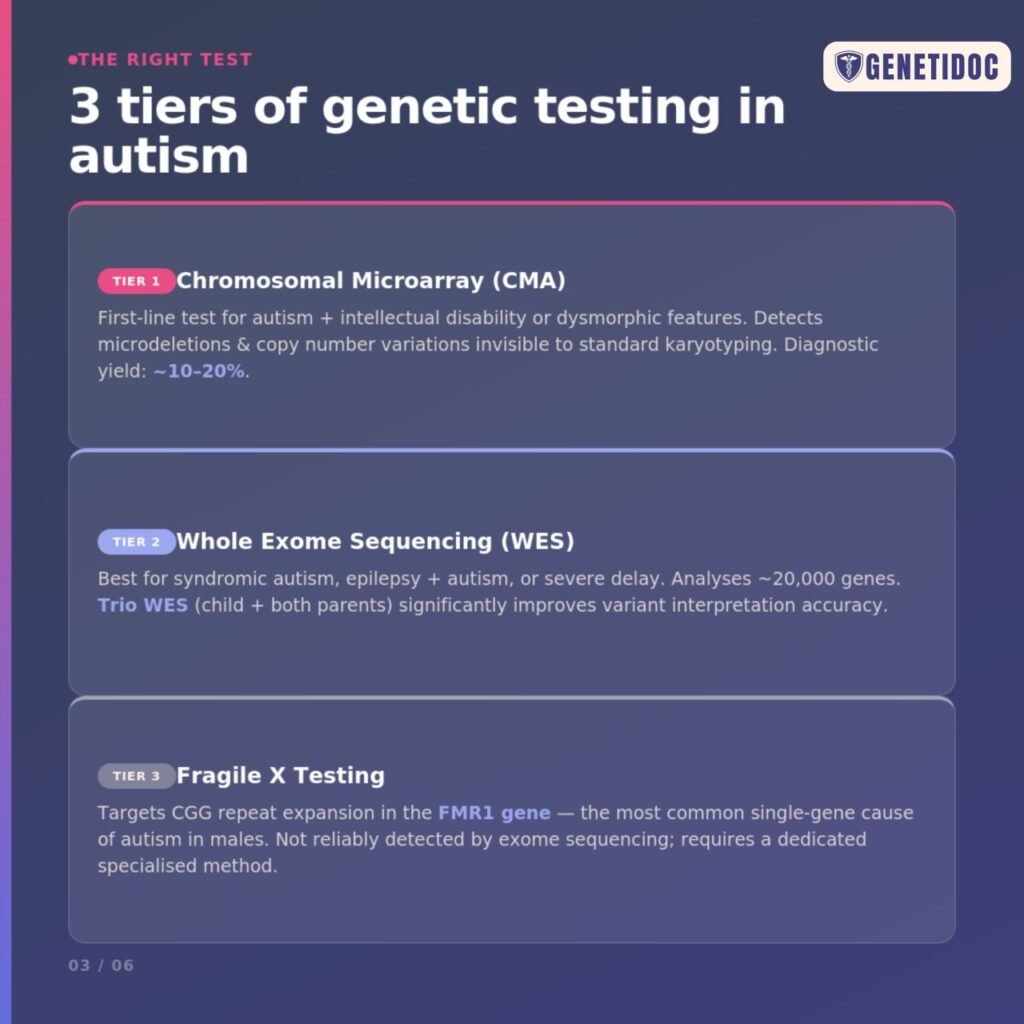
Chromosomal Microarray (CMA) is considered a first-line genetic test in many children with autism and developmental delay.
CMA detects:
- Microdeletions
- Microduplications
- Copy number variations (CNVs)
These are chromosomal changes too small to be seen on routine karyotyping.
CMA is particularly useful in children with:
- Intellectual disability
- Congenital anomalies
- Dysmorphic features
- Multiple system involvement
Conditions such as:
- 16p11.2 deletion syndrome
- 22q11.2 deletion syndrome
- 15q duplication syndromes
may be identified through CMA.
The diagnostic yield is usually around 10–20%.
2. Whole Exome Sequencing (WES)
Whole Exome Sequencing analyzes the protein-coding regions of approximately 20,000 genes.
WES is especially valuable in:
- Syndromic autism
- Epilepsy with autism
- Regression
- Severe developmental delay
- Negative CMA cases
- Suspected monogenic disorders
Genes commonly associated with autism include:
- SHANK3
- SCN2A
- SYNGAP1
- ADNP
- CHD8
- MECP2
In selected cases, trio exome sequencing (testing the child and both parents together) improves interpretation accuracy and helps identify de novo variants.
Some complex or unresolved cases may eventually require:
- Trio exome sequencing
- Whole Genome Sequencing (WGS)
- Mitochondrial testing
- Metabolic evaluation
3. Fragile X Testing
Fragile X syndrome remains one of the most important single-gene causes of autism and intellectual disability, particularly in boys.
Testing specifically evaluates CGG repeat expansion in the FMR1 gene.
Fragile X testing is especially important when there is:
- Intellectual disability
- Family history of developmental delay
- Long face or large ears
- Behavioral issues
- Hyperactivity
- Autism in males
Because Fragile X requires a specialized testing method, it may not always be detected reliably on exome sequencing alone.
When Should Genetic Testing Be Done?
Early testing offers the greatest clinical benefit.
Genetic testing should ideally be considered:
- Soon after autism diagnosis
- In toddlers with speech delay and developmental concerns
- When seizures coexist with autism
- When multiple specialists are involved
- Before planning another pregnancy
Unfortunately, many Indian families undergo years of therapy without being offered appropriate genetic evaluation.
Delayed diagnosis can result in:
- Missed treatable conditions
- Inappropriate medications
- Repeated unnecessary investigations
- Incorrect recurrence counseling
A Real-World Example: Treatable Autism Due to Homocystinuria
One of the most important reasons for genetic evaluation is the possibility of identifying treatable causes of autism-like symptoms.
In one representative scenario, a child presented with:
- Autism features
- Developmental delay
- Poor social interaction
- Behavioral abnormalities
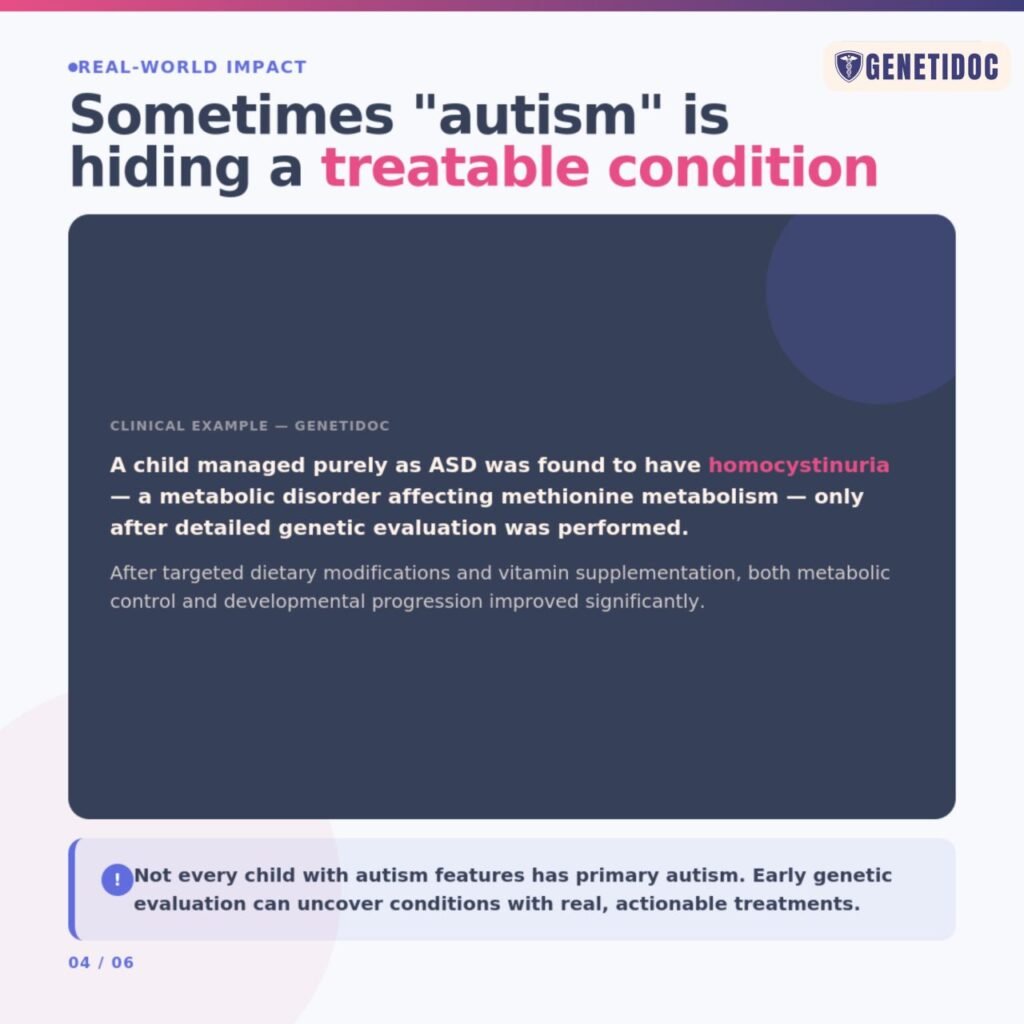
The child had initially been managed purely as autism spectrum disorder.
However, detailed clinical evaluation raised suspicion for an inborn error of metabolism. Further metabolic and genetic testing confirmed homocystinuria, a metabolic disorder affecting methionine metabolism.
Following diagnosis:
- Dietary modifications were initiated
- Vitamin supplementation was started
- Metabolic control improved
Importantly, developmental progression and behavior stabilized significantly after targeted treatment.
Without genetic and metabolic evaluation, the underlying diagnosis could have remained undetected for years.
This highlights a critical reality:
“Not every child with autism has ‘primary autism.’ Some children have underlying metabolic or genetic disorders where early diagnosis can substantially alter outcomes.”
Autism, Epilepsy, and Precision Medicine
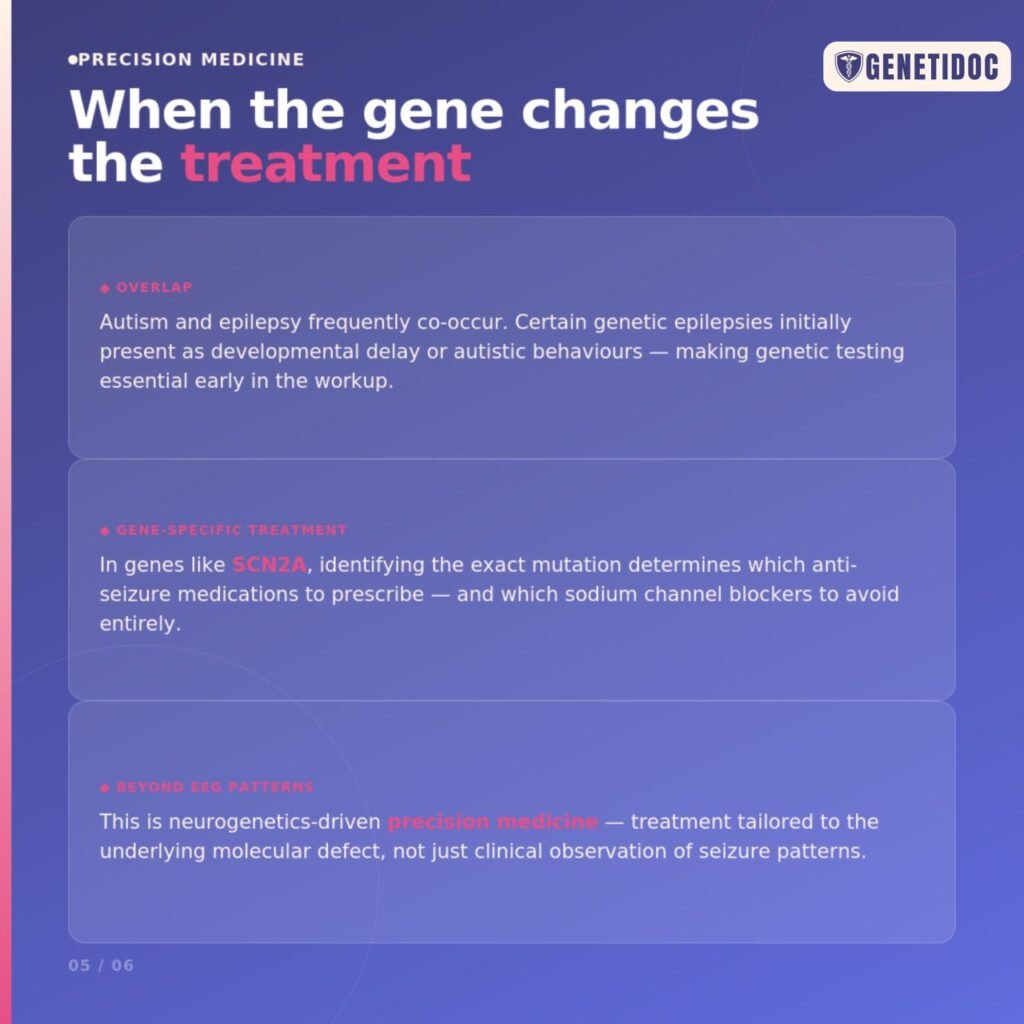
Autism and epilepsy frequently overlap.
Certain genetic epilepsies may initially present with:
- Developmental delay
- Regression
- Poor communication
- Autistic behaviors
In some children, identifying the exact mutation directly changes treatment decisions.
For example, variants in genes such as SCN2A may influence:
- Choice of anti-seizure medication
- Avoidance of sodium channel blockers in some conditions
- Prognostic counseling
- Risk assessment for future neurological complications
This is one of the most rapidly evolving areas of neurogenetics and precision medicine.
Instead of treating epilepsy purely based on EEG patterns, clinicians can increasingly tailor therapy according to the underlying molecular defect.
Preventing Recurrence: IVF with PGT-SR
Genetic testing also plays a major role in reproductive planning.
In one family, a child with developmental abnormalities was eventually found to have a chromosomal rearrangement inherited from a parent carrying a balanced structural rearrangement.
After detailed counseling, the couple underwent:
- IVF
- Preimplantation Genetic Testing for Structural Rearrangements (PGT-SR)
Embryos without the unbalanced chromosomal abnormality were selected for implantation, significantly reducing recurrence risk in future pregnancies.
For many families, this transforms genetics from a purely diagnostic tool into a preventive one.
Challenges in India
Despite increasing awareness, several challenges remain in autism genetics across India.
1. Late Diagnosis
Many children are referred for genetic evaluation only after years of therapy and specialist visits.
Earlier evaluation could improve outcomes significantly.
2. Inappropriate Test Ordering
Families are sometimes advised expensive genetic tests without proper clinical correlation.
Incorrect testing strategies may:
- Increase financial burden
- Produce uninterpretable results
- Generate unnecessary anxiety
3. Misinterpretation of Results
Variants of Uncertain Significance (VUS) are common in genomic testing.
In clinical practice:
- Approximately 20% of cases may receive a clear diagnosis
- Another 20% may show VUS findings requiring careful interpretation
A VUS does not necessarily mean disease causation.
This is why expert interpretation and genetic counseling are essential.
4. Lack of Genetic Counseling
Counseling remains one of the most overlooked aspects of autism care in India.
Families need support understanding:
- What the test can and cannot detect
- Recurrence risks
- Incidental findings
- Emotional implications
- Future reproductive options
Genetic testing without counseling can create confusion instead of clarity.
What Happens During Genetic Counseling?
A proper genetics consultation usually includes:
Clinical Evaluation
- Developmental history
- Pregnancy history
- Family history
- Examination for syndromic clues
Test Selection
Choosing the most appropriate investigation rather than ordering unnecessary broad testing.
Pre-Test Counseling
Discussion regarding:
- Diagnostic yield
- Limitations
- Cost
- Turnaround time
- Possible outcomes
Post-Test Interpretation
Explaining:
- Pathogenic variants
- VUS findings
- Negative results
- Family implications
The Future of Autism Genetics
The field of autism genetics is evolving rapidly.
Emerging areas include:
- Polygenic risk assessment
- RNA sequencing
- Long-read sequencing
- Epigenetic profiling
- AI-assisted variant interpretation
- Gene-specific therapies
As precision medicine advances, genetic diagnosis may increasingly influence:
- Medication choices
- Prognosis
- Behavioral intervention strategies
- Clinical trial eligibility
Final Thoughts
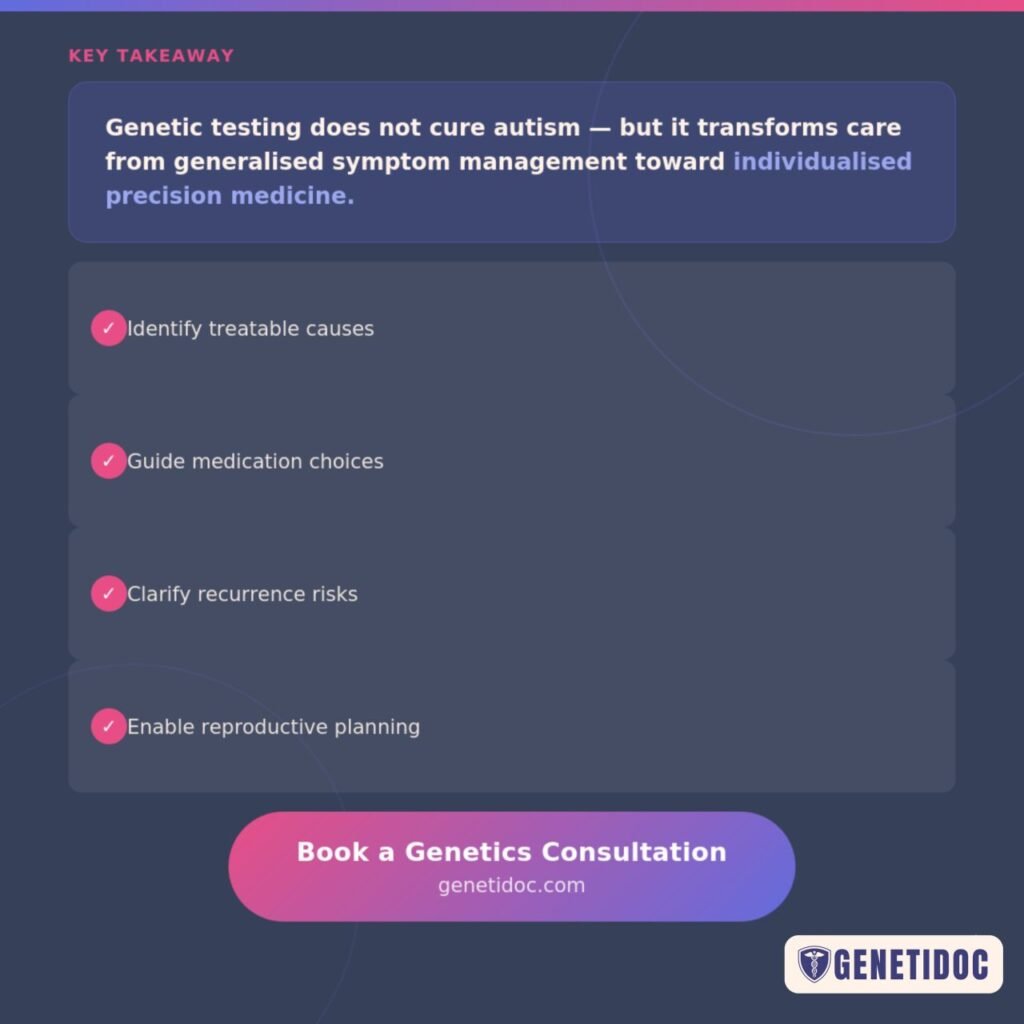
Genetic testing does not “cure” autism. However, it provides something many families desperately seek: answers.
Understanding the underlying genetic basis can:
- Guide management
- Prevent unnecessary investigations
- Identify treatable conditions
- Clarify recurrence risks
- Improve long-term planning
Most importantly, it helps transform autism care from generalized symptom management toward individualized precision medicine.
For families navigating autism, partnering with an experienced clinical genetics team ensures that testing is chosen thoughtfully, interpreted accurately, and translated into meaningful clinical action.