
If your two or three-year-old is not talking like most kids at their age, the concern that arises is understandable. Relatives try to reassure you, saying things like “boys talk late” or “give him time.” You turn to Google, where autism comes up. At the paediatrician’s office, you hear “monitor for a while more.”
The purpose of this article is not to diagnose your child. It aims to take a closer look at the three reasons for late talking — variations in development, speech-language delay as a primary problem, autism spectrum disorder, or something genetic underneath all of this — and determine whether a genetic assessment would be appropriate for your child.
What Is Considered a Speech Delay?
Approximate developmental milestones that pediatricians check for:
- 12 months old: Follows one-step command with gesture, recognizes names of two objects and looks when named. Points to get desired object, uses several gestures with vocalizing (eg: waving and reaching)
- 18 months old: Points to two of three objects when named, points to three body parts, points to self. Understands “mine” points to familiar people when named, uses 10 to 25 words, uses giant words(all gone, stop that), imitates environmental sounds (eg animals), names one picture on demand
- 24 months old: Follows two-step command, understands me/you, points to 5 to 10 pictures, two-word sentence(noun and verb), telegraphic speech, uses 50 words, 50% intelligibility, refers to self by name, names three pictures.
- 36 months old: Points to parts of pictures (nose of cow, door of car), names body parts with function, understands negatives, groups objects (foods, toys), uses 200 words, three-word sentences, uses pronouns correctly, 75% intelligibility, uses plurals, names body parts by use, asks to be read to
A child that is slightly behind on one milestone may be fine. A child that is behind on multiple milestones, or that does not point, make eye contact, or respond to their name may need further investigation.
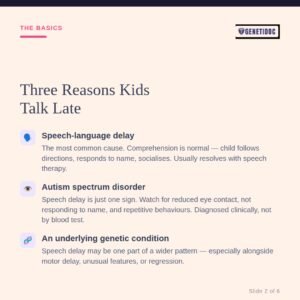
Three General Causes
1. Language Delay (Primary)
The commonest cause of delay in talking. A child has good comprehension (listens to directions, obeys commands, reacts to name, socializes). Usually solved through speech therapy, and late talkers generally ‘come out of their shell’ during schooling years. Hearing defects must always be ruled out first since it is among the most common reasons for language delay in Indian kids.
2. Autism Spectrum Disorder
While language delay may be what initially causes concern within a family or to a pediatrician, it usually isn’t the only symptom present. Some other symptoms which make the presence of autism more probable are decreased eye contact, failure to reliably respond to their name, a lack of pointing out items or sharing objects, repetitive actions or behaviors, and challenges with back-and-forth social interaction. Autism is diagnosed clinically based on a developmental evaluation and not by blood test. But there are many cases of autism where genetics plays a role.
3. A Pre-existing Genetic Disorder
Sometimes, speech delay may occur as part of a wider spectrum of a pre-existing genetic disorder, particularly in cases where speech delay occurs along with other symptoms like:
- Delayed motor development (delayed walking, poor muscle tone)
- Atypical facial appearance or growth pattern
- Seizures
- Regression (loss of acquired skills)
- Family history of intellectual disabilities or autism or unexplained developmental delay
- More than one family member with the same problem
In such scenarios, speech delay becomes just another manifestation of the overall picture and recognizing the genetic problem helps make a difference in management.
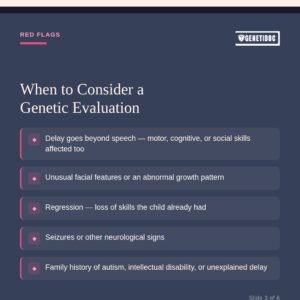
Indications for Genetic Evaluation in Late Talkers?
Genetic work-up is not required in all late talkers. Genetic work-up is indicated in the following conditions:
- Late talking is global – meaning it is associated with motor delay, cognitive delay, or social delay and not limited to speech only
- There are dysmorphic features or abnormal growth curve by the paediatrician
- History of regression in development
- Seizures or other signs of neurological problems
- Family history of autism spectrum disorders or intellectual disabilities or any other unexplained delay
- Conventional hearing tests and speech therapy have not provided any answer
If your child is developing normally in all other aspects of life except delayed expressive speech, then a genetic evaluation may not be necessary at the initial level; a hearing test and speech-language evaluation will be enough.
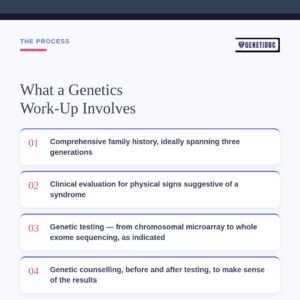
The Real Components of a Genetics Work-up
In order to determine what a genetics evaluation entails when dealing with developmental delay, the following will usually be done:
- Comprehensive Family History – preferably for three generations to establish patterns
- Clinical Evaluation – search for phenotypic signs suggestive of a syndrome
- Genetics Testing – based on findings, may vary from chromosomal microarray analysis, Fragile X test to whole exome sequencing
- Genetic Counselling – prior to and following testing to make sense of results
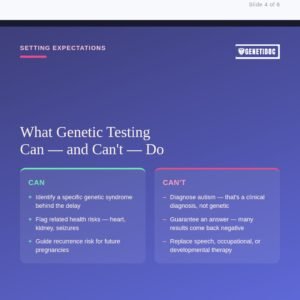
What Genetic Testing Can – and Can’t – Do For Your Child
It’s important to be straightforward here since there can be misconceptions regarding genetic testing.
- Can:
- Identify a specific genetic syndrome in a significant proportion of cases of developmental delay, often if other criteria exist
- Predict possible associated medical problems requiring attention (heart, kidneys, seizures, etc.)
- Provide recurrence risk information for future pregnancy
- Occasionally put a definitive end to what can become a frustrating hunt for answers
Cannot:
- Diagnose autism – autism is not a genetic diagnosis
- Always provide an answer – a good proportion of genetic testing results are negative for a specific syndrome and this does not mean it is not a genetic issue, only that it is yet to be found with the current technology
- Predict exact course of development – genetics is a small but important part of a bigger picture
- Replace speech, occupational, or developmental therapies – those are always necessary
- A genetic test is just one part of the puzzle.
The Practical Implications for You
If there is global delay or regression and a need for reassurance, you shouldn’t have to rely on it because early assessment enables early intervention, which has the most scientific evidence behind it
- Have your hearing tested early — it’s straightforward and easily treatable
- Referral to a clinical geneticist doesn’t mean that “something is terribly wrong” — it just means that you want more information backed by scientific evidence
- Speech therapy and development interventions need to happen at the same time as any testing
Frequently Asked Questions
After 20 months, my child is not yet talking. Should I be concerned?
Not necessarily, although a visit to the paediatrician for an evaluation would be good, especially if it involves hearing too. Many children who are slow to start talking will develop normally through speech therapy.
Could there be a way for a genetic test to confirm whether or not my child has autism?
No. There is no genetic test that could diagnose autism. However, some genetic tests may help in identifying the underlying condition that is related to autism.
Is it to be concluded that when the test result is negative, there is nothing genetic?
Not always. “Negative” only means that the testing technology of today has not found the problem yet; it does not indicate its absence. You may consult your geneticist regarding the advisability of repeating the test later on.
Will my child be hurt during the test?
Genetic tests involve just taking some blood or saliva samples from the child. This will pose no physical risk to the child at all.
Is it necessary for all children with speech delay to be seen by a geneticist?
No. Speech delay is most often effectively treated by just speech therapy. Genetic evaluation becomes more significant when speech delay is global and/or regression has taken place.
How do I begin?
Start off by taking your child to see the paediatrician for a hearing and developmental evaluation. If there are any concerns other than just speech delays, request a referral to a geneticist.
What age would be considered too young to be concerned about a speech delay?
Up until 18 months of age, there is great variability among children in terms of expressive language skills, which means that it is usually too early to make judgments on the basis of speech only. More important at this age is the babbling, response to sound, and social behaviour of the child.
Will having a family member with a “late talker” that grew out of it be indicative that my child will as well?
This may certainly be a comforting setting, but it is by no means guaranteed. A family history of late talkers that do not have other problems would indeed increase the possibility of delayed talking in an individual. However, every child should be evaluated individually based on any other issues.
My child used to talk but then he stopped using words, is this an example of regression or a mere delay?
It is regression, and it should not be confused with delay as it is a completely different case that requires a completely different approach when compared to the child who talks late.
Is it possible for bilingual or multilingual families to have a delayed speech?
Bilingualism or multilingualism does not cause any form of speech delay. The mixing of languages or even having slight differences in milestones per language does not mean that a child’s total language development including comprehension, gesture and interaction is delayed.
What is the duration that should elapse between speech therapy and genetic testing?
There is no set period of time; this largely varies with the case at hand. In cases where the developmental delay is isolated to speech, and the patient responds well to treatment, most practitioners will stick with therapy and follow up on it. However, once other delays emerge, it is not necessary to wait for the treatment period to elapse.
Will a genetic diagnosis make any difference to the way my child will be treated?
It can. Some genetic syndromes have particular health issues linked to them, such as heart problems, kidney problems, or seizures, and this information will help in designing a more individualized treatment strategy. It doesn’t replace other forms of treatment like speech therapy, occupational therapy, or developmental therapy.
Ready to Get Clarity?
Whereas your concerns about your child’s development are more than just speech, there’s no need to rely on the Internet and other people’s good intentions. A clinical genetics consultation by Dr. Roshan Daniel today Register Now will allow you to gather enough information and find out if any additional tests should be conducted.