Medically reviewed by Genetidoc’s team of clinical geneticists, in consultation with genetic counselors and consultant geneticists practising across South and North India.
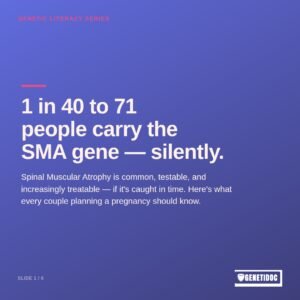
Quick answer: Spinal Muscular Atrophy (SMA) is a genetic condition that weakens the nerves controlling muscle movement, most often showing up in infancy as a “floppy baby” with breathing and feeding difficulty. It’s caused by a missing or faulty SMN1 gene. In India, roughly 1 in 40 to 1 in 71 people carry the SMA gene silently — with some clinical experience in high-carrier-frequency regions suggesting rates as high as 1 in 20 — which is why doctors increasingly recommend carrier screening for every couple planning a pregnancy, not just families with a known history.
What Is Spinal Muscular Atrophy?
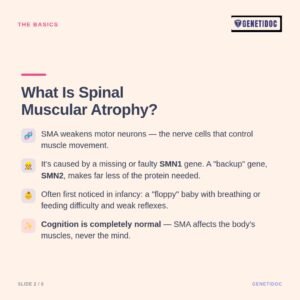
Spinal Muscular Atrophy is an inherited condition that affects the nerve cells in your spinal cord responsible for controlling muscle movement — called motor neurons. When these nerve cells don’t get enough of a protein called SMN (Survival Motor Neuron), they gradually weaken and die. Over time, this causes progressive muscle weakness and wasting.
SMA doesn’t affect thinking, learning, or emotional development. A baby or child with SMA is often bright, alert, and socially engaged — the disease affects the body’s muscles, not the mind.
SMA is caused by changes in a gene called SMN1. Almost everyone has a “backup” gene called SMN2, which is nearly identical to SMN1 but produces much less of the functional protein. As you’ll see below, how many copies of this backup gene a person has turns out to be one of the most important pieces of information in the entire diagnosis.
How SMA Usually Presents: What Parents Notice First
Most families arrive at a genetics clinic long before they’ve heard the term “SMN1 gene.” What actually brings them in are physical signs that something isn’t right.
According to Genetidoc’s consultant geneticists, the most common pattern is a baby, typically between six months and a year old, who presents with:
- Recurrent chest infections or pneumonia
- Breathing difficulty, sometimes serious enough to need ventilator support
- A noticeably “floppy” body — low muscle tone, limited spontaneous movement
- Weak or absent reflexes
- Fine tremor-like flickering of the tongue (called fasciculation)
Importantly, cognition is completely normal — babies with SMA are often described by their care teams as unusually alert and engaged, which is part of what makes the diagnosis so emotionally difficult for families to process (more on that below).
“The pattern we see most often is a six-month to one-year-old with recurrent pneumonia, breathing difficulty, and that classic floppy posture, along with absent reflexes and tongue fasciculations. But we also regularly see later-onset presentations — children who are otherwise fine but have delayed walking, difficulty with stairs, or become wheelchair-dependent over time. It’s a spectrum, not one single picture.”
— Genetidoc Clinical Genetics Team
Not every case is caught early. A recurring and difficult pattern our genetic counselors describe: a couple who lost a baby to unexplained illness — never formally diagnosed — and only receives an SMA diagnosis in a subsequent pregnancy, when a similar pattern repeats itself. This is one of the strongest arguments for carrier screening before conception, which we’ll come back to.
Conditions That Sometimes Get Confused With SMA
Because “floppy baby” and delayed milestones are non-specific signs, several other conditions can initially resemble SMA before genetic testing clarifies the picture:
| Condition often confused with SMA | Why the confusion happens |
| Prader-Willi syndrome | Newborns show poor sucking, hypotonia, and low activity |
| Down syndrome | Hypotonia is a shared early feature |
| Pompe disease | Also causes progressive muscle weakness in infancy (though usually with heart involvement) |
| Perinatal insult / cerebral palsy | Motor delay and low tone can look similar without a genetics workup |
| Duchenne/Becker muscular dystrophy | In boys presenting around age 9–10 with recurrent falls and a “Gower’s sign” (using hands to push up off the legs when standing) |
| Simple respiratory illness | Recurrent pneumonia can initially be treated as a standalone infection |
Genetic testing is what ultimately separates these look-alikes — and it’s also what tells families whether treatment options exist, which is where SMA differs enormously from most of the conditions on this list.
How SMA Is Diagnosed: The Testing Pathway Explained
If a doctor suspects SMA, the diagnostic pathway usually follows two steps.
Step 1: MLPA testing for the SMN1 gene
About 95–98% of SMA cases are caused by a missing (deleted) piece of the SMN1 gene. This is detected using a technique called MLPA (Multiplex Ligation-dependent Probe Amplification) — essentially a way of counting how many copies of specific gene segments a person has.
Step 2: Sequencing when suspicion remains high
Here’s the detail that generic online information often misses: 2–5% of SMA cases are caused by a small point mutation in the SMN1 gene rather than a full deletion. If a child has strong clinical signs of SMA but MLPA shows only one copy missing (rather than both), the lab needs to move to next-generation sequencing (NGS) to look for that second, subtler mutation on the remaining copy.
Why this matters: A lab that only runs deletion/duplication analysis and stops there — without following up with sequencing when the clinical picture still points to SMA — can miss this compound scenario entirely. This is one of the most important diagnostic pitfalls in SMA testing, and it’s exactly the kind of detail that separates a thorough workup from an incomplete one.
Why the SMN2 “backup gene” matters just as much as the diagnosis itself
SMN2 is what’s known as a pseudogene — a near-identical copy of SMN1 that sits right next to it on chromosome 5. It doesn’t cause SMA on its own. But once SMN1 is lost, the number of SMN2 copies a person has becomes the single biggest factor influencing how severe the disease will be, and how urgently treatment is needed.
This is backed by strong published data. A large genotype-phenotype study (Calucho et al., cited in the GeneReviews clinical reference for SMA) found the following relationship between SMN2 copy number and disease severity:
| SMN2 Copy Number | Likelihood of SMA Type I (most severe) | Likelihood of SMA Type II | Likelihood of SMA Type III/IV (mildest) |
| 1 copy | 96% | 4% | 0% |
| 2 copies | 79% | 16% | 5% |
| 3 copies | 15% | 54% | 31% |
| 4 or more copies | 1% | 11% | 88% |
Source: Calucho et al. 2018, as summarized in Prior, Leach & Finanger, Spinal Muscular Atrophy, GeneReviews®, University of Washington, Seattle.
“SMN2 is a pseudogene — its sequence is almost identical to SMN1, which is exactly why it’s so easy to overlook technically. On its own, even a deletion in SMN2 does not cause disease. But once SMN1 is affected, SMN2 becomes a disease modifier: more copies generally mean a milder course. It’s one of the most clinically important numbers we report, because it shapes both prognosis and the urgency of starting treatment.”
— Genetidoc Clinical Genetics Team
Why Timing Changes Everything: The Presymptomatic Treatment Window
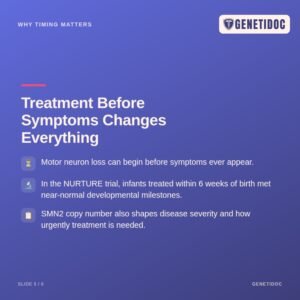
This is, arguably, the single most important shift in how SMA is managed today: treatment started before symptoms appear produces dramatically better outcomes than treatment started after.
This isn’t a marginal difference. In the NURTURE clinical trial, babies with SMA who were treated with a disease-modifying therapy within the first six weeks of life — before any visible symptoms — showed outcomes that look almost nothing like the natural history of untreated SMA. In the group with three copies of SMN2, children met nearly all normal developmental milestones. Even in the group with only two copies (typically associated with the most severe form of SMA), the majority achieved independent sitting, and a large proportion learned to walk with assistance or independently — outcomes essentially unheard of in untreated Type I SMA.
“There’s a study out of Sydney where a mother began oral treatment after her pregnancy was diagnosed with SMA through prenatal testing. The baby continued the medication after birth, and by two years of age, showed zero manifestation of the disease. That’s the power of catching this before symptoms start, not after.”
— Genetidoc Clinical Genetics Team
Why India doesn’t yet have universal newborn screening — and why preconception screening fills that gap
Unlike some countries, SMA newborn screening is not currently standard practice anywhere in India. What is increasingly offered — particularly in regions with high carrier frequency such as Punjab and Kerala — is preconception or prenatal carrier screening for couples planning a pregnancy.
“In both Punjab and Kerala, where I’ve practiced, the carrier status of SMA is quite high. We advise a lot of couples to get tested regardless of family history. Ideally, this needs to be screened universally — the same way thalassemia already is in many parts of the country.”
— Genetidoc Clinical Genetics Team
Carrier Screening: Why “No Family History” Doesn’t Mean “No Risk”
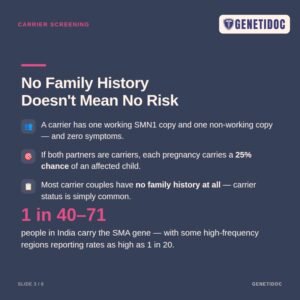
Carrier status is a completely normal part of human genetics. A carrier has one working copy of SMN1 and one non-working copy — they show no symptoms whatsoever and will never develop SMA themselves.
The trouble starts when both partners in a couple happen to be carriers. In that situation, each pregnancy carries a 25% chance of the child having SMA, a 50% chance of the child being an unaffected carrier, and a 25% chance of the child being unaffected and not a carrier at all.
Published, peer-reviewed estimates place SMA carrier frequency at roughly 1 in 40 to 1 in 71 depending on the population studied (GeneReviews cites 1 in 71 specifically for the Asian Indian population, while broader pan-ethnic ranges run from about 1 in 40 to 1 in 60). Genetidoc’s clinicians, drawing on regional clinical experience in high-frequency belts such as Punjab and Kerala, note that informal estimates in their practice run as high as 1 in 20 — underscoring that this is not a rare-population issue; it’s common enough that family history is a poor filter for who should be tested.
“I recommend that pan-India, everybody planning a pregnancy get tested for SMA specifically. Not every genetic disease needs universal screening — but for SMA, given how common carrier status is and how much difference early knowledge makes, it’s important.”
— Genetidoc Clinical Genetics Team
The “2+0” carrier trap: a limitation every patient should understand
Here’s a nuance that’s rarely explained clearly to patients, but genuinely changes how a “negative” carrier test should be interpreted.
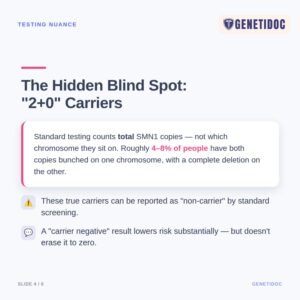
Standard SMA carrier testing counts how many total copies of SMN1 you have — it doesn’t tell you which chromosome those copies sit on. Most people have one copy of SMN1 on each of their two chromosome 5s (a “1+1” arrangement). But roughly 4–8% of people have both copies bunched onto a single chromosome, with a complete deletion on the other chromosome — a “2+0” arrangement.
A person with a 2+0 arrangement is technically a carrier — they have a chromosome with zero working copies of SMN1 — but because the total copy count still reads as “two,” standard testing reports them as a non-carrier. This is a genuine, well-documented blind spot in carrier screening, not a lab error.
“The 2+0 scenario is a major issue — around 4% of couples might carry this configuration, and it can be missed on standard carrier screening. It becomes much easier to resolve if there’s already an affected relative whose results we can reference, or if we can test the extended family directly.”
— Genetidoc Clinical Genetics Team
In practical terms: a “carrier negative” result lowers your risk substantially, but it doesn’t reduce it to zero. This residual risk is exactly why genetic counseling — not just the raw lab report — matters so much in interpreting these results.

Treatment Options and Real-World Cost in India
SMA has moved from an untreatable diagnosis to a condition with genuine, disease-modifying therapy options — though access and cost remain very real barriers for most Indian families.
| Treatment | How it works | Approximate India cost (2026) |
| Risdiplam (Evrysdi) | Daily oral liquid; increases functional SMN protein from the SMN2 gene | Roche’s branded version costs roughly ₹5.4–6 lakh per bottle. Following a 2025 Delhi High Court ruling, an Indian generic (Natco Pharma) is now available at approximately ₹15,000–20,000 per bottle — a reduction of nearly 97%. |
| Nusinersen (Spinraza) | Intrathecal (spinal) injection; loading doses followed by maintenance every 4 months, lifelong | Approximately ₹80–90 lakh per injection; lifetime cost can exceed one-time gene therapy |
| Onasemnogene abeparvovec (Zolgensma) | One-time intravenous gene replacement therapy; approved for children under 2 years | Roughly ₹16–18 crore per dose (imported) |
Costs are indicative and change frequently; always confirm current pricing and eligibility with the treating center. Risdiplam is currently the only SMA therapy with routine DCGI/CDSCO approval for standard prescription in India.
Government support and patient assistance
India’s National Policy for Rare Diseases offers a one-time financial assistance of up to ₹50 lakh for eligible rare disease patients. This is meaningful support, but families and clinicians alike note it can be exhausted quickly against the ongoing cost of therapies like risdiplam or the far larger cost of gene therapy, especially as a child’s weight — and dosage — increases over time.
Beyond government assistance, families in India commonly draw on:
- Patient advocacy organisations such as the Cure SMA Foundation, which run trials and community screening camps to identify patients who may benefit from treatment. It’s worth understanding upfront that these programs typically provide the medication itself free of cost, while the family remains responsible for procedure-related expenses such as hospital administration and monitoring.
- Crowdfunding platforms, particularly for gene therapy, given its very high one-time cost.
- Compassionate access and manufacturer assistance programs, which have historically provided free or discounted bottles of risdiplam to eligible families, though terms and availability change over time.
Does SMN2 copy number affect treatment eligibility?
Yes — and this is where the diagnostic detail discussed earlier becomes directly actionable. Based on the strength of presymptomatic trial data, current international treatment recommendations favour starting therapy immediately for infants with two, three, or four copies of SMN2, regardless of whether symptoms have appeared yet. For infants with just one copy (associated with the most severe presentation) or five or more copies (associated with the mildest), the decision is more individualized and depends on clinical judgment.
Planning Future Pregnancies After an SMA Diagnosis
For couples who have had one child diagnosed with SMA, the recurrence risk for future pregnancies is significant: approximately 25% for each pregnancy, since both parents are, by definition, carriers — they’ve already demonstrated this by having an affected child. This is reinforced by the population’s relatively high carrier frequency, which makes it statistically unsurprising in the first place.
Genetidoc’s team primarily recommends prenatal diagnosis for these couples — testing an existing pregnancy directly — while also offering Preimplantation Genetic Testing (PGT-M) as an option for couples pursuing IVF who prefer to identify unaffected embryos before pregnancy begins.
| Option | When it’s done | What it involves |
| Chorionic Villus Sampling (CVS) | 11–13 weeks of pregnancy | Sampling placental tissue to test the fetus’s genetic status directly |
| Amniocentesis | 15 weeks onward | Sampling amniotic fluid for genetic testing |
| PGT-M (via IVF) | Before pregnancy begins | Embryos are tested and only unaffected embryos are transferred |
It’s also common, and encouraged, for extended family members — siblings and cousins of the affected child’s parents — to come forward for their own carrier testing once a diagnosis is confirmed in the family, particularly when they are themselves planning marriage or conception.
The Emotional Side of an SMA Diagnosis
Genetic results don’t land in a vacuum — they land on families who are frightened, exhausted, and often meeting these terms for the first time. A few misconceptions come up again and again in the counseling room.
“It’s because we’re blood relatives”
Among consanguineously married couples especially, there’s a common and painful misconception that the diagnosis is a direct, personal consequence of their marriage. While consanguinity does raise the statistical chance of two carriers pairing up, carrier status itself is universal — non-consanguineous couples become carrier pairs too, simply by chance, given how common SMA carrier status is in the general population. This isn’t anyone’s fault; it’s basic genetics that any two people can carry.
“Every future child will have it”
Parents frequently overgeneralize a 25% recurrence risk into near-certainty for future pregnancies. Genetic counseling exists precisely to walk through what that 25% actually means in practical, reproductive-planning terms.
“Milder type now means severe type later”
Because SMA spans a spectrum, some parents whose child has been diagnosed with a milder form (Type II or III) become fixated on the outcomes associated with the most severe form (Type I), assuming that’s their child’s future trajectory. Clear communication about where their specific child’s SMN2 copy number places them on that spectrum is an important part of easing this fear.
“Gene therapy will make my child completely normal”
With growing awareness of Zolgensma and other therapies, some families arrive believing gene therapy is a full cure. Setting realistic expectations — that these treatments change the disease trajectory dramatically but cannot restore motor neurons already lost — is an essential, if difficult, part of counseling.
“One of the hardest moments is when a baby has come off the ventilator and looks stable — cognitively normal, smiling, laughing — and we have to explain that the underlying respiratory issue will continue, and that life expectancy may be affected. Delivering that news to parents who are looking at a happy, alert baby in front of them is genuinely one of the most difficult parts of this work.”
— Genetidoc Clinical Genetics Team
Why Lab Quality and Expert Interpretation Matter
SMA testing looks deceptively simple on paper — a deletion test, a copy-number count. In practice, several technical nuances can be missed by a lab that isn’t specifically attentive to them:
- Missing the 2–5% of cases caused by a point mutation rather than a deletion, if sequencing isn’t pursued when clinically warranted
- Reporting a “carrier negative” result without flagging the 2+0 residual risk, leaving a couple with false reassurance
- Not recognizing when extended family testing — grandparents, or the parents of a couple — is needed to properly resolve an ambiguous result
“A great deal of nuance goes into SMA testing. It matters enormously that a reliable lab is doing the testing, and that the interpretation accounts for both the 2+0 scenario and the possibility of point mutations. Very often, we also need to test grandparents or the parents of the couple themselves to reach a confident final answer — a simple pass/fail report doesn’t capture that complexity.”
— Genetidoc Clinical Genetics Team
A composite patient story
Several of Genetidoc’s SMA patients live with a milder form of the condition — some using wheelchairs, some with ongoing mobility challenges — while retaining completely normal cognition. Many of these individuals go on to study, work, advocate, and actively challenge public misconceptions about what a life with SMA looks like. Their outcomes are a powerful reminder that a genetic diagnosis describes a starting point, not a fixed endpoint — especially in an era where treatment, correctly timed, changes so much of what comes next.
“Genetic testing gives us data. What actually changes a family’s outcome is what we do with that data — correct interpretation, timely counseling, and connecting the diagnosis to the right treatment pathway before the window for maximum benefit closes. That’s the value a specialised genetics team brings that a standalone lab report simply cannot.”
— Genetidoc Clinical Genetics Team
Frequently Asked Questions
-
Is spinal muscular atrophy curable?
There is currently no cure for SMA. However, three targeted, disease-modifying therapies — risdiplam, nusinersen, and onasemnogene abeparvovec — can substantially change its course, especially when started before symptoms appear.
-
Does SMA affect intelligence or cognitive development?
No. SMA affects motor neurons and muscle function only. Cognitive and intellectual development are typically completely normal.
-
If both parents are carriers, will every child definitely have SMA?
No. Each pregnancy carries an independent 25% chance of an affected child, a 50% chance of an unaffected carrier child, and a 25% chance of a child who is neither affected nor a carrier.
-
Can a “carrier negative” SMA test still carry some risk?
Yes. Due to a genetic quirk called the “2+0” configuration (present in roughly 4–8% of people), standard carrier screening can miss a small proportion of true carriers. This residual risk should be discussed as part of genetic counseling.
-
Is SMA carrier screening recommended even without a family history?
Increasingly, yes. Given how common carrier status is — roughly 1 in 40 to 1 in 71 in published Indian data, with some regional clinical experience suggesting even higher rates — many clinicians now recommend screening for all couples planning a pregnancy, similar to existing thalassemia screening programs.
-
What is the SMN2 gene, and why does it matter?
SMN2 is a “backup” gene very similar to SMN1. It doesn’t cause SMA by itself, but once SMN1 is lost, the number of SMN2 copies a person has strongly influences how severe their SMA will be and how urgently treatment should start.
-
How much does SMA treatment cost in India?
Costs vary hugely by treatment. A recent Indian generic version of risdiplam brought oral therapy down to roughly ₹15,000–20,000 per bottle, a major improvement from the branded version’s ₹5–6 lakh per bottle. Nusinersen and gene therapy (Zolgensma) remain extremely expensive — running into tens of lakhs to several crores.
-
Is newborn screening for SMA available in India?
Not as standard practice currently. Preconception and prenatal carrier screening are more widely available and are the primary way SMA risk is currently identified before a child is born in India.
-
What’s the difference between prenatal diagnosis and PGT-M?
Prenatal diagnosis (via CVS or amniocentesis) tests an existing pregnancy. PGT-M tests IVF-created embryos before a pregnancy begins, allowing only unaffected embryos to be transferred.
-
Can extended family members get tested after a diagnosis in the family?
Yes, and it’s commonly recommended — particularly for siblings and cousins of the parents who are themselves planning marriage or a family.
-
Why does starting treatment before symptoms appear make such a big difference?
Motor neuron loss in SMA can begin very early, sometimes before birth. Clinical trial data (such as the NURTURE study) show that infants treated presymptomatically achieve motor milestones far closer to typical development than those treated after symptoms have already caused nerve damage.
-
What kind of doctor should I see if SMA is suspected or runs in my family?
A clinical geneticist or genetic counselor is best placed to order the right test, interpret results accurately (including nuances like the 2+0 configuration), and guide reproductive planning.
Key Takeaways
- SMA is caused by loss of the SMN1 gene and typically presents in infancy with floppy tone, breathing difficulty, and absent reflexes — though later-onset, milder forms exist too.
- SMN2 copy number is the single most important number after diagnosis — it shapes both prognosis and treatment urgency.
- Carrier screening is now recommended broadly, not just for families with a known history, given how common carrier status is across Indian populations.
- A “carrier negative” result carries a small residual risk due to the 2+0 configuration — genetic counseling helps interpret this correctly.
- Treatment started before symptoms appear produces dramatically better outcomes than treatment started afterward.
- Generic risdiplam has made oral therapy far more accessible in India, though gene therapy and injectable options remain very costly.
- Interpretation matters as much as the test itself — point mutations, 2+0 carriers, and family-based confirmatory testing all require expert oversight.
Planning a Pregnancy, or Have a Family History of SMA?
Genetidoc’s clinical geneticists offer SMA carrier screening, confirmatory diagnostic testing, and genetic counseling — including careful interpretation of the 2+0 carrier scenario and SMN2 copy number for existing diagnoses. Speak with our team to understand your specific risk and options.
Book your genetic consultation
Related Reading on the Genetidoc Blog
- Preconception Couple Carrier Screening: What Every Couple Should Know Before Trying to Conceive (anchor text: “preconception carrier screening”)
- Genetic Testing for Consanguineous Couples: Understanding and Managing Your Risk (anchor text: “consanguineous couple genetic testing”)
- Thalassemia Carrier Screening in Kerala: Why It’s Recommended Before Marriage (anchor text: “thalassemia carrier screening”)
- PGT and IVF: How Preimplantation Genetic Testing Works (anchor text: “PGT-M for inherited conditions”)
- Understanding Recurrent Pregnancy Loss: When Genetic Testing Can Help (anchor text: “recurrent pregnancy loss genetic testing”)
References
- Prior TW, Leach ME, Finanger E. Spinal Muscular Atrophy. 2000 Feb 24 [Updated 2026 Feb 12]. In: Adam MP, Feldman J, Mirzaa GM, et al., editors. GeneReviews® [Internet]. Seattle (WA): University of Washington, Seattle.
- Verhaart IEC, Robertson A, Wilson IJ, et al. Prevalence, incidence and carrier frequency of 5q-linked spinal muscular atrophy — a literature review. Orphanet J Rare Dis. 2017;12:124.
- Sugarman EA, Nagan N, Zhu H, et al. Pan-ethnic carrier screening and prenatal diagnosis for spinal muscular atrophy: clinical laboratory analysis of >72,400 specimens. Eur J Hum Genet. 2012;20:27-32.
- Calucho M, Bernal S, Alías L, et al. Correlation between SMN2 copy number and clinical phenotype of spinal muscular atrophy: three years’ experience of a Spanish national spinal muscular atrophy registry. Neuromuscul Disord. 2018;28:208-215.
- De Vivo DC, Bertini E, Swoboda KJ, et al. Nusinersen initiated in infants during the presymptomatic stage of spinal muscular atrophy: Interim efficacy and safety results from the NURTURE study. Neuromuscul Disord. 2019;29:842-856.
- Servais L, Day JW, De Vivo DC, et al. Continued benefit of nusinersen initiated in the presymptomatic stage of spinal muscular atrophy: 5-year update of the NURTURE study. Neuromuscul Disord. 2024.
- American College of Medical Genetics and Genomics (ACMG). Carrier screening for spinal muscular atrophy. Genet Med. 2008;10:840-842.
- American College of Obstetricians and Gynecologists (ACOG). Carrier Screening for Spinal Muscular Atrophy (SMA). Patient FAQ.
- Verma IC, et al. Carrier screening of spinal muscular atrophy in North Indian population and its public health implications. Clin Genet. 2020.
- National Policy for Rare Diseases, Ministry of Health and Family Welfare, Government of India, 2021 (financial assistance provisions).
This article is for educational purposes and does not replace consultation with a qualified clinical geneticist or genetic counselor. Treatment costs and drug availability referenced above are current as of 2026 and are subject to change; please confirm details with your treating center. Note for editorial review: no content in this article pertains to sex selection or PC-PNDT-restricted testing.