
What Is Thalassemia, Really?
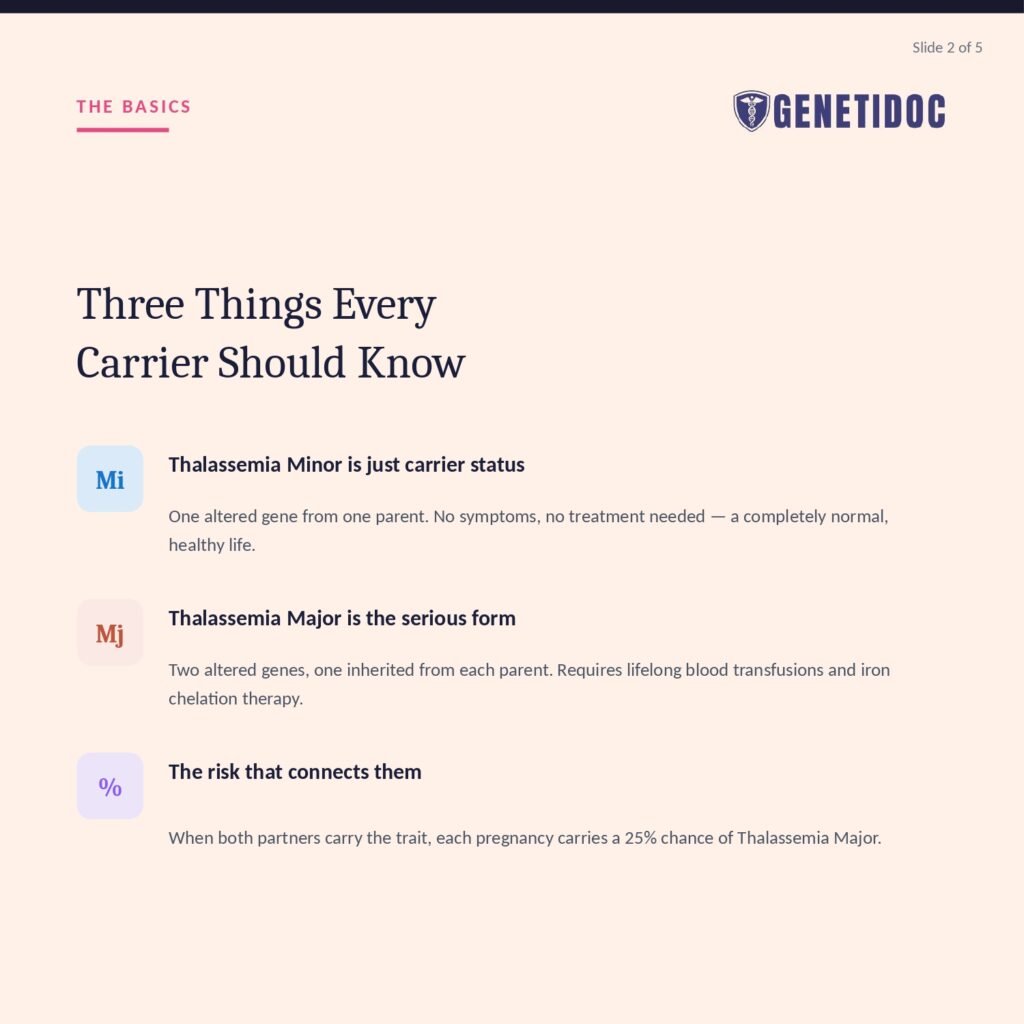
Thalassemia (pronounced thuh-lass-EE-mee-uh) is an inherited blood disorder. It affects how the body makes hemoglobin — the protein inside red blood cells that carries oxygen throughout the body. When hemoglobin production is disrupted, red blood cells become smaller and fewer, leading to anemia, or a shortage of healthy red blood cells. Hemoglobin is built from two types of protein chains: alpha and beta. Thalassemia develops when a genetic change interferes with the production of one of these chains:
- Alpha-thalassemia: the body doesn’t produce enough alpha
- Beta-thalassemia: the body doesn’t produce enough beta chains. This is the form most commonly screened for in India, including Kerala.
How serious thalassemia becomes for a person depends entirely on how many altered gene copies they inherit — one from each parent. This is why understanding both partners’ status matters so much before starting a family.
| Type / Severity | Inheritance | What It Means for Health |
|
Thalassemia Minor (Trait) |
One altered gene, from one parent |
Carrier status. Usually nosymptoms, or very mild anemiathatoftengoes unnoticed. No treatment needed. |
| Type / Severity | Inheritance | What It Means for Health |
|
Thalassemia Intermedia |
Altered genes from both parents (milder combination) | Moderate anemia. Mayoccasionally need blood transfusionsduring illness,pregnancy, or physical stress. |
|
Thalassemia Major |
Severe altered genes from both parents |
Severe anemia. Requires regular lifelong blood transfusions and ongoing iron chelation therapy to remove excess iron from the body. |
One point is worth repeating clearly: thalassemia is genetic, not contagious. You cannot catch it from another person, and you cannot develop it later in life. You are either born with the altered gene, or you are not. That’s exactly why testing — not guessing based on family history or symptoms — is the only reliable way to know your status.
Thalassemia Minor: The Carrier State
In Malayalam, Thalassemia Minor is commonly referred to as thalassemia carrier. Understanding this term matters, Because it’s often misunderstood in Kerala households as a “disease” rather than what it actually is — a harmless carrier state. A person with Thalassemia Minor carries just one copy of the altered gene, inherited from one parent. They are a carrier, not a patient with a serious illness. Their red blood cells may be slightly smaller, or their hemoglobin slightly lower, but they live entirely normal, healthy lives.
Symptoms — Usually None at All
Because the body compensates so well, most people with Thalassemia Minor have no symptoms whatsoever. They usually discover their status only through a routine premarital or preconception blood test. When symptoms do appear, they are mild and easy to mistake for ordinary tiredness:
- Mild fatigue — feeling slightly low on energy at times
- Mildpaleness — slightly pale skin or inner eyelids
- Mild dizziness or weakness — occasional lightheadedness during heavy exertion
- Slightly lower hemoglobin — typically 9–11 g/dL, compared to a standard range of 12–15 g/dL
Why This Matters: The 25% Risk Every Couple Should Understand
Being a Thalassemia Minor carrier changes nothing about your own health. What it changes is the math for your children — and only if your partner is also a carrier.
| Test Outcome | Risk to Children |
| Neither partner is a carrier |
Virtually no risk of Thalassemia Major in any pregnancy. |
| Only one partner is a carrier | Zero risk of Thalassemia Major. Each child has a 50% chance of being a healthy carrier, like the affected parent. |
| Test Outcome | Risk to Children |
| Both partners are carriers | In every single pregnancy: 25% chance unaffected, 50% chance healthy carrier, 25% chance Thalassemia Major. |
That 25% figure holds true in every pregnancy the couple has — it doesn’t decrease because a previous child was unaffected, and it doesn’t increase because a previous child was affected. Each pregnancy is an independent roll of the same dice. This is one of the most important — and most misunderstood — points in genetic counseling for carrier couples.
To be clear: being a carrier is not a reason to avoid marriage or panic. The overwhelming majority of carrier couples in Kerala go on to have healthy families. Knowing your status simply opens the door to informed choices — through preconception planning, prenatal testing, or in some cases IVF with embryo screening — instead of finding out only after a child is born with Thalassemia Major.
What Does Premarital and Preconception Screening Actually Involve?
Thalassemia carrier screening is a simple, two-step blood test process. There’s no fasting required, no special preparation, and results are typically available within a few days.
Step 1: Complete Blood Count (CBC)
This is the initial screening test. It looks at your overall red blood cell health, specifically two values:
- MCV (Mean Corpuscular Volume) — the average size of your red blood cells. A value below 80 fL suggests the cells are smaller than normal.
- MCH (Mean Corpuscular Hemoglobin) — the average hemoglobin content per cell. A value below 27 pg suggests the cells are paler than normal.
Either iron deficiency or a thalassemia trait can cause these low readings — which is exactly why CBC alone is never the final answer.
Step 2: HPLC / Hemoglobin Electrophoresis
If the CBC shows small or pale red blood cells, the next step is High-Performance Liquid Chromatography (HPLC), sometimes called hemoglobin electrophoresis. This test measures the different types of hemoglobin present in your blood.
- An HbA2 level above 5% typically confirms Beta-Thalassemia Minor (carrier trait).
- If Alpha-Thalassemia is suspected, or if the HPLC result is inconclusive, DNA-based molecular testing of the HBB or alpha-globin genes may be needed for a definitive answer. This step matters because standard HPLC can miss certain alpha-thalassemia
Deletions and some “silent” carrier variants — a gap that shows up more often than most people expect when testing is done at a lab without genetics-specific interpretation.
Why Kerala Specifically Needs This Conversation
India carries a disproportionate share of the world’s beta-thalassemia burden. The national
Carrier frequency is generally estimated between 3% and 4%, which translates to an estimated 40 to 50 million healthy carriers across the country, and approximately 10,000 to 15,000 children born each year with Thalassemia Major. Nationally, that works out to roughly 1 in every 25 to 30 people carrying the trait — often without any idea that they do.
Kerala’s own risk picture has a few distinct features worth knowing:
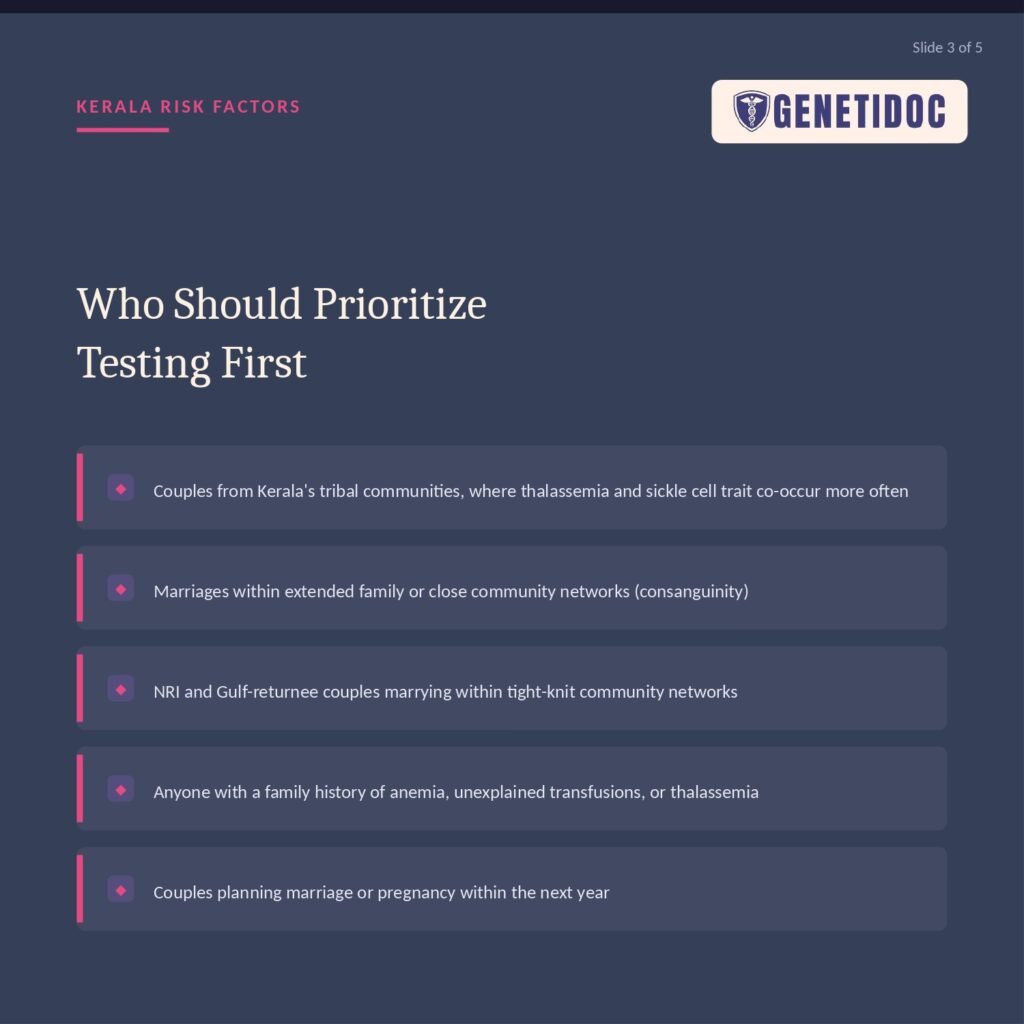
- Tribal and indigenous communities across Kerala show a notably high co-occurrence of beta-thalassemia alongside related hemoglobin disorders such as sickle cell trait, compared to the general population.
- Consanguineous marriage patterns — including marriages within extended family or close community networks, which remain more common in certain regions andCommunities of Kerala than in many other Indian states — increase the chance that both partners carry the same inherited variant.
- NRI and Gulf-returnee marriages are common in Kerala, and couples in this group often marry within tightly-knit community or family networks, which can carry similar genetic risk factors even when the couple has lived abroad for years.
- Church and community-linked premarital health checks are already a familiar part of the marriage process in many parts of Kerala, which gives thalassemia screening a natural, non-stigmatizing entry point compared to states where premarital testing has no existing cultural framework.
This is the layer of the story that’s often missing from general screening advice. Kerala doesn’t need a scare campaign — it needs couples to understand that testing is quick, private, and simply slots into a process many families already follow before marriage.
A Composite Case: What This Looks Like in Practice
The following is an anonymized, composite scenario reflecting patterns commonly seen in preconception genetic counseling — not a specific patient case.
A couple in their late twenties came in for a routine preconception check-up before trying for their first child. The wife’s CBC from a few years earlier had shown a slightly low MCV, which her previous doctor had attributed to iron deficiency, and she had been taking iron tablets on and off ever since — without much improvement in her energy levels.
An HPLC test confirmed she was a beta-thalassemia carrier, not iron deficient at all. Her husband was tested next and turned out to be a carrier too. Because they came in before pregnancy, they had time to sit with a genetic counselor, understand the 25% risk clearly, and calmly weigh their options — from prenatal testing early in a natural pregnancy to IVF with preimplantation genetic testing. They chose to proceed with a planned pregnancy and opted for CVS testing at 11 weeks, which showed their baby had inherited only one copy of the gene — a healthy carrier, like both parents. The couple’s own words afterward summed it up well: knowing early meant they never had to make a decision under pressure.
If Both Partners Are Carriers: What Are the Real Options?
This is the moment that understandably worries couples most — and it’s also the point where good counseling matters more than any single test result. There is no single “right” choice;
There are several medically sound paths, and the right one depends on the couple’s circumstances, values, and how far along they already are in family planning.
1. Preconception Planning with PGT-M
Preimplantation Genetic Testing for Monogenic disorders (PGT-M) is done through IVF.
Embryos are tested for the thalassemia mutations before being transferred, allowing the
Couple to select an embryo unaffected by Thalassemia Major. This path is chosen most often by couples who want to avoid the possibility of a difficult decision during an ongoing pregnancy.
2. Prenatal Diagnosis during a Natural Pregnancy
For couples who conceive naturally, early testing can determine the baby’s status well within the first trimester or early second trimester:
- Chorionic Villus Sampling (CVS) — typically performed at 10–13 weeks
- Amniocentesis — typically performed at 15–20 weeks
Both are established, well-studied procedures, and a qualified fetal medicine specialist will always walk a couple through the small procedural risks alongside the benefits before proceeding.
3. Proceeding with Informed Awareness
Some carrier couples choose to proceed with pregnancy without prenatal diagnostic testing, preferring instead to be fully prepared — medically and emotionally — for the possibility of a Child with Thalassemia Major, including early access to a pediatric hematology team. This, too, is a valid and increasingly well-supported choice once a couple fully understands what Thalassemia Major treatment and long-term management involves.
Why the Laboratory and the Interpretation Both Matter
Not all thalassemia screening is equal. A CBC and HPLC report is only as useful as the person interpreting it. A borderline HbA2 result, a missed alpha-thalassemia deletion, or a report read without clinical context can lead to two very different — and equally serious — mistakes: a true carrier being told they’re clear, or a healthy person being unnecessarily alarmed.
This is why the value of genetic testing was never really about the test itself. It’s about what happens after the report comes back — correlating the result with red cell indices, family
history, community background, and, when needed, confirmatory molecular testing, followed by counseling that helps a couple actually understand what the numbers mean for their family.
Action Plan: What to Do Next
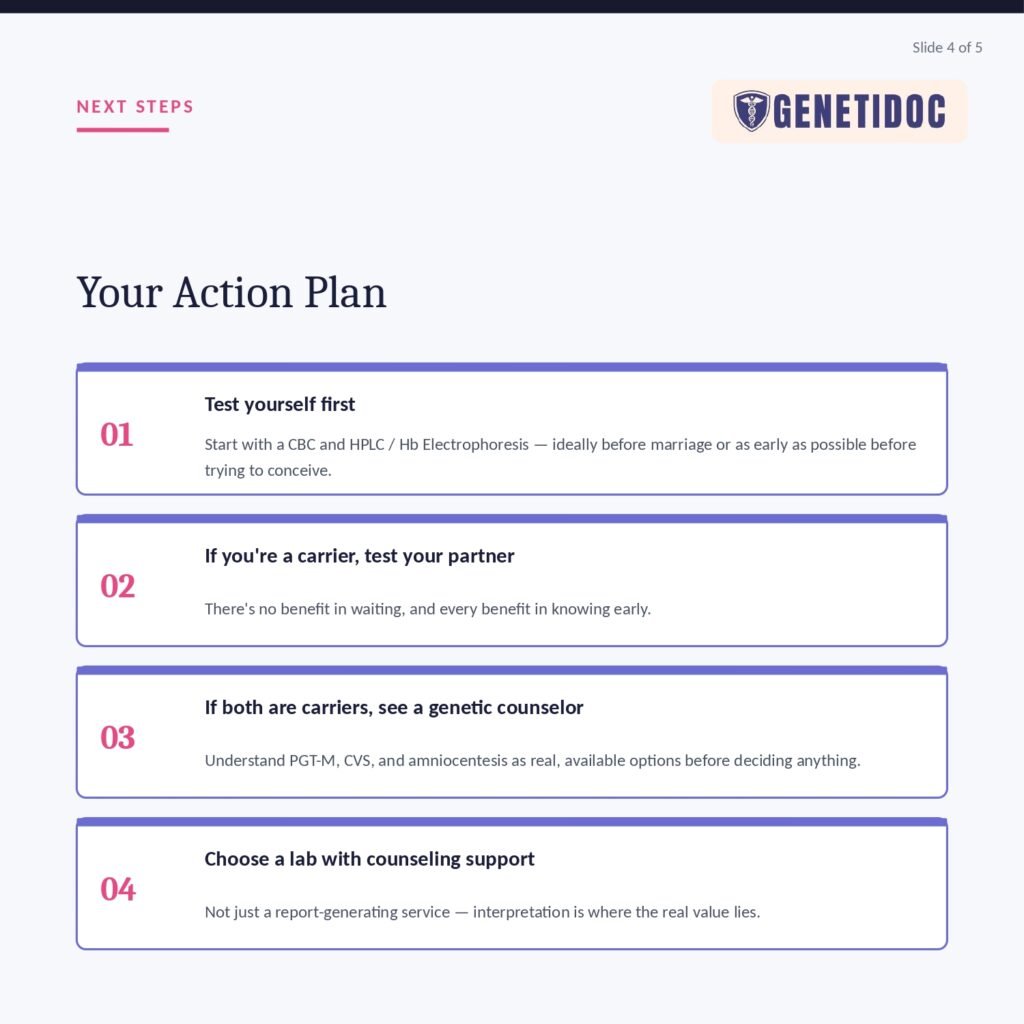
- Test yourself first. Start with a CBC and HPLC / Hb Electrophoresis — ideally before marriage, or as early as possible before trying to conceive.
- If you’re a carrier, test your partner immediately. There’s no benefit in waiting, and every benefit in knowing early.
- If both of you are carriers, speak with a genetic counselor before making any decisions. Understand PGT-M, CVS, and amniocentesis as real, available options — not just theoretical ones.
- Don’t stop at “normal-looking” results if your risk factors say otherwise. A strong family history or community background may still warrant molecular
- Choose a lab with genetic counseling support, not just a report-generating
Service. The interpretation is where the real value lies.
Frequently Asked Questions
1. What is thalassemia carrier screening?
It’s a simple blood test — usually a CBC followed by HPLC — that checks whether a person carries one altered copy of a thalassemia gene. Carriers are healthy but can pass the gene to their children.
2. What happens if both husband and wife are thalassemia carriers?
In every pregnancy, there’s a 25% chance the child will have Thalassemia Major, a 50% chance of being a healthy carrier, and a 25% chance of being completely unaffected. Genetic counseling can help the couple understand and plan around this risk.
3. Is thalassemia minor dangerous?
No. Thalassemia Minor is a harmless carrier state. Most people have no symptoms and need no treatment. It only becomes relevant when planning children with a partner who is also a carrier.
4. Can thalassemia be cured?
Thalassemia Major currently has no widely accessible cure outside of complex, high-risk bone marrow transplantation in select cases. This is exactly why prevention through carrier screening is such a central strategy.
5. What is the cost of a thalassemia test in India?
Basic screening with CBC and HPLC is relatively affordable and widely available. Confirmatory molecular (DNA) testing, partner testing, and prenatal diagnostic procedures cost more, with pricing varying by lab and by the specific tests required. Ask your clinic for a written cost breakdown before proceeding.
6. At what age or life stage should thalassemia screening be done?
Ideally before marriage or before actively trying to conceive — this gives couples time to
understand results and options without the time pressure of an ongoing pregnancy.
7. Is thalassemia testing mandatory before marriage in Kerala?
It is not currently a legal requirement in Kerala, though premarital health screening is a well-established cultural practice in many communities, and thalassemia testing fits naturally into that existing process.
8. Can two thalassemia minor (carrier) parents have a completely healthy, non-carrier child?
Yes. Even when both parents are carriers, there is a 25% chance in every pregnancy that the child inherits neither altered gene and is completely unaffected.
9. Does thalassemia minor need treatment?
No. Thalassemia Minor requires no ongoing medical treatment. It’s important not to take iron supplements for it unless a doctor has separately confirmed true iron deficiency.
10. If my CBC is normal, do I still need HPLC testing?
If your red cell indices (MCV, MCH) are within the normal range, your risk of being a beta-thalassemia carrier is low, but not zero in every case. Anyone with a family history of thalassemia, or from a higher-risk community, should discuss further testing with a genetic counselor even with a reassuring CBC.
11. What’s the difference between thalassemia trait and iron deficiency anemia?
Both can cause small, pale red blood cells on a CBC, which is why they’re often confused. HPLC testing distinguishes the two by measuring hemoglobin types — a distinction that matters because iron supplements help one condition and can harm the other if taken unnecessarily.
12. Can thalassemia be detected during pregnancy if it wasn’t tested before?
Yes. If carrier status is discovered during pregnancy, prenatal diagnostic tests like CVS (10–13 weeks) or amniocentesis (15–20 weeks) can still determine the baby’s status, though testing
Before pregnancy gives couples more time and more options.
Key Takeaways
- Thalassemia Minor (carrier status) is common, harmless on its own, and usually symptom-free.
- The real risk appears only when both partners are carriers — a 25% chance per pregnancy of Thalassemia Major.
- Screening is a simple two-step blood test: CBC first, then HPLC to
- Kerala’s tribal communities, consanguineous marriage patterns, and Gulf-returnee marriage networks make regional awareness especially important.
- Testing before marriage or pregnancy — not after — gives couples time, options, and
- When both partners are carriers, PGT-M, CVS, and amniocentesis are all established, medically sound paths — the right choice depends on the couple.
- The lab and the interpretation matter as much as the test
Planning a Pregnancy or Marriage in Kerala?
A thalassemia carrier screening test today can give you complete clarity before you need it. At Genetidoc, our team combines accurate lab testing with genetic counseling — so you don’t just get a report, you get an answer you can actually act on.
Book your Thalassemia Carrier Screening with genetidoc today.
To learn more about Genetidoc’s, the best genetic counseling and testing platform in India’s about genetic testing for expected mothers
References
- Colah R, Gorakshakar A, Nadkarni Burden of thalassemia in India: The road map for control. Pediatric Hematology Oncology Journal. ScienceDirect.
- Arora SS, Dhand N, Goyal K, Dewan P, Kakkar Extended family screening for thalassemia trait in North India: evaluating possible impact and identifying barriers. Blood Global Hematology. 2026;2(1):100042.
- Screening of Extended Family Members of Thalassemia Major Children as a Thalassemia Preventive Strategy. PMC.
- Thalassemia and Hemoglobinopathy Screening in Women Attending Antenatal Clinic at a Tertiary Care Center in Uttarakhand, India. PMC.
- Carrier Screening for β Thalassemia in Pregnant Indian Women: Experience at a Single Center in Madhya Pradesh. PMC.
- FOGSI Good Clinical Practice Recommendations: Federation of Obstetric and Gynaecological Societies of India, 2025.
- World Health Organization. Genes and human disease: Haemoglobin
- American College of Obstetricians and Gynecologists (ACOG). Hemoglobinopathies: Carrier Screening in the Prenatal and Preconception Period.
- National Estimation Report of Blood Requirement in India. National AIDS Control Organisation (NACO).
- HBB-Related Hemoglobinopathies.
Related Reading
- Preconception Carrier Screening: What Every Couple Should Test For Before Trying to Conceive
- Genetic Testing for Consanguineous Couples: What You Need to Know
- Preimplantation Genetic Testing (PGT): A Complete Guide for IVF Patients
- Genetic Testing in Recurrent Pregnancy Loss: When Should You Ask for It?
- Understanding NIPT: What Prenatal Genetic Screening Can and Cannot Tell You