

Medically reviewed with insights from Genetidoc’s team of clinical geneticists and genetic counsellors
A mother brings in her 24-year-old son. His father died of a heart attack at 45. Two weeks ago, his younger brother — just 21 — didn’t wake up one morning. No warning, no chest pain the night before. He simply passed away in his sleep.
She isn’t looking for reassurance that everything will be fine. She wants to know one thing: is this in our genes, and is my remaining son next?
This is the question that brings most families to genetic risk testing for heart disease — not curiosity, but fear, usually triggered by a loss that felt too young, too sudden, or too repeated across generations to be a coincidence. And it’s a fair question. But the answer genetic testing gives is rarely the flat “yes” or “no” that families are braced for.
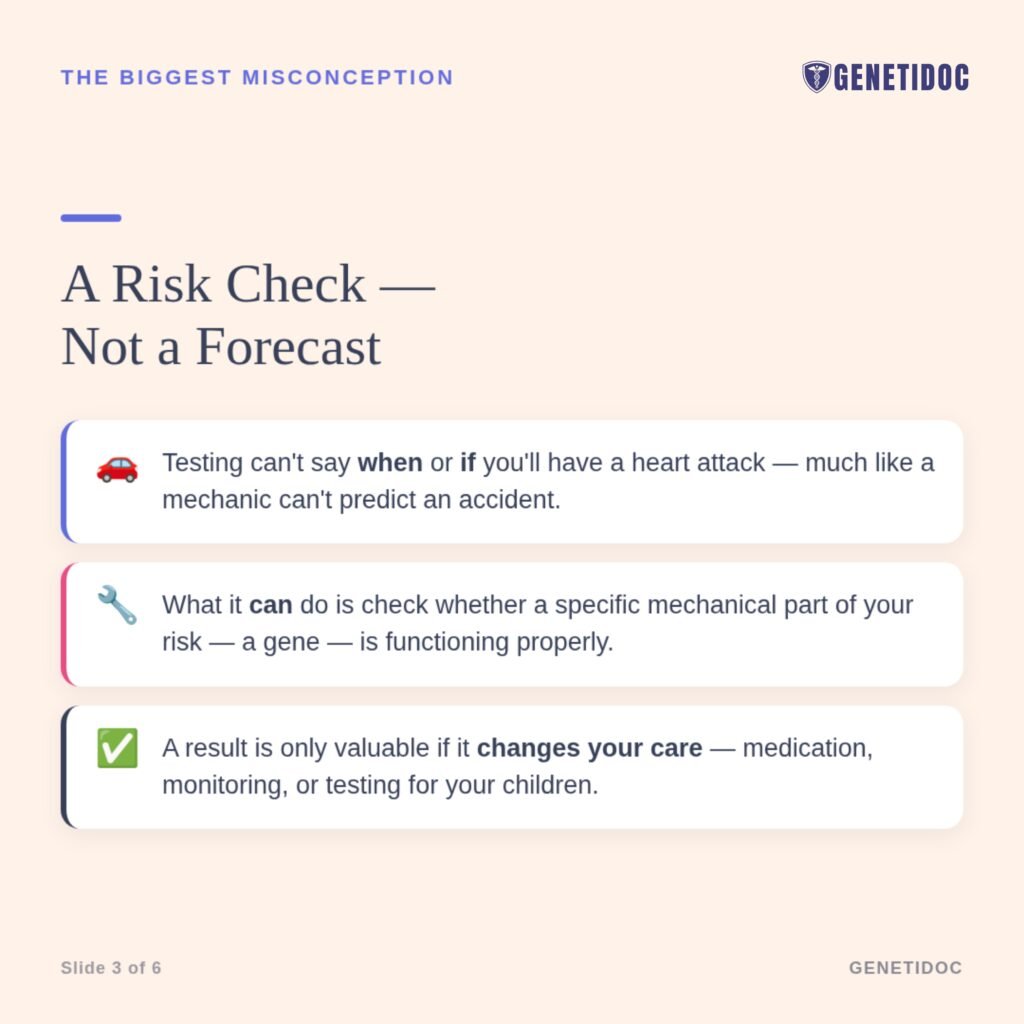
“We cannot tell someone whether they are going to get into an accident. What we can do is check whether their brakes are functioning properly,” says a Genetidoc consultant clinical geneticist. “That’s what genetic testing for heart disease actually does — it tells you if a specific mechanical part of your risk is compromised, so you can act on it before it fails.”
This article walks through exactly what inherited heart disease genetic testing can tell you, what it genuinely cannot, and how to think clearly about it if a family history — or a sudden loss — has brought you here.
Quick Answer: What Genetic Testing Can and Can’t Do
| Genetic testing CAN | Genetic testing CANNOT |
| Identify a specific gene variant that raises your risk of heart attack, arrhythmia, or heart failure | Tell you the exact date, or even certainty, that you will have a heart attack |
| Explain why heart disease or sudden death is clustering in your family | Replace lifestyle factors like smoking, diet, and exercise as contributors to risk |
| Guide which medications, procedures, or surveillance schedule you need | Guarantee safety just because a result comes back negative |
| Identify which relatives — children, siblings — are also at risk, before symptoms appear | Give a precise percentage chance of a cardiac event, in most cases |
Who Actually Needs to Consider This Testing?
Most families with “heart disease in the family” don’t need genetic testing. Heart disease is common, and in most cases it develops from a mix of high blood pressure, diabetes, smoking, obesity, and age — not a single inherited gene. Genetic testing becomes relevant when the pattern in your family looks different from the usual story.
In our practice, the scenario that most commonly brings someone in is an early heart attack in a parent or sibling, sometimes with multiple family members affected, and especially when there has been a loss — a young relative who died suddenly or unexpectedly. Late-onset heart attacks in a family bring people in too, but early and repeated events are what usually raise the alarm.
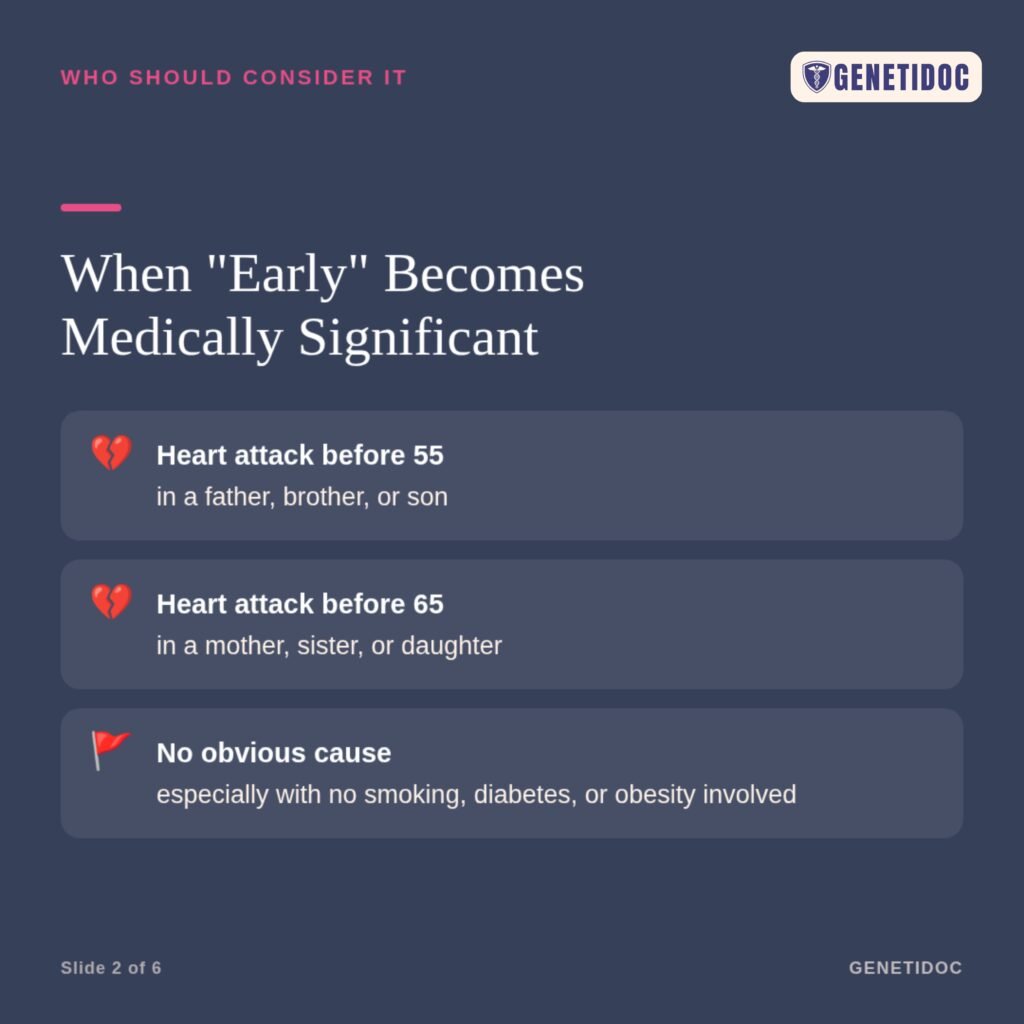
There’s a widely used clinical threshold for when “early” becomes medically significant:
Consider genetic evaluation if a first-degree relative (parent, sibling, or child) had:
- A heart attack or major cardiac event before age 55 (in men)
- A heart attack or major cardiac event before age 65 (in women)
- Especially if this happened in the absence of other obvious risk factors — no long smoking history, no diabetes, no obesity
These age cutoffs matter because they’re the point at which “bad luck plus lifestyle” becomes statistically less likely than an underlying inherited cause. This doesn’t mean every 50-year-old with a heart attack has a genetic condition — it means the odds shift enough that a genetics evaluation becomes worth having.
The Misconception That Trips Up Almost Every Family
Before we get into the science, it’s worth naming the single biggest misunderstanding we see in clinic.
Patients come in expecting a prediction — a yes-or-no answer to “will I have a heart attack?” What genetic testing actually gives you is a risk classification, not a forecast. It answers a narrower, more useful question: are you at meaningfully higher risk than the general population, and — critically — is there something we can do about it?
That last part is the whole point. A genetic test result that changes nothing about your care isn’t worth having. One that changes your medication, your monitoring schedule, or triggers testing in your children is genuinely valuable, regardless of whether it comes back positive or negative.
The Five Categories of Inherited Heart Conditions We Test For
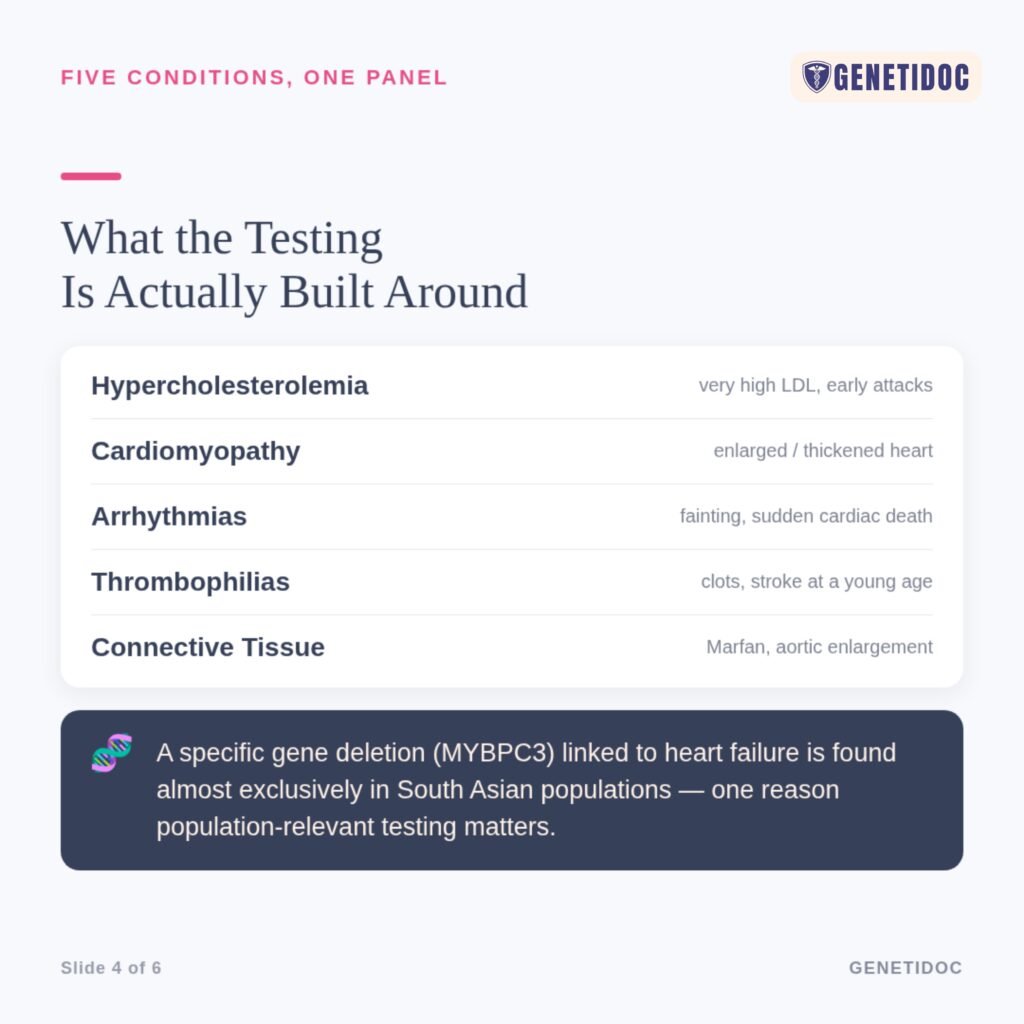
There is no single “heart disease gene test.” Genetic testing for cardiac risk is built around your specific clinical picture — your symptoms, your ECG or echocardiogram findings, and the pattern of illness in your family. Genetidoc’s clinical geneticists work from five broad disease categories, each with its own gene panel:
| Category | Key Genes | Typical Trigger |
| Familial Hypercholesterolemia (FH) | LDLR, APOB, PCSK9 | Very high LDL cholesterol from a young age; early heart attacks |
| Cardiomyopathy & Heart Failure | MYH7, MYBPC3, TTN, LMNA, TNNT2, DES | Enlarged or thickened heart on echo; unexplained heart failure |
| Inherited Arrhythmias | KCNQ1, KCNH2, SCN5A, RYR2 | Fainting spells, sudden cardiac death in the family, abnormal ECG |
| Thrombophilias | Panel varies by clinical picture | Recurrent clots, stroke at a young age |
| Connective Tissue Disorders | FBN1 and related genes (e.g., Marfan syndrome) | Aortic enlargement, tall stature with specific physical features, family history of aortic dissection |
A comprehensive lab or clinic — one that takes a proper clinical history before recommending tests — will match you to the right panel rather than running everything indiscriminately. This is one of the most important, and most overlooked, parts of choosing where to get tested: a lab without a genetics consultation attached to it has no way to know which of these five categories actually fits your case.
A Genetic Variant That Belongs to Us
One detail that matters specifically for Indian and South Asian patients: a particular deletion in the MYBPC3 gene — a 25-base-pair deletion in a non-coding region of the gene — is found almost exclusively in South Asian populations and is strongly linked to cardiomyopathy and heart failure risk. Standard international gene panels developed on Western populations can miss variants like this if the lab isn’t specifically looking for population-relevant mutations. This is one reason population-specific validation matters when you’re choosing where to test.
“In our clinic, arrhythmias and cardiomyopathies — including the MYBPC3 and MYH6 variants — make up the largest share of what we see, along with a significant number of Marfan syndrome families currently under follow-up,” notes Team Genetidoc. “Hypercholesterolemia cases are fewer in my personal caseload, but that likely reflects referral patterns more than true prevalence — FH is known to be widely underdiagnosed across India.”
What Genetic Testing Costs in India
Cost depends on how many genes are sequenced, whether the panel is targeted (built around your specific clinical picture) or broader, and the laboratory you choose.
| Test | Approximate Cost (India) | Turnaround Time |
| Familial Hypercholesterolemia (FH) Panel | ₹25,000 – ₹30,000 | 3–4 weeks |
| Broader Inherited Cardiac Panel (cardiomyopathy / arrhythmia / connective tissue) | ₹25,000 – ₹40,000 | 3–4 weeks |
| Cascade (family) testing — once a familial variant is known | ₹12,000-₹16,000 | 1–2 weeks |
That last row matters more than it might seem. Once a specific pathogenic variant is identified in one family member, testing everyone else for that same, known variant is much faster and cheaper than the original comprehensive panel — which is exactly why cascade testing is emphasized so heavily below.
A Note on Polygenic Risk Scores
You may see direct-to-consumer companies offering a “polygenic risk score” (PRS) for heart disease — a single number meant to summarize your genetic risk across many common variants at once. Genetidoc’s clinical geneticists are cautious about these for a specific reason: most PRS models are built and validated on European-ancestry populations, and very few have been properly validated for Indian or South Asian genetics. Outside of a handful of well-studied, validated contexts, much of what’s marketed as PRS testing functions more as a wellness product than a clinical diagnostic — and some of it, frankly, leans on fear rather than evidence. For the vast majority of patients with a genuine family history concern, a multigene diagnostic panel — not a PRS — is the right first step.
What Actually Changes When a Result Comes Back Positive
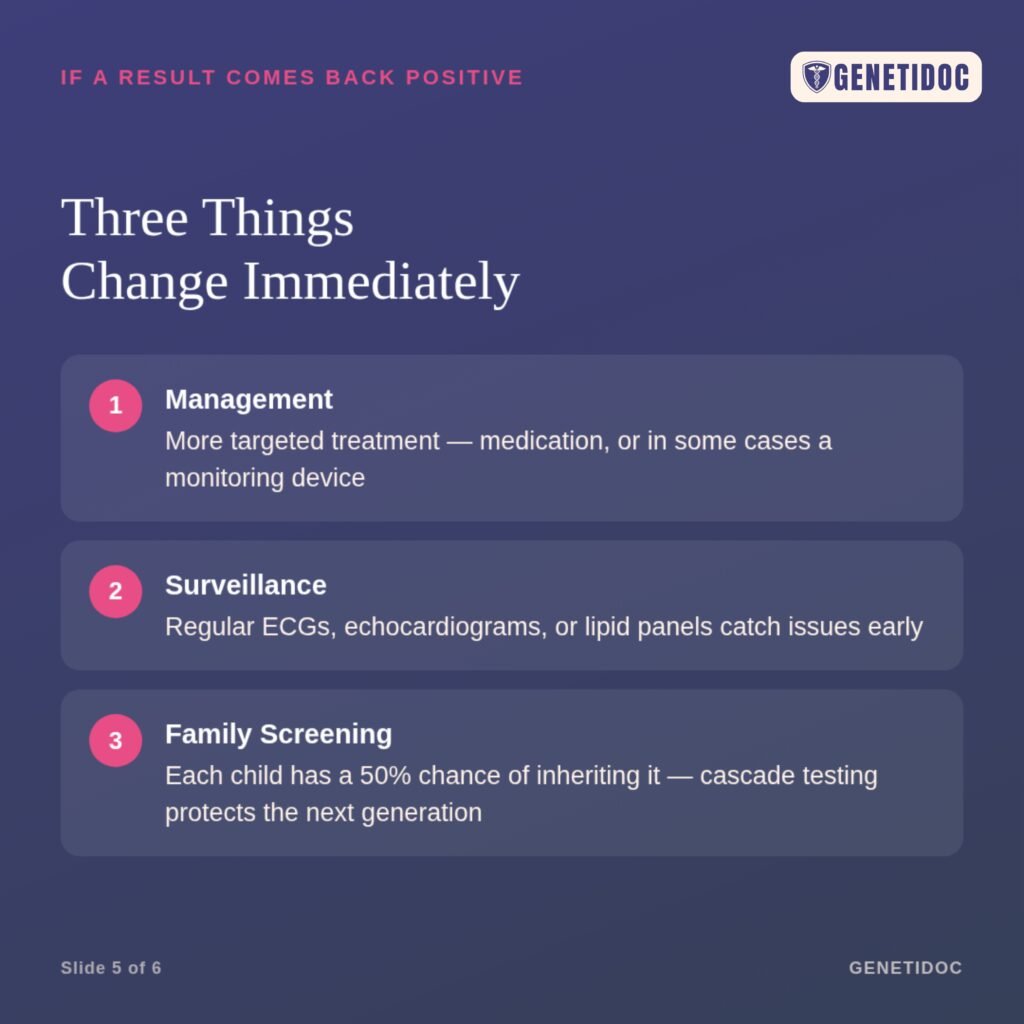
This is the part that makes the testing worthwhile. A positive result for a pathogenic variant — say, in LDLR for familial hypercholesterolemia — doesn’t just confirm a diagnosis. It changes the entire clinical plan, across three fronts:
- Management. Treatment moves from routine dietary advice to a more aggressive, often lifelong protocol — higher-intensity cholesterol-lowering therapy, specific anti-dyslipidemia medications, or, for arrhythmia and cardiomyopathy variants, interventions like an implantable device (such as a pacemaker or defibrillator) or, in Marfan syndrome, monitoring for and sometimes surgical management of aortic enlargement.
- Surveillance. You move onto a structured, closer follow-up schedule — regular echocardiograms, ECGs, or lipid panels — so that if something develops, it’s caught at the earliest, most treatable point rather than at a crisis.
- Family screening and family planning. Because most of these conditions are inherited in an autosomal dominant pattern, each child of someone who carries the variant has a 50% chance of inheriting it. A positive result in one person effectively opens a screening pathway for their children, siblings, and sometimes wider family — extending prevention into the next generation.
A Case From Clinic: When “Normal” Was the Answer
Consider that mother from the start of this article. Her husband had died of a heart attack at 45. Then her younger son, just 21, died suddenly in his sleep — no prior symptoms, no warning. Terrified for her surviving 24-year-old son, she brought him in for cardiac genetic testing.
The panel came back normal.
This didn’t erase what had happened to her husband and younger son — it’s possible their deaths weren’t genetic at all, or that her surviving son simply didn’t inherit whatever variant may have been involved. But for her living son, it meant something concrete and immediate: no identifiable inherited variant putting him at elevated risk. For a mother who had already lost two family members to sudden cardiac events, that negative result was, in her genetic counsellor’s words, a genuine sigh of relief — not a guarantee of eternal safety, but real, actionable reassurance grounded in evidence rather than fear.
“Even when a result is negative, it has to be interpreted carefully,” says Dr. Roshan Daniel, Founder of Genetidoc and Head of Medical Genetics at KIMSHealth Trivandrum. “A negative test in one family member doesn’t automatically mean the cause wasn’t genetic — it may mean that particular family member didn’t inherit the variant. That distinction has to be explained clearly, or families walk away with the wrong idea of what ‘negative’ means.”
Why the Laboratory and the Interpretation Matter More Than the Test Itself
A DNA sample doesn’t diagnose anything by itself. What matters is what happens to the data after it’s generated — and this is where a lot of direct-to-consumer and low-cost testing quietly falls short.
A few things commonly go wrong with unreviewed or low-quality genetic reports:
- Variants of Uncertain Significance (VUS) get misread as definitive. Many raw reports flag a variant without making clear that its clinical meaning isn’t yet established. Patients read this as “positive” when it isn’t confirmed to cause disease at all.
- A “positive” result isn’t automatically severe. Even confirmed pathogenic variants can vary enormously in how severely they affect different people. A report that doesn’t correlate the genetic finding with your actual clinical picture — symptoms, ECG, echo, family history — can cause unnecessary panic or, just as harmful, false complacency.
- Cheaper, lower-quality labs can produce false negatives. Insufficient technical validation — missing follow-up methods like MLPA to catch certain types of variants that standard sequencing alone can miss — means a “clear” report isn’t always a clear result.
- Reports land on the wrong desk. Patients often take a raw genetic report to their family physician or a non-genetics specialist, who may not have the training to interpret it correctly. Without a clinical geneticist reviewing the data alongside your actual symptoms and history, even an accurate lab result can be misapplied.
“The test is only half the process. Correlating the genetic finding with the patient’s actual clinical symptoms — and knowing which mutation is truly causative versus incidental — is where a clinical geneticist adds value that a lab report alone cannot,” says Team Genetidoc.
This is also why testing at a clinic-based service, rather than a mail-order kit, matters. A proper genetics consultation takes a detailed personal and family history before choosing which panel to run — which is often the difference between a test that answers your actual question and one that generates an expensive, confusing report.
If You Have a Family History but Aren’t Ready to Test

Genetic testing isn’t the only option, and it isn’t always the immediate next step. If cost, timing, or simply not being ready is holding you back, here’s what still matters:
- Get a baseline cardiac workup — lipid profile, ECG, and echocardiogram — even without genetic testing, especially if a first-degree relative had an early event.
- Share your family history in detail with a cardiologist, including ages of onset and cause of death where known — this shapes how seriously “early” or “sudden” events are treated clinically.
- Book a genetic counselling consultation even before deciding whether to test. A proper history-taking session can clarify whether your family’s pattern genuinely warrants genetic testing, or whether standard cardiac screening is sufficient for now.
- Don’t rely on a direct-to-consumer kit as a substitute for this — for the reasons outlined above, it’s likely to generate more anxiety than clarity.
“Knowing is always better than not knowing,” says a Genetidoc consultant clinical geneticist. “Not knowing doesn’t reduce your risk — it just delays the point at which you can act on it. When we catch these conditions early enough, through testing and surveillance, we can prevent the major, irreversible events entirely.”
Book your genetic consultation today with us.
Frequently Asked Questions
- If heart disease runs in my family, does that automatically mean it’s genetic?
Not necessarily. Most heart disease results from a combination of lifestyle and environmental factors shared within families — diet, smoking, activity levels — rather than a single inherited gene. A strong genetic cause becomes more likely when events happen early (before 55 in men, before 65 in women) or repeat across multiple close relatives without other clear risk factors. - What’s the difference between family history risk and genetic test risk?
Family history is a pattern you observe — it tells you something may be inherited but not what, or in whom. A genetic test identifies the specific variant (if one exists), which tells you precisely who in the family carries it and allows targeted, individualized management rather than general precaution. - Can a genetic test tell me if I’ll have a heart attack?
No. It can tell you whether you carry a variant known to increase risk of certain cardiac conditions, which allows for closer monitoring and preventive treatment. It cannot predict a specific event or timeline. - What genes are tested for familial hypercholesterolemia?
The main genes are LDLR, APOB, and PCSK9. Pathogenic variants in these genes cause very high LDL cholesterol from birth, significantly raising the risk of early coronary artery disease if untreated. - Is the MYBPC3 gene deletion specific to Indian patients?
A particular 25-base-pair deletion in MYBPC3 is found predominantly in South Asian populations and is linked to cardiomyopathy risk. It’s a good example of why genetic panels validated for our population matter — international panels built for other populations may not flag it appropriately. - How much does genetic testing for heart disease cost in India?
A targeted familial hypercholesterolemia panel typically costs ₹15,000–₹22,000. Broader inherited cardiac panels covering cardiomyopathy, arrhythmia, or connective tissue conditions run roughly ₹25,000–₹40,000. Cascade testing for a known family variant is considerably cheaper. - Should I get a polygenic risk score test instead of a diagnostic panel?
For most patients with an actual family history concern, no. Polygenic risk scores are largely research or wellness tools, and few are validated for Indian populations. A multigene diagnostic panel matched to your clinical picture is the appropriate first step in almost all cases. - What happens if my genetic test comes back positive?
Management typically intensifies — this can mean more aggressive cholesterol-lowering therapy, specific medications, closer surveillance through regular ECGs or echocardiograms, and in some cases procedures like an implantable cardiac device. It also opens up testing for children and siblings, since these conditions are usually inherited in an autosomal dominant pattern with a 50% chance of passing to each child. - If my test is negative, does that mean my children are safe too?
Not automatically. A negative result means you specifically don’t carry the variant that was tested for — but this needs to be interpreted alongside the full family picture. This is exactly why a clinical geneticist’s interpretation matters more than the raw report. - Are direct-to-consumer (DTC) heart disease DNA tests reliable?
Many are built on data not validated for Indian populations, don’t include pre-test genetic counselling, and can produce reports that are confusing or misleading without expert interpretation. Lower-quality labs can also miss variants that require additional testing methods to detect. A clinic-based genetic consultation is generally more reliable for anything beyond general curiosity. - Who should get cascade (family) testing?
Once a pathogenic variant is confirmed in one family member, first-degree relatives — parents, siblings, and children — are the priority for cascade testing, since each has up to a 50% chance of carrying the same variant. - Is genetic counselling necessary before testing?
Yes, ideally. A pre-test consultation ensures the right panel is chosen based on your specific history, sets realistic expectations for what the result can and can’t tell you, and prepares you for what a positive, negative, or uncertain result would mean for you and your family.
Key Takeaways
- Genetic testing for heart disease is most useful when a first-degree relative had a cardiac event before 55 (men) or 65 (women), especially without other clear risk factors.
- Testing is built around five categories — familial hypercholesterolemia, cardiomyopathy, arrhythmia, thrombophilia, and connective tissue disorders — matched to your specific clinical picture, not a single generic panel.
- South Asian-specific variants, like the MYBPC3 deletion, make population-validated testing important.
- A positive result changes management, surveillance, and opens family (cascade) screening — that’s where the real value lies.
- A negative result can be genuinely reassuring, but it needs expert interpretation to understand what it does and doesn’t rule out.
- Interpretation by a clinical geneticist — not the raw lab report — is what turns a DNA test into usable medical guidance.
Concerned About a Family History of Heart Disease?
If a parent or sibling had a heart attack young, or your family has experienced a sudden cardiac loss, a genetic counselling consultation can help you understand whether testing is right for you — and which panel actually fits your history.
To know more about various heart diseases visit our visit our heart disease page
References
- American College of Cardiology / American Heart Association guidelines on the management of blood cholesterol and familial hypercholesterolemia.
- ClinGen (Clinical Genome Resource) — LDLR, APOB, and PCSK9 gene-disease validity curations for familial hypercholesterolemia.
- GeneReviews (NCBI/University of Washington) — Familial Hypercholesterolemia chapter.
- GeneReviews — Hypertrophic Cardiomyopathy Overview; Dilated Cardiomyopathy Overview.
- Heart Rhythm Society (HRS) / European Heart Rhythm Association (EHRA) expert consensus statement on genetic testing for inherited cardiac arrhythmias.
- GeneReviews — Marfan Syndrome.
- Indian Journal of Pediatrics — Cascade screening for familial hypercholesterolemia in children and relatives of affected probands.
- PMC (National Center for Biotechnology Information) — The genetic landscape of familial hypercholesterolemia in Telangana, Southern India: novel mutations and clinical implications.
- World Health Organization — Cardiovascular diseases (CVDs) fact sheet.
- ACMG (American College of Medical Genetics and Genomics) — Standards and guidelines for the interpretation of sequence variants.
Related Reading on the Genetidoc Blog
- Spinal Muscular Atrophy (SMA) in India: What Genetic Testing Can Tell You
- Undiagnosed for Years: Why Rare Disease Patients in India Wait
- Married Within the Family? Here’s What Every Couple Should Know Before Planning Kids
- You Don’t Have to Have Cancer to Get Tested: Understanding Predictive Genetic Testing