
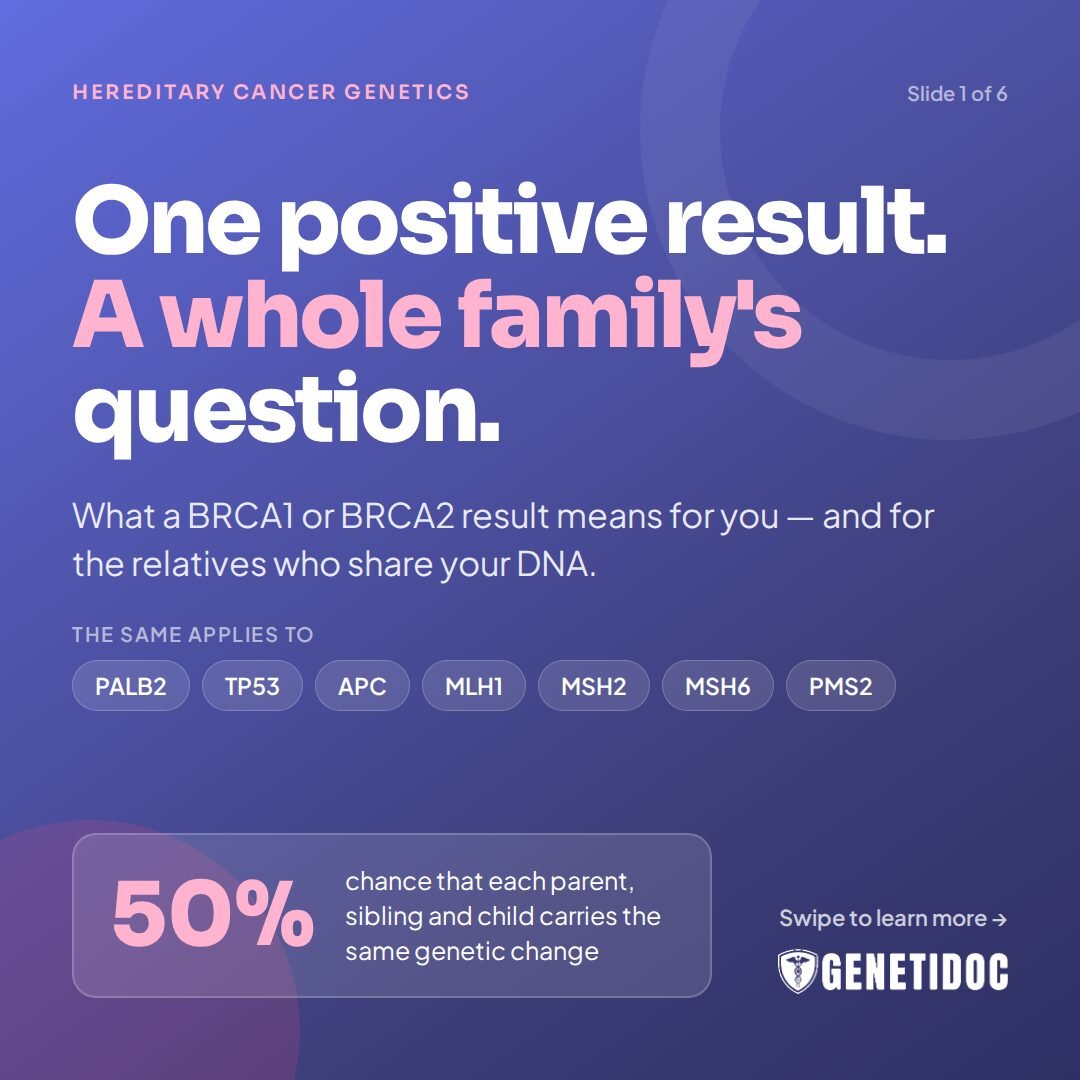
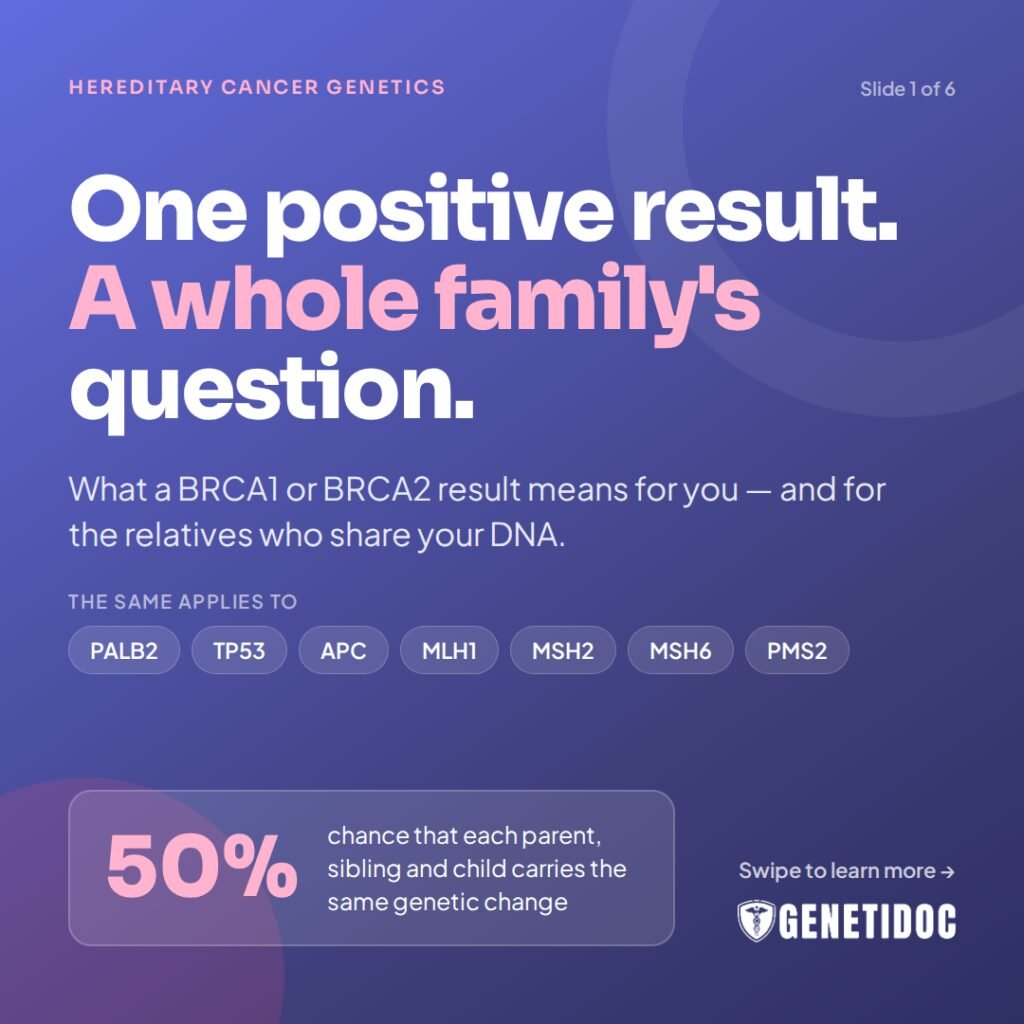
A positive hereditary cancer test result is rarely the end of a conversation. For most patients, it is the beginning of a much bigger one — with parents, siblings, children, and sometimes cousins and grandparents.
If you or someone in your family has just received a positive result on a genetic change in BRCA1, BRCA2, or a related hereditary cancer gene, it is normal to feel two things at once: relief at finally having an explanation, and uncertainty about what it means for everyone else who shares your bloodline. This article walks through both — what a positive result tells you about your own risk, and what it means for the family members who may be walking the same road without knowing it yet.
Quick answer: A positive hereditary cancer result means a specific, disease-associated genetic change was found in a gene such as BRCA1 or BRCA2. Close blood relatives — parents, siblings, and children — each have roughly a 50 percent chance of carrying the same change. The process of offering them testing for that one specific change is called cascade testing, and it is usually faster and simpler than the original test.
What Does a “Positive” Hereditary Cancer Result Actually Mean?
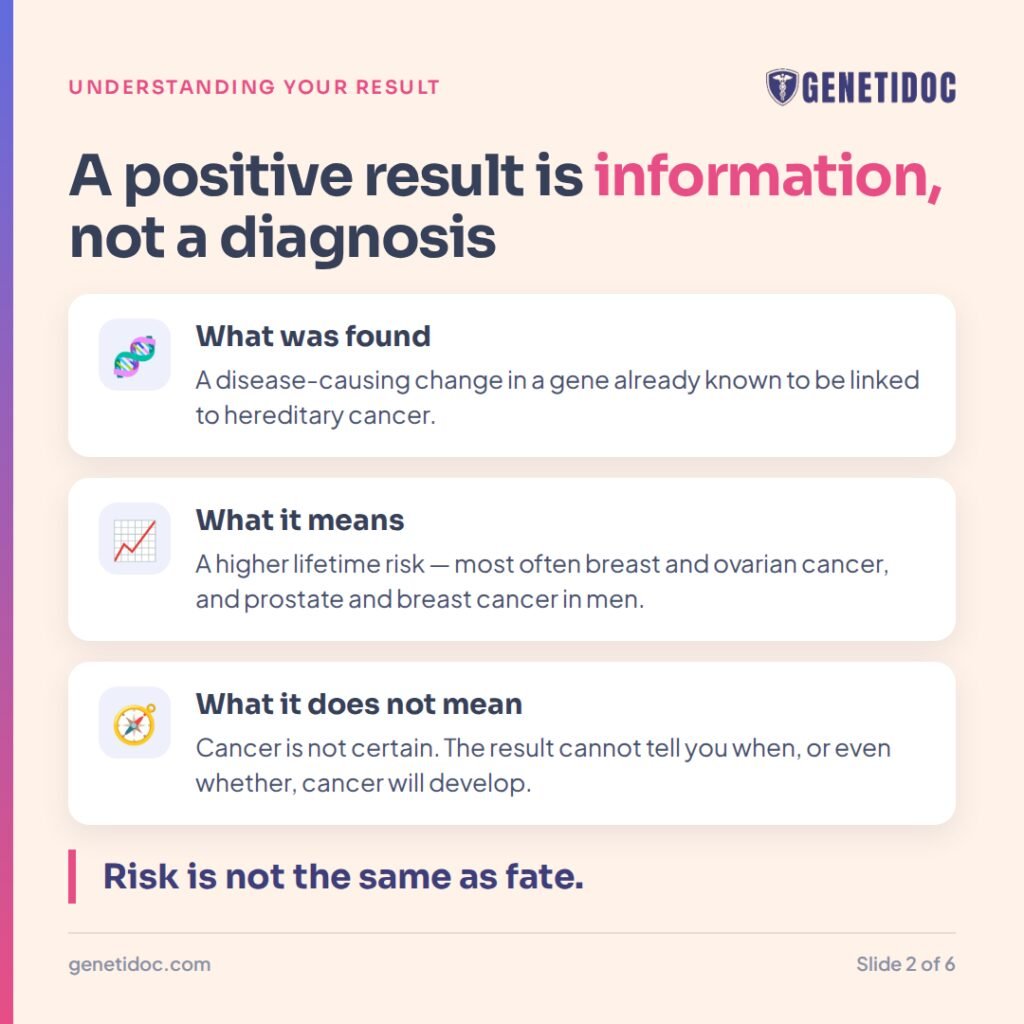
A positive result means the laboratory found a specific change in your DNA, within a gene already known to be linked to a hereditary cancer condition, and that change is classified as disease-causing (pathogenic) or likely disease-causing (likely pathogenic).
It is important to be precise about what this does and doesn’t tell you. A positive BRCA1 or BRCA2 result means you carry an increased lifetime risk of certain cancers — most often breast and ovarian cancer, and for men, prostate and breast cancer. It does not mean cancer is certain, and it does not tell you when, or even whether, cancer will develop. Risk is not the same as fate.
“A positive result is information, not a diagnosis,” explains Team Genetidoc. “Once we confirm a genetic cause, we can offer the patient targeted, guideline-based screening — following National Comprehensive Cancer Network recommendations — and the same targeted testing for their at-risk relatives. If the patient is already affected by cancer, a confirmed genetic finding can also open up genotype-matched treatment options that their treating oncologist can consider alongside the tumor type and standard treatment guidelines. That is a meaningfully different conversation from just ‘you have cancer.'”
Why a Positive Result Is a Family Matter, Not Just a Personal One
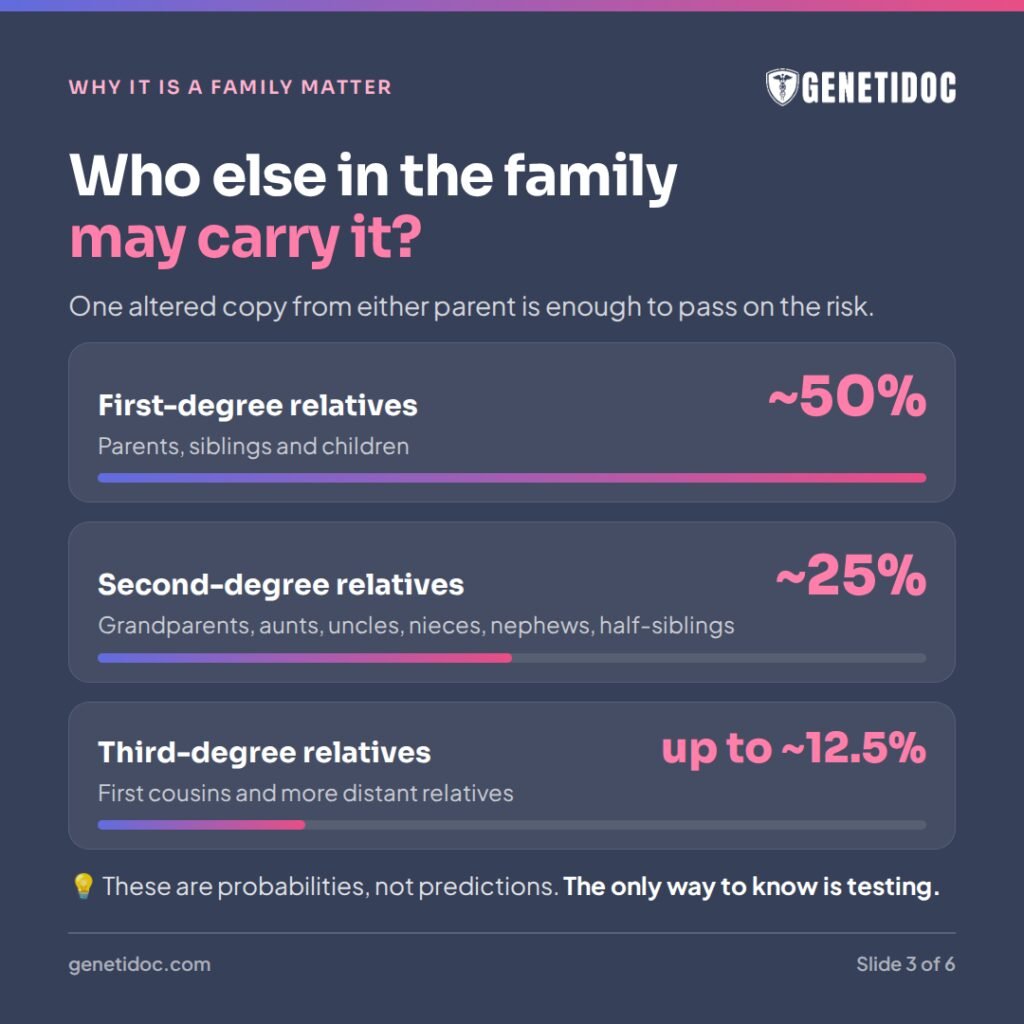
Hereditary cancer genes like BRCA1 and BRCA2 follow a pattern of inheritance called autosomal dominant, which simply means a single altered copy from either parent is enough to pass on the increased risk. In practice, this is what that looks like for blood relatives of someone who tests positive:
- Parents, siblings, and children (first-degree relatives): approximately 50 percent chance of carrying the same genetic change
- Half-siblings, aunts, uncles, nieces, nephews, and grandparents (second-degree relatives): approximately 25 percent chance
- First cousins and more distant relatives (third-degree relatives): up to approximately 12.5 percent chance
These are population-level probabilities, not individual predictions — a sibling could be a carrier or could not be, and the only way to know is testing. This is precisely why one positive result in a family is treated as an alert for the wider family tree, not a single closed case.
“Beyond BRCA”: Other Hereditary Cancer Genes That Work the Same Way
BRCA1 and BRCA2 are the most widely recognized hereditary cancer genes, largely because of how often they are discussed in relation to breast and ovarian cancer. But they are far from the only genes where a positive result carries family-wide implications. Depending on a patient’s personal and family history, a positive result might instead involve:
- PALB2: associated with increased breast and pancreatic cancer risk, and functionally works closely with the BRCA2 pathway
- TP53: associated with Li-Fraumeni syndrome, one of the few hereditary cancer conditions where cancer risk can begin in childhood — which is why it is also the main exception to the usual rule of waiting until adulthood to test minors
- MLH1, MSH2, MSH6, and PMS2: associated with Lynch syndrome, which raises the risk of colorectal, endometrial, and several other cancers
- APC: associated with familial adenomatous polyposis, a colorectal cancer predisposition condition
The specific gene changes the exact cancers to watch for and the exact screening schedule, but the core family principle stays the same across all of them: a confirmed pathogenic variant in the person originally diagnosed and tested (the index patient) becomes a known, specific target that close relatives can be tested for directly.
What Is Cascade Testing?
Cascade testing is the process of offering genetic testing to the blood relatives of someone with a confirmed positive hereditary cancer result — testing that “cascades” outward through the family tree, one branch at a time, usually starting with the closest relatives first.
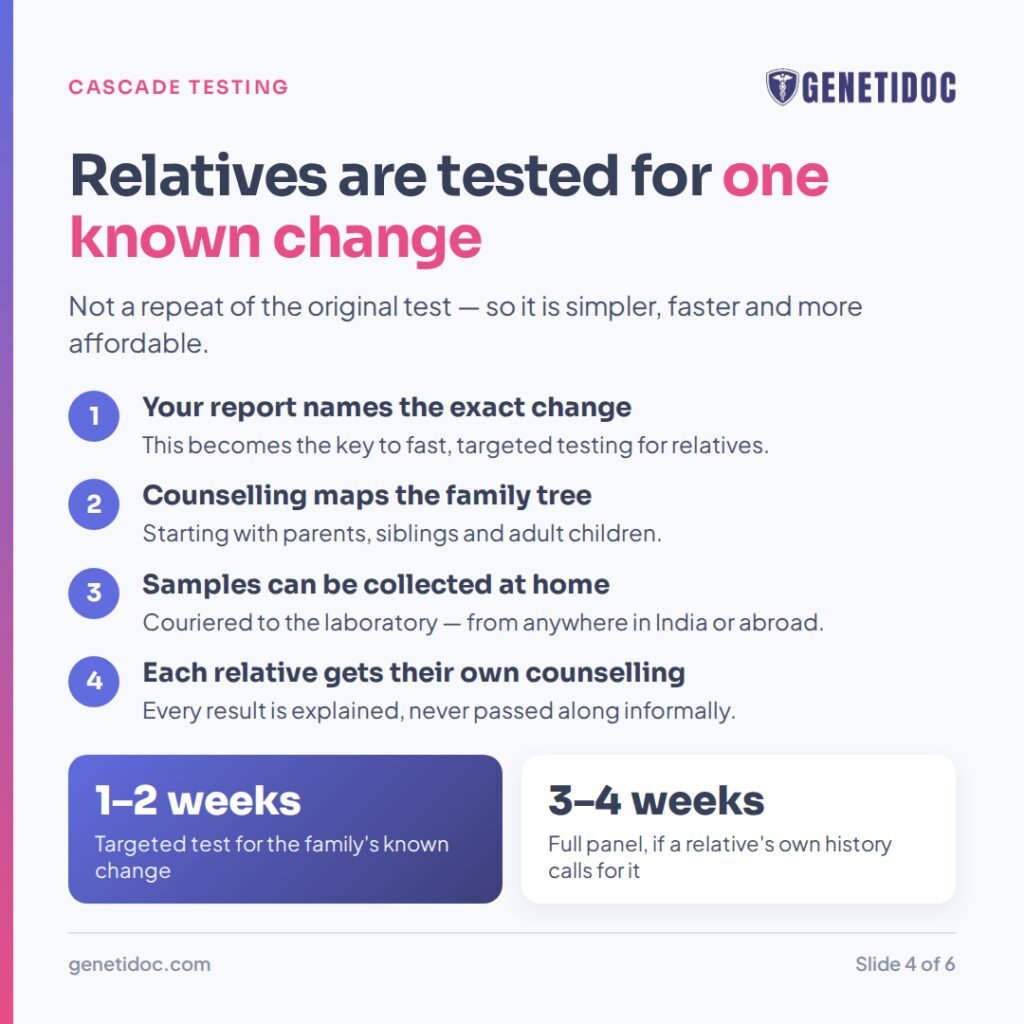
The most important thing to understand about cascade testing is what it is not: it is not automatically a repeat of the original, broad genetic test. Once the exact genetic change is known in the family, relatives are usually tested only for that one specific change — sometimes called single-site or targeted variant testing — rather than the full gene or a full multi-gene panel.
“Once we know the exact change in the gene, testing a relative for that one specific change is a much smaller task than the original test, and it is considerably more cost-effective than a full panel that checks every gene associated with the condition,” says Team Genetidoc. “That said, targeted testing isn’t automatic for every relative. If an at-risk relative has their own personal history of a different type of cancer that isn’t explained by the known family variant, or if they want a fuller picture of their own risk, we can offer them a complete panel instead.”
This distinction also matters for how Genetidoc thinks about genetic testing more broadly. A completely healthy person with no personal or family history of cancer would generally not be offered broad predictive sequencing out of curiosity alone. But once a family member has a confirmed positive result, testing relatives for that specific, known variant — or a broader panel where personal history warrants it — is targeted, medically indicated testing, a very different situation from testing “just to know.” Patients or doctors with questions about predictive genetic testing can ask them directly on the Predictive Genetic Testing forum on the Genetidoc Rare Disease Forum, where genetic counselors and consultants review the responses.
How Cascade Testing Actually Works, Step by Step
- The index patient’s report identifies the exact variant. Every hereditary cancer test report includes the precise technical description of the genetic change found — this becomes the key that unlocks fast, targeted testing for the rest of the family.
- Genetic counseling maps the family tree. A counselor works with the patient to identify which relatives are first-, second-, and third-degree, and typically recommends starting with first-degree relatives — parents, siblings, and adult children — since they carry the highest probability of also being carriers.
- Most relatives are tested for the single known variant. A relative’s sample is usually tested specifically against the family’s known genetic change; a full panel is offered instead if that relative has an unexplained personal cancer history or specifically wants broader testing.
- Sample collection does not usually require a clinic visit. For relatives who live elsewhere in India or abroad, a blood sample can typically be collected at home and couriered to the laboratory, so geography is rarely a barrier to getting tested.
- Each relative receives their own result through genetic counseling. A positive or negative result for a relative is delivered with the same counseling, explanation, and next-steps discussion the original patient received — not as a one-line message passed along informally.
Turnaround time depends on which type of test is done. Targeted, single-variant testing for a relative typically takes about one to two weeks. A full multi-gene panel — used when it’s genuinely warranted — generally takes around three to four weeks, similar to the index patient’s original test. Cost depends on the gene, the laboratory, and the specific test ordered, and is best discussed directly with your genetic counselor — but as a general principle, targeted single-variant testing is considerably more cost-effective than a full multi-gene panel, since only one specific change is being checked rather than an entire set of genes. You can also ask specific questions about cascade testing for your own family on the Cascade Testing forum on the Genetidoc Rare Disease Forum, where genetic counselors and consultants review the responses.
Telling Your Family Is Hard — And So Is Getting Them to Act On It
There’s no single pattern to how families handle this news. Some patients share a positive result with their relatives fairly openly and quickly; others hold back, for all the reasons that make this kind of conversation difficult in the first place — fear of upsetting someone, not knowing how to phrase it, or simply not being ready to talk about their own diagnosis yet.
“Sharing the news is genuinely one of the harder parts of this process for many patients,” notes Team Genetidoc. “And even when a relative is told, that’s often not where it ends — a lot of relatives who hear the news still don’t come in for a counseling session or get tested themselves.”
A few things tend to hold relatives back once they already know:
- Stigma — discomfort with the idea of a genetic condition being openly discussed or acted on within the family
- Lack of time — genetic counseling and testing competing with work, caregiving, and everyday demands, and getting deprioritized
- Not understanding the point of testing — relatives sometimes treat the news as something that happened to the patient, rather than information with direct, actionable relevance to their own health
- Thinking genetic means there’s nothing to be done — a common but inaccurate assumption; a confirmed genetic risk is exactly what makes earlier screening, closer monitoring, and sometimes preventive options possible in the first place
This is exactly why genetic counselors keep the door open for relatives well after the index patient’s own appointment is done — the goal isn’t a single disclosure moment, but ongoing, low-friction support for both telling family members and following through afterward.
Making It Easier to Start the Conversation
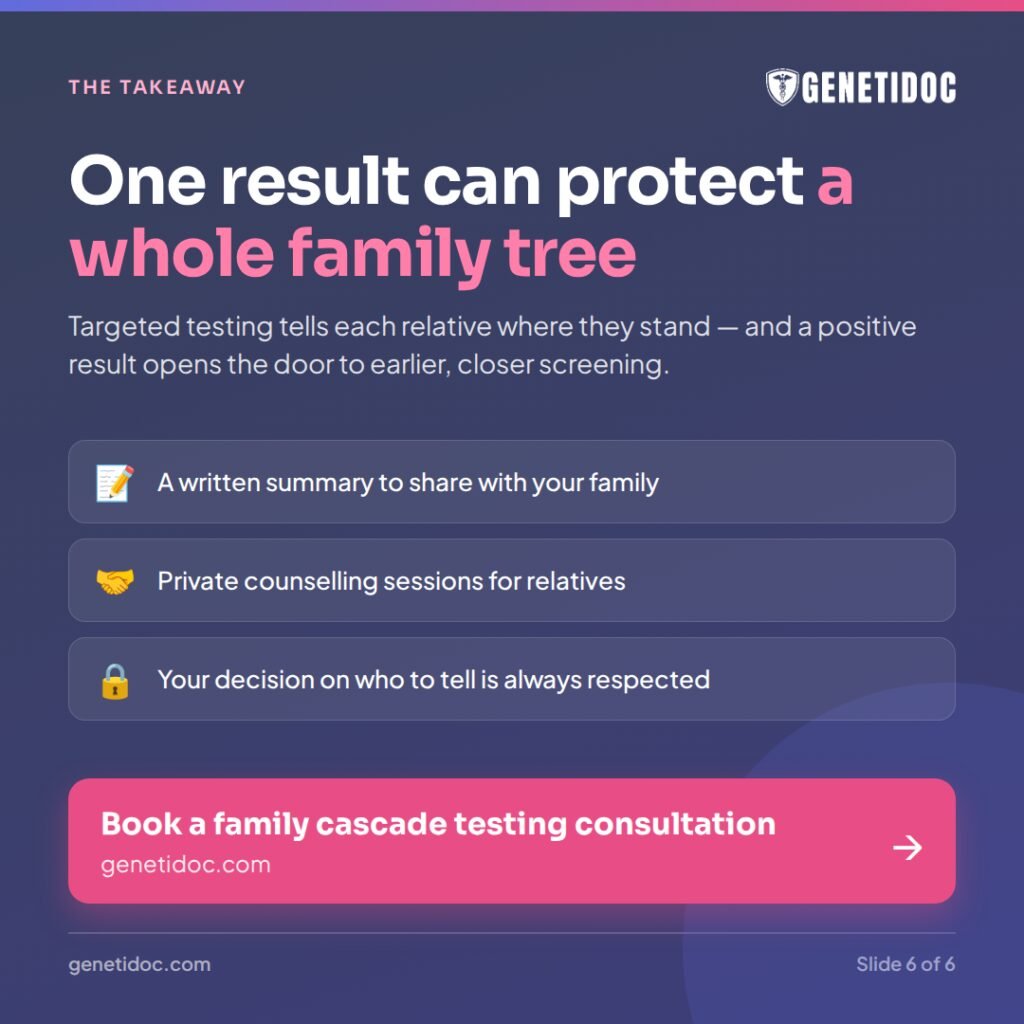
Genetidoc gives every patient a written, individualized summary after their consultation — prepared by the genetic counselor, cross-checked by the clinical geneticist, and specific to that patient’s own result and family history. It covers everything discussed in the session, including the relevant screening guidelines, and is shared with the patient soon after the appointment. Patients can use this document to open the conversation with relatives without needing to explain the genetics themselves.
What If You’d Rather Not Tell a Relative Yourself?
Some patients are comfortable managing their own result but hesitant to be the one to break the news to a sibling or parent. Genetidoc’s genetic counselors can work with that directly: if a patient would rather not have the conversation themselves, the relative can be invited to a private genetic counseling session of their own — without necessarily being told that a variant was found in the family, unless the patient is comfortable with that being shared.
If a patient decides they don’t want a particular relative informed at all, that decision is respected. Whether and how to share a genetic result is ultimately the patient’s own right to decide — the genetic counselor’s role is to inform and support that decision, not to override it.
If a Relative Tests Positive: What Actually Changes
For a relative who is found to carry the same familial variant, the practical value of knowing is real and immediate. Management typically shifts in a few directions, guided by National Comprehensive Cancer Network-based recommendations and always tailored by their own doctor and genetic counselor:
- Earlier and more frequent screening — for example, breast magnetic resonance imaging alongside mammography, starting at a younger age than average-risk guidelines recommend
- Additional screening for other cancers linked to the same gene, such as ovarian or pancreatic cancer surveillance depending on the specific variant
- A conversation about risk-reducing options, which some carriers consider and others do not — this is a personal decision made with a specialist, not a required next step
- Family planning considerations, including the option to discuss reproductive genetic testing with a genetic counselor before or during pregnancy
This is also where “beyond BRCA” matters in practice. Male relatives who carry a BRCA2 (and, to a lesser extent, BRCA1) change face increased risk of prostate cancer and male breast cancer — a fact many families don’t realize, since hereditary cancer risk is often assumed to be a “women’s issue.” Genetic counseling for male relatives should specifically address this, not treat it as an afterthought.
A Note on Minor Children
Most hereditary cancer conditions, including those linked to BRCA1 and BRCA2, are adult-onset — meaning the associated cancer risk does not typically appear in childhood. For these conditions, Genetidoc generally offers testing to at-risk minors only once they turn 18 and can make that decision for themselves.
There are a few specific exceptions, always handled through genetic counseling rather than independently. Li-Fraumeni syndrome (TP53) is one, since cancer risk can genuinely begin in childhood. Familial adenomatous polyposis (APC) is another: colon polyps in these families can start forming as early as the pre-teen years, so at-risk unaffected minors are typically offered genetic testing and, if positive, colonoscopy screening beginning around age 10 to 15 — well before the usual wait-until-18 approach used for most adult-onset hereditary cancer genes.
Clear Pathogenic Variant vs. Variant of Uncertain Significance: The Message Is Different
Not every genetic finding is equally clear-cut, and the guidance that follows depends heavily on which type of result was found.
“If a clear pathogenic variant is found, we can offer the affected patient genotype-matched treatment options for the known syndrome, along with syndrome-specific screening for their relatives,” explains Team Genetidoc. “A variant of uncertain significance is different — it isn’t a definitive answer. It could be a possible genetic cause, but there isn’t yet enough evidence to say so. We manage a variant of uncertain significance as if it were a negative result, and we offer general screening rather than condition-specific screening, until there’s enough evidence to reclassify it one way or the other. Because of that, we also don’t offer targeted cascade testing to unaffected family members based on a variant of uncertain significance alone — that step is reserved for a confirmed pathogenic finding.”
Patients dealing with a variant of uncertain significance result specifically can read more in our companion article on what a “gray” genetic finding means and how it’s managed over time.
If a Relative Tests Negative: What That Does and Doesn’t Mean
“For a relative who tests negative, we’re clear about exactly what was checked,” says Team Genetidoc. “We tested specifically for the one known change already found in the family — nothing else. So we can’t rule out every other genetic or non-genetic cancer risk. But it does substantially reduce their risk, and they are not at the elevated risk that comes with carrying what their family members carry.”
In other words, general population screening guidelines by age still apply, and a negative result for one specific familial variant doesn’t mean total immunity from cancer — only that this particular inherited risk does not apply to that relative.
Common Misconceptions Families Have
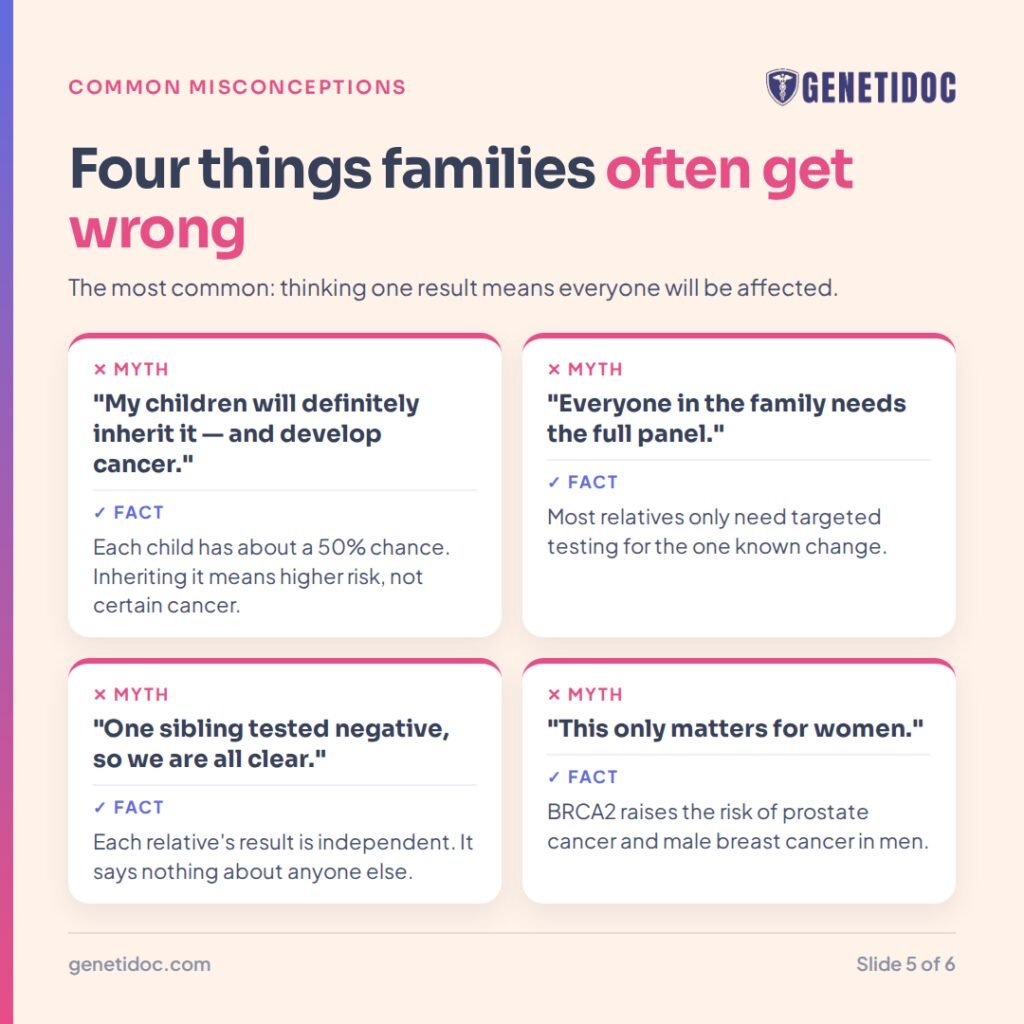
- “If I’m positive, my children will definitely inherit it — and definitely develop cancer.” Each child has roughly a 50 percent chance of inheriting the variant, not a certainty — and even a child who inherits it faces an increased risk, not a guaranteed diagnosis. Team Genetidoc notes this is the single most common misunderstanding they see: patients assuming a positive result in one person means the whole family will inevitably be affected.
- “Everyone in the family needs the full panel test.” Once the exact variant is known, most relatives only need targeted testing for that one specific change, not the full comprehensive panel the index patient underwent.
- “A negative result in one relative means the whole family is in the clear.” Each relative’s result is independent. One sibling testing negative says nothing about whether another sibling carries the variant.
- “This only matters for women.” Several hereditary cancer genes, including BRCA2, meaningfully raise cancer risk in men as well, and male relatives should be included in cascade testing conversations.
The Emotional Side for Relatives
Being asked to consider genetic testing because of someone else’s result brings up feelings that have little to do with the biology itself.
“Parents often feel guilty, as if they’re responsible for passing something on to their children,” says Team Genetidoc. “Others respond with denial, and many are simply anxious about what the future holds. None of that is unusual, and it’s exactly why we don’t just hand over a result — genetic counseling is there to help people process it, not just receive it.”
These reactions can show up in less obvious ways too. A relative who tests negative while a sibling tests positive can feel a real, if unwarranted, sense of survivor’s guilt. Others feel the weight of now having to make decisions on a timeline they didn’t choose — about their own screening, and eventually about what to tell their own children someday. At the same time, many relatives describe genuine relief once they have a clear answer, whatever that answer turns out to be, simply because living with uncertainty is its own kind of stress.
If you have specific questions about a hereditary cancer syndrome in your family, you can post them on the Hereditary Cancer Syndrome forum on the Genetidoc Rare Disease Forum, where responses are reviewed by genetic counselors and consultants.
A Real Example: Lynch Syndrome and a Family’s Next Steps
One anonymized example from Genetidoc’s own practice illustrates how this plays out. A patient already being treated for cancer underwent genetic testing as part of that care and was found to carry a pathogenic variant associated with Lynch syndrome. Team Genetidoc counseled the patient on the screening guidelines relevant to Lynch syndrome and offered targeted testing for that specific variant to the patient’s first-degree relatives.
Among those relatives were minors — in keeping with standard practice for adult-onset hereditary cancer conditions, testing for them was deferred until they turn 18, rather than done immediately. For the adult relatives who were tested and found to carry the variant, following the recommended Lynch syndrome screening protocol going forward means that if a cancer does develop, there is a meaningfully better chance of catching it early — and earlier detection generally means a better prognosis.
Why the Laboratory and the Interpretation Both Matter
A positive hereditary cancer result is only as useful as the interpretation behind it. Two patients with technically similar lab reports can receive very different guidance depending on how thoroughly their personal and family history is reviewed alongside the genetic finding.
“The report is the starting point, not the answer,” says Team Genetidoc. “Our job is to connect the genetic finding to this specific family’s history, explain exactly which relatives are at meaningful risk, and make sure cascade testing actually happens — not just gets mentioned once and forgotten. A finding without proper genetic counseling and follow-through doesn’t protect anyone.”
This is also why Genetidoc builds genetic counseling into every hereditary cancer result as standard practice, rather than treating it as an optional add-on. A pathology-accredited laboratory result and a qualified clinical geneticist’s interpretation are both necessary — one without the other leaves a family with data but no clear path forward.
Frequently Asked Questions
Don’t see your question answered below? You can post it on the Frequently Asked Questions forum on the Genetidoc Rare Disease Forum, where genetic counselors and consultants review every response.
What does it mean if I test positive for BRCA1 or BRCA2?
It means a specific, disease-associated genetic change was found in that gene, giving you an increased lifetime risk of certain cancers — most commonly breast and ovarian cancer, and for men, prostate and breast cancer. It does not mean cancer is certain.
What is cascade testing?
Cascade testing is offering genetic testing to the blood relatives of someone with a confirmed positive hereditary cancer result, testing specifically for that one known genetic change rather than repeating the full original test.
What is the chance my sibling or child also carries the same gene change?
For first-degree relatives — parents, siblings, and children — the chance is approximately 50 percent. It is a probability for each individual relative, not a guarantee either way.
Do my relatives need the same full genetic panel I had?
Usually not. Once the exact variant is identified in your report, relatives typically only need targeted testing for that one specific change. A full panel may still be offered if a relative has their own unexplained personal cancer history or specifically wants a broader picture of their genetic risk. Targeted testing is not offered for a variant of uncertain significance, since that finding is managed as negative rather than as a confirmed familial risk.
How long does cascade testing take?
Targeted testing for a single known familial variant typically takes about one to two weeks. A full multi-gene panel, when it’s needed, generally takes around three to four weeks.
Do I have to tell my family about my result?
No one can be forced to share their genetic information, and it remains entirely your decision. If you’d rather not have the conversation yourself, your genetic counselor can offer your relative a private counseling session of their own instead.
What if my relative tests negative — are they completely safe?
A negative result for the specific familial variant substantially reduces their risk and means they don’t carry the elevated risk their family members carry. It doesn’t rule out every other cancer risk, so standard age-based screening still applies.
Does a positive BRCA2 result matter for male relatives?
Yes. BRCA2 carriers who are male face increased risk of prostate cancer and male breast cancer, and should be included in cascade testing and screening conversations rather than assuming this only affects women in the family.
Are there hereditary cancer genes other than BRCA1 and BRCA2?
Yes. Genes including PALB2, TP53, APC, and the Lynch syndrome genes (MLH1, MSH2, MSH6, PMS2) also carry family-wide implications and follow the same cascade testing principle once a familial variant is identified.
Can children be tested for a hereditary cancer gene?
Usually not until age 18, since most hereditary cancer conditions are adult-onset. Exceptions include Li-Fraumeni syndrome and familial adenomatous polyposis, where cancer risk (or, for polyposis, polyp formation) can begin in childhood — in these specific cases, testing and screening for at-risk minors typically starts much earlier, always through genetic counseling rather than independently.
Where should my family get cascade testing done?
Choose a laboratory with proper accreditation and genetic counseling built into the process, not just a report generator. Interpretation of a hereditary cancer result — connecting the genetic finding to your family’s actual history — is where the real value lies, not the raw test itself.
Key Takeaways
- A positive hereditary cancer result is information about increased risk, not a diagnosis or a certainty
- Close blood relatives each face an independent probability of carrying the same variant — roughly 50 percent for parents, siblings, and children
- Most families do share the news — the real gap is getting relatives to actually attend counseling and get tested
- Cascade testing usually targets the one known familial variant and is typically simpler and faster than a full panel, though a full panel is available when a relative’s own history calls for it
- Male relatives should not be left out of the conversation, particularly with BRCA2
- A negative result substantially reduces the familial risk it was tested for, but doesn’t rule out all future cancer risk
| If someone in your family has tested positive for a hereditary cancer gene, the next step is finding out who else in the family may be at risk — and getting them tested for that specific change.
Book a Family Cascade Testing Consultation
|
References
- Centers for Disease Control and Prevention — About Cascade Testing for Hereditary Breast and Ovarian Cancer. cdc.gov/cascade-testing
- National Comprehensive Cancer Network Guidelines — Genetic/Familial High-Risk Assessment: Breast, Ovarian, Pancreatic, and Prostate. org/guidelines
- Family communication about positive BRCA1 and BRCA2 genetic test results. Genetics in Medicine. com/articles/gim200471
- Cascade genetic testing for hereditary cancer syndromes: a review of barriers and breakthroughs. Familial Cancer. springer.com/article/10.1007/s10689-024-00373-4
- Cascade testing for hereditary cancer: comprehensive multigene panels identify unexpected actionable findings in relatives. PMC. ncbi.nlm.nih.gov/articles/PMC10852611
Related Reading on Genetidoc
- Down Syndrome Screening in Pregnancy: How to Choose Between the First-Trimester Combined Test, Quad Screen, and Non-Invasive Prenatal Testing (NIPT)
- Family History of a Genetic Condition? Here’s What to Ask Before You Conceive
- What Does “Variant of Uncertain Significance” Mean — And Why It’s Not a Diagnosis
- NGS Panel Testing Explained: How Gene Sequencing Finds Inherited Diseases
- Hereditary Cancer Syndrome Forum
- Cascade Testing Forum
- Predictive Genetic Testing Forum
- Frequently Asked Questions Forum