
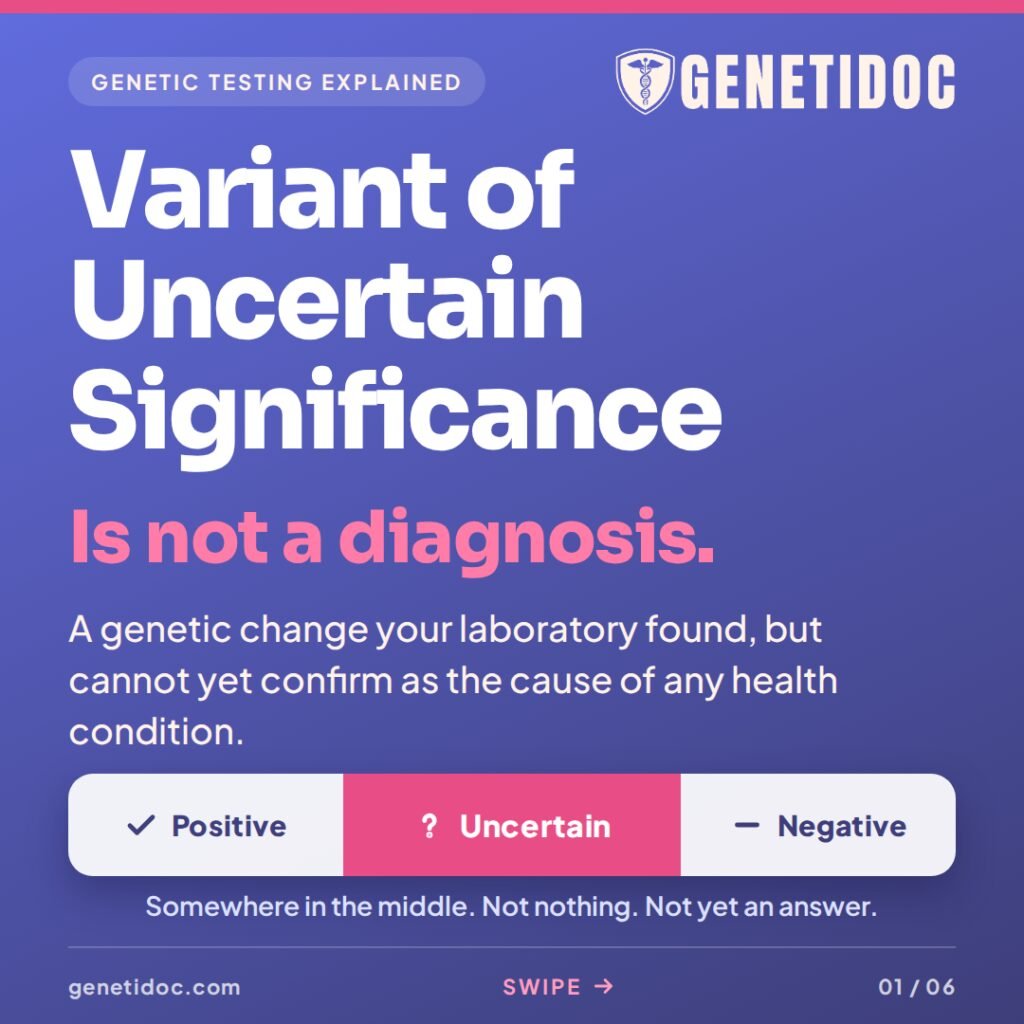
If you or a family member just had genetic testing and the report came back with the words “variant of uncertain significance,” you are probably staring at a document that raises more questions than it answers.
Here is the short version: a variant of uncertain significance is not a diagnosis. It is also not nothing. It sits in the middle — a genetic change your laboratory found but cannot yet confirm is the cause of any health condition. This article walks through exactly what that means, why it happens, why it may come up more often for Indian patients specifically, and what our clinical geneticists at Genetidoc actually do when a patient’s report contains one.
Quick answer: A variant of uncertain significance is a genetic change found during testing where current scientific evidence is not yet enough to say whether it causes disease or is a harmless, normal variation. It is a temporary, evidence-based “we don’t know yet” — not a confirmed diagnosis, and not something to act on medically by itself.
What Is a Variant of Uncertain Significance?
Every person’s DNA contains millions of small differences from the “reference” human genome sequence that laboratories compare against. Most of these differences are completely normal and harmless. A small number of differences, called pathogenic variants, are known to cause disease. In between sits a third category.
A variant of uncertain significance is a genetic change found in a gene connected to the condition a patient came in for, in a patient whose symptoms genuinely match what that gene is known to cause — but where the scientific evidence available today is not strong enough to say, with confidence, that this specific change is actually responsible for the condition.
One detail that surprises many patients: a variant of uncertain significance is generally reported only when it plausibly connects to the reason testing was done in the first place. A genetic change unrelated to the reason testing was done falls into one of two categories — and they are not the same thing. A secondary finding comes from a specific list of medically actionable genes that a laboratory deliberately checks on purpose, no matter why the test was ordered; patients are asked during pre-test counseling whether they want to know about these, and only opted-in results are reported back. An incidental finding is different: it is something noticed unexpectedly, outside that deliberate list, not something the laboratory set out to look for. Either way, if what turns up is only a variant of uncertain significance rather than a confirmed, actionable result, it is generally not reported at all — the added uncertainty does not meet the bar for a finding worth disclosing.
The Three Possible Outcomes of a Genetic Test
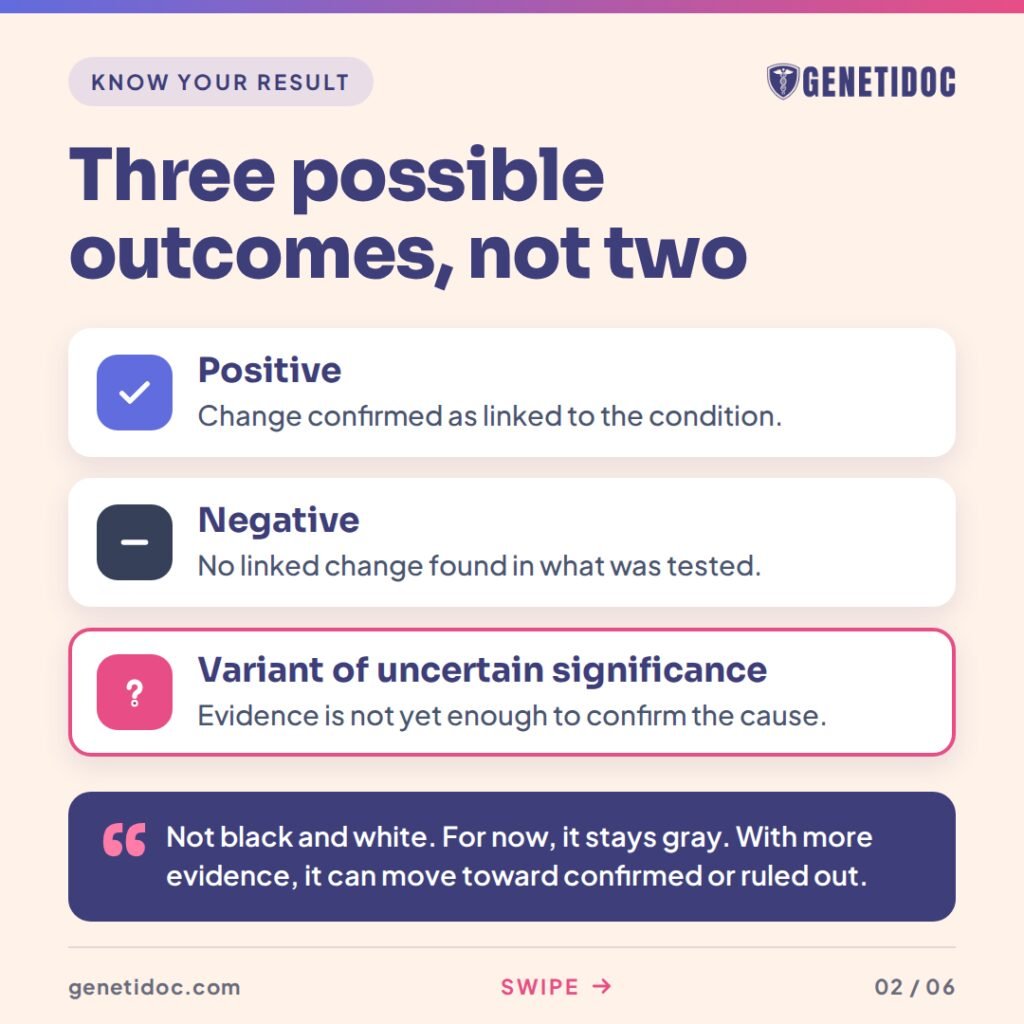
At Genetidoc, every patient is told about this possibility before testing even begins. As part of pre-test genetic counseling, our clinical geneticists explain that a genetic test can come back one of three ways:
- Positive — a genetic change is found that is confirmed to be associated with the condition the patient’s symptoms suggest.
- Negative — no genetic change connected to the condition is found in the genes tested. This means no reportable finding in what was tested, not that the condition is ruled out for good — so if symptoms and family history still point strongly toward a genetic cause, broader or follow-up testing may be recommended.
- Variant of uncertain significance — a genetic change is found that is suspected to be related to the condition, but current evidence is not sufficient to confirm that the change is actually the cause.
“We tell patients directly, before testing even happens, that there are three possible outcomes — not two,” says Team Genetidoc. “A variant of uncertain significance is not black and white the way a positive or negative result is. We describe it to families as a gray finding: for now, it stays gray. Over time, as more evidence becomes available, it can move toward black or white — toward confirmed or ruled out.”
How Common Is a Variant of Uncertain Significance?
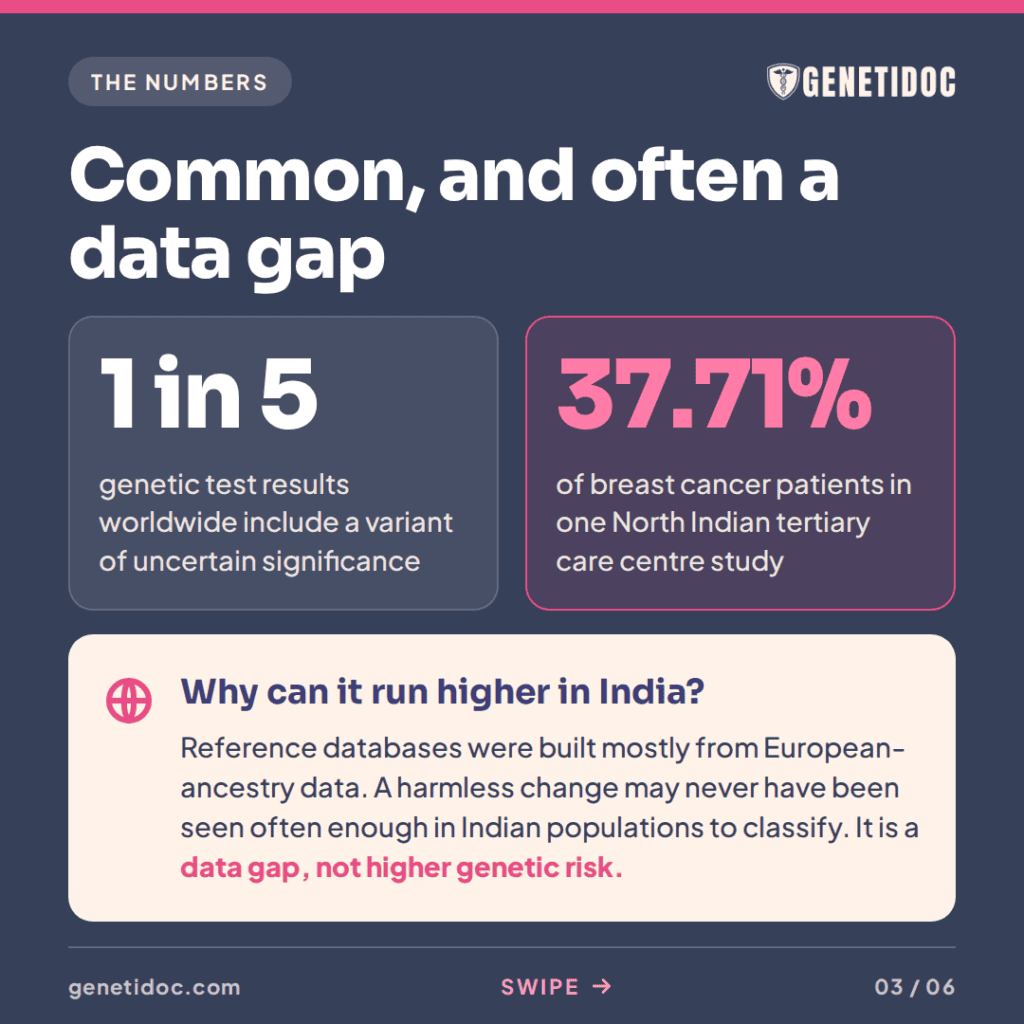
Variants of uncertain significance are not rare. Internationally, roughly one in five genetic test results includes one. They show up most often in testing methods that read large amounts of genetic code at once — multi-gene hereditary cancer panels and diagnostic whole exome sequencing, which reads the protein-coding portion of essentially all of a person’s genes rather than just one or two.
One published Indian study offers a specific data point worth knowing: a tertiary care centre in North India found a variant of uncertain significance in 37.71 percent of the breast cancer patients it tested — considerably higher than the roughly one-in-five figure often cited internationally, at least within that particular patient group.
“A variant of uncertain significance usually reflects what isn’t yet known, more than what is,” explains Team Genetidoc. “If you take almost anyone and run next-generation sequencing — a technology that reads large stretches of DNA at once — you will find a number of uncertain variants. That’s expected. It would not be possible, or medically responsible, to treat every one of those as a threat. So for practical purposes, most variants of uncertain significance are managed as if they were negative, until proven otherwise.”
Where an Indian patient’s rate does run higher than international figures, the likely reason is a data gap, not a genetic one. The reference databases laboratories worldwide use to classify variants as harmless or harmful were built predominantly from genetic data collected in populations of European ancestry. A genetic change that is well studied and confidently classified in a European population may simply never have been seen often enough in an Indian or South Asian population to classify with the same confidence — even if it turns out to be completely harmless. The North Indian study’s authors specifically called for an Indian variant registry, built from ethnically matched data, to help close this gap.
Variant of Uncertain Significance vs. Positive vs. Negative vs. Pathogenic
| Result | What it means | What patients should do |
| Pathogenic / Positive | A genetic change confirmed to cause the condition | Discuss management and family implications with a genetic counselor |
| Variant of uncertain significance | A change is found, but evidence is not yet enough to confirm it causes disease | Do not base medical decisions on it alone; follow up periodically |
| Negative | No disease-linked change found in the genes tested — this means no reportable finding in what was tested, not a guarantee the condition will never develop | Manage based on personal and family history; if clinical suspicion remains, ask your doctor whether broader or follow-up testing is appropriate |
How Genetidoc Approaches a Variant of Uncertain Significance Result
Setting expectations before testing begins
As described above, every patient hears about this possibility during pre-test counseling — not as a footnote, but as one of three clearly explained outcomes. This matters because a result that would otherwise feel alarming becomes something the patient was already prepared for.
Testing family members to help solve the puzzle
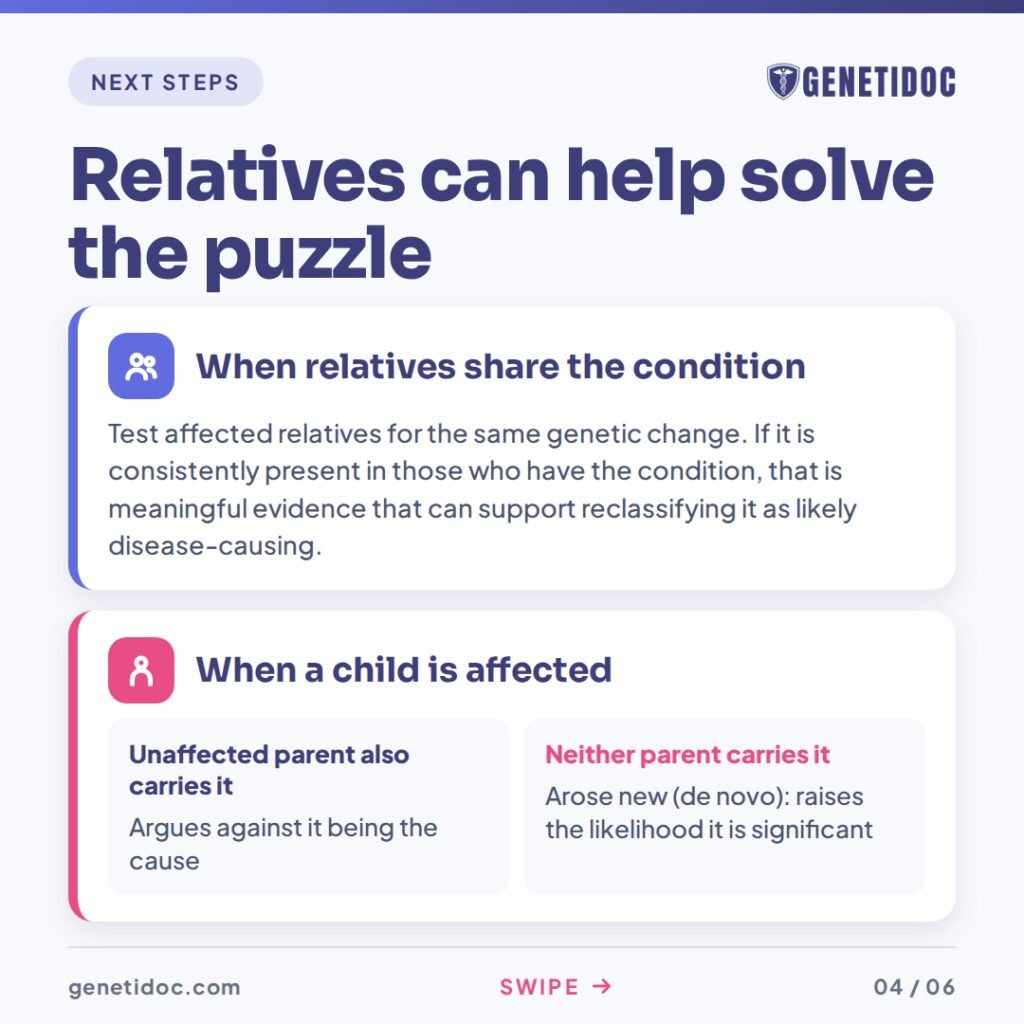
When a patient has a variant of uncertain significance and a family history of the same condition, one of the most useful next steps is testing affected relatives for that exact same genetic change — a process called segregation testing. If the variant is consistently present in relatives who also have the condition, that is meaningful evidence, and it can support reclassifying the variant toward likely pathogenic or pathogenic.
The same logic works in reverse for children. Consider a composite, anonymized example based on the kind of case our team sees regularly: a young child presents with developmental delay, and genetic testing finds a variant of uncertain significance in a gene linked to neurodevelopmental conditions. The next step is testing both parents for that same variant. If an unaffected parent also carries it, that argues against the variant being the cause of the child’s delay. But if neither parent carries it — meaning it arose new in the child, what geneticists call a de novo variant — that raises the likelihood it is genuinely significant, and strengthens the case for further evaluation.
Ongoing monitoring, not a one-time verdict
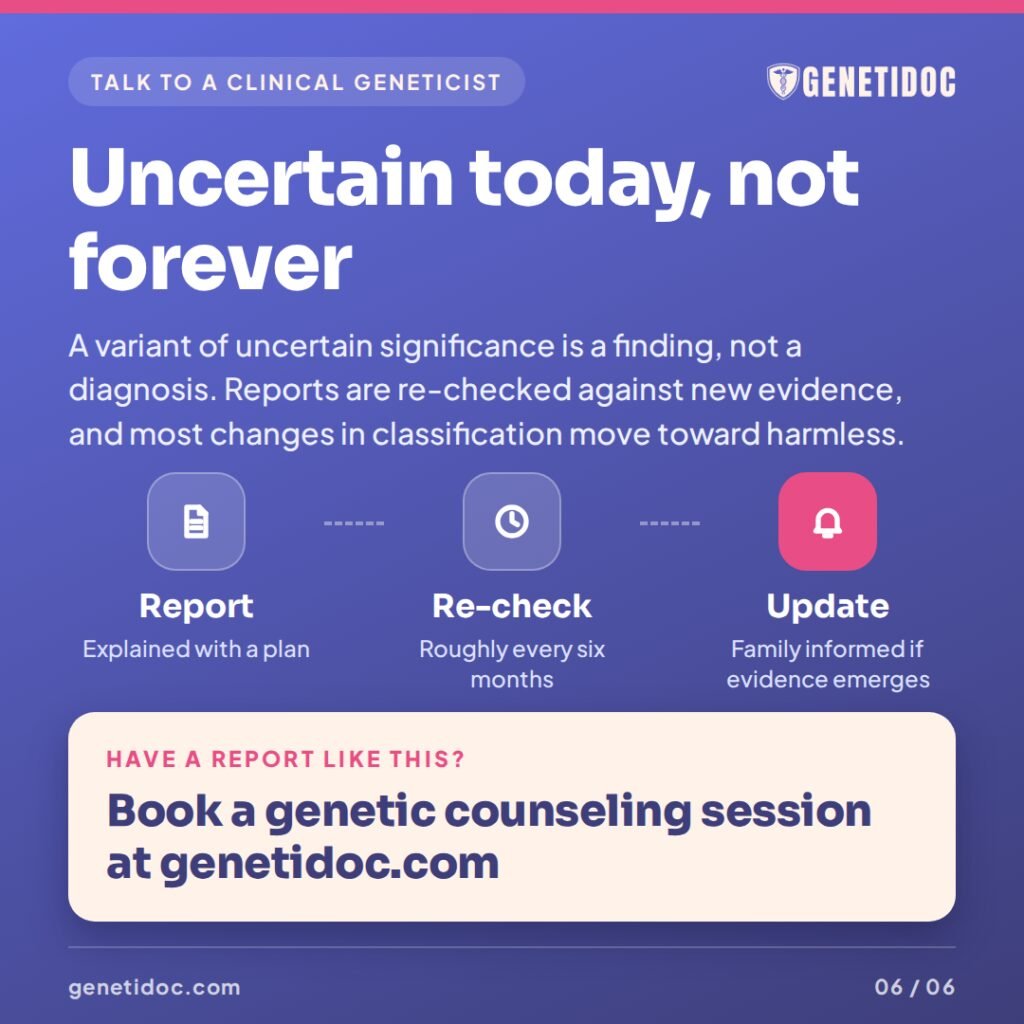
A variant of uncertain significance is not filed away and forgotten. Our clinical team periodically re-checks the latest scientific literature and public variant databases against a patient’s specific variant — roughly on a six-month rhythm, though re-evaluation can also be prompted sooner by a relevant new study or a patient’s follow-up visit. If meaningful new evidence emerges, the family is informed, and the variant is either reclassified toward a definite diagnosis or downgraded and effectively ruled out.
“We have seen genuine cases where a patient’s variant was later reclassified once more data became available,” says Team Genetidoc. “That is exactly why we don’t treat a variant of uncertain significance as a fixed result. In the meantime, because it isn’t confirmed to be a cause, we manage it practically as though it were a negative result — while continuing to watch it.”
What This Means for Your Family Members
Patients often ask whether they should tell relatives who may share the same condition in the family. Our guidance is simple: if you’re comfortable sharing the result yourself, that’s fine — but where possible, we recommend relatives book their own genetic counseling session rather than receiving the information secondhand. Details of a variant of uncertain significance are nuanced, and information passed along informally between family members can lose important context along the way. Families who want to read about others navigating a similar hereditary condition can also visit the Genetidoc Rare Disease Forum.
New 2026 Guidance: How Laboratories Are Making Reporting Clearer
This is a genuinely current development worth knowing about. In 2026, the American College of Medical Genetics and Genomics published a new points-to-consider statement specifically on reporting variants of uncertain significance in germline genetic testing — the kind of testing used to look for inherited conditions. For years, individual laboratories set their own, inconsistent policies on when and how to report these findings.
The new guidance recommends that laboratories distinguish between variants of uncertain significance that are more likely to eventually prove harmless (sometimes described as “VUS-low”) and those that carry a higher chance of clinical relevance and genuinely warrant closer follow-up (“VUS-high”). This direction reflects a practice our clinical team already follows: not treating every variant of uncertain significance as equally urgent.
What to Do If Your Report Shows a Variant of Uncertain Significance
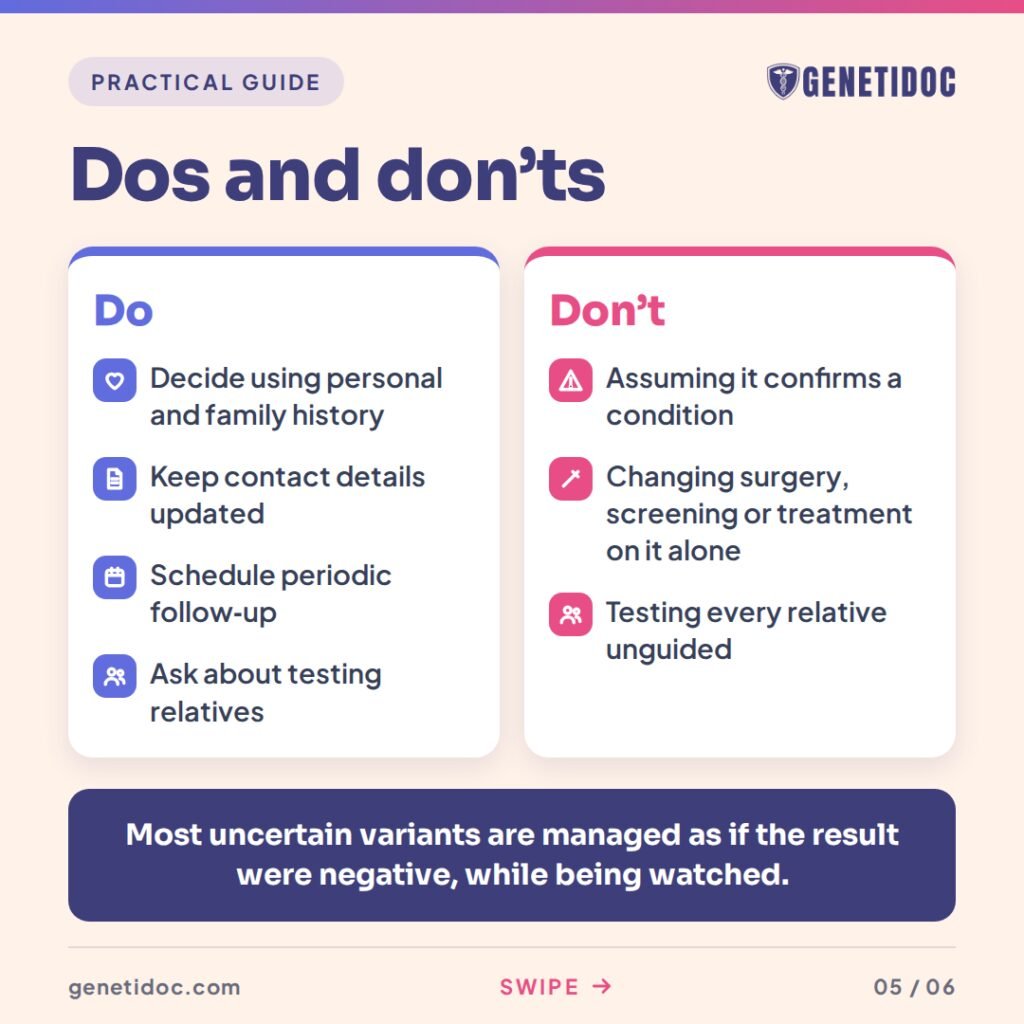
- Keep your contact details updated with the laboratory or clinic, so you can be reached if the variant is reclassified.
- Base any medical decisions on your personal and family history — not on the uncertain variant alone.
- Ask your genetic counselor whether testing affected or unaffected relatives (segregation testing) could help clarify the finding in your specific situation.
- Schedule periodic follow-up, rather than assuming the report is the final word.
- Encourage relatives who want more information to book their own counseling session.
What Not to Do
- Don’t assume a variant of uncertain significance confirms you have, or will develop, a genetic condition.
- Don’t pursue preventive surgery, major screening changes, or a treatment change based on the variant alone, without discussing it with a genetic counselor first.
- Don’t test every relative reflexively — targeted segregation testing, guided by a counselor, is more useful than broad, unfocused testing.
Why Interpretation Matters More Than the Report Itself
A variant of uncertain significance is a good illustration of why the value of genetic testing was never just about generating a report. Two patients with the identical genetic change can walk away with very different levels of clarity, depending on whether the result was explained in context — by a clinical geneticist who took a real family history and offered a clear plan for what happens next — or simply printed on a page with no interpretation at all.
This is why Genetidoc’s process treats genetic counseling as built into the result, not as an optional add-on. Our clinical geneticists are NABL and CAP accredited specialists working across India, and every report — including one containing a variant of uncertain significance — comes with a conversation, a documented follow-up plan, and ongoing monitoring for reclassification.
Frequently Asked Questions
Is a variant of uncertain significance the same as a genetic mutation?
Not in the way most people use the word “mutation” to mean a disease-causing change. A variant of uncertain significance is simply a difference from the reference DNA sequence that scientists cannot yet classify as harmful or harmless.
Should I be worried about a variant of uncertain significance result?
It’s understandable to feel uneasy, but a variant of uncertain significance is not a confirmed diagnosis. Most are ultimately reclassified toward harmless rather than harmful as more evidence becomes available.
Can a variant of uncertain significance become pathogenic later?
Yes, it’s possible, though most reclassifications go the other direction, toward benign. Reclassification depends on new scientific evidence, family testing (segregation testing), or updated population data becoming available.
How long does it take for a variant of uncertain significance to be reclassified?
There is no fixed timeline. Some are resolved within months if family testing provides quick clarity; others can take years, since reclassification depends on when enough new evidence accumulates.
Should my family members get tested if I have a variant of uncertain significance?
Sometimes, and specifically — testing affected relatives for the same variant (segregation testing) can help clarify whether it’s linked to the condition in your family. This should be guided by a genetic counselor rather than done on your own.
What’s the difference between a variant of uncertain significance and a negative result?
A negative result means no genetic change linked to the condition was found in what was tested — not that a genetic cause is ruled out entirely, so broader testing may still be recommended if suspicion remains. A variant of uncertain significance means a change was found, but it isn’t yet confirmed to be the cause. In practice, both are generally managed the same way until there’s evidence to say otherwise.
Why did my report include a variant that doesn’t mean anything yet?
Laboratories report a variant of uncertain significance because it sits in a gene connected to your symptoms, and because transparency matters — you and your doctor should know what was found, even when its meaning isn’t settled yet.
Will my treatment change because of a variant of uncertain significance?
It shouldn’t, on its own. Treatment and screening decisions should continue to be based on your personal and family medical history, not an unconfirmed genetic finding.
Is a variant of uncertain significance more common in Indian patients?
At least one published Indian study found a considerably higher rate than global averages, in the patients it looked at. This likely reflects a gap in genetic reference data for Indian and South Asian populations, not a higher underlying disease risk.
Do all genetic testing laboratories report variants of uncertain significance the same way?
No. Reporting practices have historically varied between laboratories. New 2026 guidance from the American College of Medical Genetics and Genomics recommends more consistent, tiered reporting to help patients and clinicians understand how seriously to weigh a given result.
What should I do while waiting for my variant of uncertain significance to be reclassified?
Keep your contact information current with your clinic, continue routine care based on your family history, and attend any scheduled follow-up reviews rather than making major medical decisions based on the variant alone.
Key Takeaways
- A variant of uncertain significance is a genetic finding, not a diagnosis — it means the evidence isn’t sufficient yet, not that something is wrong.
- It shows up in roughly one in five genetic tests globally; at least one Indian study found a considerably higher rate in the patients it looked at, most likely because of gaps in genetic reference data for Indian populations — not because of higher genetic risk.
- Testing affected or unaffected family members can help clarify — and sometimes reclassify — an uncertain finding.
- Medical decisions should be based on personal and family history, not an unconfirmed variant.
- Most uncertain variants are eventually reclassified toward harmless, though this can take months to years.
Already have a report with a variant of uncertain significance?
Our clinical geneticists can review your specific report, explain what it means for your situation, and discuss whether family testing could help move it toward a clearer answer. Book a genetic counseling session to review your VUS report [internal booking link placeholder].
References
- American College of Medical Genetics and Genomics — Points to Consider for the Reporting of Variants of Uncertain Significance in Germline Genetic and Genomic Testing, Genetics in Medicine, 2026
- National Human Genome Research Institute — Variant of Uncertain Significance (genetics glossary)
- Spectrum and management of breast cancer patients with variant of uncertain significance mutations at a tertiary care centre in North India — peer-reviewed study, PubMed Central
- Distinct rates of variant of uncertain significance reclassification observed when subclassifying by evidence level — peer-reviewed study, PubMed Central
Related Reading on Genetidoc
- NGS Panel Testing Explained: How Gene Sequencing Finds Inherited Diseases
- Genetic Counseling Online vs. In-Person: Does It Make a Difference?
- What Happens in a Genetic Counseling Session? A Step-by-Step Guide
- Biopsy Testing 101: How Doctors Choose the Right Cancer Treatment for You
- Screen, Confirm, or Miss: What a Four-Case Cost Study of Biotinidase Deficiency Newborn Screening Reveals
- Genetidoc Rare Disease Forum