
If your doctor has mentioned “gene panel testing” or “NGS testing,” you are not alone in feeling a little lost. These are powerful tools for finding the genetic cause of a condition that runs in a family. But the terms get thrown around loosely, and that confusion can make a stressful moment even more stressful.
This guide explains, in plain language, what next-generation sequencing (NGS) actually is, how a gene panel is different from whole exome or whole genome sequencing, how doctors decide which one you need, and what your results actually mean once they arrive.
| Quick answer: A gene panel is a genetic test that reads a specific group of genes known to be linked to a condition, rather than reading a person’s entire genetic code. It’s usually the fastest, most affordable, and most focused way to look for an inherited disease when doctors already have a good clinical reason to suspect a particular condition or group of conditions. |
What Is Next-Generation Sequencing (NGS)?
Every cell in the human body carries DNA — a long molecule that acts as an instruction manual for how the body is built and how it runs. DNA is written in a code made of just four letters: A, T, C, and G. Stretches of this code that carry specific instructions are called genes, and each gene has a job to do, from building proteins to regulating how cells grow.
Sometimes, a small change occurs in this code — for example, a C where a G should be. Most of these changes, called variants, are harmless. But some variants disrupt a gene’s instructions badly enough to cause a medical condition.
Next-generation sequencing is the laboratory technology that reads through this code, letter by letter, and checks for meaningful changes. It gets its name because it replaced an older method called Sanger sequencing, which could only read one gene at a time. Next-generation sequencing can read many genes — sometimes millions of DNA fragments — at once, which is what makes today’s multi-gene panels, exome sequencing, and genome sequencing possible.
What an NGS panel can’t do
One of the most common misunderstandings patients have is assuming that any genetic test — a panel, an exome, or even a full genome — can rule out every possible genetic condition, or predict everything that will ever happen to a person’s health. That isn’t how it works. A test only looks at what it is designed to look at. A panel built for hereditary heart conditions will not pick up a metabolic disorder it wasn’t designed to detect. Reading someone’s entire genetic code doesn’t mean reading their entire future.
There’s also a more technical blind spot worth knowing about: standard next-generation sequencing is very good at spotting small changes, like one letter of DNA code swapped for another. It is much less reliable at picking up large deletions or duplications — where an entire chunk of a gene, or the whole gene, is missing or copied an extra time. This happens because of how the technology works: it reads DNA in short, overlapping fragments and reassembles them like a puzzle. If a whole piece of the puzzle is simply missing or duplicated, that can be far harder to notice this way than spotting one mismatched letter. This is exactly why conditions caused mainly by deletions or duplications — spinal muscular atrophy and Duchenne muscular dystrophy are two well-known examples — need testing methods specifically designed to catch that kind of change, rather than relying on standard sequencing alone.
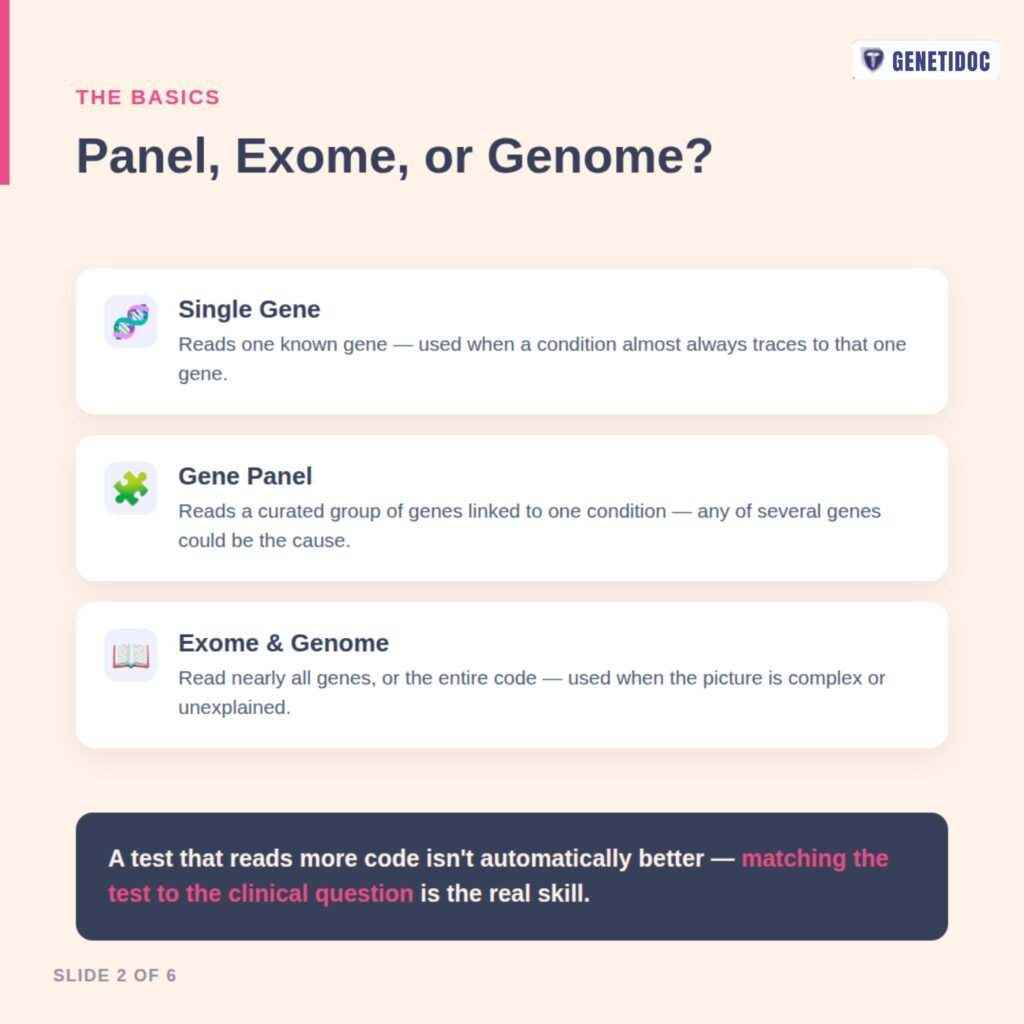
Single Gene, Gene Panel, Whole Exome, or Whole Genome — What’s the Difference?
These four terms describe how much of a person’s genetic code gets read, and each one exists for a different clinical situation. (You can also follow ongoing patient discussion on this exact topic in the post your genetic doubts here of the Genetidoc Rare Disease Forum.)
| Test type | What it reads | Typically used when |
| Single gene test | One specific gene, sometimes one specific known variant | The condition is caused almost always by one known gene (e.g., Duchenne muscular dystrophy) or one recurrent variant (e.g., achondroplasia) |
| NGS gene panel | A curated group of genes (from a handful to several hundred) linked to a specific condition or group of related conditions | The condition could be caused by any one of several known genes (e.g., hereditary cancer syndromes, inherited heart conditions, skeletal dysplasias) |
| Whole exome sequencing | The protein-coding portion of nearly all genes (about 1-2% of the total genetic code, where most disease-causing variants are found) | The clinical picture is complex or doesn’t clearly point to one gene group, or a panel has already come back negative |
| Whole genome sequencing | The entire genetic code, coding and non-coding regions | A strongly suspected genetic condition remains unexplained after exome sequencing, or the condition is known to involve changes exome sequencing tends to miss |
A pattern worth noticing: bigger is not automatically better. A test that reads more of the genetic code also takes longer to interpret, costs more, and is more likely to turn up findings that are hard to make sense of. Matching the test to the clinical question is the actual skill involved.
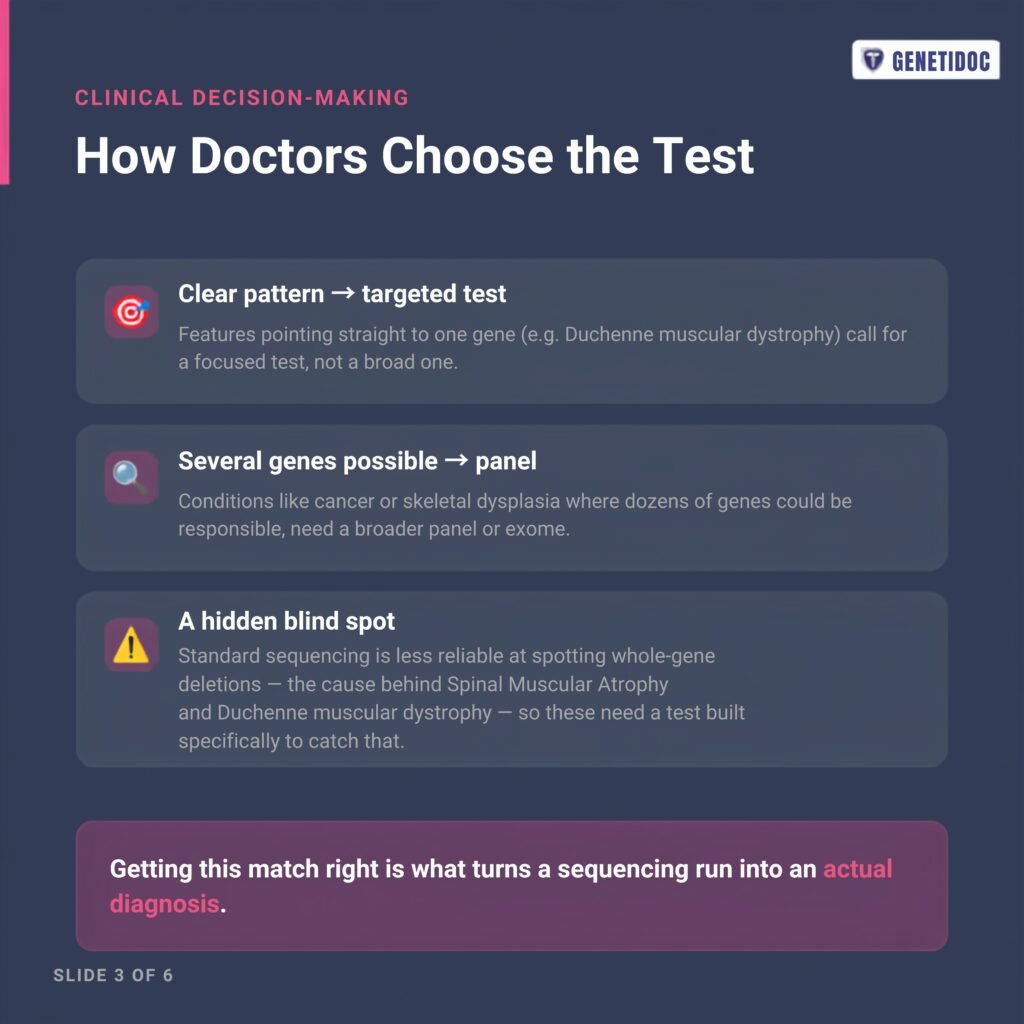
How Doctors Actually Decide Which Test You Need
At Genetidoc, whole genome sequencing is never the starting point. The process begins with a detailed consultation: family history, personal medical history, and the specific features or symptoms present. From there, the clinical genetics team works out how well the picture fits a known pattern.
| “If someone comes to us with features that clearly point to Duchenne muscular dystrophy, we don’t need to look at their whole genetic code — we go straight to the DMD gene, because we already know that’s where the answer almost always is. But if someone comes in with a skeletal dysplasia, where dozens of different genes could be responsible, a single-gene test would waste time. That’s when a broader panel, or whole exome sequencing, makes sense.” — Team Genetidoc |
Example: When a small, targeted test beats a big one
Spinal muscular atrophy and Duchenne muscular dystrophy are two conditions where targeted testing usually outperforms a large panel or even exome sequencing. Both conditions are commonly caused by deletions or duplications in a single gene — SMN1 for spinal muscular atrophy, DMD for Duchenne muscular dystrophy. Whole exome sequencing is very good at finding small spelling changes in DNA, but it is not well suited to detecting these larger deletions and duplications. A targeted test built specifically to look for them is faster, cheaper, and more reliable.
Achondroplasia, a common cause of short stature, is another example. Around 99% of cases are caused by the exact same single-letter change in one gene, FGFR3. Because the cause is so consistently the same known change, doctors can order a focused test for that specific variant rather than a broad panel — it’s quicker and less expensive, and it answers the clinical question directly.
Example: When testing needs to escalate
Sometimes a panel or exome test doesn’t fully answer the question. In recessive conditions — where a child needs to inherit a non-working copy of a gene from both parents — exome sequencing sometimes finds only one of the two expected changes. When a condition is strongly suspected clinically but only one variant turns up, the next step is often whole genome sequencing, which can pick up certain changes that exome sequencing, focused only on protein-coding regions, is not designed to detect.
There was a research paper that described exactly this kind of case: two families with inherited hearing loss present from early childhood. Exome sequencing found only one disease-causing change, in a gene called PTPRQ, in one of the families — leaving the diagnosis unsolved, since this condition needs a non-working copy of the gene from both parents. Whole genome sequencing then found the missing second change, sitting deep in a non-coding part of the same gene, in a region exome sequencing was never designed to read. Together, the two changes explained the hearing loss in both families (Hofrichter et al., BMC Medical Genomics, 2025). This kind of step-up from exome to genome sequencing after an incomplete result is a well-documented part of modern diagnostic practice for inherited conditions. Patients researching these next steps can also read more in the Whole Exome Sequencing and Whole Genome Sequencing sections of the Genetidoc Rare Disease Forum.
When an NGS Panel Actually Changes Care
Genetic testing is only useful if the result changes what happens next. Here’s where NGS panels make a concrete difference:
Hereditary cancer risk
When a hereditary cancer gene panel identifies a disease-causing variant in someone already diagnosed with cancer, or in a healthy relative with a strong family history, it changes their care plan. Instead of standard-population screening, that person moves onto a personalized surveillance schedule — earlier and more frequent screening, and sometimes risk-reducing options — designed around their specific genetic risk. That is the entire point of testing: not just a diagnosis, but a plan. Patients weighing this kind of testing can also read real patient questions and answers in the Predictive Genetic Testing section of the Genetidoc Rare Disease Forum.
Why a panel often beats testing one gene at a time
Before multi-gene panels existed, doctors sometimes tested one candidate gene, waited for a negative result, then tested the next gene, and the next — a slow and expensive process. An NGS panel checks the relevant genes together in one pass. For an inherited condition where several genes could plausibly be responsible, this generally means a higher chance of finding the answer, in less time, at lower total cost, than working through genes one at a time.
Understanding Your Result: Positive, Negative, or Uncertain
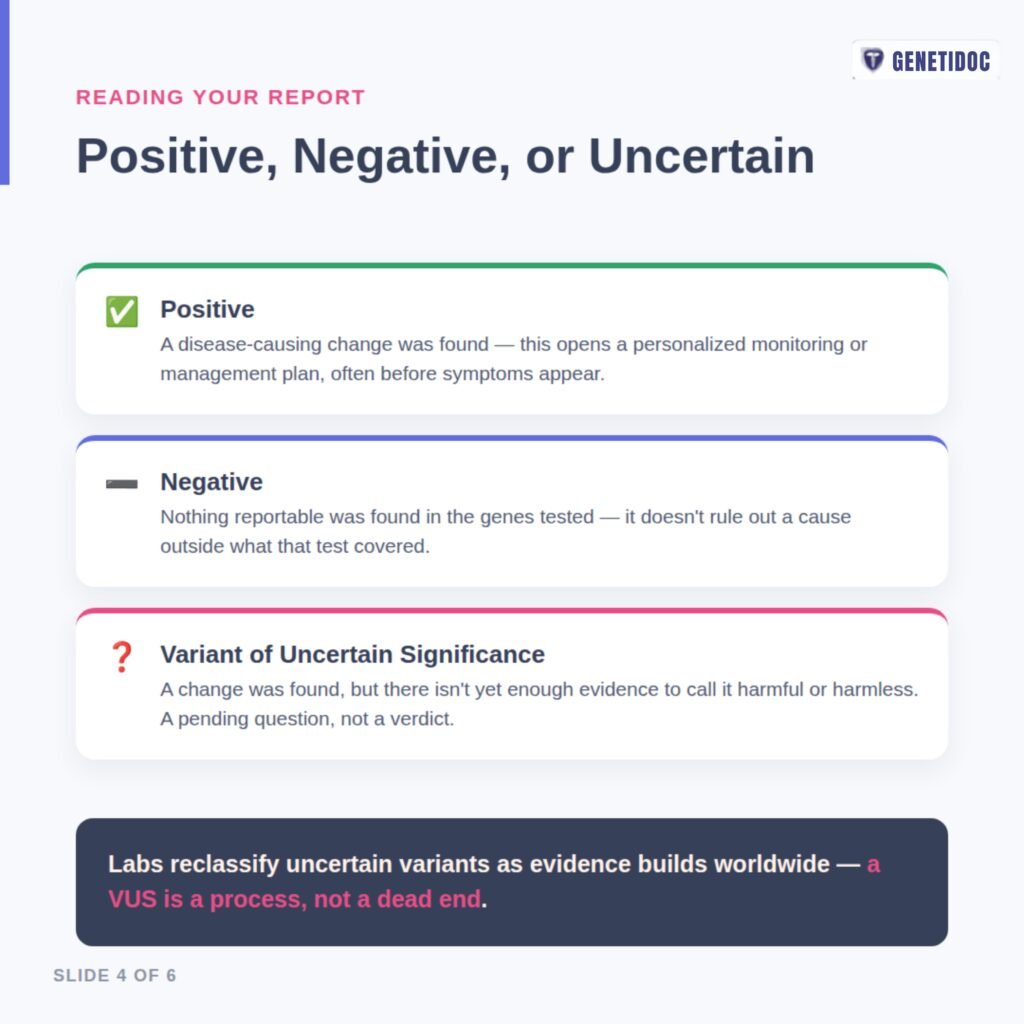
Genetic test reports typically place findings into a few categories. Here’s what each one actually means.
A positive (pathogenic) result
This means a change was found in a gene that is well established to cause disease. It does not automatically mean the worst-case outcome is guaranteed — for many conditions, it means a personalized monitoring or management plan can now begin, often before symptoms even appear.
A negative result
A negative result means no disease-causing change was found in the genes that were actually tested. It is not a guarantee that a person will never develop the condition being investigated, and it doesn’t rule out a genetic cause outside what that particular test covered. This is exactly why matching the right test to the clinical picture matters so much — and why a negative result sometimes leads to a broader test rather than an end to the investigation.
A variant of uncertain significance (VUS)
This is the result families find hardest to sit with. A variant of uncertain significance means a genetic change was found, but there isn’t yet enough evidence to say whether it causes disease or is simply a harmless difference. It is not a diagnosis, and it is not nothing — it sits in the middle, pending more evidence.
| “A variant of uncertain significance is genuinely the hardest result to explain to a family, because there’s no clean yes or no. One way we work through it is by testing affected relatives for that same specific variant — if it turns up consistently in family members who actually have the condition, that’s evidence that helps reclassify it, over time, toward pathogenic. It’s a process, not a single verdict.” — Team Genetidoc |
Laboratories reclassify variants of uncertain significance as more evidence accumulates worldwide, which is one more reason ongoing contact with a genetic counselor — not just the one-time report — matters.
NGS Panels vs. Direct-to-Consumer Gene Tests: Not the Same Thing
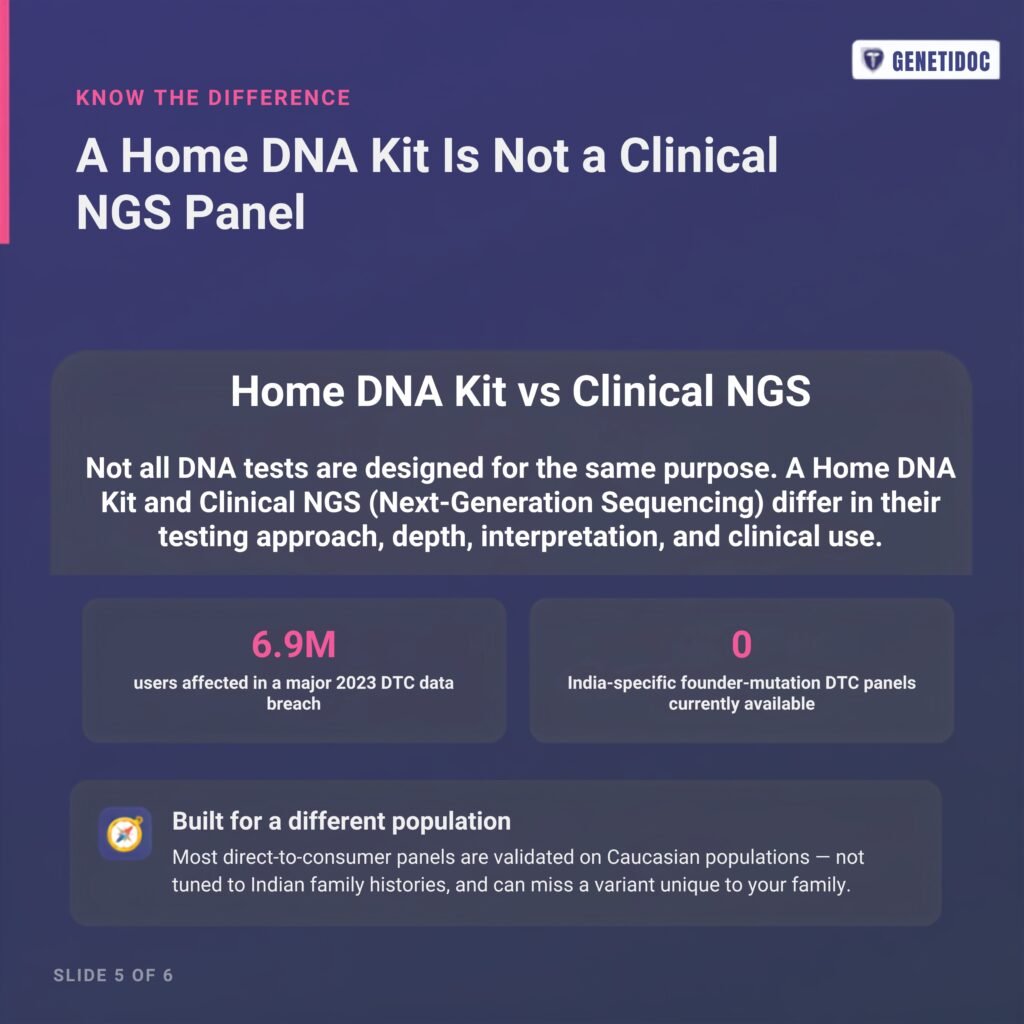
Direct-to-consumer tests — the mail-in kits ordered online without a doctor’s involvement — are often confused with clinical NGS panels. Many patients simply describe both as “genetic testing” without realizing they are fundamentally different tools.
| The core difference: Direct-to-consumer tests typically check for a limited set of already-known “founder” variants — genetic changes known to be common in a specific population. Most of these panels were built and validated using data from Caucasian populations, and generally are not specific to Indian or other non-Caucasian populations. There is no equivalent, India-specific founder-mutation panel currently available in the direct-to-consumer space. Because a direct-to-consumer test only checks off a fixed list of previously identified variants, it will miss a disease-causing change that isn’t already on that list — including a new or rare variant specific to that person’s family. A clinical NGS panel, by contrast, is selected and interpreted by a genetics team based on the patient’s own history and features, and actually reads through the relevant genes rather than checking against a fixed list, so it can pick up disease-causing changes whether or not they’ve been seen before. |
This mismatch has real consequences. A direct-to-consumer test validated on a different population can return a false positive, or just as concerning, a false sense of reassurance from a negative result that was never designed to check for a variant relevant to an Indian patient’s actual family history. Interpretation matters too — a raw result without a genetics professional’s context can create more confusion than clarity, and can lead to expensive, unnecessary follow-up testing or, conversely, false reassurance that delays a needed workup.
Data privacy is a separate but related concern. Most direct-to-consumer companies are not bound by the same clinical privacy obligations as accredited diagnostic laboratories, and genetic data breaches are not hypothetical — a well-known 2023 breach at a major direct-to-consumer testing company affected the data of roughly 6.9 million users. A clinical laboratory operating under recognized accreditation standards, with a genetics team standing behind every report, is a fundamentally different service. Questions and real experiences from other patients navigating this exact confusion are discussed in the Direct-to-Consumer Genetic Testing section of the Genetidoc Rare Disease Forum.
Turnaround Time and Cost: What to Expect
Multi-gene NGS panels typically take around two to four weeks from sample collection to a finished report, depending on how many genes are being read and how complex the case is. Whole exome and whole genome sequencing take longer to run and interpret, often a matter of months rather than weeks, because there is simply more data to review carefully.
On cost, the general pattern holds across most laboratories: a single-gene test is the least expensive option, a multi-gene panel costs more than a single gene but considerably less than exome or genome sequencing, and whole genome sequencing is the most expensive option — in India, clinical whole genome sequencing typically runs upward of ₹1,00,000, with trio sequencing (testing both parents alongside the patient) priced in a similar range. Exact panel pricing varies by lab and by how many genes are included, which is one more reason cost alone should never be the deciding factor between a panel, an exome, or a genome test — clinical fit should be.
What Happens After Sequencing: Why Interpretation Is the Real Work
Running the sequencing machine is only the first half of the process. Once raw data comes back, a genetics team checks each detected variant against population databases, published disease literature, and computational prediction tools, then classifies it following the standardized framework used internationally by medical geneticists and molecular pathologists — the American College of Medical Genetics and Genomics and Association for Molecular Pathology variant classification guidelines. Only after this review does a variant get labeled pathogenic, likely pathogenic, uncertain, likely benign, or benign on a report.
This is also why the specific genes included on a panel matter. Which genes belong on, say, a hereditary cancer panel or a cardiac panel is not arbitrary — it reflects an evidence base, curated and continuously updated by bodies like the Clinical Genome Resource (ClinGen), about which gene-disease relationships are well established enough to test for clinically. A well-designed panel from an accredited lab reflects this evidence; a poorly designed one can either miss real findings or generate a flood of uncertain ones.
This is the difference between a raw report and a clinically useful one — and it is also why Genetidoc pairs every genetic test with a genetic counseling conversation. A result on paper is only actionable once it’s placed in the context of the person’s actual medical history, family history, and current health.
Questions to Ask Before You Get an NGS Panel
If your doctor has recommended a gene panel, or you’re trying to understand whether you need one, these questions are worth asking before you proceed:
- Why this panel, specifically? Ask what clinical features or family history led your doctor to recommend this particular set of genes, rather than a smaller single-gene test or a broader exome test.
- What will a negative result mean for me? Understand in advance whether a negative result would end the investigation or lead to a bigger test.
- Could this test find something unrelated to why I’m being tested? Some panels can incidentally reveal findings unrelated to the original concern. Decide in advance whether you want to know about those, and discuss this with your genetic counselor before testing, not after.
- Who is interpreting my results, and can I talk to them? A report is only as good as the team reading it. Ask whether genetic counseling is included, and whether you’ll have a chance to discuss the result, not just receive a PDF.
Common Myths About Gene Panel Testing
Myth: “A genetic test can tell you everything about your health future.”
No single test reads for every possible condition, and most inherited disease risk is not a certainty — it’s a probability that still depends on other factors. A test answers the specific question it was designed to answer.
Myth: “A negative result means I’m in the clear.”
A negative result means nothing reportable was found in the genes that were tested — not that the condition is impossible, and not that no genetic cause exists anywhere in the genome.
Myth: “If it’s genetic, nothing can be done about it.”
This is one of the most common and most damaging misconceptions families carry into testing. In practice, identifying a genetic cause frequently opens the door to targeted treatment, earlier screening, or a monitoring plan that improves outcomes — the opposite of a dead end.
Myth: “A home DNA kit is basically the same as a clinical genetic test.”
As covered above, direct-to-consumer kits and clinical NGS panels are built, validated, and interpreted very differently, and are not interchangeable for diagnostic purposes.
Frequently Asked Questions
What is an NGS panel test?
An NGS panel test is a genetic test that reads a specific, curated group of genes known to be linked to a particular condition or group of related conditions, using next-generation sequencing technology.
How is an NGS panel different from whole exome or whole genome sequencing?
A panel reads only a selected group of genes relevant to the suspected condition. Whole exome sequencing reads the protein-coding portion of nearly all genes. Whole genome sequencing reads the entire genetic code, coding and non-coding.
How long does it take to get NGS panel results in India?
Multi-gene panels typically take around two to four weeks from sample collection to a completed report, depending on panel size and case complexity.
Can an NGS panel test detect every genetic condition?
No. A panel only detects changes in the specific genes it was designed to include. It cannot detect conditions caused by genes outside that panel.
What does a negative NGS panel result mean?
It means no disease-causing change was found in the genes that were tested. It does not guarantee the condition will never develop, and it doesn’t rule out a cause outside the genes that were tested.
What is a Variant of Uncertain Significance (VUS)?
It is a genetic change found on testing where there isn’t yet enough scientific evidence to classify it as either disease-causing or harmless. It is not a diagnosis on its own.
Is a multi-gene panel more expensive than a single-gene test?
Generally, yes — a multi-gene panel costs more than testing a single gene, but considerably less than whole exome or whole genome sequencing.
Are direct-to-consumer gene tests the same as a clinical NGS panel?
No. Direct-to-consumer kits typically check a limited set of known variants validated mostly in Caucasian populations, and are generally not specific to Indian or other non-Caucasian populations. They also don’t come with clinical interpretation. Clinical NGS panels are selected and interpreted by a genetics team based on the patient’s own medical and family history.
Do I need genetic counseling before an NGS panel test?
Pre-test counseling helps clarify what the test can and cannot answer, and what to do with unexpected or unrelated findings. Post-test counseling is essential for understanding what the result actually means for you and your family.
Which conditions are typically tested using NGS gene panels?
Common examples include hereditary cancer syndromes, inherited heart conditions, neuromuscular and metabolic disorders, and skeletal dysplasias — any condition where several different genes could plausibly be responsible.
What happens if my NGS panel is negative but I still have symptoms?
Your doctor may recommend broader testing, such as whole exome or whole genome sequencing, since the cause may lie outside the genes the panel covered.
Key Takeaways
- Next-generation sequencing is the technology; a gene panel, exome, or genome test describes how much of the genetic code gets read.
- Bigger tests are not automatically better — the right test depends on how well your clinical picture and family history point to a known condition or gene group.
- A positive result opens a management plan; a negative result rules out only what was actually tested; a variant of uncertain significance is a pending question, not a verdict.
- Direct-to-consumer kits are not a substitute for a clinically interpreted NGS panel, particularly for patients in India.
- Interpretation, by a genetics team working from your actual history, is what turns a lab report into something you can act on.
| If a doctor has recommended genetic testing for a condition that runs in your family, the first step isn’t ordering a test — it’s a conversation. Genetidoc’s clinical genetics team can review your history and help determine whether a targeted gene test, a multi-gene panel, or broader sequencing actually fits your situation, with genetic counseling built into every step. |
Book free genetics consultation with Genetidoc
Have a question about NGS panel, exome, or genome testing? Ask it in the Next Generation Sequencing, Whole Exome Sequencing, or Whole Genome Sequencing sections of the Genetidoc Rare Disease Forum, or browse condition-specific discussions in Genetic Rare Diseases and Cancer Genetics.
References
- GeneReviews — Achondroplasia (NCBI Bookshelf NBK1152)
- Bellus GA et al., “Achondroplasia is defined by recurrent G380R mutations of FGFR3,” PubMed 7847369
- Richards S et al., ACMG/AMP “Standards and guidelines for the interpretation of sequence variants,” Genetics in Medicine, 2015
- ClinGen (Clinical Genome Resource) — gene-disease clinical validity curation
- Hofrichter MA, et al. “Whole-genome sequencing, as a powerful diagnostic tool in hearing loss, reveals novel variants in PTPRQ missed by whole-exome sequencing.” BMC Medical Genomics, 2025;18:59.
- 23andMe 2023 credential-stuffing breach (~6.9M users affected) — cited per Genetidoc’s standing DTC-privacy position
Read More
Genetic Counseling Online vs. In-Person: Does It Make a Difference?
What Happens in a Genetic Counseling Session? A Step-by-Step Guide
Biopsy Testing 101: How Doctors Choose the Right Cancer Treatment for You
Biopsy Testing 101: How Doctors Choose the Right Cancer Treatment for You