
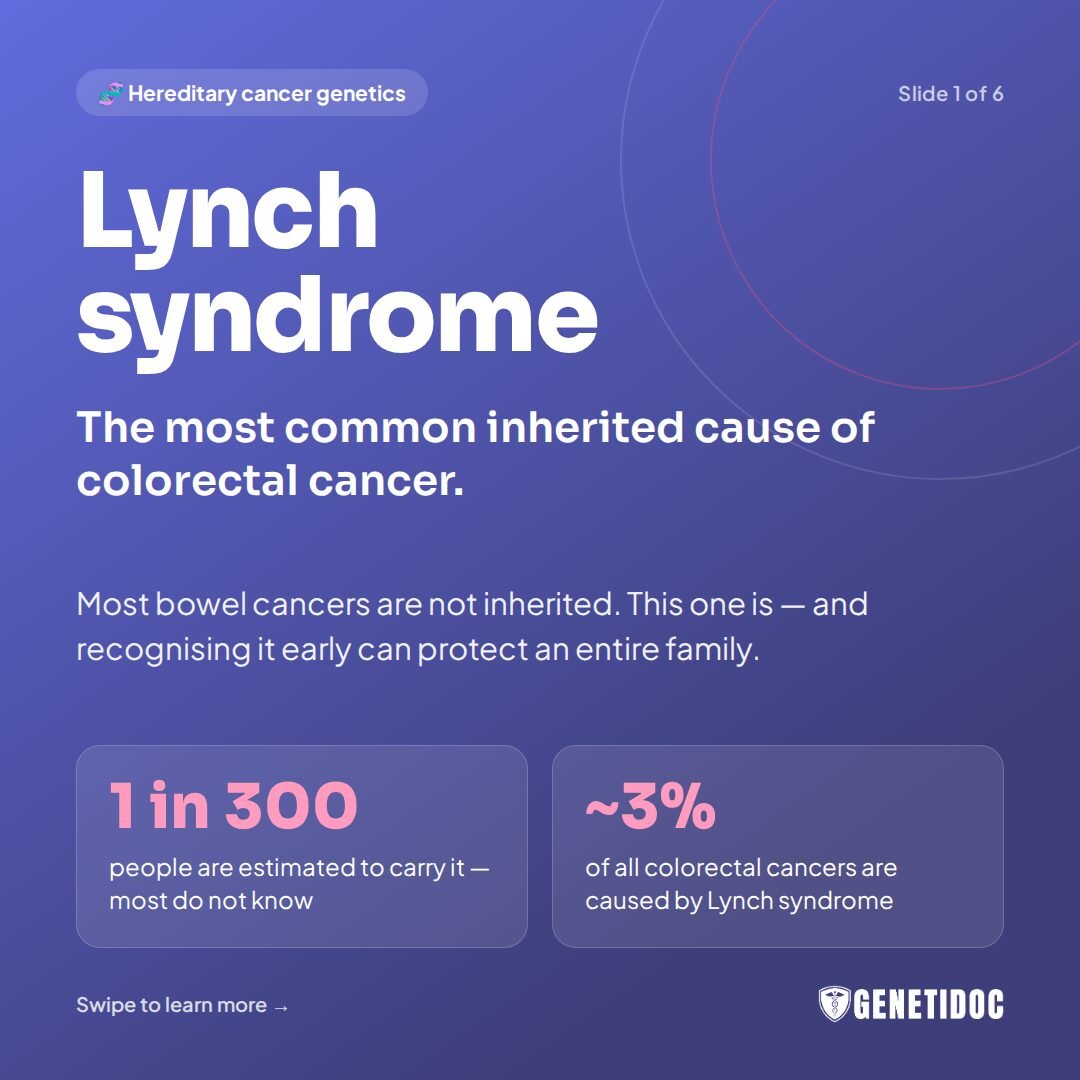
Most colorectal cancers are not inherited. They develop later in life, from a mix of age, diet, lifestyle, and chance. But a small and important group of colorectal cancers happens because a person was born with a genetic change that makes cancer far more likely — and the most common of these inherited conditions is Lynch syndrome.
Many patients in India first hear the words “Lynch syndrome” after a biopsy report comes back with a line they do not understand, such as “MSI-high” or “loss of MSH2 expression.” Others hear it when a relative is diagnosed with colorectal or uterine cancer at a young age. Either way, the questions are the same: What does this mean for me? Is my family at risk? And what can we actually do about it?
This guide answers those questions in plain language, drawing on published guidelines and on the everyday clinical experience of Team Genetidoc.
| Quick answer: Lynch syndrome is an inherited condition caused by a change in one of the genes that repair mistakes in DNA (MLH1, MSH2, MSH6, PMS2, or EPCAM). It raises the lifetime risk of colorectal cancer, uterine (endometrial) cancer, and several other cancers. It is passed down from parent to child, with a 50 percent chance for each child. It is confirmed with a blood test, and once it is known, regular screening can find cancers early — or prevent them altogether. |
What Is Lynch Syndrome?
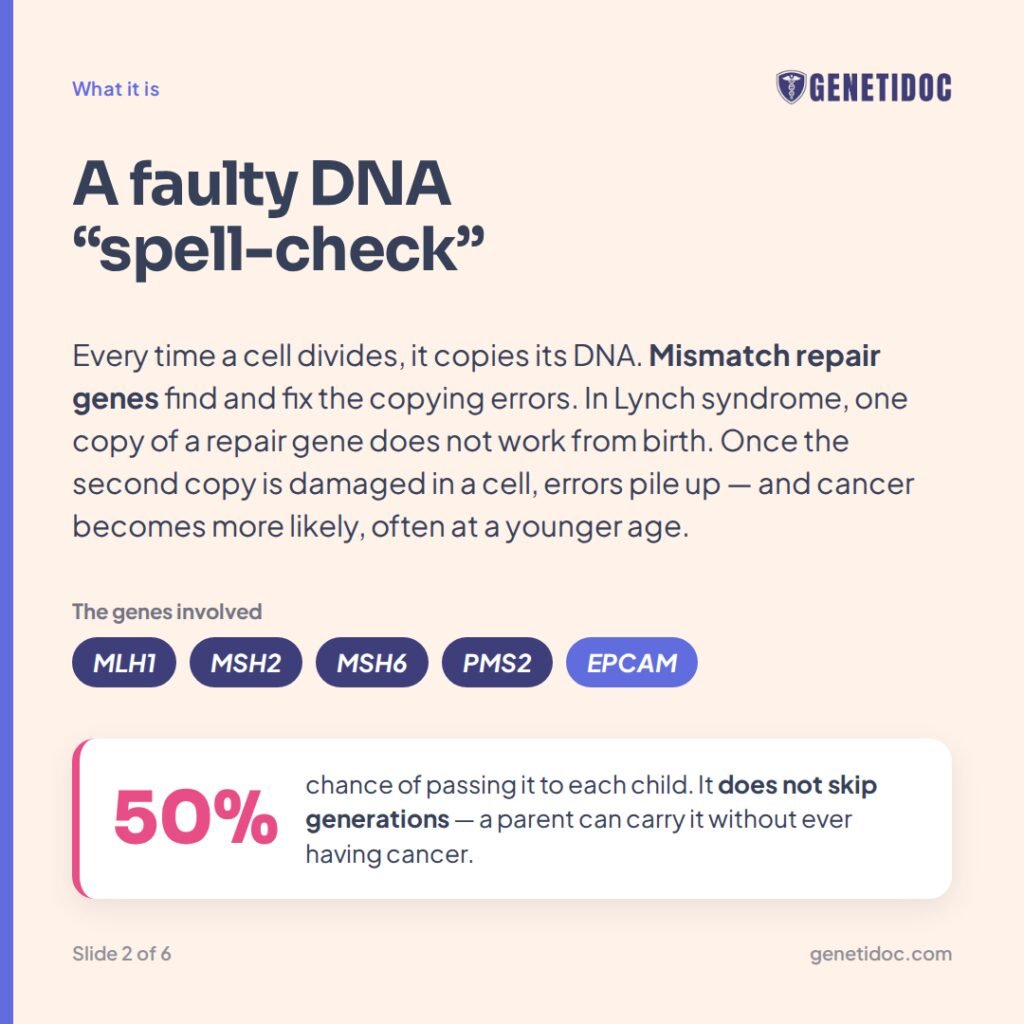
Every time a cell in your body divides, it copies its DNA — billions of letters of genetic code. Small copying errors are normal. Your cells have a built-in “spell-check” system, called the mismatch repair system, that finds and fixes these errors before they cause harm.
In Lynch syndrome, one copy of a mismatch repair gene does not work properly from birth. The body can still manage with the second, working copy — until, over the years, that copy also gets damaged in a particular cell. From that point, errors in that cell pile up unchecked, and cancer becomes much more likely to develop, often at a younger age than usual.
A few key facts:
- The genes involved: MLH1, MSH2, MSH6, and PMS2, plus EPCAM, a neighboring gene that can switch off MSH2.
- How common it is: Estimated at roughly 1 in 300 people worldwide. Most carriers do not know they have it.
- Its share of colorectal cancer: About 3 percent of all colorectal cancers are caused by Lynch syndrome — the single most common inherited cause.
- Its older name: Hereditary nonpolyposis colorectal cancer. “Nonpolyposis” means people with Lynch syndrome usually have only a few polyps, not the hundreds seen in some other inherited bowel conditions.
- How it is inherited: Autosomal dominant — a single changed copy from either parent is enough. Each child of a carrier has a 50 percent chance of inheriting it. It does not skip generations, although it can look that way if a carrier never develops cancer.
Which Cancers Are Linked to Lynch Syndrome?
Lynch syndrome is often thought of as a “colon cancer condition,” but it affects several organs. The main cancers linked to it are:
- Colorectal cancer — the most common, often on the right side of the colon
- Endometrial (uterine) cancer — for women with Lynch syndrome, this risk can be as high as, or higher than, the colorectal cancer risk
- Ovarian cancer
- Stomach and small bowel cancer
- Urinary tract cancer — particularly of the ureter and the part of the kidney that collects urine
- Less commonly: pancreatic, bile duct, brain, and certain skin (sebaceous) tumors
This matters when your doctor looks at your family tree. A grandmother with uterine cancer at 45, an uncle with colon cancer at 48, and a cousin with stomach cancer may look like three unrelated illnesses. To a clinical geneticist, they may be one pattern.
Warning Signs: When Should Lynch Syndrome Be Considered?
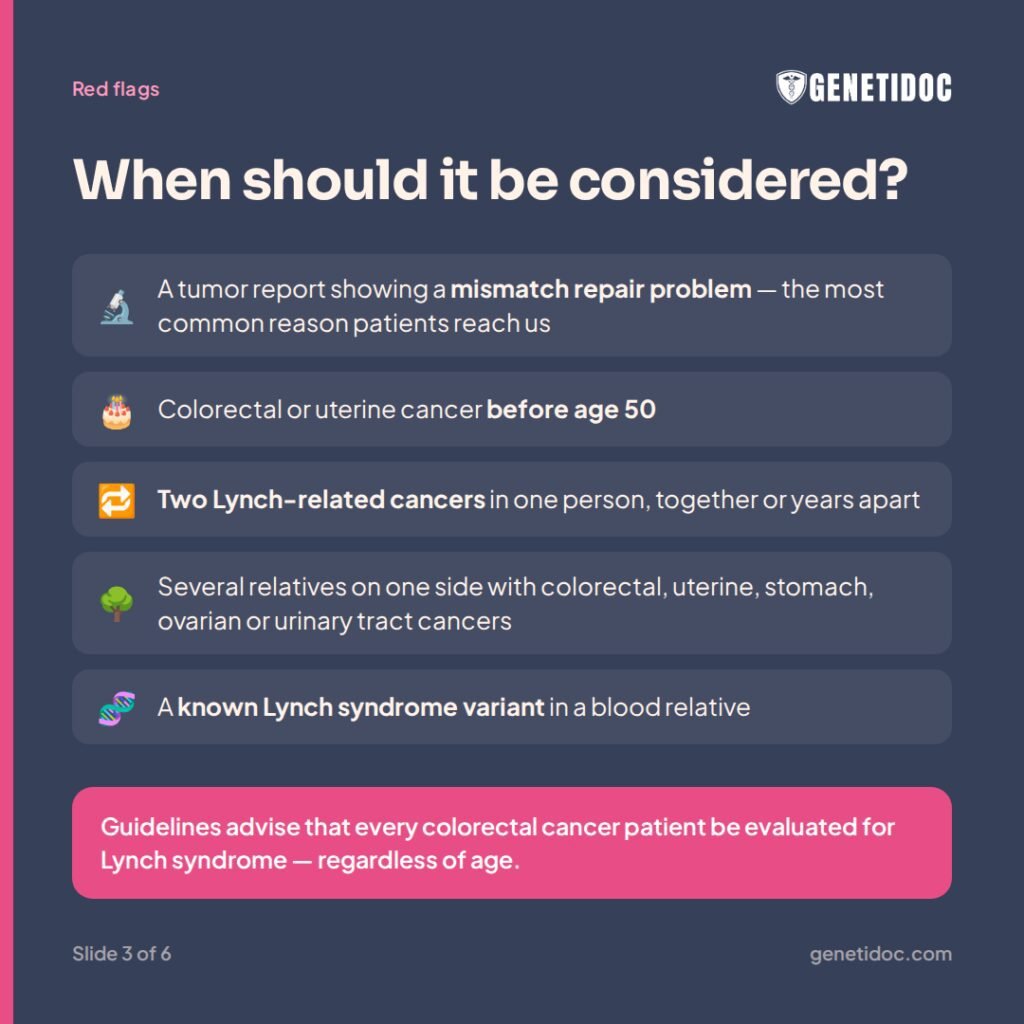
Lynch syndrome should be considered when any of the following apply:
- A colorectal or endometrial cancer shows a mismatch repair problem on tumor testing — either missing repair proteins or microsatellite instability (both explained below). This is the most common reason patients reach us.
- Colorectal cancer diagnosed under the age of 50, and especially in the 30s or around 40.
- Endometrial cancer diagnosed at a younger age than usual, especially before 50.
- One person with two Lynch-related cancers, at the same time or years apart — for example, colorectal and endometrial cancer.
- A family pattern — several relatives on the same side of the family with colorectal, endometrial, stomach, ovarian, or urinary tract cancers, particularly across more than one generation.
- A known Lynch syndrome variant in a blood relative.
| “We follow National Comprehensive Cancer Network (NCCN) guidelines for hereditary cancer syndromes,” explains Team Genetidoc. “Under those guidelines, every patient with colorectal cancer should be evaluated for Lynch syndrome, regardless of age. A young age at diagnosis — under 50 — or a family history of Lynch-related cancers makes us suspect it even more strongly. But in practice, the most common trigger we see is a tumor report showing microsatellite instability or missing mismatch repair proteins.” |
Age is a useful red flag, but it should not be the only one. A 62-year-old whose tumor shows a clear mismatch repair problem still deserves proper evaluation.
Tumor Testing vs. Blood Testing: The Most Common Source of Confusion
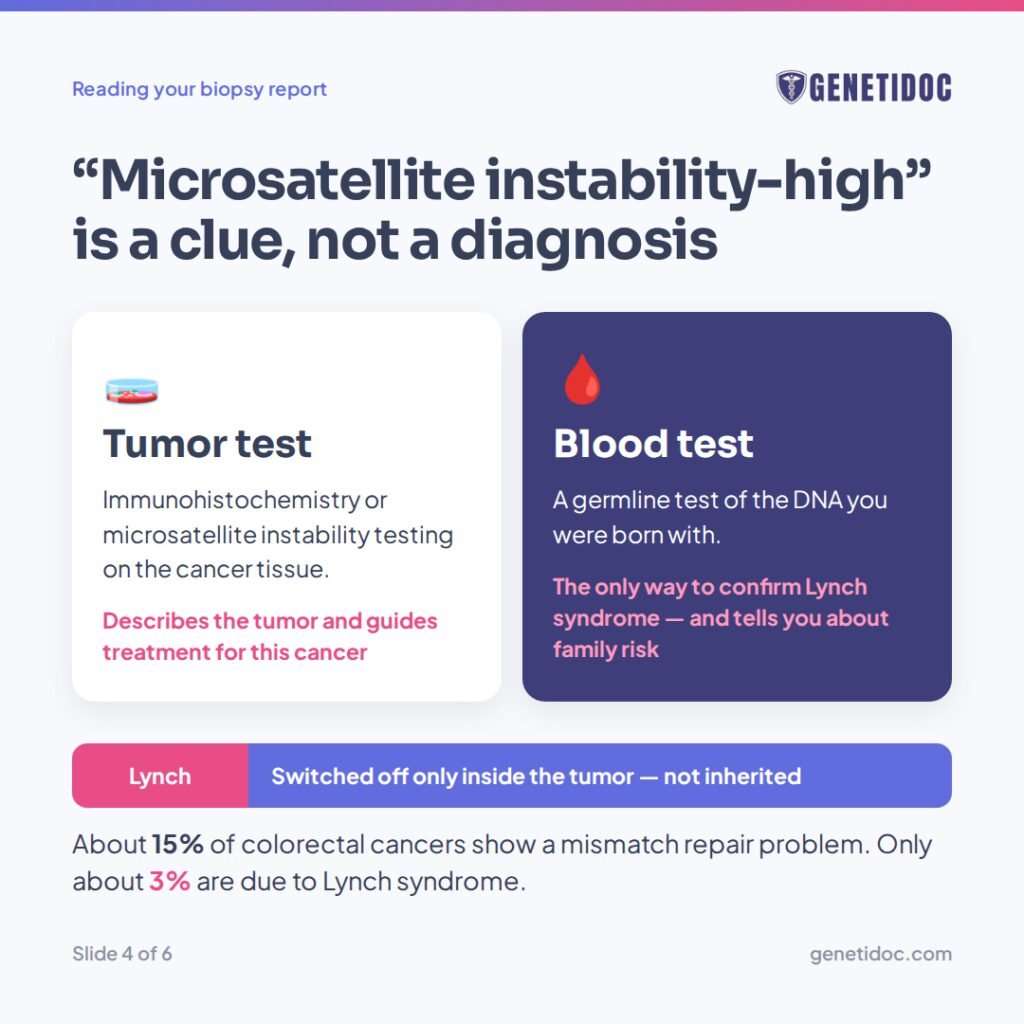
This is the part most patients find confusing, so it helps to separate two very different kinds of test.
Step 1: Tests on the tumor tissue
After a biopsy or surgery, many hospitals in India now test the tumor tissue itself for signs that the mismatch repair system has failed. There are two common methods:
- Immunohistochemistry (IHC): A staining test that checks whether the four mismatch repair proteins — MLH1, MSH2, MSH6, and PMS2 — are present in the tumor cells. If one or two are missing, the report may say something like “loss of MSH2 and MSH6 expression.” The pattern of missing proteins also hints at which gene may be involved.
- Microsatellite instability (MSI) testing: Microsatellites are short, repeated stretches of DNA that are easily miscopied. When the repair system fails, these stretches change length. A tumor with many such changes is called “MSI-high.”
Many hospitals run IHC first and add MSI testing when needed. Together, these tests tell your oncologist that the tumor has a mismatch repair problem, often described as “mismatch repair-deficient.”
Why a tumor result is not the same as Lynch syndrome
Here is the key point: a mismatch repair problem in the tumor does not automatically mean you inherited Lynch syndrome.
Published studies show that roughly 15 percent of colorectal cancers are mismatch repair-deficient, but only about 3 percent are due to Lynch syndrome. In most of the rest, the repair gene was switched off only inside the tumor, during the person’s lifetime — it was never in the rest of their body and cannot be passed on.
The most common example is MLH1 promoter methylation. Think of it as a chemical “off switch” placed on the MLH1 gene inside the tumor cells only. It is especially common in older patients and is often seen together with a change in a gene called BRAF in the tumor. When the tumor shows missing MLH1 protein, laboratories often check for these two findings to tell an acquired problem apart from an inherited one.
| “Most patients who are referred to us have not been told what ‘MSI-high’ actually means,” says Team Genetidoc. “They have usually just been told their cancer might have a genetic cause. So we start by explaining that this result came from testing the cancer tissue removed at biopsy — it describes the tumor, not necessarily the person. Whether it was inherited is a separate question, and that is what the blood test answers.” |
Step 2: The germline blood test
The only way to confirm Lynch syndrome is a germline test — a test on a blood or saliva sample that looks at the DNA you were born with, present in every cell of your body. If a disease-causing (pathogenic) variant is found in a mismatch repair gene, the diagnosis is confirmed, and your blood relatives can then be offered testing for that same variant.
The tumor test and the blood test do different jobs. The tumor test guides treatment decisions for this cancer. The blood test tells you about your future cancer risk and your family’s risk.
What If the Tumor Is Mismatch Repair-Deficient but the Blood Test Is Negative?
This situation is more common than patients expect. The next step depends on whether the tumor finding can be explained.
- If the tumor finding is explained — for example, by MLH1 promoter methylation, or by further tumor sequencing showing that both copies of a repair gene were damaged only within the tumor — then the cancer is considered sporadic (not inherited). An inherited cause is unlikely, and relatives can generally follow the screening recommended for the general population, based on age and family history.
- If the tumor finding remains unexplained, doctors sometimes call this “Lynch-like syndrome.” An inherited cause cannot be fully ruled out, because current tests do not catch every possible genetic change. In this case, the patient and their close relatives are usually offered closer surveillance — often similar to Lynch syndrome screening — tailored to the family history.
| “A negative germline result after an abnormal tumor test lowers the chance of a hereditary cause,” explains Team Genetidoc. “But what we recommend next depends on why the tumor looked the way it did. If there is a clear explanation within the tumor, general population screening is appropriate. If there isn’t, we don’t simply close the file — the patient and family are guided towards closer follow-up.” |
As with any genetic test, a negative result means “no disease-causing variant was found in the genes tested.” It does not mean a person will never develop cancer.
Which Genetic Test Is Usually Ordered?
You might expect a patient with suspected Lynch syndrome to be tested only for the five Lynch genes. In practice, a broader test is often more useful.
| “Colorectal cancer is not caused by Lynch syndrome alone,” says Team Genetidoc. “Other genes, including those behind polyposis conditions, can also be responsible. So we usually order a hereditary cancer panel that covers all the genes associated with cancer syndromes. The same applies when a patient presents with endometrial or breast cancer — it isn’t automatically Lynch syndrome or hereditary breast and ovarian cancer, and a broader panel helps us avoid missing the real cause.” |
How long does it take, and what does it cost?
- Hereditary cancer panel: Results usually take about three weeks, and at most four weeks.
- Targeted testing for relatives (for one known family variant): usually about one week, and considerably less expensive than a full panel.
- Cost: Varies with the number of genes tested and the laboratory. Your genetic counselor can explain the options that fit your situation before any sample is taken.
Why the Indian context matters
A 2026 study from a tertiary cancer center in North India looked at 136 people evaluated for Lynch syndrome and confirmed the diagnosis in 53. Colorectal cancer made up about 72 percent of confirmed cases and endometrial cancer about 28 percent. MLH1 was the most frequently affected gene in that cohort, and a single recurring MLH1 variant accounted for nearly a quarter of cases — found only in families of Punjabi ancestry.
Findings like this are a reminder that genetic patterns differ between communities. Many low-cost direct-to-consumer DNA kits only look at a limited set of well-known variants, mostly studied in European populations. They are not designed to pick up community-specific Indian variants, and a “normal” result from such a kit should never be taken as ruling out Lynch syndrome. A proper diagnostic panel, which reads through the full genes, is the right test.
Does It Matter Which Gene Is Involved?
Yes — quite a lot. Lynch syndrome is not one uniform risk. The gene involved changes the size of the risk, the age at which cancers tend to appear, and when screening should begin.
| Gene | Colorectal cancer risk | Endometrial cancer risk | Colonoscopy usually starts |
| MLH1 | Highest | High | Age 20–25 |
| MSH2 / EPCAM | High | High | Age 20–25 |
| MSH6 | Moderate | High (often the main risk for women) | Age 30–35 |
| PMS2 | Lower | Moderate | Age 30–35 |
Based on NCCN guidelines and GeneReviews. Colonoscopy may start earlier if a relative was diagnosed at a young age. Exact percentages vary widely between studies, which is why we describe risk in ranges rather than single numbers.
Online articles often quote the highest risk figures, which come from MLH1 and MSH2 families. A person with a PMS2 variant reading those numbers can end up far more frightened than their real risk justifies.
| “In our own practice, MSH2 is the gene we see most often,” notes Team Genetidoc. “But we never hand out a single number. We explain risk based on the specific gene, the specific variant, and that person’s own personal and family history — because two carriers of Lynch syndrome can have very different risks.” |
How a Lynch Syndrome Diagnosis Changes Care for Someone With Cancer
For a patient already diagnosed with colorectal or endometrial cancer, confirming Lynch syndrome can influence care in several ways:
- Immunotherapy options: Tumors with a mismatch repair problem carry many DNA errors, which makes them easier for the immune system to recognize. Immunotherapy drugs called checkpoint inhibitors can work especially well against these tumors, particularly in advanced disease. Eligibility is based on the tumor test result, whether the cause is inherited or not.
- Extent of surgery: When Lynch syndrome is known before surgery, the surgeon may discuss removing a larger part of the colon in some patients, to lower the chance of a second colorectal cancer later. This is a personal decision, weighed against quality of life.
- Long-term surveillance: Survivors remain at risk of new cancers — in the remaining bowel, the uterus, and elsewhere — so their follow-up plan changes for life.
- Protecting the family: The diagnosis allows relatives to be tested and, if needed, screened early.
| “By the time most patients come to us for genetic testing, they have usually already had a colectomy,” says Team Genetidoc. “Management from that point follows NCCN guidelines — including targeted treatment where the tumor qualifies, and a surveillance plan for the future. But it shows why earlier referral is valuable: the sooner Lynch syndrome is identified, the more decisions it can inform.” |
Screening Plan for People With Lynch Syndrome
For carriers who do not have cancer, the goal of screening is simple: find cancer early, or remove precancerous growths before they ever become cancer. A typical plan, based on NCCN guidelines and adjusted to each person’s gene and family history, includes:
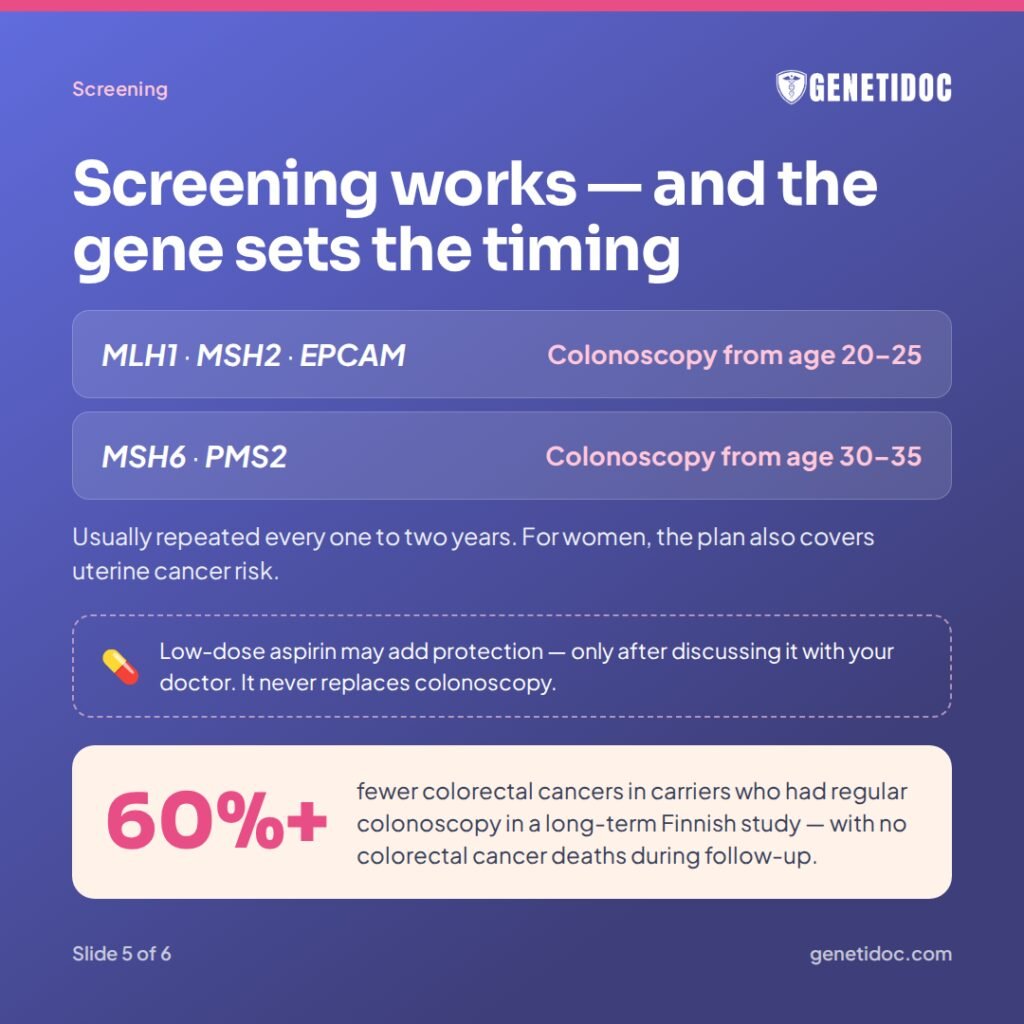
- Colonoscopy every one to two years, starting at age 20–25 for MLH1 and MSH2, and 30–35 for MSH6 and PMS2 (sometimes at slightly longer intervals for lower-risk genes). This is the most important part of the plan.
- For women — awareness of uterine cancer symptoms: Any unusual vaginal bleeding, bleeding between periods, or bleeding after menopause should be checked promptly. Some women also choose periodic endometrial sampling.
- For women — risk-reducing surgery: Removing the uterus, and often the ovaries and fallopian tubes, once a woman has completed her family (typically in her 40s) is an option that sharply reduces endometrial and ovarian cancer risk. This is a personal decision made with a gynecologic specialist, not an automatic step.
- Upper endoscopy (a camera test of the food pipe, stomach, and first part of the small bowel), considered every few years from around age 30–40, along with a one-time test for Helicobacter pylori, a stomach infection that is common in India and raises stomach cancer risk.
- Other checks, such as urine tests for urinary tract cancer, may be considered depending on the gene and family history.
Screening works. In a well-known long-term study from Finland, family members with Lynch syndrome who had regular colonoscopy had more than 60 percent fewer colorectal cancers than those who did not, and no deaths from colorectal cancer during follow-up. Polyps found during colonoscopy can usually be removed on the spot, before they turn into cancer.
Can Aspirin Help Prevent Cancer in Lynch Syndrome?
This is one of the most frequent questions patients ask, and the evidence is encouraging.
- The CAPP2 trial followed people with Lynch syndrome for more than ten years and found that those who took daily aspirin for at least two years had significantly fewer colorectal cancers in the long run.
- The CaPP3 trial, reported in 2025, compared different doses and found that a low daily dose (75–100 mg) was as effective as higher doses, with fewer side effects.
| “We do discuss aspirin with Lynch syndrome carriers for cancer prevention,” says Team Genetidoc. “The evidence shows that the risk of Lynch-related colorectal cancer is lower in people who take aspirin. But it is a conversation, not a blanket prescription — it has to suit the individual.” |
Aspirin is not right for everyone. It can cause stomach bleeding and interacts with other medicines. Please do not start aspirin on your own. Discuss it with your doctor, who will weigh your bleeding risk, other health conditions, and medications. Aspirin also does not replace colonoscopy — it is an addition to screening, never a substitute.
“I’m Scared of Colonoscopy”: Practical Reassurance
Colonoscopy is widely available at hospitals and endoscopy centers across India. The real barrier is usually fear — of pain, embarrassment, or the preparation.
| “Fear of the procedure is a real reason patients delay their colonoscopy,” acknowledges Team Genetidoc. “We spend time explaining why it matters for them specifically, because for someone with Lynch syndrome, this one test is the most powerful protection they have.” |
A few things that help:
- Ask about sedation. Most centers offer sedation, so many patients remember little or nothing of the procedure.
- Take the bowel preparation seriously. A clean bowel lets the doctor see small, flat polyps, which are common in Lynch syndrome. Follow the diet instructions (usually clear liquids the day before) and take the prep solution exactly as advised — often split between the evening before and the morning of the test.
- Tell the center you have Lynch syndrome. An experienced endoscopist will take extra care to examine the right side of the colon, where Lynch-related cancers often start.
- Keep your schedule. Regular timing matters more than any single test. Set reminders, and keep your reports together so each doctor can see your history.
What Lynch Syndrome Means for Your Family
Once a Lynch syndrome variant is confirmed in one person, it becomes a precise target that relatives can be tested for directly.
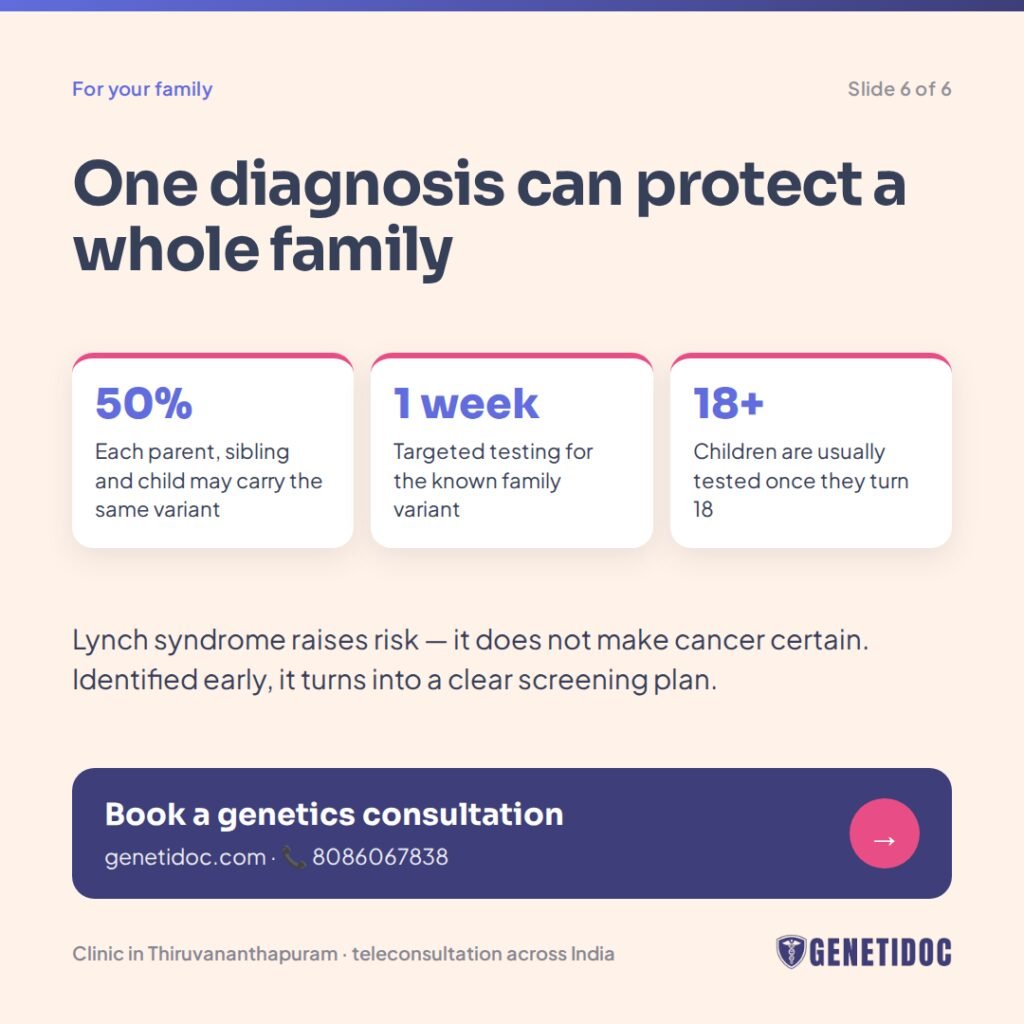
- Parents, brothers, sisters, and children each have a 50 percent chance of carrying the same variant.
- Relatives are usually offered targeted testing for that single known variant, which usually takes about a week and is simpler than a full panel.
- Children are generally tested once they turn 18. Lynch syndrome cancers are very rare in childhood, and screening does not begin until the early 20s at the earliest, so testing can wait until the young person can make the decision for themselves.
- Relatives who test positive begin the screening plan above, at the age suited to their gene.
- Relatives who test negative do not carry the family’s increased risk and can generally follow general population screening.
| “When a parent tests positive for Lynch syndrome, their children can have targeted testing for that same variant,” explains Team Genetidoc. “If they test positive, they follow the recommended screening guidelines and keep a close watch, so that if a cancer does develop, it is detected early — when it is most treatable.” |
Women in the family deserve special attention. Families often focus only on colon cancer and do not realize that a sister or daughter with Lynch syndrome may face an even higher risk of uterine cancer. Her screening plan should include this from the start.
For a detailed guide on how family testing works step by step — including how to talk to relatives — see our article on cascade testing after a positive hereditary cancer result.
A note for families where parents are related
Marriages between relatives are common in some Indian communities. In rare cases, a child can inherit a Lynch syndrome variant from both parents. This causes a different and much more serious condition called constitutional mismatch repair deficiency, in which cancers — often of the brain, blood, or bowel — can begin in childhood. Children with this condition may also have light-brown skin patches (café-au-lait spots). If both partners come from a family with Lynch syndrome, or are related to each other and there is a family history of these cancers, genetic counseling before pregnancy is strongly recommended.
Lynch Syndrome vs. Other Inherited Bowel Cancer Conditions
Lynch syndrome is the most common inherited cause of colorectal cancer, but not the only one. The number of polyps found on colonoscopy is one of the most useful clues:
- Lynch syndrome: Usually only a few polyps. Cancer can develop relatively quickly from a single polyp, which is why colonoscopy is needed more often.
- Familial adenomatous polyposis (APC gene): Hundreds to thousands of polyps, often starting in the teenage years. Screening begins in childhood.
- MUTYH-associated polyposis: Usually tens to a few hundred polyps. Unlike Lynch syndrome, a person must inherit a changed copy from both parents to be affected.
- Rarer conditions, such as Peutz-Jeghers syndrome and juvenile polyposis syndrome, have their own distinct polyp types.
Because these conditions can overlap in how they first appear, a broad hereditary cancer panel is often the most efficient way to find the right answer the first time.
Common Misconceptions About Lynch Syndrome
- “I tested positive, so I will definitely get cancer.” This is one of the most common fears we hear. Lynch syndrome raises your risk; it does not make cancer certain. Many carriers never develop cancer, and regular screening can prevent many cancers or catch them at a very treatable stage.
- “My surgery cured it.” Surgery treats the cancer that was found. It does not change the genetic variant, which is in every cell of the body. Survivors still need lifelong screening, and their relatives still need to know.
- “Colon cancer isn’t hereditary.” Most colon cancer isn’t — but a meaningful minority is, and Lynch syndrome is the most common reason.
- “It skipped my generation, so I’m safe.” Lynch syndrome does not skip generations. A parent can carry it without ever developing cancer and still pass it on.
- “MSI-high means I have Lynch syndrome.” Not necessarily. Only a blood test can confirm it.
- “It only matters for colon cancer.” For many women with Lynch syndrome, uterine cancer is an equal or greater risk.
Awareness of Lynch syndrome is still low in India, though it is growing steadily. Many families are hearing the name for the first time — which is exactly why clear, accurate information matters.
When Is Testing Not the Right First Step?
Genetic testing is powerful, but it is not always the right starting point:
- A healthy person with no personal or family history of Lynch-related cancers does not usually need Lynch syndrome testing. Age-appropriate general screening is more useful.
- A healthy relative in a family where no variant has yet been found will usually get the most useful answer if an affected family member is tested first. A negative result in an unaffected relative, without a known family variant, is hard to interpret.
- An older patient whose tumor shows MLH1 methylation is much more likely to have a sporadic cancer, and the genetic team will weigh this before recommending germline testing.
A consultation with a clinical geneticist or genetic counselor helps decide who should be tested, which test to use, and in what order.
Why Expert Interpretation Matters
A Lynch syndrome result touches treatment, lifelong screening, family planning, and the health of relatives who may not even know they are at risk. Getting it right depends on more than generating a report:
- The right test — a diagnostic panel that reads through the full genes, not a limited kit.
- The right laboratory — accredited, with careful variant classification.
- The right interpretation — connecting the tumor findings, the blood result, and the family history into one clear plan.
- Genetic counseling — so that the patient understands their result, and their family has a real path to testing.
If you have questions about Lynch syndrome in your family, you can post them on the Lynch Syndrome forum on the Genetidoc Rare Disease Forum, where responses are reviewed by genetic counselors and consultants.
Frequently Asked Questions
Don’t see your question below? Ask it on the Frequently Asked Questions forum on the Genetidoc Rare Disease Forum.
What is Lynch syndrome?
Lynch syndrome is an inherited condition caused by a change in a DNA repair gene (MLH1, MSH2, MSH6, PMS2, or EPCAM). It raises the lifetime risk of colorectal, endometrial, and several other cancers, often at a younger age.
Is colon cancer hereditary?
Most colon cancer is not inherited. About 3 percent of colorectal cancers are caused by Lynch syndrome, and a smaller number by other inherited conditions such as familial adenomatous polyposis.
What are the symptoms of Lynch syndrome?
Lynch syndrome itself causes no symptoms. The warning signs are in the medical and family history: colorectal or endometrial cancer before 50, a tumor showing a mismatch repair problem, more than one Lynch-related cancer in one person, or several relatives with these cancers.
Does MSI-high mean I have Lynch syndrome?
Not necessarily. MSI-high describes the tumor. Many MSI-high tumors are not inherited — often because the MLH1 gene was switched off only within the tumor. Only a germline blood test can confirm Lynch syndrome.
How is Lynch syndrome diagnosed?
Usually in two steps: tumor tissue testing (immunohistochemistry and/or microsatellite instability testing) that suggests a mismatch repair problem, followed by a germline blood test that confirms an inherited variant.
How long does Lynch syndrome testing take?
A hereditary cancer panel usually takes about three weeks, and at most four. Targeted testing of relatives for a known family variant usually takes about one week.
How often should someone with Lynch syndrome have a colonoscopy?
Usually every one to two years, starting at age 20–25 for MLH1 and MSH2 carriers and 30–35 for MSH6 and PMS2 carriers. Your doctor will tailor this to your gene and family history.
Does Lynch syndrome skip generations?
No. Each child of a carrier has a 50 percent chance of inheriting it. It can appear to skip a generation when a carrier never develops cancer.
Should women with Lynch syndrome worry about uterine cancer?
Yes, it should be part of their plan. Endometrial cancer risk is high for women with Lynch syndrome. Prompt checking of abnormal bleeding, and the option of risk-reducing surgery after completing a family, are discussed with a specialist.
Should people with Lynch syndrome take aspirin?
Clinical trials show daily aspirin lowers colorectal cancer risk in Lynch syndrome, and a low dose appears to work as well as higher doses. It is not right for everyone because of bleeding risk, so only start it after discussing it with your doctor.
When should my children be tested for Lynch syndrome?
Usually after age 18, since Lynch-related cancers are very rare in childhood and screening begins in the early 20s at the earliest. They are tested only for the known family variant.
Can a DNA kit bought online detect Lynch syndrome?
Not reliably. Most consumer kits check only a small set of known variants, largely studied in European populations. A diagnostic hereditary cancer panel that reads through the full genes, with genetic counseling, is the appropriate test.
Key Takeaways
- Lynch syndrome is the most common inherited cause of colorectal cancer, and also raises the risk of endometrial and other cancers
- Every colorectal cancer patient should be evaluated for it, regardless of age; diagnosis under 50 or a family pattern raises suspicion further
- A tumor result such as “MSI-high” is a clue, not a diagnosis — only a germline blood test confirms Lynch syndrome
- The specific gene changes the level of risk and when screening should start
- Regular colonoscopy is highly effective, and aspirin may add protection after discussion with your doctor
- Each close relative has a 50 percent chance of carrying the variant, and targeted testing gives them a clear answer
| Has your biopsy report mentioned MSI-high or missing mismatch repair proteins — or has colorectal or uterine cancer appeared early in your family? Speak with a clinical geneticist to find out whether Lynch syndrome is the cause, and what it means for you and your relatives.
Book a Lynch Syndrome Genetic Consultation
|
References
- Idos G, Valle L. Lynch Syndrome. GeneReviews. University of Washington, Seattle. nlm.nih.gov/books/NBK1211
- National Comprehensive Cancer Network Guidelines — Genetic/Familial High-Risk Assessment: Colorectal, Endometrial, and Gastric. org/guidelines
- Diwan H, Mehta A, Sharma S, Mattoo S, Agnihotri S. Integrated tumor and germline profiling of Lynch syndrome in a North Indian cohort. Frontiers in Oncology. 2026;16:1804614. org
- Burn J, et al. Cancer prevention with aspirin in hereditary colorectal cancer (Lynch syndrome), 10-year follow-up and registry-based 20-year data in the CAPP2 study. The Lancet. 2020;395:1855–1863. com
- Aspirin for cancer prevention in individuals with Lynch syndrome: first results from the CaPP3 multicentre, randomised, double-blind, non-inferiority trial. The Lancet Gastroenterology & Hepatology. com
- Järvinen HJ, et al. Controlled 15-year trial on screening for colorectal cancer in families with hereditary nonpolyposis colorectal cancer. Gastroenterology. 2000;118(5):829–834.
- André T, et al. Pembrolizumab in microsatellite-instability–high advanced colorectal cancer. New England Journal of Medicine. 2020;383:2207–2218.
- Win AK, et al. Prevalence and penetrance of major genes and polygenes for colorectal cancer. Cancer Epidemiology, Biomarkers & Prevention. 2017;26(3):404–412.
- Centers for Disease Control and Prevention — Managing Risk for Cancers Related to Lynch Syndrome. gov
Related Reading on Genetidoc
- BRCA and Beyond: What a “Positive” Hereditary Cancer Result Actually Means for Your Family
- Down Syndrome Screening in Pregnancy: How to Choose Between the First-Trimester Combined Test, Quad Screen, and Non-Invasive Prenatal Testing (NIPT)
- Family History of a Genetic Condition? Here’s What to Ask Before You Conceive
- What Does “Variant of Uncertain Significance” Mean — And Why It’s Not a Diagnosis
- Lynch Syndrome Forum
- Hereditary Cancer Syndrome Forum
- Cascade Testing Forum