

You have done every test. Her hormones are normal. Her tubes are open. His semen analysis is normal. The scan looks fine. And yet, month after month, there is no pregnancy. Then the doctor uses a phrase that feels both reassuring and frustrating: unexplained infertility.
Many couples in this situation start searching for answers online, and sooner or later they ask the same question: could it be genetic?
Sometimes, yes. But not always, and not for every couple. This guide explains, in plain language, what genetic testing can and cannot find in unexplained infertility, which tests are worth discussing, which ones usually add little, and what a result actually changes. It draws on international guidelines, published research and the clinical experience of Team Genetidoc.
Quick answer:
- Unexplained infertility means a couple has not conceived even though the standard tests for both partners are normal.
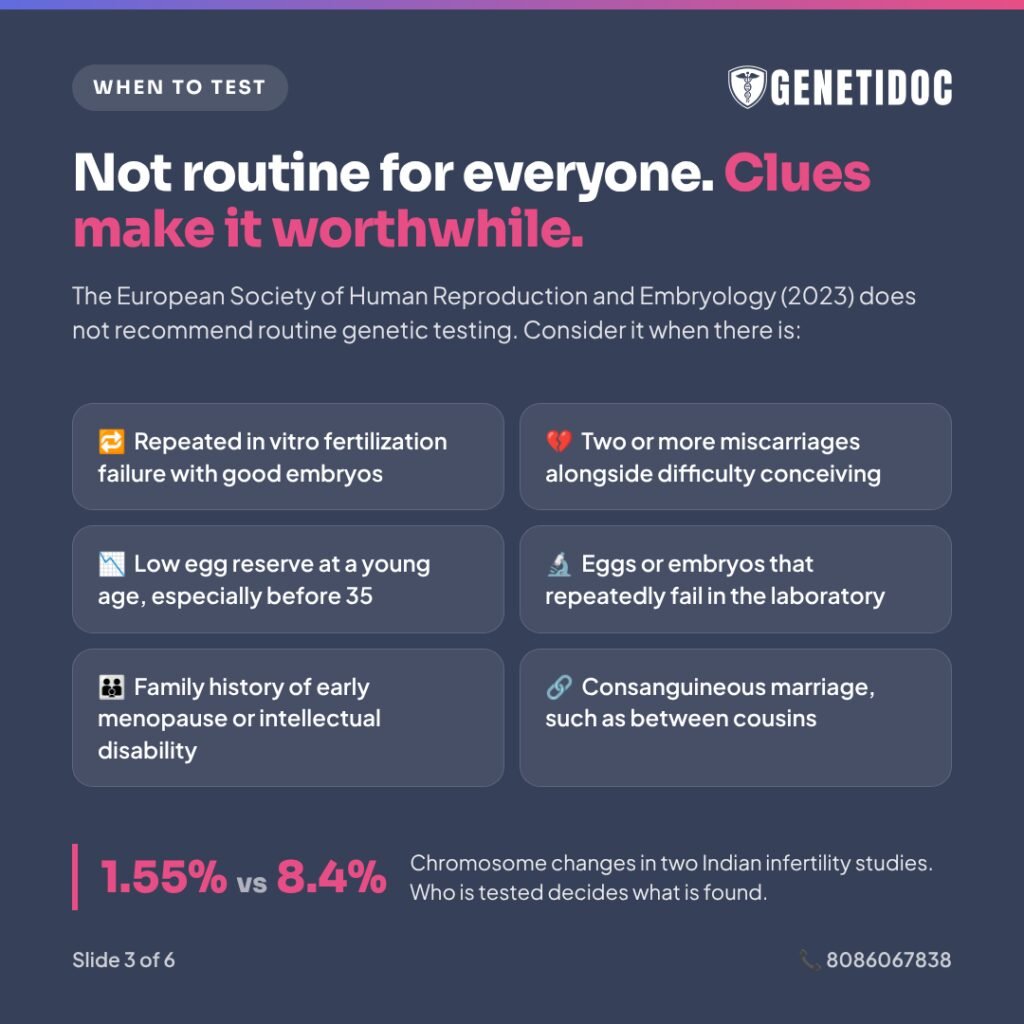
- Genetic testing is not routinely recommended for every couple with unexplained infertility. The European Society of Human Reproduction and Embryology (ESHRE) 2023 guideline lists it among tests not done routinely.
- It is worth considering when there are specific clues: failed in vitro fertilization (IVF) cycles, miscarriages, low egg reserve at a young age, eggs or embryos that repeatedly fail to develop, a family history of early menopause or intellectual disability, or a consanguineous marriage.
- The most useful tests in these situations are a karyotype of both partners, FMR1 (fragile X) testing for some women, and, in rare cases, a targeted gene panel.
What Does “Unexplained Infertility” Really Mean?
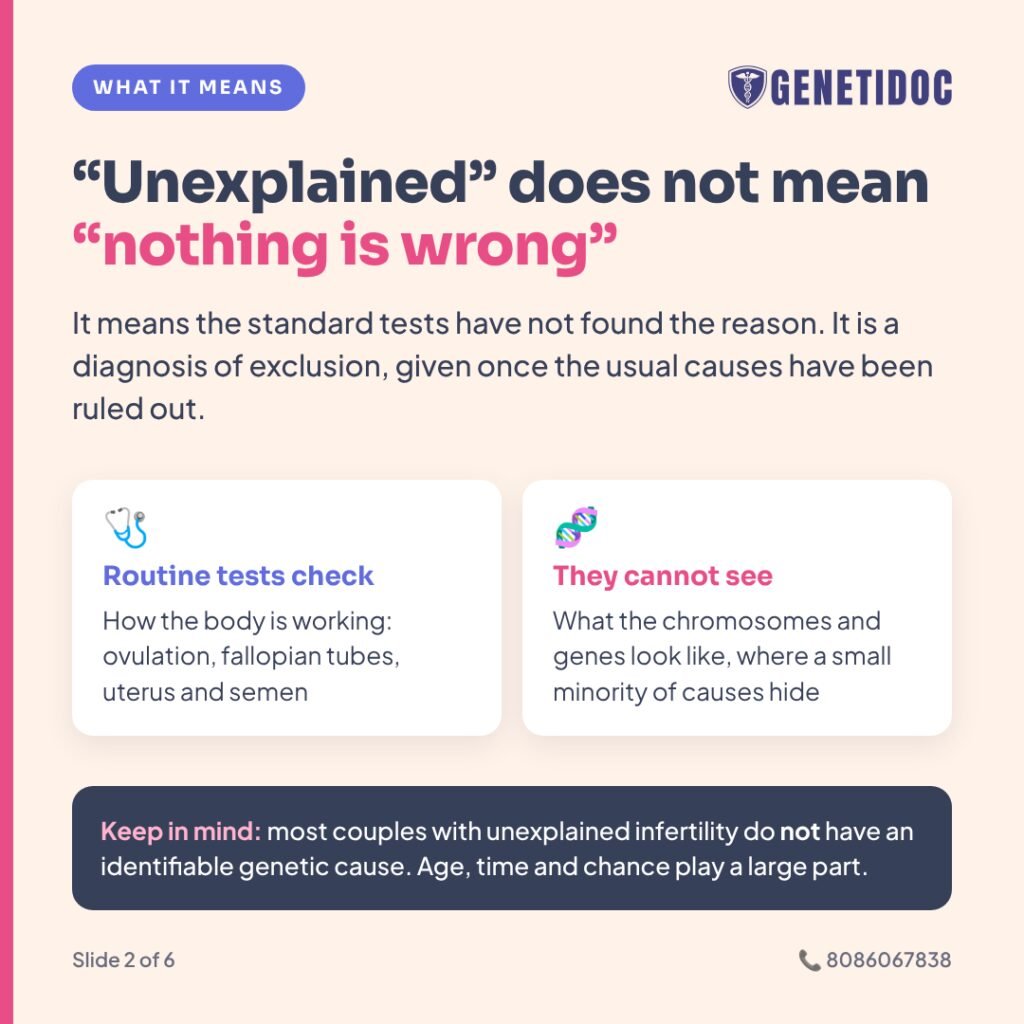
Infertility is usually defined as not conceiving after one year of regular, unprotected intercourse. When a couple is evaluated, doctors check the most common causes: ovulation, the fallopian tubes, the uterus and the semen.
The ESHRE guideline defines unexplained infertility as infertility in a couple where the woman is under 40, has normal ovarian function, normal fallopian tubes, uterus, cervix and pelvis, and the man has a normal semen analysis by World Health Organization criteria. In other words, it is a diagnosis of exclusion: it is given when the usual causes have been ruled out.
That word “unexplained” is important. It does not mean “nothing is wrong.” It means “our standard tests have not found the reason.” Some couples will conceive naturally with time. Others have a cause that standard tests simply are not designed to see.
“Most couples reach us after trying to conceive for a year or more, often with a file full of normal reports,” says Team Genetidoc. “They come with one concern: having a child. Our job is to work out whether there is a genetic reason worth looking for, and if there is, what finding it would change for them.”
Can Unexplained Infertility Be Genetic?
It can be, in a minority of couples. Genetic causes can hide behind normal reports because routine fertility tests check how the body is working, not what the chromosomes or genes look like. The main genetic factors that can sit behind “normal” results are:
- Balanced chromosome rearrangements. A person can carry chromosomes that have swapped or flipped pieces, called a balanced translocation or an inversion. They are completely healthy, and their hormone and semen tests can be normal. But their eggs or sperm may carry an unbalanced set of chromosomes, which can lead to failed implantation or early miscarriage.
- Sex chromosome mosaicism. Mosaicism means a mix of cells with different chromosome patterns in one body. For example, a small proportion of a woman’s cells may be missing one X chromosome.
- The FMR1 This is a change in the gene linked to fragile X syndrome. In women, it can reduce the egg reserve earlier than expected.
- Single-gene causes of egg, fertilization or embryo failure. These are rare. They usually show up only during IVF, when eggs repeatedly fail to mature, fail to fertilize, or embryos stop growing in the laboratory.
It is equally important to say what is not true. Most couples with unexplained infertility do not have an identifiable genetic cause. Age, time, chance and factors medicine cannot yet measure play a large part. Genetic testing is a tool for specific questions, not a routine next step for everyone.
What Do International Guidelines Say?
Patients are often surprised to learn this, so it is worth being clear. The ESHRE 2023 guideline on unexplained infertility, which makes 52 recommendations, lists genetic testing among the tests that are not routinely recommended for couples with unexplained infertility. The guideline also notes that doctors may still suggest such tests based on a couple’s symptoms or medical and family history.
The guideline also advises against several tests that are commonly sold to couples, including testing of common gene variants such as MTHFR and the follicle-stimulating hormone receptor. For men with a normal semen analysis, it found no added value in further tests such as sperm DNA fragmentation or sperm aneuploidy screening.
This does not mean genetics is irrelevant. It means testing should be targeted: chosen because of something specific in a couple’s story, not ordered as a large package “just in case.”
When Is Genetic Testing Worth Considering?
A genetics consultation is worth considering when unexplained infertility comes with any of the following clues:
- Repeated IVF failure. Good-quality embryos were transferred more than once, but none implanted.
- Miscarriages along with difficulty conceiving. Two or more pregnancy losses raise the chance of a parental chromosome rearrangement.
- Low egg reserve at a young age. A low anti-Müllerian hormone (AMH) level or a poor response to fertility medicines, especially before 35. AMH is a hormone made by the small follicles in the ovary, and its level gives a rough idea of how many eggs remain.
- Eggs or embryos that repeatedly fail in the IVF laboratory. Eggs that do not mature, eggs that do not fertilize even with intracytoplasmic sperm injection (ICSI), or embryos that stop growing after a few days.
- A family history of early menopause (before 40), intellectual disability or autism (which can point to fragile X), stillbirths, babies born with birth defects, or a known chromosome problem.
- A consanguineous marriage, meaning the partners are related by blood, such as cousins. This raises the chance that both carry the same rare recessive gene change.
- Before starting IVF, when a couple wants to understand whether embryo testing could be relevant to them.
If none of these apply, genetic testing is less likely to change your treatment plan. A clinical geneticist can help you decide either way.
The Genetic Tests Used in Unexplained Infertility
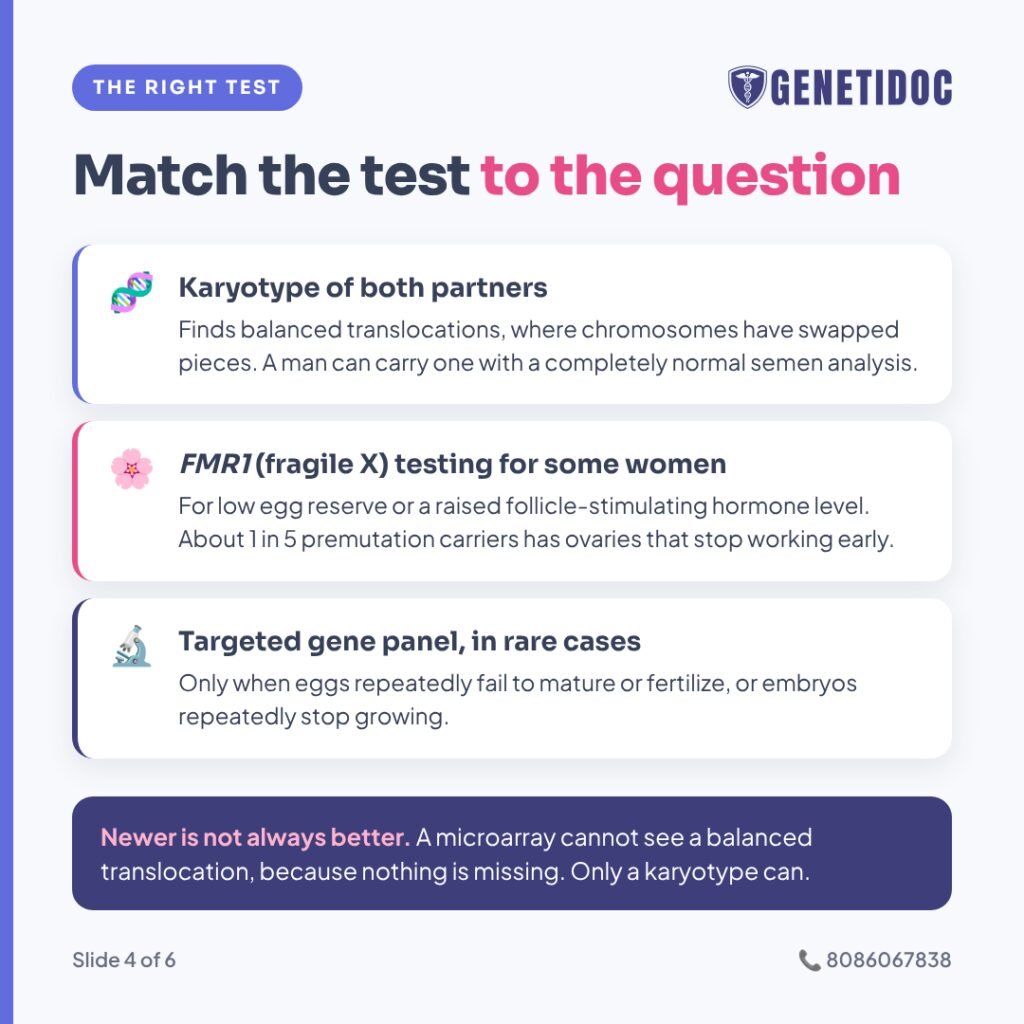
1. Karyotype for both partners
A karyotype is a picture of all your chromosomes, arranged in pairs and checked under a microscope. It needs a simple blood sample. The laboratory grows the blood cells first, so results usually take about three to four weeks.
A karyotype can show:
- Balanced translocations and inversions
- Extra or missing sex chromosomes, including mosaicism
- Other large structural changes
In couples with unexplained infertility, the karyotype is most useful after failed IVF cycles, with miscarriages, or before planning IVF. Both partners should be tested, because a rearrangement in either one can affect the embryo. A man with a balanced translocation can have a completely normal semen analysis.
Many couples assume a newer, “more advanced” DNA test would find more. For this question, that is not true. A chromosomal microarray, for example, measures how much genetic material is present. In a balanced translocation, nothing is missing or extra; pieces are simply in the wrong place. Only a karyotype, which looks at the arrangement of each chromosome, can see it.
“Newer is not always better in genetics. For couples with repeated failure, a good-quality karyotype of both partners often answers more than an expensive gene panel. The right test depends on the question you are asking.”
— Dr. Roshan Daniel, Clinical Geneticist, Genetidoc
2. FMR1 (fragile X premutation) testing for women
The FMR1 gene contains a short stretch of DNA that repeats. Most people have fewer than 45 repeats. Women with roughly 55 to 200 repeats carry what is called a premutation. They are usually healthy, but about one in five develops fragile X-associated primary ovarian insufficiency, meaning the ovaries stop working normally earlier than expected.
The American Society for Reproductive Medicine and the American College of Obstetricians and Gynecologists recommend FMR1 testing for women with ovarian insufficiency or a raised follicle-stimulating hormone (FSH) level. FSH is a brain hormone that rises when the ovaries are not responding well. Studies also suggest the premutation is more common in young women with a low egg reserve than in the general population, though the evidence here is less consistent.
Why this matters for a couple trying to conceive:
- If a woman carries the premutation, her egg reserve may fall faster. This can change how soon a couple should consider treatment, or whether egg freezing should be discussed.
- The baby. A premutation can expand to a full mutation when passed on, which causes fragile X syndrome, a common inherited cause of intellectual disability. Knowing this before pregnancy allows the couple to discuss preimplantation genetic testing (PGT) of embryos or prenatal testing.
- The family. Her sisters and other female relatives may want to be tested too.
Fragile X testing usually takes about 21 days.
3. Gene panels for egg, fertilization and embryo failure
A small group of couples discover, during IVF, a very specific and repeated problem:
- Oocyte maturation arrest: eggs are collected, but most or all remain immature.
- Fertilization failure: eggs do not fertilize, even when a sperm is injected directly into them through ICSI.
- Early embryonic arrest: embryos form, but all stop growing within the first few days.
When the same pattern repeats across cycles, a single-gene cause becomes possible. Research has identified several genes linked to these problems in women, including TUBB8, PATL2, WEE2, TLE6 and PADI6. In men, changes in genes such as PLCZ1 can stop sperm from activating the egg after fertilization, even when the semen analysis looks normal.
Many of these conditions follow a recessive pattern, meaning a person is affected only if they inherit a changed copy from both parents. This is why they are seen more often in consanguineous families.
An honest note: this is an evolving area. A positive result can explain years of failed cycles and help a couple decide whether to continue with their own eggs or sperm, or consider donor options. But many couples with these patterns will not have a cause found, and treatments specific to each gene are still limited. These tests belong only in this narrow group, chosen by a clinical geneticist. Gene panels usually take about three to four weeks; whole exome sequencing, when needed, can take one to two months.
4. Carrier screening: planning for a healthy baby
Carrier screening checks whether both partners carry a change in the same gene for a recessive condition, such as thalassemia, spinal muscular atrophy or cystic fibrosis. It does not explain infertility. It is about the health of a future child.
For couples who are about to start IVF, carrier screening can still be valuable, because if both partners are carriers of the same condition, embryo testing can be planned in the same cycle. At Genetidoc, carrier screening is matched to a couple’s community and family background, since the conditions that are common vary across India’s populations.
At a glance: which test answers which question
| Test | Who it may help | What it can find | What it cannot find |
| Karyotype (both partners) | Failed IVF, miscarriages, before IVF | Balanced translocations, inversions, sex chromosome changes | Changes within single genes, very small deletions |
| FMR1 testing | Women with low egg reserve, raised FSH, or a family history of fragile X or early menopause | Fragile X premutation and full mutation | Other causes of low egg reserve |
| Targeted gene panel or exome | Repeated egg maturation, fertilization or embryo failure in IVF | Single-gene causes in known genes | Genes not yet linked to infertility |
| Carrier screening | Couples planning pregnancy or IVF, especially consanguineous couples | Shared carrier status for recessive conditions | The cause of infertility |
Tests That Usually Do Not Help
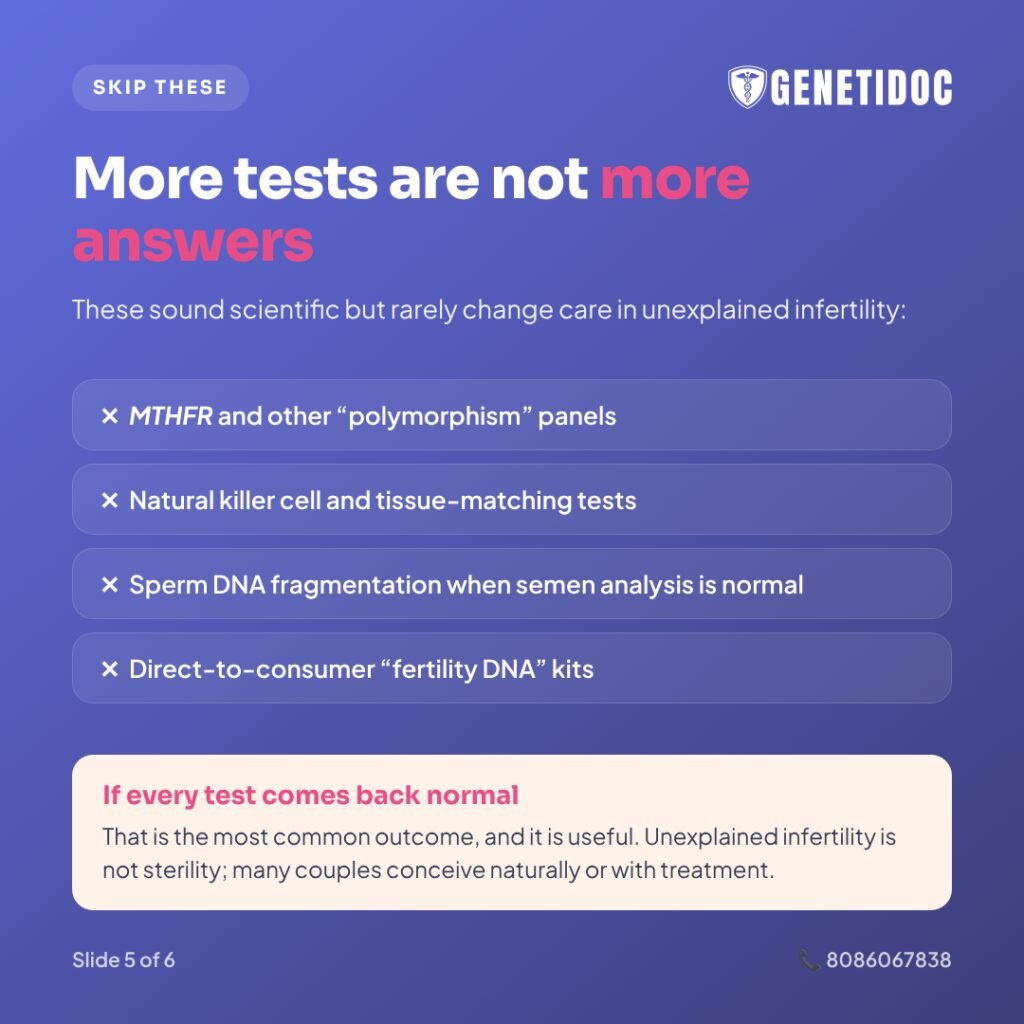
Couples are sometimes advised, or decide on their own, to take tests that sound scientific but rarely change care. These include:
- MTHFR and other “polymorphism” panels. Polymorphisms are common gene variants found in many healthy, fertile people. Major guidelines, including ESHRE, do not recommend testing for them in unexplained infertility.
- HLA matching, KIR and natural killer cell tests. These are not supported by current evidence for unexplained infertility.
- Sperm DNA fragmentation when the semen analysis is normal. ESHRE found no added value in this situation. Team Genetidoc also does not recommend embryo chromosome testing based on a high DNA fragmentation result alone.
- Direct-to-consumer “fertility DNA” kits. These are not designed to diagnose infertility, are usually built around variants studied in non-Indian populations, and their results should not be used to make treatment decisions.
“Doing more tests is not the same as getting more answers,” says Team Genetidoc. “Each test should be chosen because its result could change something for the couple. Otherwise it only adds cost, waiting and worry.”
Understanding Your Karyotype Report
Karyotype reports can contain unfamiliar terms. Some sound alarming but are harmless. Others need careful interpretation.
“Inversion 9” and other normal variants
Reports sometimes mention inversion 9, or a larger or smaller “heterochromatin” region on chromosomes such as 1, 9, 16 or Y. Heterochromatin is a tightly packed part of a chromosome that carries few active genes. These are generally considered normal variants, found in many healthy people with children. They are a common source of unnecessary worry and are rarely the explanation for infertility.
Low-level X chromosome mosaicism
One of the most common findings in women having IVF is a small proportion of cells missing one X chromosome. In one study of 1,058 women undergoing IVF, 15.7 percent had an abnormal karyotype, most often low-level X chromosome mosaicism, and it became more common with age. It is also found in women with normal fertility, so its meaning for any one woman is often uncertain. This is a result that needs a specialist to interpret, not a label to panic over.
Why the laboratory matters
Finding mosaicism depends on how many cells the laboratory examines. A standard karyotype looks at a limited number of cells. When mosaicism is suspected, examining more cells (often at least 30) gives a more reliable answer. A good laboratory knows when to extend the analysis, and a good report explains what the finding means. Genetidoc works with accredited partner laboratories, and every result is reviewed by a clinical geneticist.
What a Result Can Change: Three Illustrative Scenarios
The examples below are composites based on published guidance, not real patients. They show how genetic testing can redirect a couple’s plan.
Scenario 1: Three failed IVF cycles, all reports normal
Illustrative example (not a real patient): A couple in their early thirties have had three IVF cycles with good-looking embryos, but none implanted. Each cycle was changed: new medicines, a new protocol. A karyotype of both partners shows the husband carries a balanced translocation. He is healthy, and his semen analysis was normal. With this answer, the couple can discuss PGT designed for structural rearrangements, known as PGT-SR, instead of simply repeating the same cycle.
Scenario 2: Low egg reserve at 29
Illustrative example (not a real patient): A 29-year-old woman with regular periods has a low AMH and responds poorly to fertility medicines. Her maternal uncle has intellectual disability. FMR1 testing shows a premutation. The couple now understands why her reserve is low, decides not to delay treatment, and discusses PGT so that a future child does not inherit fragile X syndrome. Her sister is offered testing too.
Scenario 3: Eggs that never fertilize
Illustrative example (not a real patient): A consanguineous couple has had two ICSI cycles. Eggs were collected each time, but none fertilized. A targeted gene panel finds that the woman has two copies of a disease-causing change in a gene essential for egg activation. The finding ends years of uncertainty. The couple can now make an informed decision between donor eggs, adoption, or other options, with a clear understanding of why their cycles failed.
If Every Genetic Test Comes Back Normal
This is the most common outcome, and it is not a wasted effort. A normal result rules out several important causes and can bring real relief.
“A normal result means there is no reportable finding in what was tested,” says Team Genetidoc. “It does not mean genetics can never play a role, and it does not mean you will not conceive. We explain both halves of that clearly, so couples neither over-read nor under-read their report.”
What happens next:
- Unexplained infertility is not sterility. The chance of natural conception continues over time, and it depends a great deal on the woman’s age and how long the couple has been trying.
- Treatment is usually stepwise. ESHRE recommends intrauterine insemination (IUI) with ovarian stimulation as a first-line treatment, with the decision to move to IVF made individually, based on age and the length of infertility. Your fertility specialist guides this.
- Keep your report. If new problems appear, such as repeated IVF failure or a miscarriage, the question can be revisited with fresh information.
Unexplained Infertility in the Indian Context
What Indian studies show
Indian studies of chromosome testing in infertility show wide variation, mainly because they include very different groups of patients. A study of 4,204 infertile individuals at an Indian fertility centre found chromosome abnormalities in 1.55 percent. Pooled Indian data from 1,736 infertile men, many with abnormal semen results, found a higher rate of 8.4 percent. The lesson: the yield of testing depends heavily on who is tested, which is why selection by a specialist matters.
Consanguinity
Marriages between relatives are common in some communities in South India and elsewhere. Consanguinity does not cause infertility by itself, but it raises the chance that both partners carry the same rare recessive gene change. This matters for the rare single-gene causes of egg and embryo failure, and for the health of future children. Consanguineous couples benefit from discussing carrier screening before or during fertility treatment.
Blame, pressure and silence
In many Indian families, the woman is assumed to be “the problem” when a pregnancy does not happen, and questions from relatives add to the strain. Unexplained infertility, by definition, has not identified a cause in either partner. When a genetic cause is found, it can be in the man just as often as in the woman, and it is never anyone’s fault. Chromosome rearrangements and gene changes are not caused by anything a person did.
“We prefer both partners to attend the counseling session together,” says Team Genetidoc. “With online consultations, even couples who are in two different cities can join the same session, so neither partner has to relay the information secondhand. Hearing it together reduces misunderstanding and blame.”
How a Genetic Evaluation for Unexplained Infertility Works
- Consultation with a clinical geneticist. Both partners share their history: how long they have been trying, previous reports, IVF details, miscarriages, and the family history on both sides. Consultations at Genetidoc are held online, in the couple’s preferred language wherever possible.
- A decision on whether testing is needed at all. If nothing in the history points to a genetic cause, you may be told that testing is unlikely to help. That is a valid and useful outcome.
- Choosing the right test. If testing is useful, the test is matched to the question: a karyotype, FMR1 testing, a targeted panel, or carrier screening.
- Sample collection at home. Blood samples are collected through home sample pickup, so there is usually no need to travel.
- Results and post-test counseling. The result is explained alongside your fertility reports, with a clear plan for what it means. Couples receive a written summary of what was discussed, which they can share with their fertility specialist.
Why Interpretation and Counseling Matter
A genetic report on its own is only a few lines of text. Its value comes from what is done with it. Getting it right depends on:
- The right test. A test chosen to answer a specific question, not a large package that generates confusing findings.
- The right laboratory. Accredited, quality-checked, and willing to extend the analysis when needed.
- Clinical correlation. Reading the result together with the hormone reports, scans, semen analysis and IVF history.
- Genetic counseling. Helping the couple understand what the result means for their chances, for a future child and for their relatives, and supporting them to make their own decision.
“We present every option openly: treatment with the couple’s own eggs and sperm, embryo testing, donor eggs or sperm, and adoption,” says Team Genetidoc. “These are not last resorts. They are choices, and the decision always belongs to the couple.”
Questions about embryo testing or male infertility can be raised on the Genetidoc Rare Disease Forum’s Preimplantation Genetic Testing forum and Male Infertility forum, where responses are reviewed by genetic counselors and consultants.

Frequently Asked Questions
Don’t see your question below? Ask it on the Frequently Asked Questions forum on the Genetidoc Rare Disease Forum.
Can unexplained infertility be genetic?
Sometimes. Balanced chromosome rearrangements, the fragile X premutation and rare single-gene causes can sit behind normal fertility reports. Most couples with unexplained infertility, however, do not have an identifiable genetic cause.
Is genetic testing recommended for all couples with unexplained infertility?
No. The ESHRE 2023 guideline does not recommend routine genetic testing for every couple. Testing is considered when there are specific clues, such as failed IVF, miscarriages, low egg reserve at a young age or a relevant family history.
Should both partners have a karyotype?
When a karyotype is advised, yes. A chromosome rearrangement in either partner can affect the embryo, and a man can carry one even with a normal semen analysis.
Can a normal semen analysis hide a genetic problem?
Yes, in some cases. A balanced translocation, or rarely a gene change affecting how sperm activate the egg, can exist alongside a normal semen analysis.
What is a balanced translocation?
It is a chromosome change in which two chromosomes have swapped pieces, with nothing missing or extra. The carrier is healthy, but their eggs or sperm can carry an unbalanced set, leading to failed implantation or miscarriage.
Why would a woman with low AMH be tested for fragile X?
Because a premutation in the FMR1 gene can reduce the egg reserve earlier than expected. Finding it can affect treatment timing and the risk of fragile X syndrome in a future child.
Does inversion 9 on my karyotype cause infertility?
Usually not. Inversion 9 is generally considered a normal variant, found in many healthy people who have children. It is rarely the explanation for infertility.
Is there a genetic test for poor egg quality?
For most women, no. Gene panels may help a small group whose eggs repeatedly fail to mature or fertilize, or whose embryos repeatedly stop growing in IVF.
Should I get an MTHFR test for unexplained infertility?
Major guidelines, including ESHRE, do not recommend it. MTHFR variants are common in healthy, fertile people and do not guide infertility treatment.
How long do these genetic tests take?
A karyotype usually takes about three to four weeks, fragile X testing about 21 days, and a gene panel about three to four weeks. Samples can be collected from home.
If my genetic tests are normal, does that mean I cannot conceive?
No. A normal result means no reportable finding in what was tested. Unexplained infertility is not sterility, and many couples conceive naturally or with treatment.
Should we do genetic testing before starting IVF?
It depends on your history. A karyotype and carrier screening can be useful before IVF, especially after miscarriages or in consanguineous couples, because the results can shape whether embryo testing is planned.
Key Takeaways
- Unexplained infertility means standard tests are normal, not that nothing is wrong.
- Genetic testing is not routine for every couple, but it is worth considering when there are specific clues.
- A karyotype of both partners is the key test after failed IVF or miscarriages; newer tests cannot replace it for balanced rearrangements.
- FMR1 testing matters for women with low egg reserve at a young age or a family history of fragile X or early menopause.
- Gene panels help only a narrow group with repeated egg, fertilization or embryo failure.
- MTHFR, polymorphism panels and consumer DNA kits rarely change care.
- A normal result is common and useful, and it does not mean you cannot conceive.
- Genetic counseling for both partners together turns a result into a clear, personal plan.
All your fertility reports are normal, but you still have not conceived, or IVF has failed without a clear reason? Speak with a clinical geneticist together as a couple to find out whether genetic testing could change your plan, and which test, if any, is right for you.
Book an Unexplained Infertility Genetic Consultation
References
- ESHRE Guideline Group on Unexplained Infertility; Romualdi D, et al. Evidence-based guideline: unexplained infertility. Human Reproduction. 2023;38(10):1881–1890. ncbi.nlm.nih.gov/37599566
- European Society of Human Reproduction and Embryology. Unexplained Infertility: Patient Leaflet. eu/guideline/UI
- Practice Committee of the American Society for Reproductive Medicine. Evidence-based treatments for couples with unexplained infertility: a guideline. Fertility and Sterility. 2020;113(2):305–322.
- Pastore LM, Johnson J. The FMR1 gene, infertility, and reproductive decision-making: a review. Frontiers in Genetics. 2014;5:195. ncbi.nlm.nih.gov
- Prevalence of the FMR1 gene premutation in young women with a diminished ovarian reserve included in an IVF program: implications for clinical practice. Genes. 2024;15(8):1008. ncbi.nlm.nih.gov
- National Fragile X Foundation. Fragile X-Associated Primary Ovarian Insufficiency (FXPOI). org
- Torra-Massana M, et al. Exonic genetic variants associated with unexpected fertilization failure and zygotic arrest after ICSI: a systematic review. Zygote. 2023. org
- Genetic factors as potential molecular markers of human oocyte and embryo quality. Journal of Assisted Reproduction and Genetics. 2021;38(5):993–1002. springer.com
- Low-level X chromosome mosaicism: a common finding in women undergoing IVF. In Vivo. 2020;34(3):1433. iiarjournals.org
- Johnson J, Shetty N, Kumar JA, et al. Prevalence and types of chromosomal abnormalities among infertile patients from a single fertility centre in India. Scholars Academic Journal of Biosciences. 2021;9(1):1–9. com
- Chromosomal aberrations in infertile men with primary infertility in the Indian population. Journal of Clinical and Diagnostic Research. 2014;8(10):SC01–SC06. net
Related Reading on Genetidoc
- Family History of Dementia: When to Seek Genetic Counseling
- APOE and Alzheimer’s Risk: Separating Fact from Fear
- GM1 Gangliosidosis: Why Early Diagnosis Matters
- What Defines a Rare Genetic Disease? A Clear Guide
- Genetic Mosaicism: What It Means When Your Report Says “Mosaic”