Perhaps a pediatrician mentioned that your baby has “some features” worth checking. Perhaps a relative said your child does not look like anyone in the family. Or perhaps you noticed something yourself: the shape of the eyes, the position of the ears, a small chin.
Moments like these can be worrying. Many parents go home and search the internet late at night, comparing their child’s photos with pictures of genetic syndromes. That usually leads to more fear, not more clarity.
This article explains what genetic specialists actually look for, why a single feature rarely means anything on its own, how facial patterns lead to the right genetic test, and what a diagnosis can change for your child and family.
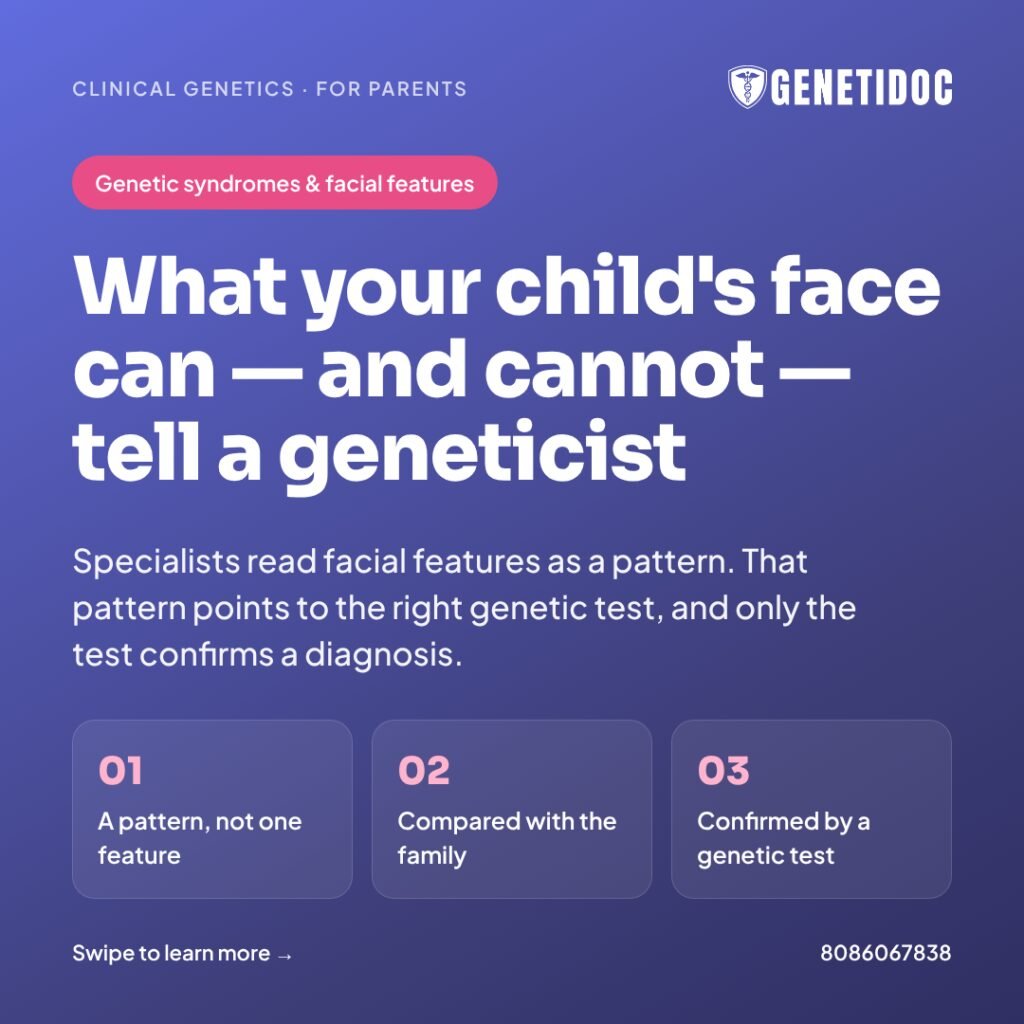
Quick AnswerMany genetic syndromes cause a recognizable pattern of facial features, called a facial gestalt. Clinical geneticists are trained to recognize these patterns and combine them with growth, development, family history and other physical findings. Facial features alone cannot diagnose a syndrome. They help a specialist decide which genetic test to order, and the test confirms the diagnosis. |
What Are “Dysmorphic Features”?
Doctors sometimes use the word “dysmorphic” to describe physical features that differ from what is typical for a child’s age, family and background. The word sounds harsh, but in medicine it is purely descriptive. It does not mean “abnormal-looking” in the everyday sense, and it says nothing about a child’s intelligence, personality or future.
The branch of genetics that studies these features is called dysmorphology. Because older terms were often vague or hurtful, an international group of experts created the Elements of Morphology standard to give doctors precise, neutral words for each feature, such as “widely spaced eyes” instead of older labels.
Major and minor differences
- Major differences affect health or function and often need medical or surgical care. Examples include a heart defect, cleft palate or a missing kidney.
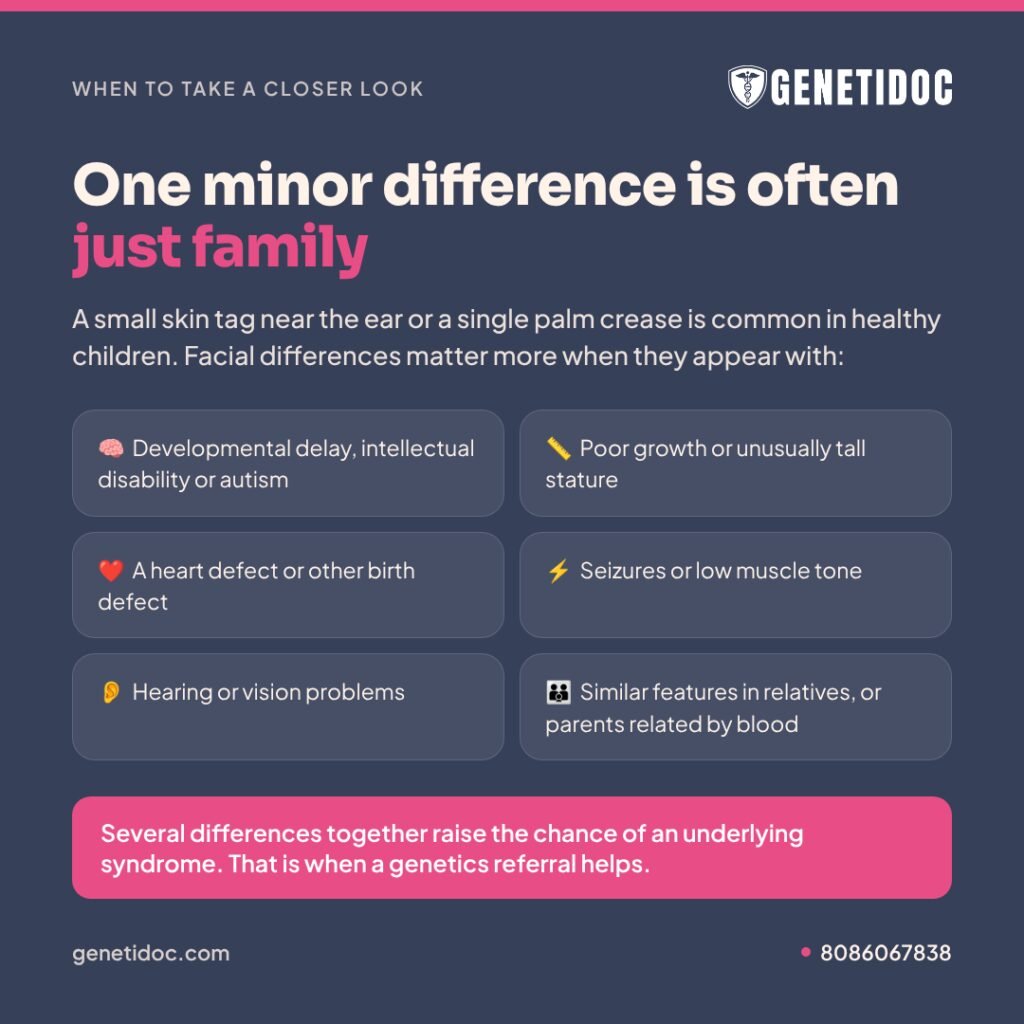
- Minor differences do not cause health problems by themselves. Examples include a small skin tag near the ear, a single crease across the palm, or folds of skin at the inner corner of the eyes.
Minor differences are common in healthy children. Many are simply inherited family traits. However, research has shown that when a child has several minor differences together, the chance of an underlying major malformation or syndrome rises. This is why specialists look at the whole child, not one feature.
What Is a Facial Gestalt?
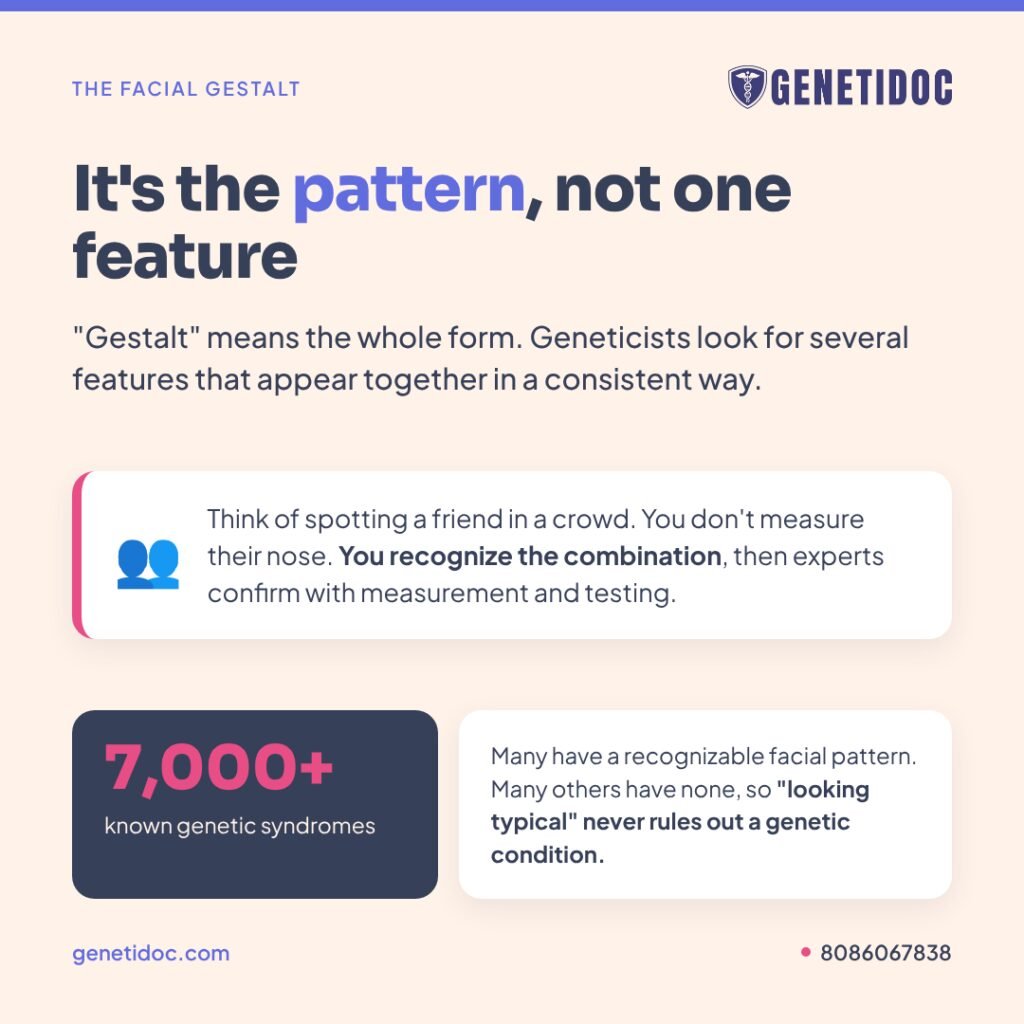
Gestalt is a German word meaning “the whole form.” In genetics, a facial gestalt is the overall impression created by several features appearing together in a consistent way.
Think of how you recognize a friend in a crowd. You do not measure their nose or count their eyelashes. You recognize the combination. Experienced geneticists recognize many syndromes in a similar way, and then confirm their impression with careful measurement and testing.
Estimates suggest that a large share of the more than 7,000 known genetic syndromes have a recognizable facial pattern. Many others have no distinctive facial features at all, which is why “looking typical” never rules out a genetic condition.
Why Does the Face Show Signs of a Genetic Condition?
The face forms very early in pregnancy, during roughly the first 4 to 10 weeks. Several groups of cells move, grow and fuse in a precise sequence to build the forehead, eyes, nose, lips, jaw and ears.
The same genes that guide this process often also guide the development of the heart, brain, kidneys, limbs and other organs. So when a genetic change affects early development, it can leave clues in the face as well as in other parts of the body. That is why facial patterns are so useful: they can point towards conditions that also affect internal organs that cannot be seen.
Features That Commonly Prompt a Genetic Evaluation
The features below are examples of what a pediatrician or genetic specialist may note. Please do not use this list to diagnose your child. Most children with one or two of these features are perfectly healthy.
- Eyes: eyes set unusually wide apart or close together; eye openings that slant upwards or downwards; drooping eyelids; unusually short or long eye openings
- Ears: ears set lower than usual, rotated backwards, very small, or unusually shaped
- Nose: a very flat or very broad nasal bridge; a short nose with upturned nostrils
- Mouth and lip area: a smooth groove between the nose and upper lip (called the philtrum); a thin upper lip; cleft lip or palate
- Jaw and chin: a very small or set-back lower jaw
- Head size and shape: a head that is much smaller or larger than expected, or unusually shaped
- Face as a whole: marked asymmetry; facial features that become “coarser” over time
When facial features matter more
Facial differences become more significant when they appear together with one or more of the following:
- Developmental delay, intellectual disability or autism
- Poor growth or unusually tall stature
- A heart defect or other birth defect
- Seizures or low muscle tone
- Hearing or vision problems
- Differences in the hands, feet, skin, hair or spine
- A family history of similar features or problems
- Parents who are related by blood (consanguineous marriage)
Common Genetic Syndromes With Recognizable Facial Patterns
Here are some well-known examples. Each syndrome varies widely, and not every child shows every feature.
Down syndrome (trisomy 21)
Caused by an extra copy of chromosome 21. Common features include upward-slanting eyes, a flatter facial profile, small ears and a single palm crease. Babies are often recognized at birth. Heart defects are common, so an echocardiogram (a heart ultrasound) is recommended for every newborn with Down syndrome.
22q11.2 deletion syndrome
Caused by a small missing piece of chromosome 22. Facial features are often subtle and include hooded eyelids, small ears and a rounded nasal tip. The syndrome can also cause heart defects, low calcium levels, immune problems, palate differences and learning difficulties. Because the face can look quite typical, many children are diagnosed late.
Williams syndrome
Caused by a small deletion on chromosome 7 that includes the ELN gene. Children may have a broad forehead, fullness around the eyes, full cheeks and a wide mouth. They are often very sociable and friendly. A narrowing of the main artery leaving the heart is a key medical concern.
Noonan syndrome
Caused by changes in genes such as PTPN11. Features include widely spaced, downward-slanting eyes, low-set ears that are rotated backwards, and a short or webbed neck. Short stature and heart problems are common. A parent may have the same condition with much milder features and may never have been diagnosed.
Kabuki syndrome
Most often caused by changes in KMT2D or KDM6A. Children have long eye openings with the outer part of the lower eyelid slightly turned out, arched eyebrows that thin towards the ends, and prominent ears. The features can be hard to recognize in newborns and become clearer with age.
Cornelia de Lange syndrome
Most often caused by changes in NIPBL. Features include eyebrows that meet in the middle, long eyelashes, a thin upper lip with downturned corners, small hands and slow growth.
Conditions where features change over time
In some metabolic conditions, such as the mucopolysaccharidoses, a baby may look entirely typical at birth. Facial features gradually become fuller and coarser as stored material builds up in the body. This is one reason a child’s face may need to be reassessed over time.
| Not all facial patterns are genetic. Exposure to alcohol during pregnancy can cause a recognizable facial pattern (a smooth philtrum, thin upper lip and short eye openings) known as fetal alcohol spectrum disorder. Some medicines taken during pregnancy can also affect facial development. A good assessment considers these causes too. |
How a Genetic Specialist Assesses Facial Features
A dysmorphology assessment is far more than “looking at the face.” It usually includes these steps:
- Detailed history: pregnancy, scans, birth, milestones, medical problems and medicines taken during pregnancy
- Family history: at least three generations, including miscarriages, early deaths, similar features in relatives and whether the parents are related
- Growth measurements: height, weight and head size plotted on growth charts
- Facial examination: each feature described using standard terms, with measurements compared against reference values
- Whole-body examination: hands, feet, nails, skin, hair, spine, joints and genitals
- Comparison with family: looking at parents and siblings, in person or through photos
- Review of reports: heart scans, brain imaging, hearing and eye tests, and earlier genetic results
- Test selection: choosing the genetic test most likely to find the answer
Why your family photos matter
Parents are often surprised when a geneticist asks for their own childhood photos. There are three good reasons:
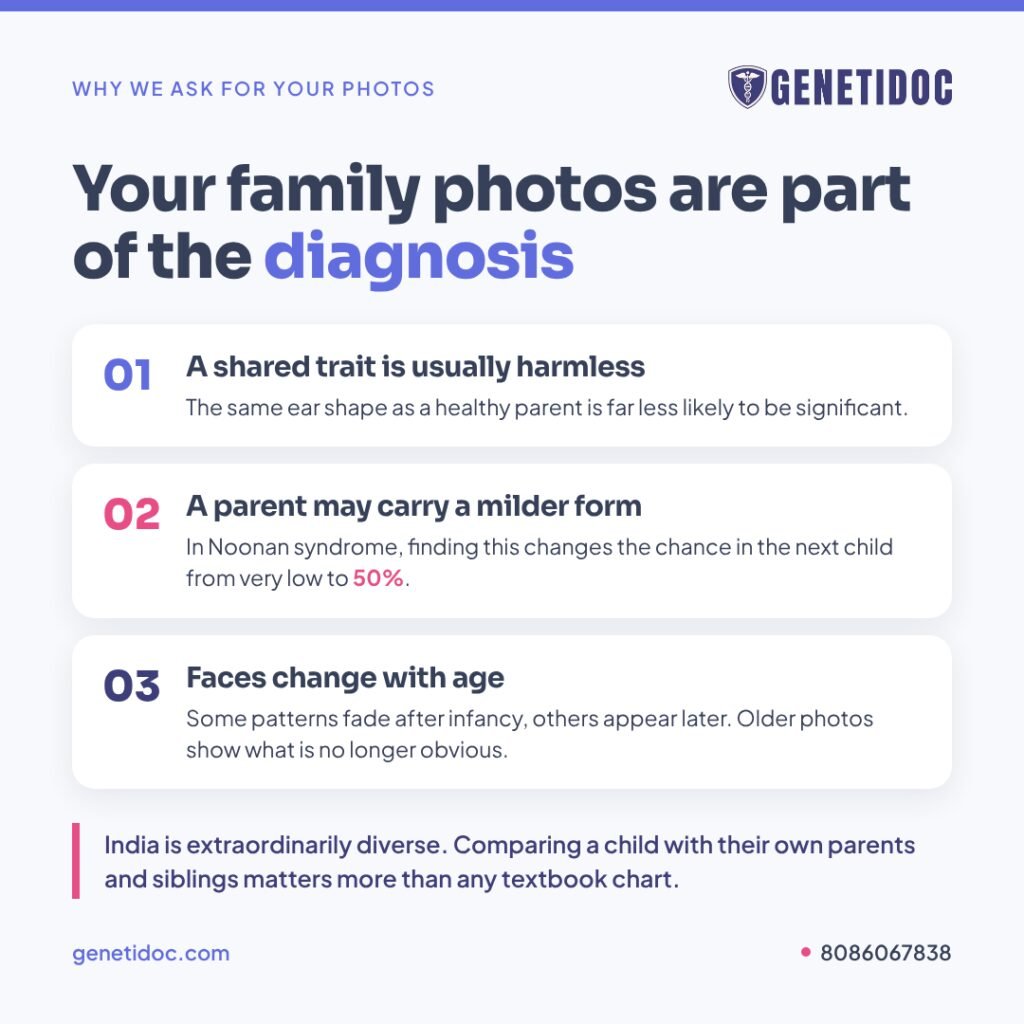
- A shared family trait is usually harmless. If a child has the same ear shape as a healthy parent, it is far less likely to be significant.
- A parent may carry the same condition in a milder form. In conditions such as Noonan syndrome or 22q11.2 deletion syndrome, recognizing this changes the chance of the condition in future children.
- Faces change with age. Some patterns are clearest in infancy and fade later, while others only appear as the child grows. Older photos can show a pattern that is no longer obvious.
Can this be done through an online consultation?
Much of the assessment, including history, family history, review of reports and test planning, works well online. Good-quality photos and short videos add a great deal. Genetic specialists commonly ask for:
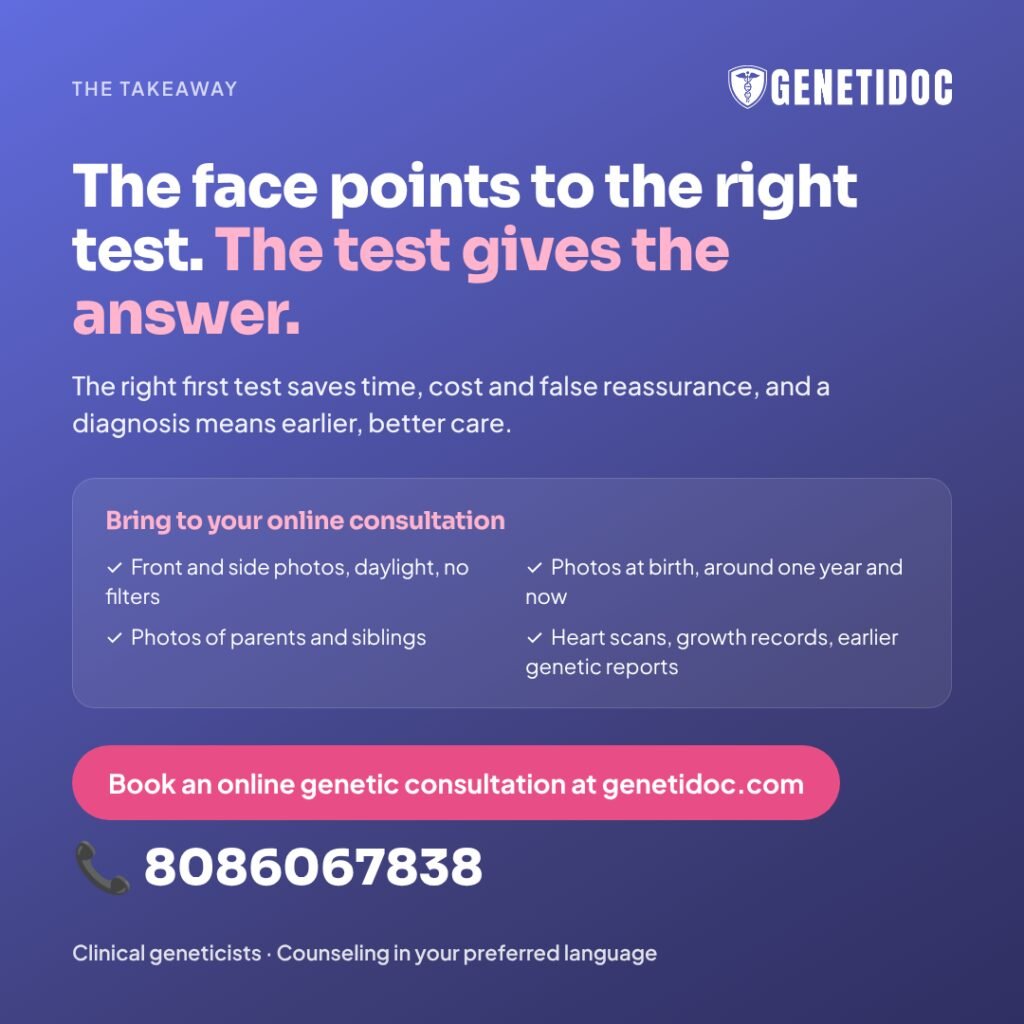
- A front view of the face and both side profiles, taken in natural daylight without filters
- Close-up photos of the ears, hands (palms up and down) and feet
- Photos of the child at birth, around one year and at the present age
- Photos of both parents and any siblings
- A short video of the child moving, playing and showing a natural expression
When features are subtle, when precise measurements are needed, or when the skin, joints or skeleton need to be examined by hand, the specialist may advise a physical examination with a local pediatrician or geneticist to complement the online consultation.
Why Ethnic Background Matters, Especially in India
Much of the medical literature on facial features was built using photographs of children of European ancestry. But what is “typical” varies between populations. A nasal bridge or eye shape that looks unusual on a Western reference chart may be entirely normal in many Indian families.
Research on diverse populations has found that some syndromes look different across ethnic groups, partly because of these background differences, while others look similar everywhere. The same research makes an important point: genetic syndromes can and should be diagnosed in every population.
India itself is extraordinarily diverse. Facial features vary from region to region and community to community. This is why comparing a child with their own parents and siblings is so important, and why experience with Indian patients matters when interpreting facial features.
Can AI or an App Diagnose a Syndrome From a Photo?
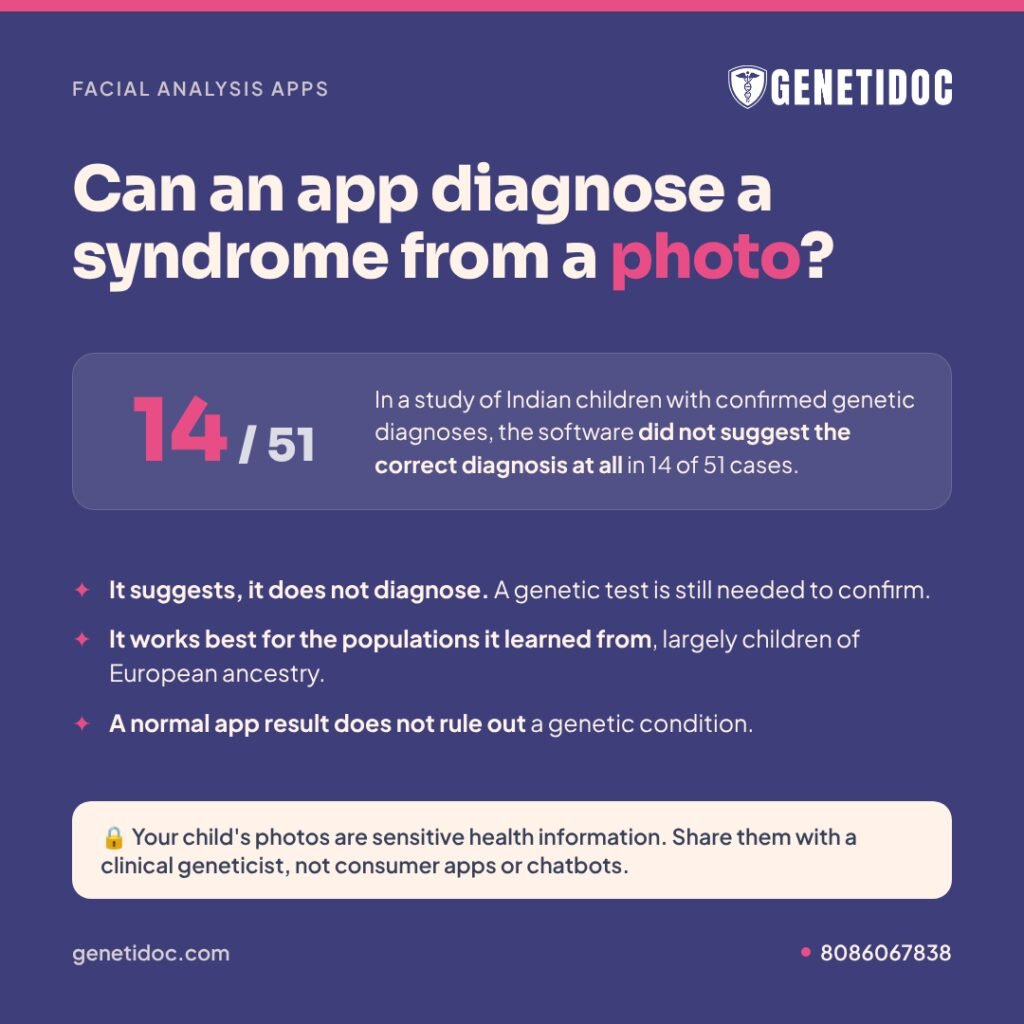
Computer programs can now analyze a facial photograph and suggest possible syndromes. Tools such as Face2Gene and GestaltMatcher are used by some clinicians as a support aid. The technology is impressive, but it has clear limits.
- It suggests, it does not diagnose. The software produces a list of possibilities. A genetic test is still needed to confirm any diagnosis.
- Accuracy is not perfect, particularly outside Europe. In a study of 51 Indian children with confirmed genetic diagnoses, the software included the correct diagnosis among its suggestions in about 72.5% of cases. In the remaining 14 children, it did not suggest the correct diagnosis at all.
- Training data is uneven. Research on a global image database found that adding photographs of non-European patients clearly improved accuracy, which shows that these tools work best for the populations they learned from.
- Many syndromes have no facial pattern. A normal result from an app does not mean a child has no genetic condition.
| A word of caution for parents: Uploading your child’s photos to consumer apps or general AI chatbots to “check for a syndrome” can cause unnecessary panic or false reassurance. Your child’s photographs are also sensitive health information, and you may not know how they will be stored or used. If you are worried, share the photos with a clinical geneticist instead. |
From Facial Pattern to Genetic Test: Choosing the Right Test
The real value of recognizing a facial pattern is that it points to the right test. Ordering the wrong test can mean a negative result, lost time, extra cost and false reassurance.
| Genetic test | What it looks for | When it is typically used |
| Karyotype | Extra, missing or rearranged whole chromosomes | When a chromosomal syndrome such as Down syndrome is clearly suspected |
| Chromosomal microarray analysis (CMA) | Small missing or extra pieces of chromosomes that a karyotype cannot see | Suspected microdeletion syndromes (such as 22q11.2 deletion or Williams syndrome); multiple birth defects |
| Single-gene test | One specific gene | When features strongly fit a syndrome caused by one known gene |
| Multi-gene panel | A group of genes linked to similar syndromes | When a syndrome group is suspected but several genes could be responsible (for example, Noonan syndrome and related conditions) |
| Whole exome sequencing (WES) | The protein-coding parts of about 20,000 genes | When the pattern is unclear, or facial features occur with developmental delay or multiple birth defects |
International guidelines support chromosomal microarray as a first-tier test for children with developmental disabilities or multiple congenital anomalies. More recently, the American College of Medical Genetics and Genomics (ACMG) recommended exome or genome sequencing as a first- or second-tier test for children with congenital anomalies, developmental delay or intellectual disability.
| Team Genetidoc perspective: The scope of testing is chosen based on how closely a child’s history and features fit a known condition. A strong, specific fit may need only a targeted test. Conditions with many possible causative genes need a broader panel or exome sequencing. Whole genome sequencing is usually reserved as a next step when a strongly suspected condition is not explained by earlier testing.
As a general guide, a targeted single-gene test may take about 3 weeks, multi-gene panels about 2 to 4 weeks, a karyotype about 3 to 4 weeks, and exome sequencing about 1 to 2 months. Timelines vary by laboratory and test, and samples can be collected through home sample pickup. |
What if the test is negative but the features are still strongly suggestive?
A negative result does not always mean there is no genetic condition. It means no reportable finding was identified in what was tested. The cause may lie in a gene or region that the test did not cover, or in a gene not yet linked to disease.
In this situation, the next steps may include:
- Reanalysis of existing exome data, typically after 6 months to 1 year, as scientific knowledge grows
- Trio exome sequencing (testing the child and both parents together) or whole genome sequencing
- Clinical review as the child grows, since facial and physical features can become clearer with age
- Testing another tissue, such as a skin sample, if the genetic change may be present in only some cells (called mosaicism)
Illustrative Scenarios
The scenarios below are general illustrations of how facial features guide diagnosis. They are not descriptions of specific Genetidoc patients.
Scenario 1: The subtle face behind a heart defect
A baby has a heart defect repaired in early infancy. Later, the child has frequent infections, a nasal-sounding voice and slow speech. The face looks almost typical, but hooded eyelids and small ears form a recognizable pattern. Chromosomal microarray confirms 22q11.2 deletion syndrome. The diagnosis leads to calcium checks, immune assessment, speech therapy and a hearing test, and gives the family an accurate answer about future pregnancies.
Scenario 2: The parent who was never diagnosed
A short child with a heart valve problem has widely spaced, downward-slanting eyes. Looking at family photos, the specialist notices similar, milder features in one parent, who was also short as a child. Testing confirms Noonan syndrome in both. This changes the chance of the condition in the family’s next child from very low to 50%.
Scenario 3: When one feature misleads
Specialists sometimes focus on the most striking feature and miss the bigger picture. In one widely reported case from the United States, a geneticist initially searched for syndromes linked to a toddler’s cleft lip. Exome sequencing eventually revealed a different, very rare condition in which cleft lip is not a typical feature. The geneticist later described the cleft as a red herring. The lesson: the whole pattern matters more than any single feature.
What a Diagnosis Changes in Real Life
Putting a name to a facial pattern is not about labeling a child. It is about better care. A confirmed diagnosis can:
- Guide health screening: heart scans, kidney ultrasound, hearing and eye checks, thyroid or calcium tests, depending on the syndrome
- Prevent complications: problems can be found and treated before they cause harm
- Start therapy early: speech, occupational and physical therapy, and educational support
- End the diagnostic journey: families can stop the cycle of repeated, inconclusive tests and specialist visits
- Clarify the outlook: families understand what to expect as their child grows
- Inform family planning: the chance of the condition happening again can be calculated accurately. Options such as prenatal diagnosis or preimplantation genetic testing (PGT) during in vitro fertilization (IVF) become available when a definite genetic cause is known
- Connect families: to support groups and others living with the same condition
When a child’s genetic change is identified, Team Genetidoc’s practice is to test the parents for that same change, especially when they are planning another pregnancy. This shows whether the change was inherited or arose for the first time in the child.
Common Misconceptions Parents Have
“My child looks normal, so it cannot be genetic.”
Many genetic conditions have subtle facial features or none at all. Development, growth and health history matter just as much.
“A different-looking feature means my child will have intellectual disability.”
Not at all. Most minor facial differences are harmless family traits. Even within a syndrome, abilities vary widely from child to child.
“We must have done something to cause this.”
Genetic syndromes are not caused by anything parents did or did not do. Many arise as a de novo change, meaning it happened for the first time in the child and was not inherited from either parent.
“The test was negative, so there is no syndrome.”
A negative result means nothing reportable was found in what was tested. Reanalysis, broader testing or reassessment over time may still find an answer.
“An app can tell me if my child has a syndrome.”
Apps can only suggest possibilities. They miss many diagnoses, especially in non-European children, and can never replace a specialist’s examination and a confirmatory genetic test.
Why Expert Interpretation and Genetic Counseling Matter
Recognizing a facial pattern is a clinical skill that takes years of training and experience. But it is only the first step. Real value comes from connecting the face, the history and the genetic result into one clear answer that changes care.
This depends on:
- Choosing the right test first, rather than the cheapest or the broadest
- Choosing an accredited laboratory with reliable, quality-controlled results
- Clinical correlation: checking whether a reported genetic change truly fits the child’s features
- Genetic counseling before and after testing, so families understand what a result means, what it does not mean, and what happens next
A genetic report on its own is just data. Interpretation by a clinical geneticist, explained through genetic counseling, is what turns it into an answer that can guide your child’s care.
Practical Advice for Parents
- Do not self-diagnose from internet photos. Comparing your child with syndrome images usually causes needless fear.
- Collect family photos of your child at different ages, and of parents and siblings.
- Keep all reports together: scans, echocardiograms, growth records, developmental assessments and any earlier genetic tests.
- Write down your family history, including miscarriages, early deaths, similar features in relatives and whether you and your partner are related.
- Ask your pediatrician for a genetics referral if facial differences come with delays, growth problems or birth defects.
- Keep your genetic reports and raw data safely, and return for review if new symptoms appear.
- Use respectful words. Your child is a child first. A diagnosis describes a condition, not who they are.
Frequently Asked Questions
1. Can a doctor diagnose a genetic syndrome just by looking at a child’s face?
No. An experienced geneticist can strongly suspect a syndrome from a facial pattern, but a genetic test is needed to confirm the diagnosis.
2. What does “dysmorphic features” mean?
It is a medical term for physical features that differ from what is typical for a child’s age and background. It is descriptive and does not predict intelligence or outcome.
3. Are minor facial differences a cause for concern?
Usually not. Single minor differences are common in healthy children and are often family traits. Several together, or alongside developmental or health problems, deserve evaluation.
4. Which genetic test is done for a child with dysmorphic features?
It depends on the pattern. Common options are karyotype, chromosomal microarray, a single-gene test, a multi-gene panel or exome sequencing. A clinical geneticist chooses the most suitable one.
5. Can facial recognition apps diagnose genetic syndromes?
No. They suggest possible syndromes for clinicians to consider. In an Indian study, the software missed the correct diagnosis in about one in four children.
6. Do facial features of genetic syndromes change with age?
Yes. Some patterns are clearest in infancy and fade later, while others, such as in Kabuki syndrome or some metabolic conditions, become more obvious as the child grows.
7. Why does the geneticist want photos of the parents?
To see whether a feature is a harmless family trait, or whether a parent may have a milder form of the same condition, which affects future pregnancies.
8. Can a child look completely normal and still have a genetic syndrome?
Yes. Many genetic conditions have subtle or no facial features. Growth, development and medical history are equally important.
9. Are facial features of syndromes different in Indian children?
Sometimes. Background facial features vary between populations, so some syndromes look different in Indian children compared with textbook images based largely on European patients.
10. Can an online genetic consultation assess facial features?
Yes, to a large extent. Clear photos and videos, family photos and medical reports allow a detailed assessment. A local physical examination may be advised when finer detail is needed.
11. What happens if genetic testing is negative?
It means no reportable finding in what was tested. Reanalysis after 6 months to 1 year, broader testing or reassessment over time may still find an answer.
12. Did we cause our child’s genetic syndrome?
No. Genetic syndromes are not caused by anything parents did. Many arise as a new (de novo) change in the child.
Key Takeaways
- Many genetic syndromes have a recognizable facial pattern, but no single feature diagnoses a syndrome.
- Facial features matter most when they occur together with developmental, growth or health concerns.
- Comparing a child with their own family is essential, especially in a population as diverse as India’s.
- AI tools can support clinicians but cannot replace a specialist’s examination or a confirmatory genetic test.
- The real value of recognizing a pattern is choosing the right test, and the real value of a diagnosis is better, earlier care.
Concerned About Your Child’s Facial Features or Development?If a doctor has mentioned “dysmorphic features,” or you have noticed differences alongside delays, growth concerns or a birth defect, a clinical geneticist can help you understand what they mean and whether testing is needed. Book an online consultation with Team Genetidoc. Share your child’s photos, family photos and medical reports, and our clinical geneticists will review the full picture, recommend the right test if needed, and explain every result through genetic counseling, in your preferred language.
|
Have a question about a specific syndrome? Join the discussion on the genetidoc rare disease forum
Related Reading
- Is Genetic Testing Useful for Unexplained Infertility?
- Family History of Dementia: When to Seek Genetic Counseling
- APOE and Alzheimer’s Risk: Separating Fact from Fear
- GM1 Gangliosidosis: Why Early Diagnosis Matters
- What Defines a Rare Genetic Disease? A Clear Guide
- Genetic Mosaicism: What It Means When Your Report Says “Mosaic”
References
- Allanson JE, Biesecker LG, Carey JC, Hennekam RC. Elements of morphology: introduction. Am J Med Genet A. 2009;149A(1):2-5.
- Leppig KA, Werler MM, Cann CI, Cook CA, Holmes LB. Predictive value of minor anomalies. I. Association with major malformations. J Pediatr. 1987;110(4):531-537.
- Kruszka P, Tekendo-Ngongang C, Muenke M. Diversity and dysmorphology. Curr Opin Pediatr. 2019;31(6):702-707.
- Narayanan DL, Ranganath P, Aggarwal S, Dalal A, Phadke SR, Mandal K. Computer-aided facial analysis in diagnosing dysmorphic syndromes in Indian children. Indian Pediatr. 2019;56(12):1017-1019.
- Gurovich Y, Hanani Y, Bar O, et al. Identifying facial phenotypes of genetic disorders using deep learning. Nat Med. 2019;25(1):60-64.
- Reiter AMV, Pantel JT, Danyel M, Horn D, Ott CE, Mensah MA. Validation of 3 computer-aided facial phenotyping tools (DeepGestalt, GestaltMatcher, and D-Score): comparative diagnostic accuracy study. J Med Internet Res. 2024;26:e42904.
- Lesmann H, Hustinx A, Moosa S, et al. GestaltMatcher Database: a global reference for facial phenotypic variability in rare human diseases. Preprint, 2024.
- Miller DT, Adam MP, Aradhya S, et al. Consensus statement: chromosomal microarray is a first-tier clinical diagnostic test for individuals with developmental disabilities or congenital anomalies. Am J Hum Genet. 2010;86(5):749-764.
- Manickam K, McClain MR, Demmer LA, et al. Exome and genome sequencing for pediatric patients with congenital anomalies or intellectual disability: an evidence-based clinical guideline of the American College of Medical Genetics and Genomics (ACMG). Genet Med. 2021;23(11):2029-2037.
- Adam MP, Feldman J, Mirzaa GM, et al., editors. GeneReviews. Seattle (WA): University of Washington; 1993–present. Chapters on 22q11.2 deletion syndrome, Williams syndrome, Noonan syndrome, Kabuki syndrome and Cornelia de Lange syndrome.