

In the first few days of life, many babies in India have a few drops of blood taken from the heel. This is the routine newborn screening test. It looks for a small group of serious conditions that can be treated if they are found early.
Today, parents are also being offered something newer: genomic newborn screening. Instead of measuring chemicals in the blood, it reads parts of the baby’s DNA to look for genetic conditions that the routine test cannot pick up.
Is it worth doing? Does it replace the heel-prick test? What can it find, and what can it miss? This guide answers these questions in plain language, so you can make an informed choice for your baby.
| Quick answer
Genomic newborn screening is a DNA test for babies that looks at a carefully chosen list of genes linked to serious conditions that start in childhood and can be treated or managed early. It adds to routine newborn screening, which measures chemicals and hormones in the blood. It does not replace it. Genomic screening can find conditions that have no blood marker, but it can miss conditions that are not caused by genes, and some types of genetic changes that are hard to read with standard sequencing. |
What Is Routine Newborn Screening?
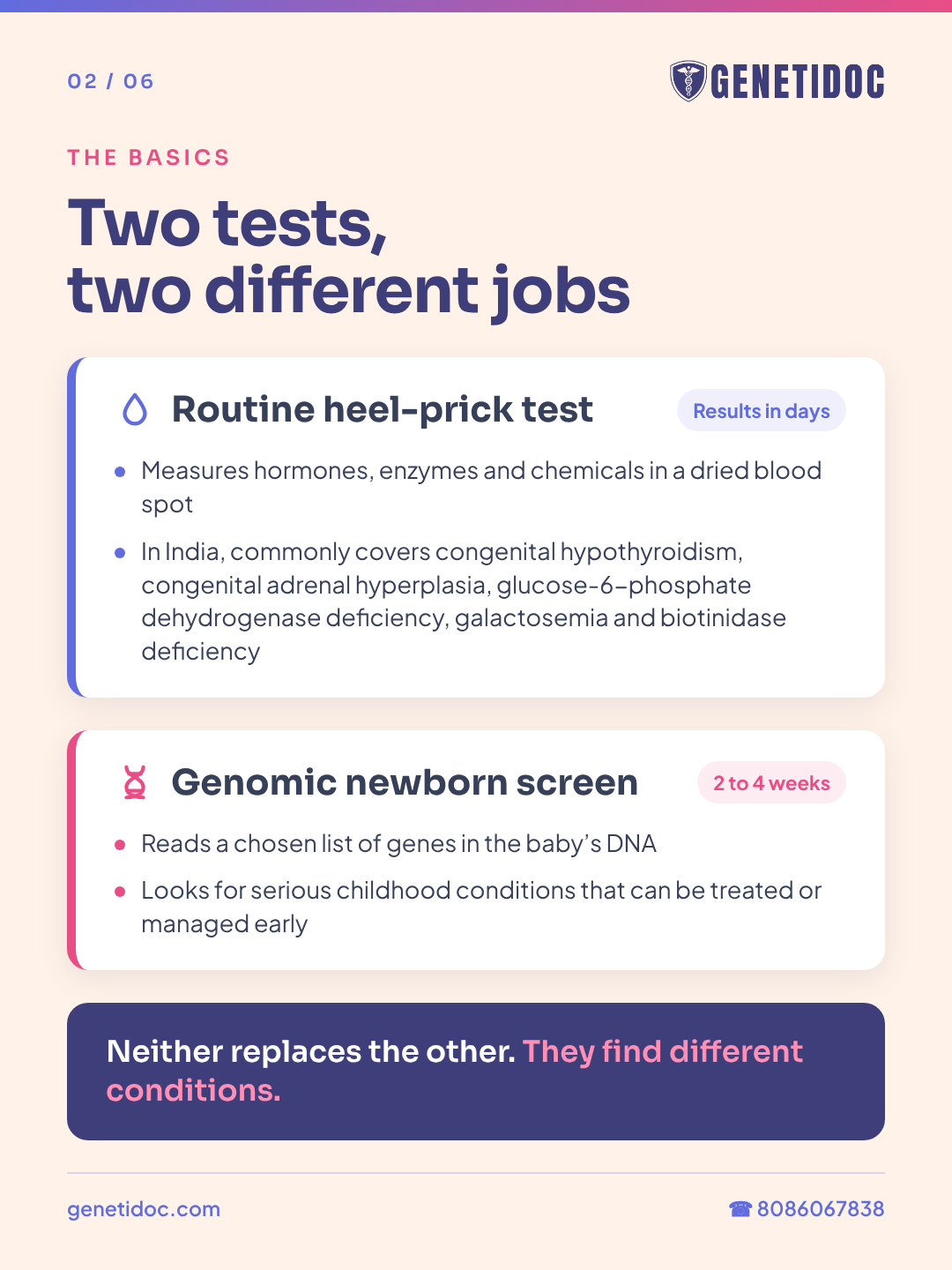
Routine newborn screening is a public health test done on healthy-looking babies. A few drops of blood from the heel are dried on a special card, called a dried blood spot, and sent to a laboratory. The laboratory measures hormones, enzymes and other chemicals. An abnormal level can be an early sign of a hidden condition.
In India, routine screening commonly covers these conditions:
- Congenital hypothyroidism: the baby’s thyroid gland does not make enough thyroid hormone. Without early treatment, it can affect brain development. With a daily tablet, children usually grow and learn normally.
- Congenital adrenal hyperplasia: the adrenal glands cannot make certain hormones properly. Some babies can become seriously ill from salt loss in the first weeks of life.
- Glucose-6-phosphate dehydrogenase (G6PD) deficiency: red blood cells break down easily after certain medicines, foods or infections.
- Galactosemia: the body cannot process a sugar found in milk.
- Biotinidase deficiency: the body cannot recycle a vitamin called biotin. It is treated with biotin supplements.
Some hospitals and laboratories also screen for phenylketonuria, cystic fibrosis and other metabolic conditions. Larger “expanded” panels use a technique called tandem mass spectrometry, which can measure many chemicals from the same blood spot.
Alongside the blood test, newborns are usually checked with a physical examination and a hearing screen. These are separate from the heel-prick test.
The gap in India
Unlike many high-income countries, India does not yet have a single, universal national newborn screening programme. Coverage varies widely between states, hospitals and families. One tertiary hospital in South India, for example, reported that only about half of babies born there were screened. Indian studies have found congenital hypothyroidism in roughly 1 in 500 babies in Kochi and 1 in 3,400 in Chandigarh, which shows why even basic screening matters.
So before considering genomic screening, the first question for any family is simple: has my baby had the routine newborn screening test, and have the results been checked?
| “Genomic screening is an addition, not a substitute. A baby should still have the routine heel-prick test, because some of the most common treatable conditions it finds, like congenital hypothyroidism, are often not caused by a gene change at all.”
— Team Genetidoc |
What Is Genomic Newborn Screening?
Genomic newborn screening reads a baby’s DNA, the instruction code inherited from both parents. It then looks for harmful changes, called variants, in a pre-selected list of genes.
This list is the most important part. A good genomic newborn screen does not try to read and report everything. It focuses on conditions that meet three tests:
- Serious: the condition can cause significant illness or disability.
- Early onset: it usually begins in infancy or childhood.
- Actionable: knowing early changes care. There is a treatment, a preventive step, a monitoring plan or something to avoid.
Laboratories use different methods. Some use a targeted gene panel. Others sequence the whole exome (the protein-coding parts of all genes) or the whole genome, but only analyse and report the chosen list. The sample is usually a small blood sample, a dried blood spot or a cheek swab, depending on the laboratory.
Why a curated list matters
Having a harmful variant does not always mean a person will develop the condition. Some variants cause disease in almost everyone who carries them. Others cause disease in only some people. This is called reduced penetrance.
If a screening test reported every possible variant, many healthy babies would be wrongly labelled as “at risk.” That is why large research programmes carefully select which genes and variants to include. In the United Kingdom, for example, the team behind the Generation Study reviewed more than 900 genes before choosing which conditions to screen for, with the aim of keeping false alarms low.
Routine vs Genomic Newborn Screening: Side by Side
| Feature | Routine newborn screening | Genomic newborn screening |
| What it measures | Hormones, enzymes and chemicals in the blood | Changes in the baby’s DNA |
| Number of conditions | Usually 5 to a few dozen | Often 150 to 250 or more |
| Finds conditions with no blood marker | No | Yes, for many |
| Finds conditions not caused by genes | Yes, for example many cases of congenital hypothyroidism | No |
| Best timing | In the first few days of life | As early as possible, ideally in the first weeks |
| Typical turnaround | Days | About 2 to 4 weeks for a panel; longer for exome-based tests |
| Replaces the other? | No. The two tests find different things and work best together. | |
What the Research Shows
Several large studies around the world are now testing how well genomic newborn screening works in real life.
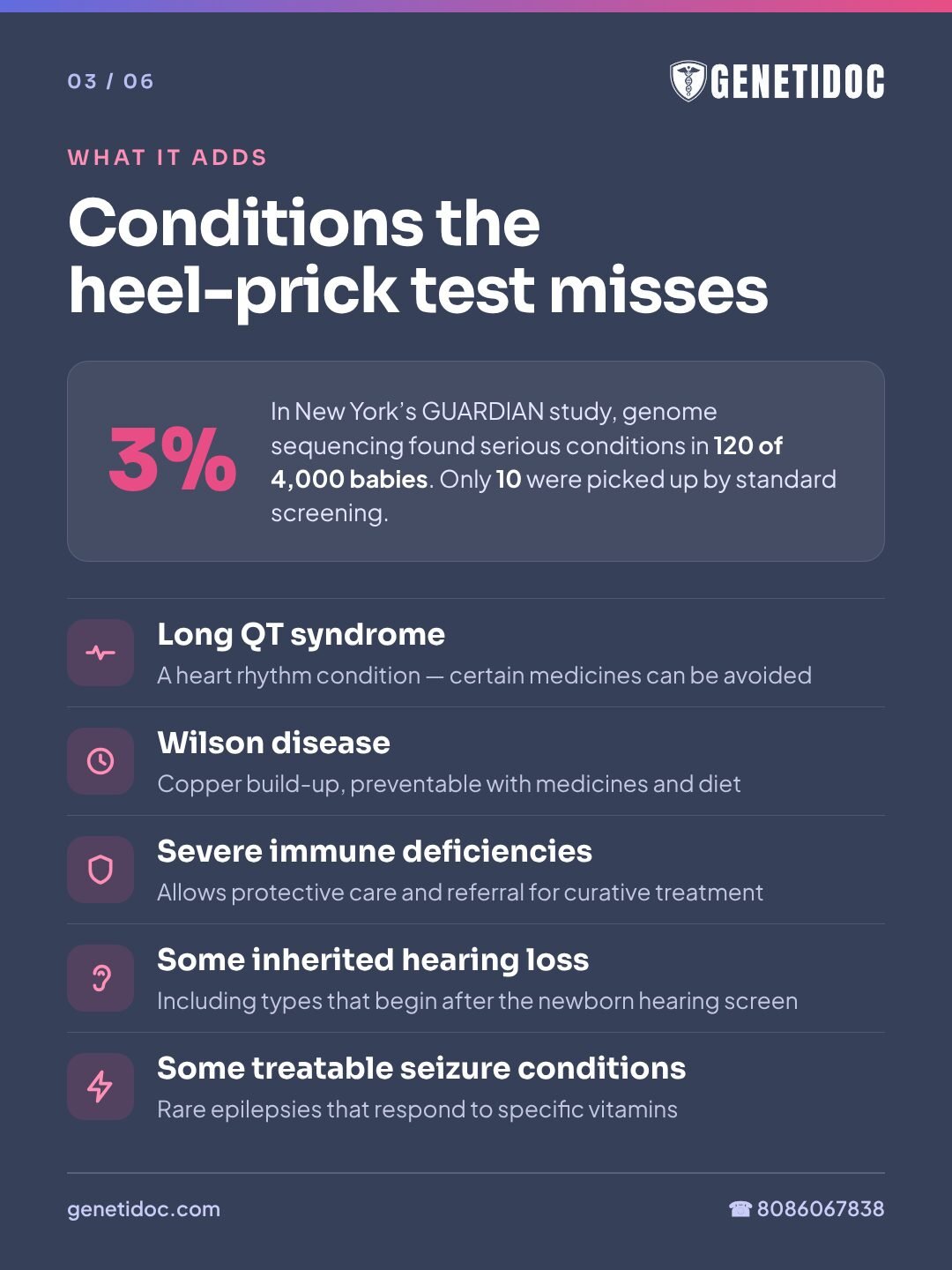
- The GUARDIAN study (New York, United States): genome sequencing was offered alongside routine screening to babies born at NewYork-Presbyterian hospitals. In the first 4,000 babies, published in the Journal of the American Medical Association in 2024, genome sequencing identified 120 babies (3%) with serious conditions. Only 10 of these were picked up by standard newborn screening. Examples included long QT syndrome, a heart rhythm condition, and Wilson disease, a condition where copper builds up in the body. Both can be managed once they are known. About 72% of families who were approached chose to take part.
- The Generation Study (England): run by Genomics England with the National Health Service, it aims to sequence the genomes of 100,000 newborns and screen for more than 200 treatable childhood conditions. For comparison, the routine heel-prick test in England looks for nine conditions. The study estimates that about 3,000 babies a year in England are born with one of these 200 or so treatable conditions.
- Combined screening studies: research from China comparing the two approaches found that DNA testing picked up some babies missed by the blood test, including cases of inherited hearing loss. Researchers increasingly describe the two methods as complementary.
- India: a national collaborative effort called GENESIS (Genomic Evidence for Newborn Screening in India) has been set up to build the evidence for a model designed for Indian babies. Genomic newborn screening is not yet part of public healthcare in India. It is currently available mainly as an optional test that families choose and pay for privately.
These studies are encouraging, but they are still research programmes. Their full results, including long-term outcomes and costs, are still being collected.
What Genomic Screening Can Add: Conditions the Heel-Prick Test Misses
Many genetic conditions do not leave any measurable chemical signal in a newborn’s blood. A baby can look and test completely normal, while a hidden condition develops. Genomic screening can flag some of these early. Examples include:
- Inherited heart rhythm conditions, such as long QT syndrome. Early knowledge allows a cardiologist to start preventive management and advise which medicines to avoid.
- Wilson disease, where copper slowly damages the liver and brain. Medicines and diet can prevent this if it is found early.
- Severe immune deficiencies, where the immune system cannot fight infections. Early diagnosis allows specialists to plan protective care, including decisions about live vaccines, and to refer for curative treatment such as a bone marrow transplant.
- Some inherited hearing loss, including types that begin after the newborn hearing screen has been passed.
- Some treatable seizure conditions, such as rare forms of epilepsy that respond to specific vitamins.
- Some metabolic and blood conditions that are not included in the routine panel a baby received.
Genomic screening can also add a second layer of information for conditions that are already in the routine panel, which can help confirm or clarify a borderline blood result.
| “The value of genomic screening is not in how many genes are listed on the brochure. It is in finding conditions where knowing early actually changes what we do for the child.”
— Team Genetidoc |
What Genomic Screening Cannot Do
Understanding the limits is just as important as understanding the benefits. Here is what genomic newborn screening may miss, and why.
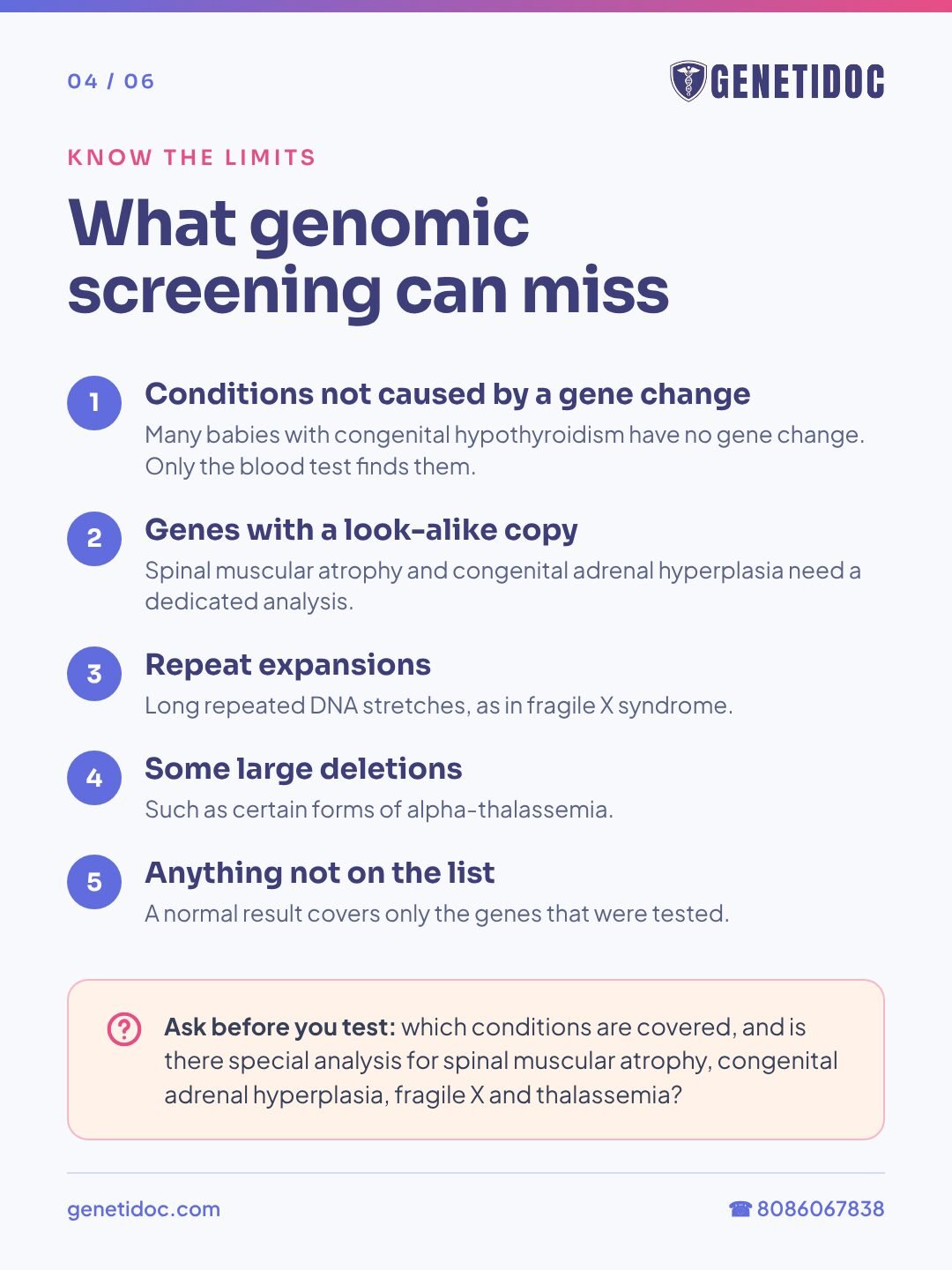
- Conditions not caused by a gene change. Many babies with congenital hypothyroidism have a thyroid gland that did not form properly for reasons unrelated to an inherited variant. A DNA test cannot see this. Only the blood hormone test can.
- Genes with a near-identical “twin” copy. Some genes sit next to look-alike copies in the DNA. Standard sequencing can struggle to tell them apart. This affects congenital adrenal hyperplasia (the CYP21A2 gene) and spinal muscular atrophy (the SMN1 gene). Spinal muscular atrophy is detected reliably only when the laboratory runs a dedicated analysis for it.
- Repeat expansions. In conditions like fragile X syndrome, a short piece of DNA is repeated too many times. Standard sequencing reads DNA in short fragments and often cannot measure these long repeats.
- Some large deletions. Certain forms of alpha-thalassemia are caused by missing pieces of DNA that standard methods may not detect.
- Conditions not on the list. A genomic screen only reports the genes it was designed to report. A normal result says nothing about conditions outside that list.
- Variants science does not yet understand. Indian and South Asian populations are still under-represented in the large international DNA databases that laboratories rely on. This can make some variants harder to interpret for Indian babies.
Before choosing a test, it is reasonable to ask the laboratory or your genetic counselor directly: which conditions are covered, and does the test include special analysis for spinal muscular atrophy, congenital adrenal hyperplasia, fragile X and thalassemia?
How to read a normal result
| “A negative result means no reportable finding in what was tested. It does not mean your child will never develop a genetic condition. If your child develops new symptoms later, please tell your doctor, even if the screening result was normal.”
— Team Genetidoc |
Which Babies May Benefit Most?
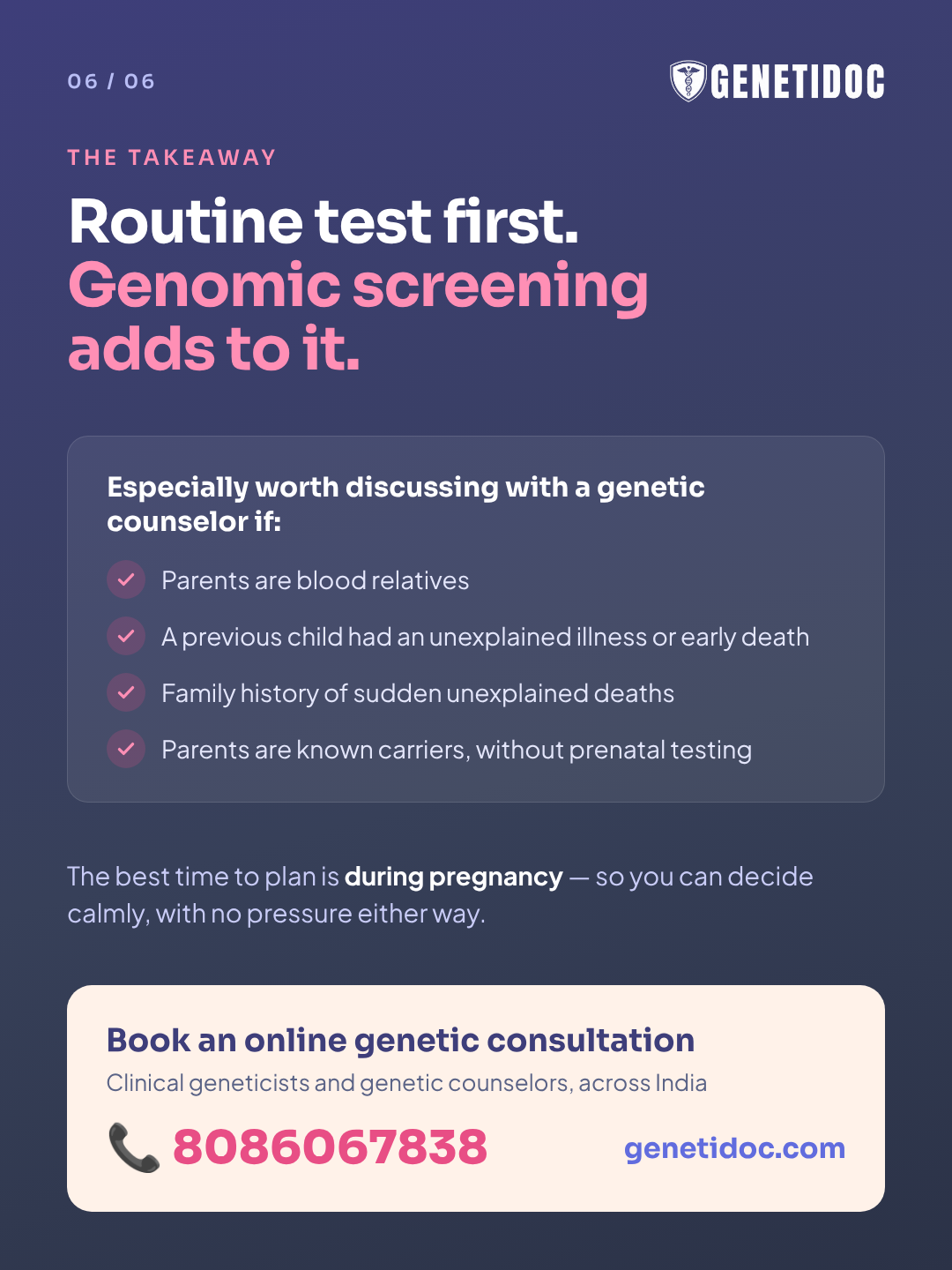
Any parent can consider genomic newborn screening. It may be especially worth discussing with a genetic counselor if:
- The parents are blood relatives. Consanguineous marriage, such as between cousins, raises the chance that a baby inherits two copies of the same harmful variant, causing a recessive condition.
- A previous child had an unexplained illness, developmental problem or early death.
- The family has a history of sudden unexplained deaths, including young adults or infants.
- The parents are known carriers of a condition, but prenatal testing was not done.
- The baby has not had routine newborn screening, or the family wants broader coverage than their local panel offers. In this case the routine test should still be done first.
When a different test is the better choice
- If the family’s genetic variant is already known: targeted testing for that specific variant is faster, more accurate and usually less expensive than a broad screen.
- If the baby is already unwell: a sick newborn, for example in the newborn intensive care unit, needs diagnostic testing chosen by the treating team, such as rapid exome or genome sequencing. Screening is designed for healthy-looking babies, not for finding the cause of an illness that has already started.
- If routine screening shows an abnormal result: the next step is confirmatory testing for that specific condition, guided by the paediatrician.
What Gets Reported, and What Does Not
A baby’s DNA contains far more information than a screening test needs. Responsible genomic newborn screening limits what is reported, to protect the child’s wellbeing and future choices.
- Adult-onset conditions are not tested in newborns. Conditions such as hereditary breast and ovarian cancer usually do not need any action in childhood. Testing a baby for them takes away that child’s own right to decide as an adult.
- Variants of uncertain significance are generally not reported. These are DNA changes where science cannot yet say whether they are harmful. Reporting them in a healthy baby would cause worry without any clear action.
- Carrier status is reported only if parents choose. Many babies carry one copy of a variant for a recessive condition. Carriers are usually healthy. Whether to receive this information should be discussed and decided in counseling before the test.
| “For most adult-onset conditions, we offer testing only after a person turns 18, so they can make that decision for themselves. A newborn screen should focus on what helps the child now.”
— Team Genetidoc |
What Happens After a Positive Result?
A positive genomic screening result is not a final diagnosis. It is a signal that needs to be checked. In the GUARDIAN study, 92% of babies with a true positive result went on to receive a confirmed diagnosis.
The usual steps are:
- Post-test genetic counseling to explain the result, what the condition is, and what happens next.
- Confirmatory testing, which may include a repeat DNA test, blood tests, enzyme tests, an ECG or other investigations depending on the condition.
- Referral to the right specialist, such as a paediatric cardiologist, hepatologist, immunologist, neurologist or metabolic specialist.
- A care plan, which may involve treatment, monitoring, or things to avoid, such as certain medicines.
- Family testing. Parents may be tested to understand how the variant was inherited and what it means for future pregnancies. Other relatives may be offered targeted testing for the same variant.
Illustrative Scenarios
The following are illustrative scenarios created to explain common situations. They are not the stories of real patients.
Scenario 1: A hidden heart rhythm condition
A healthy baby’s routine screening is normal. The parents choose genomic screening, which flags a variant in a gene linked to long QT syndrome. An ECG confirms a prolonged heart rhythm interval. The baby is referred to a paediatric cardiologist, who starts preventive management and gives the family a list of medicines to avoid. Testing the parents shows the father carries the same variant. He had fainted twice as a teenager but was never investigated. He is now referred for his own cardiac evaluation.
Scenario 2: A family with a previous loss
A couple who are first cousins lost their first child to repeated severe infections in infancy. No diagnosis was made. For their second baby, they meet a genetic counselor during pregnancy and plan for early testing. Genomic screening soon after birth shows no reportable finding in the conditions tested, including the severe immune deficiency genes on the panel. The counselor explains that this is reassuring for those conditions, though not a guarantee against everything, and advises the family to report any repeated serious infections promptly. The counselor discusses how testing could still clarify what happened to their first child, if any stored sample is available.
Common Misconceptions
| Myth: “Genomic screening tells you every disease my baby will ever get.” Fact: It checks a selected list of childhood conditions. It does not predict common illnesses, adult-onset diseases or conditions outside the list.Myth: “If we do genomic screening, we can skip the heel-prick test.” Fact: The two tests find different things. Some common treatable conditions are found only by the blood test. Myth: “My baby looks healthy, so there is no point.” Myth: “A positive result means my baby definitely has the disease.” Myth: “A normal result means my baby can never have a genetic condition.” |
The Emotional Side: What Parents Worry About
Parents of a newborn are already tired and anxious. It is natural to worry about adding a genetic test. Common concerns include:
- “What if we find something frightening?” A well-designed screen reports only conditions where early action helps. Counseling before the test explains what could be found and how it would be handled.
- The wait for confirmation. The days between a positive screen and confirmatory testing can be stressful. Clear next steps and a named contact help.
- Parents sometimes blame themselves when a condition is inherited. No parent chooses the genes they pass on. Genetic counseling makes this clear.
- Parents rightly want to know who can see their baby’s DNA data and for how long it will be stored.
| “Our role as counselors is to inform, not to direct. Some families choose genomic screening, some decide it is not for them. Both are valid decisions, and the choice belongs to the parents.”
— Team Genetidoc |
Questions to ask about consent and data
- How long will my baby’s DNA sample and data be stored?
- Will it be used for research, and can I say no?
- Can I withdraw my consent later?
- Can the data be reanalysed in future if my child develops symptoms?
A clinical consent form should answer these clearly. Parents can withdraw consent at any time.

Why the Test Alone Is Not Enough
Genomic newborn screening generates a large amount of DNA data. The real value comes from what happens around the test:
- The right test: knowing which conditions are covered, and what the method can and cannot detect.
- An accredited laboratory: with careful variant selection, quality checks and confirmation of findings.
- Expert interpretation: a clinical geneticist who reads the result in the context of the baby and the family history.
- Counseling before and after: so that parents understand the choices, the results and the next steps.
- A clear referral pathway: so that a positive result quickly reaches the right specialist.
A low-cost test that hands over a report without explanation or follow-up can leave families either falsely reassured or unnecessarily frightened.
| “A genetic report only helps a child when someone turns it into a plan. Interpretation, counseling and follow-up are what make a newborn screen genuinely useful.”
— Team Genetidoc |
Cost and Practical Points in India
- Cost: genomic newborn screening is a private, self-paid test in India. Costs vary depending on the number of conditions covered and the method used. A targeted panel usually costs less than an exome- or genome-based test.
- Turnaround: gene panels usually take about 2 to 4 weeks. Exome-based tests can take 1 to 2 months.
- Timing: earlier is better, ideally in the first weeks of life, so that action can be taken before symptoms. It can still be useful later in infancy.
- Sample collection: depending on the test, a small blood sample or cheek swab can often be collected at home.
- Best time to plan: during pregnancy. Discussing options with a genetic counselor before delivery gives parents time to decide calmly.
Frequently Asked Questions
What is genomic newborn screening?
It is a DNA test for newborns that checks a selected list of genes linked to serious childhood conditions that can be treated or managed early.
Is genomic newborn screening the same as the heel-prick test?
No. The heel-prick test measures chemicals and hormones in the blood. Genomic screening reads the baby’s DNA. They find different conditions.
Does genomic screening replace routine newborn screening?
No. Routine screening is still needed, because some treatable conditions, such as many cases of congenital hypothyroidism, are not caused by gene changes.
Which conditions does routine newborn screening cover in India?
Commonly congenital hypothyroidism, congenital adrenal hyperplasia, G6PD deficiency, galactosemia and biotinidase deficiency. Some panels include more.
What extra conditions can genomic screening find?
Examples include inherited heart rhythm conditions, Wilson disease, severe immune deficiencies, some inherited hearing loss and some treatable seizure conditions.
What can genomic newborn screening miss?
Non-genetic conditions, conditions not on the list, repeat expansions such as fragile X, and genes that are hard to read, such as those for spinal muscular atrophy and congenital adrenal hyperplasia unless special analysis is done.
When should genomic newborn screening be done?
As early as possible, ideally in the first weeks of life. Planning during pregnancy helps.
How long do results take?
Gene panels usually take about 2 to 4 weeks. Exome-based tests can take 1 to 2 months.
Will genomic screening test my baby for adult diseases like cancer?
It should not. Testing for adult-onset conditions is generally left until the child is 18 and can decide for themselves.
Does a positive result mean my baby has the condition?
Not necessarily. A positive screening result needs confirmatory testing and a specialist review before a diagnosis is made.
Does a normal result mean my baby has no genetic condition?
No. It means no reportable finding in what was tested. New symptoms later should always be checked.
Is genomic newborn screening useful if parents are related?
It can be especially worth discussing, because consanguineous marriage raises the chance of recessive genetic conditions. A genetic counselor can advise on the best test.
Key Takeaways
- Routine newborn screening measures blood chemicals. Genomic newborn screening reads DNA. They find different conditions.
- Genomic screening adds to the heel-prick test. It does not replace it.
- In large studies, genomic screening found serious, treatable conditions that standard screening missed.
- It has real limits, including non-genetic conditions, repeat expansions and genes that are hard to read.
- A good test focuses on childhood conditions where early action helps, and avoids reporting adult-onset and uncertain findings.
- Counseling before and after the test is what turns a result into a plan for your baby.
| Expecting a baby, or recently welcomed one, and wondering whether genomic newborn screening is right for your family?
Our clinical geneticists and genetic counselors can review your family history, explain what routine and genomic screening each cover, and help you decide calmly, with no pressure either way. Consultations are available online across India. If testing is right for your baby, we can guide you to an appropriate test and arrange home sample collection where available.
|
Book a newborn screening counseling consultation.
Join the Conversation
Related Reading on Genetidoc
- Chromosomal Microarray or Whole Exome Sequencing: Which First?
- Pompe Disease: A Genetic Disorder of Muscle and Metabolism
- Understanding Pitt-Hopkins Syndrome
- Noonan Syndrome: Symptoms, Causes and Genetic Testing Explained
- Developmental Delay: When to Consider a Genetic Evaluation
- What Defines a Rare Genetic Disease? A Clear Guide
References
- Ziegler A, Koval-Burt C, Kay DM, et al. Expanded newborn screening using genome sequencing for early actionable conditions (GUARDIAN study). Journal of the American Medical Association. 2024.
- Genomics England and NHS England. The Generation Study: study protocol, ISRCTN10894729.
- Chen T, Fan C, Huang Y, et al. Genomic sequencing as a first-tier screening test and outcomes of newborn screening. JAMA Network Open. 2023.
- Huang Z, Zhou W. Next-generation sequencing in newborn screening: current status, challenges, and future perspectives. Pediatric Investigation. 2026.
- Woerner AC, Gallagher RC, Vockley J, Adhikari AN. The use of whole genome and exome sequencing for newborn screening: challenges and opportunities for population health. Frontiers in Pediatrics. 2021;9:663752.
- Kapoor S. Newborn screening: the roadmap for India. Molecular Cytogenetics. 2014;7(Suppl 1):I41.
- Indian Council of Medical Research Task Force on Inherited Metabolic Disorders. Newborn screening for congenital hypothyroidism and congenital adrenal hyperplasia. Indian Journal of Pediatrics. 2018;85:935–940.
- Indian Society for Pediatric and Adolescent Endocrinology. Newborn screening guidelines for congenital hypothyroidism in India. Indian Journal of Pediatrics. 2018;85:440–453.