
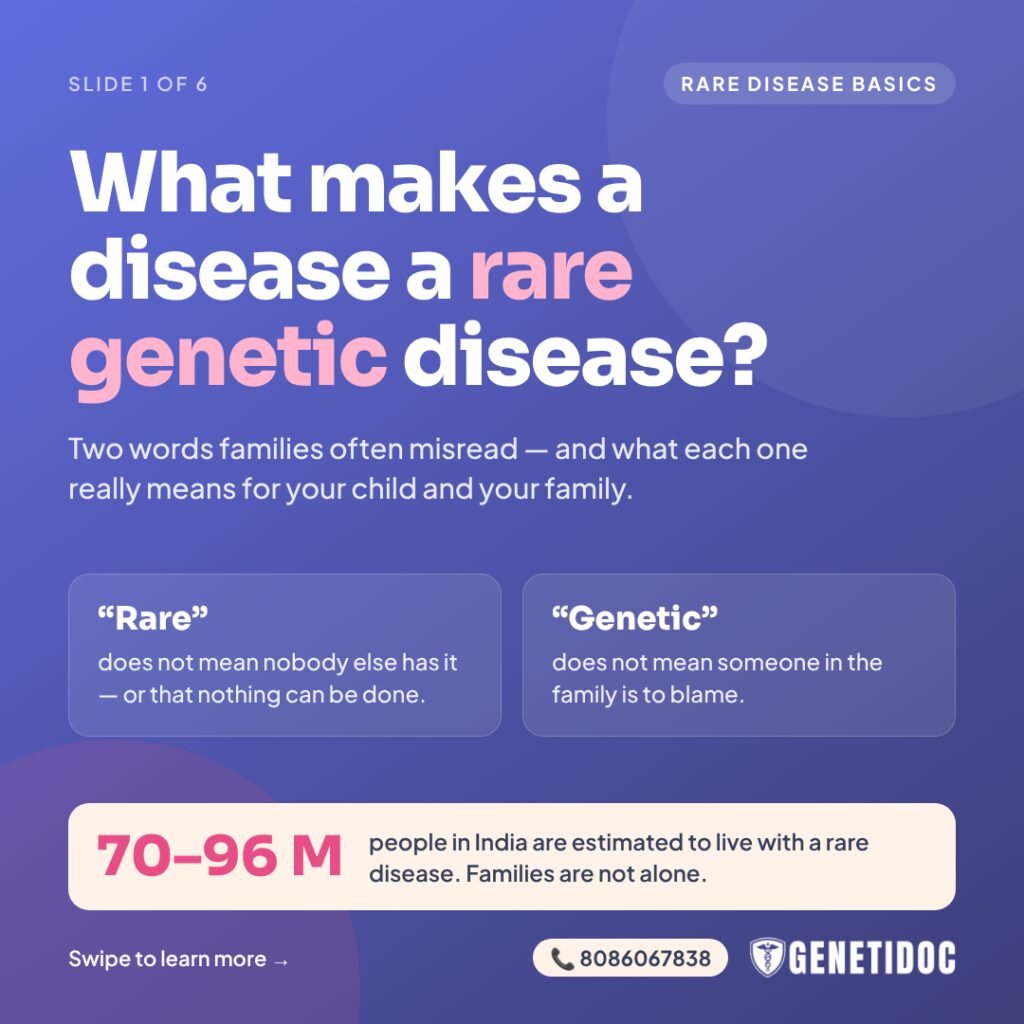
Sometimes a doctor says the words “rare genetic disease” for the first time. Families usually hear two things in that sentence. “Rare” sounds like nobody else has it, nobody understands it, and nothing can be done. “Genetic” sounds like someone in the family is to blame.
Neither of these is usually true.
This guide explains what actually makes a disease “rare,” what makes it “genetic,” how India defines rare diseases, which signs should make you think of one, and what a diagnosis can change for your family.
| Quick answer
A rare genetic disease is a condition that affects only a small number of people in a population and is caused by a change in a person’s genes or chromosomes. There is no single worldwide cut-off for “rare.” The World Health Organization uses a working figure of 1 or fewer in 1,000 people. The European Union uses 5 or fewer in 10,000, and the United States uses fewer than 200,000 people nationally. India has no fixed number yet. Its National Policy for Rare Diseases, 2021 instead groups listed conditions by the kind of treatment they need. About 7 in 10 rare diseases are genetic, and about 7 in 10 begin in childhood. |
What makes a disease “rare”?
A disease is called rare when it affects a small number of people compared with the general population. How small depends on who is defining it. Most definitions use prevalence, which means the number of people living with the condition at a given time.
Some definitions also consider whether the disease is serious, long-lasting (chronic), life-threatening, or lacking good treatment.
How different countries define “rare”
| Region or body | Definition of a rare disease |
| World Health Organization (working figure) | 1 or fewer per 1,000 people, usually lifelong and debilitating |
| European Union | 5 or fewer per 10,000 people, and life-threatening or chronically debilitating |
| United States | Fewer than 200,000 people in the country (about 1 in 1,500) |
| Japan | Fewer than 50,000 people (about 1 in 2,500) |
| India | No official number yet. The national policy lists specific diseases and groups them by type of treatment. |
The European Union also uses the term “ultra-rare” for conditions affecting fewer than about 1 in 50,000 people.
“Rare” diseases are not rare when counted together
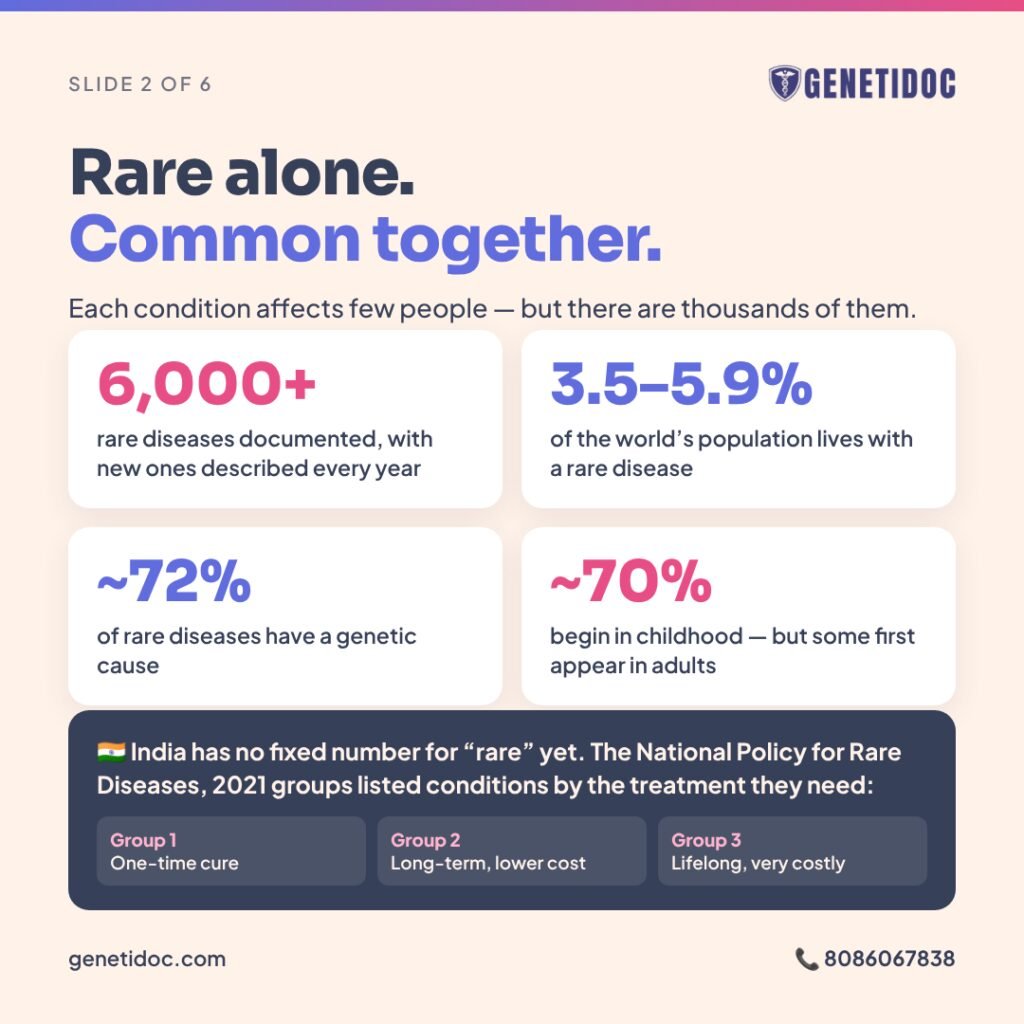
Each rare disease affects few people. But there are more than 6,000 of them. A large analysis of the Orphanet database estimated that 3.5% to 5.9% of the world’s population lives with a rare disease at any given time. That is roughly 263 to 446 million people.
Estimates for India range from about 70 to 96 million people. In other words, families living with a rare disease are not alone. They are part of a very large community.
You may also hear the term “orphan disease.” It describes a rare disease that has received little research or drug development, often because the number of patients is small. The medicines developed for these conditions are called orphan drugs.
What makes a rare disease “genetic”?
A rare disease is genetic when it is caused by a change in a person’s DNA. This could be a change in a single gene, a missing or extra piece of a chromosome, or a change in the DNA of mitochondria, the energy-producing parts of our cells.
In the Orphanet analysis of 6,172 rare diseases, 71.9% were genetic. The figure of “about 80%” is also widely quoted. Either way, most rare diseases have a genetic cause.
The remaining rare diseases include:
- Rare infections
- Rare autoimmune conditions, where the immune system attacks the body
- Rare cancers that are not inherited
- Rare conditions caused by poisoning or environmental exposure
The difference matters. A genetic cause can affect other family members and future pregnancies. A non-genetic rare disease usually does not.
“Genetic” does not always mean “inherited”
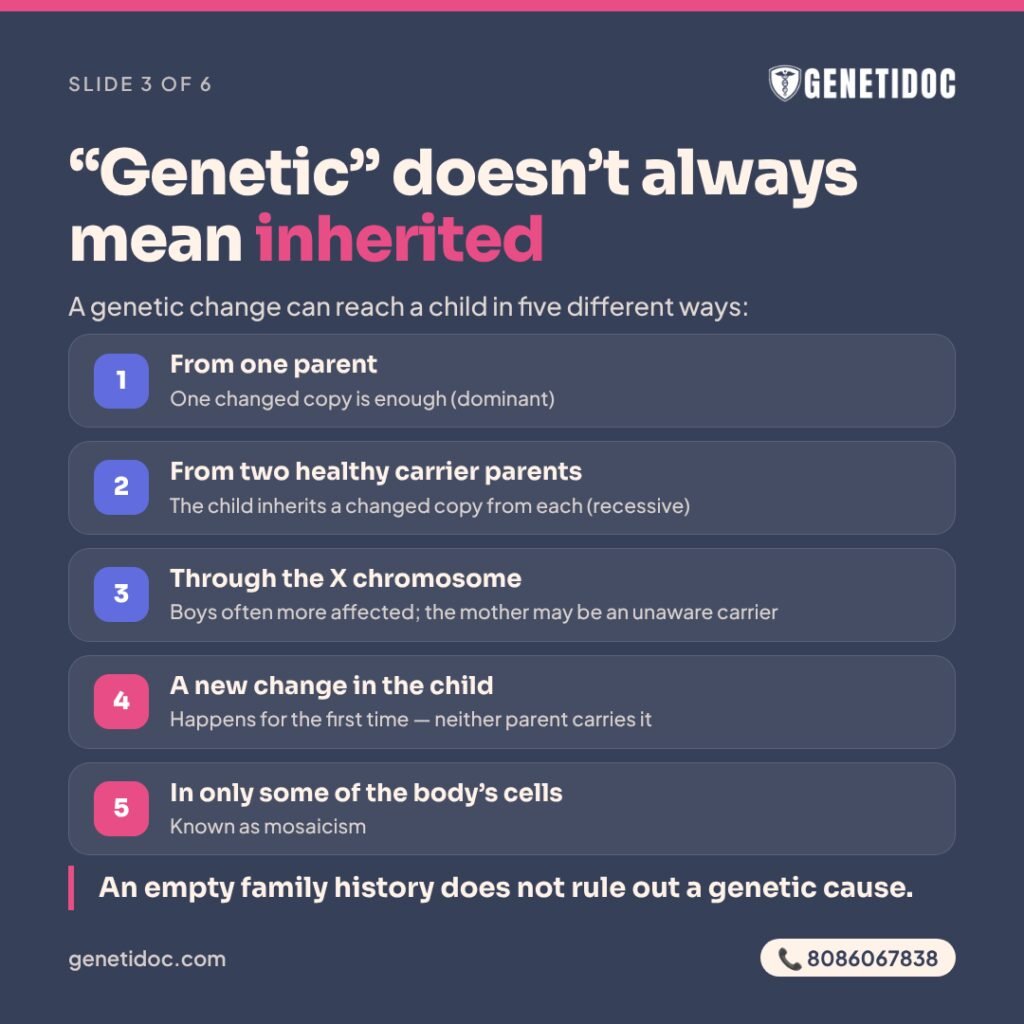
This is one of the most important points for families to understand. A genetic disease can reach a person in different ways:
- Inherited from one parent (dominant inheritance). One changed copy of the gene is enough to cause the condition.
- Inherited from both parents (recessive inheritance). Both parents are healthy carriers. A child who inherits the changed copy from each parent is affected.
- Inherited through the X chromosome (X-linked inheritance). Boys are often more severely affected, and the mother may be an unaware carrier.
- A new change that happens for the first time in the child (de novo). Neither parent carries it.
- A change present in only some of the body’s cells (mosaicism).
Because of this, a family can have no history at all of a condition and still have a child with a genetic disease.
| “‘Nobody in our family has this’ is one of the first things parents tell us. A recessive change can stay hidden for generations, and a new change may never have existed in the family before. An empty family history does not rule out a genetic cause.”
— Dr. Roshan Daniel, Clinical Geneticist, Genetidoc |
Rare in one place, common in another
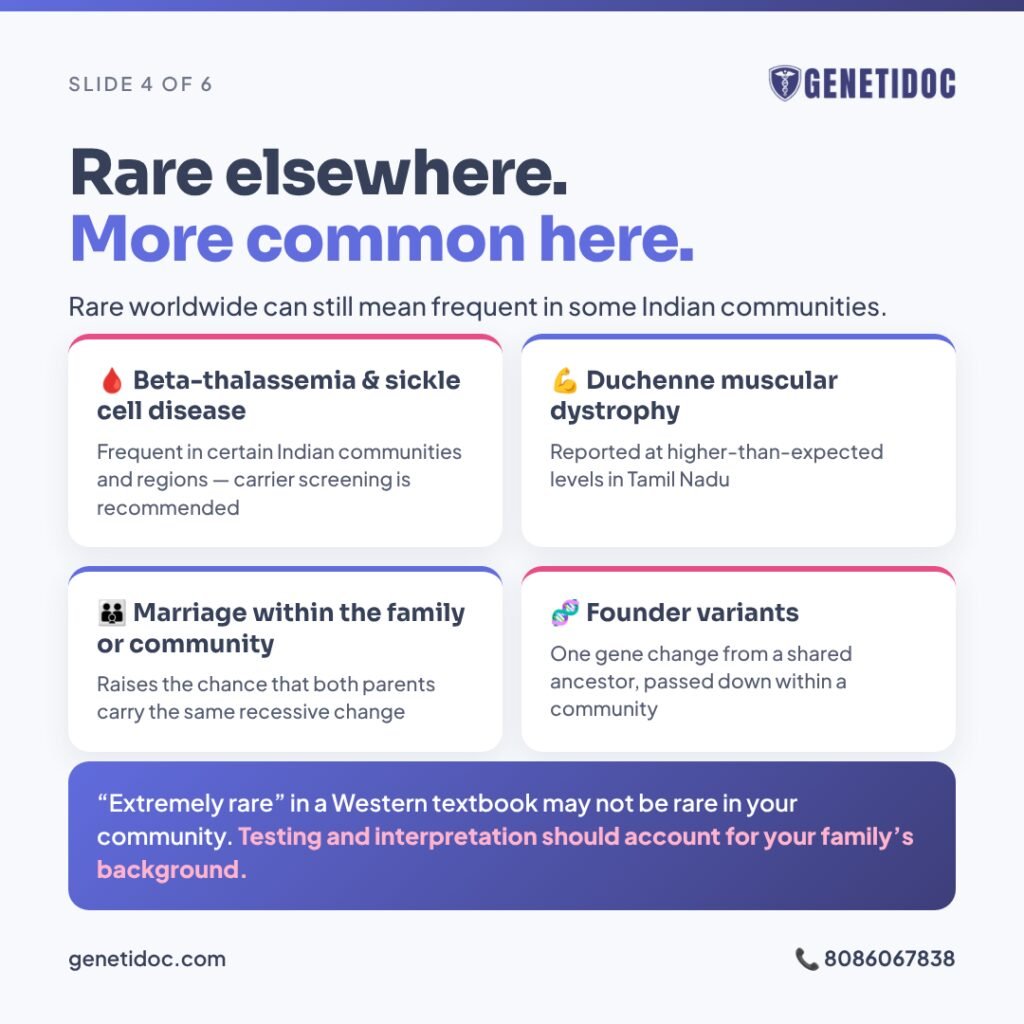
A disease can be rare worldwide but much more common in a particular country, region or community. This is especially true for genetic diseases.
- Cystic fibrosis is relatively common in people of European ancestry, but much less common in most of Asia.
- Beta-thalassemia and sickle cell disease are uncommon in many parts of the world. In India, they are frequent in certain communities and regions, which is why carrier screening is recommended there.
- Duchenne muscular dystrophy has been reported at higher-than-expected levels in Tamil Nadu.
- Some conditions are linked to founder variants. A founder variant is a single gene change that came from a shared ancestor and is passed down within a community. Some Indian communities that marry within the group (endogamy) have founder variants for specific rare conditions.
Consanguineous marriage, meaning marriage between blood relatives, is common in some parts of South India. It raises the chance that both parents carry the same recessive gene change. Endogamy has a similar effect in communities in North India and elsewhere.
This has a practical consequence. A condition described as “extremely rare” in a Western textbook may not be so rare in your community. Testing and interpretation should take your family’s background into account.
How India defines rare diseases
India does not yet have an official numerical definition of a rare disease. The main reason is that reliable prevalence data for most rare diseases in India does not exist yet. The Indian Council of Medical Research has started a hospital-based National Registry for Rare Diseases to collect this data.
Instead, the National Policy for Rare Diseases, 2021 lists specific diseases and places them in three groups based on treatment:
- Group 1: Conditions that can be treated with a one-time curative treatment. For example, some conditions treatable by stem cell transplantation (hematopoietic stem cell transplantation) or organ transplantation.
- Group 2: Conditions that need long-term or lifelong treatment at a relatively lower cost. For example, some metabolic conditions managed with special diets or medical foods.
- Group 3: Conditions that have a definitive treatment that is very expensive and lifelong. For example, lysosomal storage disorders such as Gaucher disease, Pompe disease and Fabry disease, which can be treated with enzyme replacement therapy.
What support is available under the policy?
- According to the Ministry of Health and Family Welfare, the policy covers 63 listed rare diseases.
- Financial assistance of up to ₹50 lakh per patient is available for treatment at notified Centres of Excellence. This is a one-time ceiling per patient, not a yearly amount. For lifelong therapies such as enzyme replacement, which can cost several lakh to over a crore of rupees a year, the assistance may not cover the full course of treatment.
- The number of Centres of Excellence, which are major government tertiary hospitals, has grown from 8 to 15, including centres in North-East India.
- Medicines imported for listed rare diseases, either by an individual for personal use or through a Centre of Excellence, are exempt from basic customs duty and integrated goods and services tax.
An important limit: many rare genetic diseases are not on the policy list. A condition can be medically rare and genetic without qualifying for support under the policy. Your clinical geneticist can tell you whether your family’s condition is listed and how to approach a Centre of Excellence.
Do rare genetic diseases only affect children?
No, although most begin in childhood. In the Orphanet analysis, about 70% of rare diseases begin only in childhood. Many are present from birth, even if signs appear later.
Some rare genetic diseases first show symptoms in adolescence or adulthood. Examples include:
- Huntington disease, which affects movement, thinking and mood, usually from middle age
- Fabry disease, which may first appear as kidney, heart or nerve problems in adults
- Wilson disease, a copper build-up condition that can affect the liver and brain in teenagers and young adults
- Hereditary transthyretin amyloidosis, which can affect the nerves and heart in adults
- Marfan syndrome, which can remain undiagnosed until an eye or major blood vessel problem appears
- Li-Fraumeni syndrome, a rare hereditary cancer condition linked to the TP53 gene
Adults with a long-standing, unexplained condition affecting several parts of the body can still benefit from a genetic evaluation.
Warning signs that suggest a rare genetic disease
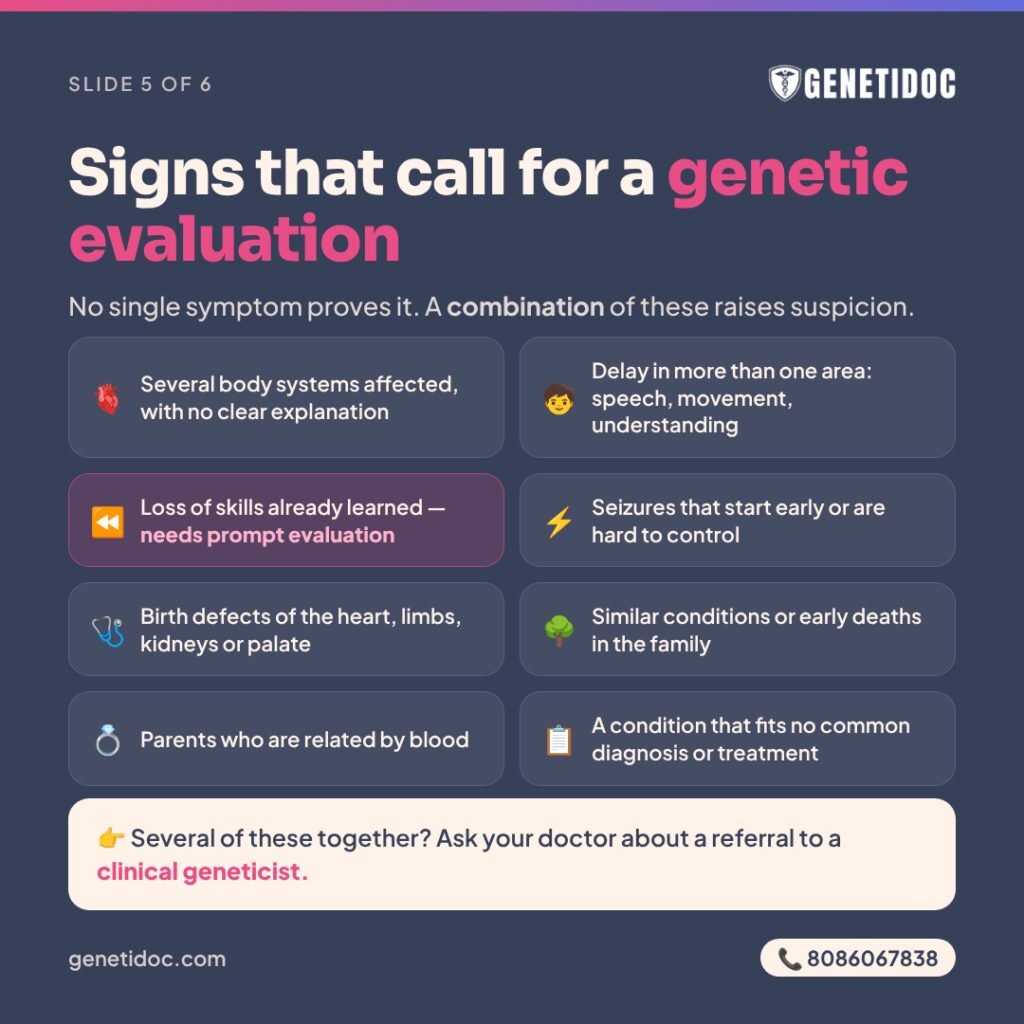
No single symptom proves a rare genetic disease. Doctors become more suspicious when they see a combination of the following:
- Several body systems are affected, for example, the brain, heart, kidneys, eyes or skeleton, without one clear explanation
- Developmental delay in more than one area, such as speech, movement and understanding
- Loss of skills a child had already learned (regression). This needs prompt evaluation, because some causes are treatable.
- Seizures that start early or are hard to control
- Birth defects, such as heart, limb, kidney or palate differences
- Unusual facial features or body proportions compared with the rest of the family
- Unusual growth: very short or very tall stature, or an unusually small or large head
- Symptoms that worsen after illness, fasting or certain foods, which can point to a metabolic condition
- The same or a similar condition in other family members, especially if it repeats across generations
- Unexplained deaths of babies, children or young adults in the family
- Parents who are related by blood
- A condition that does not respond to standard treatment, or does not fit any common diagnosis
- Disease at an unusually young age, for example, cancer, stroke or heart disease much earlier than expected
If your child or a family member has several of these features, ask your doctor about a referral to a clinical geneticist.
Why rare genetic diseases are hard to diagnose
Families often spend years searching for an answer. Doctors call this the diagnostic odyssey. The Global Commission to End the Diagnostic Odyssey for Children with a Rare Disease estimates that it takes an average of about five years to reach an accurate diagnosis, even in countries with well-developed health systems.
There are several reasons:
- Each condition is uncommon. Most doctors may see a particular rare disease only once in their career, or never.
- Symptoms overlap with common conditions. Early signs are often treated one at a time by different specialists.
- The same disease can look different in different people, even within one family.
- Symptoms change with age, so the full picture may only become clear over time.
- Access to clinical geneticists is limited, especially outside large cities.
- The wrong test may be chosen, or a normal result may be taken as final.
In India, families often reach a geneticist only after “wait and watch” advice, multiple specialists and repeated scans. A careful genetic evaluation can often shorten this journey.
How a rare genetic disease is diagnosed
Diagnosis is not just a laboratory test. It combines a detailed clinical evaluation with the right genetic test and expert interpretation.
The diagnostic pathway, step by step
- Detailed history. Pregnancy, birth, development, symptoms over time, and earlier reports.
- Family tree (pedigree). At least three generations, including miscarriages, early deaths and whether parents are related.
- Physical examination. The geneticist looks for features that point toward specific conditions.
- Supporting tests. Depending on the features, these may include metabolic or enzyme tests, imaging, heart tests, or eye and hearing checks.
- Choosing the genetic test. The test is matched to how strongly the features point to one condition.
- Pre-test genetic counseling. What the test can and cannot find, possible results, and whether you want to know about unrelated but medically important findings (secondary findings).
- Interpretation and post-test counseling. The result is explained in the context of the person’s symptoms and family.
- Family testing, planning and follow-up.
Which genetic test, and why?
| Test | When it is used | Typical turnaround |
| Single-gene test | The features clearly point to one gene, for example SMN1 for spinal muscular atrophy or DMD for Duchenne muscular dystrophy | About 1 to 3 weeks, depending on the gene and method |
| Multi-gene panel | The features fit a group of conditions caused by several possible genes | About 3 to 4 weeks |
| Exome sequencing | Many possible causes, or features that do not fit one clear group | About 1 to 2 months |
| Genome sequencing | An escalation step when a genetic condition is strongly suspected but earlier testing was negative or incomplete | About 1 to 3 months, including interpretation |
| Chromosome tests (karyotype, chromosomal microarray) | Suspected extra, missing or rearranged chromosome material | Varies by test |
| Special tests | Conditions that standard sequencing cannot see well, such as fragile X syndrome (a repeat condition) or some imprinting conditions | Fragile X: about 21 days |
Single-gene tests usually cost the least. Exome sequencing costs more. Genome sequencing and trio exome sequencing, in which the child and both parents are tested together, sit in a similar, higher range. Your genetic counselor will explain the cost of the recommended test before anything is ordered.
Why some conditions need special tests: exome sequencing reads DNA in short pieces. Some genetic changes, such as long repeated stretches of DNA (as in fragile X syndrome) or the gene changes behind spinal muscular atrophy and some forms of thalassemia, cannot be measured accurately that way. A geneticist who knows these blind spots will choose the right test first.
How often does testing find the answer?
Large studies show that exome sequencing finds a diagnosis in about 1 in 3 children with a suspected genetic condition. Genome sequencing finds slightly more. Chromosomal microarray alone finds about 1 in 10. The chance is higher when the features are clearly genetic and the right test is chosen.
This also means that many people do not get an answer from the first test. That is not the end of the search.
| “A negative report means there was no reportable finding in what was tested. It does not mean the condition is not genetic. Science adds new disease genes every year, so we ask families to keep their report and raw data and come back for a review.”
— Dr. Roshan Daniel, Clinical Geneticist, Genetidoc |
Understanding the three main types of result
- Positive: a disease-causing change (a pathogenic or likely pathogenic variant) that explains the condition.
- Negative: no reportable finding in what was tested. The cause may lie in an area the test could not see, or in a gene not yet discovered.
- Variant of uncertain significance: a change that science cannot yet classify. It is not a diagnosis and is not used to test healthy relatives or make pregnancy decisions.
After a negative or uncertain exome, Team Genetidoc usually advises a review and reanalysis of the existing data after 6 months to 1 year, or sooner if new symptoms appear. Reanalysis takes about 3 to 4 weeks, and the whole test usually does not need to be repeated.
When genetic testing is useful, and when it may not be
Testing is most likely to help when:
- Several body systems are involved
- There is developmental delay, regression or early seizures
- More than one family member is affected
- Parents are related by blood
- The family is planning another pregnancy
- A relative already has a confirmed genetic diagnosis
Testing may be less useful when:
- There is a clear, well-documented non-genetic cause, such as a serious brain infection in a child who was developing normally before
- A single mild feature is present with no other concerns
- The test is chosen out of curiosity, without a clinical question. Genetidoc does not offer whole genome or exome sequencing to healthy people with no personal or family warning signs. Instead, we take a full history and suggest targeted options where appropriate.
What a diagnosis can change
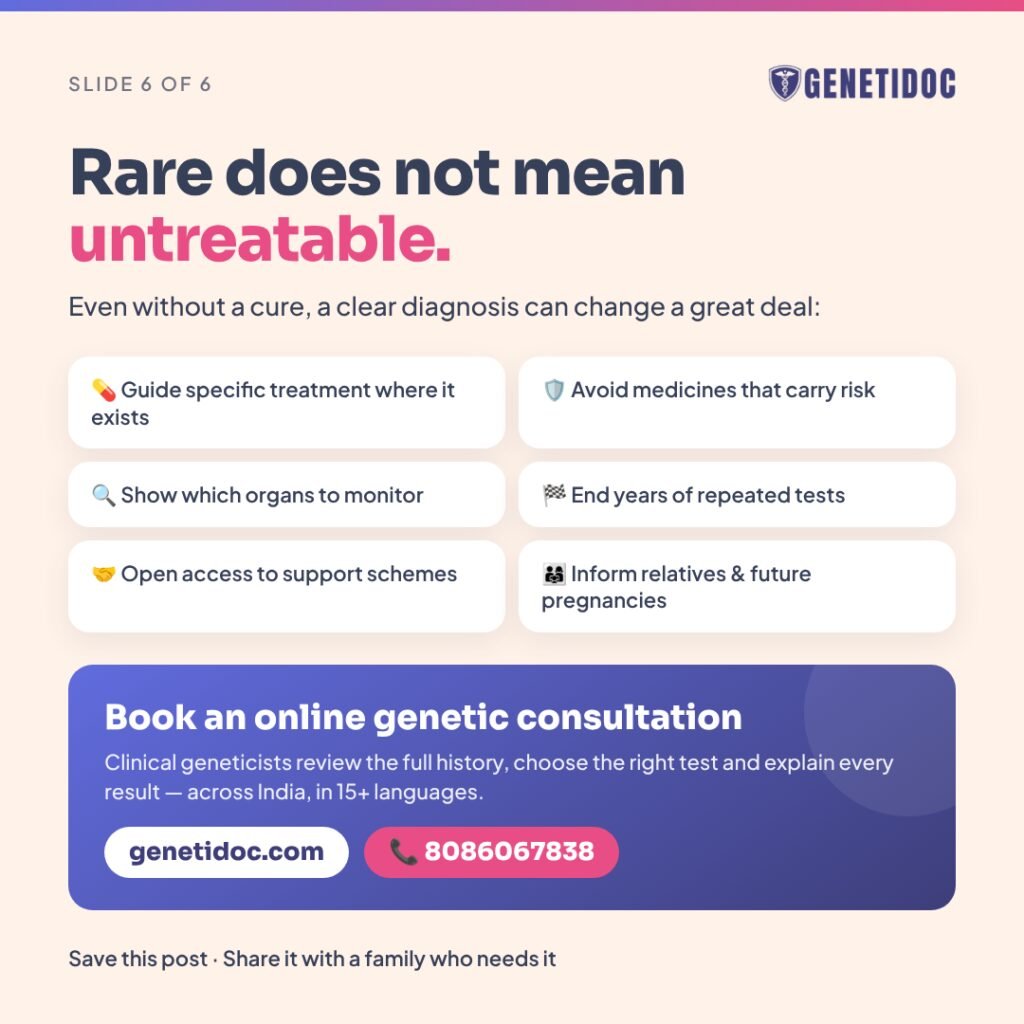
Families often ask, “If it is rare and has no cure, why do we need a name for it?” In practice, a diagnosis can change a great deal.
- Specific treatment, where it exists. Some rare genetic diseases have targeted treatments, such as enzyme replacement therapy for some lysosomal storage disorders, special diets for some metabolic conditions, gene-based therapies for spinal muscular atrophy, or stem cell transplantation for some immune and blood conditions.
- Avoiding harm. Some medicines, anaesthetics or activities are risky in certain conditions. Knowing the diagnosis helps doctors avoid them.
- Screening for hidden problems. Many conditions affect organs silently. A diagnosis tells doctors what to monitor, such as the heart, kidneys, eyes or hearing.
- An end to the search. A clear answer can stop years of repeated tests and hospital visits.
- A realistic picture of the future, which helps with school, work and care planning.
- Access to support. This may include the national rare disease policy, disability certification, patient support groups and clinical trials where available.
- Answers for the wider family, including relatives who may be at risk and couples planning a pregnancy.
Effective, specific therapies currently exist for only a small fraction of rare diseases, estimated at under 5%. But “no cure” is not the same as “nothing can be done.” Good supportive care, therapy and monitoring can make a real difference to quality of life.
| “Rare does not mean untreatable, and it certainly does not mean unimportant. Even when there is no cure, a diagnosis tells us what to watch for, what to avoid, and what it means for the rest of the family.”
— Dr. Roshan Daniel, Clinical Geneticist, Genetidoc |
What it means for family members and future pregnancies
Once the exact genetic change is known, the risk to relatives and future children can be estimated accurately. It depends on how the condition is inherited:
- Dominant condition: each child of an affected parent has a 1 in 2 (50%) chance of inheriting it.
- Recessive condition: when both parents are carriers, each pregnancy has a 1 in 4 (25%) chance of being affected.
- X-linked condition with a carrier mother: each son has a 1 in 2 chance of being affected, and each daughter has a 1 in 2 chance of being a carrier.
- New (de novo) change: the chance of it happening again is usually low, but not zero, because a parent can rarely carry the change in some of their egg or sperm cells.
Testing relatives
When a disease-causing change is found, at-risk relatives can have a targeted test for that one change. This is called cascade testing. Targeted testing for a known familial change usually takes about one week.
Options for the next pregnancy
- Preimplantation genetic testing with in vitro fertilisation: embryos are tested before transfer.
- Prenatal diagnosis: the baby’s DNA is tested during pregnancy through chorionic villus sampling or amniocentesis. Genetidoc arranges these through partner centres, because we do not currently perform invasive prenatal procedures.
- Natural conception without testing, with full knowledge of the risk.
Planning works best before the next pregnancy begins, because some tests take weeks to prepare. Every decision belongs to the couple. The role of genetic counseling is to inform, not to direct.
Common misconceptions about rare genetic diseases
- “Rare means nobody else has it.” Millions of Indians live with a rare disease. Many specific conditions have patient groups and support networks.
- “Rare means there is no treatment.” Some rare genetic diseases have specific treatments, and almost all benefit from good supportive care.
- “Nobody in our family has it, so it cannot be genetic.” Recessive and new changes often appear with no family history.
- “It is the mother’s fault.” Genetic changes can come from either parent, from both, or from neither. Blame has no medical basis.
- “The test was normal, so it is not genetic.” A normal result covers only what the test was able to see.
- “Rare diseases only affect children.” Many begin in childhood, but some first appear in adulthood.
- “A disease that is rare abroad is rare here too.” Community background can make some conditions much more frequent in India.
The emotional side of a rare diagnosis
A rare diagnosis can bring relief, grief, fear and guilt, sometimes all at once. Parents may face questions or blame from relatives, especially when the parents are related by blood.
Genetic counseling makes space for these feelings. We explain clearly that genetic changes are nobody’s fault. We help families decide how to share information with relatives. After the consultation, families receive a written, individualised summary they can use to explain the result to others.
| “Parents do not choose the genes they pass on, and no one can feel or control a change in their DNA. When families understand this, much of the guilt they have carried for years begins to lift.”
— Dr. Roshan Daniel, Clinical Geneticist, Genetidoc |
Why the right test, laboratory and interpretation matter
In rare diseases, the report is only the beginning. Common problems we see include:
- The wrong first test, for example an exome for a condition that exome sequencing cannot reliably detect
- A negative result treated as final, with no plan for reanalysis
- A variant of uncertain significance read as a diagnosis, causing false worry or false reassurance
- A report interpreted without examining the patient, when a variant only makes sense if it matches the person’s features
- Low-cost testing without counseling, leaving families with a report but no plan
Genetidoc works with accredited partner laboratories that confirm reportable findings. Every result is interpreted by a clinical geneticist and explained through genetic counseling.
| “In rare diseases, the choice of test decides what you can find. A well-chosen test, read alongside the patient’s own story, is worth far more than a bigger test read in isolation.”
— Dr. Roshan Daniel, Clinical Geneticist, Genetidoc |
Illustrative scenarios
The following are composite examples created to explain common situations. They are not real patients.
| Scenario 1: A toddler who stopped making progress
A two-year-old was developing normally, then began losing words and had a coarse facial appearance, a large liver and stiff joints. After several specialist visits, a clinical geneticist suspected a lysosomal storage disorder. Enzyme testing followed by gene testing confirmed a type of mucopolysaccharidosis. The family learned that the condition is recessive, that both parents are carriers, and that the condition is listed under the national rare disease policy. They were guided to a Centre of Excellence for treatment planning and to options for their next pregnancy. |
| Scenario 2: An adult with a long, unexplained medical history
A man in his thirties had burning pain in his hands and feet since childhood, reduced sweating, and now protein in his urine. Each problem had been treated separately. A geneticist connected the features and arranged testing, which confirmed Fabry disease, an X-linked condition. Specific treatment was discussed with his specialists. His mother and sisters were offered targeted testing, and his daughters learned they would inherit the change. |
| Scenario 3: A negative exome that was not the end
A girl with developmental delay and seizures had a negative exome result. Her parents were told to keep the report and return for review. Eighteen months later, reanalysis of the same data linked a change to a newly described gene. Her seizure treatment was adjusted. Parental testing showed the change was new in her, and the family was counseled that the chance of recurrence was low. |
Frequently asked questions
1. What is a rare genetic disease?
It is a condition that affects only a small number of people and is caused by a change in a person’s genes or chromosomes. Most are lifelong, and many begin in childhood.
2. How rare does a disease have to be to count as rare?
It depends on the country. The World Health Organization uses 1 or fewer in 1,000 people, the European Union uses 5 or fewer in 10,000, and the United States uses fewer than 200,000 people nationally.
3. What is the definition of a rare disease in India?
India has no official numerical definition yet. The National Policy for Rare Diseases, 2021 lists specific diseases and groups them by treatment type: one-time curative, long-term lower-cost, and expensive lifelong treatment.
4. How many rare diseases are genetic?
Most of them. An analysis of more than 6,000 rare diseases found about 72% were genetic. The figure of about 80% is also often quoted.
5. How many rare diseases are there?
More than 6,000 are documented, and some estimates exceed 7,000. New ones are described every year as genetic testing improves.
6. Can a rare genetic disease appear in adulthood?
Yes. Conditions such as Huntington disease, Fabry disease, Wilson disease and hereditary transthyretin amyloidosis can first cause symptoms in teenagers or adults.
7. Can a child have a genetic disease if nobody in the family has it?
Yes. The child may have inherited a recessive change from two healthy carrier parents, or have a new change that neither parent carries.
8. Are rare diseases curable?
Most cannot be cured, and specific treatments exist for only a small fraction. However, many can be managed, and some have effective treatments such as enzyme replacement, special diets or stem cell transplantation.
9. What is the difference between a rare disease and an orphan disease?
A rare disease is defined by how few people it affects. An orphan disease is a rare disease that has received little research or drug development, often because of its rarity.
10. Which test diagnoses a rare genetic disease?
It depends on the features. A single-gene test is used when one condition is clearly suspected, a panel when a group of conditions fits, and exome or genome sequencing when the picture is broad or earlier tests were negative.
11. Does marrying a relative increase the risk of rare genetic diseases?
Yes. Consanguineous marriage raises the chance that both parents carry the same recessive change. Carrier screening before pregnancy helps such couples understand their risk.
12. Does the government help with rare disease treatment in India?
Yes, for listed diseases. Under the National Policy for Rare Diseases, a one-time financial assistance of up to ₹50 lakh per patient is available for treatment at notified Centres of Excellence, of which there are now 15.
Key takeaways
- A rare genetic disease affects few people and is caused by a change in genes or chromosomes.
- There is no single global definition of “rare.” India currently groups listed rare diseases by treatment type rather than by a fixed number.
- Most rare diseases are genetic, and most begin in childhood, but some appear in adulthood.
- A disease that is rare elsewhere may be more common in your community.
- No family history does not mean no genetic cause.
- The right test, expert interpretation and genetic counseling matter as much as the test itself.
- A diagnosis can guide treatment, monitoring, family testing and pregnancy planning, even when there is no cure.
What to do next
- Write down the symptoms and when each one started.
- Draw a three-generation family tree, including early deaths, miscarriages and whether parents are related.
- Collect all earlier reports: scans, blood tests, metabolic tests and any genetic reports.
- If a child is losing skills, seek medical evaluation promptly.
- Ask for a consultation with a clinical geneticist before choosing a genetic test.
- If you are planning a pregnancy, start the conversation before conceiving.
| Searching for answers to an unexplained condition in your family?
Book a rare disease genetic evaluation with Genetidoc. Our clinical geneticists will review the full history and earlier reports, connect the features, choose the test most likely to find the answer, and explain every result through genetic counseling. This includes what it means for relatives and future pregnancies. Online consultations are available across India in more than 15 languages, with home sample collection.
|
Book a rare disease genetic evaluation
Have a question about a rare condition in your family? Join the discussion on the Genetidoc rare genetic diseases forum
Related reading
- Skipping Generations: What Families Should Know
- Unusual Inheritance Patterns: Mitochondrial DNA Explained
- Congenital Insensitivity to Pain: When a Child Cannot Feel Pain
- Nutrigenomics: How Your Genes Shape Your Response to Diet
- Parkinson’s Disease: When Genetics Plays a Role
- Single Gene vs Panel Testing Explained
References
- Nguengang Wakap S, Lambert DM, Olry A, et al. Estimating cumulative point prevalence of rare diseases: analysis of the Orphanet database. European Journal of Human Genetics. 2020;28(2):165–173.
- Ministry of Health and Family Welfare, Government of India. National Policy for Rare Diseases, 2021.
- Ministry of Health and Family Welfare. Details of National Policy for Rare Diseases. Press Information Bureau release, 9 August 2024.
- Lok Sabha written reply by the Minister of State for Health and Family Welfare, 6 February 2026: Centres of Excellence under the National Policy for Rare Diseases increased from 8 to 15.
- Ministry of Health and Family Welfare. National Conference on Rare Diseases, New Delhi, 5–6 May 2026. Press Information Bureau.
- Lok Sabha Unstarred Question No. 4610, answered 28 March 2025: National Fund for Rare Diseases. Ministry of Health and Family Welfare.
- Regulation (EC) No 141/2000 of the European Parliament and of the Council on orphan medicinal products. 1999.
- Rare Diseases Act of 2002, United States Public Law 107-280.
- Global Commission to End the Diagnostic Odyssey for Children with a Rare Disease. 2024 End of Year Report.
- Clark MM, Stark Z, Farnaes L, et al. Meta-analysis of the diagnostic and clinical utility of genome and exome sequencing and chromosomal microarray in children with suspected genetic diseases. npj Genomic Medicine. 2018;3:16.
- Manickam K, McClain MR, Demmer LA, et al. Exome and genome sequencing for pediatric patients with congenital anomalies or intellectual disability: an evidence-based clinical guideline of the American College of Medical Genetics and Genomics. Genetics in Medicine. 2021;23(11):2029–2037.
- Richards S, Aziz N, Bale S, et al. Standards and guidelines for the interpretation of sequence variants: a joint consensus recommendation of the American College of Medical Genetics and Genomics and the Association for Molecular Pathology. Genetics in Medicine. 2015;17(5):405–424.
- Observer Research Foundation. Rare Diseases in India: Orphan No More. 2023.
This article is for educational purposes and does not replace a medical consultation. Please speak with a qualified clinical geneticist about your family’s specific situation.