
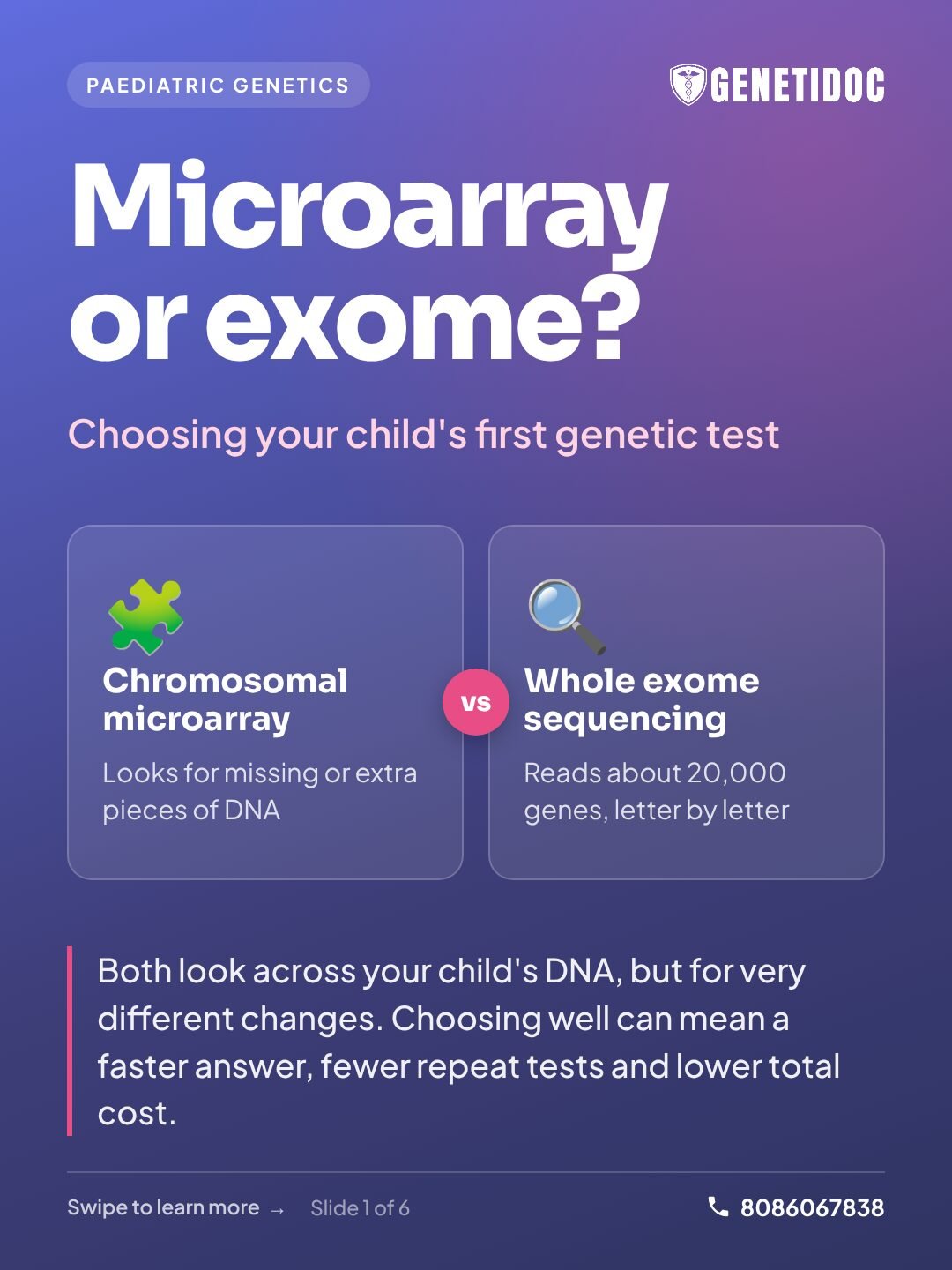
Your child is not reaching milestones on time. Or a scan, a seizure or a set of unusual features has led your paediatrician to suggest a genetic test. Then you hear two names: chromosomal microarray and whole exome sequencing.
Which one should come first? Is one simply better? And why do different doctors and laboratories seem to give different advice?
These are fair questions. Both tests look across your child’s DNA for a cause, but they look for very different kinds of changes. Choosing well can mean a faster answer, fewer repeat tests and lower total cost. Choosing poorly can mean months of waiting and a normal report that does not actually rule anything out.
This guide explains what each test does, what each one can miss, what current guidelines say, and how clinical geneticists decide which test fits your child.
Quick answer
A chromosomal microarray looks for missing or extra pieces of DNA (deletions and duplications) across all the chromosomes. Whole exome sequencing reads the protein-coding parts of about 20,000 genes, letter by letter, to find small spelling changes. For most children with unexplained developmental delay or intellectual disability, current guidelines support exome sequencing as a first or second test, because it finds a cause more often. Microarray is still a strong first choice when the child’s features suggest a chromosomal deletion or duplication. Neither test detects everything, and the right choice depends on your child’s features.
Why Children Are Offered Genetic Testing in the First Place
Genetic testing is commonly offered when a child has one or more of the following:
- Global developmental delay: delays in two or more areas, such as walking, speech, understanding or social skills
- Intellectual disability: lasting difficulty with learning and everyday reasoning
- Autism spectrum disorder, especially with other features such as unusual facial features, growth problems or seizures
- Congenital anomalies: differences in body structure present from birth, such as heart defects, cleft lip or palate, or kidney anomalies
- Seizures that start early in life, or loss of skills a child once had (regression)
- Unusual growth, such as very short stature or a very small or large head
Finding the genetic cause does not change who your child is. But it can explain why, guide care, point to treatable complications, and tell the family whether the condition could happen again in a future pregnancy.
What Is a Chromosomal Microarray?
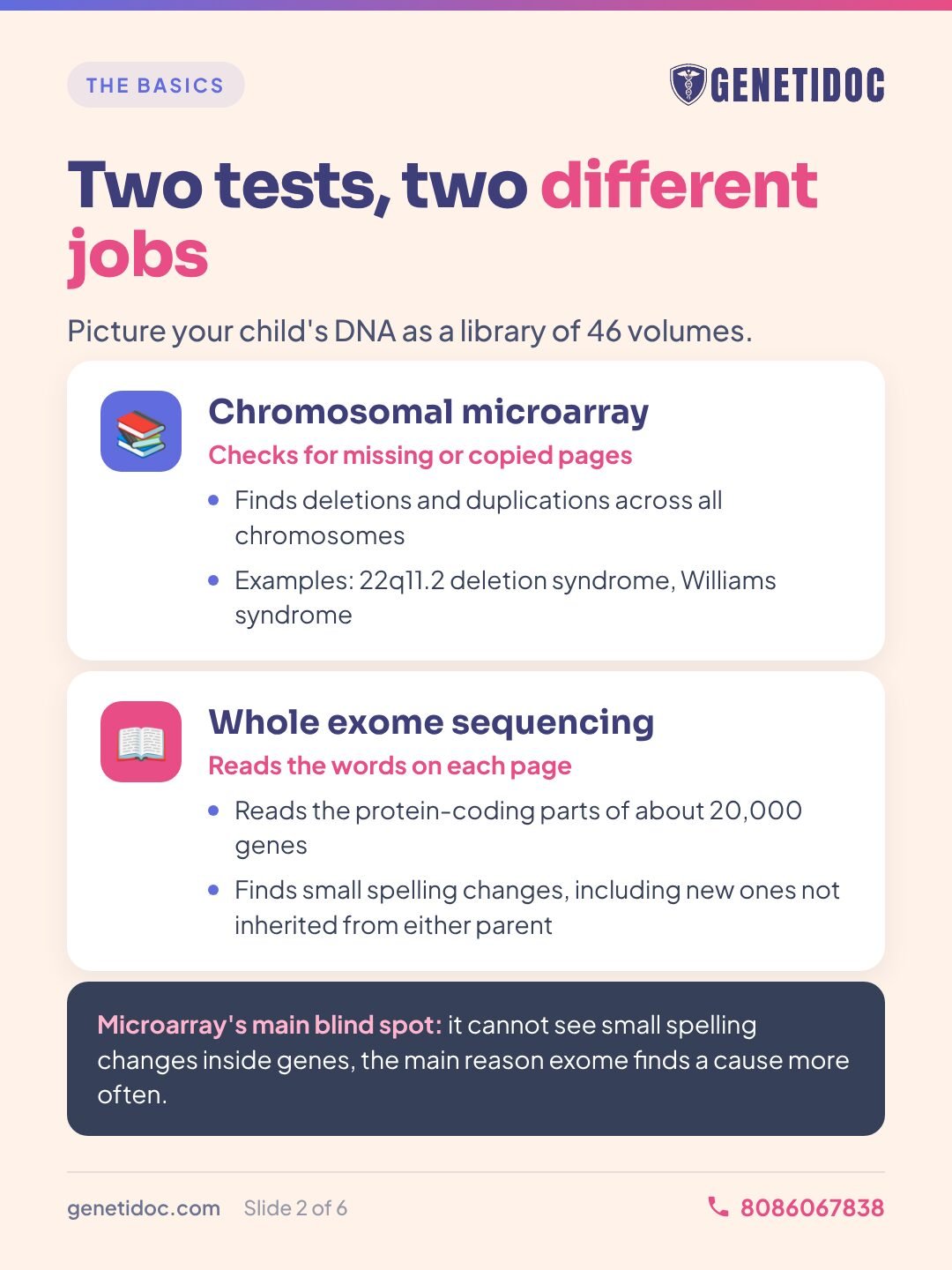
Think of your child’s DNA as a library of 46 volumes (chromosomes). A chromosomal microarray checks whether any pages, or whole chapters, are missing or copied twice.
These missing or extra pieces are called copy number variants. When a missing piece is large enough to remove several genes, it can cause a recognisable condition. Examples include 22q11.2 deletion syndrome, Williams syndrome and many other deletion or duplication syndromes.
A microarray is far more detailed than a traditional karyotype (the older test that looks at chromosomes under a microscope). It can detect pieces of DNA many times smaller than a karyotype can see.
A useful extra: regions of homozygosity
Many microarrays used today, known as single nucleotide polymorphism (SNP) arrays, can also show long stretches where a child inherited identical DNA from both parents. These are called regions of homozygosity.
This matters in India, where marriages between relatives are common in some communities. Long shared stretches can point to a recessive condition, where a child inherits the same faulty gene from both parents. They can also hint at uniparental disomy, where both copies of a chromosome come from one parent. The microarray does not name the faulty gene, but it can tell specialists where to look.
What microarray finds
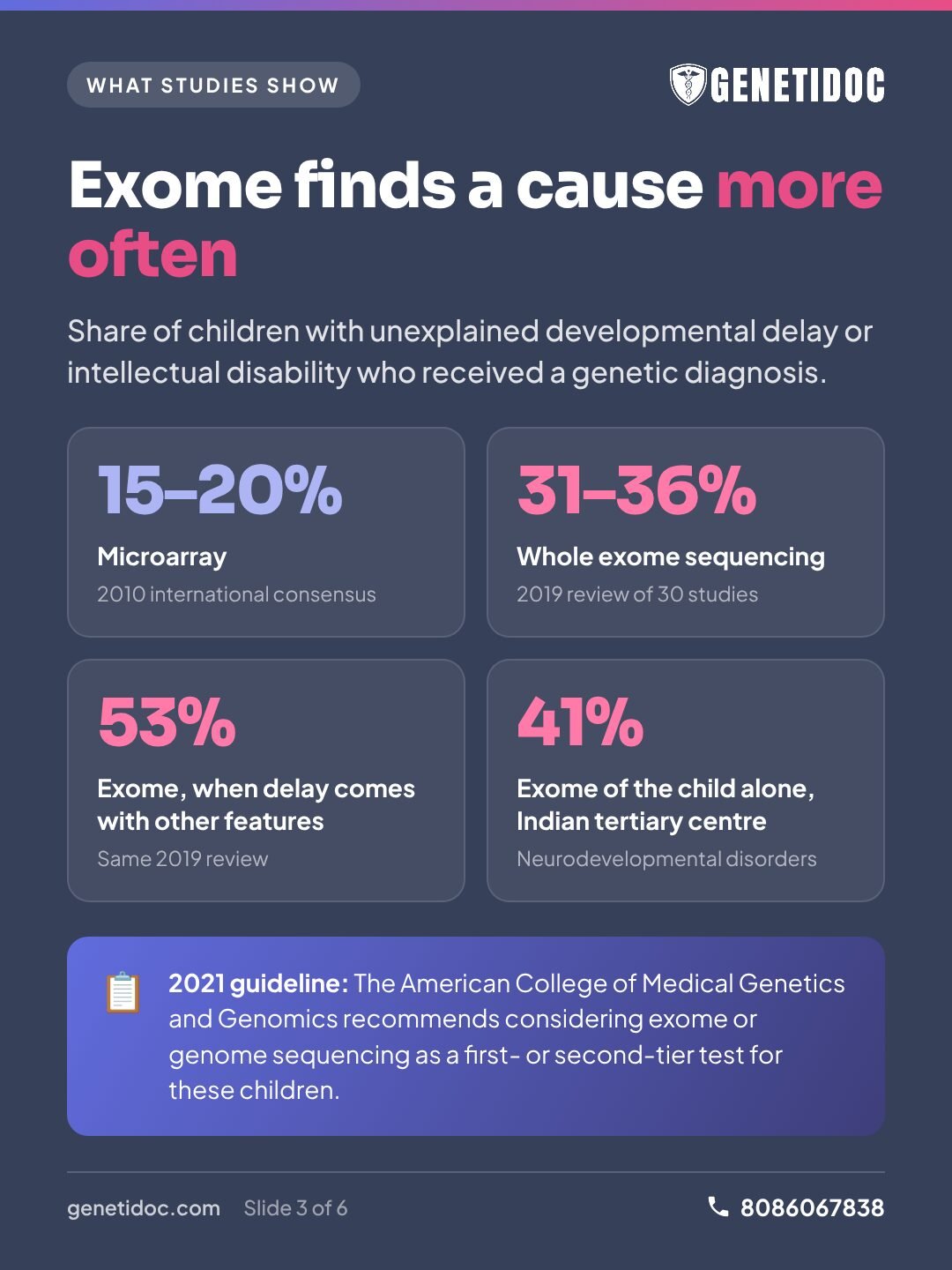
In 2010, an international consensus statement recommended microarray as the first-tier test for children with unexplained developmental delay, intellectual disability, autism or multiple congenital anomalies. It found a cause in about 15–20% of these children, far more than a karyotype.
What Is Whole Exome Sequencing?
If microarray checks for missing pages, exome sequencing reads the words on each page.
The exome is the part of your DNA that carries instructions for making proteins. It makes up only about 1–2% of the total DNA, but most known disease-causing changes are found here. Exome sequencing reads these regions in roughly 20,000 genes and looks for small spelling changes, such as a single wrong letter or a few missing letters, that can stop a gene from working.
Many childhood conditions are caused by exactly this type of change. Some happen for the first time in the child and are not inherited from either parent. These are called de novo variants, and they are a common cause of developmental delay and epilepsy.
Proband-only exome and trio exome
- Proband-only exome: only the child is tested. Parents may be tested afterwards for any important finding.
- Trio exome: the child and both parents are tested together. This helps the laboratory quickly spot de novo changes and see which changes came from which parent, which can make interpretation clearer.
Trio testing costs more, so it is usually chosen when a de novo cause seems likely, when the child is very unwell and a fast, clear answer matters, or when an earlier exome did not give an answer.
Can exome sequencing also find deletions and duplications?
Increasingly, yes. Many laboratories now analyse exome data for copy number variants as well. A 2025 study in Clinical Genetics compared children who had both tests and found close agreement (about 99%) for regions the exome captured well.
There are limits. Exome may miss very small deletions, changes affecting only one section (exon) of a gene, and changes in regions the exome does not capture well. Not every laboratory includes this analysis, and not every laboratory does it equally well. That is why one of the most important questions to ask is: “Does this exome report include deletion and duplication analysis?”
Microarray vs Exome Sequencing: Side-by-Side Comparison
| Feature | Chromosomal microarray | Whole exome sequencing |
| What it looks for | Missing or extra pieces of chromosomes (deletions and duplications) | Small spelling changes in about 20,000 genes; many labs also report deletions and duplications |
| Typical chance of finding a cause | About 15–20% in unexplained delay or intellectual disability | About 31–36%; up to about 53% when delay comes with other features |
| Best first test when | Multiple birth anomalies, growth problems or features suggesting a deletion or duplication syndrome | Developmental delay or intellectual disability, seizures, regression, consanguinity, or a suspected single-gene condition |
| Main blind spot | Cannot see small spelling changes within genes | May miss very small deletions and changes outside the coding regions |
| Uncertain results | Possible; uncertain deletions or duplications often need parental testing | More common, because far more genes are read |
| Typical turnaround | Usually a few weeks, depending on the laboratory | About 1 to 2 months at Genetidoc |
What Do the Guidelines Say Now?
Guidance has changed over the last decade, and this explains why families sometimes hear different advice.
- 2010: Microarray was recommended as the first-tier test for unexplained developmental delay, intellectual disability, autism and multiple congenital anomalies. Fragile X testing was recommended alongside it where relevant.
- 2019: A large review of 30 studies found that exome sequencing identified a cause in about 36% of people with neurodevelopmental disorders: 31% with isolated delay, and 53% when delay came with other features. The authors concluded that exome should be a first-tier test for these children.
- 2021: The American College of Medical Genetics and Genomics (ACMG) strongly recommended that exome or genome sequencing be considered as a first- or second-tier test for children with congenital anomalies starting before age one, or developmental delay or intellectual disability starting before age 18.
Indian studies show similar results. A study from an Indian tertiary centre found a cause in 41% of children with neurodevelopmental disorders using exome sequencing of the child alone. A 2025 study of 137 Indian children with autism found a cause in 35% of children with syndromic autism (autism with other physical or medical features), compared with about 8% in non-syndromic autism.
The message is not that microarray is outdated. It is that, for many children, exome sequencing is now the test most likely to find the answer, and microarray remains the better first step for certain patterns.
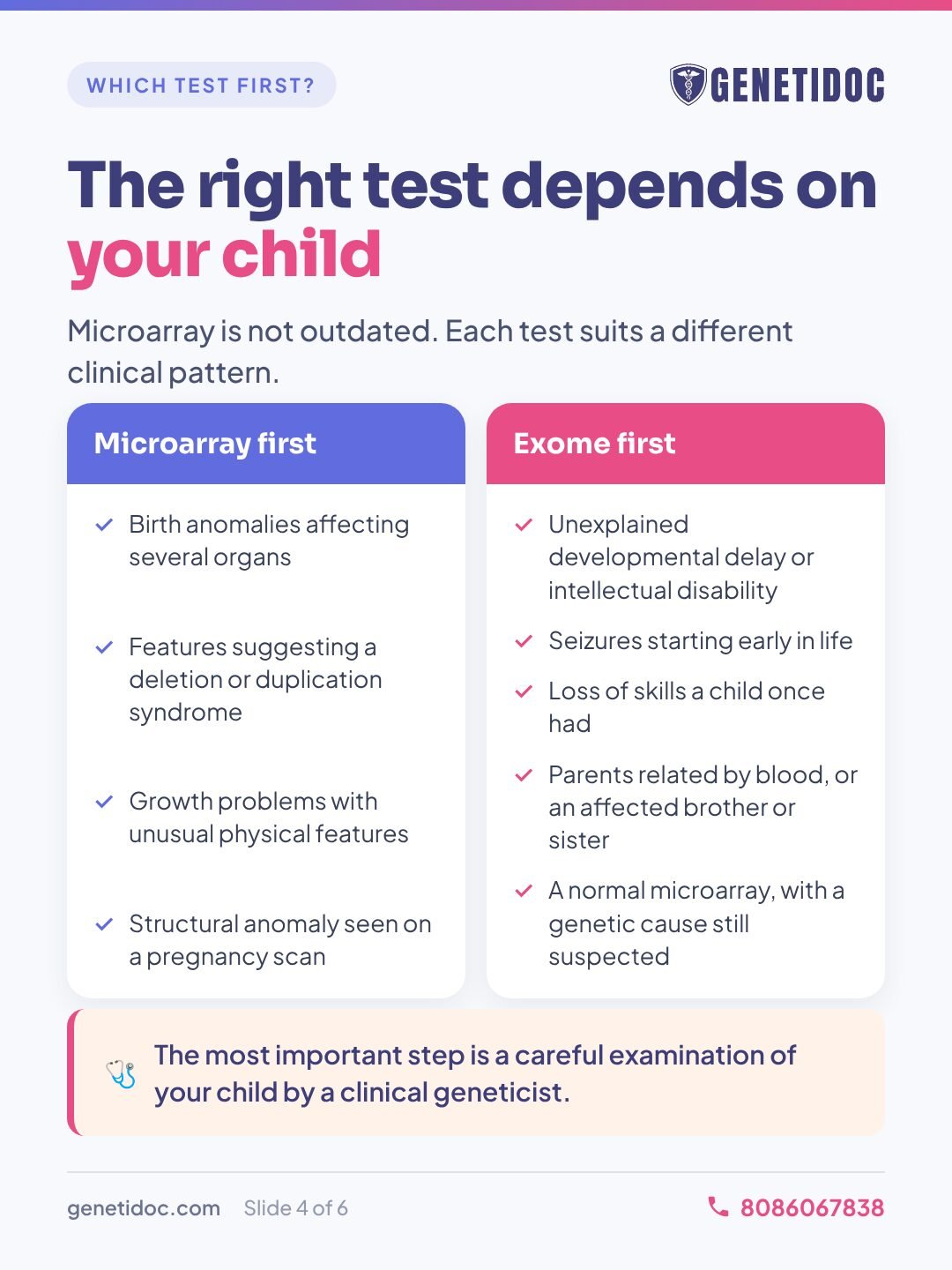
When Microarray Is Usually the Better First Test
- Multiple congenital anomalies affecting different organs, such as a heart defect with a kidney anomaly and unusual facial features, without a clear single-gene pattern.
- A suspected deletion or duplication syndrome, such as 22q11.2 deletion syndrome or Williams syndrome, where the features point towards a missing piece of chromosome.
- Growth problems with dysmorphic features, meaning physical features that differ from family members in a way that suggests a syndrome.
- A structural anomaly first seen on pregnancy ultrasound, where microarray is commonly the first test after birth if it was not done during pregnancy.
- When only one test is possible and the child’s features clearly point to a chromosomal cause.
When Exome Sequencing Is Usually the Better First Test
- Unexplained developmental delay or intellectual disability, especially with no major birth anomalies.
- Early-onset seizures or epileptic encephalopathy, where many single genes can cause similar seizures.
- Developmental regression, where a child loses skills they once had. Some metabolic and neurodegenerative conditions in this group have specific treatments or dietary management.
- Movement disorders, muscle weakness or unusual neurological signs that fit a group of single-gene conditions.
- Parents who are related by blood, since recessive single-gene conditions become more likely.
- A brother or sister with the same condition, which suggests an inherited single-gene cause.
- A normal microarray already done, with a genetic cause still suspected.
When Neither Should Come First
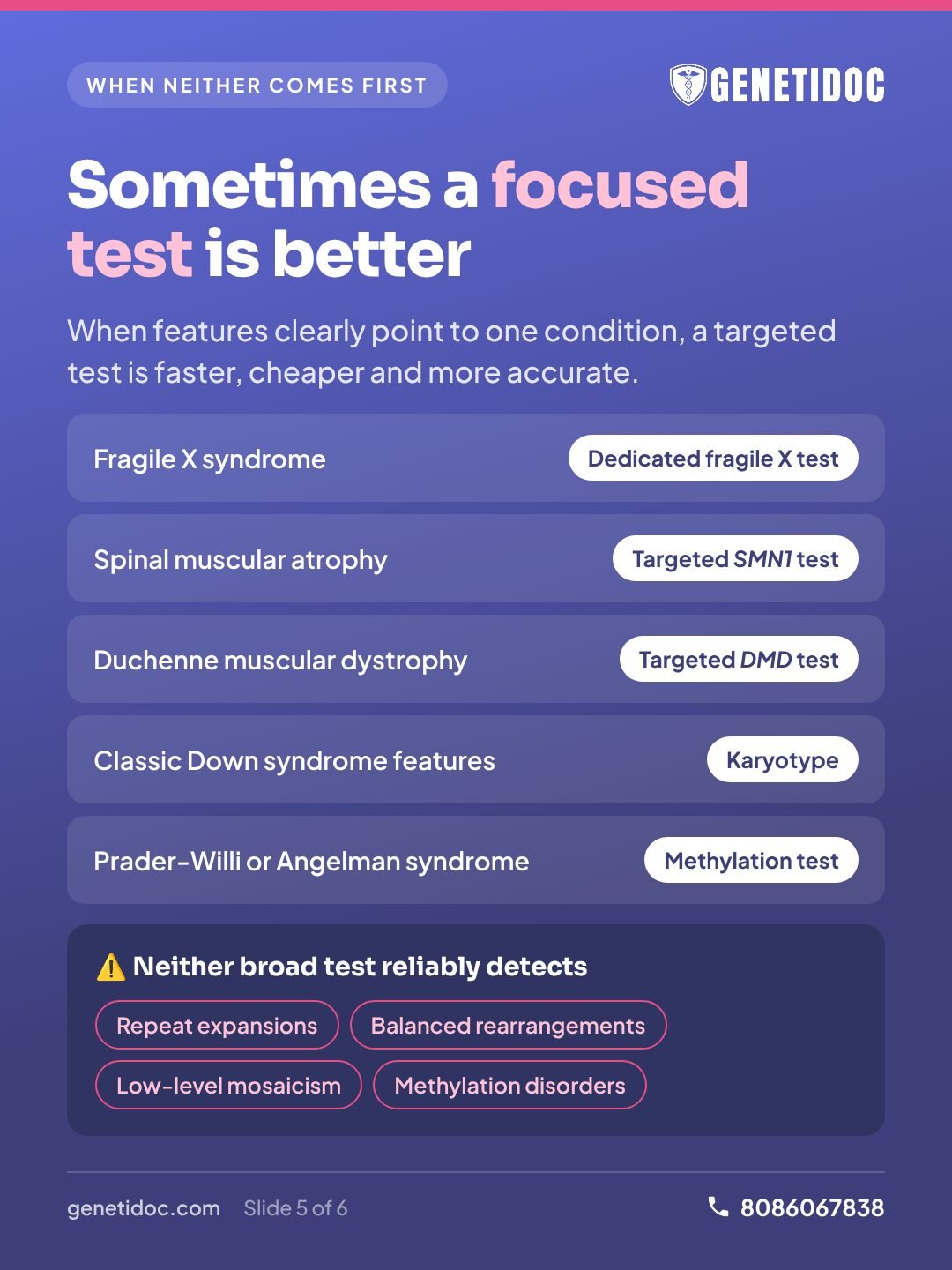
Sometimes a child’s features point so clearly to one condition that a focused test is faster, cheaper and more accurate than either broad test:
- Suspected fragile X syndrome: for example, a boy with intellectual disability and a family history of learning difficulties on the mother’s side. Fragile X is caused by a repeated stretch of DNA that neither microarray nor standard exome can reliably detect. It needs its own test, which takes about 21 days at Genetidoc.
- Suspected spinal muscular atrophy: a baby with weak, floppy muscles needs a targeted SMN1 gene test, not a broad test.
- Suspected Duchenne muscular dystrophy: a targeted DMD gene test is the right starting point.
- Classic features of Down syndrome: a karyotype confirms the diagnosis and shows whether a chromosome rearrangement (translocation) is involved, which matters for future pregnancies.
- Suspected Prader-Willi or Angelman syndrome: a methylation test is usually the first step, because some cases are not caused by a deletion and can be missed by both broad tests.
What Neither Test Can Reliably Detect
A normal result means no reportable finding was found in what was tested. It does not mean the condition is not genetic. Here is why:
- Repeat expansions, such as fragile X syndrome and some inherited ataxias (balance disorders). These are short pieces of DNA repeated too many times. Microarray only counts how much DNA is present in each region, and exome sequencing reads DNA in pieces too short to measure long repeats.
- Balanced rearrangements, where pieces of chromosomes have swapped places but no DNA is missing or extra. Microarray counts DNA, so if nothing is lost or gained, it sees nothing wrong. Exome reads genes, not chromosome structure.
- Low-level mosaicism, where a change is present in only some of the body’s cells. If only a small fraction of blood cells carry the change, it can fall below what either test can pick up.
- Methylation (imprinting) disorders, where the DNA letters are normal but the chemical tags that switch genes on or off are wrong.
- Deep intronic changes, which lie in the non-coding parts of genes that exome sequencing does not read.
- Genes with near-identical copies elsewhere in the DNA, such as SMN1, which make the results hard to read accurately.
In addition, microarray cannot see small spelling changes inside genes at all. This is its biggest limitation, and the main reason exome finds a cause more often.
Important
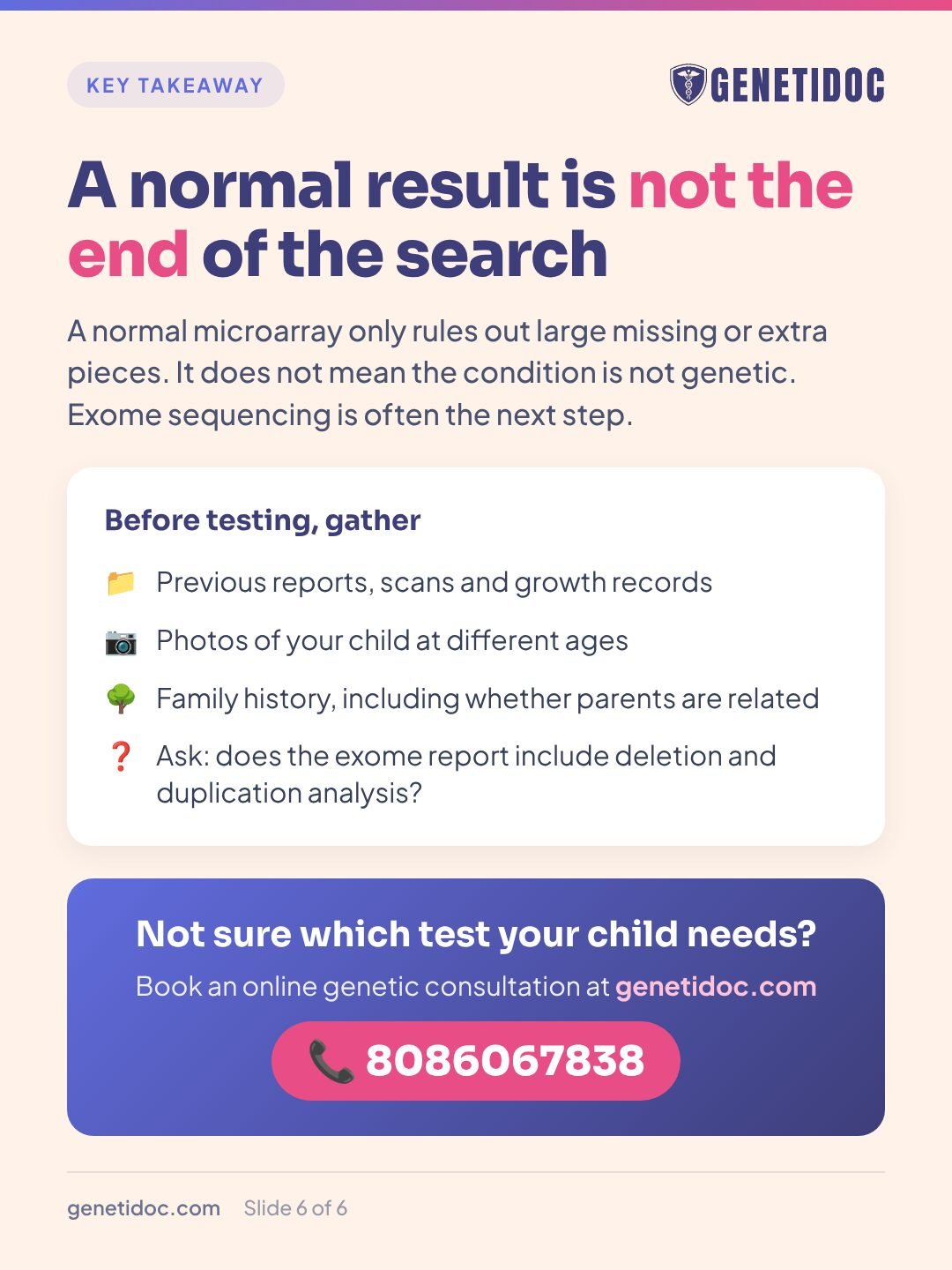
If your child had a normal microarray, the search is not over. It only means there is no large missing or extra piece of chromosome. The most common next step is exome sequencing, chosen after a fresh look at your child’s features.
How a Clinical Geneticist Chooses the First Test: Step by Step
- Detailed history: pregnancy and birth details, milestones, seizures, regression, growth and previous investigations.
- Three-generation family tree: who else is affected, miscarriages, early deaths, and whether the parents are related.
- Careful examination: physical features, head size, growth, skin, and signs in other organs. This is called phenotyping, and it is often the single most important step.
- Review of earlier tests: karyotype, microarray, metabolic tests and scans, so nothing is repeated without reason.
- Matching the test to the pattern: a targeted test if one condition is clearly suspected, microarray if a chromosomal cause is likely, and exome if a single-gene cause is likely or the picture is unclear.
- Pre-test counseling: what the test can and cannot find, the chance of an uncertain result, and whether parent samples should be collected.
- Interpretation and follow-up: matching the report to the child’s actual features, explaining it clearly, and planning next steps if the result is negative or uncertain.
At Genetidoc, the scope of testing is matched to how closely a child’s features fit a known condition. Whole genome sequencing is kept as a next step for children whose exome is negative or incomplete despite a strongly suspected genetic condition. It is not usually the first test.
Illustrative Examples
The following are illustrative examples created to explain common situations. They are not the stories of real patients.
Example 1: A baby with a heart defect and low calcium
A newborn has a heart defect, a cleft palate and low calcium levels. Together, these suggest 22q11.2 deletion syndrome, a condition caused by a missing piece of chromosome 22.
Microarray is the right first test here. It confirms the deletion within weeks. The baby’s care team now knows to monitor calcium, check immunity, and plan speech and developmental support early. The parents are offered testing to see whether either of them carries the same deletion, which affects the chance of it happening in a future pregnancy.
Example 2: A toddler with seizures and slow development
A two-year-old has had seizures since infancy and is not yet walking or speaking. There are no birth anomalies. Many different single genes can cause this picture.
Exome sequencing is chosen first. It finds a de novo change in a gene linked to early-onset epilepsy. The neurologist adjusts the seizure medicines to suit that specific condition, and the parents learn that the chance of it happening again in another child is low, though not zero. Starting with microarray would likely have given a normal result and delayed this answer by weeks.
Example 3: A normal microarray and a family still searching
A five-year-old with intellectual disability had a microarray two years ago, and it was normal. The family was told “it is not genetic.” The parents are first cousins, and their younger child is now showing similar delays.
After counseling, the family understands that a normal microarray only rules out large deletions and duplications. With related parents and two affected children, a recessive single-gene condition is likely. Exome sequencing finds the same disease-causing change in both copies of one gene in the older child, one copy inherited from each parent. The younger sibling is tested for the same change, and the parents can now plan future pregnancies with accurate information.
How a Diagnosis Changes Care
- Treatment: some diagnoses lead to specific treatments, diets or medicines to avoid, especially in some epilepsies and metabolic conditions.
- Screening for complications: many syndromes come with known risks to the heart, kidneys, eyes, hearing or growth, which can be checked before they cause problems.
- Prognosis: knowing the exact condition helps doctors explain what to expect and which therapies are most useful.
- Ending the diagnostic odyssey: families can stop repeated, expensive tests that are no longer needed.
- Family planning: once a diagnosis is definite, couples can consider prenatal diagnosis or preimplantation genetic testing in a future pregnancy, and relatives can be tested where relevant.
- Support: a named diagnosis helps families connect with others facing the same condition.
Uncertain Results: What They Mean
Both tests can return a variant of uncertain significance. This is a change in the DNA whose effect science cannot yet explain. It is not a diagnosis, and medical decisions should not be based on it alone.
Uncertain results are more common with exome sequencing, simply because far more genes are read. They are also more common in Indian children, because Indian and South Asian populations are under-represented in the international databases laboratories use to judge whether a change is rare.
Our team handles uncertain results in a few ways:
- Testing the parents to see whether the change was inherited or is new, which often helps clarify its meaning
- Checking whether the change matches the child’s features
- Advising reanalysis of the data after 6 months to 1 year, or sooner if new symptoms appear
- Not using an uncertain result for testing relatives or for prenatal decisions until it is reclassified
Cost and Time: Thinking About the Whole Pathway
Most families in India pay for genetic testing themselves, so cost matters. Prices vary widely between laboratories, and the cheapest single test is not always the cheapest route to a diagnosis.
When a child’s features suggest a single-gene condition, testing one step at a time (microarray first, then a panel, then exome) often costs more in total and takes much longer than starting with the right test. On the other hand, when a chromosomal deletion is strongly suspected, microarray alone may answer the question.
Ask about the likely total pathway, not just the price of the first test. Also ask whether parent samples can be collected and stored at the start, so that trio analysis or parental testing does not need a fresh round of sample collection later. Genetidoc arranges sample collection from home, so a clinic visit is usually not needed for the test itself.
Common Misconceptions
Myth: “A normal microarray means it is not genetic.”
Fact: It only rules out large deletions and duplications. Many genetic conditions are caused by small spelling changes that microarray cannot see.
Myth: “Exome sequencing checks everything.”
Fact: Exome reads the coding parts of genes. It can miss repeat expansions, balanced rearrangements, methylation disorders and changes outside these regions.
Myth: “The bigger test is always better.”
Fact: For fragile X, spinal muscular atrophy or classic Down syndrome, a focused test is more accurate than any broad test.
Myth: “Microarray and karyotype are the same.”
Fact: Microarray sees much smaller changes. Karyotype, however, can see balanced rearrangements that microarray cannot.
Myth: “If exome is negative, we must redo the whole test later.”
Fact: Existing exome data can usually be reanalysed as science advances, without collecting a new sample or repeating the test.
Practical Checklist Before Testing
- Gather all previous reports, scans, discharge summaries and growth records.
- Collect photos of your child at different ages, which can help with recognising features.
- Note your family history, including miscarriages, early deaths, and whether you and your partner are related.
- Ask whether the exome includes deletion and duplication analysis.
- Ask whether parent samples should be collected at the same time.
- Ask what the next step will be if the result is negative or uncertain.
- After the result, keep the report and request a copy of the raw data for future reanalysis.
Frequently Asked Questions
What is the difference between chromosomal microarray and whole exome sequencing?
Microarray looks for missing or extra pieces of chromosomes. Exome sequencing reads the coding parts of about 20,000 genes to find small spelling changes. They detect different types of genetic change.
Which test is better for developmental delay?
For most children with unexplained developmental delay or intellectual disability, exome sequencing finds a cause more often. Microarray remains a good first test when features suggest a chromosomal deletion or duplication.
Can exome sequencing detect deletions and duplications?
Many laboratories now analyse exome data for deletions and duplications, with results closely matching microarray for well-covered regions. Very small changes may still be missed, so ask whether this analysis is included.
My child’s microarray was normal. What next?
A normal microarray does not rule out a genetic cause. A clinical geneticist will review your child’s features, and exome sequencing is often the next step.
Which genetic test is best for autism?
It depends on the child. Children with autism plus other features such as unusual facial features, seizures or growth problems have a higher chance of a genetic diagnosis, and exome sequencing is often preferred. Fragile X testing may also be recommended.
What is trio exome sequencing?
Trio exome tests the child and both parents together. It helps identify new changes not inherited from either parent and can make interpretation faster and clearer.
How long do these tests take?
Microarray results usually take a few weeks, depending on the laboratory. Exome sequencing takes about 1 to 2 months at Genetidoc.
Is microarray the same as karyotype?
No. Microarray detects much smaller deletions and duplications. Karyotype can detect balanced rearrangements, which microarray cannot. Each is useful in different situations.
Can these tests detect fragile X syndrome?
No. Fragile X is caused by a repeat expansion that needs its own dedicated test. It may be ordered alongside or before broader testing.
What if the exome result is uncertain or negative?
Parental testing, reanalysis of the data after 6 months to 1 year, or further testing such as trio exome or whole genome sequencing may be advised, depending on your child’s features.
Should my child have whole genome sequencing instead?
Whole genome sequencing is usually kept as a next step when exome is negative or incomplete but a genetic condition is still strongly suspected.
Do we need genetic counseling before the test?
Yes, it is strongly recommended. Counseling helps choose the right first test, plan parent samples, and prepare the family for every possible result.
Key Takeaways
- Microarray finds missing or extra pieces of chromosomes. Exome sequencing finds small spelling changes in genes.
- For most children with unexplained developmental delay or intellectual disability, exome sequencing finds a cause more often, and current guidelines support it as a first or second test.
- Microarray is still the better first test for multiple birth anomalies, growth problems or suspected deletion syndromes.
- Some conditions, such as fragile X and spinal muscular atrophy, need focused tests instead.
- A normal result means no reportable finding in what was tested, not that the condition is not genetic.
- The right first test depends on careful examination of your child, which is why expert evaluation matters more than the name of the test.
Not sure whether your child needs a microarray, an exome or a focused test?
Bring your child’s reports, photos and family history to a clinical geneticist before choosing a test. Our team will examine the full picture, recommend the first test most likely to give an answer, plan parent samples if needed, and explain the result clearly when it arrives. Consultations are online, usually in your preferred language, with sample collection from home.
Book a paediatric genetic evaluation.
Join the Conversation
Related Reading on Genetidoc
- Pompe Disease: A Genetic Disorder of Muscle and Metabolism
- Understanding Pitt-Hopkins Syndrome
- Noonan Syndrome: Symptoms, Causes and Genetic Testing Explained
- Developmental Delay: When to Consider a Genetic Evaluation
- What Defines a Rare Genetic Disease? A Clear Guide
- Skipping Generations: What Families Should Know
References
- Miller DT, Adam MP, Aradhya S, et al. Consensus statement: chromosomal microarray is a first-tier clinical diagnostic test for individuals with developmental disabilities or congenital anomalies. American Journal of Human Genetics. 2010;86(5):749–764.
- Manning M, Hudgins L; Professional Practice and Guidelines Committee. Array-based technology and recommendations for utilization in medical genetics practice for detection of chromosomal abnormalities. Genetics in Medicine. 2010;12(11):742–745.
- Srivastava S, Love-Nichols JA, Dies KA, et al. Meta-analysis and multidisciplinary consensus statement: exome sequencing is a first-tier clinical diagnostic test for individuals with neurodevelopmental disorders. Genetics in Medicine. 2019;21(11):2413–2421.
- Manickam K, McClain MR, Demmer LA, et al. Exome and genome sequencing for pediatric patients with congenital anomalies or intellectual disability: an evidence-based clinical guideline of the American College of Medical Genetics and Genomics (ACMG). Genetics in Medicine. 2021;23(11):2029–2037.
- Malinowski J, Miller DT, Demmer L, et al. Systematic evidence-based review: outcomes from exome and genome sequencing for pediatric patients with congenital anomalies or intellectual disability. Genetics in Medicine. 2020;22(6):986–1004.
- High concordance of copy number variants detected by chromosomal microarray and exome sequencing in clinical diagnostics. Clinical Genetics. 2026;109(3):529–538.
- Clinical utility of proband only clinical exome sequencing in neurodevelopmental disorders. Indian Journal of Pediatrics. 2025;92(2):185–190.
- Prospective study to analyze the yield and clinical impact of trio exome sequencing in 137 Indian children with autism spectrum disorder. Journal of Human Genetics. 2025;70(12):611–624.
- Sheth F, Shah J, Jain D, et al. Comparative yield of molecular diagnostic algorithms for autism spectrum disorder diagnosis in India: evidence supporting whole exome sequencing as first tier test. BMC Neurology. 2023. doi:10.1186/s12883-023-03341-0.
- Moeschler JB, Shevell M; Committee on Genetics. Comprehensive evaluation of the child with intellectual disability or global developmental delays. Pediatrics. 2014;134(3):e903–e918.