
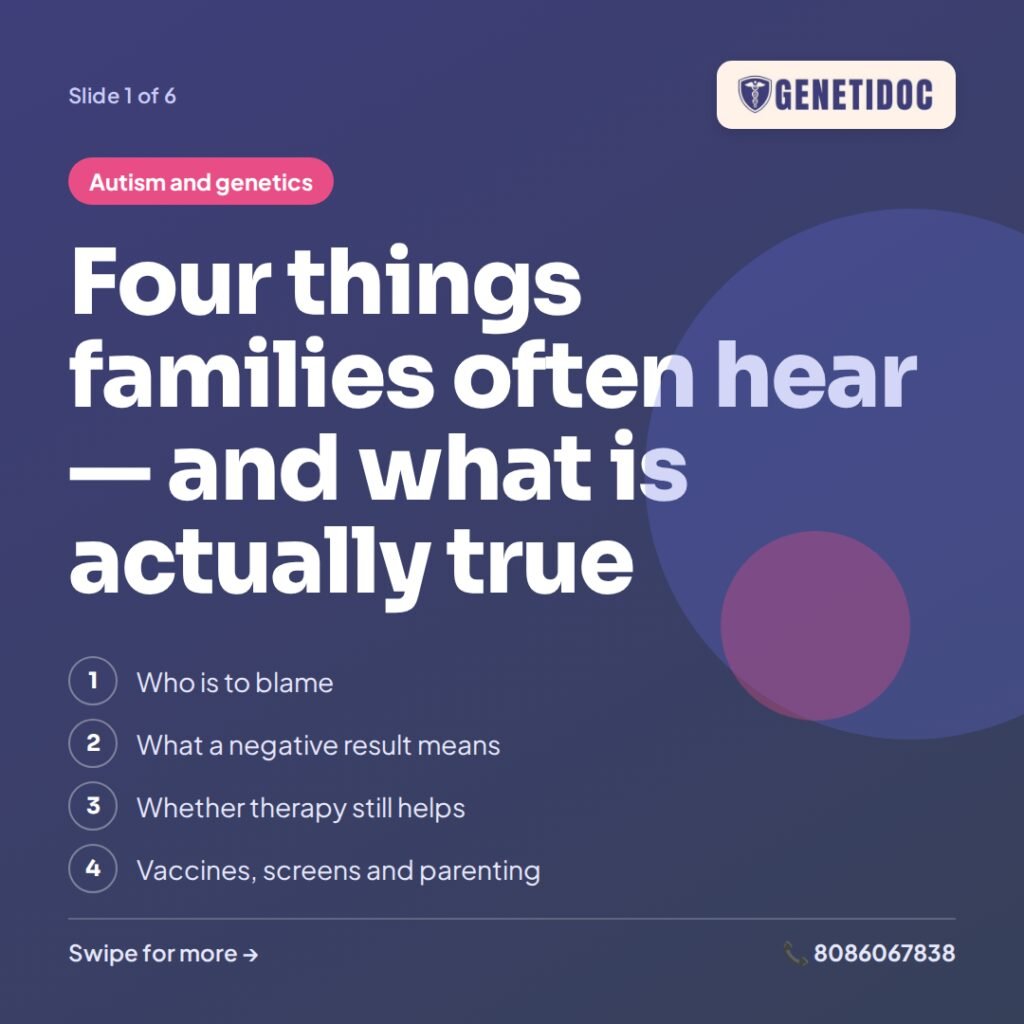
For many parents, an autism diagnosis is followed almost immediately by one question: “Why?” Did something happen during pregnancy? Is it from one side of the family? Will our next child have it too?
Genetic testing cannot answer every one of these questions. But for a meaningful number of families, it can find the underlying reason for a child’s autism. That answer can shape the child’s medical care, explain the family history, and help parents plan future pregnancies with clear information instead of fear.
This guide explains how genes are involved in autism, which children benefit most from testing, which tests are used, what the results can and cannot tell you, and what it all means for your family.
Quick answer: Is autism genetic?
Yes, genes play a major role. Twin and family studies estimate that around 80% of the differences in autism risk between people are explained by genetic factors. In some children, a single identifiable genetic change is the main cause. In many others, autism results from the combined effect of many small genetic differences. Genetic testing does not diagnose autism. It looks for a specific genetic cause in a child who already has an autism diagnosis.
What Is Autism Spectrum Disorder?
Autism spectrum disorder is a difference in brain development that affects how a person communicates, interacts with others and experiences the world. Autistic children may have:
- Delayed speech, or speech that develops differently
- Difficulty with back-and-forth social interaction and eye contact
- Repetitive movements or routines, and strong focused interests
- Unusual responses to sounds, textures, lights or tastes
It is called a “spectrum” because it looks very different from one person to another. Some autistic children need a high level of support every day. Others go on to study, work and live independently.
Autism is common in India. A large study across five regions of the country found that about 1 in 100 children aged 2 to 9 years is autistic. Boys are diagnosed about three to four times more often than girls.
How is autism diagnosed?
Autism is diagnosed by observing the child’s development and behaviour. A developmental paediatrician, child psychiatrist, child neurologist or clinical psychologist usually makes the diagnosis using standard criteria and assessment tools. In India, tools such as the INCLEN Diagnostic Tool for Autism Spectrum Disorder are also used.
No blood test or genetic test can diagnose autism. This is one of the most common misunderstandings families have. Genetic testing comes after the diagnosis, to look for a cause.
How Do Genes Cause Autism?
Our genes are instructions for building and running the body, including the brain. Hundreds of genes help guide how brain cells grow, connect and communicate. When some of these instructions are changed, brain development can follow a different path.
Genetic causes of autism fall into a few broad groups.
1. Single-gene changes
A change in one important gene can be enough to cause autism, often along with other features such as developmental delay or seizures. More than 100 such genes are now known. Examples include SHANK3, CHD8, SCN2A, SYNGAP1 and PTEN.
2. Missing or extra pieces of chromosomes
Sometimes a small piece of a chromosome is missing (a deletion) or repeated (a duplication). These are called copy number variants. Well-known examples linked with autism include changes in regions called 16p11.2 and 15q11–q13. They are often too small to see under a microscope.
3. Known genetic syndromes
Some genetic conditions commonly include autism as one of their features. These include fragile X syndrome, tuberous sclerosis complex, Rett syndrome and PTEN hamartoma tumour syndrome.
4. Many small genetic differences together
In many autistic people, there is no single “autism gene”. Instead, many common genetic differences, each with a tiny effect, add up. Current genetic tests cannot yet use this information to give a diagnosis or predict autism reliably.
Inherited or new?
A genetic change linked to autism can be:
- Inherited from a parent, who may have mild features or none at all.
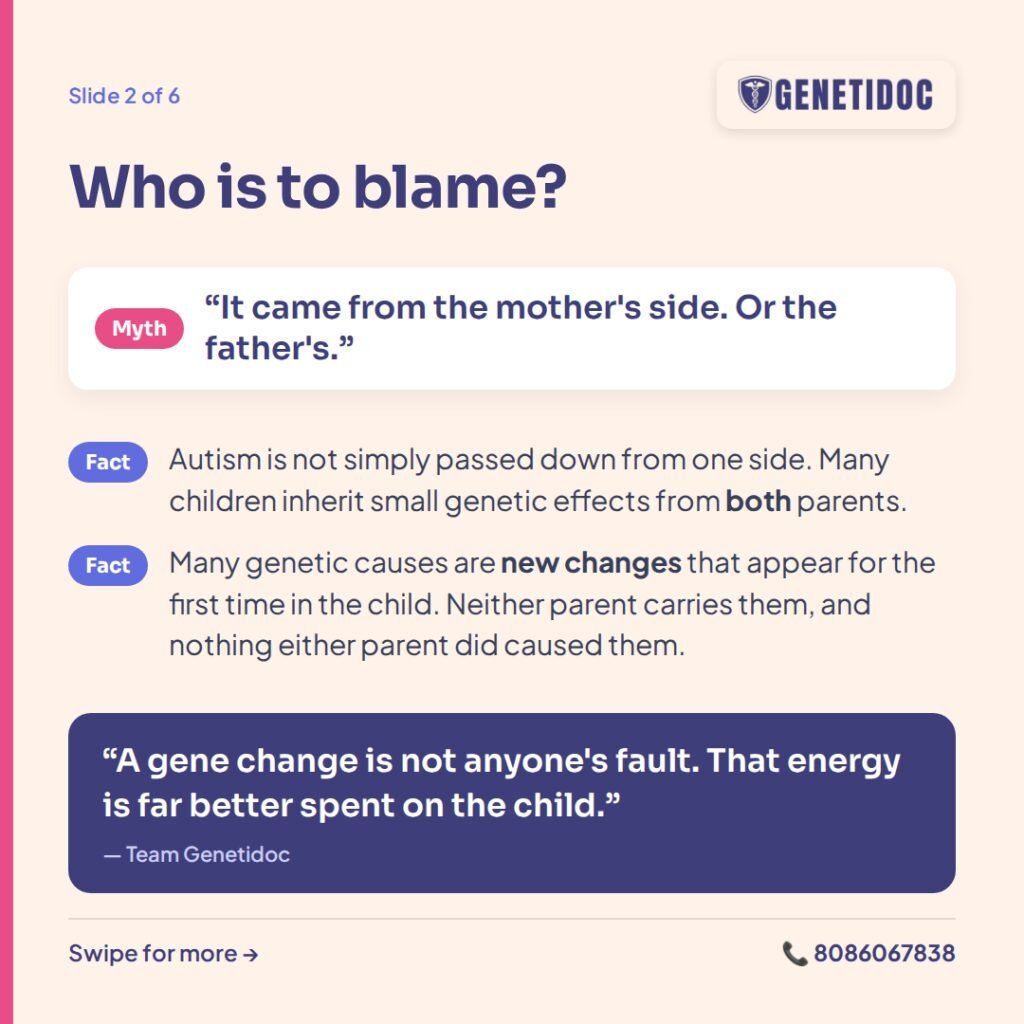
- New, appearing for the first time in the child. This is called a de novo Neither parent carries it in their blood, and nothing either parent did caused it.
Studies show that de novo changes are a major cause of autism, especially when autism comes with intellectual disability. This includes research on Indian children.
“When we explain a genetic result, one of the first things we tell parents is that a gene change is not anyone’s fault. Many of these changes happen for the first time in the child. Families don’t need to spend energy searching for blame. That energy is far better spent on the child.”
— Team Genetidoc
What about vaccines?
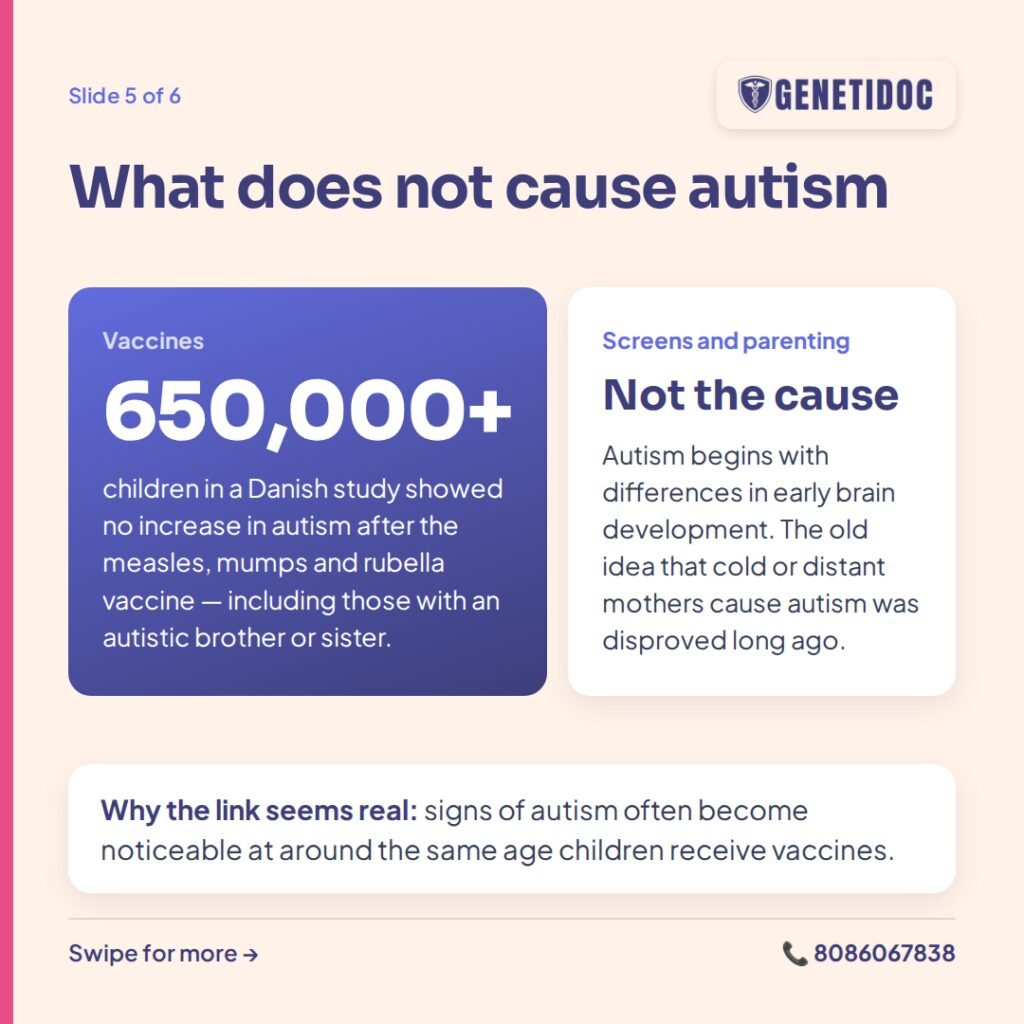
Vaccines do not cause autism. This question has been studied extensively. A Danish study of more than 650,000 children found no increase in autism after the measles, mumps and rubella vaccine, including in children with an autistic brother or sister. Signs of autism often become noticeable at around the same age that children receive vaccines, which is why the two can seem linked.
Why Consider Genetic Testing After an Autism Diagnosis?
International guidelines recommend that every child diagnosed with autism be offered a genetic evaluation. Finding a genetic cause can help in five practical ways.
- It explains the “why”. Many parents describe a sense of relief when a cause is found, especially if they have been blaming themselves.
- It can change medical care. Some genetic conditions carry risks beyond autism, such as seizures, heart or kidney problems, or a higher risk of certain cancers. Knowing the diagnosis allows these to be watched for early.
- It gives a clearer picture of the future. A specific diagnosis can help doctors anticipate likely needs, so families can plan support and therapy.
- It clarifies the risk for future children. The chance of autism in a brother or sister depends greatly on the cause.
- It can help other relatives. Some causes, such as fragile X syndrome, can affect aunts, uncles, cousins and grandparents in different ways.
A diagnosis can also connect families with condition-specific support groups, research studies and, for some conditions, clinical trials.
What genetic testing will not do
- It will not change the autism diagnosis itself.
- It will not replace speech therapy, occupational therapy, behavioural support or special education.
- For most children, it will not lead to a “cure”. Autism is a lifelong difference in development, and the goal of care is support, not cure.
Which Children Are Most Likely to Have a Genetic Cause?
Any autistic child can be offered testing. But a genetic cause is more likely to be found when autism comes with other features. Talk to a clinical geneticist if your child has any of the following:
- Intellectual disability or global developmental delay – delays in learning, motor skills and daily living skills, not just speech and social skills.
- Seizures, or an abnormal brain wave test (electroencephalogram).
- Unusual facial features or birth differences, such as heart, kidney, hand or feet differences.
- An unusually large or small head size. A large head, in particular, can point to a PTEN gene change.
- Loss of skills that the child once had, especially in a girl who loses purposeful hand use and speech. This can point to Rett syndrome.
- Skin findings, such as pale “ash-leaf” patches or multiple light-brown café-au-lait spots.
- Low muscle tone, growth problems or unusual movement patterns.
- A family history of autism, intellectual disability or learning difficulties, early menopause in women, or a late-onset tremor and balance problems in a grandfather. The last two can be clues to fragile X syndrome in the family.
- Parents who are related by blood, as in consanguineous marriages, which are common in several Indian communities. This increases the chance of recessive conditions.
Studies consistently show that when autism comes with intellectual disability, seizures or other physical features, the chance of finding a genetic cause can be well over 30%. When autism is the only finding, the chance is lower, but a cause is still found in some children.
What Genetic Tests Are Used for Autism?
Most tests need only a small blood sample. Some can be done on saliva. The main options are explained below.
| Test | What it looks for | What it can miss |
| Whole exome sequencing | Spelling changes in the protein-coding parts of about 20,000 genes. Many laboratories also analyse it for larger deletions and duplications. | Fragile X syndrome, some changes outside the genes, and some small deletions or duplications |
| Chromosomal microarray | Missing or extra pieces of chromosomes (copy number variants) | Single-gene spelling changes and fragile X syndrome |
| Fragile X testing | An expanded repeat in the FMR1 gene | All other genetic causes |
| Whole genome sequencing | Almost the entire DNA code, including regions outside the genes and many structural changes | Some repeat expansions, including fragile X in many laboratories |
| Targeted single-gene test | One specific gene, when the features strongly suggest one condition (for example, MECP2 for Rett syndrome) | Everything outside that gene |
Why fragile X needs its own test
Fragile X syndrome is the most common inherited cause of intellectual disability and the most common single-gene cause of autism. It is caused by a short stretch of DNA in the FMR1 gene that repeats too many times. Exome sequencing reads DNA in short fragments, so it cannot reliably count these long repeats. That is why fragile X is checked with a dedicated test, especially in boys and in families with the clues listed above.
Exome sequencing as a first test: the Indian evidence
For many years, the recommended first tests for autism were a chromosomal microarray and fragile X testing. Newer evidence has changed this thinking.
- A 2019 analysis of 30 studies found that exome sequencing found a cause in about 36% of people with neurodevelopmental conditions, compared with about 15–20% for chromosomal microarray. The yield rose to 53% when other medical features were present.
- In 2021, the American College of Medical Genetics and Genomics recommended exome or genome sequencing as a first-tier test for children with developmental delay or intellectual disability.
- An Indian study of 101 autistic children, tested together with their parents, found a genetic cause in 7% with exome sequencing, compared with 2.9% with chromosomal microarray. Karyotyping and fragile X testing found no cause in this group. The authors recommended exome sequencing as the first-tier test for autism in India.
These figures come from research groups selected in particular ways, so your child’s individual chance may be higher or lower. What they show clearly is that the choice of test makes a large difference.
“We don’t start with the test. We start with the child. The history, the examination and the family tree tell us how broad the testing needs to be. A highly specific picture may need only one gene. A child with several features and no clear pattern needs a broad test such as exome sequencing. Genome sequencing is usually a next step when a strong suspicion remains after exome testing.”
— Team Genetidoc
Why parents are often tested too
In a trio test, the child and both parents are tested together. This helps in two ways. It shows whether a change was inherited or is new in the child. It also helps the laboratory sort important changes from harmless family variations, which makes a clear answer more likely.
What about metabolic tests?
Routine metabolic testing is not recommended for every autistic child. However, a small number of treatable metabolic conditions can look like autism. Targeted testing is considered when there is loss of skills, seizures, unusual episodes of illness, movement problems, or parents who are related by blood. This is especially relevant in India, where newborn screening for metabolic conditions is not yet available to every baby.
What Can a Genetic Diagnosis Change? Three Illustrative Situations
The following examples are illustrative scenarios, not real patients.
The boy whose grandfather developed a tremor. Consider a 4-year-old boy with autism and learning delay. His mother’s brother had learning difficulties, and his maternal grandfather developed a tremor and balance problems in his sixties. Fragile X testing confirms fragile X syndrome. His mother is found to carry an FMR1 change. This one result explains three generations of the family history. It also lets the mother’s sisters learn whether they are carriers before planning their own pregnancies.
The girl who stopped using her hands. Now consider a 2-year-old girl first thought to have autism. Over the following months, she loses words she once used and begins repetitive hand-wringing movements. Testing finds a change in the MECP2 gene, confirming Rett syndrome. Her care now includes monitoring for seizures, breathing irregularities, scoliosis and heart rhythm, which would not be routine for autism alone.
The child with a large head. Finally, consider a 6-year-old autistic boy whose head size has always been well above average for his age. Testing finds a PTEN gene change. This condition carries a higher lifetime risk of certain cancers, including thyroid, breast and kidney cancers. The child begins age-appropriate surveillance. When his father is tested, he is also found to carry the change and starts his own screening.
Understanding Your Child’s Results
A positive result
A disease-causing or likely disease-causing change has been found that explains your child’s features. The geneticist will explain what the condition means, what monitoring is needed, whether either parent carries it, and what it means for brothers, sisters and future pregnancies.
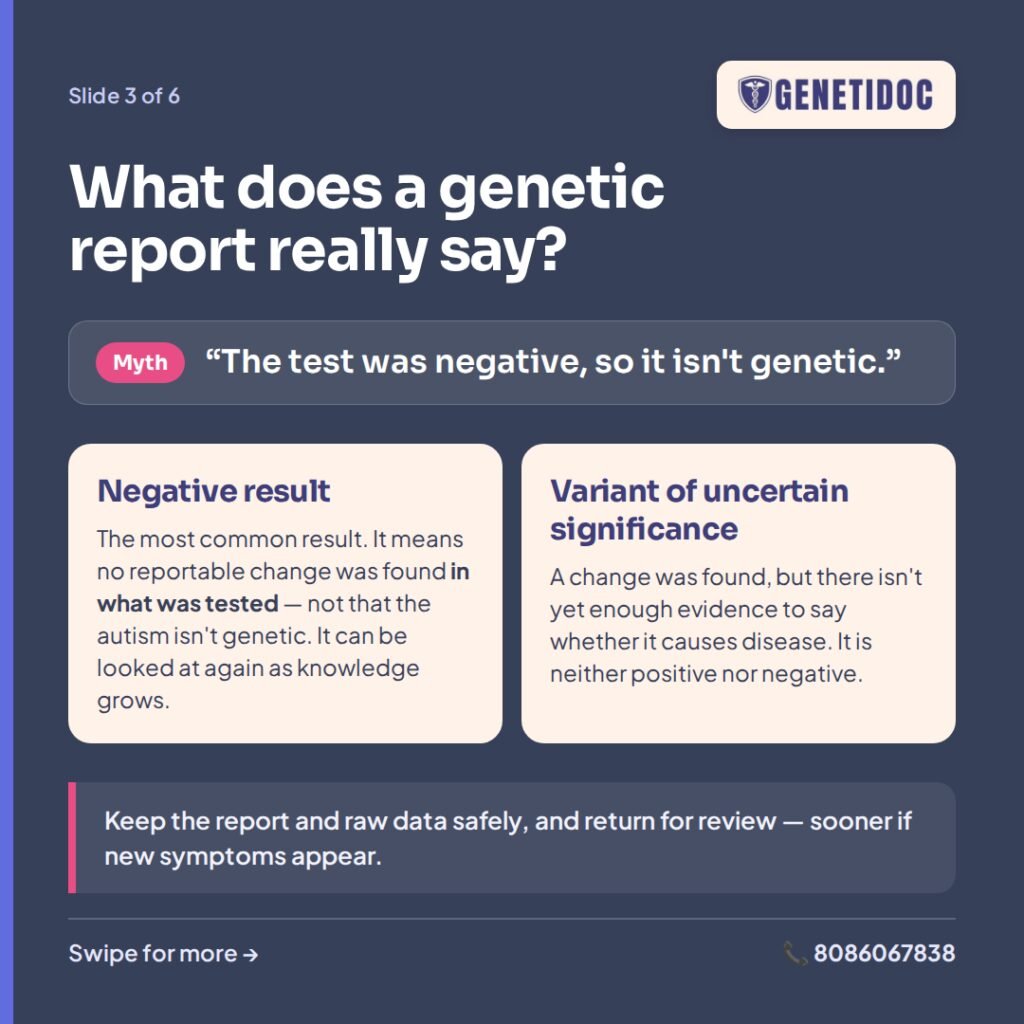
A negative result
No reportable change was found in what was tested. This is the most common result, and it is often misunderstood.
“A negative report means no reportable finding in what was tested. It does not mean the autism isn’t genetic, and it doesn’t change your child’s diagnosis or therapy plan. Our knowledge of autism genes is growing every year, so a result that is negative today can be looked at again later.”
— Team Genetidoc
A variant of uncertain significance
Sometimes the test finds a change, but there is not yet enough scientific evidence to say whether it causes disease. This is called a variant of uncertain significance. It is neither a positive nor a negative result.
- Testing the parents, and sometimes other relatives, can help clarify it.
- The result should be reviewed again over time, as more is learned about the gene.
- It should not be used to test healthy relatives or to make pregnancy decisions until it is clarified.
“We ask families to keep the report and the raw data safely, keep their contact details current, and come back in about six months to a year, or sooner if new symptoms appear. An uncertain result today can become a clear answer later.”
— Team Genetidoc
Secondary findings
Broad tests such as exome sequencing can sometimes reveal medically important information unrelated to autism, such as a change that increases the risk of a heart condition or cancer. Before testing, your genetic counselor will ask whether you want to be told about these findings. It is your choice.
Will Our Next Child Have Autism?
This is one of the questions parents ask most often. The answer depends on whether a genetic cause has been found.
When no genetic cause is found
A large international study published in 2024 followed younger siblings of autistic children. It found:
- About 20% of younger siblings were also diagnosed with autism overall.
- About 25% of younger brothers, and about 13% of younger sisters.
- About 37% when a family already had two or more autistic children.
Put the other way, most younger siblings are not autistic. But the chance is clearly higher than in the general population, so younger siblings should have their development watched closely, and families should seek early evaluation if concerns arise.
When a genetic cause is found
The risk becomes much more specific:
- A new (de novo) change: the chance of it happening again is usually low, often around 1–2%. It is not zero, because a parent can rarely carry the change in some egg or sperm cells without it showing in their blood. This is called germline mosaicism.
- A dominant change inherited from a parent: each child has a 50% chance of inheriting it.
- A recessive condition, where both parents are carriers: each child has a 25% chance of being affected. This is more common when parents are related by blood.
- Fragile X syndrome, where the mother is a carrier: each son has up to a 50% chance of being affected. Daughters can also be affected, often more mildly.
Options for a future pregnancy
There is no prenatal test that can detect autism itself. But once a definite genetic cause is known in the family, couples have options:
- Prenatal diagnosis through chorionic villus sampling or amniocentesis, to check the pregnancy for the family’s specific genetic change. This is arranged together with the couple’s obstetrician.
- Preimplantation genetic testing during IVF (in vitro fertilisation), to select embryos without the family’s genetic change.
“Our role is to make sure a couple understands every option clearly. Some families choose testing in a future pregnancy, and some do not. Both are valid choices. The decision always belongs to the family.”
— Team Genetidoc
This is why genetic testing is ideally done before the next pregnancy. Results can take several weeks, and testing during an ongoing pregnancy leaves very little time for decisions.
Common Misconceptions About Autism and Genetics
“The genetic test will tell us if our child has autism.”
No. Autism is diagnosed by assessing development and behaviour. Genetic testing looks for a cause.
“The test was negative, so it isn’t genetic.”
A negative result means no cause was found with current knowledge and the test used. Many genetic causes are still being discovered.
“It came from the mother’s side” or “It came from the father’s side.”
Autism is not simply passed down from one side. Many causes are new changes that neither parent carries, and many children inherit small effects from both parents. Blaming one side of the family is both inaccurate and harmful.
“Screen time, parenting style or a cold mother caused it.”
Autism begins with differences in early brain development. It is not caused by parenting. The old idea that cold or distant mothers cause autism was disproved long ago.
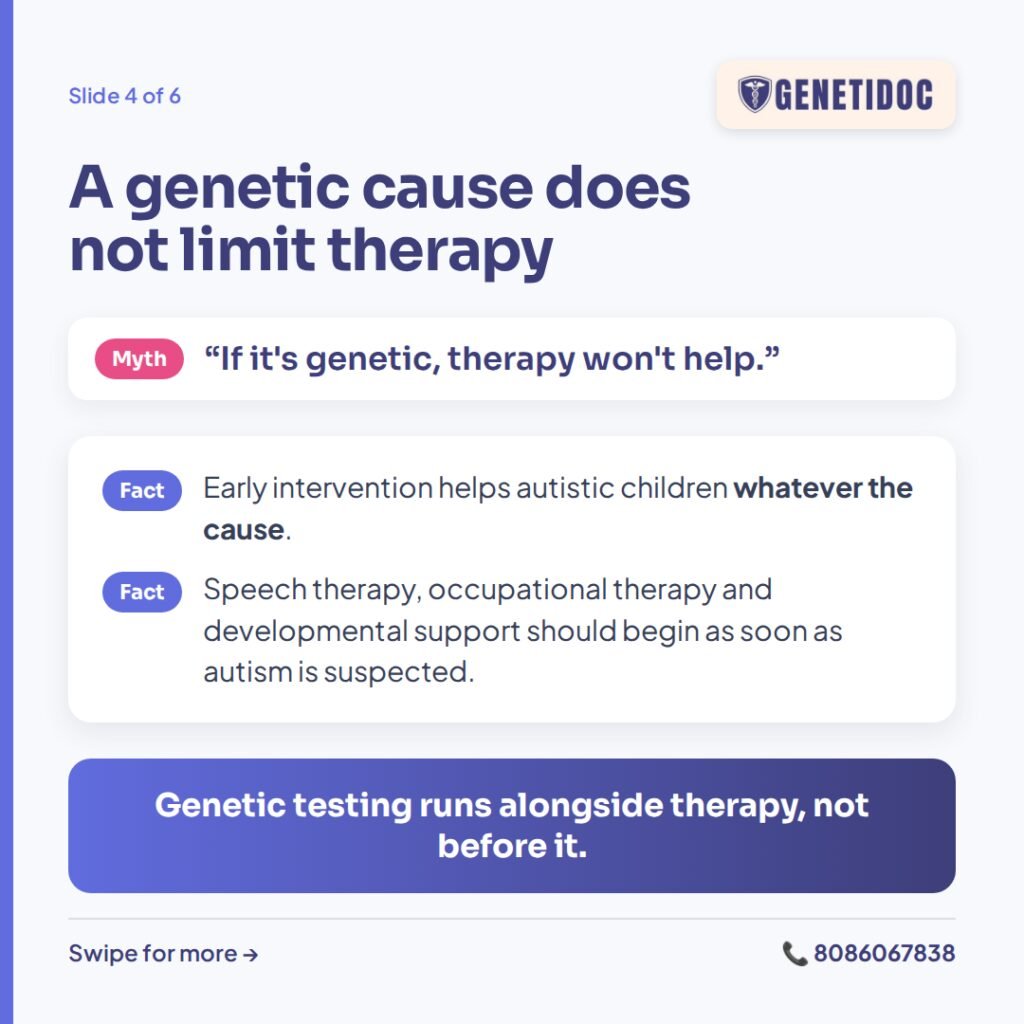
“If it’s genetic, therapy won’t help.”
This is not true. A genetic cause does not limit what therapy can achieve. Early intervention helps autistic children whatever the cause.
“We should wait for the genetic result before starting therapy.”
Please don’t wait. Speech therapy, occupational therapy and developmental support should begin as soon as autism is suspected. Genetic testing runs alongside therapy, not before it.
When Genetic Testing May Not Add Much
- When the family’s goal is to confirm autism. Genetic testing cannot do this.
- When a cause is already known in the family. A relative usually needs only a targeted test for that one change, not a broad test.
- Consumer DNA kits. Direct-to-consumer genetic kits are not designed to find the causes of autism and should not be used for this purpose.
- Testing an unaffected child “just to check” for autism risk. There is no genetic test that can predict autism in a healthy child.
Cost and Time: What to Expect in India
The cost of genetic testing varies with the test chosen. A single-gene or fragile X test generally costs less than exome sequencing, and genome sequencing generally costs more. A trio test, which includes both parents, costs more than testing the child alone, but often gives a clearer answer.
Results for most of these tests take from a few weeks to about two months, depending on the test. Since the child’s therapy should continue meanwhile, this waiting time does not delay care.
The most expensive test is not always the right one, and the cheapest is not always good value. What matters is choosing the test that fits your child’s features, and having the result interpreted by someone who understands both genetics and your child.
Why Expert Interpretation and Genetic Counseling Matter
A genetic report is only as useful as the understanding behind it. Expert genetic care adds value at every step:
- Before testing: a detailed history, examination and family tree to choose the right test, explain possible results and discuss secondary findings.
- Choosing the right laboratory: an accredited laboratory with strong analysis for both small changes and larger deletions or duplications.
- Interpreting the result: matching the genetic finding with the child’s actual features. A reported change that does not fit the child needs careful review, not automatic acceptance.
- Indian context: Indian populations are under-represented in global genetic databases, so new and uncertain changes are common. Careful interpretation and family testing matter even more.
- After the result: a clear plan for medical follow-up, family testing and future pregnancies, along with time to ask questions and absorb the news.
At Genetidoc, testing is carried out through accredited partner laboratories, and every result is reviewed by a clinical geneticist and explained through genetic counseling. Consultations are available online across India in many Indian languages, and samples can be collected at home.
Practical Steps for Families
- Start or continue therapy now. Do not wait for genetic results.
- Write down your family history. Note any relatives with autism, learning difficulties, seizures, early menopause, late-onset tremor or pregnancy losses, and whether the parents are related by blood.
- Collect your child’s reports: developmental assessments, brain scans, brain wave tests and any earlier genetic reports.
- Consult a clinical geneticist to decide whether testing is useful and which test fits your child.
- Plan testing before the next pregnancy, if you are thinking of having another child.
- Keep your reports and raw data safely, and return for review if new symptoms appear or every year or two if no cause has been found.
- Watch younger siblings’ development closely, and seek early evaluation if you notice concerns.
Frequently Asked Questions
1. Is autism genetic?
Yes, genes play a major role. Around 80% of the variation in autism risk is linked to genetic factors. Some children have a single identifiable genetic cause, while others have many small genetic differences.
2. Can a blood test diagnose autism?
No. Autism is diagnosed by assessing development and behaviour. A genetic blood test looks for an underlying cause in a child who already has an autism diagnosis.
3. Which genetic test is best for autism?
It depends on the child. Exome sequencing finds a cause more often than chromosomal microarray, and Indian research supports it as a first test. Fragile X needs a separate test. A clinical geneticist chooses the right combination.
4. How often does genetic testing find a cause of autism?
Studies report a cause in roughly 10% to over 30% of autistic children. The chance is higher when autism comes with intellectual disability, seizures or physical differences.
5. Should every autistic child have genetic testing?
International guidelines recommend that every autistic child be offered a genetic evaluation. Whether to test is the family’s choice after counseling.
6. If our child has autism, will our next child also have it?
Without a known cause, about 1 in 5 younger siblings is also autistic. If a genetic cause is found, the risk can be calculated much more precisely, and may be much lower or higher.
7. Can autism be detected during pregnancy?
No test can detect autism in pregnancy. If a definite genetic cause is known in the family, the pregnancy can be tested for that specific change.
8. Is autism inherited from the mother or the father?
Neither alone. Many genetic causes are new changes that neither parent carries, and many children inherit small effects from both parents. Fragile X syndrome is one cause usually passed on through the mother.
9. What does a negative genetic test for autism mean?
It means no reportable change was found in what was tested. It does not rule out a genetic cause, and the result can be reanalysed later as knowledge grows.
10. Do vaccines cause autism?
No. Large studies involving hundreds of thousands of children have found no link between vaccines and autism.
11. Can adults with autism have genetic testing?
Yes. Adults can be tested at any age. A result can still explain their features, guide health monitoring and inform family planning.
12. Will a genetic diagnosis change my child’s treatment?
For some children, yes. It can add monitoring for seizures, heart, kidney or cancer risks. Therapy for autism itself continues regardless of the result.
Key Takeaways
- Genes play a major role in autism, but genetic testing looks for a cause; it does not diagnose autism.
- A cause is more likely to be found when autism comes with intellectual disability, seizures, physical differences or a family history.
- Exome sequencing finds a cause more often than chromosomal microarray, including in Indian children. Fragile X needs its own test.
- A negative result does not rule out a genetic cause, and results can be reviewed again later.
- A diagnosis can change medical monitoring, explain family history and clarify the chance of autism in future children.
- Therapy should never wait for genetic results.
Has Your Child Been Diagnosed With Autism? Find Out Whether Genetic Testing Can Help
If your child is autistic, especially with developmental delay, seizures, a family history, or if you are planning another pregnancy, a consultation with a clinical geneticist can help you understand whether testing is useful, which test fits your child, and what the result would mean for your family.
Genetidoc offers genetic counseling in person in Thiruvananthapuram and online across India, with home sample collection and counseling in multiple Indian languages.
Book an autism genetic evaluation: call 8086067838
Join the conversation: Have questions about autism and genetics, or want to connect with other families? Visit the Genetidoc Rare Disease Forum.
Related Reading
- Marfan Syndrome: Symptoms, Diagnosis and Genetic Testing Explained
- Understanding Familial Hypercholesterolemia (Familial Hypercholesterolaemia): When High Cholesterol Runs in the Family
- Li-Fraumeni Syndrome: When Many Different Cancers Run in One Family
- Genetic Testing for Infertility in India: A Complete Guide for Couples
- Genetic Testing for Recurrent Abortions in India: A Complete Guide for Couples
References
- Hyman SL, Levy SE, Myers SM; Council on Children With Disabilities. Identification, evaluation, and management of children with autism spectrum disorder. Pediatrics. 2020;145(1):e20193447.
- Schaefer GB, Mendelsohn NJ; Professional Practice and Guidelines Committee. Clinical genetics evaluation in identifying the etiology of autism spectrum disorders: 2013 guideline revisions. Genet Med. 2013;15(5):399–407.
- Manickam K, McClain MR, Demmer LA, et al. Exome and genome sequencing for pediatric patients with congenital anomalies or intellectual disability: an evidence-based clinical guideline of the American College of Medical Genetics and Genomics. Genet Med. 2021;23(11):2029–2037.
- Srivastava S, Love-Nichols JA, Dies KA, et al. Meta-analysis and multidisciplinary consensus statement: exome sequencing is a first-tier clinical diagnostic test for individuals with neurodevelopmental disorders. Genet Med. 2019;21(11):2413–2421.
- Comparative yield of molecular diagnostic algorithms for autism spectrum disorder diagnosis in India: evidence supporting whole exome sequencing as first tier test. BMC Neurol. 2023;23(1):292. doi:10.1186/s12883-023-03341-0
- Ozonoff S, Young GS, Bradshaw J, et al. Familial recurrence of autism: updates from the Baby Siblings Research Consortium. Pediatrics. 2024;154(2):e2023065297.
- Arora NK, Nair MKC, Gulati S, et al. Neurodevelopmental disorders in children aged 2–9 years: population-based burden estimates across five regions in India. PLoS Med. 2018;15(7):e1002615.
- Bai D, Yip BHK, Windham GC, et al. Association of genetic and environmental factors with autism in a 5-country cohort. JAMA Psychiatry. 2019;76(10):1035–1043.
- Hviid A, Hansen JV, Frisch M, Melbye M. Measles, mumps, rubella vaccination and autism: a nationwide cohort study. Ann Intern Med. 2019;170(8):513–520.
- Hunter JE, Berry-Kravis E, Hipp H, Todd PK. FMR1 In: Adam MP, et al., eds. GeneReviews. Seattle (WA): University of Washington, Seattle. Available at: https://www.ncbi.nlm.nih.gov/books/NBK1384/
This article is for educational purposes and does not replace personal medical advice. Please consult a qualified doctor or clinical geneticist about your individual situation.