
Why Genetics and Infertility Are More Connected Than Most Couples Realise
Infertility affects roughly 1 in 6 couples worldwide, and in India, the numbers are comparable. For many years, the genetic contribution to infertility was underestimated. Today, we know better.
Chromosomes carry the blueprint for every function in the body — including the creation and maturation of eggs and sperm, the development of the uterus, and the ability of an embryo to implant and grow. When any part of this blueprint has an error, fertility is affected.
Some of these errors are large enough to show up on standard chromosome analysis. Others are tiny deletions or mutations visible only with advanced molecular testing. And some involve the quality of genetic material within the sperm itself — something a routine semen analysis cannot measure.
“We see couples who have been through two or three IVF cycles without success. When we finally sit down and do a thorough genetic workup, we find the answer that was always there — just never looked for.” — Dr. Roshan Daniel, Genetidoc Genetic Clinic and DNA Testing Lab
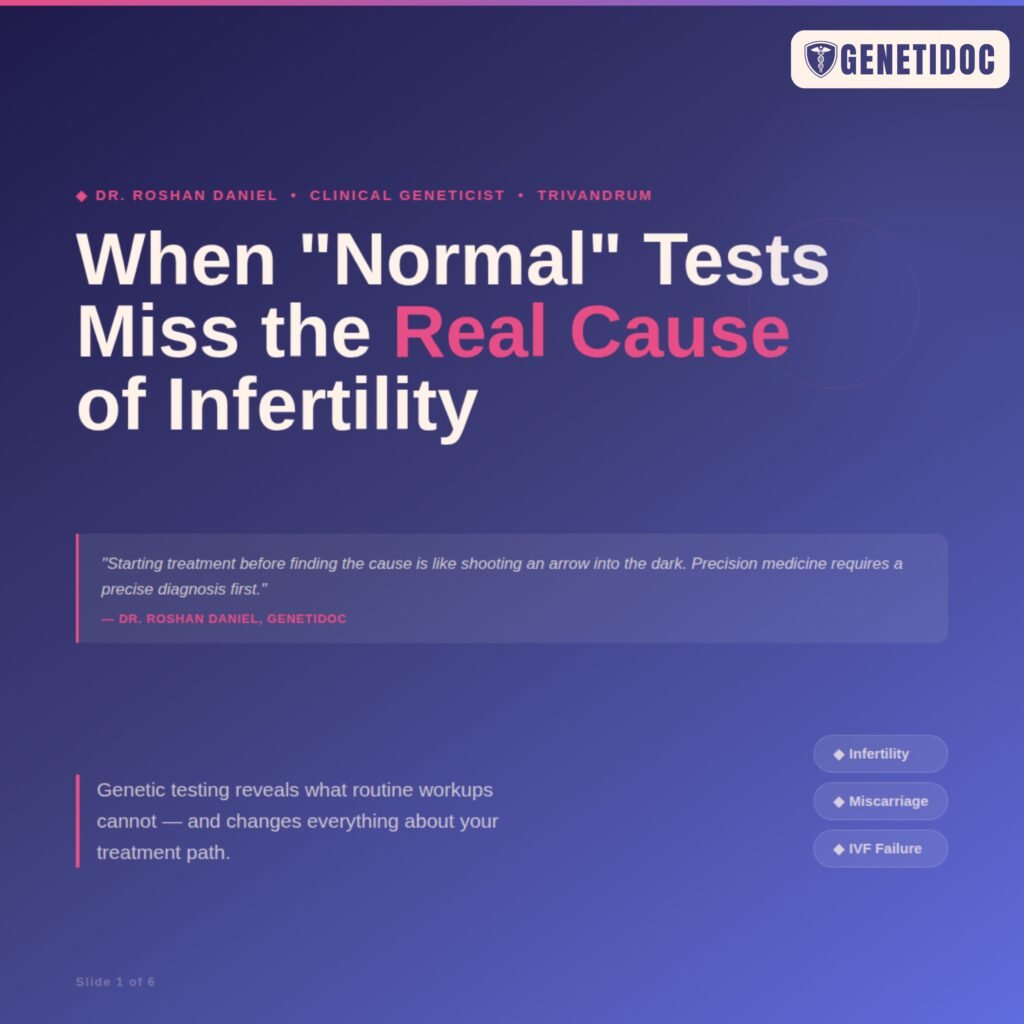
“Starting treatment before finding the cause is like shooting an arrow into the dark. You might get lucky, but precision medicine requires a precise diagnosis first.” — Dr. Roshan Daniel, Genetidoc Genetic Clinic and DNA Testing Lab
Who Should Consider Genetic Testing for Infertility?
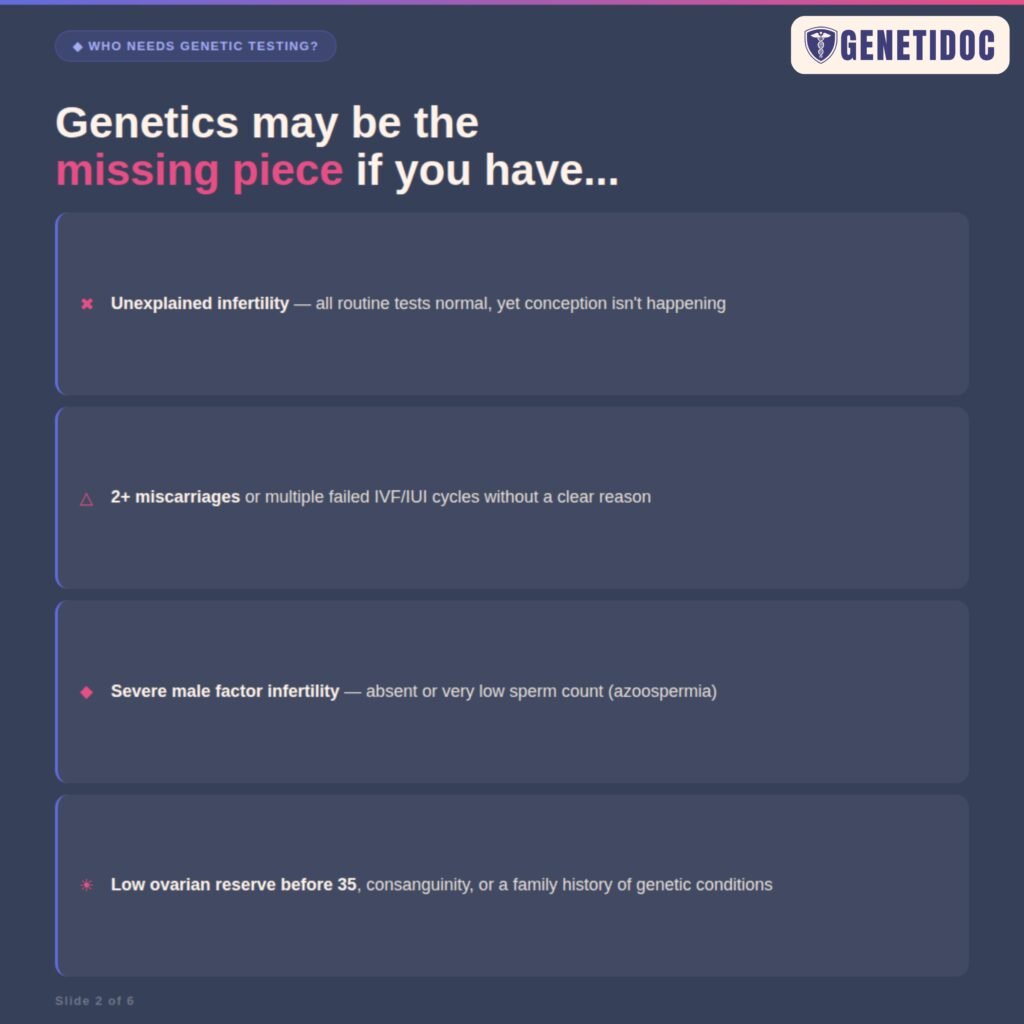
Not every couple needs every genetic test. The right tests depend on the clinical picture. In general, genetic evaluation is strongly recommended when any of the following apply:
- Unexplained infertility — all routine tests are normal, but conception is not occurring
- Recurrent pregnancy loss — two or more miscarriages
- Failed IVF or IUI cycles — especially multiple failures without a clear reason
- Severe male factor infertility — azoospermia (no sperm) or severe oligozoospermia (very low sperm count)
- Diminished ovarian reserve — low AMH or poor response to stimulation, especially in younger women
- Primary ovarian insufficiency — irregular or absent periods before age 40
- A previous pregnancy with a chromosomal or genetic abnormality
- Family history of genetic conditions, inherited disorders, or birth defects
- Consanguinity — related couples have a higher chance of sharing recessive gene mutations
- Abnormal result already found on a previous chromosome or genetic test
The referral pathway in India most commonly looks like this: couples complete the standard fertility workup — hormone tests, ultrasound, hysteroscopy, and semen analysis. When no cause is identified, they are referred for genetic evaluation. By that point, the genetic investigation is overdue — but it is never too late to start.
The Six Key Genetic Tests for Infertility — Explained
There is no single “genetic test for infertility.” Different tests look at different parts of the genetic picture. A specialist will recommend specific tests based on the couple’s history, symptoms, and previous results. Here is what each test involves and why it matters.
1. Couple Karyotype — Mapping the Chromosomes
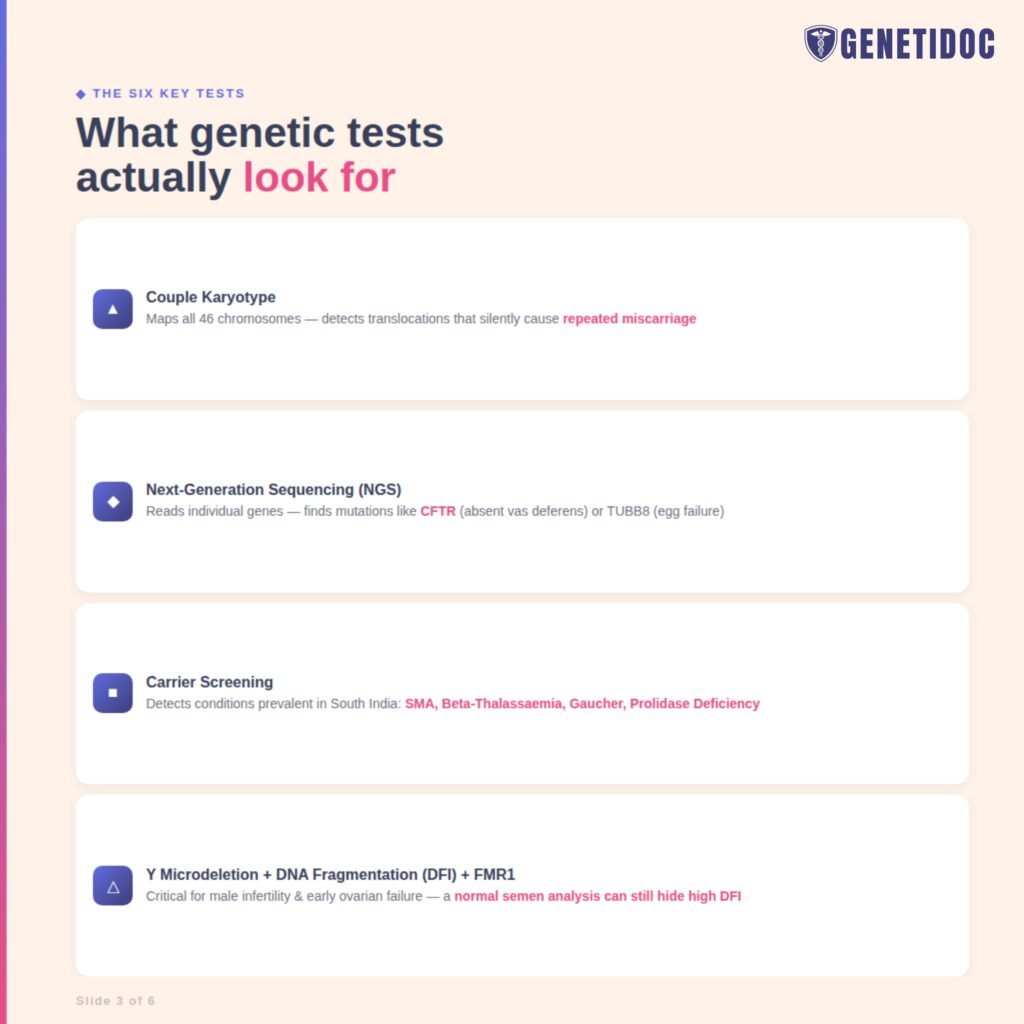
A karyotype is a visual map of all 46 chromosomes in a person’s cells. It shows the number, size, and structure of each chromosome. Both partners are tested separately, using a blood sample.
Missing chromosomes, extra chromosomes, structural rearrangements (where pieces of chromosomes have broken off and reattached in the wrong place), and translocations (where segments of two chromosomes have swapped positions).
Why It Matters in Infertility
Chromosomal abnormalities are one of the leading genetic causes of infertility and recurrent miscarriage. At Genetidoc Genetic Clinic and DNA Testing Lab, one of the most commonly identified findings in couples with recurrent pregnancy loss is a Robertsonian translocation — a specific type of structural chromosome rearrangement.
In a Robertsonian translocation, two specific chromosomes fuse together. The carrier is healthy — their body compensates. But when they pass their chromosomes to an embryo, there is a risk of the embryo receiving an abnormal chromosomal combination. This can cause miscarriage or, in some cases, a baby born with a chromosomal condition.
⚠️ Important: A 21;21 Robertsonian translocation — where both copies of chromosome 21 are fused — carries a 100% recurrence risk for chromosomal imbalance in every pregnancy. This is one of the most consequential findings in reproductive genetics. Detailed counselling about all available options is essential.
What Happens If an Abnormality Is Found?
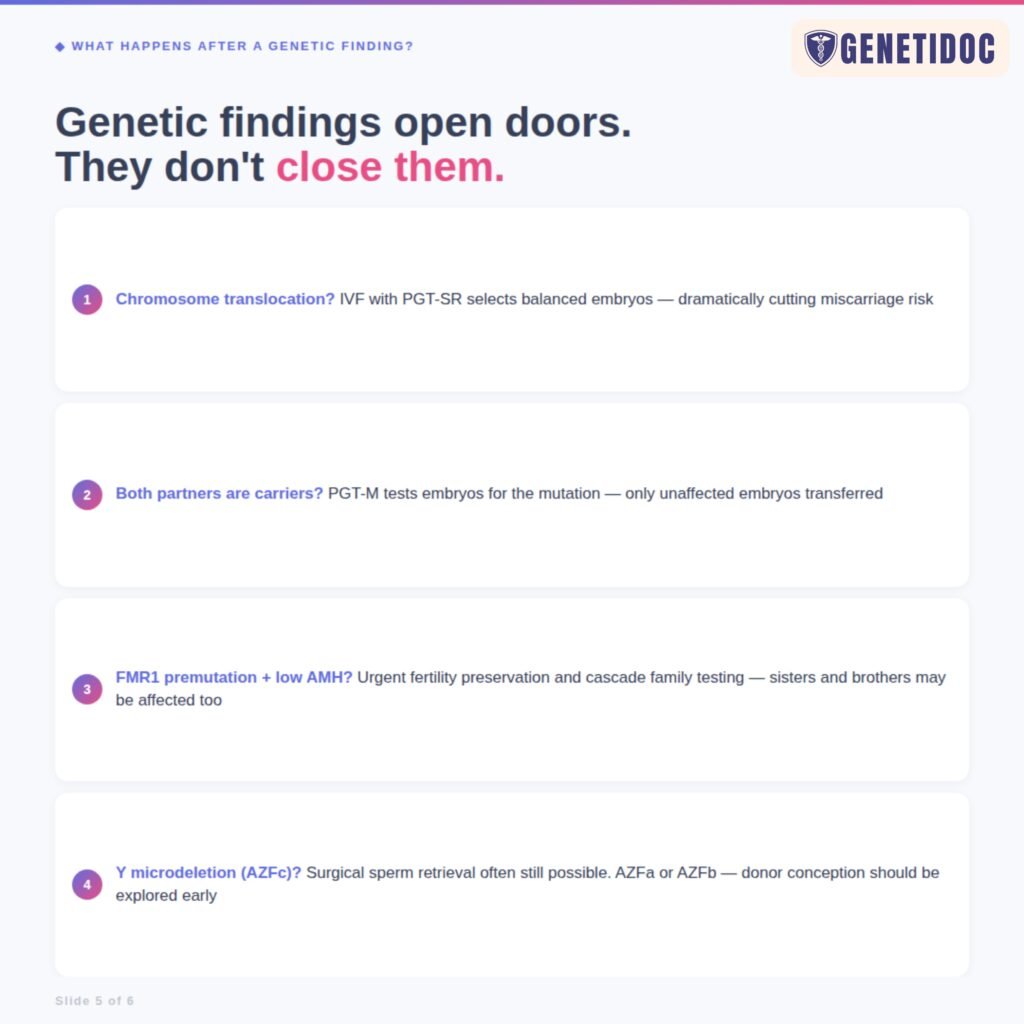
Finding a chromosomal abnormality does not mean giving up. It means redirecting. Couples with translocations or other structural changes can often still have biological children using IVF with Preimplantation Genetic Testing for Structural Rearrangements (PGT-SR) — a technique that tests embryos before transfer to identify those with a balanced chromosomal complement.
“Karyotyping looks simple, but the interpretation is not. A missed translocation in a report from an inexperienced laboratory can mean a couple goes through multiple failed cycles — looking for a problem that was already identified and misread.” — Dr. Roshan Daniel, Genetidoc Genetic Clinic and DNA Testing Lab
2. Couple NGS (Next-Generation Sequencing) — Looking Beyond the Chromosomes
Next-generation sequencing (NGS) reads the genetic code at a far deeper level than a karyotype. While karyotyping shows large chromosomal changes, NGS can detect mutations in individual genes — changes too small to see under a microscope.
When Is NGS Recommended?
- The routine workup — including karyotype — is normal, but infertility persists
- There is a history of a child born with an anomaly or a genetic condition
- There is consanguinity (the couple are related)
- Recurrent miscarriage occurs despite normal karyotypes
- There are features suggesting a single-gene cause of infertility
A clinical example from Genetidoc Genetic Clinic and DNA Testing Lab illustrates the value of NGS: a man with abnormal semen parameters underwent NGS testing, and a mutation in the CFTR gene — the gene associated with cystic fibrosis — was identified. CFTR mutations can cause congenital bilateral absence of the vas deferens (CBAVD), where the tubes carrying sperm are missing. This is entirely manageable: sperm can be retrieved surgically (TESA/PESA) and used for ICSI. Without NGS, the underlying cause would have gone unrecognised.
Another clinically relevant gene, particularly in South India, is TUBB8, which is linked to oocyte maturation defects. This can present as repeated IVF failure with consistently poor egg quality — and is identifiable only through molecular genetic testing.
3. Carrier Screening — Protecting the Next Generation
Carrier screening checks whether one or both partners carry a mutation in a gene associated with a recessive genetic condition. Carriers are completely healthy — they have one working copy of the gene and one altered copy. The risk arises only when both partners carry a mutation in the same gene.
How Autosomal Recessive Conditions Work
Think of each gene as coming in pairs — one inherited from each parent. For a recessive condition to affect a child, the child must inherit a faulty copy from both parents. A person who inherits only one faulty copy is a carrier — healthy, with no symptoms, but able to pass the mutation to their children.
The problem is that most carriers do not know they carry a mutation. There are no symptoms. There may be no family history. The first sign is often a child born with a serious condition — and that is entirely preventable with carrier screening before conception.
Why Carrier Screening Matters in the South Indian Population
Certain conditions are more prevalent in specific populations. For couples from Kerala and the broader South Indian population, the following conditions are particularly relevant:
- Spinal Muscular Atrophy (SMA) — a severe neuromuscular condition; one of the leading genetic causes of infant death in India
- Beta-Thalassaemia — a blood disorder requiring lifelong transfusions; carrier rates are significant across the Indian population
- Prolidase Deficiency — seen in South Indian families; causes recurrent skin ulcers, infections, and intellectual disability
- Gaucher Disease — a lysosomal storage disorder affecting the liver, spleen, and bones
- TUBB8 gene mutations — linked to egg development failure; identified in South Indian families in clinical practice at Genetidoc Genetic Clinic and DNA Testing Lab
When both partners are found to be carriers of the same condition, they have important options. They can proceed with IVF and use Preimplantation Genetic Testing for Monogenic Disorders (PGT-M) to test embryos before transfer, selecting only unaffected embryos for implantation.
“Carrier screening is not about finding something wrong with you. It is about finding information that empowers you to make the safest choices for your future children.” — Dr. Roshan Daniel, Genetidoc Genetic Clinic and DNA Testing Lab
4. Y Chromosome Microdeletion — Understanding Male Infertility at the Genetic Level
The Y chromosome contains a critical region called the AZF region (Azoospermia Factor region). This region carries genes essential for sperm production. Small deletions within this region — too tiny to see on a standard karyotype — can severely impair or completely block sperm production.
How Common Are Y Microdeletions?
In Indian men with azoospermia or severe oligozoospermia, published studies report Y chromosome microdeletion rates ranging from approximately 12% to 16% — making it one of the most significant genetic causes of severe male infertility in India. AZFc deletions are the most common, followed by AZFb and AZFa.
What Do the Results Mean?
The clinical significance of a Y microdeletion depends entirely on which region is deleted:
- AZFa or AZFb deletion: Surgical sperm retrieval is generally unsuccessful. Couples are typically counselled about donor sperm or donor embryo as their path to parenthood.
- AZFc deletion (most common): Surgical sperm retrieval — Testicular Sperm Extraction (TESE or micro-TESE) — may successfully yield mature sperm in a proportion of men. These sperm can then be used for ICSI.
Any son born through ICSI using sperm from a man with an AZFc deletion will inherit the same deletion — and will face severe fertility problems himself. Families must understand this clearly before proceeding with treatment.
The Most Common Misunderstanding
Many couples believe that because the sperm count is the problem, the solution is always to retrieve sperm and do ICSI. The type of deletion determines whether that is even possible. Getting the genetic diagnosis first avoids unnecessary surgical procedures and allows couples to make a truly informed choice.
5. DNA Fragmentation Analysis (DFI) — The Test Most Often Missed
A standard semen analysis measures sperm count, motility, and shape. What it cannot measure is the quality of the genetic material inside each sperm — specifically, whether the DNA strands are intact or broken.
The DNA Fragmentation Index (DFI) measures the percentage of sperm in a sample that carry damaged DNA. This damage — called DNA strand breaks — can occur due to oxidative stress, infection, varicocele, lifestyle factors, or exposure to heat and toxins.
Why Does High DFI Matter?
Sperm with high DNA fragmentation can fertilise an egg, but the resulting embryo carries damaged genetic instructions. This can lead to:
- Failure of the embryo to implant
- Early miscarriage
- Repeated IVF failure despite good-looking embryos on Day 3 or Day 5
- Unexplained infertility in couples with otherwise normal semen parameters
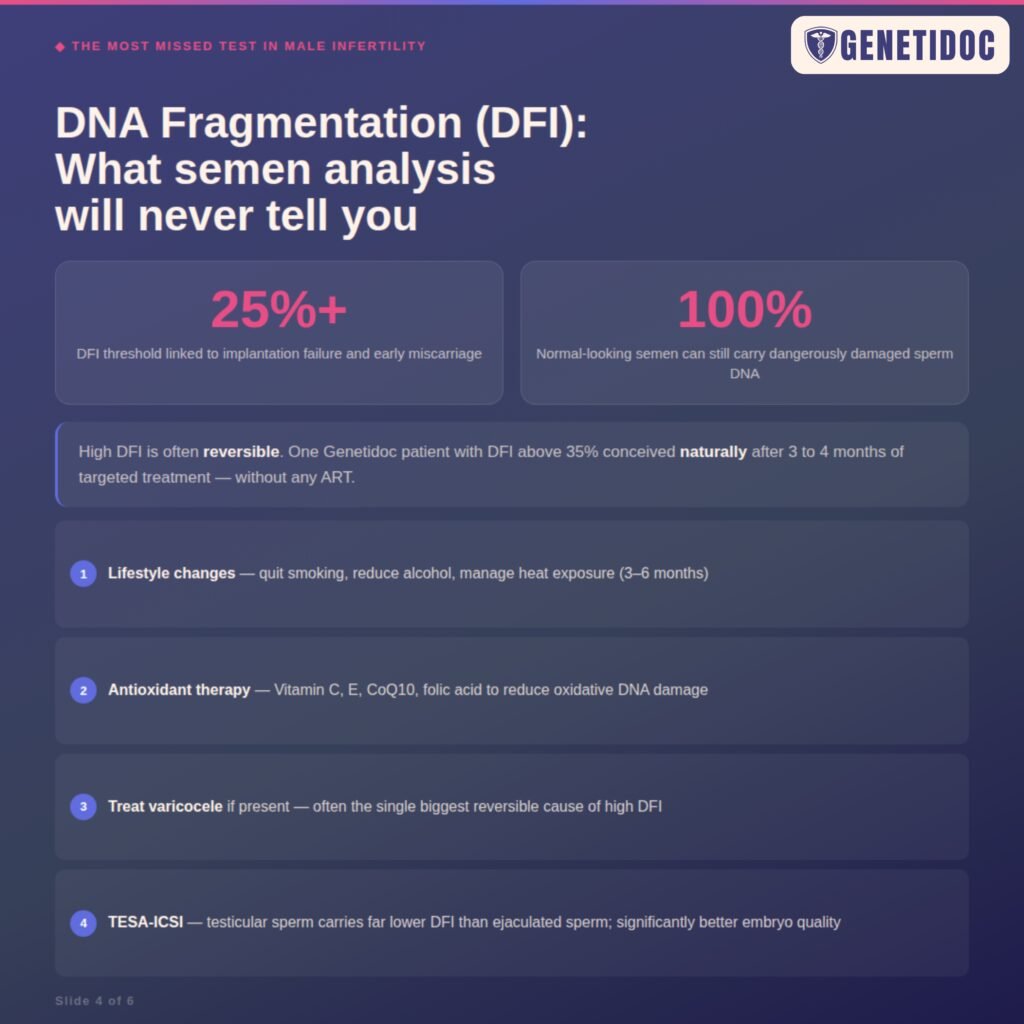
⚠️ Critically, a man can have a completely normal semen analysis — normal count, normal motility, normal shape — and still have high DFI. This is precisely why DNA fragmentation is the most commonly under-investigated genetic factor in male infertility.
What DFI Threshold Matters Clinically?
At Genetidoc Genetic Clinic and DNA Testing Lab, a DFI between 25–30% is considered a grey zone — warranting attention and repeat testing after intervention. Above 30%, the impact on fertility outcomes is more consistent and requires active management. According to ASRM guidelines, a DFI of ≥25–27% (by SCSA methodology) is considered abnormal.
What Can Be Done If DFI Is High?
The good news: elevated DFI is frequently reversible — making it one of the most actionable findings in male infertility. Management is stepwise:
- Lifestyle modification: Quitting smoking, reducing alcohol, managing weight, improving sleep, and reducing heat exposure. This is recommended for 3–6 months, followed by repeat testing.
- Antioxidant therapy: Targeted supplementation — Vitamin C, Vitamin E, CoQ10, and folic acid — reduces oxidative damage to sperm DNA.
- Repeat DFI testing: After the above measures, retesting confirms whether DFI has improved sufficiently.
- TESA-ICSI: Testicular sperm (retrieved directly from the testis) typically carry far lower DNA fragmentation than ejaculated sperm. In men with persistently high DFI, using testicular sperm with ICSI significantly improves embryo quality and pregnancy outcomes.
A man in his early thirties presented with a normal semen analysis but repeated early pregnancy losses. His DFI was found to be significantly elevated at over 35%. After three to four months of targeted lifestyle changes, antioxidant supplementation, and treatment of an underlying varicocele, his DFI dropped into the normal range. The couple conceived naturally within two months of the repeat test — without any assisted reproduction. This outcome would have been impossible without identifying the correct diagnosis first.
6. FMR1 Gene Testing (Fragile X Premutation) — A Hidden Cause of Ovarian Failure
The FMR1 gene carries instructions essential for normal brain development and ovarian function. In the general population, the FMR1 gene contains between 5 and 44 CGG repeats in a specific region. When this repeat number expands:
- 55–200 repeats (premutation): The gene partially works, but the expanded repeat causes significant problems — particularly affecting ovarian function, and in older carrier men, a neurological condition called FXTAS.
- More than 200 repeats (full mutation): This causes Fragile X syndrome — the most common inherited cause of intellectual disability.
What Does an FMR1 Premutation Mean for Fertility?
Women with an FMR1 premutation have a significantly elevated risk of Fragile X-associated Premature Ovarian Insufficiency (FXPOI). Studies estimate that approximately 16–20% of women with an FMR1 premutation will develop premature ovarian insufficiency. In women younger than 35 with unexplained diminished ovarian reserve, the prevalence of the premutation is approximately 7–8% — compared to around 1% in the general population.
At Genetidoc Genetic Clinic and DNA Testing Lab, FMR1 testing is strongly recommended for women presenting with:
- Unexplained diminished ovarian reserve (low AMH or poor IVF stimulation response)
- Primary ovarian insufficiency — early menopause, irregular periods, or elevated FSH before age 40
- A family history of Fragile X syndrome, intellectual disability, or tremor/ataxia in older male relatives
What Does Finding a Premutation Mean?
For the woman herself: The premutation explains her ovarian insufficiency and guides decisions about fertility preservation, egg donation, and the urgency of attempting conception — the sooner, the better, as ovarian reserve will continue to decline.
For her family: The FMR1 premutation is inherited on the X chromosome. A woman who carries the premutation has a 50% chance of passing it to each child. When a premutation is passed to a son, it can expand into a full mutation, causing Fragile X syndrome. Brothers may carry the premutation and risk FXTAS later in life. Sisters should be offered testing.
Finding an FMR1 premutation is not just a diagnosis for one patient — it is a finding with implications for an entire family. This is precisely why expert genetic counselling is indispensable. A lab report alone cannot guide a family through these implications.
Genetic Tests for Infertility: At a Glance
| Test | Who Is Tested | What It Detects | Typical TAT | Approx. Cost (India) |
|---|---|---|---|---|
| Couple Karyotype | Both partners (blood) | Chromosomal number & structure abnormalities, translocations | 7–14 days | ₹3,000–₹8,000 per person |
| Couple NGS (Panel/Exome) | Both partners (blood) | Single-gene mutations, small deletions, variants in fertility-related genes | 21–45 days | ₹25,000–₹1,00,000+ |
| Carrier Screening | Both partners (blood/saliva) | Carrier status for recessive conditions (SMA, thalassaemia, and others) | 14–21 days | ₹8,000–₹40,000 (panel-dependent) |
| Y Chromosome Microdeletion | Male partner (blood) | AZFa, AZFb, AZFc deletions affecting spermatogenesis | 7–14 days | ₹5,000–₹12,000 |
| DNA Fragmentation Index (DFI) | Male partner (semen) | Percentage of sperm with damaged DNA strands | 7–10 days | ₹5,000–₹10,000 |
| FMR1 Gene Testing | Female partner (blood) | CGG repeat expansion — premutation or full mutation | 14–21 days | ₹6,000–₹15,000 |
Note: Costs vary by laboratory, panel size, and technology. At Genetidoc Genetic Clinic and DNA Testing Lab, testing is recommended based on individual clinical needs — not as a standard package for everyone. A consultation determines which investigations are actually necessary.
After Genetic Diagnosis: The Role of Preimplantation Genetic Testing (PGT)
Once a genetic cause of infertility or recurrent pregnancy loss is identified, it fundamentally changes the ART pathway. Preimplantation Genetic Testing — testing embryos created through IVF before they are transferred to the uterus — becomes a powerful tool.
PGT-A — Preimplantation Genetic Testing for Aneuploidies
PGT-A screens embryos for abnormal chromosome numbers — too many or too few chromosomes. It is recommended in cases of recurrent implantation failure, multiple failed IVF cycles, advanced maternal age, and as a routine option to select chromosomally normal embryos for transfer.
PGT-M — Preimplantation Genetic Testing for Monogenic Disorders
PGT-M is used when a specific gene mutation has been identified in one or both partners — for example, where both carry mutations for SMA or thalassaemia. The test is designed specifically for each couple, and only unaffected embryos are transferred.
PGT-SR — Preimplantation Genetic Testing for Structural Rearrangements
PGT-SR is used when one partner has a chromosomal structural rearrangement — such as a Robertsonian translocation or an inversion — identified on karyotype. The test selects embryos with a balanced chromosomal complement, dramatically reducing the risk of miscarriage and chromosomal conditions in the baby.
Why the Laboratory and the Interpreter Matter as Much as the Test Itself
Genetic testing is not a commodity. Two laboratories can run the same test and produce very different results — in quality, accuracy, and clinical utility.
The Problem of Low-Quality Testing
In India, the availability of very low-cost genetic tests has created a misleading impression that all labs are equivalent. They are not. The problems arising from poor-quality testing include:
- False negatives: A deletion or mutation exists but is not detected. The couple is incorrectly told their results are normal.
- False positives: A variant is flagged as significant when it is not — causing anxiety, additional testing, and wrong treatment decisions.
- Variants of Uncertain Significance (VUS): Variants whose clinical significance is not established. Without expert interpretation, couples make decisions based on results that require careful contextualisation.
- Incomplete panels: Some labs test only a fraction of relevant variants, missing clinically important mutations.
- Poor chromosome resolution: On karyotyping, insufficient banding resolution can cause a Robertsonian translocation to be missed entirely — at enormous cost to the couple.
“I have seen couples come to us after getting a ‘normal’ karyotype elsewhere — and when we repeated the test with proper resolution and experienced eyes, a translocation was there all along. The cost of using a cheap lab is paid in wasted time, wasted cycles, and broken hope.” — Dr. Roshan Daniel, Genetidoc Genetic Clinic and DNA Testing Lab
Why Expert Genetic Counselling Changes Outcomes
A genetic report is the beginning of the process, not the end. The true value lies in what is done with the result — and that requires expert clinical interpretation and counselling.
At Genetidoc Genetic Clinic and DNA Testing Lab, genetic counselling in the infertility context covers:
- Explaining what the result means — in plain language, without ambiguity
- Distinguishing significant findings from variants of uncertain significance
- Discussing implications for the couple’s children and other family members
- Outlining all available fertility pathways with their respective success rates, risks, and costs
- Addressing emotional concerns: guilt, stigma, and the “why us” questions that inevitably arise
- Planning the next steps — whether PGT, donor conception, lifestyle change, or further investigation
“A chromosomal change or gene mutation is not a mistake. It is not something the person did or did not do. These are natural variations — they do not reflect on the individual’s worth or health. The goal of counselling is to move the family from guilt to empowerment.” — Dr. Roshan Daniel, Genetidoc Genetic Clinic and DNA Testing Lab
Frequently Asked Questions
1. Can genetic testing tell me exactly why I am not getting pregnant?
Genetic testing can identify specific genetic causes of infertility in a significant proportion of couples. However, not all infertility has a detectable genetic cause, and genetics is one part of a complete evaluation. A genetic specialist will guide which tests are most relevant for your situation.
2. If my semen analysis is normal, do I still need DNA fragmentation testing?
Possibly, yes. A normal semen analysis checks count, motility, and shape, but says nothing about the quality of the sperm’s DNA. Men with normal semen analysis can still have high DNA fragmentation, which affects embryo quality and can cause implantation failure or miscarriage.
3. We have had two miscarriages. Is genetic testing useful at this stage?
Absolutely. Recurrent pregnancy loss is a key indication for couple karyotyping. A chromosomal abnormality — particularly a translocation — in one partner can cause repeated miscarriage. Identifying this changes the management plan significantly.
4. What does it mean if I am a “carrier” for a genetic condition?
Being a carrier means you carry one altered copy of a gene but are completely healthy. It only becomes relevant when your partner is also a carrier of the same condition — in that case, each pregnancy has a 25% chance of being affected. Carrier status in one partner alone poses no risk to a child.
5. My husband has no sperm. Does he need a genetic test?
Yes — strongly recommended. Men with azoospermia should have both a karyotype and a Y chromosome microdeletion test. Together, these identify the most common genetic causes of absent sperm production and determine whether surgical sperm retrieval is likely to be successful.
6. I am only 31 but my AMH is very low. Should I test for FMR1?
Yes. Diminished ovarian reserve below age 35 warrants FMR1 testing. Studies show that young women with low ovarian reserve have a significantly higher prevalence of FMR1 premutation compared to the general population. The result has implications not just for your fertility plan but for your family.
7. Can we do IVF even if a Y microdeletion is found?
It depends on which region is deleted. An AZFc deletion allows for surgical sperm retrieval in many cases, and ICSI can be attempted. AZFa or AZFb deletions generally mean sperm cannot be retrieved surgically. Your specialist will counsel you on the specific options based on your deletion type.
8. How much does a genetic workup for infertility cost in India?
Individual tests range from approximately ₹3,000 to ₹1,00,000 depending on the test and laboratory. The key point is that not every couple needs every test. After a thorough consultation, a specialist selects only the investigations that are clinically indicated.
9. What is a VUS, and should I be worried if my report mentions one?
VUS stands for Variant of Uncertain Significance. It means a genetic variant has been found, but its clinical significance is not yet fully established. A genetic counsellor will explain whether the VUS is relevant to your situation. Do not make treatment decisions based on a VUS without specialist guidance.
10. What if our genetic test results are normal but we still cannot conceive?
Normal genetic results are still valuable — they rule out a significant category of causes and prevent incorrect treatments. Your specialist may recommend further investigation or a broader panel. Unexplained infertility after thorough investigation may still benefit from IVF with PGT-A.
11. What is PGT-SR and how is it different from PGT-A?
PGT-SR is used specifically when one partner has a chromosomal structural rearrangement (like a translocation) identified on karyotype. It tests embryos for the specific imbalance caused by that rearrangement. PGT-A is a broader screen for any chromosomal number abnormality in embryos, without a known rearrangement in the parents.
12. Does consanguinity (being related) increase the need for genetic testing?
Yes, significantly. Related couples are more likely to share carrier mutations in the same recessive genes. Extended carrier screening is strongly recommended for consanguineous couples before attempting conception or ART.
Conclusion: A Diagnosis Is the Foundation of Every Successful Treatment
Infertility is not always a dead end. Very often, it is a problem waiting for the right question to be asked.
Genetic testing for infertility is that question. It brings clarity to “unexplained” situations, identifies reversible causes like DNA fragmentation, reveals chromosomal factors that determine which ART pathway will work, and uncovers inherited risks that matter not just for this couple — but for generations to come.
The key messages for any couple navigating infertility are:
- Do not begin treatment before completing the right evaluation. A precise diagnosis leads to precise management.
- Genetic testing is not frightening — it is informative. The majority of findings lead to actionable next steps.
- A result from a quality laboratory, interpreted by an experienced specialist, is worth far more than a cheaper report that may be wrong or incomplete.
- Genetic counselling is part of the test — not an optional add-on. Understanding your results is as important as getting them.
- Many genetic causes of infertility can be worked around. Finding the cause opens doors, not closes them.
References
- Dutta S et al. Prevalence of Y chromosome microdeletion in azoospermia factor subregions among infertile men from West Bengal, India. Molecular Genetics & Genomic Medicine. 2021.
- Ambulkar PS et al. Prevalence of Y chromosome microdeletions in idiopathic azoospermia cases in central Indian men. Applied Clinical Genetics. 2015.
- Colaco S, Modi D. Genetics of the human Y chromosome and its association with male infertility. Reproductive Biology and Endocrinology. 2018.
- Krausz C et al. EAA/EMQN best practice guidelines for molecular diagnosis of Y-chromosomal microdeletions: State of the art 2023. Andrology. 2024.
- Agarwal A et al. Clinical practice guidelines for sperm DNA fragmentation testing in male infertility. Translational Andrology and Urology. 2017.
- Rodriguez-Purata J et al. Prevalence of the FMR1 gene premutation in young women with a diminished ovarian reserve. International Journal of Molecular Sciences. 2024.
- Murray A et al. Population-based estimates of the prevalence of FMR1 expansion mutations in women with early menopause and primary ovarian insufficiency. Genetics in Medicine. 2014.
- Mignot C et al. Study of the genetic etiology of primary ovarian insufficiency: FMR1 gene. Genes. 2016.
- ACMG Practice Guidelines: Carrier Screening in the Age of Genomic Medicine. Genetics in Medicine. 2017.
- GeneReviews: Fragile X Syndrome. NCBI Bookshelf, National Library of Medicine.
- Mascarenhas MN et al. National, regional, and global trends in infertility prevalence since 1990. PLOS Medicine. 2012.
- Samplaski MK. A few more fragments: putting sperm DNA integrity testing into clinical practice. Translational Andrology and Urology. 2017.