
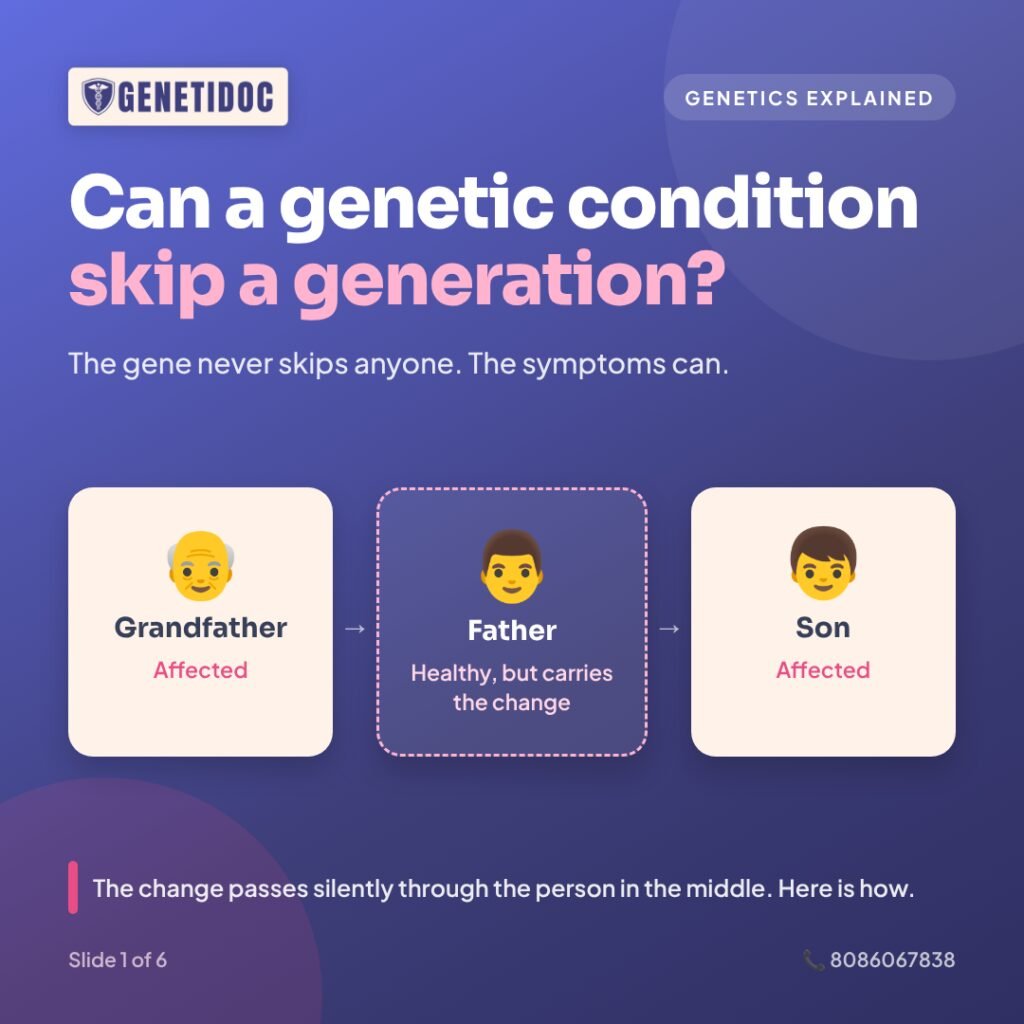
“My grandfather had it. My father never did. Now my son has been diagnosed. How is that possible?”
It is one of the most common questions families bring to a genetic consultation. A condition seems to vanish for a generation and then reappear, often without warning. Some families conclude that the condition “skips” people at random. Others assume a healthy parent means a safe child. Both ideas can lead to worry, and sometimes to missed chances for testing and prevention.
This article explains, in plain language, why a genetic condition can appear to skip a generation, which inheritance patterns make this happen, what it means for Indian families in particular, and when genetic testing can give you a clear answer.
| Quick answer
Yes, a genetic condition can appear to skip a generation, but the gene itself does not skip anyone. The genetic change is passed down quietly through a person who does not show the condition. This usually happens because that person is a healthy carrier of a recessive or X-linked condition, carries a gene change that does not always cause disease, has signs too mild to notice, or died before the condition would have appeared. |
Genes Don’t Skip Generations Symptoms Can
We each carry two copies of most of our genes, one copy from each parent. When a parent has a genetic change, it can be passed to a child whether or not the parent ever had symptoms. The genetic change is present in every generation it travels through. What changes from person to person is whether that change actually causes visible illness.
So when a family tree looks like this:
- Grandparent: affected
- Parent: healthy
- Child: affected
the healthy parent in the middle very often carries the same genetic change. They simply never developed the condition, or developed it so mildly that nobody recognized it.
| “Families often tell us a condition ‘skipped’ someone,” says Team Genetidoc. “In genetics, nothing really disappears. The change was carried silently through that person. Finding out exactly how it was carried is what lets us give the family an accurate risk, instead of a guess.” |
7 Reasons a Genetic Condition Can Appear to Skip a Generation
- Recessive inheritance: the “skipped” person is a healthy carrier with one changed copy and one working copy.
- X-linked inheritance: the condition passes through healthy carrier women and mainly affects boys.
- Reduced penetrance: the person carries a disease-causing change but never develops the condition.
- Variable expressivity: the person has the condition, but in such a mild form that nobody noticed.
- Late onset or early death: the person died of something else before the condition would have appeared.
- Missed or wrong diagnosis: an older relative’s illness was labelled as something else, such as a “heart attack.”
- Changes that grow across generations: some genetic changes become larger, and more harmful, as they are passed down.
Each of these is explained below.
Inheritance Patterns at a Glance
| Inheritance pattern | Can it appear to skip a generation? | Examples |
| Autosomal recessive | Yes, very often. Carriers are healthy, and the condition can stay hidden for many generations. | Beta-thalassemia, sickle cell disease, spinal muscular atrophy, many metabolic disorders |
| X-linked recessive | Yes. It is often carried silently by women and shows up in their sons or grandsons. | Duchenne muscular dystrophy, hemophilia, G6PD deficiency |
| Autosomal dominant | Usually seen in every generation, but it can appear to skip when the gene change does not always cause disease, or causes very mild signs. | Hereditary breast and ovarian cancer (BRCA1, BRCA2), Lynch syndrome, neurofibromatosis type 1, Marfan syndrome |
| Repeat expansion conditions | Yes. A smaller change in a grandparent can grow into a larger, disease-causing change in a grandchild. | Fragile X syndrome, myotonic dystrophy, Huntington disease |
| Mitochondrial | Can appear to. It is passed only from the mother, and severity varies widely between her children. | Some inherited forms of vision loss, muscle and energy disorders |
1. Recessive Conditions: The Silent Carrier
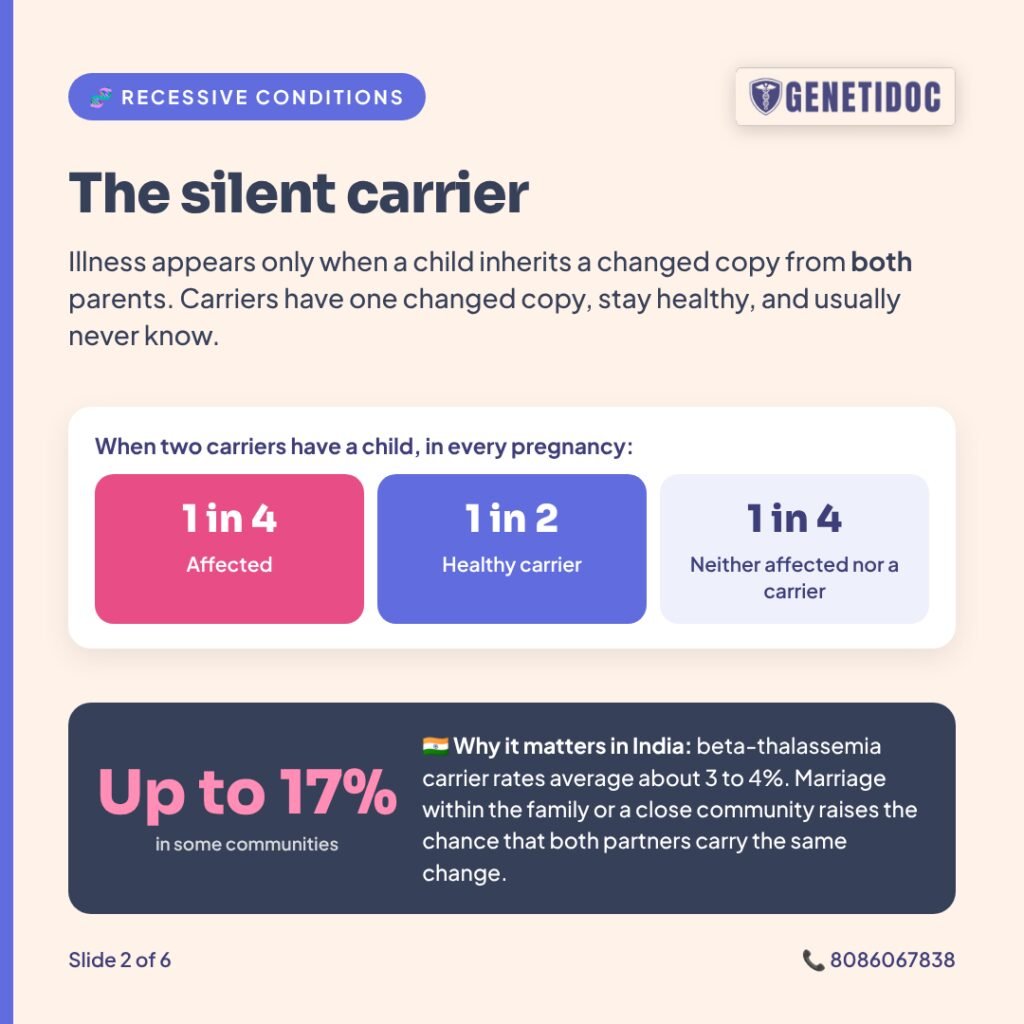
In a recessive condition, a person becomes unwell only if both copies of a gene are changed: one from the mother and one from the father. A person with just one changed copy is called a carrier. Carriers almost always stay completely healthy, and most have no idea they are carriers.
When two carriers have children together, each pregnancy carries the same chances:
- 1 in 4 chance the child is affected
- 1 in 2 chance the child is a healthy carrier, like the parents
- 1 in 4 chance the child neither has the condition nor carries it
These chances apply to every pregnancy separately. Having one affected child does not make the next three children safe.
Because carriers are healthy, a recessive change can pass silently through grandparents, parents, aunts and uncles for many generations. It only shows itself when two carriers happen to have a child together. To the family, it can feel as if the condition came out of nowhere, or skipped several generations.
Why this matters especially in India
Recessive conditions are a major concern in India for two reasons.
The first is how common some carrier states are. Beta-thalassemia is the clearest example. Indian studies report an average beta-thalassemia carrier rate of about 3.3 percent, ranging from under 1 percent to as high as 17 percent in different regions and communities. A large review of Indian studies found a pooled carrier rate of about 3.7 percent in the general population. Sickle cell disease is mainly reported in communities of tribal origin. With carrier rates this high, two healthy carriers marrying each other is not rare.
The second is marriage patterns. In many Indian communities, marriage within the extended family (consanguineous marriage) or within a closed community is common. Related partners, or partners from the same small community, are more likely to carry the same recessive change inherited from a shared ancestor. Team Genetidoc sees this in practice. For example, the severe form of familial hypercholesterolemia, in which a child inherits two changed copies, is seen mostly in consanguineous families.
| “A healthy family history does not mean a couple carries no recessive conditions,” says Team Genetidoc. “Carrier screening matched to the couple’s community and background is the only reliable way to know, and the best time to do it is before pregnancy.” |
2. X-Linked Conditions: Passed Through Mothers, Seen in Sons
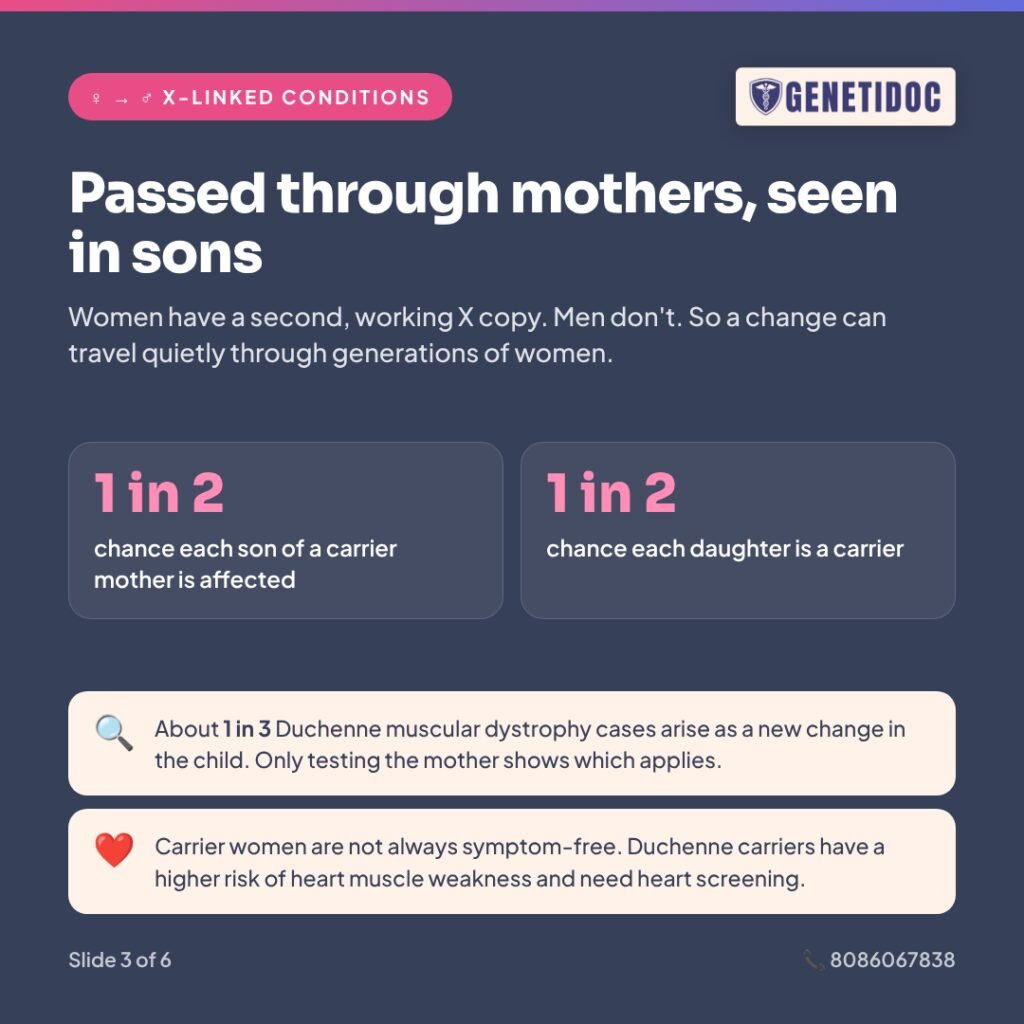
Women have two X chromosomes. Men have one X and one Y. When a gene on the X chromosome is changed, a woman usually has a second, working copy on her other X, so she stays healthy or has only mild symptoms. A man has no second copy, so he is affected.
For a mother who carries an X-linked change, each pregnancy carries these chances:
- Each son has a 1 in 2 chance of being affected
- Each daughter has a 1 in 2 chance of being a carrier, like her mother
This is how a condition such as Duchenne muscular dystrophy or hemophilia can travel through a mother, grandmother and great-grandmother, none of whom were ill, and appear in a boy whose only affected relative was a great-uncle the family barely remembers.
It is important to know that not every affected boy’s mother is a carrier. In Duchenne muscular dystrophy, roughly a third of cases are caused by a new genetic change that arose for the first time in the child. Testing the mother is the only way to know which situation applies, and the answer changes the risk for her sisters, her daughters and her future pregnancies.
Carrier women are not always symptom-free
“Carrier” does not always mean “unaffected.” Women who carry a Duchenne muscular dystrophy change have an increased risk of heart muscle weakness. Published studies have found heart involvement on echocardiography (an ultrasound scan of the heart) in anywhere between 2.5 and 75 percent of carrier women without symptoms, and heart screening is recommended for them. Some carriers of hemophilia have lower clotting factor levels and bleed more than expected. Women who carry G6PD deficiency range from no symptoms at all to clear deficiency.
| “When a mother learns she passed on an X-linked condition, guilt is often her first reaction,” says Team Genetidoc. “We are very clear with families: nobody chooses the genes they carry or pass on. No parent is to blame. What matters now is using the information to protect the rest of the family.” |
3. Reduced Penetrance: Carrying the Gene Without the Disease
Some genetic changes do not cause disease in everyone who carries them. Geneticists call this reduced (or incomplete) penetrance. Penetrance is the proportion of people with a genetic change who actually develop the condition.
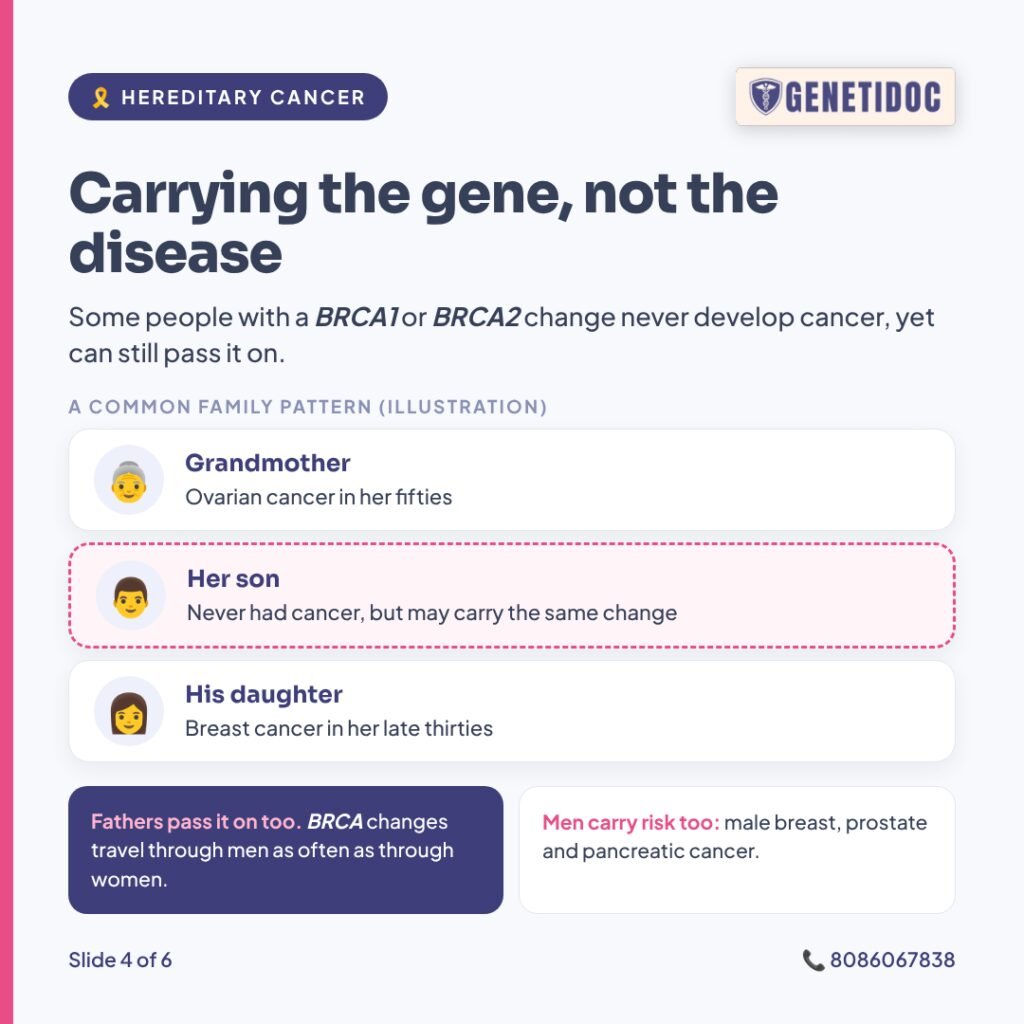
Reduced penetrance is common in hereditary cancer syndromes. A person can carry a disease-causing change in BRCA1 or BRCA2 and never develop breast or ovarian cancer. Yet they can still pass that change to their children, who face the same raised risk. When an unaffected carrier passes the change on, the family tree looks as if the condition skipped a generation.
Here is a common family pattern, shown as an illustration rather than a real patient:
- A grandmother developed ovarian cancer in her fifties.
- Her son never had cancer and assumed the family risk did not apply to him.
- His daughter developed breast cancer in her late thirties.
The son in the middle may well carry the same BRCA change. It can be passed through fathers as readily as through mothers. Men with BRCA changes also have their own raised risks, including male breast cancer, prostate cancer and pancreatic cancer.
| “A parent who never had cancer is often surprised to learn they carry the family’s gene change,” says Team Genetidoc. “We explain that the gene raises risk but does not guarantee cancer, and that every person’s risk is different. That is why we never give a family a single number. We explain risk person by person.” |
4. Variable Expressivity: Present, But Too Mild to Notice
Sometimes the “skipped” person did have the condition, just in a very mild form. Geneticists call this variable expressivity: the same genetic change causes severe illness in one family member and barely noticeable signs in another.
Conditions like neurofibromatosis type 1 and Marfan syndrome show this well. A parent with a few light-brown skin patches, or with tall, flexible joints, may never have been told they had a genetic condition. Their child, with the same change, may have far more obvious features. Medical references note that some apparent “skips” are simply minor signs that were never recognized.
This is why a clinical geneticist will often examine the parents carefully, not just the child. Small, overlooked signs can completely change how the family’s inheritance pattern is understood.
5. Late Onset and Early Death
Some genetic conditions appear only in adulthood. Huntington disease, for example, usually begins in a person’s forties. A person can pass the condition to their children years before they develop any symptoms themselves.
If a relative carrying such a change died young, in an accident, from an infection or from another illness, they may never have reached the age at which the condition would have appeared. On paper, they look unaffected. In reality, they carried the change and passed it on.
The same applies to many hereditary cancer syndromes and inherited heart conditions, where risk rises with age.
6. When an Older Generation Was Never Diagnosed
Many families have incomplete medical histories. Grandparents may have lived before genetic testing existed, may have died in another state, or may have had illnesses that were described only in general terms.
Inherited heart conditions are a clear example. Team Genetidoc’s most common cardiac referral is a family history of young deaths that were labelled “heart attacks.” When the history is looked at closely, many of these turn out to have been sudden deaths. They may reflect an inherited heart rhythm disorder or heart muscle condition that nobody recognized at the time.
Other reasons a family history can look incomplete include small families with few children, relatives the family has lost touch with, and adoption. A condition can look as if it skipped a generation simply because nobody knows what happened to the people in that generation.
| “We always take a detailed family history across at least three generations,” says Team Genetidoc. “When we ask exactly how and at what age a relative died, a ‘heart attack at 35’ or a ‘weak child who passed away young’ can point us straight toward a genetic diagnosis the family never suspected.” |
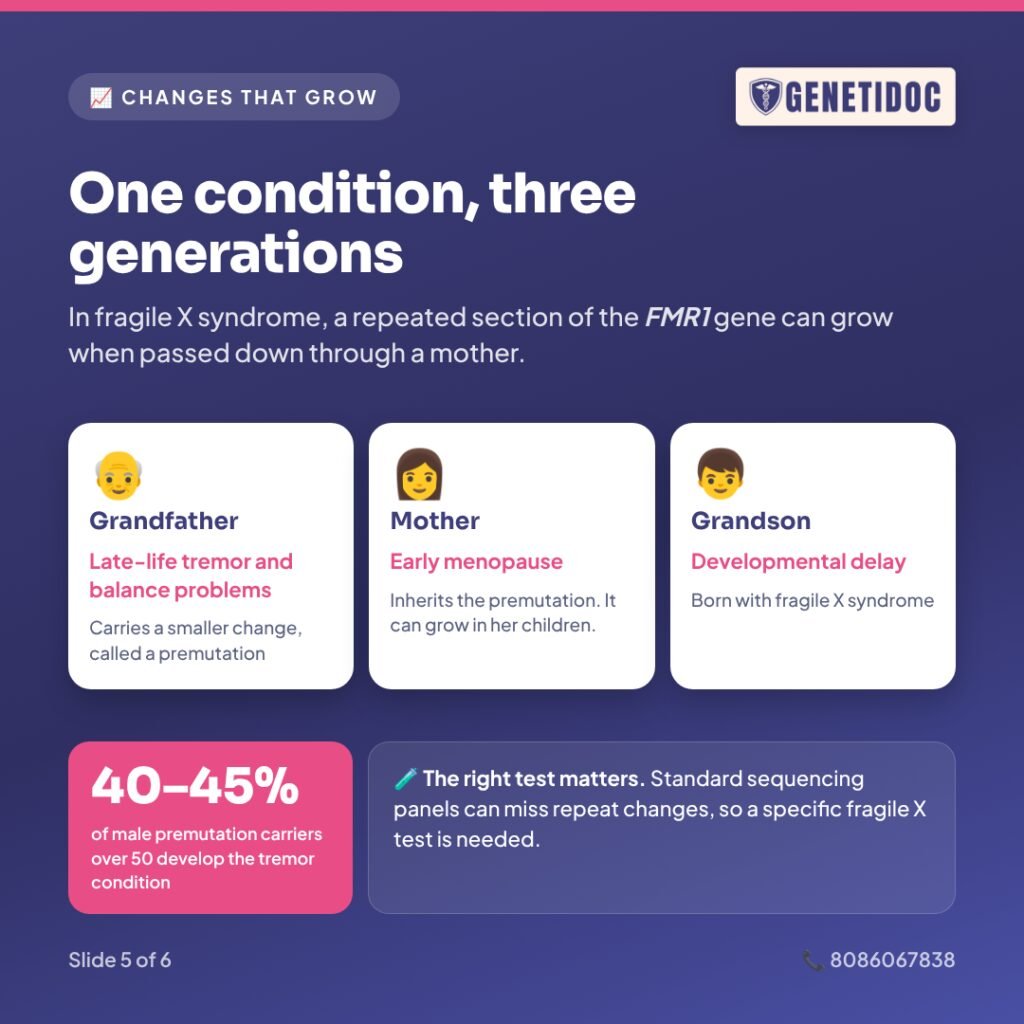
7. Changes That Grow Across Generations: The Fragile X Example
A few genetic conditions are caused by a short section of DNA that is repeated too many times, like a word stuck on repeat. In some of these conditions, the repeated section can grow longer each time it is passed down. A small change in a grandparent can grow into a large, disease-causing change in a grandchild. Geneticists sometimes call this anticipation: the condition tends to appear earlier or more severely in each new generation.
Fragile X syndrome is the best-known example, and the most common inherited cause of intellectual disability in boys. It works like this:
- A grandfather carries a medium-sized change in the FMR1 gene, called a premutation. He does not have fragile X syndrome.
- He passes this premutation to all of his daughters, but to none of his sons.
- When his daughter passes it to her own children, the premutation can grow into a full mutation. Only premutations passed through women can grow in this way.
- Her son can then be born with fragile X syndrome.
The grandfather is not always free of symptoms either. Premutation carriers can develop fragile X-associated tremor/ataxia syndrome later in life, a condition causing a shaking tremor and balance problems. It affects 40 to 45 percent of male premutation carriers over the age of 50. The condition was first described in 2001 in grandfathers of children with fragile X syndrome. Even today, many grandfathers are diagnosed only after a grandchild is. Women who carry a premutation have a higher chance of their ovaries stopping working early, which can mean early menopause and difficulty conceiving.
For a family, this can look baffling: a grandfather with a late-life tremor, a mother with early menopause and a grandson with developmental delay. These can all be one genetic condition, carried through three generations. At Genetidoc, the fragile X test takes about 21 days.
Myotonic dystrophy type 1, a muscle condition, can follow a similar path. Published family studies describe it typically moving from a mild, late-onset form in the first generation to a childhood or newborn form by the third. A grandparent may have only cataracts (clouding of the eye lens) and mild muscle stiffness, and never be diagnosed. A parent may have muscle weakness starting in early adulthood. A child may have a severe form from birth, called congenital myotonic dystrophy. That form is passed on almost always by the mother. It is not unusual for a mother to be diagnosed only after her baby is.
What About a Child With a Condition Nobody Else Has?
Sometimes a child has a genetic condition and neither parent carries the change. This is called a de novo change: a new change that arose for the first time in the child. It is not a skipped generation. It is a new event.
There is one important exception. In a small number of families, a parent carries the change in some of their egg or sperm cells but not in their blood. Geneticists call this germline mosaicism. The parent’s blood test looks normal, but the condition can happen again in another pregnancy. This is why the chance of recurrence after a “new” change is low but never zero. It is also why Team Genetidoc tests the parents of an affected child for the child’s specific change, especially when they are planning another pregnancy.
Common Myths About Conditions That “Skip” Generations
Myth: “It skips every other generation.”
There is no fixed every-other-generation pattern. Each pregnancy has its own independent chance, set by the inheritance pattern and by what each parent carries. A condition can appear in three generations in a row, or vanish for five.
Myth: “I am healthy, so my children are safe.”
Healthy carriers pass on genetic changes all the time. That is exactly how conditions appear to skip a generation. Only testing can tell you whether you carry a change.
Myth: “Only boys get it, so girls don’t need to worry.”
Girls can carry X-linked conditions and pass them to their sons, and some carrier women develop symptoms themselves, including heart problems in Duchenne muscular dystrophy carriers.
Myth: “It comes from the mother’s side.”
Many conditions can come from either parent. Hereditary cancer genes such as BRCA1 and BRCA2 pass through fathers just as often as through mothers. Recessive conditions need a contribution from both parents. Blaming one side of the family is both inaccurate and harmful.
Myth: “No family history means it isn’t genetic.”
Recessive conditions, new changes and incomplete histories all mean that a genetic condition can occur in a family with no known history at all.
How Genetic Testing Gives a Clear Answer
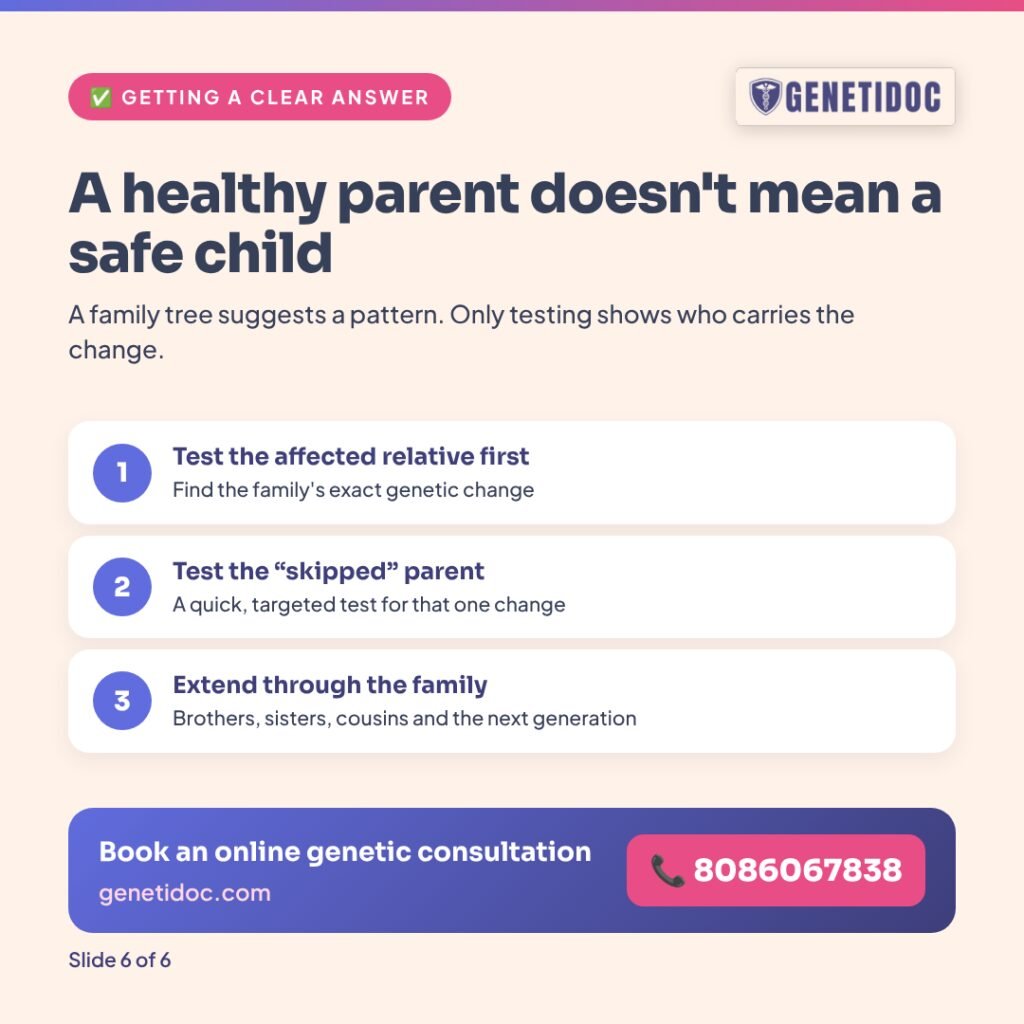
A family tree can suggest a pattern, but it cannot tell you who carries a change. Genetic testing can. The right test, ordered in the right order, turns uncertainty into a clear risk for each person.
Step 1: Test the affected person first, whenever possible
The most useful first step is usually to test a family member who actually has the condition. Once their exact genetic change is found, every other relative can be tested for that one specific change. This targeted testing is faster and gives a clear yes-or-no answer. If the affected relative has died, a stored blood or tissue sample can sometimes be used. If not, at-risk relatives can be offered a suitable gene panel.
Step 2: Test the “skipped” generation
Once the family’s genetic change is known, the healthy parent in the middle can be tested to find out whether they carry it. This matters for their own health, since some carriers need screening, and for their other children and their brothers and sisters.
Step 3: Extend testing through the family
Testing relatives one branch at a time, called cascade testing, finds other carriers in the family. For adult-onset conditions such as hereditary cancer, testing is generally offered from age 18. For conditions that can affect children, testing may be discussed earlier.
Common tests and typical turnaround times at Genetidoc
| Test | When it is used | Typical turnaround |
| Targeted test for a known family change | Relatives of someone whose genetic change is already known | About 1 week |
| Multi-gene panel | When the condition could be caused by several different genes | About 3 to 4 weeks |
| Fragile X test | Developmental delay, intellectual disability, early menopause or a late-onset tremor with a family pattern | About 21 days |
| Chromosome test (karyotype) | Recurrent pregnancy loss, infertility or suspected chromosome rearrangements | About 3 to 4 weeks |
| Whole exome sequencing | Complex presentations where many conditions are possible | About 1 to 2 months |
A negative result always means “no reportable change found in what was tested.” It does not guarantee a person will never develop a condition. Interpreting what a result means for each family member is where expert genetic counseling makes the biggest difference.
When Genetic Testing May Not Be Useful
Testing is most valuable when it answers a specific family question. It is less helpful, or not the right first step, in some situations:
- Common conditions with no clear pattern: Diabetes, high blood pressure or a single older relative with a common cancer usually reflect many genes plus lifestyle, not one inherited change. A family history review is the right starting point, and it may show that no test is needed.
- Testing a healthy relative before the affected person: If the family’s specific change is not yet known, a negative result in a healthy relative can be falsely reassuring. The change may simply not have been looked for.
- Children and adult-onset conditions: For conditions that start only in adulthood and have nothing to prevent in childhood, testing is generally delayed until the young person can decide for themselves.
- Curiosity-only whole genome tests: For a completely healthy person with no family red flags, broad sequencing rarely changes care. A family history assessment and, where relevant, carrier screening suited to the person’s community is more useful.
Why the Right Test and Expert Interpretation Matter
In families where a condition seems to skip generations, the wrong test can give the wrong answer. A few examples:
- Fragile X and myotonic dystrophy are caused by repeated sections of DNA. Standard sequencing panels can miss these repeats, so specific repeat tests are needed.
- Many thalassemia carriers are first picked up by blood tests, and DNA testing then confirms the exact change. A normal blood count alone does not always exclude carrier status.
- A gene change found in one relative must be interpreted alongside the whole family tree. The same result can mean very different things for a parent, a sibling and a child.
Costs vary with the type of test, from a single targeted test for a known family change to larger panels and exome sequencing. Choosing a low-cost test without expert interpretation can mean paying for an answer that does not actually answer the family’s question. The real value of genetic testing lies in a result that is correctly chosen, correctly read and turned into a clear plan for each family member.
| “A report on its own rarely tells a family what to do,” says Team Genetidoc. “What matters is choosing the right test for the right person first, and then explaining what the result means for every relative it affects.” |
What Knowing Your Carrier Status Changes in Real Life
- Planning a family: If you carry a recessive change, testing your partner shows whether your children are actually at risk. If both partners are carriers, options include prenatal diagnosis during pregnancy and preimplantation genetic testing, in which embryos created through in vitro fertilization are tested before transfer.
- Your own health: Carriers of certain changes, such as women carrying a Duchenne muscular dystrophy change, or relatives in hereditary cancer and inherited heart condition families, can start appropriate screening early.
- Relatives who test negative: When a relative does not carry the family’s known change, they can often be reassured and follow the usual screening for the general population.
- Your wider family: One diagnosis can open the door to accurate answers for brothers, sisters, cousins and the next generation.
Testing decisions for future pregnancies are based only on a definite diagnosis. A variant of uncertain significance, meaning a genetic change whose effect is not yet understood, is not used to test unaffected relatives or to guide prenatal decisions.
Talking to Your Family About a Genetic Condition
In our experience, Indian families usually share genetic results with relatives quite openly. The bigger challenge is that relatives often do not follow through with their own counseling and testing. They may feel it doesn’t apply to them, may not have time, or may worry about stigma.
After a consultation, Genetidoc patients receive an individualized written summary, prepared by a genetic counselor and checked by a clinical geneticist. Many families find it helps them start conversations with relatives. If you would rather not tell a relative yourself, that relative can be offered a private counseling session without being told a change was found in the family, unless you agree to share that. If you would prefer a relative is told nothing at all, that choice is respected. These decisions belong to you.
| “Our role is to inform, not to decide for anyone,” says Team Genetidoc. “We give families the clearest possible picture of who may be at risk and what their options are. Every decision about testing, disclosure and family planning stays with the family.” |
When Should You See a Clinical Geneticist?
Consider a genetic consultation if:
- The same condition has appeared in more than one family member, even if generations apart
- A grandparent, uncle or aunt had a known genetic condition and you are planning marriage or pregnancy
- Relatives died suddenly or young, especially from “heart attacks” before age 50
- You and your partner are related by blood, or come from a community where thalassemia or sickle cell disease is common
- A child in the family has developmental delay, intellectual disability or a muscle-weakening condition
- A woman in the family had early menopause and a male relative has a late-onset tremor or balance problem
Direct-to-consumer DNA kits are not a substitute. They usually test only a small number of genetic changes, are often built around populations outside India, and are not designed to answer a specific family question. A clinical geneticist starts with your family history and chooses the test that fits it.
Frequently Asked Questions
Can genetic diseases skip a generation?
A genetic disease can appear to skip a generation, but the gene change itself is passed through the “skipped” person. That person is usually a healthy carrier, carries a change that did not cause disease in them, or has signs too mild to notice.
Can I be a carrier of a genetic condition and not know it?
Yes. Most carriers of recessive conditions, such as beta-thalassemia, are completely healthy and only find out through carrier screening or after an affected child is born.
Does cancer skip a generation?
Hereditary cancer can appear to skip a generation because not everyone who carries a cancer gene change, such as in BRCA1 or BRCA2, develops cancer. They can still pass the change to their children.
Does thalassemia skip a generation?
Beta-thalassemia is recessive, so it can stay hidden for many generations through healthy carriers. It appears when two carriers have a child, with a 1 in 4 chance in each pregnancy.
If my grandfather had a genetic condition but my parents didn’t, am I at risk?
You may be. It depends on the condition and how it is inherited. A clinical geneticist can review your family history and, ideally, test an affected relative first to give you an accurate answer.
Can a father pass on a condition that only affects boys?
A father with an X-linked condition passes his X chromosome to all of his daughters, making them carriers, but not to his sons. His daughters’ sons can then be affected, which is why these conditions often appear to skip a generation.
Do genetic conditions skip every other generation?
No. There is no fixed every-other-generation pattern. Each pregnancy has its own independent chance, based on the inheritance pattern and what each parent carries.
Does marrying a relative increase the risk of genetic conditions?
Yes, for recessive conditions. Related partners are more likely to carry the same recessive change from a shared ancestor. Carrier screening before pregnancy can clarify the risk.
Can a genetic condition appear with no family history at all?
Yes. Recessive conditions, new (de novo) changes and incomplete family histories mean a genetic condition can occur in a family with no known history.
Who should be tested first in a family?
Whenever possible, the family member who actually has the condition should be tested first. Once their change is identified, other relatives can have quick, targeted testing for that one change.
Can carrier women have symptoms of X-linked conditions?
Yes. For example, women who carry a Duchenne muscular dystrophy change have an increased risk of heart muscle weakness, and heart screening is recommended for them.
Is a negative genetic test a guarantee I won’t develop a condition?
No. A negative result means no reportable change was found in what was tested. Your genetic counselor will explain what it means for your specific situation.
Key Takeaways
- Genes never skip a generation. The genetic change is carried silently through people who do not show the condition.
- The most common reasons are healthy carriers in recessive and X-linked conditions, gene changes that do not always cause disease, very mild signs, late onset and incomplete family histories.
- Some conditions, such as fragile X syndrome, can change and grow as they pass down the generations.
- In India, high carrier rates for conditions like beta-thalassemia, together with marriage within families and communities, make carrier screening especially valuable.
- Testing the affected relative first, then testing other relatives for that one change, is the fastest route to a clear answer for each person.
- No one is to blame for the genes they carry. Knowing is what allows families to plan and protect the next generation.
| Seeing a condition reappear in your family after a generation?
Our clinical geneticists can review your family tree, work out how the condition is being passed down, and recommend the right test for you, your partner or your children, ideally before your next pregnancy. |
Book an online genetic counseling consultation to understand your family’s inheritance pattern.
Families who want to connect with others navigating inherited and rare genetic conditions can visit the Genetidoc Rare Disease Forum.
References
- MedlinePlus Genetics, National Library of Medicine: What are reduced penetrance and variable expressivity?
- MSD Manual Professional Version: Factors Affecting Gene Expression
- NHS Genomics Education Programme: Do our genes govern our fate? Penetrance and expressivity
- Madan N, et al. Frequency of beta-thalassemia trait and other hemoglobinopathies in northern and western India. Indian Journal of Human Genetics, 2010
- Prevalence of beta thalassemia carriers in India: a systematic review and meta-analysis. Journal of Community Genetics, 2023
- Bourke J, et al. Cardiac care of children with dystrophinopathy and females carrying DMD-gene variations. Open Heart, 2022
- da Silva RMFL. Heart Disease in Mothers of Children with Duchenne Muscular Dystrophy. Current Cardiology Reviews, 2024
- NHS Genomics Education Programme, GeNotes: Duchenne muscular dystrophy (inheritance and genomic counselling)
- MedlinePlus Genetics, National Library of Medicine: Myotonic dystrophy
- Parental age effects, but no evidence for an intrauterine effect in the transmission of myotonic dystrophy type 1. Peer-reviewed study, PubMed Central
- Muscular Dystrophy Association: In Focus: Myotonic Muscular Dystrophy
- National Fragile X Foundation: The History and Discovery of Fragile X-associated Tremor/Ataxia Syndrome
- Fragile X Society (United Kingdom): Fragile X-Associated Tremor/Ataxia Syndrome information leaflet
Related Reading on Genetidoc
- Unusual Inheritance Patterns: Mitochondrial DNA Explained
- Congenital Insensitivity to Pain: When a Child Cannot Feel Pain
- Nutrigenomics: How Your Genes Shape Your Response to Diet
- Parkinson’s Disease: When Genetics Plays a Role
- Single Gene vs Panel Testing Explained
- Why Identical Twins Are Not Always Genetically Identical