
When a parent, grandparent or sibling develops dementia, one question often follows quietly: “Will this happen to me?”
For most families, the honest answer is reassuring. Most dementia is not passed down through a single faulty gene. But in a small number of families, it is. Knowing which situation you are in can change how you plan your health, your finances and even your family’s future.
This guide explains when a family history of dementia is worth looking into, what genetic counseling actually involves, and how testing works in India.
Quick answer
Consider genetic counseling if dementia started before age 65 in a relative, if several relatives across generations were affected, if a relative has a known dementia gene change, or if dementia in the family came with early strokes, motor neuron disease or unusual behaviour or movement changes. A single grandparent with dementia in their 80s rarely points to an inherited cause.
Is Dementia Hereditary?
Dementia is a group of symptoms, including memory loss, confusion, and changes in thinking, behaviour and daily functioning, that get worse over time. Alzheimer’s disease is the most common cause, but there are many others.
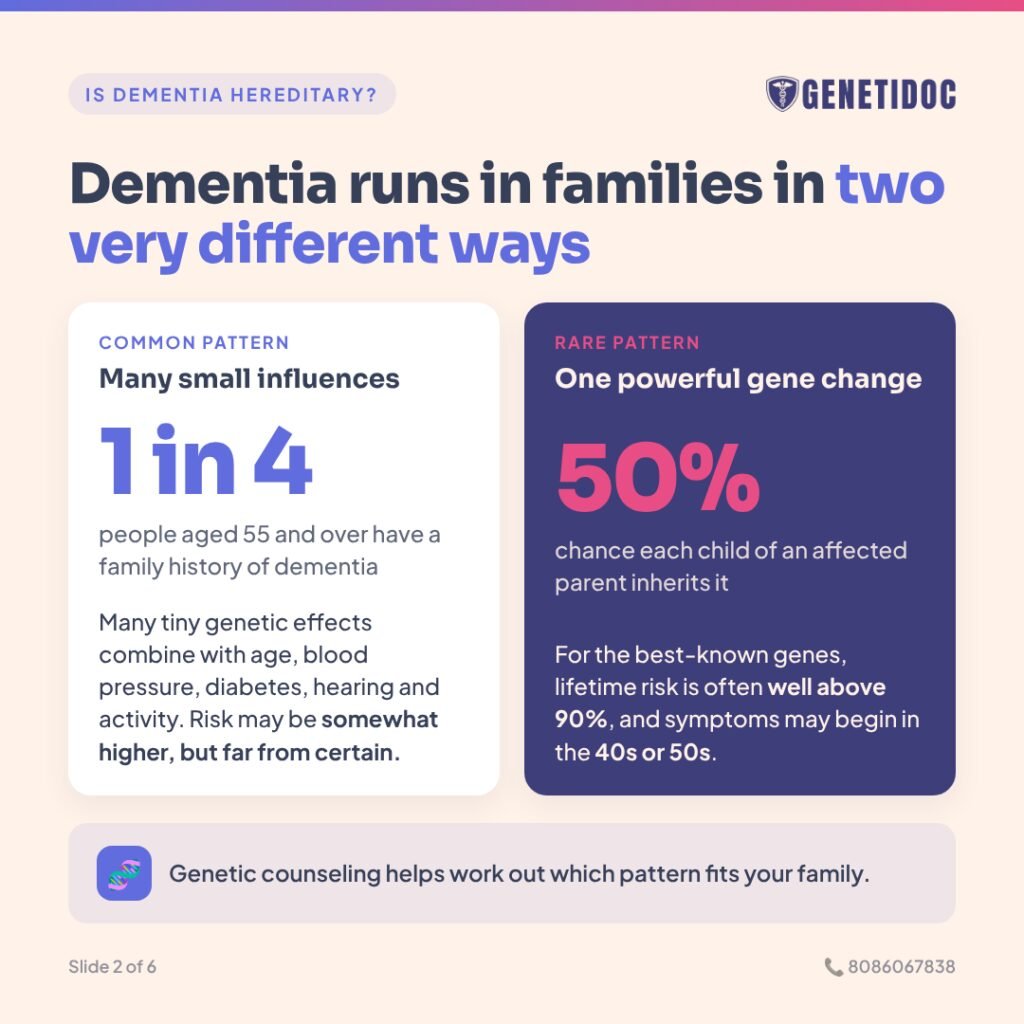
Dementia can run in families in two very different ways.
1. The common pattern: many small influences
Around one in four people aged 55 and over has a family history of dementia. For most of them, that history reflects many small genetic differences, each with a tiny effect, combined with age, blood pressure, diabetes, hearing, activity and other lifestyle factors. Your risk may be somewhat higher than average, but it is far from certain.
2. The rare pattern: a single gene change
In a small number of families, dementia is caused by one powerful gene change passed from parent to child. This is called autosomal dominant inheritance. It means:
- Each child of an affected parent has a 50% chance of inheriting the gene change.
- For the best-known Alzheimer’s and frontotemporal dementia genes, people who inherit the change have a very high lifetime chance of developing dementia, often well above 90%.
- Symptoms often begin earlier than usual, sometimes in a person’s 40s or 50s.
Genetic counseling helps you work out which of these two patterns best fits your family.
Why This Matters in India
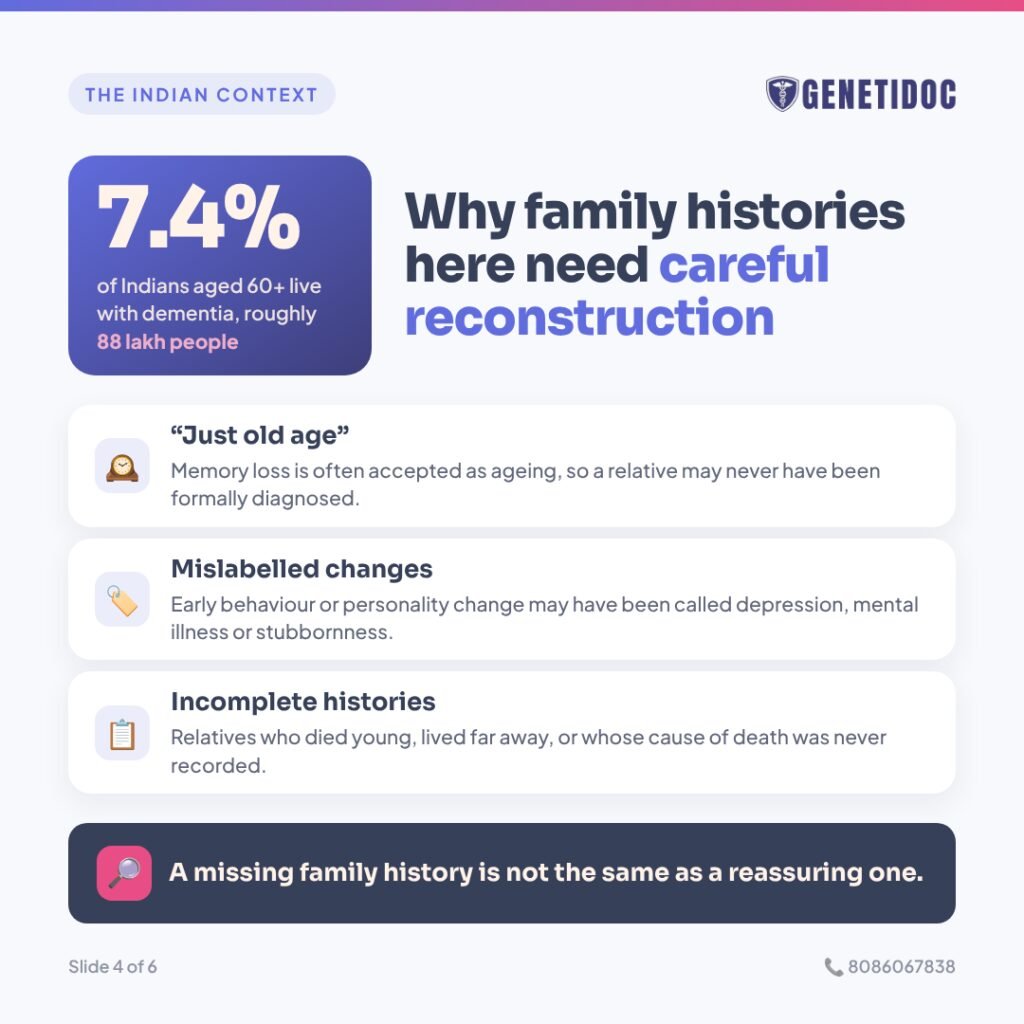
A nationwide study, the Longitudinal Aging Study in India – Diagnostic Assessment of Dementia (LASI-DAD), estimated that about 7.4% of Indians aged 60 and over live with dementia. That is roughly 88 lakh people. As life expectancy rises, more families will care for a relative with dementia, and more adult children will wonder about their own risk.
Indian families also face particular challenges:
- Memory loss is often accepted as “just old age”, so a relative may never have received a formal diagnosis.
- Behaviour or personality changes may have been labelled as depression, “mental illness” or stubbornness, when they were early signs of dementia.
- Family histories are often incomplete, especially when relatives died young, lived far away, or causes of death were never recorded.
None of this rules out an inherited cause. It simply means the family history needs careful, expert reconstruction.
Types of Dementia That Can Run in Families
Several kinds of dementia have known genetic causes. The table below summarises the main ones.
| Condition | Main genes | Typical onset | Clues in the family |
| Early-onset familial Alzheimer’s disease | APP, PSEN1, PSEN2 | Usually 40s–50s | Memory loss starting young, in several generations |
| Frontotemporal dementia (FTD) | C9orf72, GRN, MAPT | Often 45–65 | Personality or behaviour change, language problems, motor neuron disease, psychiatric illness |
| CADASIL (an inherited small blood vessel disease of the brain) | NOTCH3 | Strokes often from 40s–50s | Early strokes without usual risk factors, migraine with aura, later dementia |
| Huntington’s disease | HTT | Usually 30s–50s | Involuntary movements, mood and behaviour change, thinking problems |
| Late-onset Alzheimer’s disease (risk factor only) | APOE ε4 | Usually after 65 | Raises risk but does not cause dementia on its own |
Frontotemporal dementia stands out. Around a third of people with FTD have a strong family history, which is far higher than for typical Alzheimer’s disease. C9orf72 is the most common genetic cause of FTD worldwide.
CADASIL is the most common inherited cause of stroke and vascular dementia in adults, and it has been confirmed in families of Indian origin. It is easily missed when early strokes are blamed only on blood pressure or stress.
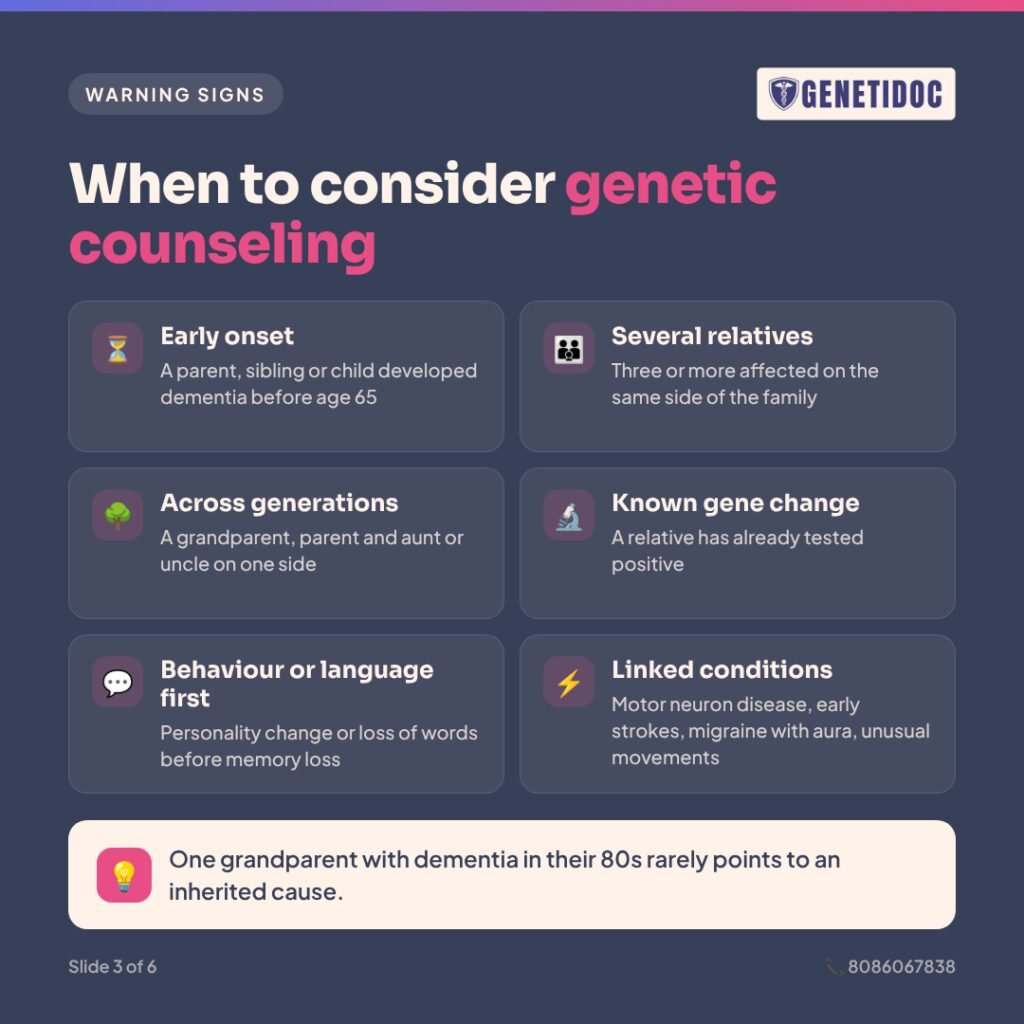
When to Seek Genetic Counseling: 8 Signs
Consider a genetic counseling appointment if any of these apply to your family:
- Early onset: a parent, sibling or child developed dementia before age 65 (some services use 60).
- Several affected relatives: three or more relatives with dementia on the same side of the family.
- More than one generation: dementia in a grandparent, a parent and an aunt or uncle on the same side.
- A known gene change: a relative has already tested positive for a dementia-related gene.
- Behaviour or language changes first: a relative’s dementia started with personality change, poor judgement or loss of language rather than memory loss.
- Linked conditions: relatives with motor neuron disease (amyotrophic lateral sclerosis, ALS), early strokes, migraine with aura, unusual movements, or late-onset psychiatric illness alongside dementia.
- Treatment decisions: a relative is being considered for newer anti-amyloid Alzheimer’s medicines and needs APOE
- Family planning: you are planning a pregnancy and a dementia gene change is known or suspected in your family.
You can also seek counseling if your family history is unknown, for example because of adoption or relatives who died young, and you have concerns.
“A missing family history is not the same as a reassuring one. When relatives died young or were never diagnosed, we take extra care to piece the story together before drawing any conclusions.”
— Team Genetidoc
When counseling helps but testing is unlikely to
If your only affected relative is a grandparent who developed memory loss in their late 70s or 80s, the chance of a single-gene cause is low. A genetic test is unlikely to give you useful information.
A counseling session can still help. It can confirm that your risk is close to that of the general population, explain the factors you can control, and give you peace of mind.
What Happens During Genetic Counseling
Genetic counseling is a conversation with a genetics specialist that helps you understand whether a condition may be inherited, what testing can and cannot tell you, and what your options are. The decision to test is always yours.
A typical first session covers:
- Your family tree: at least three generations on both sides, including who had dementia, at what age, what type, and how it was diagnosed.
- Medical records: brain scans, neurologist notes or previous genetic reports of affected relatives, if available.
- Your risk estimate: whether the pattern suggests a common or a single-gene cause.
- Testing options: who should be tested first, which test fits, and what each possible result would mean.
- Personal impact: how you might feel about each result, and what you would do with it.
Most Genetidoc consultations take place online, so family members in different cities, or even different countries, can join the same session. Blood samples can be collected from home.
How Genetic Testing for Dementia Works
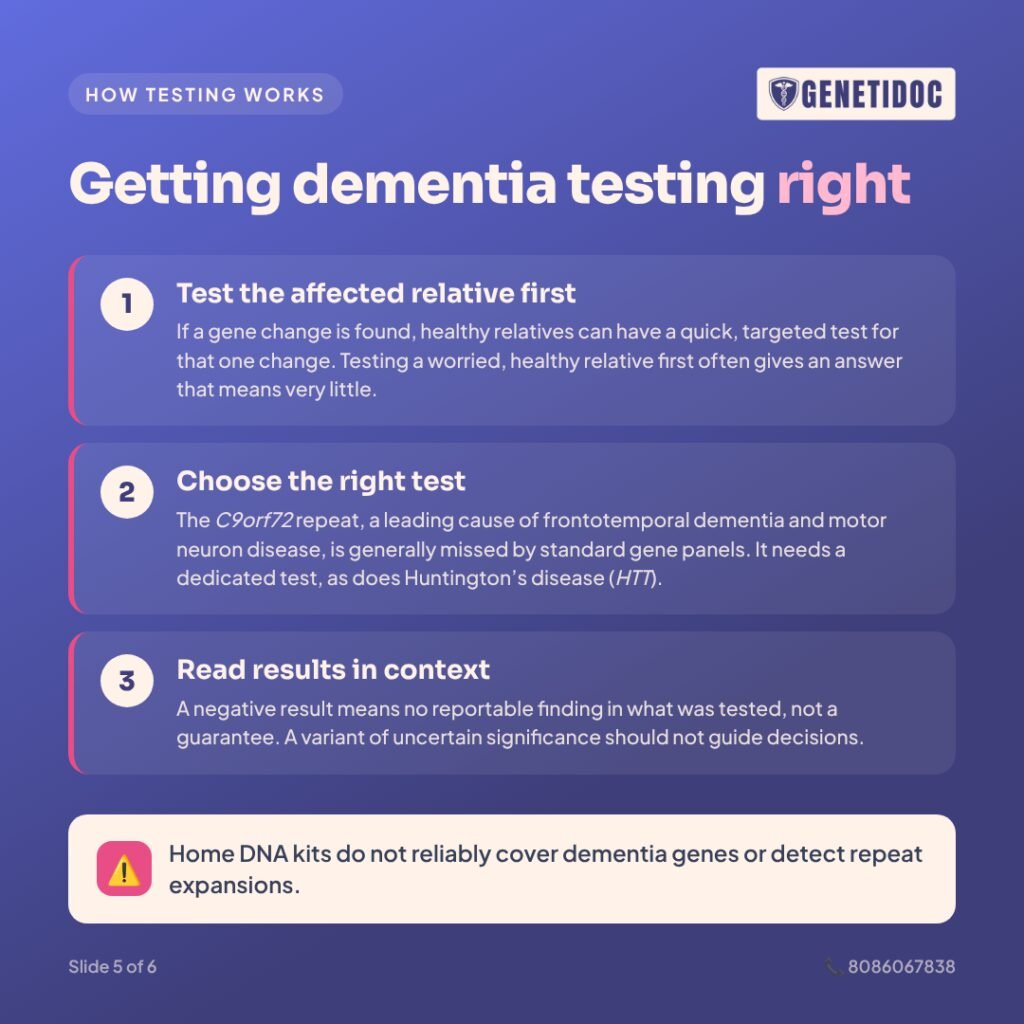
Test the affected relative first
The most informative first step is usually to test a relative who has dementia, not a healthy relative who is worried.
- If a gene change is found in the affected person, healthy relatives can then have a quick, targeted test for that one change. This is called cascade testing.
- If a healthy relative is tested first and nothing is found, the result is hard to interpret. It could mean they did not inherit the family’s gene change, or that the test simply did not look for it.
“Wherever possible, we start with the family member who is affected. Once we know the family’s gene change, testing for everyone else becomes simpler, faster and far more meaningful.”
— Team Genetidoc
Types of tests
- Dementia gene panel: checks a group of genes linked to inherited dementia at once. Results usually take about 3–4 weeks.
- Targeted variant test: checks a single known family gene change in relatives.
- Repeat expansion tests: separate tests for C9orf72 and Huntington’s disease (HTT).
- APOE genotyping: identifies a risk factor for late-onset Alzheimer’s. Results usually take about 1–2 weeks.
Why some important changes need a separate test
Standard gene panels read DNA in short stretches, like reading a book a few words at a time. This works well for spelling mistakes in a gene.
But some dementia genes are affected by a different kind of change: a short piece of DNA that is repeated far too many times, sometimes hundreds or thousands of times. Short reading fragments cannot measure how long these repeats are. This is why the C9orf72 repeat, a leading genetic cause of FTD and motor neuron disease, is generally missed by standard sequencing and needs a dedicated test.
This is one reason test selection should be guided by a specialist. A “negative” panel can be falsely reassuring if the right test was never done.
Predictive Testing: For Healthy Relatives
Predictive testing means testing a healthy person to find out whether they carry a gene change that causes a condition later in life. For dementia, it is only meaningful when the family’s specific gene change is already known.
Because the result can be life-changing, international guidelines recommend a careful process:
- Counseling before and after testing, not just a report.
- Time to reflect between the first conversation and the blood test.
- A support person, such as a spouse or close friend, encouraged to attend.
- Minimum age of 18, so each person can make their own decision as an adult.
- Freedom to stop at any point, and return later if you wish.
Testing children for adult-onset dementia is not recommended. Your children can decide for themselves when they are adults.
Choosing not to test is a valid decision
Some people decide, after counseling, that they would rather not know. Others choose to wait until a particular life stage. Both are reasonable.
“Some of our most useful counseling sessions end with the person deciding not to test. If that is the right decision for them, it is a good outcome.”
— Team Genetidoc
Understanding Your Results
Positive result
A disease-causing gene change was found. This explains the family history and allows relatives to have targeted testing. It does not tell you exactly when symptoms will start, and it is never a reason for blame. Nobody chooses the genes they pass on.
Negative result
If the family’s known gene change was not found in you, your risk falls back to roughly that of the general population. If no family gene change was known, a negative result means no reportable finding in what was tested. It does not mean you will never develop dementia.
Variant of uncertain significance
Sometimes a test finds a DNA change whose effect is not yet known. This is called a variant of uncertain significance (VUS). A VUS should not be used to make medical decisions or to test healthy relatives. Testing affected relatives and periodic re-review of the variant can help clarify it over time.
What Changes After Genetic Counseling
There is currently no cure for inherited dementia. But knowing your status can still make a real difference to your life.
For your own health
- Controlling blood pressure, diabetes and cholesterol, staying active, protecting your hearing, avoiding smoking and staying socially engaged are recommended for everyone, whatever their genetic result.
- Earlier attention to memory or behaviour changes, with a neurologist who knows your family history.
- For CADASIL, strict control of stroke risk factors becomes especially important.
For treatment decisions
Newer anti-amyloid medicines for early Alzheimer’s disease, such as lecanemab and donanemab, carry a higher risk of brain swelling or bleeding side effects in people with APOE ε4, especially those with two copies. APOE testing is recommended before starting treatment. Because the result also has implications for children and siblings, counseling should come with it. Read more in our article on what your APOE result really means.
For planning
- Making financial, legal and care arrangements while you are well.
- Choosing when and how to talk with family members.
- Considering research registries and clinical trials for inherited dementia.
For future pregnancies
When the family’s gene change is known, couples can discuss options such as preimplantation genetic testing (PGT) during IVF, or prenatal testing in pregnancy. A genetic counselor can explain these options and refer you to appropriate centres.
Insurance, Privacy and Family Conversations
India does not yet have a dedicated law preventing genetic information from being used in insurance decisions. This is one of the reasons we discuss the practical consequences of a result before testing, not after.
Sharing results with relatives is your decision. After a consultation, you receive a written summary that can help you explain things to family. If you prefer not to tell a relative yourself, Genetidoc can offer that relative a private counseling session without revealing your result unless you agree.
Why Expert Interpretation Matters
Dementia genetics is an area where the wrong test, or the right test read the wrong way, can do real harm.
- Home DNA kits do not reliably cover the genes that cause inherited dementia, and they cannot detect repeat expansions. A “clear” kit result can be falsely reassuring.
- Testing the wrong person first can leave a family with an answer that means very little.
- A raw report without context can cause unnecessary fear, or false comfort.
Genetidoc works with accredited partner laboratories, and every result is explained by a clinical geneticist in a follow-up consultation, in the language you are most comfortable with.
Illustrative Examples
Illustrative example (composite, not a real patient): A 38-year-old man’s father developed personality changes at 54 and was first treated for depression. Later, his paternal aunt developed motor neuron disease. The combination of early behaviour change and motor neuron disease raised suspicion of a C9orf72 repeat expansion. Counseling focused first on testing his father, using the dedicated repeat test rather than a standard panel alone. The son was then offered time to decide whether he wished to learn his own status.
Illustrative example (composite, not a real patient): A 45-year-old woman was anxious because her grandmother had dementia at 84 and her mother was showing mild forgetfulness at 76.
After a detailed family history, the pattern did not suggest a single-gene cause. She chose not to test. She left with a clear plan to manage her blood pressure and blood sugar, and guidance on when to seek a memory assessment for her mother.
Common Myths About Dementia and Genetics
Myth: “My parent had dementia, so I will get it too.”
Fact: Most family histories reflect many small influences, not a single gene. Your risk may be higher than average, but it is not a certainty.
Myth: “Dementia skips a generation.”
Fact: Dominant dementia genes do not skip generations. A generation can appear unaffected when a carrier died young of another cause or was never diagnosed.
Myth: “My home DNA kit was negative, so I’m safe.”
Fact: Consumer kits do not cover most causative dementia genes or repeat expansions.
Myth: “A negative genetic test means I will never get dementia.”
Fact: It means no reportable finding was seen in what was tested. Everyone still carries the general risk that comes with age.
Myth: “Nothing can be done, so there is no point knowing.”
Fact: Knowing can guide treatment safety, family planning, life planning, risk-factor control and access to research. Whether that is worthwhile is a personal decision that counseling helps you make.
Frequently Asked Questions
1. Is dementia genetic?
Sometimes. Most dementia is caused by a mix of age, health and many small genetic factors. A small number of families carry a single gene change that directly causes dementia.
2. If my mother has Alzheimer’s, will I get it?
Not necessarily. If she developed it after 65 and no one else is affected, your risk is only modestly higher than average. Early onset or several affected relatives warrant genetic counseling.
3. At what age does genetic dementia start?
Inherited forms often begin between the 40s and early 60s, earlier than typical dementia. Onset can vary even within one family.
4. Does dementia skip a generation?
Dominant dementia genes do not skip generations, but a generation can look unaffected if a carrier died young or was never diagnosed.
5. Who should be tested first in a family?
Ideally, a relative who has dementia. If a gene change is found, other relatives can then have a targeted test.
6. Is frontotemporal dementia hereditary?
More often than Alzheimer’s disease. About a third of people with FTD have a strong family history. The main genes are C9orf72, GRN and MAPT.
7. Can a normal gene panel miss inherited dementia?
Yes. Repeat expansions such as C9orf72 and Huntington’s disease need separate, dedicated tests.
8. Should my children be tested?
No. Testing for adult-onset dementia is not recommended before 18. Children can make their own choice as adults.
9. How long do dementia genetic test results take?
APOE genotyping usually takes about 1–2 weeks. Broader dementia gene panels take around 3–4 weeks.
10. Can genetic dementia be prevented?
There is no proven way to prevent single-gene dementia yet. Managing blood pressure, diabetes, hearing and activity helps everyone, and research trials are ongoing.
11. Can a genetic result affect my insurance in India?
India has no dedicated law protecting genetic information in insurance. Discuss this with a genetic counselor before testing.
12. Can I have genetic counseling online?
Yes. Genetic counseling for dementia works well online, family members in different places can join together, and samples can be collected from home.
Key Takeaways
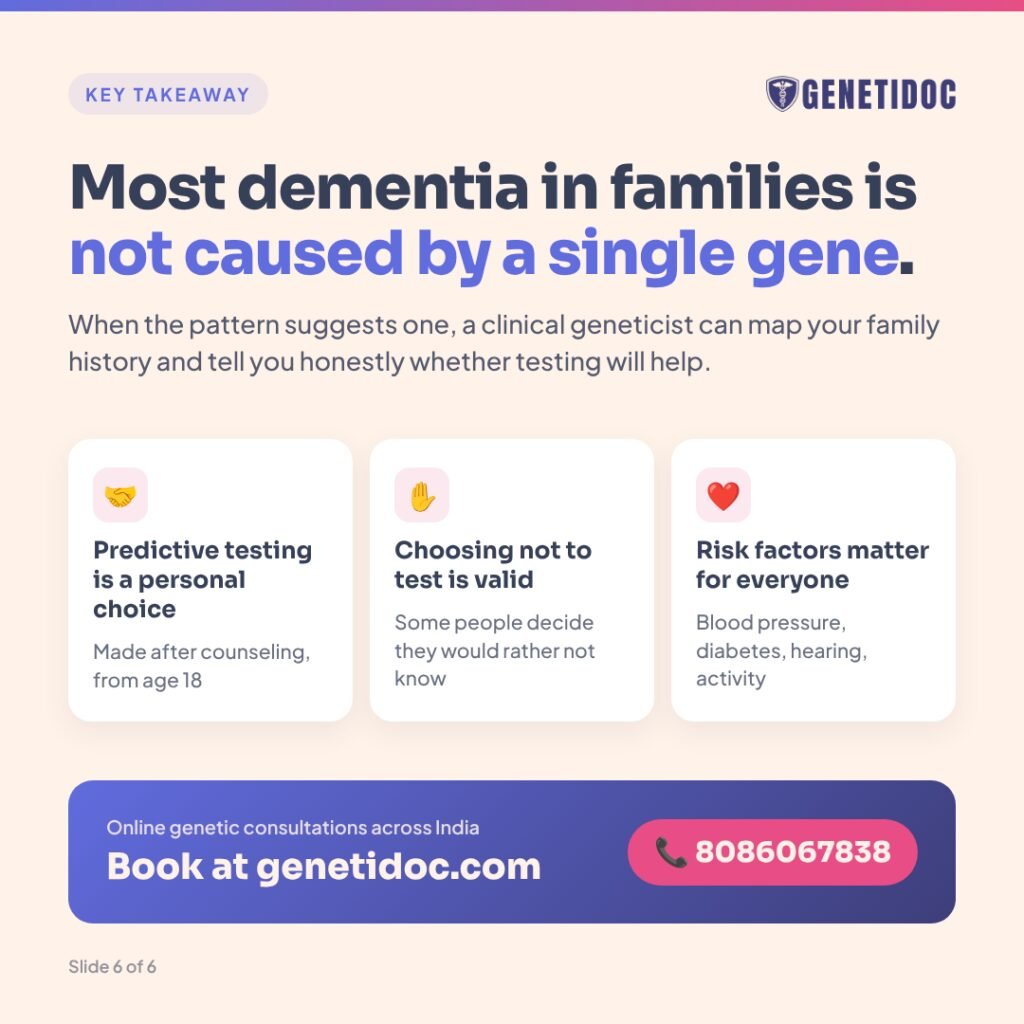
- Most dementia in families is not caused by a single gene.
- Early onset, several affected relatives, behaviour-first changes, early strokes or motor neuron disease in the family are reasons to seek genetic counseling.
- The affected relative should ideally be tested first.
- Some key changes, such as the C9orf72 repeat, need a dedicated test that standard panels miss.
- Predictive testing is a personal choice, made after counseling, from age 18.
- A negative result means no reportable finding in what was tested, not a guarantee.
- Risk-factor control helps everyone, whatever their genes.
Dementia in Your Family? Find Out What It Means for You
If a relative developed dementia early, several family members are affected, or dementia in your family came with strokes, behaviour changes or motor neuron disease, a conversation with a clinical geneticist can bring clarity. We will map your family history, tell you honestly whether testing is likely to help, and support whatever decision you make.
Book a family dementia risk consultation with Genetidoc, online from anywhere in India.
Have a question about dementia genetics or predictive testing? Ask it in our Predictive Genetic Testing forum.
Related Reading
- APOE and Alzheimer’s Risk: Separating Fact from Fear
- GM1 Gangliosidosis: Why Early Diagnosis Matters
- What Defines a Rare Genetic Disease? A Clear Guide
- Genetic Mosaicism: What It Means When Your Report Says “Mosaic”
- Consanguineous Marriage and Your Child’s Genetic Risk
References
- Goldman JS, Hahn SE, Catania JW, et al. Genetic counseling and testing for Alzheimer disease: joint practice guidelines of the American College of Medical Genetics and the National Society of Genetic Counselors. Genetics in Medicine. 2011;13(6):597–605.
- Loy CT, Schofield PR, Turner AM, Kwok JBJ. Genetics of dementia. The Lancet. 2014;383(9919):828–840.
- Bird TD. Early-Onset Familial Alzheimer Disease. In: GeneReviews. University of Washington, Seattle.
- Greaves CV, Rohrer JD. An update on genetic frontotemporal dementia. Journal of Neurology. 2019;266(8):2075–2086.
- Le Ber I, Camuzat A, Guillot-Noel L, et al. C9ORF72 repeat expansions in the frontotemporal dementias spectrum of diseases: a flow-chart for genetic testing. Journal of Alzheimer’s Disease. 2013;34(2):485–499.
- In: GeneReviews. NCBI Bookshelf NBK1500.
- MacLeod R, Tibben A, Frontali M, et al. Recommendations for the predictive genetic test in Huntington’s disease. Clinical Genetics. 2013;83(3):221–231.
- Lee J, Meijer E, Langa KM, et al. Prevalence of dementia in India: national and state estimates from a nationwide study. Alzheimer’s & Dementia. 2023;19(7):2898–2912.
- Cummings J, Apostolova L, Rabinovici GD, et al. Lecanemab: appropriate use recommendations. Journal of Prevention of Alzheimer’s Disease. 2023;10(3):362–377.
- Livingston G, Huntley J, Liu KY, et al. Dementia prevention, intervention, and care: 2024 report of the Lancet standing Commission. The Lancet. 2024;404(10452):572–628.