
If you’ve ever hesitated before booking an online genetic counseling session — wondering whether a video call can really replace sitting across the table from a genetic counselor — you’re not alone. It’s one of the most common questions patients ask before their first appointment.
The short answer, backed by both published research and years of clinical experience, is that online genetic counseling works just as well as in-person counseling for most patients and most situations. But “most” is not “all,” and knowing the difference matters. This article walks through exactly what changes when a genetic counseling session moves from a clinic room to a video call, what stays exactly the same, and the specific situations where an in-person visit is still the better choice.
Quick answer: For history-taking, pretest counseling, result disclosure, and ongoing risk discussion, online and in-person genetic counseling produce comparable patient satisfaction, understanding, and emotional support. The main exception is when a physical examination — such as checking a child’s facial features or body proportions for signs of a genetic syndrome — is part of the evaluation. In those specific cases, an in-person visit gives the geneticist information a screen cannot.
What Genetic Counseling Actually Involves
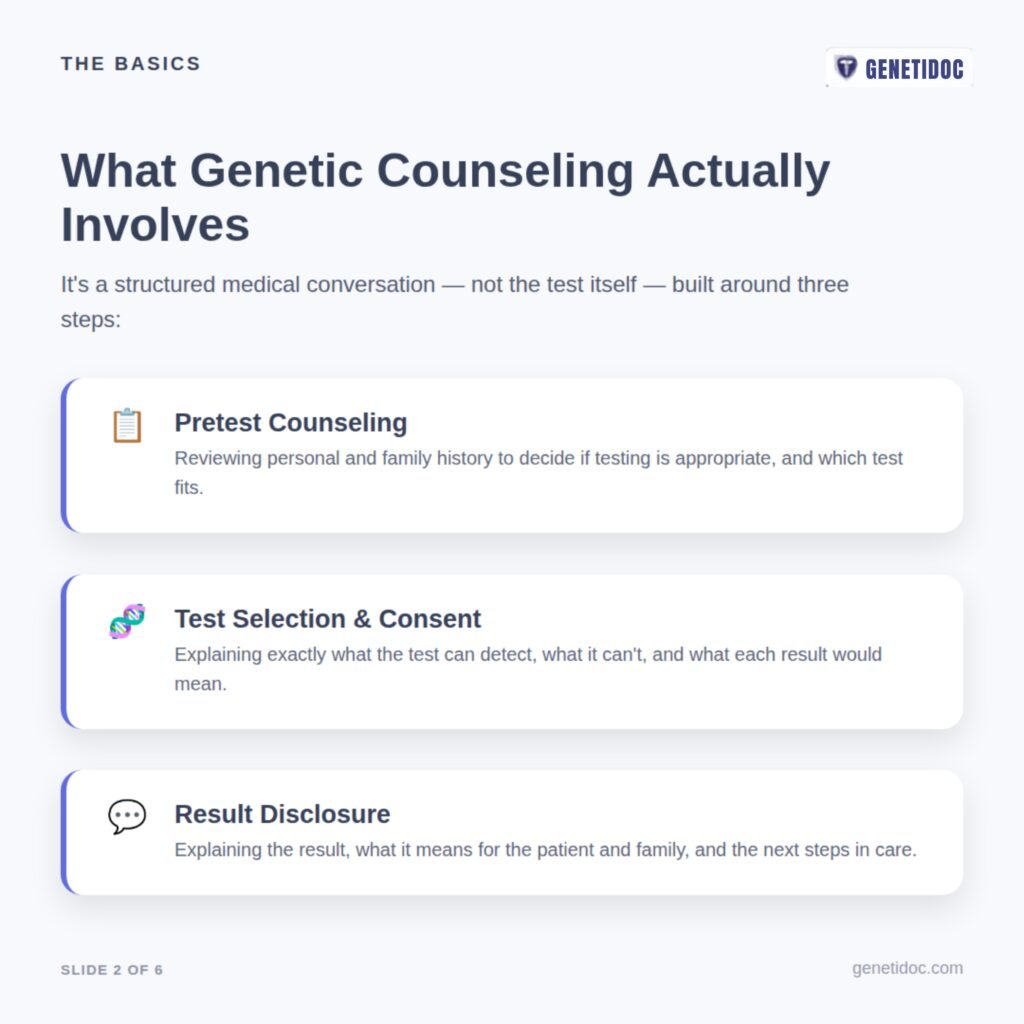
Genetic counseling is a structured conversation with a trained clinical geneticist or genetic counselor about your personal and family health history, your risk of an inherited condition, and what a genetic test can and cannot tell you. It is not the test itself — it is the medical reasoning that happens before and after testing.
A genetic counseling session typically has three parts, whether it happens online or in person:
- Pretest counseling: reviewing your personal history, family history, and current concern, then recommending whether testing is appropriate and which test fits your situation.
- Test selection and consent: explaining what the recommended test looks for, what it cannot detect, and what a positive, negative, or uncertain result would mean.
- Post-test (result) counseling: disclosing the result, explaining what it means for your health and your family’s health, and outlining next steps in management or further testing.
Every one of these steps is a conversation, not a physical procedure — which is precisely why most of it translates well to video.
How an Online Genetic Counseling Session Actually Works
Team Genetidoc runs the majority of its genetic counseling sessions online, not as a fallback option but as the primary way the practice reaches patients. Genetidoc’s clinical geneticists are based across different cities in India rather than at a single physical clinic, so online consultation is what makes it possible for a patient in a small town, a metro city, or even abroad to see the right specialist for their specific concern.
Before the session
Sessions are conducted over a secure video link. Access is controlled deliberately: a patient joining the call has to be admitted by an administrator, who confirms the identity of the person joining and checks that anyone else present — a spouse, parent, or family member — is who the patient intended to include. This is a meaningful safeguard for a conversation that often involves sensitive family medical history.
During the session
The counselor takes a full personal and family history, asks about the presenting concern and chief complaints, and reviews how any relevant condition has progressed over time. Based on this, a specific test is recommended, along with a clear explanation of what that test can and cannot find. When a result is ready, it’s disclosed directly, and if the finding is positive, the counselor walks through what the condition means, how it’s likely to progress, what related risks the patient’s family should know about, and what management looks like going forward.
After the session
A follow-up is scheduled — often around six months out — to check on treatment progress and monitor the condition. Where the workup requires a blood or saliva sample, this is usually arranged through home sample collection, so an in-person clinic visit generally isn’t necessary just to provide a specimen.
Where Online and In-Person Genetic Counseling Perform Equally Well
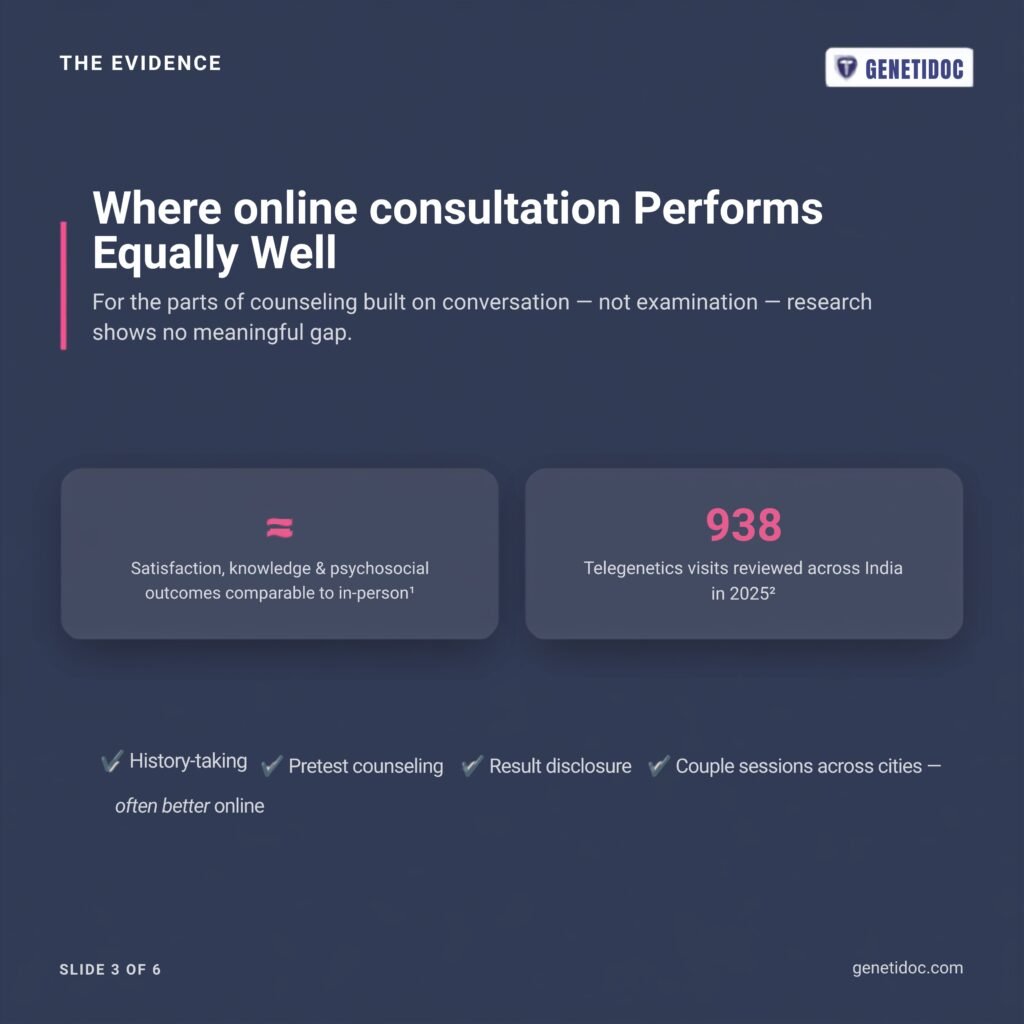
This is the part patients are most often surprised by: for the large majority of genetic counseling — the history-taking, the risk discussion, the test explanation, the result disclosure — there is no meaningful difference in how well online counseling works compared to sitting in the same room.
This isn’t just anecdotal. A 2021 systematic review published in Genetics in Medicine examined studies comparing videoconferencing-based genetic counseling to in-person and telephone delivery. It found that “patient satisfaction, genetic knowledge, and psychosocial outcomes were similar for in-person and telegenetic counseling,” and that video-based sessions performed as well as, and in some measures of knowledge gain, better than telephone-only sessions.¹ A 2025 review of 938 telegenetics appointments in India reached a similar practical conclusion: video-based genetic counseling is workable at scale across a range of patients and conditions.²
“There isn’t a formal satisfaction survey running behind every session, but clinically, online and in-person counseling feel equivalent for the vast majority of consultations we do,” notes Team Genetidoc. “The conversation is the same conversation — the medium doesn’t change the medicine.”
| Part of the Session | Works Equally Well Online? | Notes |
| Personal & family history intake | Yes | Purely conversational |
| Pretest counseling & test selection | Yes | Based on history and records, not examination |
| Result disclosure & risk discussion | Yes | Emotional processing does not differ meaningfully by format |
| Couple / family counseling across locations | Often better online | Both partners can join simultaneously even from different cities or countries |
| Physical / dysmorphology examination | Limited | Best done in person; see below |
Where In-Person Counseling Still Makes a Real Difference
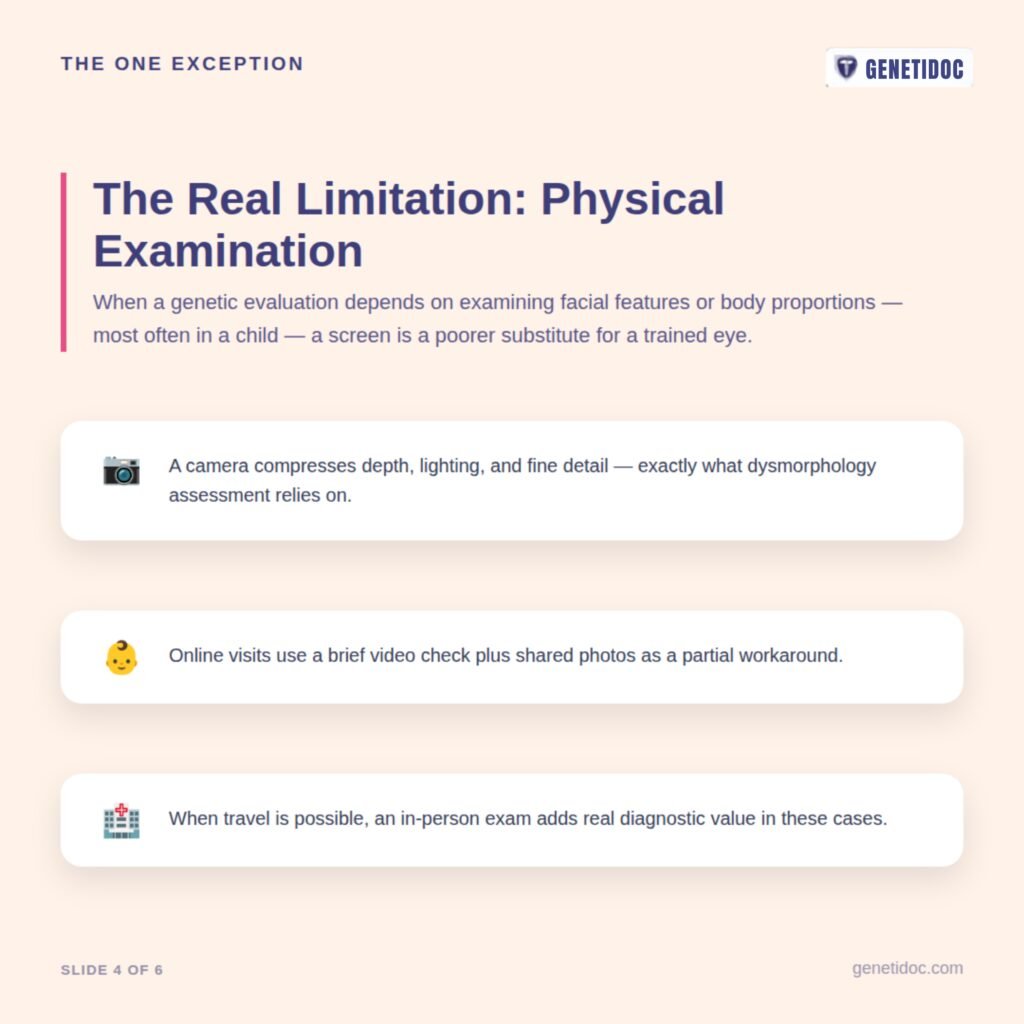
The one area where video has a genuine limitation is physical examination. When a genetic evaluation depends on carefully observing a person’s features — facial structure, proportions, skin findings, or subtle signs associated with a genetic syndrome, commonly needed when evaluating a child for a suspected genetic condition — a screen is a poorer substitute for a clinician’s trained eye than it is for a conversation.
This is a real, physical limitation, not a matter of preference: a camera compresses depth, lighting, and fine detail in ways that can hide or distort exactly the features a geneticist needs to assess. “Occasionally, when a dysmorphology assessment is needed, it can be a little difficult over video,” Team Genetidoc explains. “For an online consultation, we’ll usually ask the family to bring the child on camera for a brief visual check, and they often share photographs as well — but if a proper physical examination is needed, we recommend coming in when the family is able to.”
In practice, this means: for straightforward risk assessment, carrier screening, prenatal counseling, or explaining a lab result, online is entirely sufficient. For evaluating a child with unexplained developmental delay, unusual physical features, or a suspected genetic syndrome that depends on examination findings, an in-person visit — when travel is possible — adds real diagnostic value.
What Actually Changes Online — and What Doesn’t
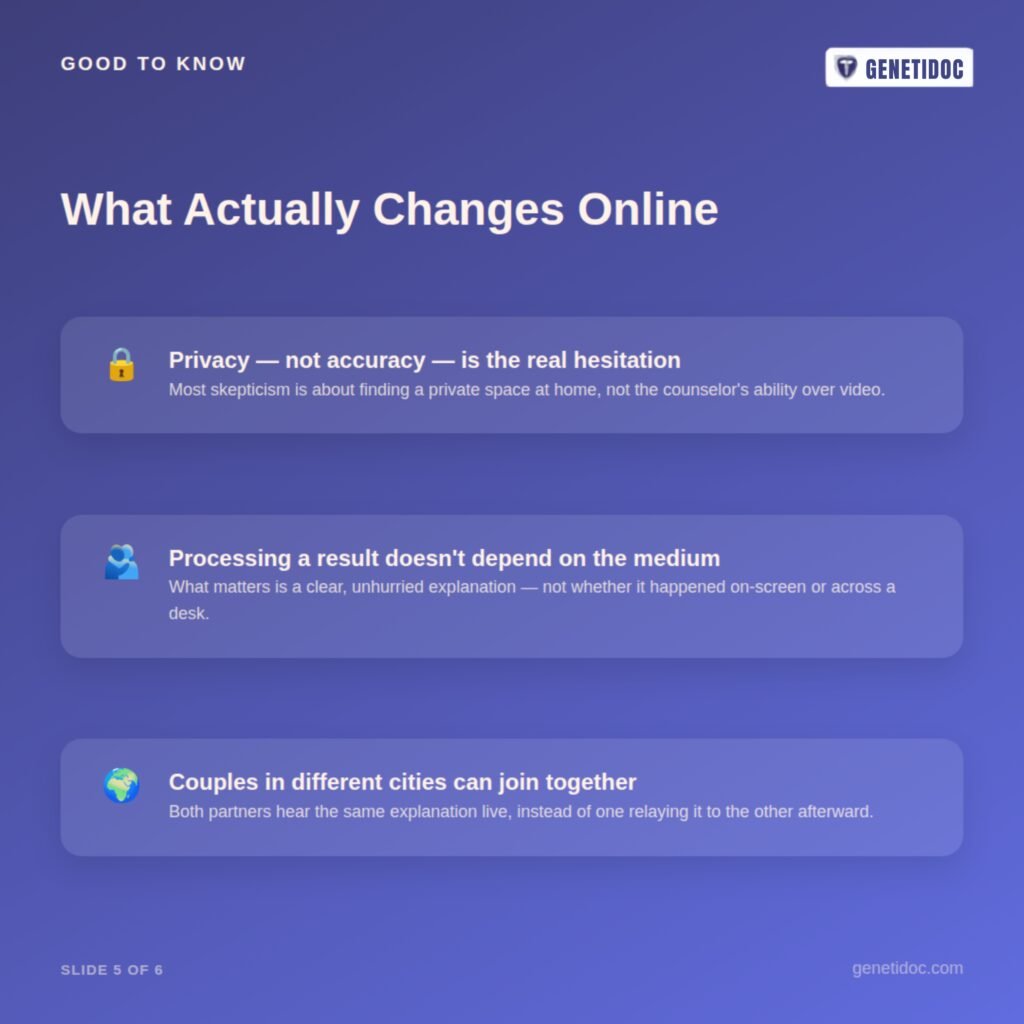
Privacy is the real hesitation, not accuracy
Interestingly, when patients are skeptical of online counseling, it’s rarely because they doubt the counselor’s ability to assess their risk over video. The more common concern is privacy: many patients simply don’t have a private space at home to speak openly about sensitive family health history during a call. This is a legitimate, practical barrier — not a flaw in the counseling itself — and it’s worth planning around: scheduling your session at a time when you can find a quiet, private room, or using headphones, can make a meaningful difference to how comfortable the conversation feels.
At the same time, the opposite is often just as true. For many patients, being in their own home — rather than a clinic room — actually makes it easier to open up. A familiar, comfortable setting can lower the guard that a formal clinical environment sometimes raises, especially when the conversation touches on sensitive family history.
Connectivity is a real, if occasional, obstacle
Bandwidth and network issues do come up, particularly for patients in areas with inconsistent internet access. This is a genuine trade-off of the online model, though it needs to be weighed against what online counseling makes possible in the first place: patients in remote areas who cannot travel long distances to reach a clinical geneticist get access to a specialist consultation they otherwise would not have had at all.
Emotional processing of a result does not depend on the medium
A common worry is that receiving difficult news over a screen feels colder or harder to process than hearing it in person. Clinically, this hasn’t held up: how a patient processes a result — positive, uncertain, or life-changing — varies from person to person, not by whether the conversation happened on video or across a desk. What matters far more than the medium is whether the counselor takes the time to explain the finding clearly, check understanding, and address the patient’s actual concerns.
Language is less of a barrier than patients expect
Because Genetidoc’s clinical geneticist team is spread across India, a patient who prefers to speak in a specific regional language — Kannada or Marathi, for instance — can usually be matched with a counselor who speaks that language. For patients consulting from outside India, sessions are conducted in English.
Family and couple sessions can genuinely work better online
This is one of the clearest advantages of the online format, not just a workaround. In preconception, carrier, or prenatal counseling, it’s common for one partner to be working in a different city or country. Bringing both partners into the same session at the same time — rather than one partner attending in person and relaying the conversation secondhand to the other — means both people hear the same explanation, ask their own questions, and make the decision together. “It’s much better for both partners to attend the same consultation simultaneously, even from two different locations, than for the information to be passed from one person to the other afterward,” says Team Genetidoc.
Building Trust With a Genetic Counselor You’ve Never Met in Person
A fair question patients raise: how do you build trust with someone over a screen you’ve never met face-to-face? In practice, the starting point isn’t the video format at all — it’s the fact that the patient is consulting a doctor. That professional relationship carries a baseline of trust into the conversation before it even begins. From there, most sessions open the same way an in-person visit would: a few minutes of ordinary conversation to help the patient settle in, followed by an open question — what’s the concern, why are you here for counseling — that lets the real conversation begin naturally.
Does Choosing Online Change Your Testing or Follow-Up Process?
For most patients, no. Where a blood or saliva sample is needed for testing, home sample collection is typically arranged, so a clinic visit usually isn’t required just to provide a specimen. An in-person visit becomes relevant only when the evaluation itself calls for a physical examination — and even then, it’s offered when the patient or family is able to travel, not treated as mandatory for every case.
So, When Should You Choose In-Person Over Online?
Based on how these sessions actually play out in practice, in-person counseling is worth prioritizing when:
- The evaluation involves a child or adult where a physical examination for dysmorphic features is clinically necessary.
- You genuinely cannot find a private space at home and would feel more comfortable discussing sensitive family history in a clinical setting.
- Your internet connectivity is unreliable enough that a video call would be repeatedly interrupted during a complex discussion.
For nearly everything else — pretest counseling, test selection, result disclosure, risk discussion, and follow-up — online genetic counseling gives you the same clinical conversation, often with better access and more flexibility for your family.
As with any part of genetic counseling, the choice is yours to make. The genetic counselor’s role is to give you accurate, complete information about your options — not to steer you toward one format over another.
Book your genetic consultation today.
Frequently Asked Questions
Is online genetic counseling as accurate as in-person counseling?
Yes, for the parts of counseling based on history, risk assessment, and result interpretation. Published research comparing video-based and in-person genetic counseling has found comparable patient satisfaction, knowledge gain, and psychosocial outcomes. The exception is when a physical examination is part of the evaluation, which is better done in person.
What platform is used for online genetic counseling sessions?
Genetidoc conducts online sessions over a secure video call, with controlled, admin-verified access to protect patient privacy.
Can a genetic counselor properly assess my risk without meeting me in person?
For the majority of genetic counseling — which is based on your personal and family history rather than a physical exam — yes. Risk assessment relies primarily on the information you provide, not on being physically examined.
Will I need to visit a clinic in person for genetic testing if I do an online consultation?
Usually not. Sample collection for most genetic tests is arranged through home pickup. An in-person visit becomes relevant only if your evaluation requires a physical examination.
Is it harder to receive a difficult genetic test result over video?
Not in a way that’s tied to the format itself. How a person processes a difficult result depends on the individual, not on whether it was delivered online or in person. What matters most is a clear, unhurried explanation and time for questions.
What if I don’t have a private space at home for an online session?
This is a common and valid concern. If possible, schedule your session for a time when you can be alone in a room, or use headphones to keep the conversation private. If a private space genuinely isn’t available, mention this when booking — an in-person session may be a better fit.
Can both partners join an online genetic counseling session if they’re in different cities?
Yes — this is one of the clearest advantages of online counseling for couples. Both partners can join the same session simultaneously from different locations, rather than one attending and relaying the information to the other afterward.
When is in-person genetic counseling recommended instead of online?
Mainly when a physical examination is clinically necessary — for example, evaluating a child for physical features associated with a genetic syndrome. If a family cannot travel, a brief visual check over video and shared photographs are used as a partial workaround, though this doesn’t fully replace an in-person examination when one is needed.
Does online genetic counseling work for patients outside India?
Yes. Sessions with patients consulting from outside India are conducted in English. Patients within India who prefer a specific regional language, such as Kannada or Marathi, can usually be matched with a counselor who speaks it.
Is online genetic counseling less thorough than an in-person session?
No. The structure — history-taking, pretest counseling, test recommendation, result disclosure, and follow-up — is the same regardless of format. What changes is only the physical examination component, when one is clinically required.
How do I know whether I need online or in-person genetic counseling?
If your concern involves interpreting a family history, deciding on a genetic test, or discussing a result, online counseling covers this fully. If your concern involves evaluating a child’s physical features or a condition that depends on physical examination, ask about an in-person visit when you book.
Key Takeaways
Online genetic counseling is not a diminished version of in-person care — for most patients, it’s simply a different way of having the same clinical conversation, one that removes distance as a barrier to reaching the right specialist. The evidence backs this up, and so does day-to-day clinical experience: satisfaction, understanding, and support come through equally well on video for the parts of counseling that are built on conversation and history. The one place a screen has a real limitation is physical examination, and that’s a specific, identifiable situation rather than a reason to be skeptical of the model as a whole.
If your concern is about interpreting your family history, deciding whether to test, or understanding a result, an online genetic counseling session with Genetidoc’s team gives you direct access to a clinical geneticist without needing to travel. If your situation involves a child who may need a physical evaluation, mention this when you book, and the team can advise whether an in-person visit would add value.
If you still have questions specific to your own situation, you can also post them on the Genetidoc Rare Disease Forum [FORUM LINK PLACEHOLDER], where Team Genetidoc answers reader questions on genetic conditions and testing.
Next step: Book an online genetic counseling session with Genetidoc’s pan-India clinical geneticist team — from wherever you are, in the language you’re most comfortable with. [CTA / BOOKING LINK PLACEHOLDER]
References
- Vrinten C, et al. Videoconferencing to deliver genetics services: a systematic review of telegenetics in light of the COVID-19 pandemic. Genetics in Medicine. 2021. https://www.nature.com/articles/s41436-021-01149-2
- Bajaj K, et al. Telegenetics in India: A 3-year review of 938 appointments and patient-clinician perspectives. Journal of Genetic Counseling. 2025. https://onlinelibrary.wiley.com/doi/10.1002/jgc4.70152
- Transformation to telephonic genetic counselling during SARS-CoV-2 pandemic: challenges and suggested protocol in Indian scenario. Journal of Genetics. 2021. https://link.springer.com/article/10.1007/s12041-022-01370-1
- Randomized Trial of Telegenetics vs. In-Person Cancer Genetic Counseling: Cost, Patient Satisfaction and Attendance. Journal of Telemedicine and Telecare. https://pubmed.ncbi.nlm.nih.gov/25833335/
- Binion S, et al. Telephone versus in-person genetic counseling for hereditary cancer risk: Patient predictors of differential outcomes. Journal of Telemedicine and Telecare. 2024. https://pmc.ncbi.nlm.nih.gov/articles/PMC9902210/
Read More
What Happens in a Genetic Counseling Session? A Step-by-Step Guide
Biopsy Testing 101: How Doctors Choose the Right Cancer Treatment for You
Non-Invasive Prenatal Testing (NIPT) in India: What Every Pregnant Woman Needs to Know
Non-Invasive Prenatal Testing (NIPT) in India: What Every Pregnant Woman Needs to Know