
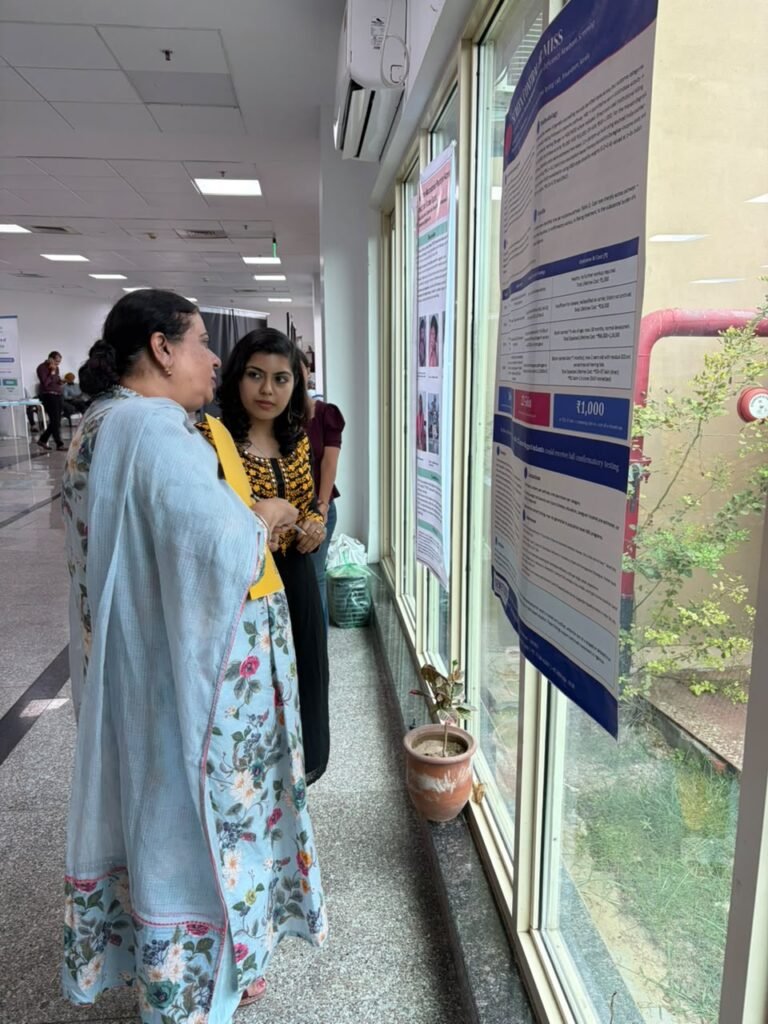
Dr. Neeta Nelson, from Genetidoc’s Department of Genetic Rare Diseases, presented a research paper titled “Screen, Confirm, or Miss: A Series of Four Cases Showing Cost Analysis of Biotinidase Deficiency Newborn Screening” at the Newborn Screening Awareness Programme CME 2026, organised by the Department of Pediatrics and Neonatology at the All India Institute of Medical Sciences, Bathinda, on 5 September 2026. The research paper received First Position and a Certificate of Participation from the organising committee.
The recognition is a good occasion to walk through what the study actually found — because the findings speak to a question every parent encounters, usually without realising it: what happens after a newborn screening result comes back abnormal?
Why biotinidase deficiency is on the newborn screening panel
Biotinidase deficiency is an inherited disorder of biotin recycling. The body can’t release and reuse biotin (a B-vitamin) properly, and without treatment, this can lead to seizures, developmental delay, and irreversible sensorineural hearing loss and optic atrophy. The reason it’s included in newborn screening programmes is that all of this is preventable — a child identified early can be started on a simple biotin supplement and go on to develop normally.
The complication is in how the screening works. Newborn screening measures biotinidase enzyme activity, not the underlying gene. That means it cannot, on its own, tell the difference between a child who actually has the disorder (having two altered copies of the BTD gene) and a child who is simply an unaffected carrier (with one altered copy). Reported
false-positive rates for biotinidase deficiency screening vary widely in published literature — from under 1% to more than half of screen-positive results in some settings — and heterozygous carriers are a well-documented cause of these screen-positive flags requiring molecular confirmation. What hasn’t been well characterised, particularly in the Indian context, is what each of these screening outcomes actually costs — in money, and in consequences for the child.
The study
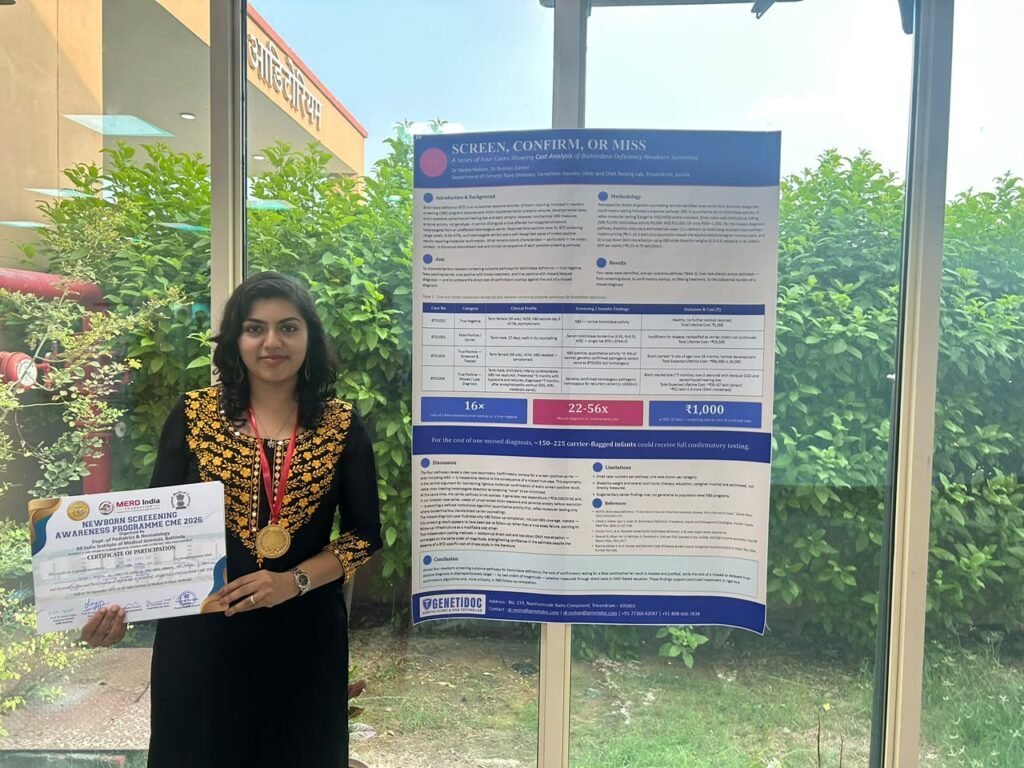
Dr. Neeta Nelson reviewed genetic counseling records and identified one case for each of four possible newborn screening outcome pathways for biotinidase deficiency:
- True negative — normal screening result
- False positive / carrier — an abnormal screen that, on confirmatory testing, turns out to be a single-copy carrier rather than true disease
- True positive, treated early — confirmed disease, treatment started promptly
- True positive, missed or delayed — confirmed disease, but diagnosis came late
Confirmatory testing followed a stepwise pathway: newborn screening, then quantitative serum biotinidase activity testing, then reflex molecular testing (Sanger sequencing or whole exome sequencing) where indicated. Direct costs were based on institutional billing. For the missed-diagnosis pathway, the disability-related cost was estimated two independent ways — a bottom-up build using real Indian cochlear-implant pricing plus assumption-based therapy, education, and caregiver-income costs, and a top-down disability-adjusted life year monetisation using standard disability-weighting methodology. Both methods converged on a similar order of magnitude, which strengthens confidence in the estimate.
What the four cases showed
Case 1 — True negative. A full-term newborn girl with a normal biotinidase activity results in newborn screening. No further workup needed. Total lifetime cost: ₹1,000 — the screening test itself.
Case 2 — False positive / carrier. A full-term newborn boy with a borderline serum biotinidase activity result. Whole exome sequencing identified a single heterozygous BTD variant — insufficient to cause disease, and he was reclassified as an unaffected carrier. Biotin supplementation was not continued. Total lifetime cost: approximately ₹16,500.
Case 3 — True positive, treated early. A full-term newborn girl recalled after a positive screen, with biotinidase activity at roughly 2–5% of normal. Genetic testing confirmed the same pathogenic variant as Case 2, but in two copies (homozygous). Biotin was started at around three weeks of age. At 18 months, she has normal development. Total expected lifetime cost: approximately ₹66,000–1,16,000.
Case 4 — True positive, missed diagnosis. A full-term newborn boy whose early infancy appeared unremarkable and whose newborn screening result was not captured. He presented at around five months with low muscle tone and seizures, and was diagnosed roughly seven months after birth, following an encephalopathy workup. Genetic testing confirmed the same recurrent pathogenic variant, homozygous. Biotin was started late, at around seven months. At two years old, he has residual developmental delay and sensorineural hearing loss. Total expected lifetime cost: approximately ₹25–37 lakh in direct costs, or ₹32 lakh–1.9 crore when the disability burden is monetised.
The numbers that matter
- The cost of a false-positive/carrier workup was about 16 times the cost of a true-negative result — but still modest in absolute terms.
- The cost of a missed diagnosis was 22 to 56 times higher than the cost of a case caught and treated early.
- For the price of confirming one missed diagnosis, roughly 150 to 225 carrier-flagged infants could receive full confirmatory testing.
What this means
The study’s central argument is a case for restraint, not economy: confirmatory testing for every screen-positive result — including whole exome sequencing where needed — is inexpensive relative to the cost of missing a true case. Treating carrier detection as screening “noise” to be minimized would be a false saving.
At the same time, the carrier pathway isn’t free. It generates real expenditure per child, and in the broader case series behind this poster, weeks of unnecessary biotin exposure and parental anxiety before resolution — an argument for a standardised institutional algorithm: quantitative enzyme activity testing first, reflex molecular testing where results are borderline or low, and consistent carrier counseling.
Perhaps the more striking finding is in Case 4. The missed diagnosis wasn’t a screening failure — the test itself works. It was a follow-up failure: the result appears to have been lost to follow-up rather than reflecting a true assay miss. That points to follow-up infrastructure, not the screening technology, as the most modifiable driver of cost and outcome in biotinidase deficiency care in India.
Limitations

The authors were direct about the constraints of this analysis: it draws on one case per pathway rather than a large cohort, several cost inputs (therapy, education, caregiver income, disability weighting) are estimated rather than directly measured, and the findings come from a single tertiary centre, so they may not generalise to population-level newborn screening programmes across India.
The takeaway for families
If your baby’s newborn screening result comes back abnormal for biotinidase deficiency, an abnormal result is not the same as a diagnosis. Confirmatory testing exists precisely to sort carriers from true cases, and it’s a small cost against the alternative. What matters most — for parents and for the health system alike — is following through: showing up for the confirmatory workup, and not letting a flagged result slip through gaps in follow-up.
Biotinidase deficiency is one of several rare metabolic disorders covered on the Genetidoc Rare Disease Forum — [link to relevant subforum].