
A 40-year-old woman came to my clinic anxious because both her mother and aunt had breast cancer.
Her first question was simple: “Does that mean I’ll get it too? Can I predict it with genetic testing for breast cancer?”
This question echoes in many families. Breast cancer is common, and when it affects more than one person in a family, fear naturally follows.
But here’s the truth — not all breast cancers are inherited.
Still, for some families, genes like BRCA1 and BRCA2 play a strong role, and learning about them early can make all the difference.
1️⃣ How Often Is Breast Cancer Genetic?
Most breast cancers occur by chance (sporadic).
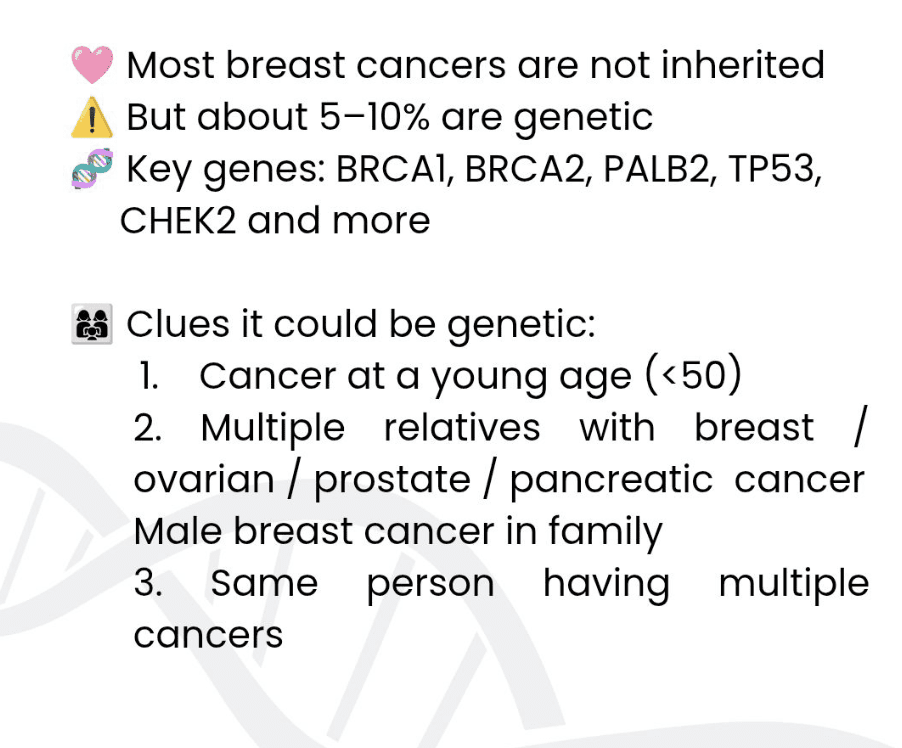
However, 5–10% are hereditary, passed from parent to child through mutations in key genes.
The main genes linked to hereditary breast cancer are:
-
BRCA1 and BRCA2 – well-known tumor-suppressor genes
-
PALB2, TP53, CHEK2 – other important DNA-repair genes
These genes usually act as your DNA repair system.
When one has a “spelling mistake” (mutation), DNA damage builds up — and cancer risk rises.
2️⃣ Clues That Breast Cancer Could Be Hereditary
Doctors look for certain red flags:
-
Cancer before age 50
-
Multiple relatives with breast, ovarian, prostate, or pancreatic cancer
-
Male breast cancer (rare but significant)
-
A single person with multiple cancers
-
Triple-negative breast cancer before 60
If you notice these patterns, consider meeting a clinical geneticist for assessment.
3️⃣ Why Genetic Counseling Matters
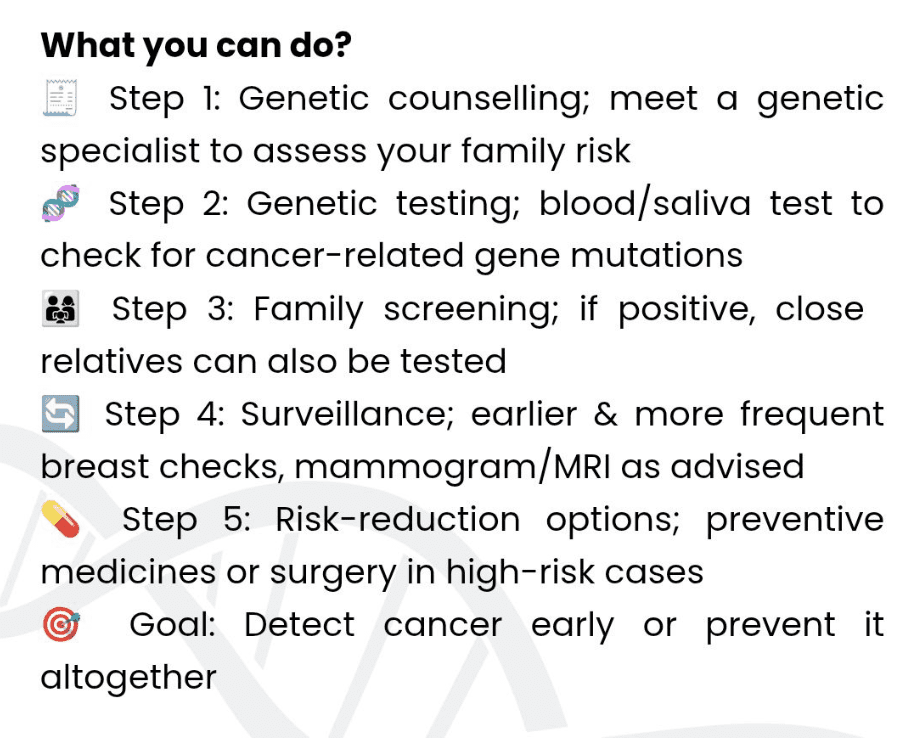
Before testing, start with genetic counseling.
A counselor reviews your history, explains what testing can show, and helps you decide if it’s needed.
This step ensures:
-
You understand what a positive, negative, or uncertain result means
-
Testing is done only when relevant
-
Your family is guided properly
Think of counseling as your roadmap before testing.
4️⃣ What Genetic Testing Involves
Genetic testing for breast cancer is simple — a blood or saliva test analyzed in a specialized lab.
The lab looks for changes in genes like BRCA1, BRCA2, PALB2, and others.
Results usually fall into three categories:
-
Pathogenic variant – harmful change increasing risk
-
Normal (negative) – no known harmful change
-
VUS (Variant of Uncertain Significance) – unclear effect yet
5️⃣ What If My Test Is Positive?
A positive result doesn’t mean you’ll definitely get cancer — it means higher risk.
Your prevention plan may include:
-
Regular mammograms or MRIs starting early
-
Risk-reducing medications (e.g., tamoxifen)
-
Preventive surgeries, like prophylactic mastectomy or oophorectomy, in select cases
These decisions are personal, guided by your age, health, and comfort.
6️⃣ What If My Test Is Negative?
A negative test can be reassuring — but it doesn’t erase all risk.
You may still have lifestyle or environmental risks or undiscovered gene variants.
Doctors may still recommend regular screening if your family history is strong.
7️⃣ How Family Members Benefit
If you test positive, your parents, siblings, and children each have a 50% chance of carrying the same gene change.
Testing them allows:
-
Early screening
-
Risk-reducing steps
-
Relief from uncertainty
Genetic testing empowers families with knowledge — sometimes saving lives.
8️⃣ Lifestyle Tips to Lower Risk
Even with inherited risk, lifestyle still matters:
-
Maintain healthy weight
-
Limit alcohol
-
Exercise regularly
-
Eat more fruits, vegetables, whole grains
-
Avoid smoking
-
Breastfeed if possible
🩷 Genes load the gun; lifestyle decides whether it fires.
9️⃣ How Genetic Testing Helps Treatment
For those already diagnosed with breast cancer, genetic testing influences treatment:
-
BRCA1/BRCA2-positive cancers may respond better to PARP inhibitors
-
Family risk may guide preventive surgeries or targeted therapy
Genetic testing is now a core part of precision oncology.
🔟 Can Breast Cancer Be Prevented?
Sometimes, yes.
With genetic counseling, testing, and proactive screening, many hereditary cancers can be prevented or caught early.
At Genetidoc Genetic Clinic and DNA Testing Lab, led by Dr. Roshan Daniel, we follow a structured pathway:
-
Genetic counseling
-
Blood or saliva testing
-
Family screening if positive
-
Early surveillance
-
Risk-reduction options
🎯 Goal: Detect cancer early or prevent it altogether.
🌷 Real-World Story
A 33-year-old woman came for counseling because her mother and grandmother both had breast cancer.
Testing revealed a BRCA2 mutation.
She began yearly MRIs. Two years later, an early tumor was found and completely removed.
Her sister, also positive, chose preventive surgery — and remains cancer-free.
👉 This is preventive genetics in action.
💬 Common Questions
Can breast cancer genes come from my father’s side?
Yes. BRCA1 and BRCA2 can be inherited from either parent.
If my mother tested negative, should I test?
Maybe — if there’s a strong family pattern. Your counselor can advise.
Can men carry breast cancer genes?
Yes. They can pass them on and face higher risks of male breast or prostate cancer.
When should I test?
After 18 years if strong family history; screening starts 5–10 years before the earliest diagnosis in the family.
What is triple-negative breast cancer?
A type not responsive to hormone or HER2 therapy — often linked with BRCA1 mutations.
💗 Awareness Saves Lives
Genetic testing for breast cancer isn’t about fear — it’s about taking control.
Families who test together make informed, confident decisions for their health.
🌸 Take Action — Know Your Risk, Own Your Future
If you have a family history of breast cancer, don’t wait for symptoms.
Start with a genetic counseling session — it’s just a conversation, not a commitment.
A simple blood or saliva test can protect you and future generations.
✨ Knowledge is power — and prevention starts with awareness.