👩⚕️ “Doctor, My Mother and Aunt Both Had Thyroid Cancer. Should I Be Worried?”
Most thyroid cancers happen sporadically — caused by random cell mutations or radiation exposure.
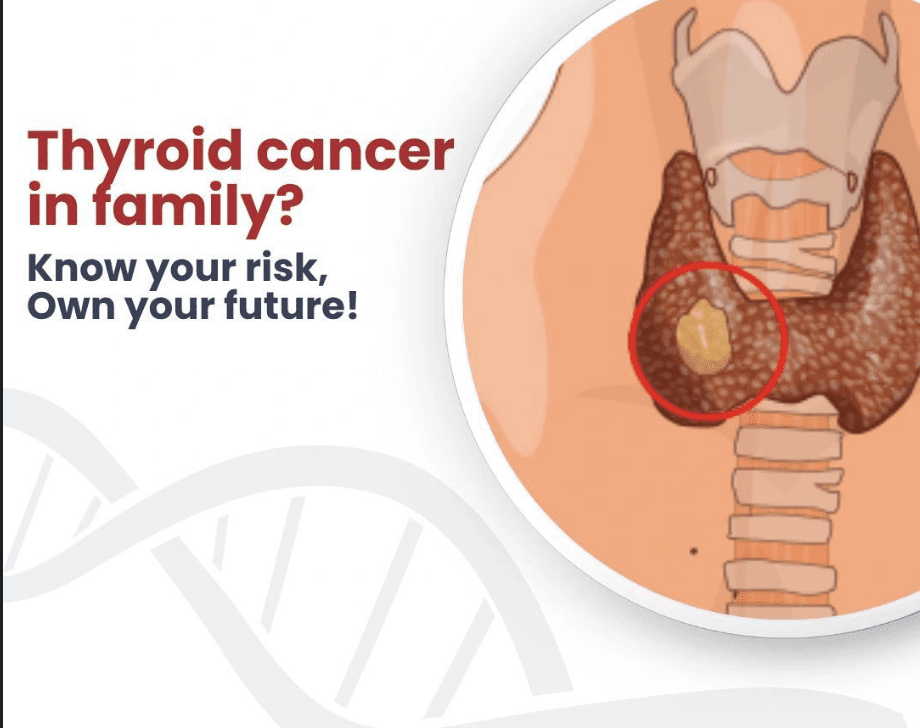
However, around 5–10% of thyroid cancers are hereditary, passed through families via identifiable genetic changes.
Understanding whether a thyroid cancer is genetic can help in early diagnosis, preventive surgery, and protection of relatives.
1️⃣ How Common Is Hereditary Thyroid Cancer?
Thyroid cancer is among the most curable cancers, but hereditary forms behave differently.
In most people, thyroid cancer develops sporadically, usually in the 40s–50s.
In contrast, hereditary thyroid cancers occur at younger ages (sometimes in childhood) and may involve multiple family members or multiple endocrine glands.
Hereditary forms account for:
-
Nearly all familial medullary thyroid carcinomas (MTC)
-
A small proportion of papillary or follicular thyroid cancers
-
Cases associated with multi-organ tumor syndromes
2️⃣ What Causes Hereditary Thyroid Cancer?
The condition arises from mutations in specific cancer-predisposition genes.
Each gene corresponds to a distinct syndrome with its own cancer profile.
🧬 Major Genes and Syndromes:
-
RET – causes Multiple Endocrine Neoplasia type 2 (MEN2A & MEN2B), responsible for almost all hereditary medullary thyroid cancers.
-
PTEN – part of Cowden syndrome, associated with thyroid (often follicular) cancer, breast, uterine, and colon tumors.
-
APC – linked to Familial Adenomatous Polyposis (FAP); patients may develop papillary thyroid carcinoma.
-
TP53 – seen in Li-Fraumeni syndrome, increasing the risk for thyroid, breast, and sarcoma.
-
DICER1 – associated with DICER1 syndrome, which can cause thyroid tumors, ovarian tumors, and lung cysts in children.
Each of these genes follows autosomal dominant inheritance, meaning a 50% risk to each child of an affected person.
3️⃣ Which Types of Thyroid Cancer Are Hereditary?
-
Medullary Thyroid Carcinoma (MTC):
-
The hallmark of MEN2 syndromes
-
Caused by mutations in the RET gene
-
Can appear in childhood or adolescence
-
Often accompanied by pheochromocytoma (adrenal tumor) or parathyroid tumors
-
-
Papillary or Follicular Thyroid Carcinoma:
-
Occasionally seen in PTEN (Cowden) or APC (FAP) mutations
-
May occur with other tumors or characteristic features like intestinal polyps or macrocephaly
-
-
DICER1-related Thyroid Tumors:
-
Typically occur in children or young adults
-
May coexist with ovarian or lung lesions
-
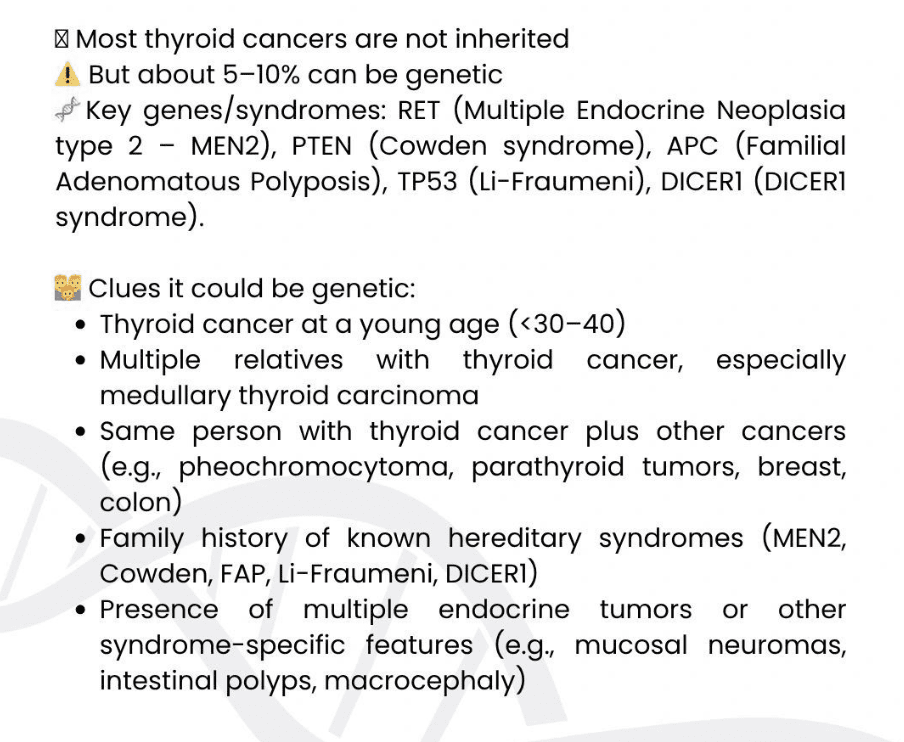
4️⃣ Clues That Thyroid Cancer May Be Hereditary
You or your doctor should suspect a genetic component if any of these apply:
-
Thyroid cancer diagnosed before age 30–40
-
Multiple relatives with thyroid cancer, especially medullary type
-
A person with thyroid cancer plus other endocrine tumors (adrenal, parathyroid)
-
Family history of known hereditary cancer syndromes (MEN2, Cowden, FAP, Li-Fraumeni, DICER1)
-
Presence of multiple endocrine tumors or syndrome-specific findings like mucosal neuromas, intestinal polyps, or large head size
If any of these fit, genetic counseling is strongly advised.
5️⃣ Why Genetic Testing Matters
For hereditary thyroid cancer, genetic testing does more than confirm a diagnosis — it can prevent the disease altogether.
-
RET testing can identify children at risk for medullary thyroid carcinoma before cancer starts.
-
PTEN or APC testing allows doctors to monitor thyroid and other organs closely.
-
A positive result enables predictive testing for relatives and early intervention.
Knowing your mutation means you can act before symptoms appear.
6️⃣ What Happens During Genetic Counseling and Testing?
A clinical geneticist reviews:
-
Your personal and family history of thyroid and related tumors
-
The types of cancers seen in relatives (adrenal, parathyroid, breast, colon)
-
Possible syndromic features (polyps, skin lesions, macrocephaly)
Testing is done on blood or saliva and looks for genes such as:
RET, PTEN, APC, TP53, DICER1
The results guide next steps:
-
Positive → confirms hereditary cause, triggers family screening
-
Negative → rules out known genes, but clinical follow-up continues
-
VUS → uncertain variant, re-evaluated periodically
7️⃣ What If My Test Is Positive?
A positive result helps doctors tailor your monitoring and management:
-
RET mutation (MEN2):
-
Regular calcitonin tests to detect early medullary thyroid cancer
-
Preventive thyroidectomy in high-risk children before cancer develops
-
Screening for pheochromocytoma (adrenal tumors)
-
-
PTEN mutation (Cowden):
-
Annual thyroid ultrasound, plus breast and uterine surveillance
-
Lifestyle and weight management
-
-
APC mutation (FAP):
-
Thyroid and colon surveillance
-
Polyp removal and preventive surgery if needed
-
-
DICER1 or TP53:
-
Periodic imaging and multidisciplinary follow-up
-
🎯 Goal: Detect early disease, prevent complications, and protect relatives.
8️⃣ What If My Test Is Negative?
A negative result doesn’t entirely exclude genetic risk.
Some families carry undiscovered or mosaic mutations.
If your family history is strong, doctors may still recommend:
-
Yearly thyroid ultrasound
-
Hormone monitoring (calcitonin, CEA)
-
Screening for other endocrine tumors
-
Lifestyle measures: avoid radiation exposure and unnecessary imaging
You may also be advised to retest in future as new genes are identified.
9️⃣ How Does Family Screening Help?
When a hereditary mutation is confirmed, close relatives can be tested.
Benefits include:
-
Early diagnosis or prevention through surveillance or prophylactic surgery
-
Peace of mind for those who test negative
-
Avoiding unexpected thyroid emergencies later in life
For instance, a child with a RET mutation may undergo thyroid removal before age 5 — preventing medullary thyroid cancer completely.
🔟 Can Hereditary Thyroid Cancer Be Prevented?
Yes — it’s one of the few hereditary cancers where complete prevention is possible.
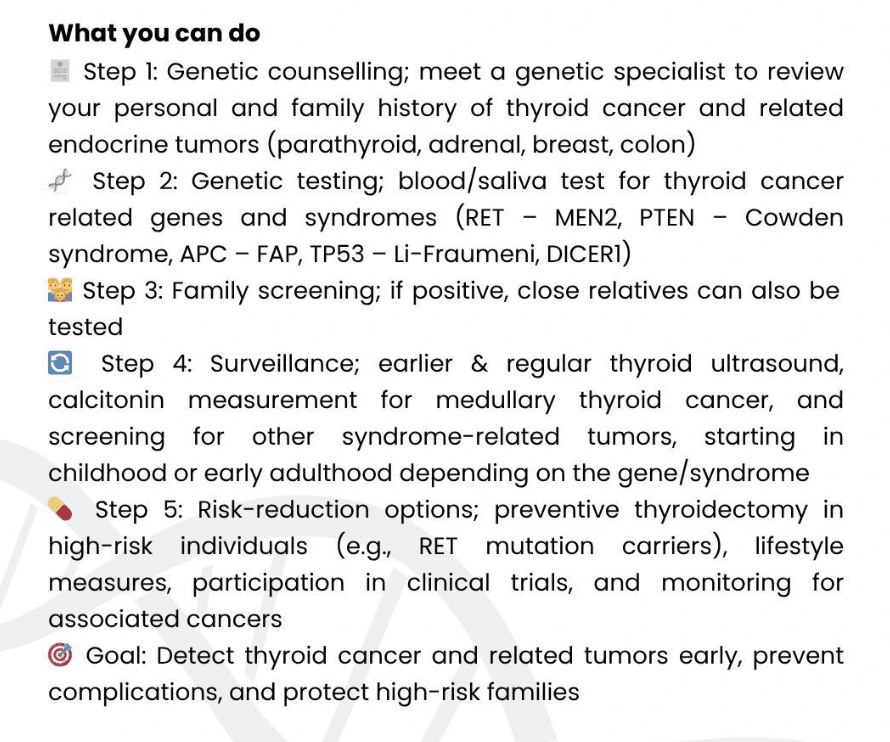
At Genetidoc Genetic Clinic and DNA Testing Lab, we use a 5-step plan:
-
Genetic Counseling: Review family and tumor history
-
Genetic Testing: RET, PTEN, APC, TP53, DICER1
-
Family Screening: Identify at-risk relatives
-
Surveillance: Early ultrasound, calcitonin checks, adrenal screening
-
Risk Reduction: Preventive surgery, lifestyle changes, and regular follow-up
🩺 Goal: Detect or prevent thyroid cancer early, and safeguard future generations.
🌷 Real-World Example
A 16-year-old girl was found to carry a RET mutation after her mother was treated for medullary thyroid carcinoma.
Genetic counseling revealed a family history of pheochromocytoma.
Following expert advice, she underwent a prophylactic thyroidectomy before cancer developed — pathology confirmed early changes only.
Her siblings tested negative and were spared unnecessary procedures.
This proactive approach turned a high-risk situation into a lifelong success story.
💬 Frequently Asked Questions
Can thyroid cancer really run in families?
Yes. Around 1 in 10 cases are hereditary, especially medullary thyroid carcinoma.
Is preventive thyroid removal safe?
Yes — when done early under guidance, it’s life-saving for RET carriers.
If I test positive, can my children be tested?
Absolutely. Because these mutations are inherited, family testing is essential.
Does radiation cause hereditary thyroid cancer?
No. Radiation causes sporadic cases, while hereditary cases stem from gene mutations.
Can I live normally after preventive thyroid surgery?
Yes. With thyroid hormone replacement, people live full, healthy lives.
🌼 The Emotional Side of Genetic Awareness
Learning about a hereditary thyroid cancer risk can be emotionally heavy — especially when preventive surgery is discussed.
But this knowledge gives clarity and control.
Families who understand their genes can act early, stay safe, and spare loved ones from future illness.
🌸 Awareness Saves Lives
Thyroid cancer is one of the most treatable cancers — and when hereditary, it’s often preventable.
Early testing for RET and related genes can completely eliminate the risk of advanced medullary thyroid cancer.
If you have thyroid cancer in your family or multiple endocrine tumors, don’t wait — genetic evaluation can change the story for your next generation.
💜 Take Action — Know Your Risk, Protect Your Family
Your DNA holds answers.
A single consultation with a genetic specialist can help you detect, prevent, and protect your loved ones.