
“My mother had migraines. So did my grandmother. Now I have them. Will my daughter get them too?”
This is one of the most common questions families ask about headaches. The short answer is yes, migraine often runs in families. But the full answer is more reassuring and more useful than a simple yes.
For most people, migraine is shaped by many small genetic differences working together with hormones, sleep, stress and lifestyle. No single gene test can predict it. For a small number of families, though, migraine is a sign of a rare inherited condition caused by one gene. In those families, genetic testing can change treatment and protect relatives.
This guide explains how migraine is inherited, which warning signs point to a rare genetic form, when testing helps, when it does not, and what a diagnosis means for your family.
Quick Answer: Is Migraine Hereditary?
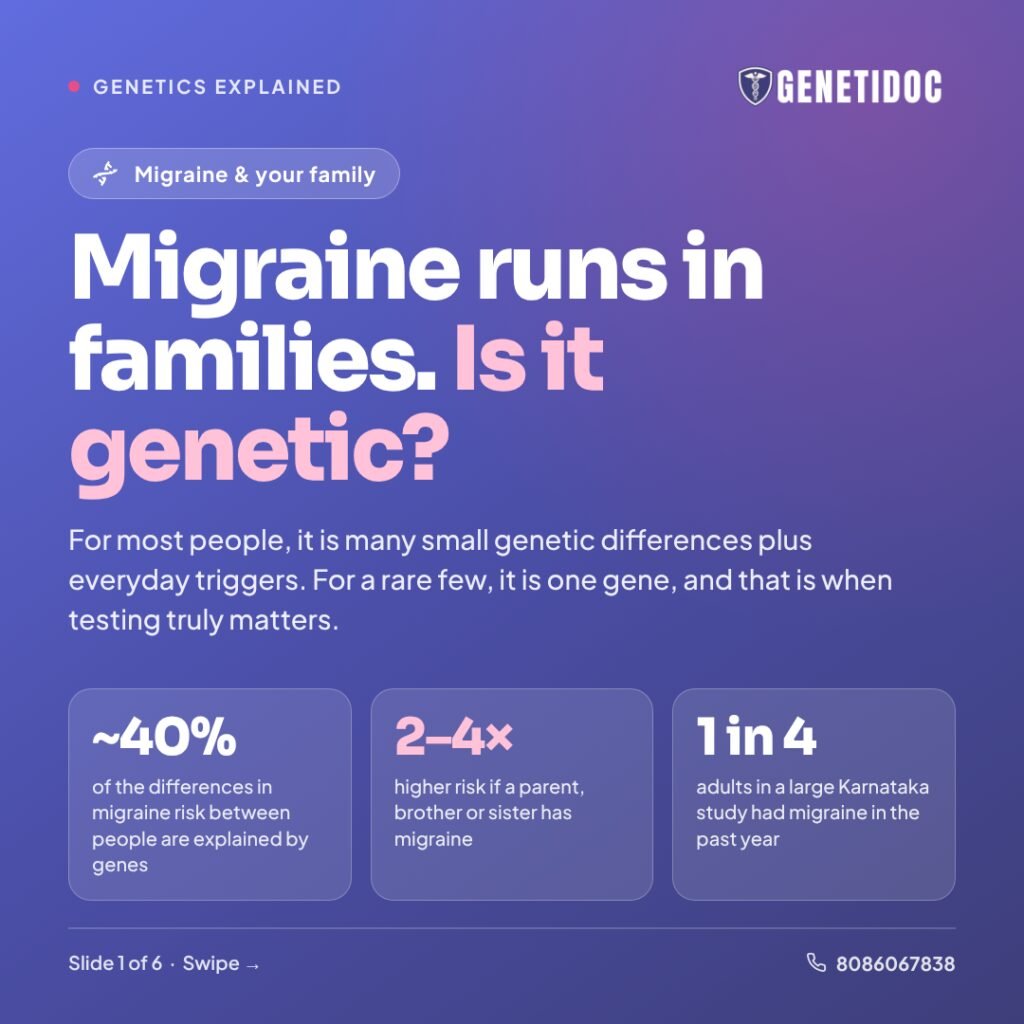
Yes, migraine is partly hereditary. Family and twin studies suggest that genes explain roughly 40% of the differences in migraine risk between people. If a parent or sibling has migraine, your risk is about two to four times higher than average. Most migraine is polygenic, meaning many genes each add a small effect, so there is no single test for it. A few rare forms, such as familial hemiplegic migraine and CADASIL, are caused by one gene and can be confirmed with genetic testing.
How Common Is Migraine in India?
Migraine is not a minor problem in India. A large population study in Karnataka found that about 1 in 4 adults (25.2%) had migraine in the previous year. That is well above the estimated global average of about 14.7%. Women were affected about twice as often as men, and rates were higher in rural areas.
A recent analysis that pooled Indian studies estimated overall migraine prevalence at about 18%. The numbers vary widely between regions, but the message is the same. Migraine is one of the most common health conditions in Indian families.
Because it is so common, many families have several members with migraine just by chance. That is an important point. Several people with migraine in one family does not automatically mean a rare genetic disease.
What Does Science Say About Migraine and Genes?
Migraine clusters in families
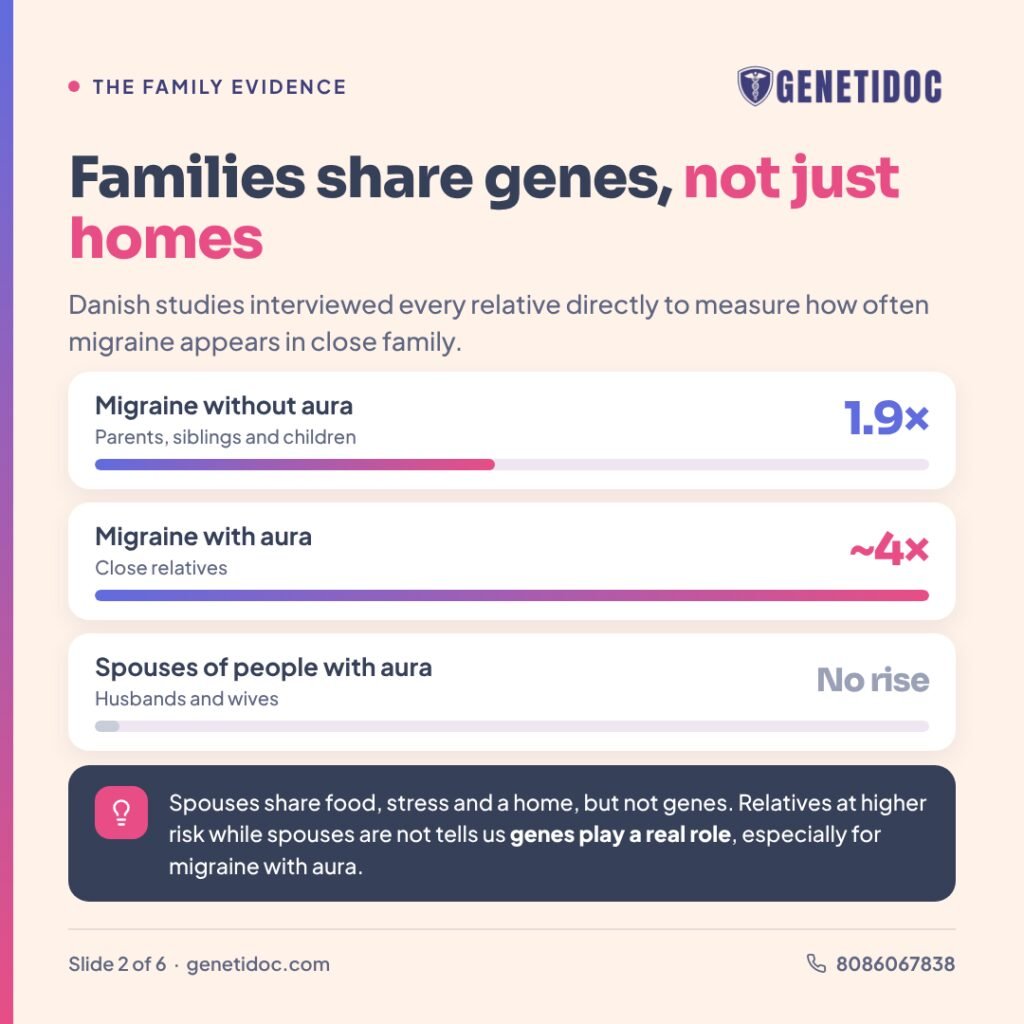
Doctors have long noticed that migraine runs in families. Careful Danish studies, in which a doctor interviewed every relative directly, put numbers on this:
- Migraine without aura: Parents, brothers, sisters and children of an affected person had about 9 times the usual risk.
- Migraine with aura: Close relatives had nearly 4 times the usual risk of migraine with aura.
- Spouses: Husbands and wives of people with migraine with aura had no increased risk.
That last point matters. Spouses share a home, food and stress, but not genes. When relatives are at higher risk and spouses are not, it tells us genes play a real role. This seems especially true for migraine with aura.
What is an aura? An aura is a set of temporary nerve symptoms that usually come before or with the headache. Common examples are zigzag lines, flashing lights or blind spots in vision, tingling in the hand or face, or difficulty finding words. An aura usually lasts 5 to 60 minutes and then fully goes away. About one in three people with migraine have aura.
Scientists have found over 100 genetic regions linked to migraine
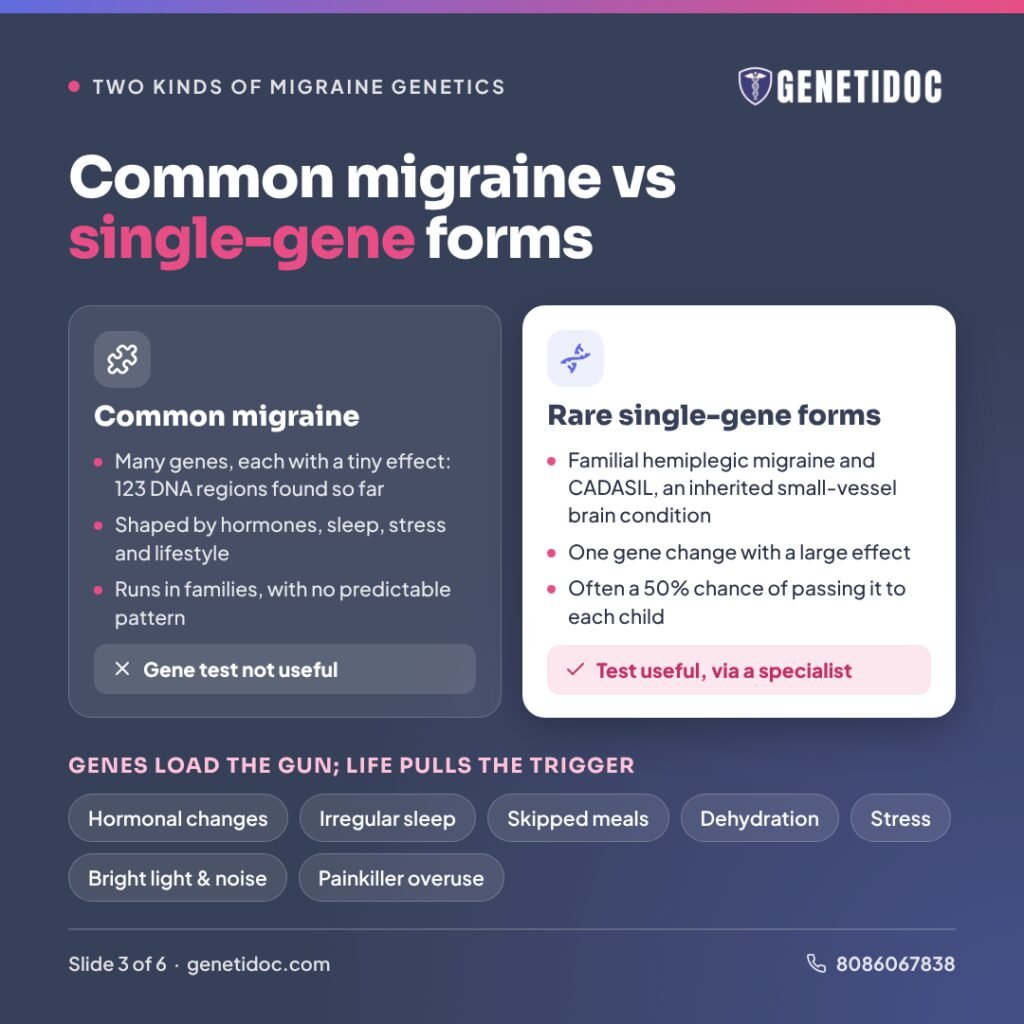
In 2022, researchers compared the DNA of more than 1,00,000 people with migraine against over 7,00,000 people without it. They found 123 regions of DNA linked to migraine risk. Each one nudges risk up only a tiny amount.
Two of these regions are especially interesting. They contain genes for calcitonin gene-related peptide (a chemical messenger that triggers migraine pain) and a serotonin receptor (a docking point on nerve cells for the brain chemical serotonin). Several newer migraine medicines work by blocking exactly these targets. Genetics research has confirmed that these treatments aim at the right biology.
Genes load the gun; life pulls the trigger
Even in families with many affected members, research suggests migraine is usually multifactorial. That means many genes plus environment together decide whether someone gets migraine, how often, and how severely. Common influences include:
- Hormonal changes, especially around periods, pregnancy and menopause
- Poor or irregular sleep
- Skipped meals and dehydration
- Stress, and the “let-down” after stress
- Bright light, loud noise and strong smells
- Overuse of painkillers, which can make headaches more frequent
This is good news. You cannot change your genes, but you can change many of the things that set off attacks.
Common Migraine vs Single-Gene Migraine: What Is the Difference?
Think of migraine genetics in two groups. The first is very common. The second is rare, but it is the group where genetic testing really matters.
| Feature | Common migraine | Single-gene (monogenic) forms |
| How common | Very common (about 1 in 5 Indian adults) | Rare |
| Cause | Many genes with small effects, plus environment | A change in one gene with a large effect |
| Inheritance pattern | Runs in families, but no predictable pattern | Often a 50% chance of passing it to each child |
| Typical features | Headache with or without typical aura | Weakness during attacks, seizures, unsteadiness, early strokes in the family |
| Genetic test useful? | No | Yes, when chosen and interpreted by a specialist |
Rare Inherited Conditions Where Migraine Is a Clue
Familial hemiplegic migraine
Familial hemiplegic migraine is a rare type of migraine with aura in which the aura includes weakness on one side of the body. “Hemiplegic” means affecting one half of the body. The weakness is temporary, but it can look frighteningly like a stroke. It can last from minutes to hours, sometimes longer.
Which genes are involved?
Four genes are known to cause it: CACNA1A, ATP1A2, SCN1A and PRRT2. These genes help control how electrical signals and salts move in and out of brain cells. When one of them does not work properly, brain cells become overexcitable, which can set off severe attacks.
Features that suggest it
- Attacks that often begin in childhood or the teenage years
- Weakness, numbness or speech difficulty on one side during attacks
- In some CACNA1A families, mild unsteadiness or abnormal eye movements between attacks
- Seizures, which are more common with ATP1A2 and SCN1A changes
- Occasional severe attacks with confusion, fever or drowsiness
- A parent, brother, sister or other close relative with similar attacks
How is it inherited?
It is autosomal dominant. This means one changed copy of the gene, from either parent, is enough to cause the condition. Each child of an affected parent has a 50% chance of inheriting the gene change.
Inheriting the change does not always mean having attacks, though. In one large study, about 11% of people carrying a CACNA1A change never had a hemiplegic attack. Doctors call this incomplete penetrance. It explains why the condition can sometimes seem to “skip” a generation.
CADASIL
CADASIL stands for cerebral autosomal dominant arteriopathy with subcortical infarcts and leukoencephalopathy. In plain words, it is an inherited condition that slowly damages the small blood vessels of the brain. It is caused by changes in the NOTCH3 gene.
Migraine with aura is often the first sign of CADASIL. It usually starts around age 30, years before other problems appear. Later features can include:
- Strokes or “mini-strokes” at a young age, often without the usual risk factors such as high blood pressure or diabetes
- Mood changes such as depression or apathy
- Memory and thinking problems in mid-life
- Characteristic white patches on brain MRI scans
Like familial hemiplegic migraine, CADASIL is autosomal dominant. Each child of an affected person has a 50% chance of inheriting it.
“If migraine attacks come with weakness on one side, or if relatives had strokes at a young age, please don’t dismiss it as an ordinary headache. That is when a genetics opinion can change care.”
Dr. Roshan Daniel, Clinical Geneticist and Founder, Genetidoc
When Should You Consider Genetic Testing for Migraine?
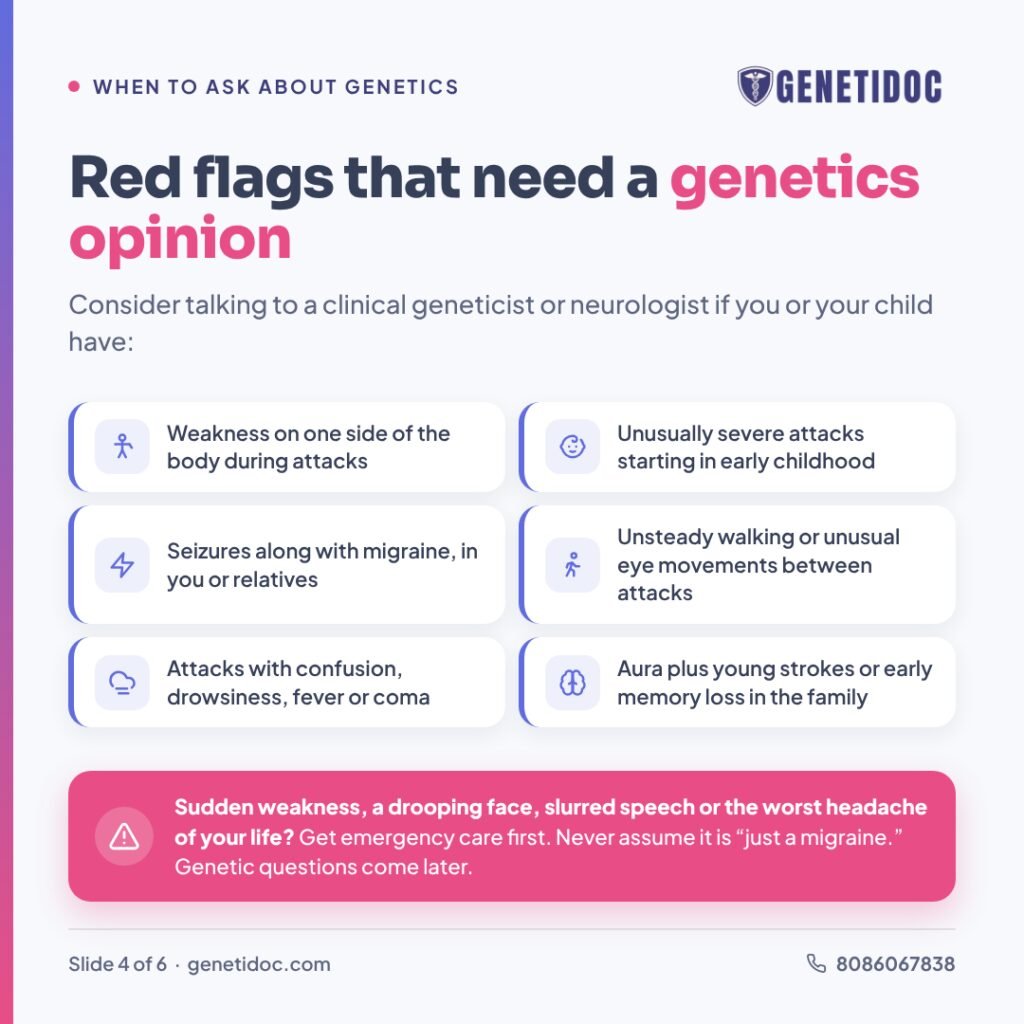
Genetic testing is worth discussing with a clinical geneticist or neurologist if you or your child have any of the following:
- Weakness on one side of the body during migraine attacks
- Migraine attacks that started in early childhood and are unusually severe
- Attacks with confusion, drowsiness, fever or coma
- Seizures along with migraine, in you or in relatives
- Unsteady walking or abnormal eye movements between attacks
- Migraine with aura plus strokes, mini-strokes or early memory loss in you or a close relative
- Brain MRI showing white matter changes at a young age without a clear cause
- A relative already diagnosed with familial hemiplegic migraine or CADASIL
Urgent warning: Sudden weakness, a drooping face, slurred speech or the worst headache of your life always needs emergency medical care first. Never assume it is “just a migraine,” even if you have had migraines before. Genetic questions come later.
When Genetic Testing Is Not Useful
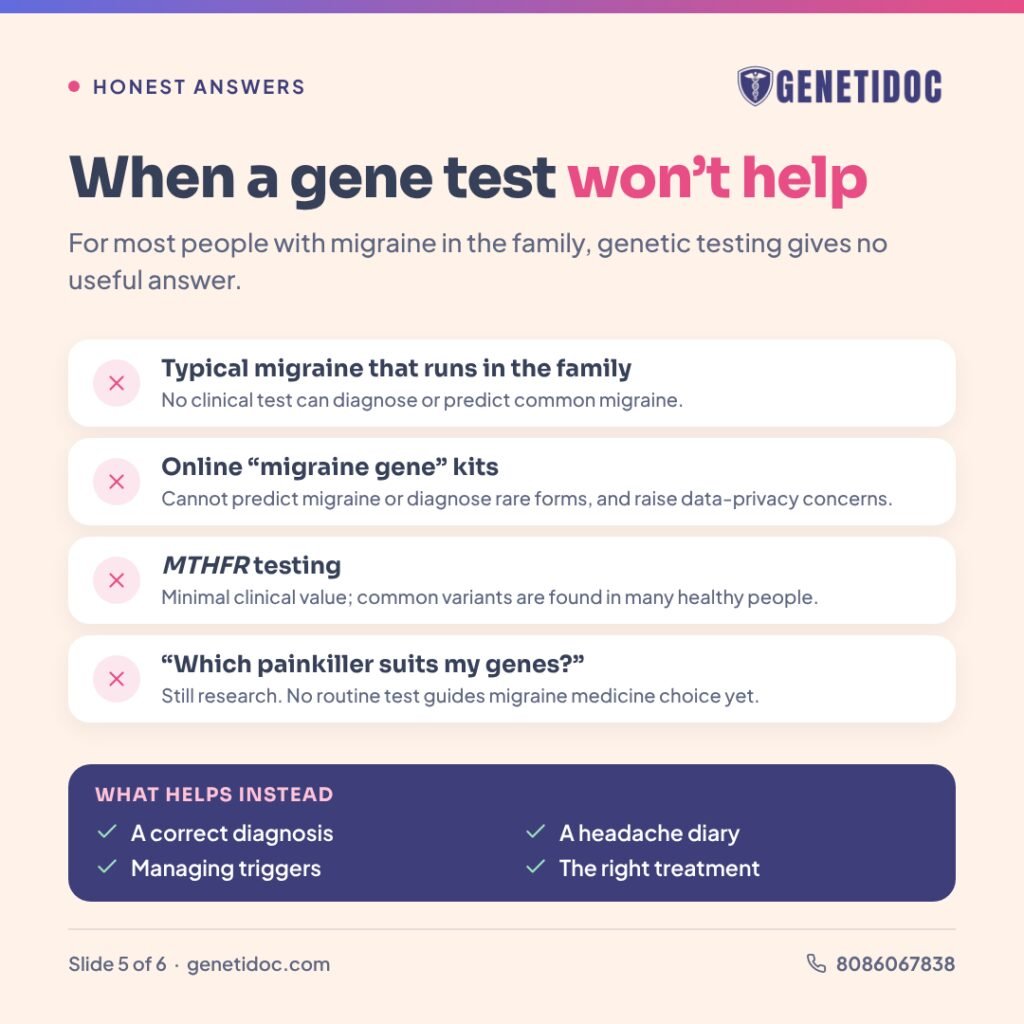
Honesty matters here. For the large majority of people with migraine, a genetic test will not help.
Typical migraine that runs in the family
If you have ordinary migraine, with or without a typical aura, and your relatives have the same, Team Genetidoc does not recommend genetic testing. No clinical test can diagnose or predict common migraine. The 123 genetic regions found in research each have very small effects. Together they still cannot tell one person whether they will get migraine.
What helps instead is a correct diagnosis from a doctor, a headache diary, managing triggers, and the right treatment.
“Most people with migraine in the family do not need a gene test. What they need is a correct diagnosis and good treatment. Genetics matters most when the pattern looks unusual.”
Dr. Roshan Daniel, Clinical Geneticist and Founder, Genetidoc
Direct-to-consumer “migraine gene” reports
Some online and wellness DNA kits claim to report your “migraine risk genes.” These reports look at a handful of common DNA differences with tiny effects. They cannot tell you whether you will get migraine, and they cannot diagnose a rare genetic form. Team Genetidoc does not recommend these kits for health decisions. They can also raise privacy concerns about who stores and uses your DNA data.
MTHFR testing for migraine
You may have been told to test for MTHFR gene variants. The American College of Medical Genetics and Genomics has concluded that routine MTHFR variant testing has minimal clinical value. Common MTHFR variants are found in a large share of healthy people. A “positive” result does not explain your migraine or change your treatment.
“Which painkiller suits my genes?”
Researchers have found that a combined genetic score is linked to how well people respond to triptans, a common group of migraine medicines. This is exciting science and may support more personal treatment one day. For now, it is still research. No routine test today tells you which migraine medicine will work best. Your doctor still finds that out through careful trial and follow-up.
What Does Genetic Testing for Migraine Involve?
When a rare genetic form is suspected, testing follows a clear process.
- Consultation with a clinical geneticist. The doctor reviews your symptoms, scans and medical records. Most Genetidoc consultations happen by video, in your preferred language.
- Drawing the family tree. The genetic counselor maps at least three generations. They ask who had migraine, what kind, and whether anyone had seizures, weakness, strokes or memory problems.
- Choosing the right test. This is the most important step:
- A single-gene test, such as NOTCH3, when the picture points strongly to one condition
- A multi-gene panel covering CACNA1A, ATP1A2, SCN1A, PRRT2 and related genes when hemiplegic migraine is suspected
- Exome sequencing, which reads the protein-coding parts of about 20,000 genes, when the picture is complex or a panel is negative
- A targeted test for one known variant when a relative has already been diagnosed
- Sample collection. Usually a simple blood sample, which can be collected through home sample pickup.
- Laboratory analysis. Typical turnaround is about 1 week for a known family variant, about 3 weeks for a single gene, 3 to 4 weeks for a multi-gene panel, and 1 to 2 months for exome sequencing.
- Post-test counseling. The geneticist explains the result, what it means for treatment, and what it means for your relatives. You receive a written summary.
What about cost? Costs in India vary with the type and size of the test. A single-gene test usually costs the least, and exome sequencing costs more. Your genetic counselor can explain the options before you decide. The aim is the right test, not the biggest one.
Understanding Your Results
A positive result
A pathogenic (disease-causing) variant confirms the diagnosis. It explains your symptoms, guides treatment, and allows accurate testing of relatives.
A negative result
A negative result means no reportable finding in the genes tested. It does not prove your migraine is not genetic. Even in confirmed hemiplegic migraine, roughly three in four cases test negative for the three best-known genes. Science has not yet found all the genes involved.
If your symptoms strongly suggest a genetic form but the test is negative, Team Genetidoc may suggest broader testing such as exome sequencing. We also advise reanalysis of your data after 6 to 12 months, or sooner if new symptoms appear, because new genes and evidence are discovered every year.
A variant of uncertain significance
Sometimes the lab finds a DNA change but cannot yet say whether it causes disease. This is called a variant of uncertain significance. It should not be used to make treatment decisions or to test healthy relatives. Testing affected family members and later reanalysis can help clarify it over time.
“A negative report does not always mean the cause isn’t genetic. It means nothing was found in what was tested. Knowing what the test could and couldn’t see is where expert interpretation matters.”
Dr. Roshan Daniel, Clinical Geneticist and Founder, Genetidoc
How a Genetic Diagnosis Changes Treatment
A confirmed diagnosis does more than give a name. It helps your neurologist make safer, more targeted choices. These are decisions for your treating doctor, but genetics provides the information.
In familial hemiplegic migraine
- Preventive medicines: Acetazolamide may be tried in CACNA1A-related cases. Standard preventive migraine medicines may help frequent attacks in all types.
- Seizure care: People with ATP1A2 or SCN1A changes may need anti-seizure treatment.
- Acute medicine choices: The labels of triptans and ergot medicines advise against their use in hemiplegic migraine because they narrow blood vessels. Some newer studies suggest triptans may be safer than once feared, so your neurologist will weigh this carefully.
- Avoiding misdiagnosis: Knowing the diagnosis helps emergency doctors understand that one-sided weakness may be a known migraine pattern. Stroke must still be ruled out every time.
- Trigger awareness: In some families, even minor head injury can set off a severe attack.
In CADASIL
- It ends the search for other causes of young strokes or white matter changes.
- It shifts focus to protecting brain blood vessels: no smoking, and close control of blood pressure, sugar and cholesterol.
- It guides caution around certain procedures and blood-thinning decisions, which your doctors will discuss.
- It allows the patient and family to plan ahead.
What a Diagnosis Means for Your Family
Genetic results are shared information. When one person is diagnosed, relatives can learn their own risk.
Testing relatives
Once the family’s exact gene change is known, relatives can have a targeted test for that single variant. It is faster and simpler than the first test. This approach is called cascade testing.
For an adult-onset condition such as CADASIL, Team Genetidoc offers predictive testing to healthy relatives from age 18, after detailed pre-test counseling. Testing is always a personal choice. Some people want to know; others prefer not to. Both choices are respected.
For children in families with hemiplegic migraine, testing a child who already has symptoms helps confirm the diagnosis. Testing a child with no symptoms is discussed case by case with the family.
Planning a pregnancy
Couples who know the family variant can discuss reproductive options with a genetic counselor before pregnancy. These include preimplantation genetic testing during IVF and prenatal testing during pregnancy. The decision always belongs to the couple. Counseling exists to give clear information, not to direct choices.
No one is to blame
Parents often feel guilty about passing on a gene. No one chooses their genes, and a parent cannot control which copy a child inherits. Many families find that understanding the cause brings relief rather than blame.
Illustrative Scenarios
These examples are hypothetical and are shared to explain common situations. They are not real patients.
Scenario 1: “Everyone in my family has migraine”
A 28-year-old woman has migraine without aura that worsens around her periods. Her mother and sister have the same. She asks whether a gene test can tell her if her baby will get it.
What helps: This is common, multifactorial migraine. No genetic test can predict it in her child. The useful steps are a neurology review, a headache diary, and a plan for safe migraine treatment during pregnancy with her obstetrician.
Scenario 2: A teenager with “stroke-like” migraines
A 14-year-old boy has repeated attacks where his right arm and leg become weak before a severe headache. Scans are normal each time, and he recovers fully. His father had similar episodes as a teenager, once labelled as “fits.”
What helps: The pattern suggests familial hemiplegic migraine. A multi-gene panel is chosen. If a disease-causing change is found, his neurologist can tailor treatment, and his younger sister can be offered testing when appropriate.
Scenario 3: Migraine with aura and a young stroke in the family
A 42-year-old man has had migraine with visual aura since his early thirties. His MRI, done for persistent headaches, shows white matter changes. His mother had a stroke at 50 despite normal blood pressure.
What helps: CADASIL is a possibility. NOTCH3 testing is discussed. A confirmed diagnosis would guide stroke prevention for him and allow his adult children to decide whether they want predictive testing.
Common Myths About Migraine and Genetics
- Myth: “If my parent has migraine, I will definitely get it.”
Fact: Your risk is higher, but many children of parents with migraine never develop it. - Myth: “Migraine is just stress.”
Fact: Migraine is a real brain disorder with a strong biological and genetic basis. Stress is only one trigger. - Myth: “If it’s genetic, nothing can be done.”
Fact: Treatment and trigger management help most people, whether or not genes are involved. - Myth: “A DNA kit can tell me my migraine risk.”
Fact: Consumer kits cannot predict migraine or diagnose rare genetic forms. - Myth: “The mother is always the one who passes it on.”
Fact: Both parents contribute genes. Blaming either parent is neither accurate nor helpful.
Practical Steps for Families Living With Migraine
- Keep a headache diary. Note dates, symptoms, triggers, aura and medicines taken.
- Record your family history. Write down which relatives have migraine and what type. Note any seizures, weakness during attacks, strokes or memory problems.
- See a neurologist if attacks are frequent, changing or disabling.
- Avoid taking painkillers too often. Frequent use can cause more headaches.
- Protect sleep, meals and hydration. Regular routines reduce attacks for many people.
- Ask about genetics only when red flags are present. Use the checklist above.
- Seek emergency care for sudden weakness, speech trouble or the worst headache of your life.
Why the Right Test, Lab and Interpretation Matter
In rare neurological conditions, a genetic report is only as useful as the thinking behind it.
- The right test: Ordering a broad test for common migraine wastes money and can create confusing results. Ordering too narrow a test for a complex picture can miss the diagnosis.
- The right laboratory: Accredited laboratories with strict quality checks give results you can trust and act on.
- Expert interpretation: A report must be matched with your symptoms, scans and family history. A variant that looks alarming on paper may not explain your condition, and a negative result may not be the final word.
- Genetic counseling: Counseling before and after testing helps you understand what the test can and cannot answer, and what it means for your relatives.
The value of genetics lies not just in the test, but in actionable answers that improve care.
Key Takeaways
- Migraine is partly hereditary. Genes explain roughly 40% of the differences in risk.
- Close relatives of people with migraine have about two to four times the usual risk, especially for migraine with aura.
- Most migraine is polygenic, so no genetic test can diagnose or predict it.
- Rare single-gene forms, such as familial hemiplegic migraine and CADASIL, can be confirmed with testing.
- Red flags include one-sided weakness, early severe attacks, seizures, unsteadiness, and young strokes in the family.
- A negative test means nothing was found in the genes tested. It is not always the final answer.
- A diagnosis can guide safer treatment and help relatives understand their own risk.
Migraines With Weakness, Seizures or Young Strokes in Your Family?
If your migraine pattern includes any of the red flags in this article, a clinical geneticist can help you decide whether testing is useful, choose the right test, and explain what the result means for you and your relatives. If testing is not needed, we will tell you that too.
Genetidoc’s team of clinical geneticists offers online consultations across India in 15+ languages, with home sample collection and genetic counseling with every result.
Book a neurogenetics consultation with Team Genetidoc
Frequently Asked Questions
1. Is migraine hereditary?
Yes, partly. Family and twin studies suggest genes explain about 40% of the differences in migraine risk. The rest comes from hormones, sleep, stress and other triggers.
2. If my mother has migraine, will I get it?
Not necessarily. Having a parent with migraine raises your risk about two to four times, but many people with an affected parent never develop migraine.
3. Can migraine skip a generation?
It can seem to. Common migraine has no fixed pattern. In rare single-gene forms, some people carry the gene change without having attacks, so the condition may appear to skip a generation.
4. Is there a genetic test for migraine?
There is no test for common migraine. Genetic testing is available for rare inherited forms such as familial hemiplegic migraine and CADASIL.
5. Who should consider genetic testing for migraine?
People with weakness on one side during attacks, early-onset severe attacks, seizures, unsteadiness, or migraine with aura plus young strokes or memory problems in the family.
6. What is familial hemiplegic migraine?
It is a rare inherited migraine in which the aura causes temporary weakness on one side of the body. It is caused by changes in genes such as CACNA1A, ATP1A2, SCN1A or PRRT2.
7. Is migraine with aura linked to stroke?
Migraine with aura is linked to a small increase in stroke risk, especially in people who smoke. Rarely, migraine with aura is an early sign of CADASIL, an inherited condition affecting small brain blood vessels.
8. Can a genetic test tell which migraine medicine will work for me?
Not yet. Research links some genetic scores to triptan response, but no routine test currently guides migraine medicine choice.
9. Will my child inherit my migraine?
Your child has a higher chance than average, but it is not certain. In rare single-gene forms, each child has a 50% chance of inheriting the gene change.
10. Does a negative genetic test mean my migraine is not genetic?
No. It means no reportable finding was seen in the genes tested. Many genetic causes are still unknown, so reanalysis or broader testing may help later.
11. How long does genetic testing for migraine take in India?
About 3 weeks for a single-gene test, 3 to 4 weeks for a multi-gene panel, and 1 to 2 months for exome sequencing.
12. Why are women more affected by migraine?
Hormones, especially changes in estrogen around periods, pregnancy and menopause, influence migraine. In India, women are affected about twice as often as men.
Related Reading
- Rett Syndrome and Its Genetic Basis: What Every Parent Should Know About the MECP2 Gene
- Mucopolysaccharidosis: Signs Parents Should Not Ignore
- Genetic Causes of Intellectual Disability: A Complete Guide for Indian Families
- Seizures in Infancy: When Genetic Testing Helps
- Twin Pregnancy and Genetic Screening: A Complete Guide for Expecting Parents in India
- Male BRCA Carriers: An Overlooked Risk Group
Have a question about migraine and genetics? Join the discussion on the Genetidoc Rare Disease Forum: genetidoc.com/rarediseaseforum/
References
- Hautakangas H, Winsvold BS, Ruotsalainen SE, et al. Genome-wid
- Ulrich V, Russell MB, Ostergaard S, Olesen J. Analysis of 31 families with an apparently autosomal-dominant transmission of migraine with aura in the nuclear family. American Journal of Medical Genetics. 1997.
- e analysis of 102,084 migraine cases identifies 123 risk loci and subtype-specific risk alleles. Nature Genetics. 2022;54:152–160.
- Russell MB, Olesen J. Increased familial risk and evidence of genetic factor in migraine. BMJ. 1995;311:541–544.
- Russell MB, Iselius L, Olesen J. Migraine without aura and migraine with aura are inherited disorders. Cephalalgia. 1996;16(5):305–309.
- Kulkarni GB, Rao GN, Gururaj G, et al. Headache disorders and public ill-health in India: prevalence estimates in Karnataka State. The Journal of Headache and Pain. 2015;16:67.
- Prevalence of migraine in India: a meta-analysis with subgroup analyses by population type. Population Medicine.
- Jen JC. Familial Hemiplegic Migraine. In: GeneReviews®. University of Washington, Seattle. NCBI Bookshelf NBK1388.
- MedlinePlus Genetics. Familial hemiplegic migraine. U.S. National Library of Medicine.
- In: GeneReviews®. University of Washington, Seattle. NCBI Bookshelf NBK1500.
- Hickey SE, Curry CJ, Toriello HV. ACMG Practice Guideline: lack of evidence for MTHFR polymorphism testing. Genetics in Medicine. 2013;15(2):153–156.
- Kogelman LJA, Esserlind AL, Christensen AF, et al. Migraine polygenic risk score associates with efficacy of migraine-specific drugs. Neurology Genetics. 2019;5(6):e364.
- Mathew PG, Krel R, Buddhdev B, et al. A retrospective analysis of triptan and DHE use for basilar and hemiplegic migraine. Headache. 2016;56(5):841–848.
- Headache Classification Committee of the International Headache Society. The International Classification of Headache Disorders, 3rd edition. Cephalalgia. 2018;38(1):1–211.
This article is for education only and does not replace medical advice. Please consult your doctor, neurologist or a clinical geneticist about your own situation. Reviewed by Team Genetidoc.