
A mother sits across from us on a video call. Her son is five. He started talking late, struggles at school, and his teacher has used the words “intellectual disability.” Her first question is almost always the same: “Did this happen because of something we did?”
Her second question usually follows quickly: “Will our next child have it too?”
If you are asking these questions, this guide is for you. We explain what causes intellectual disability, how genetic testing finds the cause, what a diagnosis can change for your child, and what it means for your family.
| Quick answer
Genetic factors are the single biggest known cause of intellectual disability. The main genetic causes are chromosome conditions such as Down syndrome, small missing or extra pieces of chromosomes, changes in single genes (many of which are new changes not inherited from either parent), fragile X syndrome, and inherited metabolic conditions. Modern tests such as exome sequencing, genome sequencing and chromosomal microarray can find the cause in many children. A small number of these causes are treatable. |
What is intellectual disability?
Intellectual disability is a lifelong condition that starts during childhood. It involves difficulty with thinking and learning (intellectual functioning), together with difficulty managing everyday tasks for one’s age, such as communication, self-care and social skills (adaptive functioning).
Doctors describe it as mild, moderate, severe or profound. Most children have the mild form.
In children younger than five, doctors often use the term global developmental delay instead. This means a child is clearly behind in two or more areas of development, such as speech, movement, understanding or social skills. Many children with global developmental delay are later diagnosed with intellectual disability, but not all.
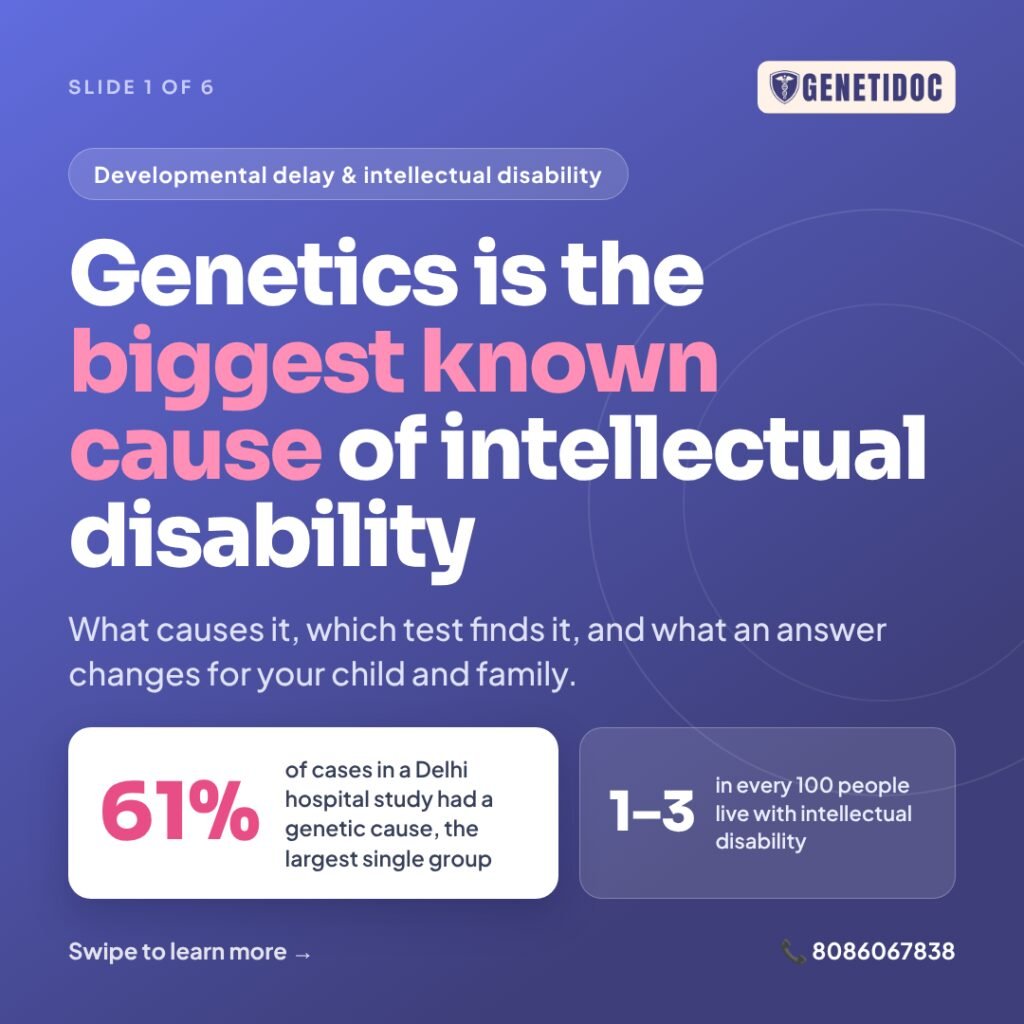
Intellectual disability affects roughly 1 to 3 in every 100 people. In India, it is recognised as a specified disability under the Rights of Persons with Disabilities Act, 2016.
You may still hear the older term “mental retardation” in some reports and certificates. Doctors no longer use it because it is outdated and hurtful.
Is intellectual disability genetic?
Often, yes, but not always. Intellectual disability can be caused by:
- Genetic factors: changes in chromosomes or genes
- Problems before birth: infections in pregnancy, severe iodine deficiency, alcohol exposure
- Problems around birth: extreme prematurity, serious lack of oxygen
- Problems after birth: brain infections such as meningitis, head injury, severe malnutrition, untreated low thyroid hormone
In an Indian study from a tertiary hospital in Delhi, doctors found a cause in more than 8 out of 10 children. Genetic causes were the most common group, explaining about 61% of cases. Problems around the time of birth explained about 20%.
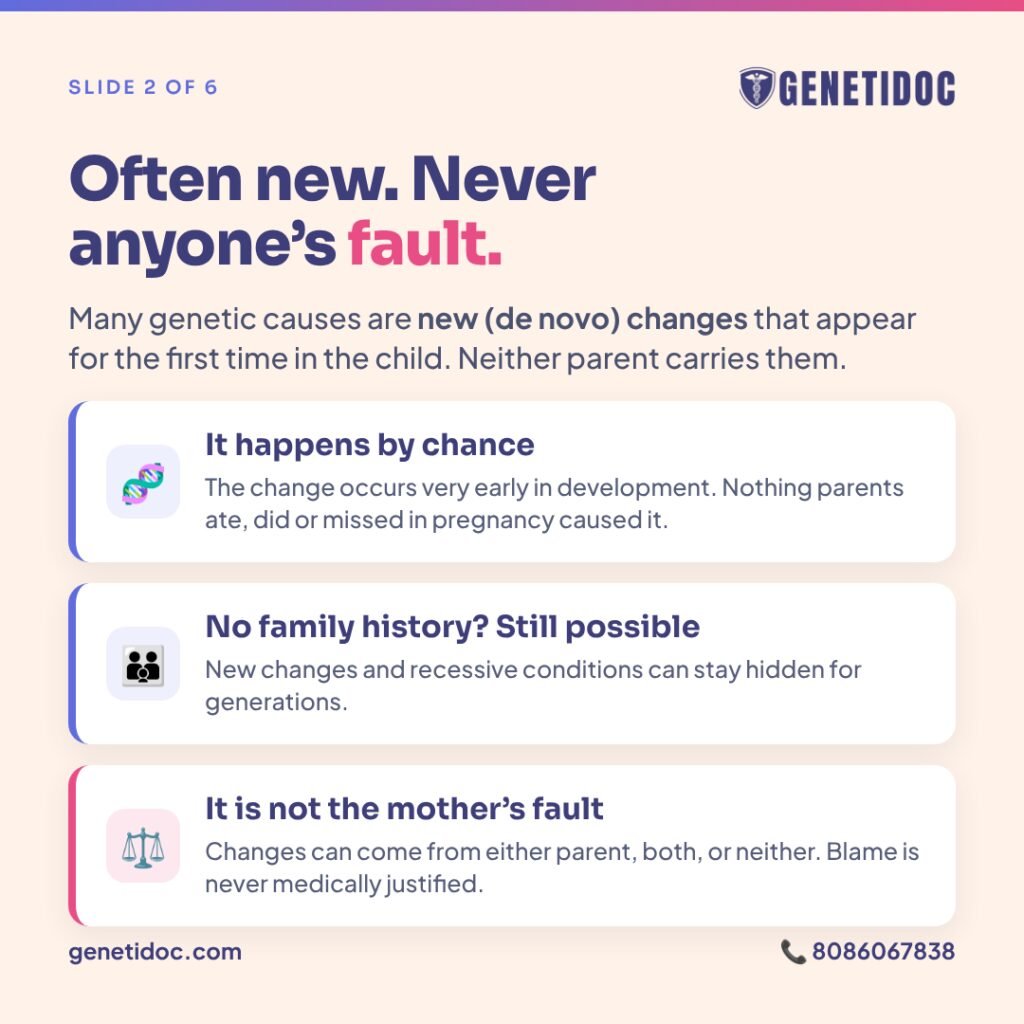
It also helps to know what “genetic” really means. Many families think a genetic condition must run in the family. In fact, many genetic causes of intellectual disability are new changes that happened for the first time in the child. Doctors call these de novo changes. The parents do not carry them.
| “Most parents I meet are carrying guilt they do not deserve. In many children, the genetic change happened by chance, very early in development. Nothing the parents ate, did or failed to do during pregnancy caused it.”
— Dr. Roshan Daniel, Clinical Geneticist, Genetidoc |
The main genetic causes of intellectual disability
Here are the main groups of genetic causes, in simple terms:
- Chromosome conditions, such as Down syndrome
- Small missing or extra pieces of chromosomes (copy number variants)
- Changes in a single gene, which may be new, recessive or X-linked
- Fragile X syndrome, the most common inherited cause
- Inherited metabolic conditions, some of which are treatable
- Imprinting conditions, such as Angelman syndrome and Prader-Willi syndrome
- Mitochondrial conditions, which are rarer
1. Chromosome conditions
Chromosomes are packages that hold our genes. Most people have 46. An extra or missing chromosome can affect how the brain develops.
Down syndrome is the most common genetic cause of intellectual disability. It is caused by an extra copy of chromosome 21. Most cases are not inherited from a parent. Rarely, a parent carries a rearranged chromosome (a balanced translocation). This raises the chance of it happening again in another pregnancy.
2. Small missing or extra pieces of chromosomes
Sometimes a tiny piece of a chromosome is missing (a deletion) or doubled (a duplication). These pieces are too small to see under a standard microscope. Doctors call them copy number variants.
Examples include:
- 2 deletion syndrome: often linked with heart defects, palate problems, low calcium and learning difficulties
- Williams syndrome: often linked with a heart narrowing, high calcium levels in infancy and a very friendly personality
- 1p36 deletion syndrome and many others
3. Changes in a single gene
Scientists have linked well over a thousand genes to intellectual disability. A change in just one of them can be enough to affect brain development. These changes reach a child in three main ways.
New (de novo) changes
The change appears for the first time in the child. Both parents’ DNA is normal for that gene. This is one of the most common causes of moderate to severe intellectual disability. A well-known exome study in the New England Journal of Medicine found that most of its diagnoses came from such new changes.
Recessive changes
Both parents are healthy carriers of a change in the same gene. A child who inherits the change from both parents is affected.
This pattern is much more common when parents are related by blood (consanguineous marriage). Such marriages are common in some communities in South India and other parts of the country. In a study of 152 consanguineous families, exome sequencing found a clear diagnosis in about 37% of families. Most of these were recessive conditions.
X-linked changes
The change is on the X chromosome. Boys have only one X chromosome, so they are usually more severely affected. A mother may carry the change without knowing it. Rett syndrome, caused by changes in the MECP2 gene, mainly affects girls. It is usually a new change rather than an inherited one.
4. Fragile X syndrome
Fragile X syndrome is the most common inherited cause of intellectual disability. It affects about 1 in 4,000 males and a smaller number of females.
It is caused by a short stretch of DNA in the FMR1 gene (the “CGG repeat”) that grows too long and switches the gene off. Boys may have learning difficulty, autism-like behaviour, anxiety, a long face and large ears. Girls are often more mildly affected.
Families should know three important things about fragile X:
- The repeat can grow larger when passed from mother to child. A mother may carry a “premutation” (a medium-sized repeat) and be completely unaware of it.
- Women with a premutation have a higher chance of early menopause. Older men with a premutation can develop tremor and balance problems.
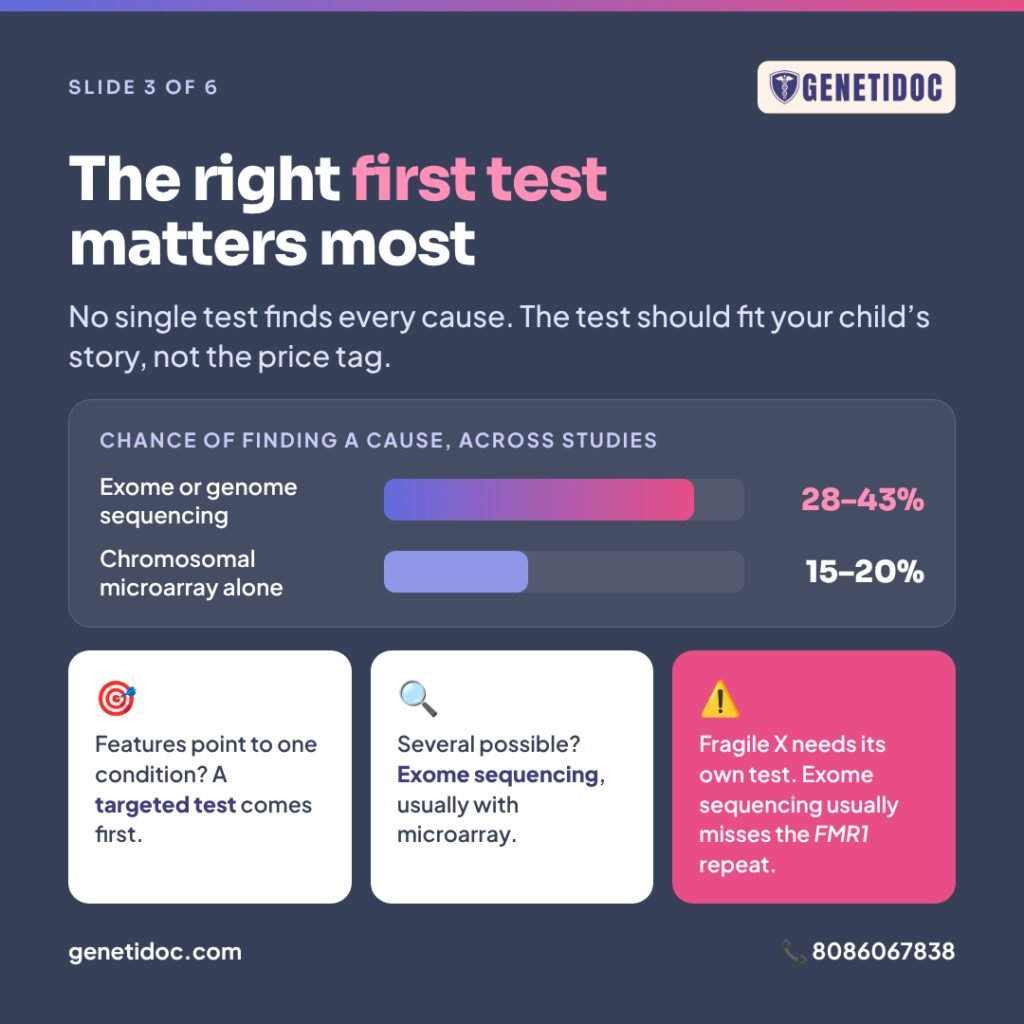
- Standard exome sequencing usually cannot detect fragile X. The repeat is a long, repetitive stretch of DNA, and exome sequencing reads DNA in short pieces. A long repeat cannot be measured accurately that way. Fragile X needs its own dedicated test.
5. Inherited metabolic conditions
Our bodies use thousands of chemical reactions (metabolism) to break down food and produce energy. When a gene for one of these reactions does not work, harmful substances can build up, or the brain may not get what it needs. These conditions are called inborn errors of metabolism.
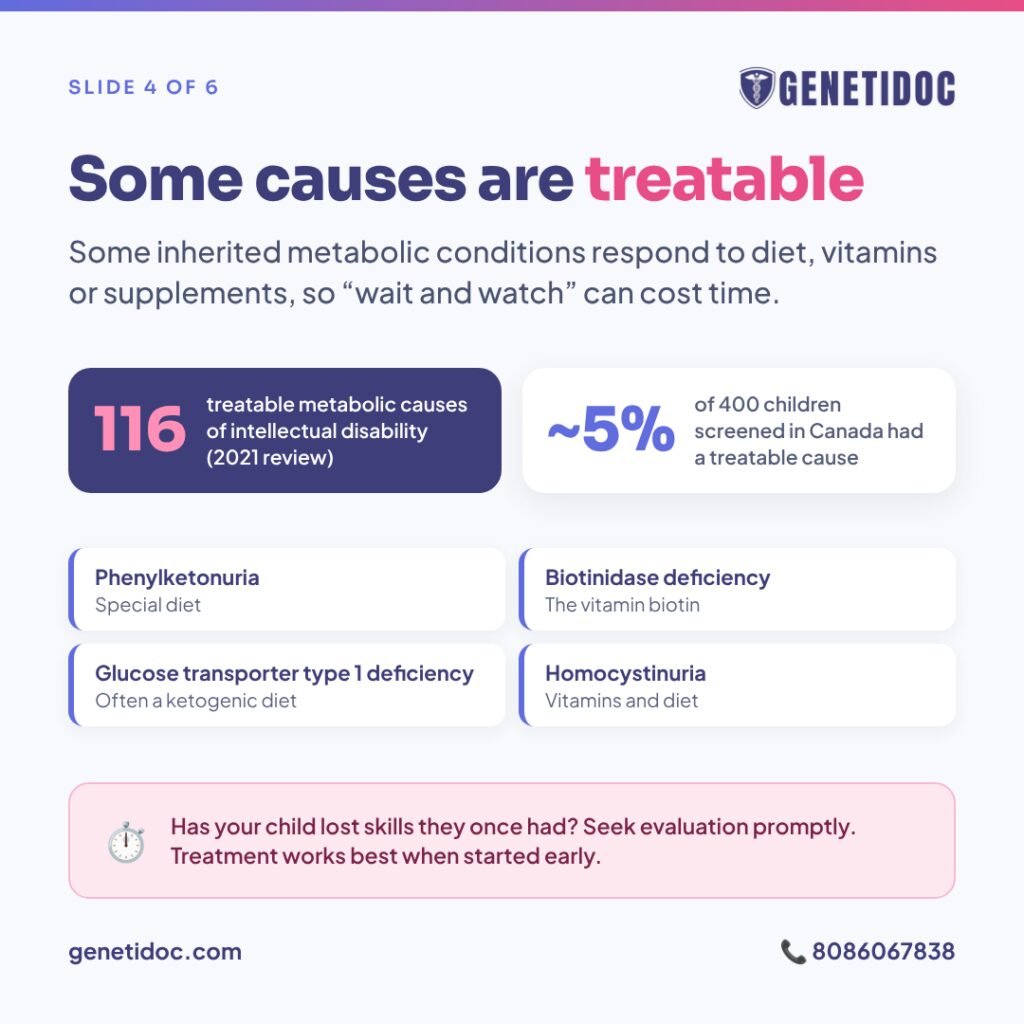
This group matters a great deal because some of these conditions are treatable. A 2021 review identified 116 treatable metabolic conditions that can cause intellectual disability. A Canadian programme that screened 400 children with intellectual disability found a treatable condition in about 5%. Treatment improved behaviour and learning in many of them.
Examples include:
- Phenylketonuria: managed with a special diet
- Biotinidase deficiency: treated with the vitamin biotin
- Glucose transporter type 1 deficiency (SLC2A1 gene): often treated with a ketogenic diet
- Some creatine deficiency syndromes: treated with supplements
- Homocystinuria: treated with vitamins and diet
Treatment works best when started early. It can prevent further brain damage, but it usually cannot undo damage that has already happened. This is one reason we encourage families not to “wait and watch” for years. Our team has a long-standing interest in early detection. Genetidoc doctors have presented research on newborn screening for biotinidase deficiency.
6. Imprinting conditions
For a few genes, it matters whether the copy came from the mother or the father. Angelman syndrome and Prader-Willi syndrome both involve the same region of chromosome 15. Some forms of these conditions are missed by standard sequencing and need a special test called methylation analysis.
7. Mitochondrial conditions
Mitochondria are the “power stations” of our cells. Conditions affecting them can cause developmental problems along with muscle weakness, seizures or problems with several organs. They are less common causes of intellectual disability.
Signs that suggest a genetic cause
Doctors become more likely to suspect a genetic cause when a child has intellectual disability or developmental delay along with any of the following:
- A family history of developmental delay, intellectual disability, autism or epilepsy
- Parents who are related by blood
- Facial features that are different from the rest of the family
- Birth defects, such as heart, kidney or limb differences
- A head that is unusually small (microcephaly) or large (macrocephaly)
- Seizures
- Autism features
- Loss of skills the child once had (regression). This needs urgent evaluation, because some metabolic causes are treatable.
- Unusual growth: very short, very tall, or poor weight gain
- Vision or hearing problems, or unusual movements
- Delay in a child who had an uneventful pregnancy and birth
Research supports this pattern. In a study of 154 children, testing was far more likely to find a cause when a child also had motor delay, facial differences, birth defects or an unusual head size.
A label of “birth asphyxia” does not always rule out a genetic cause. Some babies with an underlying genetic condition have difficulty during birth because of that condition. If the child’s development does not match what the birth history would suggest, a genetic evaluation is worth discussing.
Intellectual disability, autism and epilepsy: why they often go together
Many genes that affect learning also affect social communication and the brain’s electrical activity. That is why intellectual disability, autism and epilepsy often appear together in the same child. The same gene can also cause different features in different family members.
For families, this means one well-chosen genetic test can sometimes explain all three. Studies have also found that children who have both intellectual disability and autism are more likely to receive a genetic diagnosis.
Genetic tests for intellectual disability: which one, and why?
No single test finds every cause. Each test is designed to see certain kinds of genetic changes. The skill lies in choosing the right test for the right child.
| Test | What it finds | What it can miss |
| Karyotype | Extra, missing or rearranged whole chromosomes (for example, Down syndrome) | Small deletions and single-gene changes |
| Chromosomal microarray | Small missing or extra pieces of chromosomes | Single-gene changes, fragile X, balanced rearrangements |
| Exome sequencing | Changes in the protein-coding parts of about 20,000 genes | Fragile X and other repeat conditions, some deletions, imprinting changes |
| Trio exome sequencing | The same as exome, but child and both parents are tested together, which makes new changes easier to identify | The same gaps as exome |
| Genome sequencing | Almost the entire DNA, including many changes outside genes and many deletions | Some repeat and imprinting conditions still need separate tests |
| Fragile X test | The size of the CGG repeat in FMR1 | All other causes |
| Metabolic tests | Chemical signs of metabolic conditions in blood or urine | Non-metabolic causes |
What international guidelines now recommend
Recommendations have changed a lot in recent years:
- In 2021, the American College of Medical Genetics and Genomics (ACMG) recommended exome or genome sequencing as a first- or second-tier test for children with developmental delay or intellectual disability.
- In 2025, the American Academy of Pediatrics recommended exome or genome sequencing as a first-tier test for most children with unexplained global developmental delay or intellectual disability. Chromosomal microarray still has a role alongside exome sequencing.
- Fragile X testing is now usually kept for children with suggestive features or a family history, rather than done for every child.
Across studies, exome or genome sequencing finds a cause in roughly 28% to 43% of children, compared with about 15% to 20% for chromosomal microarray alone.
How Genetidoc chooses a test
At Genetidoc, the test is chosen after a careful history and examination, not before. Our approach follows a simple rule:
- If the features clearly point to one condition, we choose a targeted test for that condition. For example, a fragile X test or methylation testing for Angelman syndrome.
- If several conditions are possible, as is often the case in intellectual disability, we choose a broader test such as exome sequencing, usually together with microarray.
- Genome sequencing is an escalation step when a genetic condition is strongly suspected but earlier testing has not found the answer.
Single-gene tests usually cost the least. Exome sequencing costs more. Genome sequencing and trio exome sequencing sit in a similar, higher price range. Your genetic counselor will discuss the cost of the specific test recommended for your child before anything is ordered.
Typical turnaround times: a fragile X test takes about 21 days. Gene panels take about 3 to 4 weeks. Exome sequencing takes about 1 to 2 months. Genome sequencing, including interpretation, can take 1 to 3 months.
| “The most expensive test is not always the right first test. The right first test is the one that fits your child’s story. That is why we spend time on the history and examination before we order anything.”
— Dr. Roshan Daniel, Clinical Geneticist, Genetidoc |
The testing journey, step by step
- Consultation with a clinical geneticist. We take a detailed history of the pregnancy, the birth, developmental milestones and three generations of family history. Most consultations at Genetidoc happen online, so both parents can join the same session even if they are in different places.
- We look carefully for features that point to specific conditions. An in-person visit is recommended when a detailed physical examination is needed and the family is able to travel.
- Basic checks. Depending on the child, we may recommend hearing and vision tests, thyroid tests, a brain MRI, or metabolic tests.
- Pre-test counseling. We explain what the test can and cannot find, possible results, and whether you want to be told about unrelated but medically important findings (secondary findings).
- Sample collection. A blood sample is usually enough. Home sample pickup is available, so a clinic visit is not needed for the sample.
- Results and post-test counseling. A clinical geneticist explains the report in the context of your child’s features. You receive a written, individualised summary of what was discussed.
- Family testing and planning. If needed, we test parents or relatives and discuss options for future pregnancies.
- Follow-up. We plan reviews and, where appropriate, reanalysis of the data.
When is genetic testing most useful, and when may it not be?
Testing is most likely to help when:
- The intellectual disability is moderate, severe or profound
- There are additional features, such as seizures, birth defects, autism, facial differences or an unusual head size
- Parents are related by blood
- More than one family member is affected
- The child has lost skills (regression)
- The family is planning another pregnancy
Testing may be less likely to find an answer when:
- The child has mild learning difficulty with no other features. In one study, children with intellectual disability and no other features had a diagnosis rate of only about 6% to 11%.
- There is a clear, well-documented acquired cause, such as severe meningitis in a child who was developing normally before.
- The concern is only a slower school performance without true developmental delay.
A lower chance of an answer does not mean testing is wrong. It means the decision should be made together with your genetic counselor, weighing cost, emotional readiness and plans for future children.
Understanding your child’s results
A positive result
The test found a change that explains your child’s condition. This is called a pathogenic or likely pathogenic variant. It opens the door to specific care, family testing and pregnancy planning.
A negative result
A negative result means “no reportable finding in what was tested.” It does not mean the condition is not genetic. The cause may lie in a part of the DNA the test could not see, or in a gene not yet linked to intellectual disability.
A variant of uncertain significance (VUS)
A VUS is a DNA change that science cannot yet classify as harmful or harmless. A VUS is not a diagnosis. We do not use a VUS to test healthy relatives or to make pregnancy decisions. We may test parents or other affected relatives to understand it better.
Reanalysis: your data can answer more questions later
Scientists discover new intellectual disability genes every year. After a negative or uncertain exome result, Team Genetidoc usually advises a review and reanalysis after 6 months to 1 year. We also advise it sooner if new symptoms appear. Reanalysis of existing data takes about 3 to 4 weeks. The whole test usually does not need to be repeated.
If the answer is still unclear and a genetic condition is strongly suspected, trio exome or genome sequencing may be the next step.
| “A normal report is not the end of the search. It tells us where the answer is not. Keep your report, keep your raw data, and come back to us when something changes. Many families get their answer on the second look.”
— Dr. Roshan Daniel, Clinical Geneticist, Genetidoc |
What a genetic diagnosis can change for your child
Families often ask, “If there is no cure, why find the cause?” In practice, a diagnosis changes a lot.
- Treatment, for treatable causes. Metabolic conditions such as biotinidase deficiency or glucose transporter type 1 deficiency have specific treatments.
- Better seizure care. Some genetic epilepsies respond better to certain medicines and worse to others. For example, in Dravet syndrome (SCN1A gene), some common seizure medicines can make seizures worse.
- Screening for hidden health problems. Children with Down syndrome need regular thyroid and heart checks. Children with Williams syndrome need heart and calcium monitoring. Children with 22q11.2 deletion need calcium and immune checks.
- An end to the search. A clear answer can stop years of repeated tests, scans and hospital visits.
- Realistic expectations. Knowing the condition helps doctors explain what the future may look like.
- Focused therapy and school planning. Speech, occupational and behavioural therapy can be tailored to the condition.
- Connection with other families living with the same condition, and access to research or clinical trials where available.
- Clear documentation, which can support applications for disability certification and school support in India.
| “A diagnosis does not change who your child is. It changes how well we can care for them, what we watch for, and what we can tell you about the next pregnancy.”
— Dr. Roshan Daniel, Clinical Geneticist, Genetidoc |
What it means for your family and future pregnancies
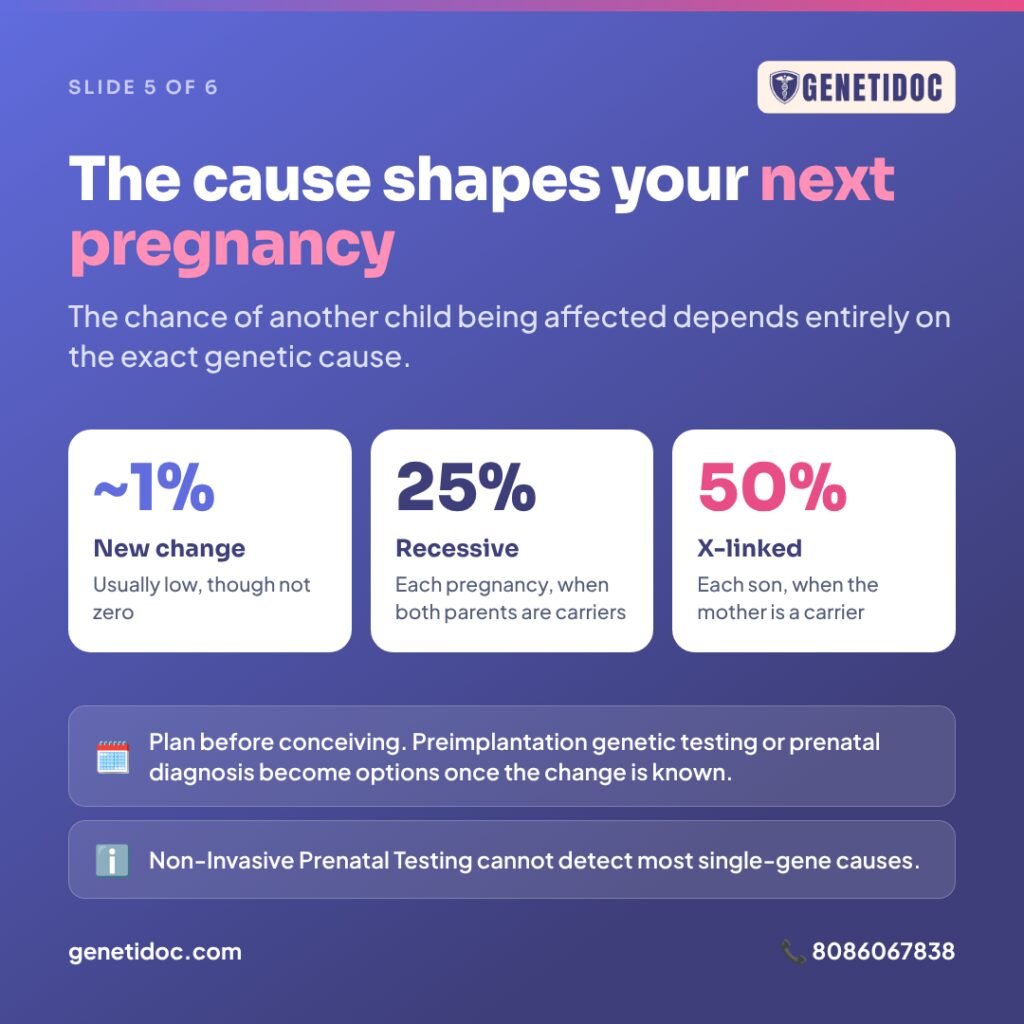
The chance of another child being affected depends entirely on the cause. This is why finding the exact cause matters so much for families planning more children.
- New (de novo) change: The chance of it happening again is usually low, around 1%. It is not zero, because rarely a parent carries the change in some of their egg or sperm cells.
- Recessive condition: When both parents are carriers, each pregnancy has a 1 in 4 (25%) chance of being affected.
- X-linked condition, with the mother as carrier: Each son has a 1 in 2 (50%) chance of being affected. Each daughter has a 1 in 2 chance of being a carrier.
- Fragile X: The risk depends on the size of the mother’s repeat. Female relatives on the mother’s side may also benefit from testing.
- Chromosome condition: This is usually not inherited. If a parent carries a balanced rearrangement, the risk is higher.
- Cause not found: The risk is higher than in the general population but hard to estimate. Your genetic counselor will discuss it based on your family’s history.
Options for the next pregnancy
Once the exact genetic change is known, couples have options:
- Preimplantation genetic testing (PGT) with IVF: Embryos are tested before transfer to the womb.
- Prenatal diagnosis: The baby’s DNA is tested during pregnancy through chorionic villus sampling or amniocentesis. Genetidoc arranges these through partner centres, because we do not currently perform invasive prenatal procedures.
- Natural conception without testing, with full information about the risk.
Non-Invasive Prenatal Testing (NIPT) cannot test for most single-gene causes of intellectual disability. NIPT screens the baby’s chromosomes using a blood sample from the mother. It does not look for the specific gene change found in your family.
Planning works best before the next pregnancy begins. Some tests take weeks, and decisions are easier without time pressure.
What if the affected child has passed away, or no sample is available?
Families sometimes reach us only after losing a child. If a stored sample is available, it may still be tested. If not, the couple can sometimes be tested to look for carrier status, especially when parents are related by blood. A genetic counselor can explain what is and is not possible.
The Indian context: what families here should know
- Consanguineous marriage is common in some communities. It increases the chance of recessive conditions. Couples who are related by blood can consider carrier screening before pregnancy.
- Community-specific genetic changes occur in some Indian populations. Tests and interpretation should take this background into account.
- Late evaluation is common. Many children reach a geneticist only after years of “wait and watch,” which can delay treatment for the few treatable causes.
- Newborn screening is not yet universal across India. Some treatable metabolic conditions may go unnoticed until symptoms appear.
- An older large Indian study by the Indian Council of Medical Research found chromosome conditions in about 24% of children with intellectual disability. Many of the remaining children had features suggesting an undiagnosed genetic cause.
Common myths we hear from families
- “He will grow out of it.” Some children with speech delay catch up. A child with delay in several areas needs proper evaluation rather than waiting.
- “It is the mother’s fault.” Genetic changes can come from either parent, or from neither. Blame is never medically justified.
- “Nobody in our family has it, so it is not genetic.” Many causes are new changes or recessive conditions that hide for generations.
- “The MRI was normal, so it is not genetic.” Many genetic conditions show a normal brain scan.
- “The test was normal, so it is not genetic.” A normal result only covers what the test was able to see.
- “Nothing can be done, so why test?” A diagnosis can guide care, screening, therapy and family planning, and occasionally treatment.
| “‘Wait and watch’ sounds safe, but for a child with a treatable condition, time is the one thing we cannot give back. If your child is behind in more than one area, ask for an evaluation now.”
— Dr. Roshan Daniel, Clinical Geneticist, Genetidoc |
Why the right test, laboratory and interpretation matter
A genetic report is only as useful as the decisions it leads to. Problems we commonly see in families who come to us after testing elsewhere include:
- The wrong first test. For example, an exome ordered for a boy with clear signs of fragile X, which exome sequencing cannot reliably detect.
- A microarray-only “normal” result treated as final, when the child has never had exome sequencing.
- A VUS mistaken for a diagnosis, leading to false reassurance or unnecessary worry for relatives.
- Reports read without examining the child. A variant only makes sense when it matches the child’s features.
- Low-cost tests with no counseling, leaving families with a report but no plan.
Genetidoc works with accredited partner laboratories that confirm reportable findings. Every result is interpreted by a clinical geneticist who has assessed your child, and explained through genetic counseling. The value lies not in the report itself, but in the decisions it helps you make.
The emotional side of the journey
Parents often feel guilt, fear for the future, and pressure from relatives looking for someone to blame. In our counseling sessions, we make space for these feelings.
We explain clearly that genetic changes are nobody’s fault. We help parents decide how to share results with grandparents and other relatives. Many parents find it easier to talk openly from home, and online sessions allow both parents to hear the same information together.
Final decisions about testing and family planning always belong to the family. Our role is to inform, not to direct.
Illustrative scenarios
The following are composite examples created to explain common situations. They are not real patients.
| Scenario 1: A four-year-old with speech delay and parents who are cousins
A boy has not started speaking in sentences and needs help with daily tasks. His parents are first cousins. Exome sequencing finds the same change in both copies of a gene linked with recessive intellectual disability. Both parents are found to be carriers. Each future pregnancy has a 25% chance of being affected. The couple decides to explore preimplantation genetic testing. The boy’s therapy plan is adjusted to the specific condition. |
| Scenario 2: A girl with seizures, developmental delay and a normal MRI
A two-year-old girl has frequent seizures and delayed walking and speech. Her MRI is normal. Trio exome sequencing finds a new (de novo) change in a gene linked to epilepsy and intellectual disability. Neither parent carries it. Her neurologist adjusts her seizure medicine based on the diagnosis. Her parents, who had blamed a fever in pregnancy, learn that the change happened by chance and that the risk for a future child is low. |
| Scenario 3: A boy with learning difficulty and an uncle who was similar
A seven-year-old boy has learning difficulty, anxiety and autism-like behaviour. His mother’s brother had similar difficulties. A fragile X test shows a full mutation. His mother carries a premutation. His mother’s sister chooses testing before planning her own pregnancy. His mother also receives information about her own health, including the higher chance of early menopause. |
Frequently asked questions
1. What is the most common genetic cause of intellectual disability?
Down syndrome is the most common genetic cause. Fragile X syndrome is the most common inherited cause.
2. Is intellectual disability inherited from the mother or the father?
It can come from either parent, from both (in recessive conditions), or from neither (in new changes). X-linked conditions such as fragile X are usually passed on through the mother.
3. Which genetic test is best for intellectual disability?
For most children with unexplained intellectual disability, exome or genome sequencing, often with chromosomal microarray, gives the highest chance of a diagnosis. A targeted test is better when features point to one specific condition.
4. Can intellectual disability be cured?
Most genetic causes cannot be cured. However, some metabolic causes are treatable, and early therapy, education and medical care can greatly improve a child’s abilities and quality of life.
5. If my child’s test is normal, does that mean the cause is not genetic?
No. A normal result means no reportable change was found in what the test could see. Reanalysis or a different test may still find the cause later.
6. What is the chance our next child will have intellectual disability?
It depends on the cause. It is usually around 1% for a new change, 25% for a recessive condition, and up to 50% for sons in X-linked conditions. Genetic counseling gives your family-specific risk.
7. Can intellectual disability be detected during pregnancy?
If the exact genetic cause in your family is known, the baby can be tested through chorionic villus sampling or amniocentesis. Routine scans and NIPT cannot detect most causes of intellectual disability.
8. How long does genetic testing take?
A fragile X test takes about 21 days, and gene panels usually take about 3 to 4 weeks. Exome sequencing takes about 1 to 2 months, and genome sequencing can take 1 to 3 months including interpretation.
9. Is an MRI enough to find the cause?
No. An MRI shows the brain’s structure, but many genetic conditions show a normal MRI. Genetic testing looks at the DNA itself.
10. Should adults with intellectual disability be tested?
Yes, it can still be useful. A diagnosis can guide health screening and help siblings and relatives understand their own risk when planning a family.
11. Does marrying a relative increase the risk of intellectual disability?
Yes. Consanguineous marriage increases the chance that both parents carry the same recessive change. Carrier screening before pregnancy can help such couples understand their risk.
12. Can genetic testing be done without visiting the clinic?
Yes. At Genetidoc, consultations can be done online and samples can be collected from home. An in-person visit is suggested only when a detailed physical examination is needed.
Key takeaways
- Genetic factors are the most common known cause of intellectual disability.
- Many genetic causes are new changes, not inherited, and nobody is to blame.
- Exome or genome sequencing, often with microarray, finds a cause in many children. Some conditions, such as fragile X, need their own test.
- A small number of causes are treatable, so early evaluation matters.
- A negative result does not rule out a genetic cause. Reanalysis can help later.
- Knowing the exact cause tells you the real risk for future pregnancies and the options available.
What to do next
- Write down your child’s milestones, medical history and three generations of family history.
- Gather earlier reports: MRI, EEG, hearing and vision tests, metabolic tests and any genetic reports.
- If your child has lost skills, seek medical evaluation promptly.
- Book a consultation with a clinical geneticist before choosing a test.
- If you are planning another pregnancy, start the conversation before conceiving.
| Looking for the reason behind your child’s developmental delay?
Book a developmental delay and intellectual disability genetic consultation with Genetidoc. Our clinical geneticists will review your child’s history and reports, recommend the right test (not the most expensive one), and explain every result with genetic counseling. This includes what it means for your next pregnancy. Online consultations are available across India in more than 15 languages, with home sample collection.
|
Book your child’s genetic evaluation
Have a question you would like to ask other families or our doctors? Join the discussion on the Genetidoc Rare Disease Forum at genetidoc.com/rarediseaseforum/
Related reading
- Seizures in Infancy: When Genetic Testing Helps
- Twin Pregnancy and Genetic Screening: A Complete Guide for Expecting Parents in India
- Chimerism: When One Person Carries Two Sets of DNA
- Male BRCA Carriers: An Overlooked Risk Group
- Cowden Syndrome and the PTEN Gene: Signs, Cancer Risks, Testing and Screening Explained
- Autism Spectrum Disorder and Genetic Testing: A Guide for Indian Families
References
- Manickam K, McClain MR, Demmer LA, et al. Exome and genome sequencing for pediatric patients with congenital anomalies or intellectual disability: an evidence-based clinical guideline of the American College of Medical Genetics and Genomics (ACMG). Genetics in Medicine. 2021;23(11):2029–2037.
- Rodan LH, Stoler J, Chen E, Geleske T; Council on Genetics. Genetic evaluation of the child with intellectual disability or global developmental delay: clinical report. Pediatrics. 2025.
- Miller DT, Adam MP, Aradhya S, et al. Consensus statement: chromosomal microarray is a first-tier clinical diagnostic test for individuals with developmental disabilities or congenital anomalies. American Journal of Human Genetics. 2010;86(5):749–764.
- Kim J, Lee J, Jang DH. Combining chromosomal microarray and clinical exome sequencing for genetic diagnosis of intellectual disability. Scientific Reports. 2023;13:22807.
- de Ligt J, Willemsen MH, van Bon BW, et al. Diagnostic exome sequencing in persons with severe intellectual disability. New England Journal of Medicine. 2012;367(20):1921–1929.
- Reuter MS, Tawamie H, Buchert R, et al. Diagnostic yield and novel candidate genes by exome sequencing in 152 consanguineous families with neurodevelopmental disorders. JAMA Psychiatry. 2017;74(3):293–299.
- Jain S, Chowdhury V, Juneja M, et al. Intellectual disability in Indian children: experience with a stratified approach for etiological diagnosis. Indian Pediatrics. 2013;50(12):1125–1130.
- Agarwal SS. Multicentric study on genetic causes of mental retardation in India. ICMR Collaborating Centres and Central Co-ordinating Unit. Indian Journal of Medical Research. 1991;94:161–169.
- Indian Academy of Pediatrics. Consensus statement on diagnosis and management of fragile X syndrome in India. Indian Pediatrics. 2019;56(3):221–228.
- Hoytema van Konijnenburg EMM, Wortmann SB, Koelewijn MJ, et al. Treatable inherited metabolic disorders causing intellectual disability: 2021 review and digital app. Orphanet Journal of Rare Diseases. 2021;16:170.
- van Karnebeek CDM, Stockler-Ipsiroglu S. Early identification of treatable inborn errors of metabolism in children with intellectual disability: the Treatable Intellectual Disability Endeavor protocol in British Columbia. Paediatrics & Child Health. 2014;19(9):469–471.
- Hunter JE, Berry-Kravis E, Hipp H, Todd PK. FMR1 disorders. In: GeneReviews. University of Washington, Seattle (updated edition).
- Richards S, Aziz N, Bale S, et al. Standards and guidelines for the interpretation of sequence variants: a joint consensus recommendation of the ACMG and the Association for Molecular Pathology. Genetics in Medicine. 2015;17(5):405–424.
- Government of India. The Rights of Persons with Disabilities Act, 2016.
This article is for educational purposes and does not replace a medical consultation. Every child is different. Please speak with a qualified clinical geneticist about your child’s specific situation.