
Your daughter was smiling, babbling and reaching for her toys. Then, somewhere between her first and second birthday, things began to slip. She stopped using the few words she had. Her hands, once busy with toys, began wringing or tapping at her mouth. Someone mentioned autism. Someone else said, “Wait and watch.”
If this sounds familiar, you may have searched for answers and come across the words Rett syndrome. This guide explains, in plain language, what Rett syndrome is, the gene behind it, how it is confirmed with genetic testing in India, what it means for your family’s future pregnancies, and what care and treatment look like today.
Quick Answer: What Is the Genetic Basis of Rett Syndrome?
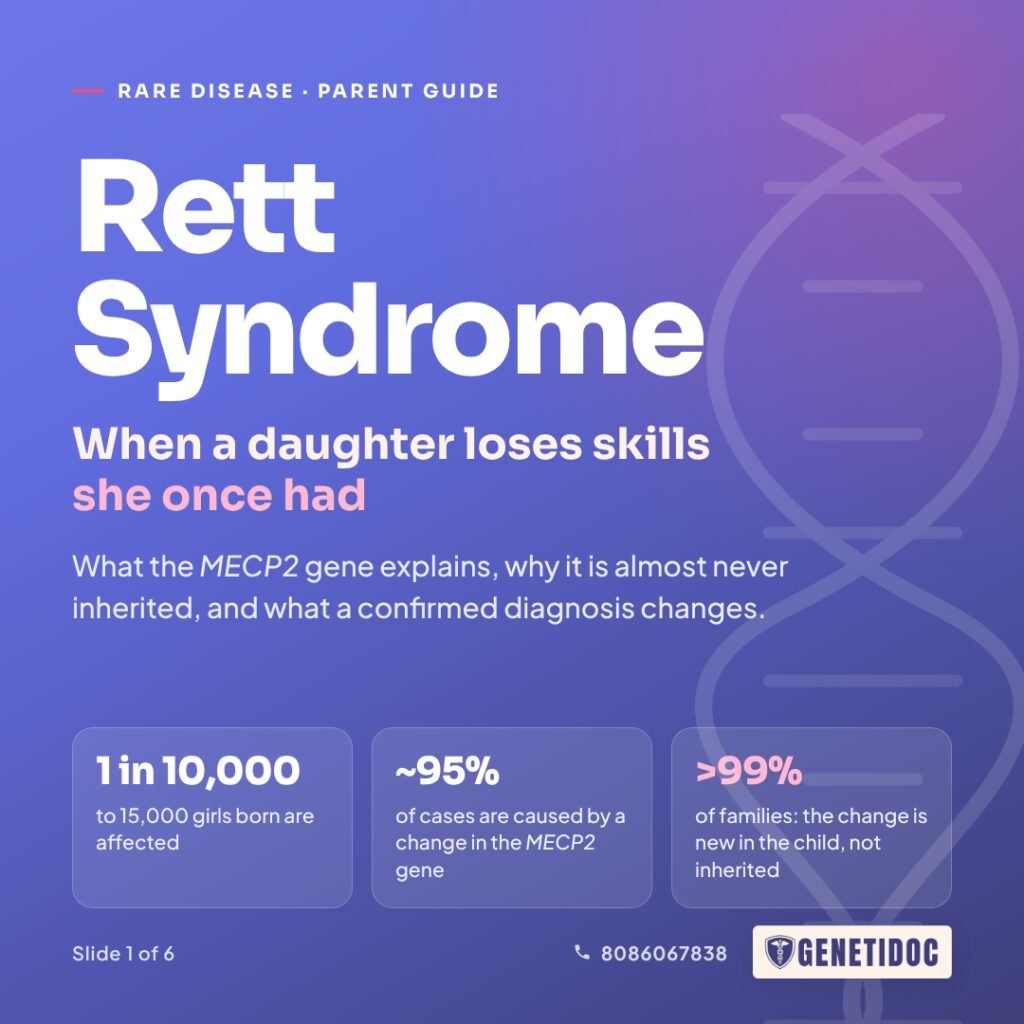
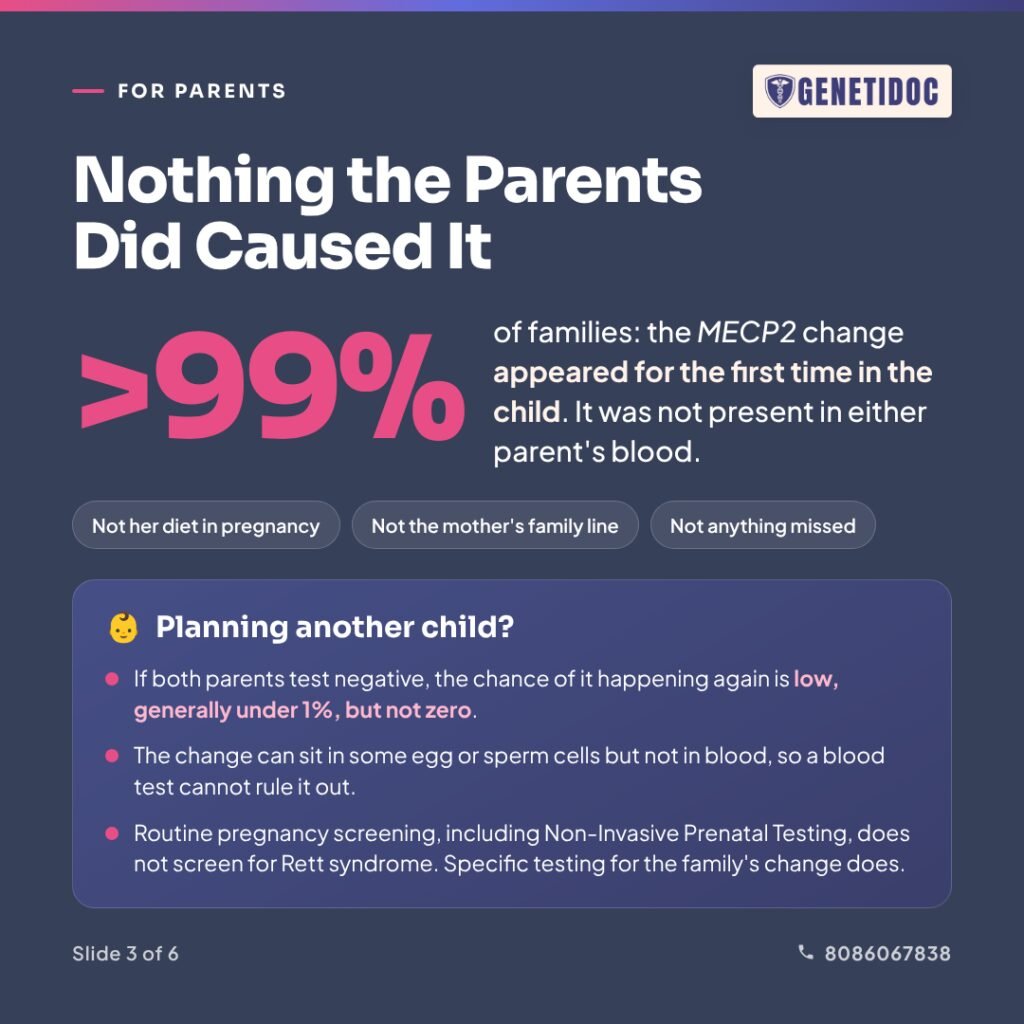
Rett syndrome is a rare neurodevelopmental condition (a condition affecting how the brain develops). It mainly affects girls. In about 95% of cases, it is caused by a change in a gene called MECP2, found on the X chromosome. In more than 99% of families, this change happens for the first time in the child (de novo). It is not inherited from the parents, and nothing the parents did caused it.
What Is Rett Syndrome?
Rett syndrome is a genetic condition that affects brain development, movement, communication and breathing. It was first described by an Austrian doctor, Andreas Rett, in 1966. Its link to the MECP2 gene was discovered in 1999.
It affects roughly 1 in 10,000 to 15,000 girls born. That makes it rare. Even so, it is one of the more common genetic causes of severe developmental disability in girls.
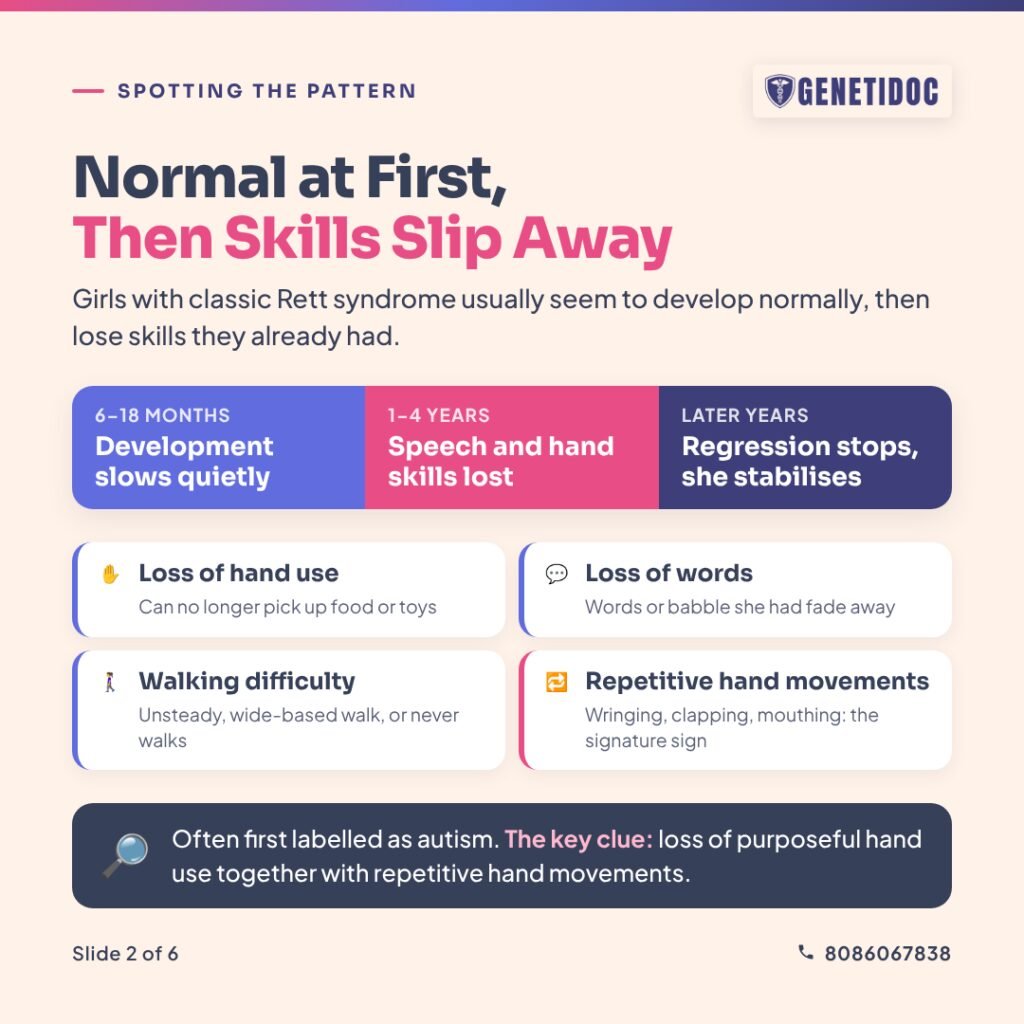
The most striking feature of Rett syndrome is its timing. Unlike many developmental conditions that are visible from birth, girls with classic Rett syndrome usually seem to develop normally for the first 6 to 18 months. Then development pauses, and some skills are lost. This is called regression (losing skills a child already had).
The Main Features Doctors Look For
Doctors diagnose classic Rett syndrome using internationally agreed clinical criteria, revised in 2010. A child must have a period of regression, followed by recovery or stabilisation, plus all four main features:
- Loss of purposeful hand skills: a child who could pick up food or toys loses that ability, partly or fully.
- Loss of spoken language: words or babble that were present fade away.
- Walking difficulties: an unsteady, wide-based walk, or never learning to walk.
- Repetitive hand movements: hand-wringing, clapping, tapping, mouthing or “washing” movements. These are the signature sign of Rett syndrome.
Many girls also have supportive features such as:
- breathing irregularities while awake (breath-holding or over-breathing)
- teeth grinding
- disturbed sleep
- abnormal muscle tone
- cold, small hands and feet
- scoliosis (a curved spine)
- poor growth
- spells of laughing or screaming
- a reduced response to pain
One feature parents often notice is especially moving. Many girls develop intense eye contact and eye communication. They use their eyes to “point” at what they want.
The Four Stages of Rett Syndrome
Doctors often describe classic Rett syndrome in four stages. Not every child follows them exactly, and the ages are approximate.
- Stage 1: Early slowing (about 6–18 months). Development slows quietly. Parents may notice less interest in toys or less eye contact. It is easy to miss.
- Stage 2: Rapid regression (about 1–4 years). Speech and hand skills are lost, sometimes over weeks or months. Hand-wringing, irritability and breathing irregularities often begin. This stage is frightening for families.
- Stage 3: Plateau (preschool to school years, often lasting many years). Regression stops. Many girls become calmer, more alert and more socially connected. Some regain small skills. Seizures may appear during this stage.
- Stage 4: Late motor changes (often after age 10). Mobility may decline, with stiffness and scoliosis. Thinking, communication and eye contact usually stay stable or improve.
“The regression in Rett syndrome is real, but it does not go on forever. That is one of the first things I tell parents. After the difficult early phase, most girls stabilise. Many become more connected, more aware and more expressive with their eyes than families expected.”
Dr. Roshan Daniel, Clinical Geneticist and Founder, Genetidoc
Classic and Atypical Rett Syndrome
Some children have only some of the features, or a different pattern. This is called atypical (or variant) Rett syndrome. Doctors use it when a child has at least two of the four main features and several supportive features. Atypical forms can be milder than classic Rett syndrome (for example, a “preserved speech” form where some words remain) or more severe.
Two other conditions can look very similar but are caused by different genes:
- CDKL5 deficiency disorder usually starts with seizures in the first months of life.
- FOXG1 syndrome usually shows problems from early infancy.
Today, both are recognised as separate conditions in their own right. This is one reason careful genetic testing matters.
The Genetic Basis: How the MECP2 Gene Causes Rett Syndrome
What Does the MECP2 Gene Do?
Think of your DNA as a huge library of instruction manuals. Each gene is one manual.
The MECP2 gene is special. Its instructions make a protein (called MeCP2) that acts like a librarian for the brain. It decides which other manuals nerve cells should read, and when. It helps switch other genes on and off at the right moments.
This control matters most as the brain matures in early childhood. That is when nerve cells are building and fine-tuning their connections. When MeCP2 does not work properly, nerve cells are not destroyed. Instead, they cannot mature and communicate normally. This explains why girls seem to develop normally at first, and why problems appear when the brain’s demands increase.
It also explains one of the most hopeful findings in Rett syndrome research. In laboratory studies, restoring the MeCP2 protein reversed many symptoms. The brain in Rett syndrome is not permanently damaged. It is held back. This is the scientific basis for today’s gene therapy trials.
Why Rett Syndrome Mostly Affects Girls
The MECP2 gene sits on the X chromosome. Girls have two X chromosomes (XX). Boys have one X and one Y (XY).
In girls, a natural process called X-inactivation takes place early in development. In each cell of the body, one of the two X chromosomes is randomly “switched off.” So a girl with Rett syndrome is a mosaic, a mixture of two kinds of cells:
- cells using the X chromosome with the working MECP2 gene
- cells using the X chromosome with the changed MECP2 gene
Having some working cells allows girls to survive and develop, though with significant difficulties.
Boys have no second X chromosome to fall back on. A boy who inherits the same type of MECP2 change usually has a much more severe condition from birth, called severe neonatal encephalopathy (serious brain dysfunction in newborns).
There is another reason boys are rarely affected. Research shows that new MECP2 changes usually arise in the father’s sperm, on his X chromosome. A father passes his X chromosome only to daughters. His sons receive his Y chromosome instead.
Can Boys Have Rett Syndrome?
Yes, but rarely, and usually in special situations. Classic Rett syndrome has been seen in boys who have:
- an extra X chromosome (47,XXY, also called Klinefelter syndrome), or
- mosaicism (the gene change is present in only some of their cells).
Boys with MECP2 changes can also have other conditions, including intellectual disability with movement problems.
There is a separate condition called MECP2 duplication syndrome. Here, a boy has an extra copy of the gene rather than a faulty one. Too much MeCP2 is as harmful as too little. It mainly affects boys and is a different diagnosis with different family implications.
Why Is Severity So Different From One Girl to Another?
Parents who meet other Rett families are often surprised. One girl may walk and say a few words. Another may need a wheelchair and have frequent seizures. Two main factors explain this:
- The type of MECP2 More than 70% of cases are caused by just eight common changes. Some changes tend to cause milder disease, and some cause more severe disease. This is only a tendency, not a fixed prediction.
- The X-inactivation pattern. The switching-off process is random. Some girls happen to have more cells using the working X chromosome, especially in the brain, and they often have milder symptoms. Doctors call this skewed X-inactivation.
Because of these factors, a genetic report alone cannot tell you exactly how your daughter will do. The report is one piece of information. Her own development and care matter just as much.
Is Rett Syndrome Inherited?
Quick answer: Usually not. In about 99.5% of families, the MECP2 change is de novo. It appeared for the first time in the child and was not present in either parent’s blood. Rett syndrome is technically described as X-linked dominant, meaning one changed copy on an X chromosome is enough to cause it. Inherited cases are rare.
This is often the question parents carry most heavily, especially mothers. In many Indian families, a child’s disability is quietly blamed on the mother, her diet during pregnancy, or her family line. The genetics tell a very different story.
“In almost every family we see with Rett syndrome, the change in the MECP2 gene happened for the first time in the child. Nothing the mother ate, did or failed to do during pregnancy caused it. When families hear this clearly, explained with the genetics, a great deal of guilt lifts.”
Dr. Roshan Daniel, Clinical Geneticist and Founder, Genetidoc
When Can Rett Syndrome Run in a Family?
Rarely, more than one child in a family is affected. There are two main explanations:
- Germline mosaicism. A parent carries the MECP2 change in some of their egg or sperm cells, but not in their blood. A blood test on the parent is therefore normal, yet the change can be passed on again.
- A carrier mother with skewed X-inactivation. Very rarely, a mother carries the MECP2 change in her blood but has no or very mild symptoms. This happens because her body mostly switched off the X chromosome carrying the change. She can pass it to her children.
What Is the Chance of It Happening Again?
Once your daughter’s MECP2 change is known, both parents can be tested for that exact change. This is a quick, targeted test.
- If both parents test negative: the chance of another affected child is low, generally less than 1%. But it is not zero, because of germline mosaicism. A blood test cannot rule this out.
- If the mother carries the change: each pregnancy has a 50% chance of inheriting it. How a child is affected then depends on the child’s sex and X-inactivation. This situation needs detailed genetic counseling.
Because of the small mosaicism risk, many genetic centres offer testing in a future pregnancy even when both parents’ blood tests are normal. Published experience supports this. In one European series, a family with apparently de novo Rett syndrome had an affected pregnancy detected this way.
“When both parents test negative, the chance of it happening again is low, but it is not zero. We never let a family leave thinking it is impossible, and we never let them leave thinking it is likely. Both are wrong. They deserve the real picture, and the options that come with it, before the next pregnancy.”
Dr. Roshan Daniel, Clinical Geneticist and Founder, Genetidoc
When Should a Child Be Tested for Rett Syndrome?
Genetic testing for Rett syndrome is worth discussing with a specialist if a child, especially a girl, has:
- loss of words, babble or hand skills she previously had
- repetitive hand movements such as wringing, clapping or mouthing
- slowing of head growth after a normal head size at birth
- a diagnosis of autism together with loss of hand use or walking difficulties
- breath-holding or over-breathing spells while awake
- unexplained developmental delay with seizures
- a sister or close relative with confirmed Rett syndrome or an MECP2 change
Illustrative Scenario: “We Were Told It Was Autism”
This is a composite of a common pattern described in the medical literature, not an individual patient.
A 2-year-old girl in South India was developing well. She waved bye-bye, said “amma” and fed herself biscuits. Around 18 months, she stopped using words and lost interest in toys. A few months later, her parents noticed she kept rubbing her hands together near her mouth.
She was first labelled as having autism and started therapy. When her hand skills kept declining and she began holding her breath, her paediatric neurologist referred her for genetic evaluation. MECP2 testing confirmed Rett syndrome.
The diagnosis changed her care. She began heart rhythm checks, a seizure plan, spine monitoring and an eye-gaze communication approach. Her parents were tested and found negative. They then received counseling about the small risk in a future pregnancy.
Early autism-like features are common in Rett syndrome. The clue that separates the two is loss of purposeful hand use together with repetitive hand movements. If your child’s “autism” includes losing hand skills, ask about Rett syndrome.
When Testing May Not Be Useful
Genetic testing is not the right first step for every child with a delay. For example, a child whose development is slow but steady, without loss of skills and without hand stereotypies, may need a different evaluation. A clinical geneticist decides which test fits the child’s features. Testing “just in case” with the wrong test can produce confusing results.
How Rett Syndrome Is Diagnosed: Genetic Testing Options in India
Rett syndrome is first a clinical diagnosis, based on the child’s history and examination. Genetic testing then confirms the cause. Confirmation matters for family planning, for eligibility for new treatments and trials, and for ending the uncertainty many families live with.
The Step-by-Step Testing Pathway
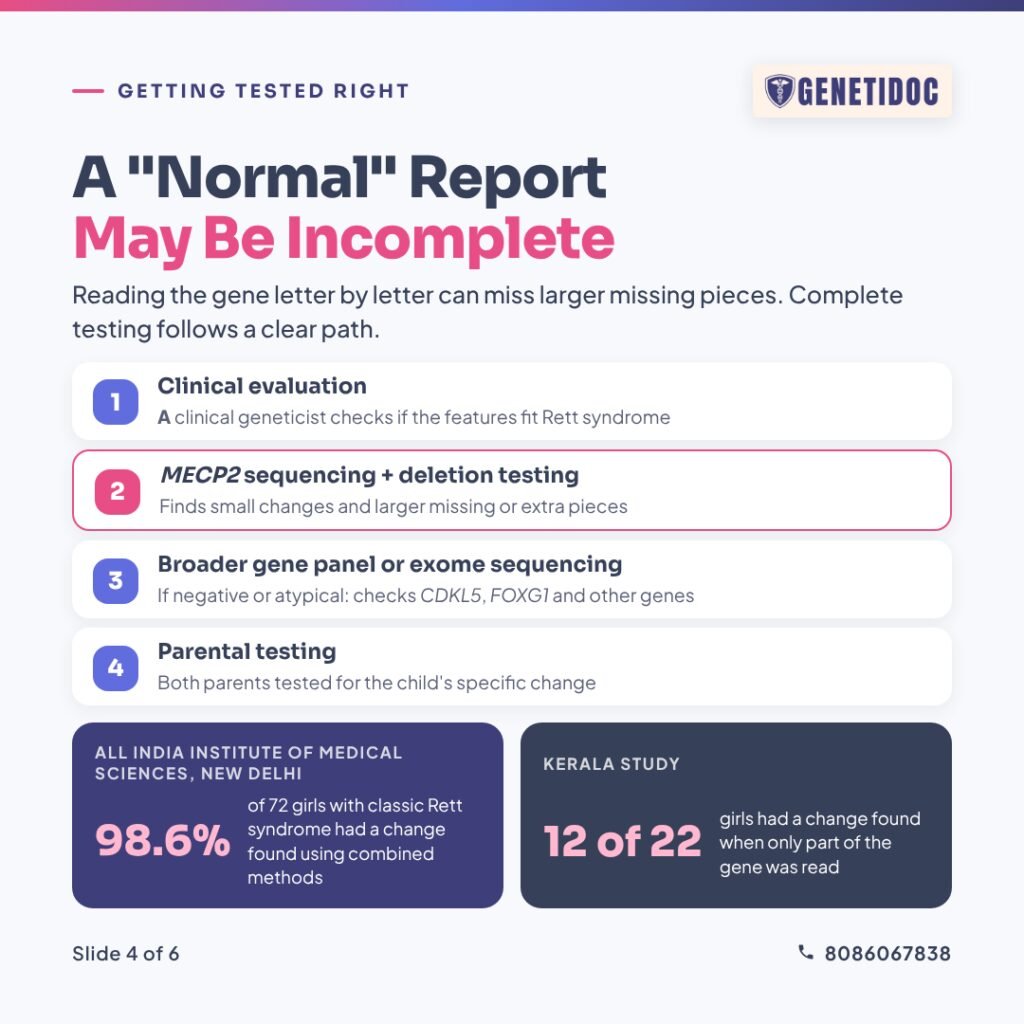
- Clinical evaluation. A clinical geneticist reviews development, examines the child and checks whether the features fit classic Rett syndrome, atypical Rett syndrome or something else.
- MECP2 This reads the gene letter by letter to find small changes. It detects most cases of classic Rett syndrome.
- MECP2 deletion/duplication analysis. Some girls are missing a larger piece of the gene that sequencing can miss. A separate method, such as multiplex ligation-dependent probe amplification (MLPA), looks for these. MLPA is a test that counts gene segments to find missing or extra pieces.
- A broader gene panel or exome sequencing. This is used if MECP2 testing is negative, or if the features are atypical. A multi-gene neurodevelopmental or epilepsy panel, or whole exome sequencing (reading all the protein-coding genes at once), can look for CDKL5, FOXG1 and many other genes that can mimic Rett syndrome.
- Parental testing. Once a change is found, both parents are tested for that specific change. This confirms whether it is de novo and guides recurrence counseling.
In practice, many laboratories now combine steps 2 and 3, or include MECP2 within a broader panel. The right starting point depends on how closely the child fits classic Rett syndrome.
What Indian Studies Tell Us
Indian research shows how much testing quality matters:
- A large study from the All India Institute of Medical Sciences, New Delhi, tested 72 girls with classic Rett syndrome. Using a combination of methods, it found MECP2 changes in 98.6% of them.
- A study from Kerala tested girls with suspected Rett syndrome by sequencing only part of the gene. It found changes in 12 of 22 girls. The authors recommended adding deletion testing and checking genes like CDKL5 and FOXG1 when the first test is negative.
- Another Indian study found that some girls with classic Rett syndrome had large deletions, detected only with MLPA.
The lesson is simple. When the clinical picture is carefully assessed and the testing is complete, the cause is found in almost every girl with classic Rett syndrome. When testing is incomplete, children can be wrongly told their result is “normal.”
“A Rett syndrome test is only as good as the question it was designed to answer. If a laboratory sequences MECP2 but never looks for larger deletions, a ‘normal’ report can send a family back into years of uncertainty. Choosing the right test, and reading the result against the child in front of you, is where the real value lies.”
Dr. Roshan Daniel, Clinical Geneticist and Founder, Genetidoc
Comparing the Main Test Options
| Test | What it looks for | Best used when |
| MECP2 sequencing plus deletion/duplication analysis | Small changes and larger missing or extra pieces of MECP2 | Features strongly fit classic Rett syndrome |
| Neurodevelopmental or epilepsy gene panel | MECP2 plus CDKL5, FOXG1 and other related genes | Atypical features, early seizures, or overlap with other conditions |
| Whole exome sequencing | Nearly all protein-coding genes | Earlier tests are negative but a genetic cause is still strongly suspected |
| Targeted familial variant test | The one specific change already found in the child | Testing parents, sisters or a future pregnancy |
How Long Does Testing Take, and What Does It Cost?
Turnaround times:
- A targeted test for a known family change is usually quickest.
- Gene panels typically take a few weeks.
- Exome sequencing often takes around 1 to 2 months, including expert interpretation.
Cost: In general, a single-gene test costs less than whole exome sequencing. Your genetic counselor can explain the costs of the specific test recommended for your child before anything is ordered.
The cheapest test is not always the most economical one. An incomplete test that misses the diagnosis often leads to repeat testing, more delay and more cost later.
Understanding Your Report
- Pathogenic or likely pathogenic: a change known or very likely to cause Rett syndrome. Together with the clinical features, this confirms the diagnosis.
- Variant of uncertain significance (VUS): a change whose effect is not yet clear. A VUS is not a diagnosis. Testing the parents can help. A new change present only in the child, with a matching clinical picture, may support reclassification. Never make pregnancy decisions on a VUS alone.
- Negative: no reportable change was found in what was tested. It does not mean the condition is not genetic, especially if the test was limited. Ask your geneticist whether further testing or reanalysis is worthwhile.
How a Genetic Diagnosis Changes Care
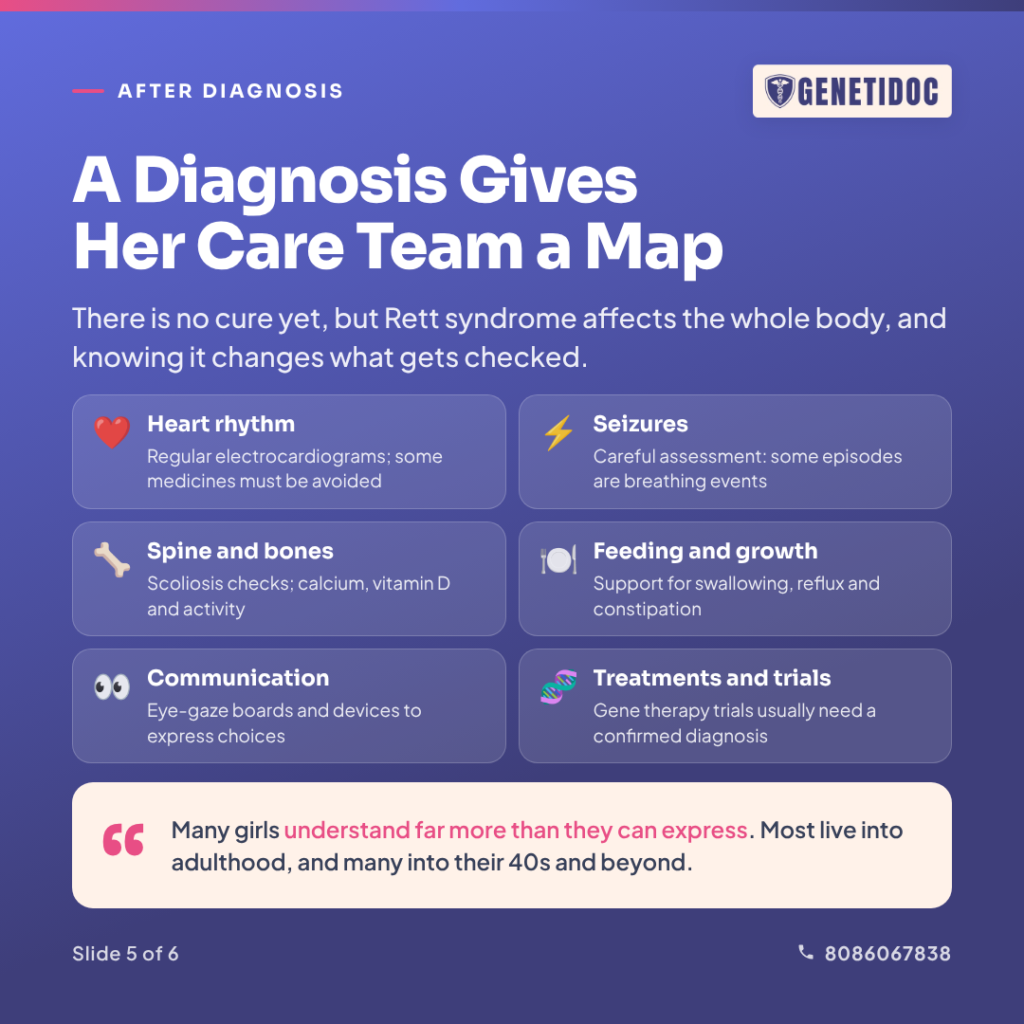
There is no cure for Rett syndrome yet. But a confirmed diagnosis changes what happens next in very practical ways. International consensus guidelines published in 2020 describe Rett syndrome as a condition affecting the whole body. It needs coordinated care across many specialties throughout life.
Health Checks That Matter After Diagnosis
- Heart rhythm: Some people with Rett syndrome have a prolonged QT interval, a heart rhythm finding that can raise the risk of dangerous arrhythmias. Regular electrocardiograms (ECGs) are recommended. Certain medicines that further prolong the QT interval should be avoided. Always tell new doctors about the diagnosis.
- Seizures: These are common, especially in the plateau stage. Some episodes that look like seizures are actually breathing or movement events, so careful assessment matters.
- Breathing: Breath-holding and over-breathing while awake are part of the condition. They are managed with the care team.
- Spine: Scoliosis is frequent. Regular spine checks allow early bracing or surgery when needed.
- Bones: Bones can become thin, raising the risk of fractures. Calcium, vitamin D and activity help.
- Feeding and growth: Chewing and swallowing difficulties, reflux and constipation are common. Some children need nutritional support, including feeding tubes.
- Sleep: Sleep problems are common and treatable.
- Communication: Eye-gaze boards and devices can help girls express choices and feelings. These are known as augmentative and alternative communication (AAC).
- Therapies: Physiotherapy, occupational therapy and speech therapy help maintain movement, hand use and communication.
“Many girls with Rett syndrome understand far more than their bodies allow them to show. A diagnosis gives the care team a map. It tells us to check the heart, watch the spine, protect the bones and, above all, give her a way to communicate. That changes her daily life.”
Dr. Roshan Daniel, Clinical Geneticist and Founder, Genetidoc
What Is the Outlook?
Most girls and women with Rett syndrome live into adulthood. Many live into their 40s and beyond. One analysis found that about 78% were alive at age 25. Chest infections and breathing or heart complications are the main risks, which is why good everyday care makes such a difference.
Treatment Options: Where Things Stand Today
Trofinetide: The First Approved Medicine
In 2023, the United States Food and Drug Administration approved trofinetide (brand name Daybue). It was the first medicine specifically for Rett syndrome, approved for people aged 2 years and older.
In its main 12-week trial of 187 girls and women, trofinetide improved caregiver-rated behaviour scores and doctors’ overall impression compared with placebo. It does not cure the condition. Diarrhoea and vomiting are its most common side effects.
In June 2026, the European Medicines Agency’s committee recommended it for approval in the European Union for children aged 5 and older. It is also approved in Canada.
Availability in India may be limited and can change. If you are interested, discuss current access, import options and suitability with your child’s neurologist and geneticist.
Gene Therapy: Promising but Still Experimental
Because restoring MeCP2 reversed symptoms in laboratory studies, several companies are testing gene therapies. These deliver a working copy of MECP2. The challenge is getting the dose right, because too much MeCP2 is also harmful.
Early results are encouraging. In one company’s early-phase trial, all 10 participants gained new developmental skills, with follow-up of up to 30 months. Larger trials are under way. These treatments remain investigational and are not yet approved anywhere.
A confirmed genetic diagnosis is usually a requirement for joining such trials. This is one more reason to complete testing.
Planning a Future Pregnancy After a Rett Syndrome Diagnosis
Many couples wonder whether they can safely have another child. With the right information, most can plan with confidence. Options to discuss with a genetic counselor include:
- Prenatal diagnosis. In a future pregnancy, a sample from the placenta (chorionic villus sampling, at about 11–14 weeks) or the fluid around the baby (amniocentesis, from about 15–16 weeks) can be tested for the family’s specific MECP2 These procedures are done at specialist fetal medicine centres. Your genetic counselor can guide you.
- Preimplantation genetic testing (PGT). With in vitro fertilisation (IVF), embryos can be tested for the family’s MECP2 change before transfer. This is more involved but avoids decisions during pregnancy.
- Natural conception without testing. Some couples, after understanding the low recurrence risk, choose this. That decision is theirs to make.
Two important points:
- Routine pregnancy screening, including Non-Invasive Prenatal Testing (NIPT), does not screen for Rett syndrome. Only specific testing for the family’s known change can do that.
- Prenatal or embryo testing is reliable only when the child’s change is clearly pathogenic. A VUS is not used for prenatal decisions.
Should Sisters and Other Relatives Be Tested?
If the mother tests negative, extended relatives are generally not at increased risk. If the mother carries the change, her sisters and daughters may wish to have counseling and targeted testing before planning pregnancies. A healthy sibling of a child with de novo Rett syndrome is very unlikely to carry the change, but can discuss testing with a geneticist when older.
Common Myths About Rett Syndrome
- Myth: “It happened because of something during pregnancy.” Fact: It is caused by a gene change, almost always arising by chance.
- Myth: “It’s just a type of autism.” Fact: Rett syndrome is a distinct genetic condition. Autism-like features can appear early, but loss of hand skills and its genetic cause set it apart.
- Myth: “Vaccines triggered the regression.” Fact: The regression comes from the MECP2 change and the brain’s developmental timing, not vaccines.
- Myth: “She will keep losing skills forever.” Fact: Regression usually stops, and many girls become more alert and engaged.
- Myth: “She doesn’t understand anything.” Fact: Many girls understand far more than they can express. Eye-gaze communication can reveal this.
- Myth: “A normal genetic report means it’s not Rett syndrome.” Fact: The test may have been incomplete. Ask what was tested.
Why Expert Interpretation and Genetic Counseling Matter
A genetic report is not the end of the journey. It is the start of a conversation. The value of testing comes from what it changes for your child and family. That depends on several steps:
- Choosing the right test for your child’s features, so the cause is not missed
- Choosing an accredited laboratory that uses complete methods, including deletion testing
- Clinical correlation: matching the report to your child’s actual development and examination
- Genetic counseling: explaining recurrence risk, family testing and pregnancy options clearly and without pressure
At Genetidoc, every result is reviewed by a clinical geneticist and explained in a counseling session. Families also receive a written summary they can share with their child’s other doctors and with relatives.
“Our job is not to tell a family what to do. It is to make sure they truly understand their daughter’s diagnosis and every option ahead of them. The decisions about care and about future pregnancies belong to the family. Our role is to make those decisions informed ones.”
Dr. Roshan Daniel, Clinical Geneticist and Founder, Genetidoc
Families can also connect with others and ask questions on the Genetidoc Rare Disease Forum. For more on the tests mentioned here, see our forum sections on whole exome sequencing, preimplantation genetic testing and amniocentesis.

Frequently Asked Questions About Rett Syndrome
1. What causes Rett syndrome?
About 95% of cases are caused by a change in the MECP2 gene on the X chromosome. This gene helps control how brain cells mature and communicate.
2. Is Rett syndrome inherited from parents?
Usually not. In about 99.5% of families, the change appears for the first time in the child. Rare inherited cases occur through germline mosaicism or a carrier mother.
3. Can boys get Rett syndrome?
Rarely. Boys with MECP2 changes often have a more severe condition from birth. Classic Rett syndrome in boys is seen mainly with an extra X chromosome or mosaicism.
4. At what age is Rett syndrome usually diagnosed?
Signs usually appear between 6 and 18 months, with regression between 1 and 4 years. Diagnosis is often made between 2 and 5 years, though it can be confirmed earlier with genetic testing.
5. What is the difference between Rett syndrome and autism?
Both can involve loss of speech and social withdrawal early on. Rett syndrome also causes loss of purposeful hand use, repetitive hand movements, walking difficulties and breathing irregularities. It has a known genetic cause.
6. Which genetic test confirms Rett syndrome?
MECP2 sequencing combined with deletion/duplication analysis confirms most cases. A broader gene panel or exome sequencing is used when features are atypical or MECP2 testing is negative.
7. What is the chance of having another child with Rett syndrome?
If both parents test negative for the child’s change, the risk is generally less than 1%, but not zero, because of germline mosaicism. If the mother carries the change, the risk is much higher and needs detailed counseling.
8. Can Rett syndrome be detected during pregnancy?
Yes, if the family’s specific MECP2 change is known. Chorionic villus sampling or amniocentesis can test for it. Routine screening, including NIPT, does not detect Rett syndrome.
9. Is there a cure for Rett syndrome?
Not yet. Trofinetide is approved in some countries to help symptoms. Gene therapies are in clinical trials. Coordinated care greatly improves health and quality of life.
10. What is the life expectancy of someone with Rett syndrome?
Most people with Rett syndrome live into adulthood, and many into their 40s or beyond. Good management of breathing, heart, nutrition and infections is key.
11. Why do some girls have milder Rett syndrome than others?
Severity depends on the type of MECP2 change and on X-inactivation, the random switching off of one X chromosome in each cell.
12. My child’s genetic test was normal, but doctors still suspect Rett syndrome. What now?
Check whether the test included deletion analysis and other genes like CDKL5 and FOXG1. A clinical geneticist can advise on further testing or reanalysis.
Key Takeaways
- Rett syndrome is a genetic brain development condition, mainly in girls, usually caused by an MECP2
- In more than 99% of families, the change is new in the child and not caused by anything the parents did.
- Loss of hand skills with repetitive hand movements is the key clue that separates it from autism.
- Complete testing (sequencing plus deletion analysis, then broader testing if needed) finds the cause in almost all girls with classic Rett syndrome.
- A diagnosis guides heart, seizure, spine, bone, feeding and communication care, and opens the door to treatments and trials.
- Recurrence risk is low when parents test negative, but not zero. Options for future pregnancies are available.
What to Do Next
- Write down when your child’s skills changed, and record short videos of her hand movements and breathing patterns.
- Gather any previous reports, including MRI, EEG (electroencephalogram, a brain-wave test) and earlier genetic tests.
- Ask your paediatrician or neurologist for a referral to a clinical geneticist.
- If a test was already done, ask exactly what it covered.
- If you are planning another pregnancy, book genetic counseling before conceiving.
Has Your Daughter Lost Words or Hand Skills She Once Had?
You don’t have to wait and watch. Genetidoc’s clinical geneticists can assess whether Rett syndrome, or a related condition, could explain the changes you are seeing. They will recommend the right test, not just any test, and explain the result in a language you are comfortable with.
Already have an MECP2 report, or planning another pregnancy after a Rett syndrome diagnosis? Our team can review the report, test parents for the family’s specific change and walk you through your options.
Consultations are available online across India and in person in Thiruvananthapuram, with home sample collection.
Book a Rett syndrome genetic consultation
Related Reading From Genetidoc
- Mucopolysaccharidosis: Signs Parents Should Not Ignore
- Genetic Causes of Intellectual Disability: A Complete Guide for Indian Families
- Seizures in Infancy: When Genetic Testing Helps
- Chimerism: When One Person Carries Two Sets of DNA
- Male BRCA Carriers: An Overlooked Risk Group
References
- Kaur S, Christodoulou J. MECP2 In: Adam MP, et al., editors. GeneReviews®. Seattle (WA): University of Washington, Seattle. Available at: https://www.ncbi.nlm.nih.gov/books/NBK1497/
- Neul JL, Kaufmann WE, Glaze DG, et al. Rett syndrome: revised diagnostic criteria and nomenclature. Annals of Neurology. 2010;68(6):944–950.
- Amir RE, Van den Veyver IB, Wan M, et al. Rett syndrome is caused by mutations in X-linked MECP2, encoding methyl-CpG-binding protein 2. Nature Genetics. 1999;23(2):185–188.
- Fu C, Armstrong D, Marsh E, et al. Consensus guidelines on managing Rett syndrome across the lifespan. BMJ Paediatrics Open. 2020;4(1):e000717.
- Khajuria R, Gupta N, Sapra S, et al. Spectrum of MECP2 mutations in Indian females with Rett syndrome: a large cohort study. Journal of Translational Genetics and Genomics. 2020. https://www.oaepublish.com/articles/jtgg.2020.06
- Lallar M, Srivastava P, Gupta N. Molecular testing of MECP2 gene in Rett syndrome phenotypes in Indian girls. Indian Pediatrics. 2018;55:474–477.
- MECP2 mutations in the Rett syndrome patients from South India. Neurology India. 2022;70(1):249–253.
- Trappe R, Laccone F, Cobilanschi J, et al. MECP2 mutations in sporadic cases of Rett syndrome are almost exclusively of paternal origin. American Journal of Human Genetics. 2001;68(5):1093–1101.
- Mari F, Caselli R, Russo S, et al. Germline mosaicism in Rett syndrome identified by prenatal diagnosis. Clinical Genetics. 2005;67(3):258–260.
- Neul JL, Percy AK, Benke TA, et al. Trofinetide for the treatment of Rett syndrome: a randomized phase 3 study. Nature Medicine. 2023;29:1468–1475.
- European Medicines Agency. Daybu (trofinetide): opinion on marketing authorisation, 25 June 2026. https://www.ema.europa.eu/en/medicines/human/EPAR/daybu
- Downs J, Bergman A, Carter P, et al. Guidelines for management of scoliosis in Rett syndrome patients based on expert consensus and clinical evidence. Spine. 2009;34(17):E607–E617.
- Rett Syndrome and the Role of MECP2: Signaling to Clinical Trials. Brain Sciences. 2024;14(2):120. https://www.ncbi.nlm.nih.gov/pmc/articles/PMC10886956/
This article is for educational purposes and does not replace personalised medical advice. Please consult a qualified clinical geneticist for evaluation and testing decisions.