
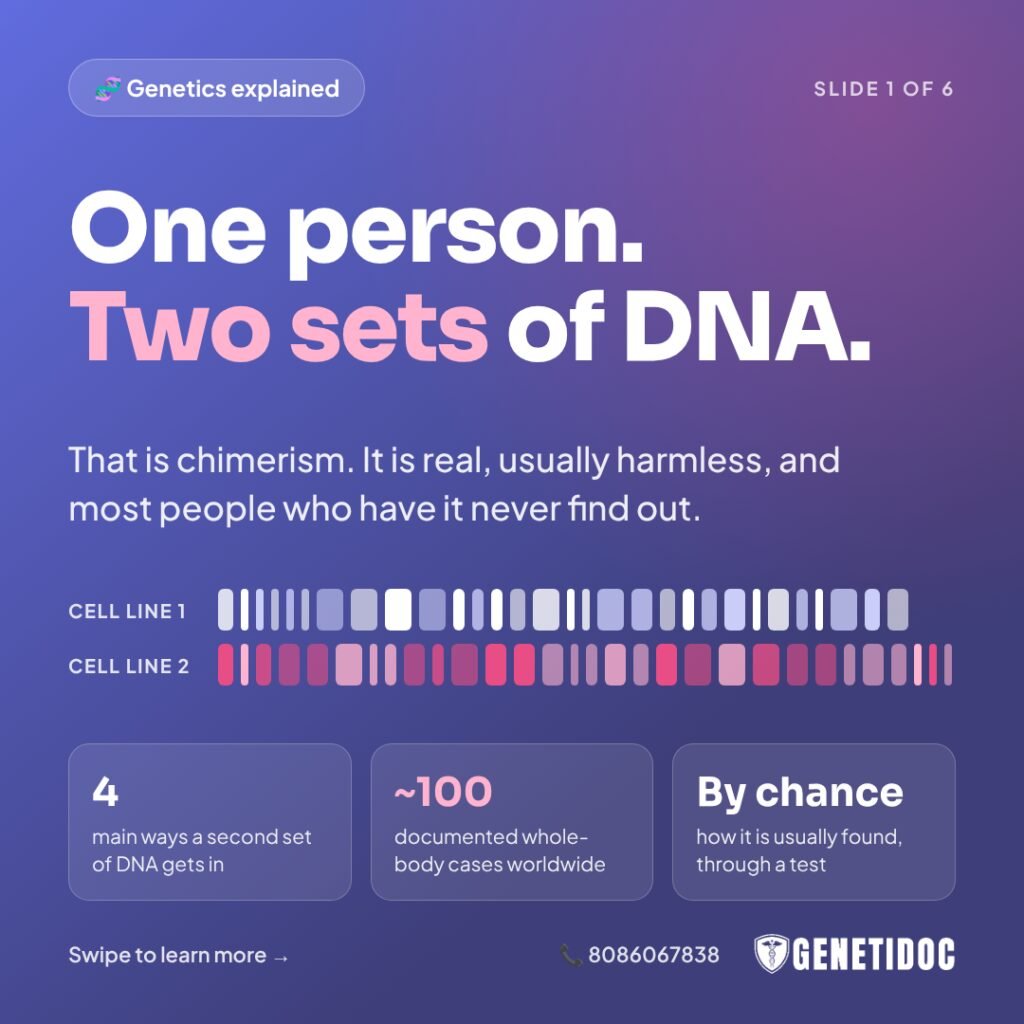
| Quick answer: What is chimerism?
Chimerism is when one person’s body contains cells with two (or more) different sets of DNA. It happens when cells from two different fertilized eggs, a twin, a mother and baby, or a transplant donor live together in one body. Most people with chimerism are healthy and never find out unless a blood or DNA test gives an unexpected result. |
Every person is taught that all the cells in their body carry the same DNA. For almost everyone, that is true. But a small number of people carry two genetically different groups of cells, as if two people’s blueprints were used to build one body.
This is called chimerism. The name comes from the Chimera of Greek mythology, a creature made from parts of different animals.
Chimerism sounds like science fiction. Most of the time it is harmless. But it can confuse blood group tests, DNA identity tests, prenatal screening results and chromosome reports. In some people, it also affects sexual development and fertility.
In this guide, we explain what chimerism is, how it happens, how doctors confirm it, and what it really means for your health, your children and your family. We also explain when testing is useful, and when it is not.
| “Most people with chimerism live their whole lives without knowing it. It usually comes to light by accident, through a blood group that doesn’t add up or a DNA result that seems impossible. Our job is to explain it calmly and work out whether it matters for that person’s health at all.”
— Dr. Roshan Daniel, Clinical Geneticist and Founder, Genetidoc |
What Does “Two Sets of DNA” Actually Mean?
DNA is the instruction manual inside each of your cells. You inherit half of it from your mother’s egg and half from your father’s sperm. Normally, one fertilized egg divides again and again to build your whole body. So every cell carries the same instruction manual.
In a person with chimerism, some cells come from a different source. That source may be:
- A second fertilized egg (a twin that merged early in pregnancy)
- A twin who shared a blood supply in the womb
- A baby’s cells that crossed into the mother during pregnancy, or the mother’s cells that crossed into the baby
- A donor, after a bone marrow, stem cell or organ transplant
The two cell groups live side by side. They do not mix their DNA. Each cell keeps its own original set.
The 4 Main Types of Chimerism in Humans
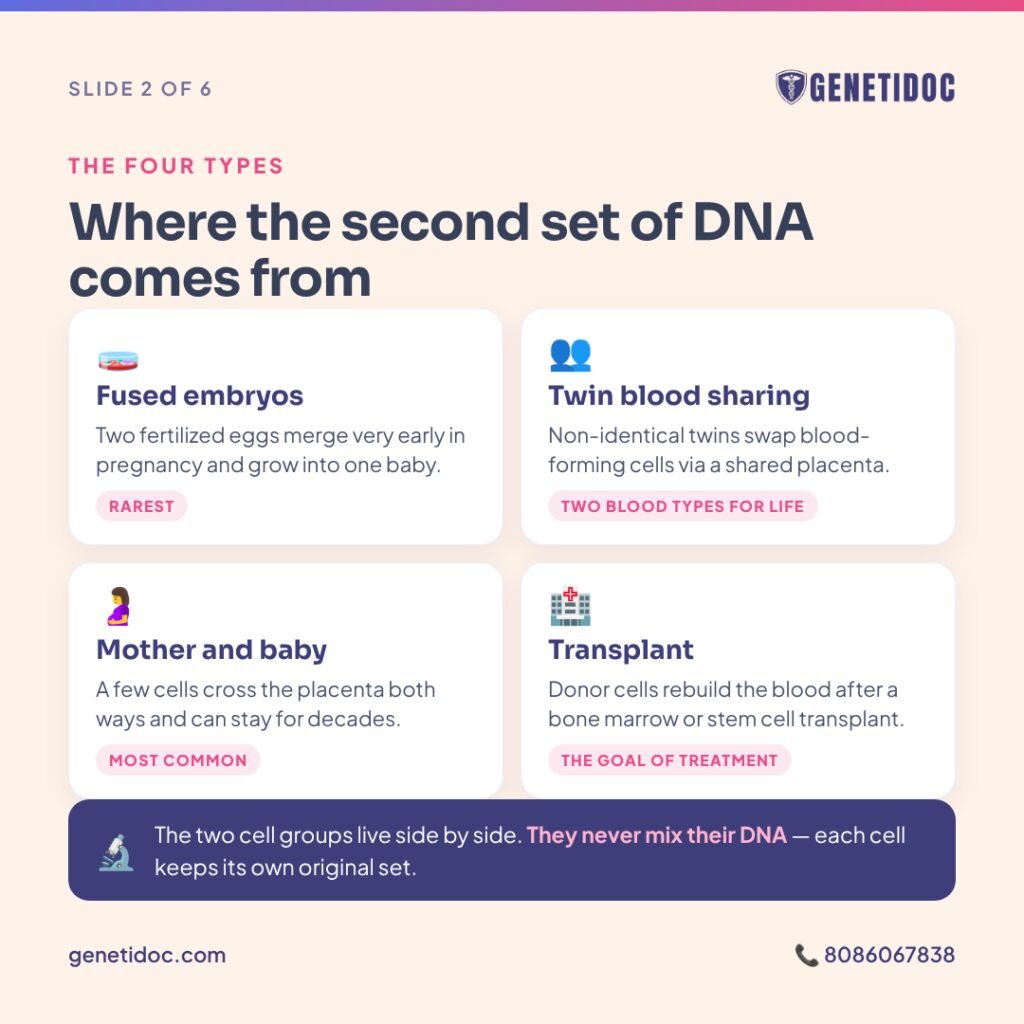
Doctors usually group chimerism into four types:
- Tetragametic (fusion) chimerism: two separately fertilized eggs fuse very early in pregnancy and grow into one baby.
- Twin (blood) chimerism: non-identical twins exchange blood-forming cells through shared placental blood vessels.
- Microchimerism: small numbers of cells pass between mother and baby during pregnancy and can stay for decades.
- Transplant (acquired) chimerism: a person receives donor cells through a bone marrow, stem cell or organ transplant.
1. Tetragametic chimerism: the “absorbed twin”
“Tetragametic” means four gametes. A gamete is an egg or a sperm. Two eggs are fertilized by two sperm, creating two embryos. Very early in pregnancy, before either can grow separately, the two embryos fuse into one.
The baby that results carries two complete sets of DNA, often spread through many organs. One part of the body may carry one set, while another part, such as the ovaries or testes, carries the other.
This is the rarest type. Only around 100 cases of whole-body chimerism have been documented in medical literature, although many more probably go undetected because the person has no symptoms.
If the two embryos were of different sexes, the person may carry both XX (female) and XY (male) cells. A chromosome report may then read 46,XX/46,XY. We explain what this means for health later in this article.
2. Twin chimerism: sharing blood in the womb
Non-identical (fraternal) twins usually have separate placentas. Sometimes their placentas join, or they share one placenta, and small blood vessels connect the two babies. Blood-forming stem cells then cross from one twin to the other and settle in the bone marrow.
After birth, that twin carries two blood types for life. The rest of their body, such as skin, cheek cells and organs, still has only their own DNA.
This is more common than most people think. A classic Dutch study found blood chimerism in about 8% of non-identical twins and about 21% of triplets.
Twin chimerism can also explain a well-known puzzle: the vanishing twin. In some twin pregnancies, one twin stops developing early and is reabsorbed. The surviving baby may carry cells from the lost twin, sometimes without anyone knowing there was a twin.
3. Microchimerism: a lasting link between mother and baby
During every pregnancy, a small number of cells travel across the placenta in both directions. Cells from the baby enter the mother, and cells from the mother enter the baby.
Research shows these cells can stay in the body for decades. A mother may still carry cells from a son many years after his birth. “Micro” means the amounts are very small.
Microchimerism is the most common form of chimerism. It is part of normal pregnancy biology. Scientists are still studying whether these cells help with tissue repair or play a role in some autoimmune conditions. For now, this is a research question, and no testing or treatment is needed.
4. Transplant chimerism: a medical form of chimerism
When someone receives a bone marrow or blood stem cell transplant, the donor’s cells rebuild their blood system. Afterwards, the person’s blood carries the donor’s DNA, while the rest of their body keeps their own.
In this setting, chimerism is not a surprise. It is the goal of the treatment. Organ transplants and blood transfusions can also leave small amounts of donor DNA in the body.
Chimerism vs Mosaicism: What Is the Difference?
These two words are often confused, even on medical websites. Both describe a person with more than one group of cells. The difference lies in where the cells came from.
- Mosaicism starts with one fertilized egg. As it divides, a change happens in some cells but not others. The two cell groups are almost identical, apart from one change.
- Chimerism involves cells from two different sources, such as two fertilized eggs, a twin or a donor. The two cell groups differ across the whole genome, as two siblings would.
| Feature | Mosaicism | Chimerism |
| Starting point | One fertilized egg | Two or more fertilized eggs, or donor cells |
| How different are the cell groups? | Nearly identical, apart from one change | Different across the whole genome, like two siblings |
| How common? | Common; small degrees occur in everyone | Whole-body form is rare; twin blood form and microchimerism are more common |
| How it is confirmed | Chromosome or DNA testing showing one change in some cells | DNA fingerprint testing showing two complete genetic profiles |
This difference matters. A chromosome report that reads “46,XX/46,XY” could reflect either process. The explanation changes how doctors counsel the family about health, fertility and future pregnancies.
| “When a report shows two cell lines, the first question is not ‘what is wrong?’ but ‘where did the second cell line come from?’ Whether it is chimerism or mosaicism changes how we counsel the family about health, fertility and the next pregnancy.”
— Dr. Roshan Daniel |
Is Chimerism Rare? Separating Fact From Viral Myth
Chimerism often goes viral on social media, and many websites repeat claims that are not accurate. Some say chimerism affects “1 in 100 births.” That figure mixes up very different things.
- Microchimerism after pregnancy is very common. Most mothers probably carry some cells from their babies.
- Twin blood chimerism is not rare among non-identical twins, though few people ever have it tested.
- Whole-body (tetragametic) chimerism is genuinely rare, with only around 100 documented cases worldwide.
The true number of people with chimerism is unknown, because most never have symptoms and are never tested.
In India, in vitro fertilization (IVF) and other assisted reproduction treatments are now widely used. Studies suggest that assisted reproduction increases the chance of a rare type of twin pregnancy in which non-identical twins share one placenta. These twins are especially likely to share blood cells. Indian blood bank specialists have also noted that blood group chimerism is being recognised more often, partly because of increasing stem cell transplants.
How Do People Find Out They Have Chimerism?
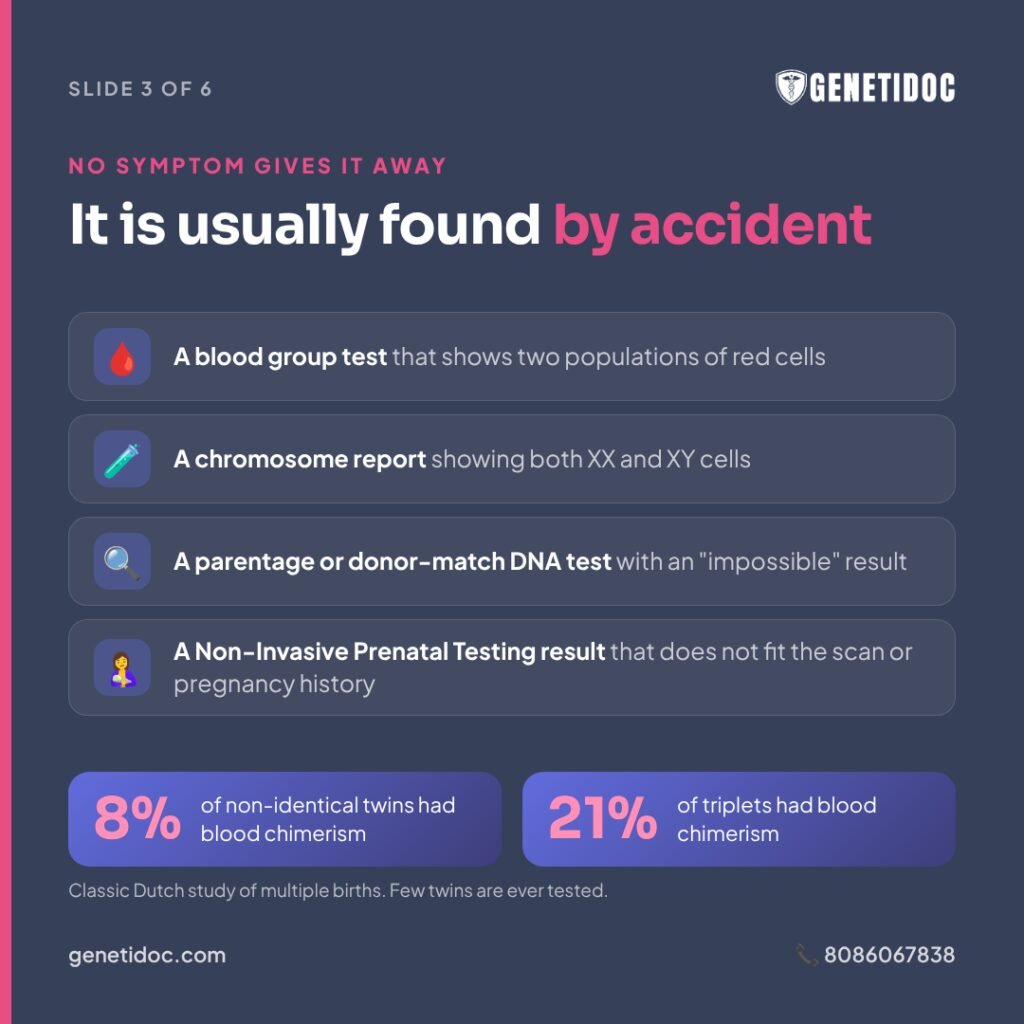
There is no symptom that says “you are a chimera.” Most people discover it by chance in one of these situations.
A blood group test that doesn’t make sense
The blood bank sees two populations of red cells, for example some group A and some group O. Laboratories call this “mixed field.” It has several possible causes, including a recent transfusion, a rare blood subgroup, a past transplant, mosaicism, or twin chimerism. Working out which one needs careful testing.
A chromosome report showing both XX and XY cells
A karyotype is a test in which the laboratory grows cells, usually from blood, and looks at the chromosomes under a microscope. A result showing both XX and XY cells may be ordered because of infertility, atypical genitalia in a newborn, or another concern. Chimerism is one possible explanation.
A DNA identity test with an “impossible” result
The most famous cases involve parentage. In 2002, a woman in the United States named Lydia Fairchild applied for state support. DNA tests suggested she was not the biological mother of her own children, and she was accused of fraud.
Her lawyers found a medical report about another woman, Karen Keegan, published the same year in the New England Journal of Medicine. Keegan had been tested as a possible kidney donor match for her sons, and the tests at first suggested two of them were not hers. She was later shown to be a tetragametic chimera. When Fairchild’s own cervical cells were tested, they revealed her second cell line, which matched her children. She was a chimera too, and the case was dismissed.
A transplant or donor matching test
Tissue typing before an organ or stem cell transplant can show unexpected results when two cell populations are present.
A prenatal test that doesn’t match the scan
Non-Invasive Prenatal Testing (NIPT) studies small pieces of DNA in the mother’s blood. Most of this DNA comes from the mother, and a smaller portion comes from the placenta. If the mother carries cells from someone else, such as a vanishing twin or a past transplant donor, NIPT results can be confusing. We explain this in more detail below.
| Published case: chimerism found during a pregnancy loss workup
A woman in Brazil had genetic tests after a miscarriage. Her blood showed male (XY) cells, while her skin showed female (XX) cells. Doctors learned she had a twin brother, and the DNA in her blood matched his. She had blood chimerism from sharing blood with him in the womb. Her blood carried his DNA, but her own tissues, including her eggs, did not. |
How Is Chimerism Diagnosed?
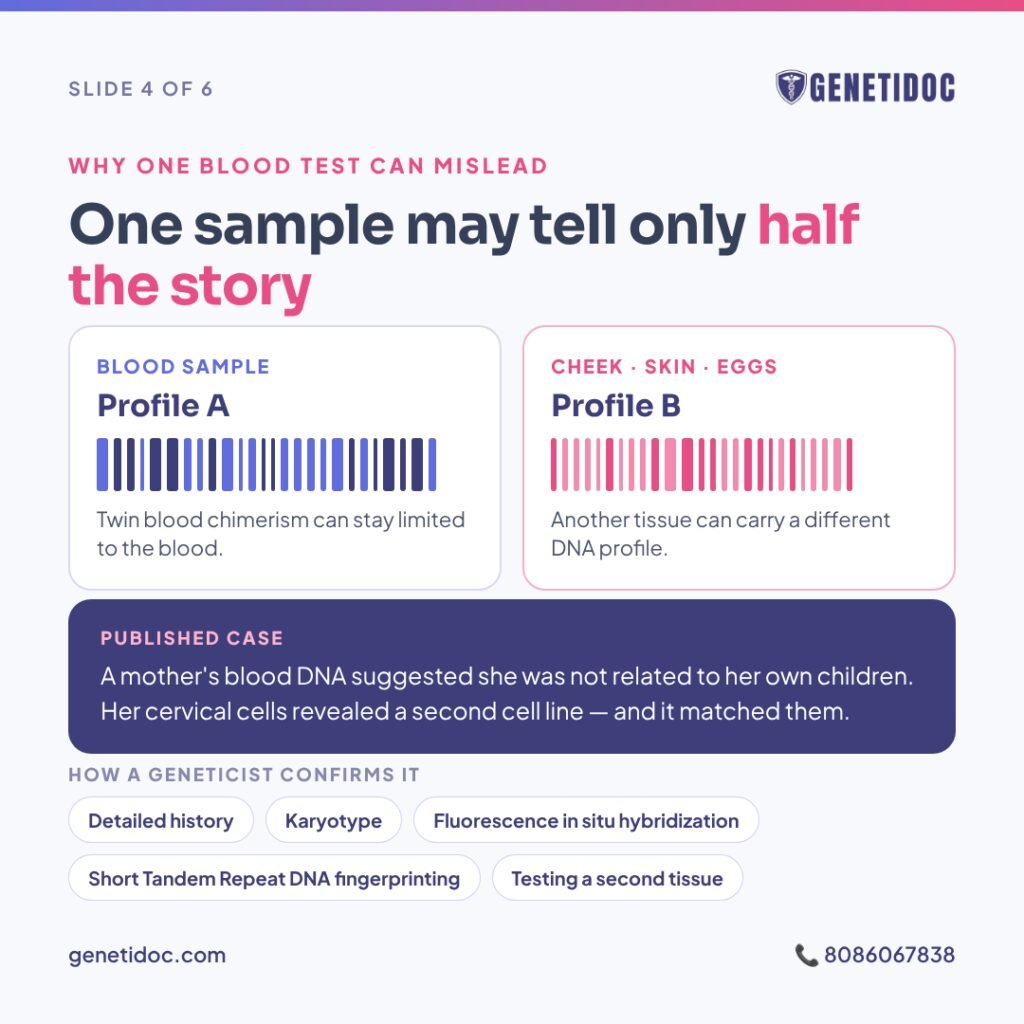
Diagnosing chimerism is detective work. No single test is enough. A clinical geneticist usually combines several steps:
- Detailed history: twin or triplet pregnancy, a vanishing twin, IVF conception, past transfusions or transplants, and family history.
- Karyotype (chromosome analysis): shows whether there are two cell lines, such as XX and XY. In the male infertility setting, a karyotype typically takes about 3 to 4 weeks.
- Fluorescence in situ hybridization (FISH): uses glowing DNA probes to count X and Y chromosomes in many more cells, quickly.
- DNA fingerprinting with Short Tandem Repeat (STR) markers: STRs are short, repeated stretches of DNA that differ between people, a little like a barcode. In chimerism, the laboratory finds two barcodes, sometimes with more than two copies inherited from one parent.
- Single Nucleotide Polymorphism (SNP) microarray: examines hundreds of thousands of points across the genome and can show whether the two cell lines come from two different embryos.
- Testing a second tissue: cheek cells, skin, saliva or, in special cases, gonadal tissue.
Why a blood test alone can mislead
Blood chimerism may be limited to the blood. In a published case from China, a woman whose twin brother shared her placenta had mostly male cells in her blood. Testing of her cheek cells and the lining of her uterus showed only her own female DNA.
The reverse is also true. In Lydia Fairchild’s case, her blood did not reveal the cell line that matched her children. Her cervical cells did. This is why an expert will often ask for more than one type of sample.
When a real finding is mistaken for a lab error
Two DNA profiles in one sample can look like contamination or a sample mix-up. In one published prenatal case, two amniotic fluid samples taken during the same procedure showed different DNA profiles. The team first suspected the samples had been confused, but further testing proved the baby was a tetragametic chimera.
| “A second genome in a sample is easy to dismiss as contamination. An experienced team does not stop there. We ask the next question, test a second tissue, and only then draw a conclusion. A report on its own cannot do that.”
— Dr. Roshan Daniel |
Does Chimerism Affect Health?
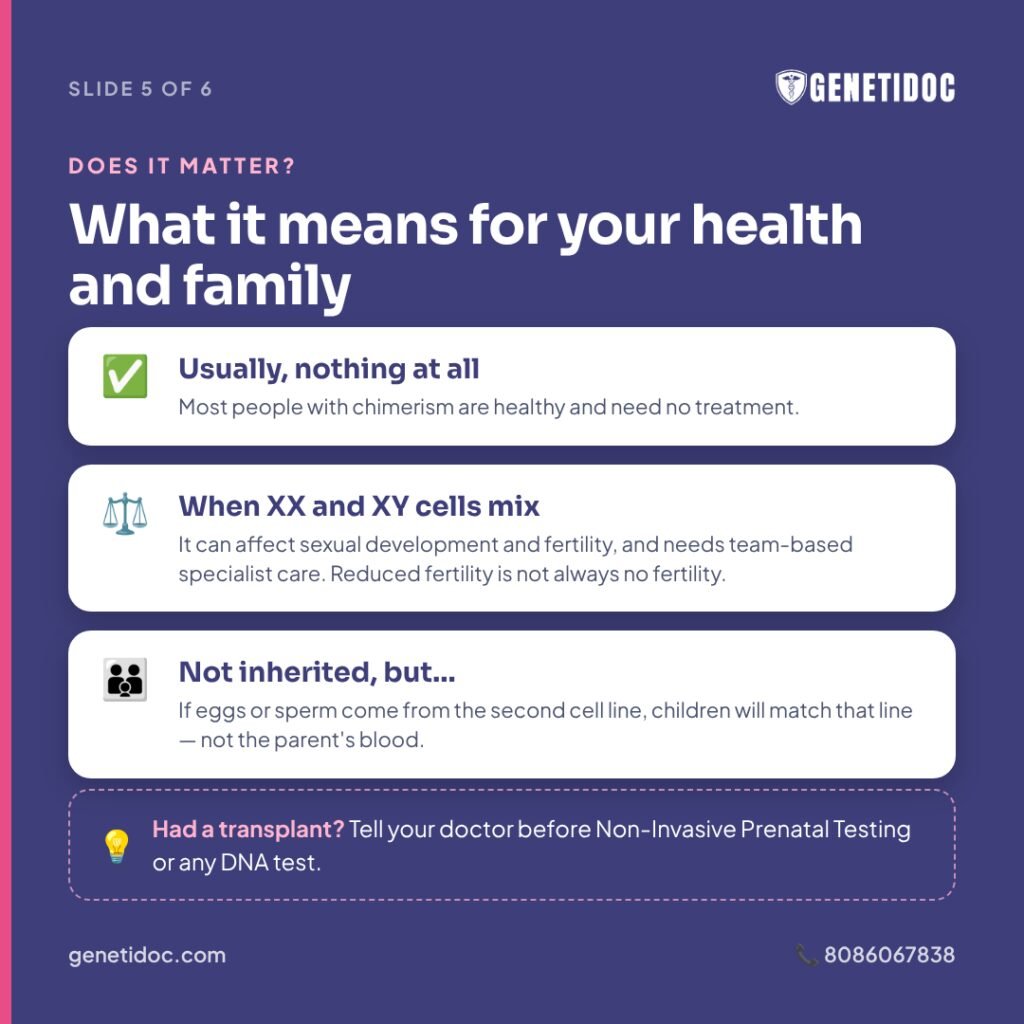
For most people, no. Natural chimerism usually causes no symptoms and needs no treatment. If both cell lines are from the same sex, the person typically looks and develops completely as expected.
Health effects are more likely in a few situations.
When XX and XY cells are both present
If the two cell lines are of different sexes, a baby may be born with genitalia that look different from what is typical, called a difference of sex development. In some people, the sex glands contain both ovarian and testicular tissue, called an ovotestis.
Many people with XX/XY chimerism have a typical male or female appearance and find out only as adults. In one published case, a man came to doctors with breast enlargement and a painless lump in the scrotum. Tests showed tetragametic chimerism with ovotestes.
Fertility
Chimerism involving XX and XY cells can reduce fertility. It is one reason a karyotype is part of a standard infertility workup. Reduced fertility does not always mean no fertility. A published case describes a man with 46,XX/46,XY chimerism and a low sperm count who fathered a healthy child through IVF with intracytoplasmic sperm injection (ICSI), a technique in which a single sperm is injected directly into an egg.
Tumor risk in atypical gonads
When the sex glands have not developed typically, there may be a higher risk of tumors in that tissue. The level of risk depends on the exact situation. A specialist team decides whether monitoring, imaging or surgery is needed. This is a decision for experts, not something to worry about on your own.
Blood donation and transfusion
A person with blood chimerism may have a confusing blood group result. Accurate blood typing protects both blood donors and patients who receive their blood. If you know you have blood chimerism, tell the blood bank.
Newborns With Atypical Genitalia: What Parents Should Know
Hearing that a baby’s genitalia look different, or that a chromosome test shows both XX and XY cells, is overwhelming for any parent. Here is what international expert guidance recommends:
- Do not rush. Irreversible surgery is generally not urgent, and decisions should not be made in panic.
- A full team should be involved: clinical genetics, pediatric endocrinology (hormone specialists), pediatric urology or surgery, and psychology.
- Testing comes before decisions. Chromosome tests, hormone tests and imaging help the team understand the baby’s development.
- Parents are partners in every decision, supported by counseling at every stage.
| “Parents often feel they must decide everything in the first week. They don’t. The right decisions come from a complete evaluation and a full team (genetics, endocrinology, urology and psychology) working alongside the family, not ahead of them.”
— Dr. Roshan Daniel |
Chimerism, Pregnancy and Prenatal Testing
Can chimerism affect NIPT results?
Yes, occasionally. NIPT reads DNA fragments in the mother’s blood. Published research has linked unexpected NIPT results about the sex chromosomes to:
- A vanishing twin, whose DNA may stay in the mother’s blood for weeks. One report found DNA from the lost twin for at least 9 weeks.
- A past transplant from a donor of the opposite sex, such as a bone marrow transplant from a brother
- Chimerism or mosaicism in the mother
- Mosaicism confined to the placenta
In India, fetal sex is not disclosed under the Pre-Conception and Pre-Natal Diagnostic Techniques (PCPNDT) Act, 1994. Genetidoc does not report fetal sex from NIPT results. But these same factors can affect NIPT screening for sex chromosome conditions, such as Turner syndrome or Klinefelter syndrome.
That is why genetic counseling before NIPT always asks about twin pregnancies, early ultrasound findings and any past transplant. If you have had a transplant, tell your doctor before NIPT.
Screening is not diagnosis
NIPT is a screening test. An unusual result needs confirmation through a diagnostic test, such as chorionic villus sampling or amniocentesis, arranged with your obstetric team. Those samples are then analysed with karyotype or chromosomal microarray testing. If chimerism or a vanishing twin is suspected, the counselor and laboratory need to know so the results are read correctly.
Chimerism and IVF
For a person who knows they have chimerism and is planning a family through IVF, preimplantation genetic testing (PGT) of embryos may be discussed. In the case of the woman with blood chimerism from her twin brother described above, she chose testing of her embryos before transfer to be safe. It later became clear that her chimerism was limited to her blood. Whether embryo testing is needed depends entirely on the individual situation.
Is Chimerism Inherited? What It Means for Your Children
Chimerism itself is not inherited. It happens because of an event in early pregnancy or a medical treatment, not because of a gene change in the family. Having chimerism does not mean your children will have it.
But chimerism can affect what your children inherit. If your eggs or sperm come from your “second” cell line, your children will match that line, not the DNA in your blood. This is exactly why Lydia Fairchild’s children did not match her blood test.
Blood chimerism from a twin usually stays in the blood, so it does not change what passes to children. Specialist testing can clarify this if needed.
For siblings and relatives: chimerism is not a family condition, so relatives do not usually need testing. The exception is a twin, who may share the same blood chimerism.
Chimerism After a Bone Marrow or Stem Cell Transplant
If you or a family member has had a bone marrow or blood stem cell transplant, for example for leukaemia or thalassemia, your doctors may order “chimerism testing.” This is a routine check, not a new diagnosis.
The test measures how much of your blood comes from the donor and how much from you:
- Full donor chimerism: nearly all blood cells come from the donor. This usually means the transplant has taken well.
- Mixed chimerism: both donor and your own blood cells are present.
Doctors usually track these numbers over time using Short Tandem Repeat (STR) markers. A rising proportion of your own cells can be an early warning of graft rejection, or of the original disease returning, sometimes before symptoms appear. This gives the transplant team time to act. Your transplant team will explain how often testing is needed and what your results mean for you.
Emotional Concerns: “Did I Absorb My Twin?”
Learning you have chimerism can bring strong feelings. People sometimes feel unsettled about their identity, or sad about a twin they never knew. Some worry about their children, or feel anxious after a confusing DNA result.
It helps to know a few things:
- Chimerism does not change who you are. It is a quiet biological detail that most people with it never discover.
- Nobody did anything wrong. Chimerism is not caused by anything a parent did during pregnancy.
- When a person has a difference of sex development, ongoing psychological support is a standard and valued part of care.
Genetic counseling gives people space to ask these questions, understand their results, and decide what information to share with family.
When Is Testing for Chimerism Useful, and When Is It Not?
Testing is useful when:
- A karyotype shows two cell lines, such as 46,XX/46,XY
- A newborn has atypical genitalia, or an adult has unexplained differences in sexual development
- Infertility evaluation shows mixed chromosome results
- A blood group result shows two populations of cells without another explanation
- A parentage or donor-matching DNA test gives a result that does not fit the known facts
- An NIPT result does not match ultrasound findings or the pregnancy history
- After a bone marrow or stem cell transplant, as advised by the transplant team
Testing is usually not useful when:
- You are healthy and simply curious whether you are a chimera after reading a news story
- You want to “check for” microchimerism after pregnancy. It is normal and has no test-based management.
- You were a twin but have no unusual test results or health concerns
What about cost?
The cost depends on which tests are needed: karyotype, FISH, Short Tandem Repeat analysis, SNP microarray, or testing of more than one tissue. A good first step is a consultation, so that only the tests that answer your specific question are ordered.
Why Interpretation Matters More Than the Report
Chimerism shows why genetic testing is never just about the machine. The same laboratory finding can mean very different things:
- Two DNA profiles could mean contamination, a sample mix-up, a past transplant, a vanishing twin, mosaicism or true chimerism.
- A blood test could show one profile while another tissue holds a second.
- An XX/XY result could be harmless, or could need specialist care.
The value lies in choosing the right test and the right tissue, using an accredited laboratory, and having a clinical geneticist interpret the result alongside your history and examination. Low-cost testing without expert interpretation can lead to wrong conclusions, including false accusations of sample errors, misread blood groups or needless anxiety.
| “A DNA result is only as good as its interpretation. In chimerism, one person’s samples can tell two different stories. Someone has to read both, connect them with the person’s history, and explain what it really means for their health and family.”
— Dr. Roshan Daniel |
Practical Advice If You Suspect Chimerism
- Don’t panic over a single strange result. Most unusual results have an explanation, and most people with chimerism are healthy.
- Collect your history: twin or triplet pregnancies, a known vanishing twin, IVF conception, past transfusions or transplants.
- Keep copies of all reports, including blood group results that changed between tests.
- Ask whether a second tissue should be tested before accepting a surprising DNA result.
- Tell your doctor about any past transplant before NIPT or any DNA test.
- Seek genetic counseling before making decisions about fertility, pregnancy or legal matters based on a DNA result.
How Genetidoc Can Help
Genetidoc is a team of clinical geneticists across India, all super-specialised in Medical Genetics, with counseling available in many Indian languages. Testing is carried out through laboratories accredited by the National Accreditation Board for Testing and Calibration Laboratories (NABL) and the College of American Pathologists (CAP). Genetic counseling is built into every result.
Most consultations happen online, so you can speak with a specialist from anywhere in India. Couples can join the same session from different cities. Samples can be collected through home pickup. An in-person visit is suggested only when a physical examination is needed.
For a chimerism question, we review your reports and history, decide which test and tissue will actually answer your question, and explain what the result means for your health, fertility and family.
You can also read and ask questions in our community forum: Genetidoc Rare Disease Forum. For questions about prenatal screening, visit the NIPT discussion forum.
Key Takeaways
- Chimerism means one person carries cells with two different sets of DNA.
- There are four main types: tetragametic (fused embryos), twin blood chimerism, microchimerism from pregnancy, and transplant chimerism.
- Most people with chimerism are healthy and never find out.
- It is usually discovered by chance, through blood group tests, chromosome reports, DNA identity tests or prenatal screening.
- Chimerism is different from mosaicism, and the difference matters for counseling.
- XX/XY chimerism can affect sexual development and fertility and needs specialist, team-based care.
- Chimerism is not inherited, but children may inherit DNA from the “second” cell line.
- Correct diagnosis needs the right tests, often more than one tissue, and expert interpretation.
| Has a blood group, chromosome or DNA result left you confused?
If a report shows two cell lines, a DNA test doesn’t match what you know, or your NIPT result doesn’t fit your pregnancy history, a clinical geneticist can help you understand what it really means before you make any decision. Share your reports with Team Genetidoc for an expert review and genetic counseling, online or in person.
|
Book a chimerism and unexpected DNA result consultation

Frequently Asked Questions About Chimerism
1. What is a human chimera?
A human chimera is a person whose body contains cells with two different sets of DNA. The second set may come from a twin, a fused embryo, a mother or baby during pregnancy, or a transplant donor.
2. How do I know if I am a chimera?
Most people cannot tell. Chimerism is usually found by chance when a blood group test shows mixed results, a chromosome test shows both XX and XY cells, or a DNA test gives an unexpected result. Confirmation needs specialist testing, often of more than one tissue.
3. Can a person have two blood groups?
Yes. A person with blood chimerism, often from sharing blood with a twin in the womb, can carry two blood groups. People who have had a stem cell transplant from a donor with a different blood group may also show two groups for a time.
4. Is chimerism a disease?
Usually not. Most people with chimerism are healthy and need no treatment. It can matter when XX and XY cells cause differences in sexual development or reduced fertility, or when it confuses medical or DNA tests.
5. Is chimerism inherited?
No. Chimerism is not passed down as a genetic condition. However, if a person’s eggs or sperm come from their second cell line, their children will match that line rather than the DNA in their blood.
6. What is the difference between chimerism and mosaicism?
Mosaicism starts from one fertilized egg, with a change occurring in some cells. Chimerism involves cells from two different sources, such as two fertilized eggs or a donor, so the cell groups differ across the whole genome.
7. Can chimerism cause a paternity or maternity test to fail?
Yes, rarely. If the DNA tested (often blood or a cheek swab) is from a different cell line than the person’s eggs or sperm, a parent may appear unrelated to their own child. Testing another tissue can resolve this.
8. Can a woman have male DNA in her body?
Yes. A mother can carry cells from a son for decades after pregnancy, called microchimerism. A woman may also carry a twin brother’s blood cells, or male cells from a male transplant donor.
9. What is a vanishing twin, and how is it linked to chimerism?
A vanishing twin is a twin that stops developing early in pregnancy and is reabsorbed. The surviving baby may carry some of its cells, and its DNA may also appear in the mother’s blood during that pregnancy, affecting NIPT results.
10. Does chimerism affect fertility?
It can, especially when both XX and XY cells are present. Fertility may be reduced, but some people with chimerism have children naturally or with assisted reproduction such as IVF with ICSI.
11. What is chimerism testing after a bone marrow transplant?
It is a routine test that measures how much of a patient’s blood comes from the donor. A rising share of the patient’s own cells can be an early sign of graft rejection or relapse, helping the transplant team act early.
12. Which test confirms chimerism?
There is no single test. Doctors combine a karyotype, FISH, Short Tandem Repeat DNA fingerprinting and sometimes SNP microarray, ideally on more than one tissue, and interpret the results with the person’s history.
Related Reading
- Male BRCA Carriers: An Overlooked Risk Group
- Cowden Syndrome and the PTEN Gene: Signs, Cancer Risks, Testing and Screening Explained
- Autism Spectrum Disorder and Genetic Testing: A Guide for Indian Families
- Marfan Syndrome: Symptoms, Diagnosis and Genetic Testing Explained
- Li-Fraumeni Syndrome: When Many Different Cancers Run in One Family
- Genetic Data Reanalysis: Why Your Genetic Testing Result Can Change Over Time
References
- Yu N, Kruskall MS, Yunis JJ, et al. Disputed maternity leading to identification of tetragametic chimerism. N Engl J Med. 2002;346(20):1545–1552.
- Embryo Project Encyclopedia. The Case of Lydia Fairchild and Her Chimerism (2002). Arizona State University.
- van Dijk BA, Boomsma DI, de Man AJ. Blood group chimerism in human multiple births is not rare. Am J Med Genet. 1996;61(3):264–268.
- Gammill HS, Nelson JL. Naturally acquired microchimerism. Int J Dev Biol. 2010;54(2-3):531–543.
- Chen J, Xu J, Chen ZH, et al. Case Report: Identification of germline chimerism in monochorionic dizygotic twins. Front Genet. 2021;12:744890.
- Chen K, Chmait RH, Vanderbilt D, Wu S, Randolph L. Chimerism in monochorionic dizygotic twins: case study and review. Am J Med Genet A. 2013;161A(7).
- Biesecker LG, Spinner NB. A genomic view of mosaicism and human disease. Nat Rev Genet. 2013;14(5):307–320.
- Charalsawadi C, Jaruratanasirikul S, Hnoonual A, et al. Case report: Molecular analysis of a 47,XY,+21/46,XX chimera using SNP microarray and review of literature. Front Genet. 2022;13:802362.
- Chen L, Wang L, Zeng Y, et al. A prenatal case misunderstood as specimen confusion: 46,XY/46,XY chimerism. BMC Pregnancy Childbirth. 2024. doi:10.1186/s12884-024-06321-5.
- van Bever Y, Wolffenbuttel KP, Brüggenwirth HT, et al. Multiparameter investigation of a 46,XX/46,XY tetragametic chimeric phenotypical male patient with bilateral scrotal ovotestes and ovulatory activity. Sex Dev. 2018;12:145–154.
- Lee PA, Houk CP, Ahmed SF, Hughes IA. Consensus statement on management of intersex disorders. Pediatrics. 2006;118(2):e488–e500.
- Dhamankar R, DiNonno W, Martin KA, et al. Fetal sex results of noninvasive prenatal testing and differences with ultrasonography. Obstet Gynecol. 2020;135(5):1198–1206.
- Case report: 46,XX/46,XY chimeric infertile male fathering a child after ICSI. J Assist Reprod Genet. 2018. doi:10.1007/s10815-018-1194-5.
- Clark JR, Scott SD, Jack AL, et al. Monitoring of chimerism following allogeneic haematopoietic stem cell transplantation: technical recommendations for the use of short tandem repeat based techniques. Br J Haematol. 2015;168(1):26–37.
- Murugesan M, Rajendran V. Blood group chimerism is not rare anymore. Manipal J Med Sci. 2018;3(1):Article 9.
- Cleveland Clinic. Chimerism: What It Is, Types, Causes and Diagnosis. Accessed October 2026.
This article is for educational purposes and does not replace personal medical advice. Please consult a clinical geneticist for advice about your own reports.