
Many families finish genetic testing expecting a final answer. Instead, the report says “no pathogenic variant identified” or lists a “variant of uncertain significance.” A few months or years later, they may hear that the same test data now points somewhere new.
That can feel confusing, even unsettling. Was the first report wrong? Has something changed in the DNA? Should the whole test be repeated?
The short answer is reassuring. Your DNA has not changed. What changes is the scientific knowledge used to read it. This article explains what genetic data reanalysis is, why genetic testing results can change, who benefits most, and what practical steps families in India can take to make sure an old report keeps working for them.
Quick answer
Genetic data reanalysis means taking the raw data from a previous genetic test, usually exome sequencing, and interpreting it again using the latest scientific knowledge and the patient’s current symptoms. Results can change because new genes are linked to disease, new evidence emerges about specific variants, population databases improve, and the patient’s clinical picture evolves. In most cases, the test itself does not need to be repeated.
What Is Genetic Data Reanalysis?
When a laboratory performs exome sequencing, it reads the DNA code of around 20,000 genes. This produces a very large digital file, often called raw data. The laboratory then filters through this data, looking for changes (variants) that could explain the patient’s symptoms.
That filtering depends on what science knows on the day the report is written. Which genes are linked to which inherited diseases? Which variants are known to be harmful, and which are harmless? How common is a variant in healthy people?
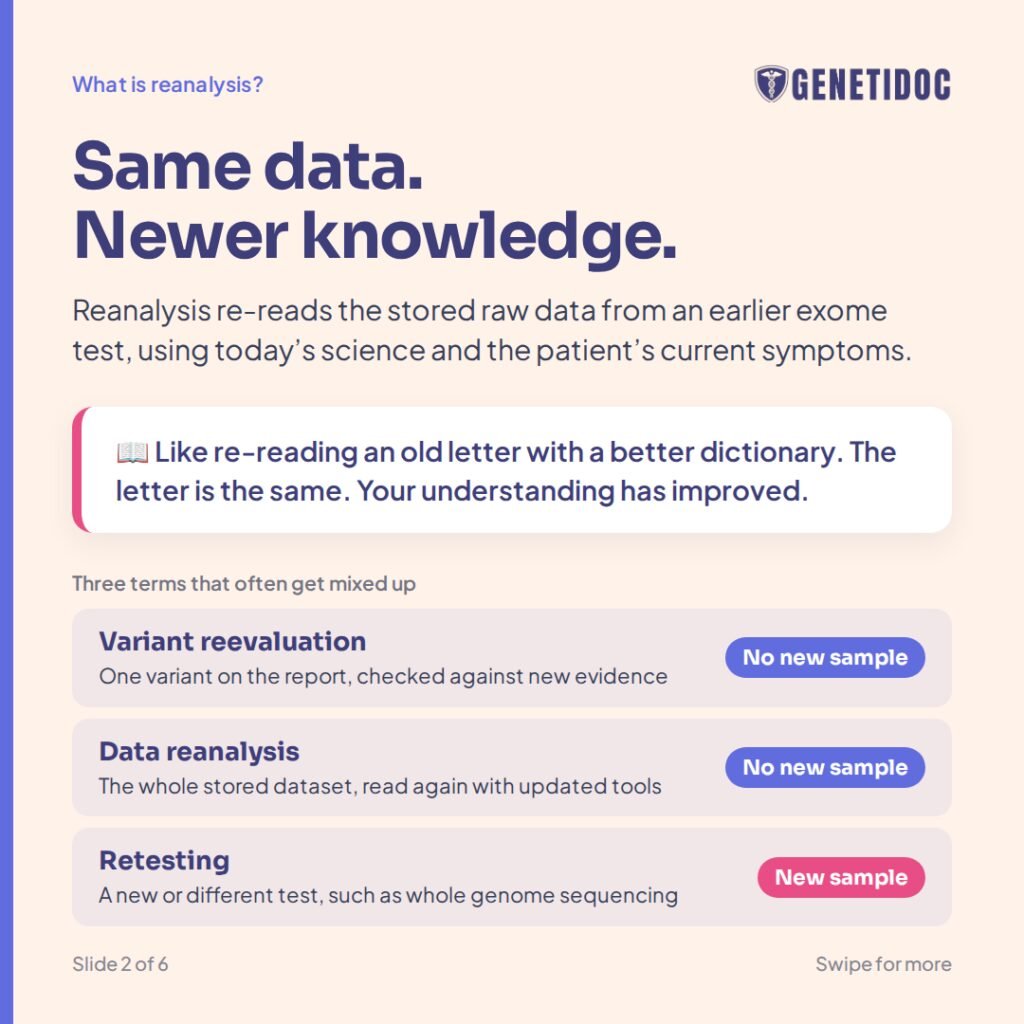
Genetic data reanalysis is the process of going back to that same stored data and reading it again with today’s knowledge. Think of it like re-reading an old letter with a better dictionary. The letter is the same. Your ability to understand it has improved.
Reanalysis, reevaluation and retesting: what is the difference?
These three terms are often mixed up. They mean different things:
| Term | What it means | New sample needed? |
| Variant reevaluation | Reviewing one specific variant already on the report, such as a variant of uncertain significance, against new evidence | No |
| Data reanalysis | Re-examining the entire stored dataset with updated gene lists, databases, software and the patient’s current symptoms | No |
| Retesting | Running a new or different test, such as trio exome sequencing or whole genome sequencing | Yes |
According to the American College of Medical Genetics and Genomics, both variant reevaluation and data reanalysis can be started by the clinical team, by the patient, or by the laboratory itself, for example when a laboratory reviews older unsolved cases after improving its analysis tools.
Your DNA Has Not Changed. The Science Has
One of the most common worries our team hears is that a changed result means the patient’s DNA has changed. It has not. The DNA you inherited is the same today as it was on the day of your first test.
“Some families want to repeat the entire test from the beginning, because they think their DNA must have changed in five years. It hasn’t. What has changed is the evidence we use to interpret it. That is exactly why we reanalyse.”
— Team Genetidoc
Genetics is one of the fastest-moving fields in medicine. Every month, researchers around the world publish new links between genes and inherited diseases, and share new evidence about individual variants. A report that was accurate and complete two years ago can simply be out of date today.
Genetics is also still a developing science. For many of our roughly 20,000 genes, we do not yet fully know what they do or which diseases they cause when they are changed. Even for well-studied genes, the effect of many individual variants is still unknown. Every genetic report is therefore a snapshot of what science understands at that moment, and that understanding keeps growing.
The American College of Medical Genetics and Genomics, one of the leading professional bodies in genetics, describes variant classification as “a dynamic process” and states that changes in the interpretation of genomic test results are expected. It also recommends that laboratory consent forms and reports tell patients, from the start, that clinically significant changes in classification can happen over time.
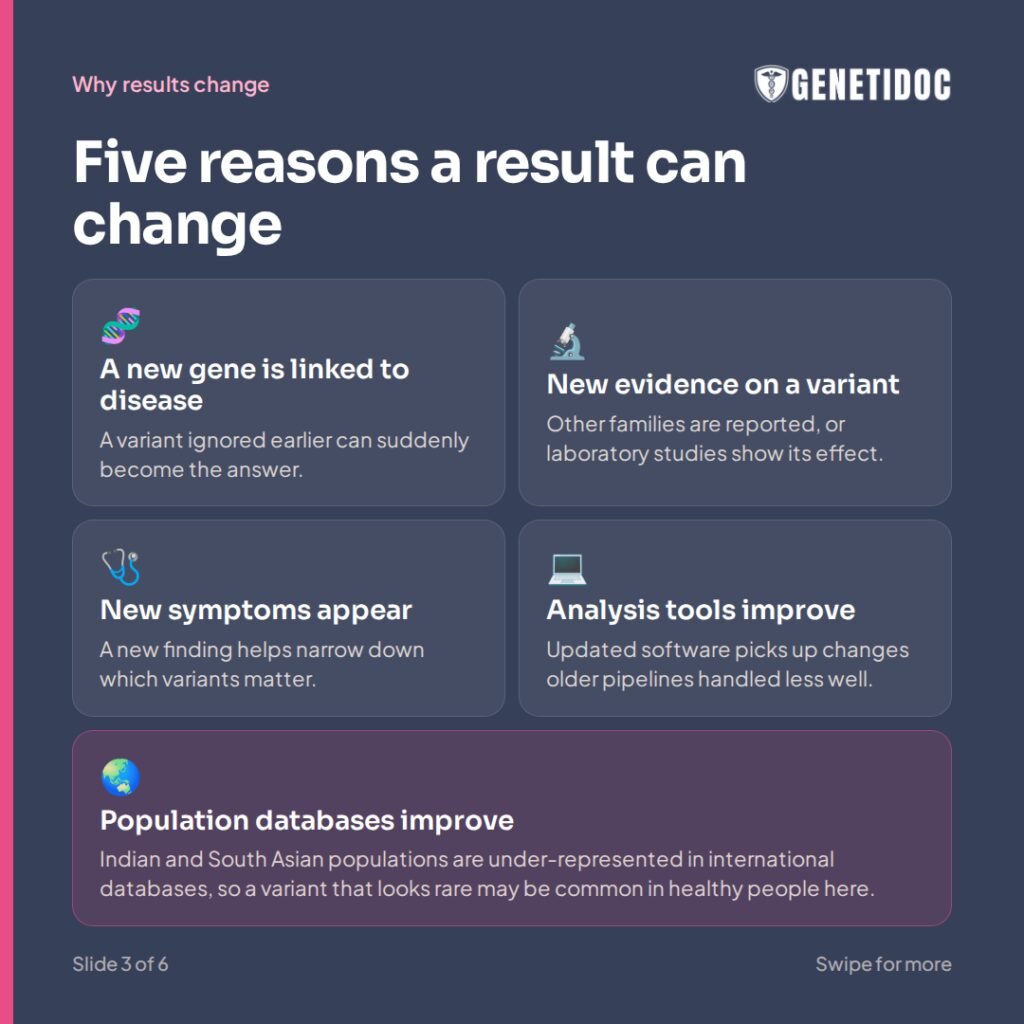
5 Reasons Genetic Testing Results Change Over Time
- A new gene is linked to disease. When your test was first analysed, the gene carrying your variant may not have been known to cause any condition. Once researchers describe a new gene–disease link, a variant that was previously ignored can suddenly become the answer.
- New evidence emerges about a specific variant. Other families with the same variant may be reported. Laboratory studies may show how the variant affects the protein. This can move a variant of uncertain significance towards “likely pathogenic” (probably disease-causing) or towards “benign” (harmless).
- Population databases improve. A variant that looks rare, and therefore suspicious, may turn out to be common in healthy people from a particular community. Indian and South Asian populations are still under-represented in the large international databases laboratories rely on, so this is especially relevant for Indian patients.
- The patient’s clinical picture changes. A child may develop new symptoms. A new scan or blood test may show something unexpected. A sibling may become affected. Each new clinical detail helps the analyst narrow down which variants matter. This matters most in two situations. First, if a new symptom does not fit the condition already diagnosed, it may point to a second genetic cause that reanalysis can look for. Second, if the patient has a variant of uncertain significance, a new symptom can strengthen the case for that variant. International variant classification guidelines from the American College of Medical Genetics and Genomics include a specific piece of evidence (called PP4) for when a patient’s features or family history are highly specific to a disease that has a single genetic cause. When a new symptom makes the clinical picture match such a disease closely, this evidence, together with other findings, may help move an uncertain result towards a definitive answer.
- Analysis tools improve. Software and computer prediction tools used to filter and score variants are updated regularly, and can pick up certain types of changes that older pipelines handled less well.
What the Research Shows
Published studies consistently show that looking at old genetic data again finds new answers for some families.
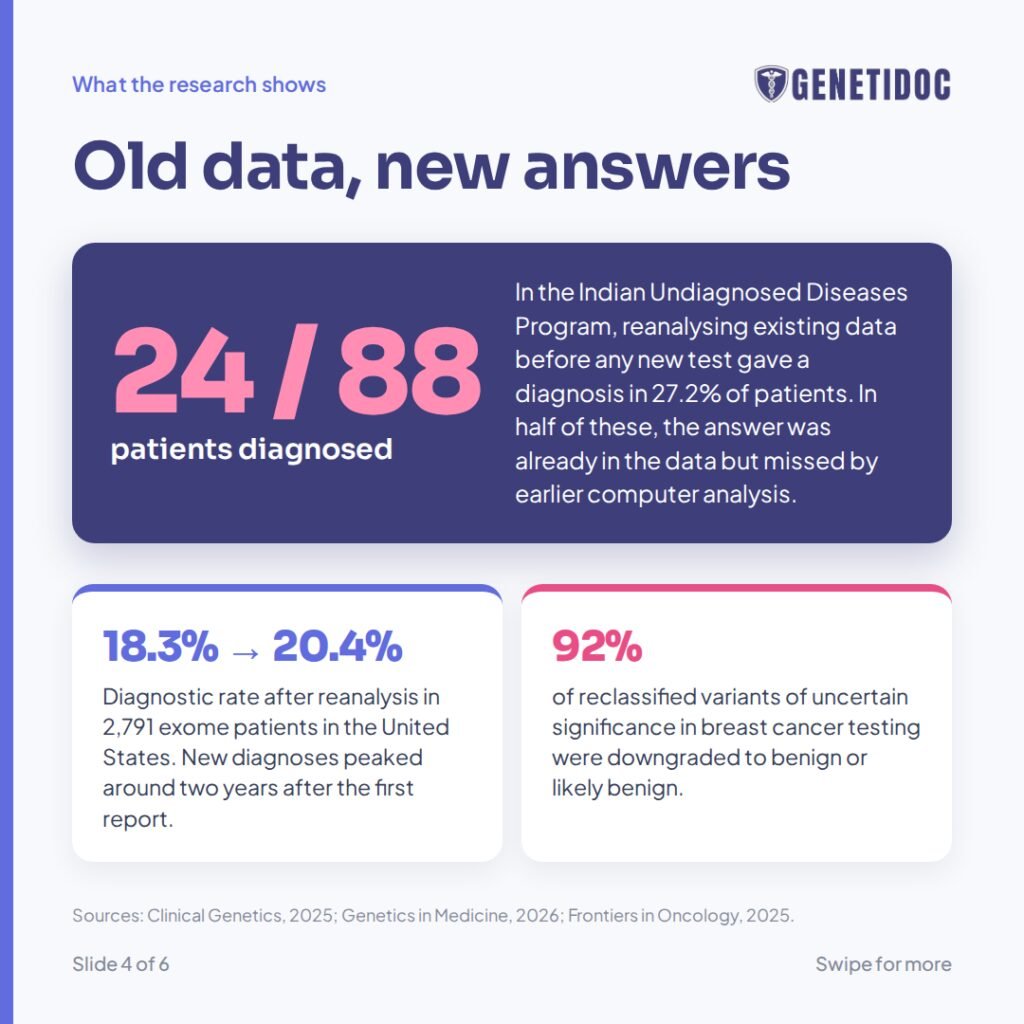
- A large 2026 study published in Genetics in Medicine followed 2,791 patients who had exome sequencing at a single laboratory in the United States. Reanalysis and reevaluation raised the overall diagnostic rate from 18.3% to 20.4%. New diagnoses were most likely to appear around two years after the original report. More than half came from new evidence about specific variants, and much of the rest came from reviewing the whole case again.
- A 2025 study in Frontiers in Oncology tracked more than 1,000 variants of uncertain significance found during breast cancer genetic testing. About one in five had been reclassified, on average about 2.8 years later. Of those reclassified, 92% were downgraded to benign or likely benign, and only 8% were upgraded to pathogenic or likely pathogenic.
- Indian data: The Indian Undiagnosed Diseases Program, a four-centre study published in Clinical Genetics in 2025, recruited 88 patients who still had no diagnosis after extensive evaluation. Reanalysing their existing genetic data, before ordering any new test, was the first step. A genetic diagnosis was reached in 24 of the 88 patients (27.2%). In 12 of these, the answer was a variant already present in the data but missed by the earlier computer analysis, including variants in non-coding (intronic) regions, large deletions and areas the test had read poorly. In 3 cases, more detailed clinical examination of the patient led to the diagnosis. The study also identified a new gene–disease link, in the DAAM2
The lesson is balanced. Reanalysis does not produce a diagnosis for everyone. But for families with an unexplained condition, it is an evidence-based step that can make a real difference. The Indian study specifically recommends reanalysing existing data before moving to more advanced tests. This matters in India, where most families pay for genetic testing themselves.
Who Should Consider Reanalysis?
In our practice, reanalysis is useful for almost anyone who has had exome sequencing without a clear, complete answer. Families usually come back to us in one of these situations:
- The report showed a variant of uncertain significance
- The exome result was negative, but a genetic cause is still strongly suspected
- The report was inconclusive, for example only one variant found in a condition that usually needs two
- A positive result does not fully fit the patient’s features, suggesting something else may also be involved
- The patient has developed new symptoms or has new scan or laboratory findings
- A family is planning another pregnancy and needs a definite answer to understand their options
“It is not just the patient who benefits. When we reach a definitive diagnosis, the whole family gets a definite answer, and they can finally move forward.”
— Team Genetidoc
When Is the Right Time for Reanalysis?
There is no single international rule on how often reanalysis should be done. The American College of Medical Genetics and Genomics guidance does not set a fixed schedule. Instead, it suggests prioritising results where a change is most likely to affect care, such as variants of uncertain significance and likely pathogenic variants. At Genetidoc, our general approach is:
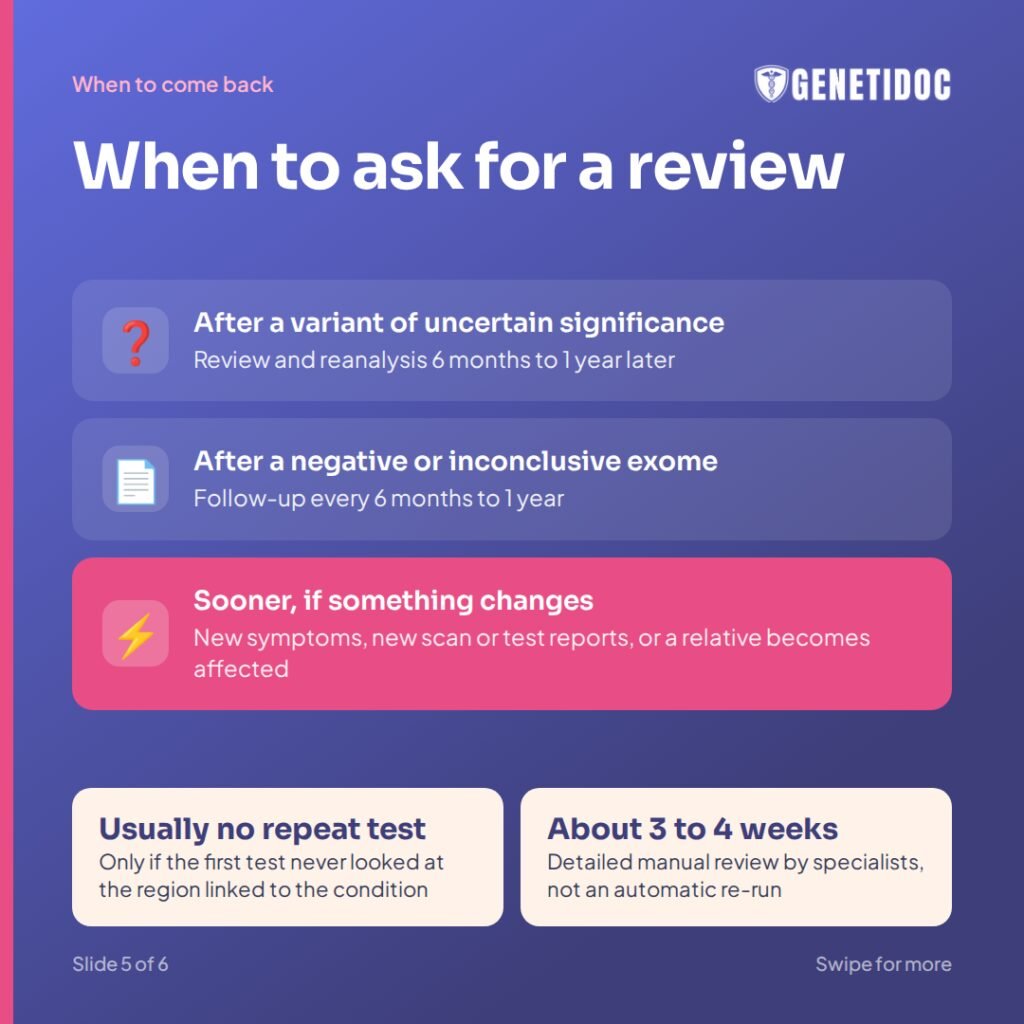
- After a variant of uncertain significance: we usually advise a follow-up and reanalysis 6 months to 1 year later, to check whether new evidence allows the variant to be reclassified.
- After a negative or inconclusive exome: we advise regular follow-up every 6 months to 1 year, where both the patient’s condition and the variant findings are reviewed.
- At scheduled follow-up: updates on whether a partner laboratory has reclassified a variant are usually reviewed at these scheduled follow-up visits, which is one more reason not to skip them.
- Sooner, if something changes: new symptoms, new medical problems, new scan or test reports, or new research about the patient’s variant are all reasons to come back earlier.
“If a child develops a new symptom or a new problem, the family should come back for a consultation and keep the clinic informed. That new symptom may be the clue that connects the genetic finding to a specific condition.”
— Team Genetidoc
How Reanalysis Works: Step by Step
- Clinical review. A clinical geneticist reviews the original report and takes an updated history of the patient’s symptoms, investigations and family history.
- Raw data retrieval. Most laboratories store exome data for later reanalysis, though how long they keep it varies from lab to lab. We can request the raw data from the laboratory that did the original test, including tests done elsewhere.
- The data is filtered and interpreted again using current gene–disease knowledge, updated population databases and the patient’s current clinical features.
- Confirmation and family testing if needed. A new finding may be confirmed, and relatives may be tested for the specific variant to clarify its meaning.
- Post-test counseling. The updated result is explained, along with what it means for treatment, prognosis and the wider family.
Does the whole test need to be repeated?
Usually not. Reanalysis works on the existing data. A new test is advised only when the original test did not actually look at the part of the genome linked to the suspected condition. For example, a small targeted gene panel may not have included a gene that is now suspected, or a particular type of genetic change may be outside what the original method can detect.
“In most cases, the whole exome does not need to be repeated. We collect the raw data from the laboratory and reanalyse it. A repeat or new test is advised only if the previous test never looked at the region linked to the condition.”
— Team Genetidoc
How long does it take?
At Genetidoc, reanalysis typically takes about 3 to 4 weeks. It involves detailed manual review by specialists, not just an automatic re-run of the data.
Should you ask for a copy of your raw data?
Yes, it is a good idea to request a copy of your raw data from the laboratory. It keeps your options open if you later change hospitals or the laboratory’s storage period ends. But treat it like any other sensitive medical record. Your raw genetic data can reveal information about you and your blood relatives, so it should not be shared with anyone who simply asks for it. Understand what it contains before sharing it, and share it only with your clinical team.
When Reanalysis Is Not Enough
Sometimes reanalysis still does not find an answer, even though the patient’s features strongly suggest a genetic condition. This is usually a limitation of the original test, not of the reanalysis.
Exome sequencing reads only the exons, the small protein-coding sections of genes, along with some nearby splice sites (the “joints” where the cell cuts and pastes genetic instructions). Exactly which regions are covered depends on the capture kit each laboratory uses. Changes deep inside the non-coding regions of genes, and some structural or repeat-type changes, can be missed.
When deciding between reanalysis and a new test, clinical geneticists weigh several factors, which are also highlighted by the American College of Medical Genetics and Genomics:
- How much time has passed since the original test
- Whether testing technology has improved since then
- Whether the computer tools used to analyse data have improved
- New knowledge about the genetic causes of the patient’s condition
- New symptoms or family history that have appeared in the meantime
In these situations, our team may recommend:
- Trio exome sequencing: testing the patient together with both parents, which makes it much easier to spot new (de novo) changes and to confirm how a variant was inherited.
- Whole genome sequencing: reading almost the entire DNA code, including non-coding regions. We generally use this as a next step after a negative or incomplete exome, not as a first test.
Why is whole genome sequencing not the first test?
It is natural to ask why we do not simply start with the biggest test. There are good clinical reasons:
- Most known disease-causing changes are in the exome. The protein-coding regions that exome sequencing reads are where the majority of currently understood disease-causing variants are found.
- More data means more uncertainty. A genome contains millions of variants in non-coding regions, and the meaning of most of them is still unknown. This can lead to more uncertain findings that are difficult to interpret.
- It takes longer. Analysing and interpreting a whole genome generally takes more time than an exome.
- The right test depends on the clinical picture. A targeted test or an exome answers the question for many patients. Whole genome sequencing adds the most value when a genetic condition is strongly suspected and an exome has not found the answer.
To understand the difference in more detail, read our article Whole Exome Sequencing vs Whole Genome Sequencing.
How Family Testing Helps Clarify a Result
Families themselves are often the most powerful source of new evidence. This is done through segregation testing, which means checking whether a specific variant “travels” with the condition through the family.
- If a variant of uncertain significance is found in a patient, and other affected family members also carry it, this supports moving the variant up to likely pathogenic or pathogenic.
- For a child with a disease-causing variant, we usually test both parents for that variant. This shows whether it was inherited or arose new in the child, which often clarifies the result and helps estimate the chance of recurrence, especially when the couple is planning another child.
There is one important limit. A variant of uncertain significance should not be used to test unaffected relatives to predict their risk. Until a variant is confirmed as disease-causing, a positive or negative result in a healthy relative cannot be interpreted reliably.
What Changes When a Result Changes?
When a variant is upgraded to pathogenic
A confirmed, definitive diagnosis opens doors that a variant of uncertain significance cannot:
- Condition-specific treatment: where a treatment or management plan exists for the diagnosed condition, it can be started or adjusted.
- Targeted monitoring: the patient can be checked regularly for complications known to occur with that condition.
- The right specialists: referral to the specialists most relevant to the condition, such as a neurologist, cardiologist or metabolic specialist.
- Fewer repeated investigations: families no longer need to keep going through repeated tests and scans in search of a cause.
- Cascade testing for relatives: at-risk family members can now be offered targeted testing for that single variant.
- Reproductive options: for future pregnancies, couples can consider prenatal diagnosis, or preimplantation genetic testing during in vitro fertilisation (IVF), to test for the specific familial variant. If you have questions about preimplantation genetic testing, you can ask them on our Preimplantation Genetic Testing forum, and questions about prenatal diagnosis on our Amniocentesis forum.
- An end to the search: for many families, simply having a name for the condition ends years of uncertainty and repeated investigations.
When a variant is downgraded to benign
Published evidence shows this is actually the more common direction for variants of uncertain significance that get reclassified. A downgrade usually brings relief. The variant is no longer considered a possible cause, and relatives do not need to be tested for it. For the patient, it may also mean the search for the real cause continues, which is where broader testing or future reanalysis can help.
Downgrades of variants previously reported as pathogenic or likely pathogenic are rare. Our team has not seen this happen in practice. It is still possible in principle as evidence improves, and if it ever does happen, any medical decisions made on the basis of the earlier result should be reviewed with a clinical geneticist.
How families feel when a result changes
There is no single “right” reaction to a changed result. Some families feel deep relief at finally having an answer. Some feel confused about what the change means for them. Some feel angry, often about how long it took to reach a diagnosis. All of these reactions are understandable, and a good counseling session makes room for each of them.
“Some families are relieved, some are confused, and some are angry about how long it took. Human reactions are complicated, and we go into every counseling session expecting all of these possibilities.”
— Team Genetidoc
Common Misconceptions About Changing Genetic Results
Myth: “A negative test means my condition is not genetic.”
Fact: A negative result means no reportable finding was found in what was tested, with the knowledge available at the time. It does not rule out a genetic cause.
Myth: “If my result changed, my DNA must have changed.”
Fact: Your inherited DNA does not change. The interpretation changes as science improves.
Myth: “It has been five years, so I need to repeat the whole test.”
Fact: In most cases, the existing data can simply be reanalysed. A new test is needed only if the original one could not look at the relevant region.
Myth: “A variant of uncertain significance means I have the disease.”
Fact: It means the evidence is not yet enough to decide. Care should be based on your symptoms and family history, not on the uncertain variant alone.
Myth: “A changed result means the first laboratory made a mistake.”
Fact: Usually, the first report was accurate for the knowledge available at the time. Reanalysis reflects progress, not error.
“Many families take a negative test to mean their child’s condition is not genetic. We need to be clear that a negative result does not rule out a genetic cause. And we always discuss, right from the start, that a result may change later.”
— Team Genetidoc
Illustrative Examples
The following are illustrative examples created to explain common situations. They are not the stories of real patients.
Example 1: A negative exome, a new symptom and a new gene
A four-year-old girl with developmental delay has exome sequencing. The report is negative. Two years later, she develops seizures, and her parents return for follow-up. The team retrieves the original raw data and reanalyses it with her updated clinical features. In the meantime, a new gene has been linked to a neurodevelopmental condition with seizures, and the child carries a new (de novo) variant in that gene. Testing both parents confirms neither carries it. The family finally has a diagnosis, the child’s neurologist has clearer guidance, and the parents learn that the chance of the same condition in a future child is low.
Example 2: A variant of uncertain significance that became a clear answer
A young boy with a muscle condition has a variant of uncertain significance in a gene that fits his symptoms. His parents want to plan another pregnancy but cannot make informed decisions with an uncertain result. At the 1-year review, new published cases and family segregation testing in an affected cousin support upgrading the variant to likely pathogenic. The management becomes clear, cascade testing is offered to at-risk relatives, and the couple can now consider prenatal diagnosis or preimplantation genetic testing for their next pregnancy.
Why Expert Interpretation Matters More Than the Report Itself
Genetic testing produces data. Interpretation turns that data into answers. The same raw data can lead to very different outcomes depending on who reads it, how carefully the patient’s symptoms are matched to the findings, and whether anyone looks at it again as science moves forward.
This is why the choice of laboratory and clinical team matters. Look for:
- An accredited laboratory that stores data and allows reanalysis
- A clinical geneticist who correlates the report with the patient’s actual features
- Pre-test counseling that explains, before testing, that results can change over time
- A clear follow-up plan, rather than a report handed over with no next steps
A test with no interpretation or follow-up can leave families with a result they cannot use. The real value of genetic testing lies in actionable insight that improves care, for the patient and for the family.
Practical Checklist: What You Can Do Now
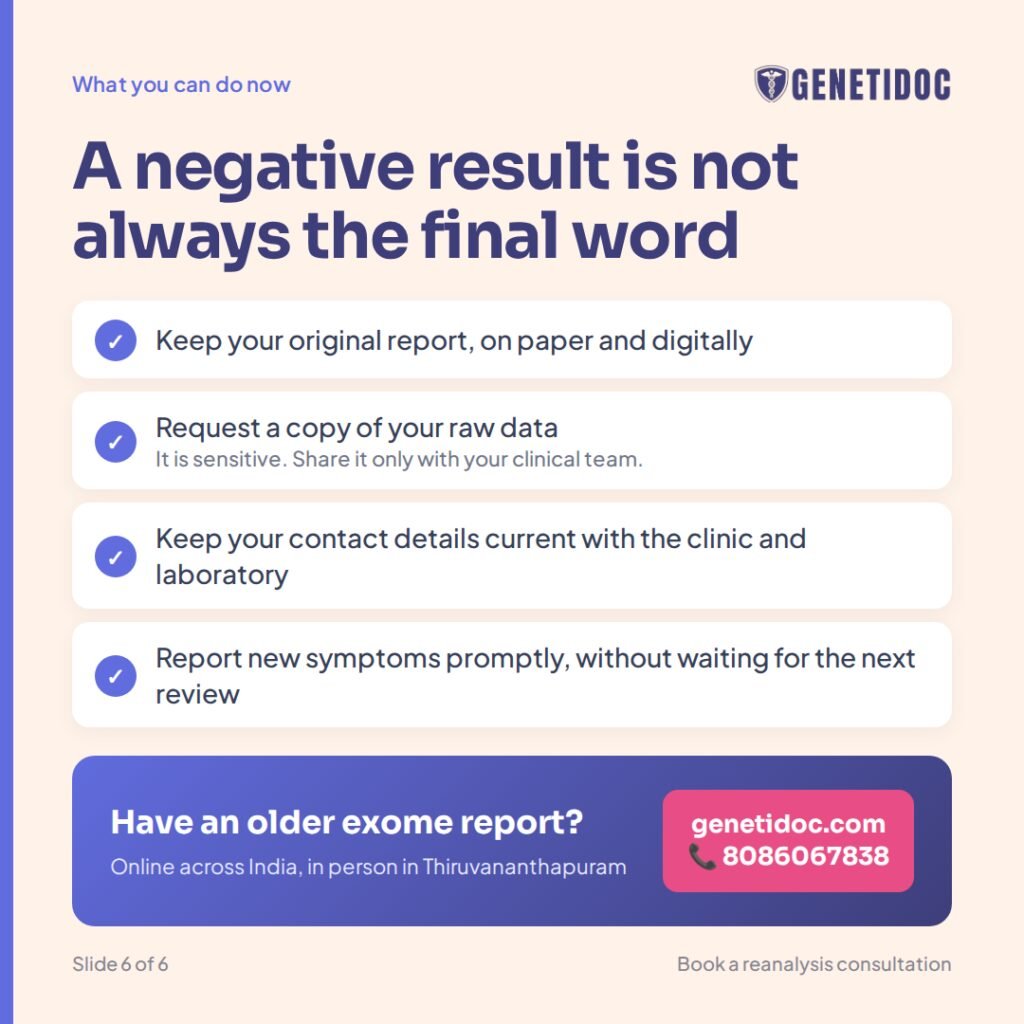
- Keep your original report safely, in both paper and digital form.
- Request a copy of your raw data from the laboratory, and store it securely. Share it only with your clinical team.
- Keep your contact details up to date with the clinic and the laboratory, so you can be reached if anything changes.
- Attend follow-up reviews every 6 months to 1 year if your result was negative, inconclusive or showed a variant of uncertain significance.
- Report new symptoms or new test results to your clinical geneticist promptly, rather than waiting for the next review.
- Do not make major medical decisions based on a variant of uncertain significance alone.
“Keep the report, keep the data if it is available, keep your contact details current, and keep us informed. Reanalysis only works if we can find you and if we know what has changed.”
— Team Genetidoc
Frequently Asked Questions
What is genetic data reanalysis?
It is the process of re-interpreting the raw data from a previous genetic test, usually exome sequencing, using updated scientific knowledge and the patient’s current symptoms. No new sample is usually needed.
Can genetic testing results change over time?
Yes. Your DNA does not change, but the interpretation can. New gene discoveries, new evidence about variants, better population data and new symptoms can all change what a result means.
What happens when a new gene is discovered after my test?
If the gene was covered by your original exome test, reanalysis can check whether you carry a relevant variant in it. This is one of the most common reasons reanalysis finds a new diagnosis.
How often should exome data be reanalysed?
There is no fixed international rule. At Genetidoc, we usually advise review every 6 months to 1 year after a negative, inconclusive or uncertain result, and sooner if new symptoms appear.
Do I need to repeat my genetic test?
Usually not. The existing raw data can be reanalysed. A new test is advised only if the original test did not cover the region linked to the suspected condition.
Can a test done at another laboratory be reanalysed?
Yes, in most cases. The raw data can be requested from the original laboratory, though how long laboratories store data varies.
How long does reanalysis take?
At Genetidoc, reanalysis usually takes about 3 to 4 weeks, depending on the case.
Can a variant of uncertain significance become pathogenic?
Yes, but it is less common than being downgraded. Published data show most reclassified variants of uncertain significance move towards benign.
Does a negative exome result mean my condition is not inherited?
No. It means no reportable variant was found in what was tested, with current knowledge. Inherited diseases can still be present, and reanalysis or broader testing may find the cause later.
What if reanalysis still does not find an answer?
If a genetic condition is still strongly suspected, trio exome sequencing or whole genome sequencing may be recommended, as these can detect changes that a standard exome may miss.
Can my relatives be tested for my variant of uncertain significance?
Affected relatives may be tested to help clarify the variant. Unaffected relatives should not use it to predict their own risk until the variant is confirmed as disease-causing.
Is it safe to share my raw genetic data?
Raw genetic data is sensitive and can reveal information about you and your relatives. Store it securely and share it only with your clinical care team.
Key Takeaways
- A genetic test result reflects the science available on the day it was written. As knowledge grows, interpretation can change.
- Your DNA does not change. In most cases, reanalysis uses your existing data, with no need to repeat the test.
- New gene discoveries, new variant evidence, better population data and new symptoms are the main reasons results change.
- Most reclassified variants of uncertain significance move towards benign, but some become definitive diagnoses.
- A definitive diagnosis benefits the whole family, through cascade testing and informed reproductive choices.
- Keep your report, your raw data and your contact details, and attend follow-up reviews.
Have an older exome report that was negative, inconclusive or showed a variant of uncertain significance?
Our clinical geneticists can review your report, retrieve your raw data from the original laboratory and advise whether reanalysis, family testing or a different test could bring you closer to an answer. Consultations are available online across India and in person in Thiruvananthapuram.
Call 8086067838 or book a genetic data reanalysis consultation.
Join the Conversation
- Whole Exome Sequencing forum
- Next-Generation Sequencing forum
- Preimplantation Genetic Testing forum
- Amniocentesis forum
- Frequently Asked Questions forum
- Genetidoc Rare Disease Forum
Related Reading on Genetidoc
- Genetic Testing for Infertility in India: A Complete Guide for Couples
- Genetic Testing for Recurrent Abortions in India: A Complete Guide for Couples
- Sudden Cardiac Death in Young People: The Genetics of Long QT Syndrome
- Why Accuracy and Interpretation Differ in Home DNA Kits vs. Clinical Genetic Testing
- Understanding the Genetic Causes of Male Infertility
References
- Deignan JL, Chung WK, Kearney HM, Monaghan KG, Rehder CW, Chao EC; ACMG Laboratory Quality Assurance Committee. Points to consider in the reevaluation and reanalysis of genomic test results: a statement of the American College of Medical Genetics and Genomics (ACMG). Genetics in Medicine. 2019;21(6):1267–1270.
- Ting YL, Williams TJ, Metz H, et al. Diagnostic yield of exome reanalysis over time: contribution of reevaluation type, timing, and patient phenotype. Genetics in Medicine. 2026;28(5).
- Pleasant V, et al. Reclassification of variants of uncertain significance by race, ethnicity, and ancestry for patients at risk for breast cancer. Frontiers in Oncology. 2025.
- Garg N, Lakshmi P, Singh SM, Kulshreshta S, Ranganath P, Moirangthem A, Dalal A, Gahlot A, Puri RD. Reanalysis of exome sequencing data in the Indian Undiagnosed Diseases Program: improving diagnostic yield and ending diagnostic odyssey. Clinical Genetics. 2025.
- Clinical exome reanalysis: current practice and beyond. Molecular Diagnosis & Therapy. 2021.