
Ancestry and health DNA kits are easy to buy. You spit into a tube, post it back, and a few weeks later an app tells you where your ancestors came from, what your “genetic diet” should be, and sometimes whether you carry a risk for cancer or another disease.
For many people, that feels like the same thing a doctor would order. It isn’t. A consumer DNA kit and a clinical genetic test are built for different jobs, use different technology, and are held to different standards. Those differences matter most at exactly the moment people care about them most: when a result says something about their health.
This guide explains how the two differ, why a kit can get a rare result wrong, when a kit is simply the wrong tool, and what to do if you already have a result that worries you.
Quick answer
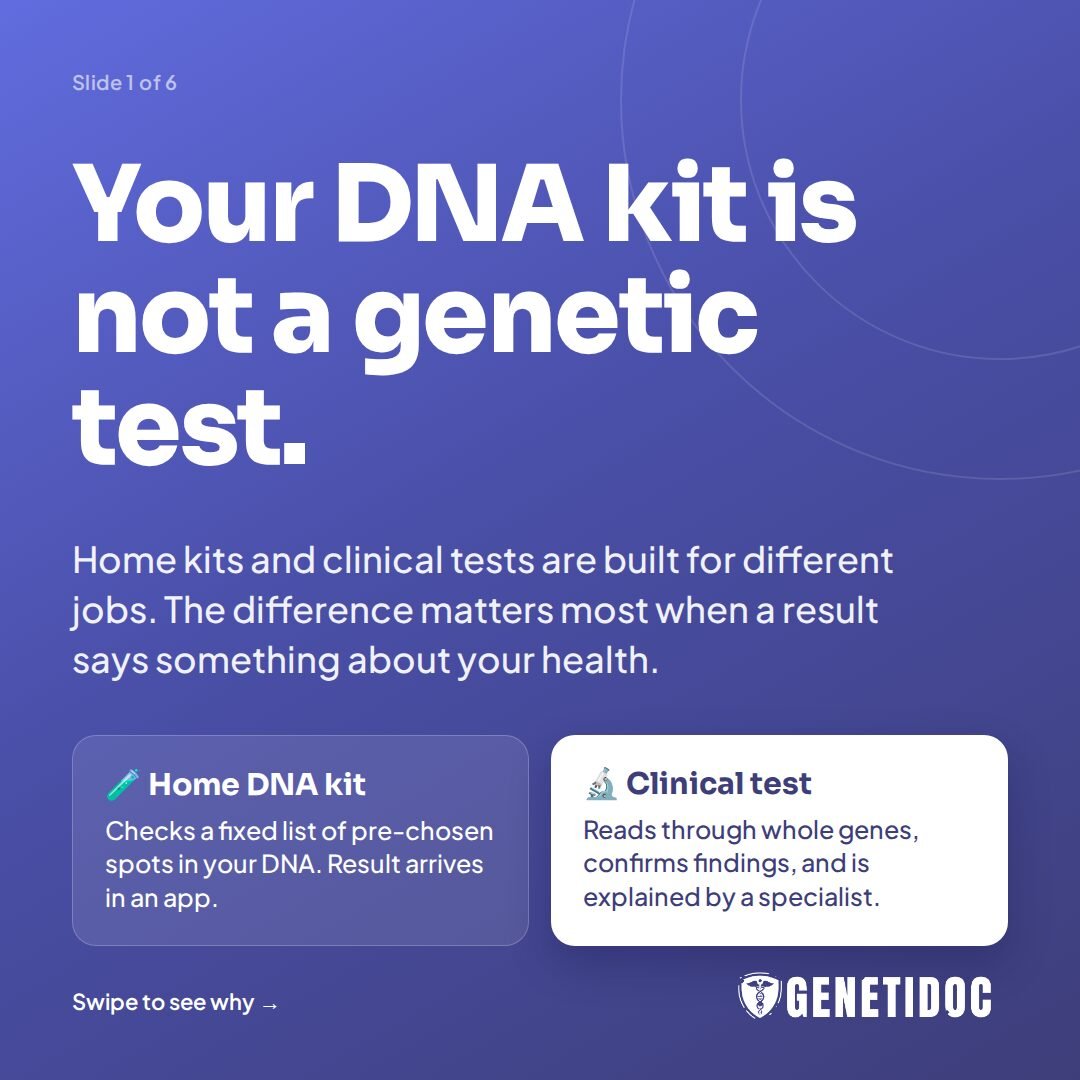
A direct-to-consumer (DTC) DNA kit usually checks a fixed list of pre-chosen spots in your DNA using a genotyping chip. A clinical genetic test reads through whole genes letter by letter in an accredited laboratory, confirms important findings, classifies each change using international guidelines, and comes with interpretation by a specialist. Kits can be reasonable for ancestry curiosity. They should not be used to make, or rule out, health decisions.
What Is a Direct-to-Consumer (DTC) Genetic Test?
A direct-to-consumer genetic test is one you order yourself, usually online, without a doctor being involved. Well-known international examples include 23andMe and AncestryDNA, and several Indian companies now sell similar kits. They typically offer some mix of:
- Ancestry reports — estimates of which world regions your ancestors came from
- Wellness reports — diet, fitness, sleep, skin, and sometimes “personality” traits
- Health risk reports — a small number of variants linked to conditions such as hereditary breast cancer
- Medicine response reports — how your body may process certain drugs
- Raw data files — a downloadable file of the chip readings, which many people upload to third-party websites for extra “interpretation”
What Is Clinical-Grade Genetic Testing?
A clinical genetic test is ordered by a doctor or clinical geneticist for a specific medical reason: a personal or family history of cancer, a child with developmental concerns, a pregnancy question, recurrent miscarriage, or a family member with a known genetic condition.
The sample is processed in an accredited laboratory. Genetidoc’s partner laboratories hold national and international accreditation (NABL and CAP), and findings that will be reported are confirmed before a report is issued. The result is then explained to you in a genetic counseling session, in the context of your own health and family history.
DTC Kit vs. Clinical Genetic Test: Side-by-Side Comparison
| Feature | Typical DTC kit | Clinical genetic test |
| Who orders it | You, online | A doctor or clinical geneticist, for a medical reason |
| Technology | Genotyping chip: checks pre-chosen spots | Sequencing: reads through whole genes |
| New or rare variants | Cannot find variants not on its list; rare readings are often wrong | Can find changes nobody was looking for in advance |
| Confirmation of findings | Raw data is usually unconfirmed | Reportable findings are confirmed in the laboratory |
| How variants are classified | Varies by company; often not explained | Five-tier American College of Medical Genetics and Genomics (ACMG) system |
| Indian population variants | Panels largely built on European-ancestry data | Full-gene reading picks up community-specific variants |
| Interpretation | An app report | A specialist, with pre-test and post-test genetic counseling |
| Data and consent | Depends on company policy, which can change | Storage, research use, and withdrawal stated in consent |
Why a DNA Kit Can Get a Rare Result Wrong
The biggest difference is not the brand or the price. It is the technology inside the test.
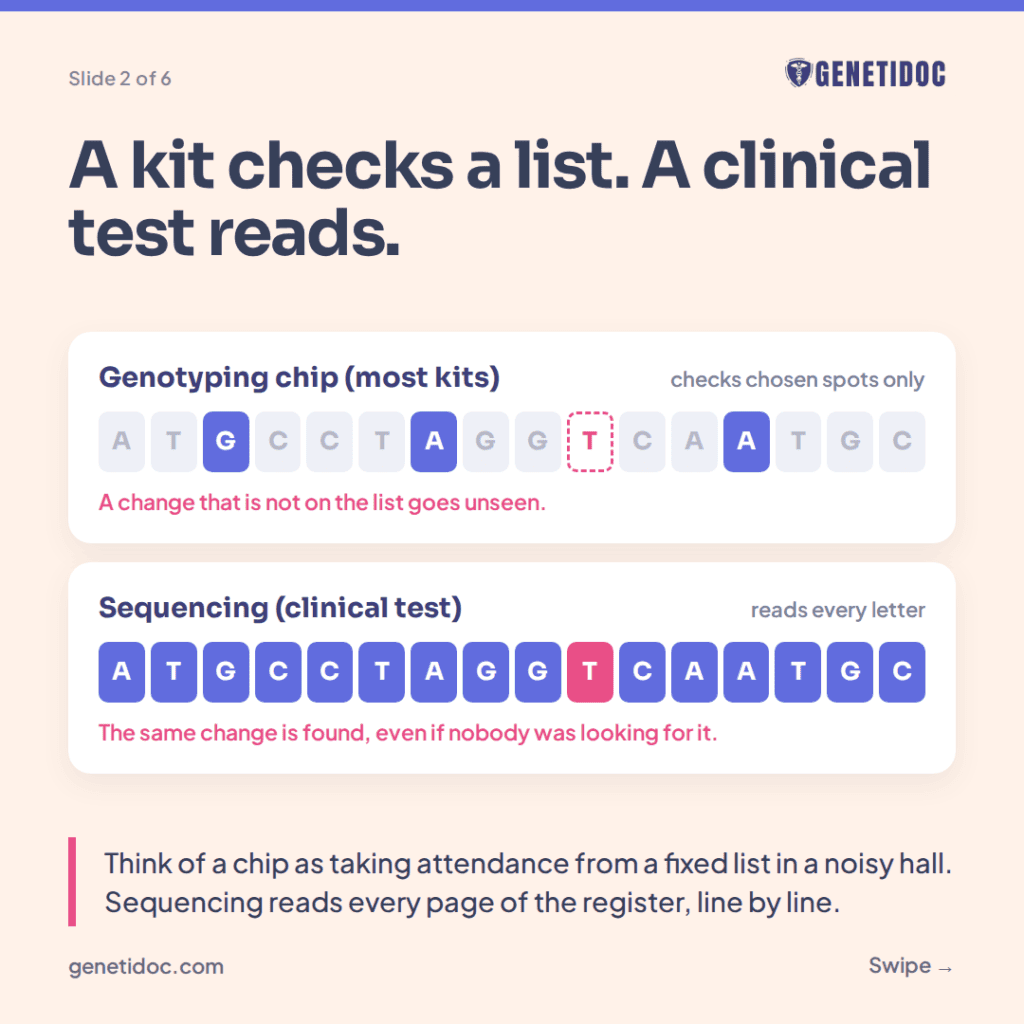
“A genotyping chip doesn’t read your DNA. It only checks whether a specific, pre-chosen variant is there or not. For rare variants, that answer is very often wrong, which is why any health finding from a chip has to be confirmed. Sequencing works differently. It reads a person’s DNA letter by letter, so it can find a change even if nobody was looking for it in advance,” says Team Genetidoc.
How a genotyping chip works
Most DTC kits use a genotyping chip: a small slide carrying hundreds of thousands of tiny probes. Each probe is designed to check one fixed spot in your DNA. Here is why that can go wrong for rare, health-related variants:
- The chip decides what it sees by comparing you with other people. Each probe gives off a light signal, and software works out your result by grouping your signal with thousands of other samples. For common variants, there are plenty of examples, and chips are very accurate. For a rare variant, there may be almost no one to compare with, so background “noise” can be misread as a harmful change.
- Nearby DNA differences can confuse the probe. A probe works by sticking to a matching stretch of DNA. A harmless difference right next to the spot being checked can stop it sticking properly. This is more likely in populations that were under-represented when chips were designed, including Indian populations.
- It can only find what it was built to look for. If your variant is not on the chip’s list, the chip cannot detect it. This is how a “normal” kit result can give false reassurance.
- Raw data is not checked before you see it. Third-party websites that interpret raw data files often report rare “harmful” variants straight from unconfirmed chip readings.
A simple way to picture it
A chip is like a teacher taking attendance from a fixed list of names in a noisy hall. A student who is not on the list is never noticed, and a rarely heard name can be misheard as “present.” Sequencing is like reading every page of the register, line by line.
What the research shows
This is not just theory. Two well-known studies tested it directly:
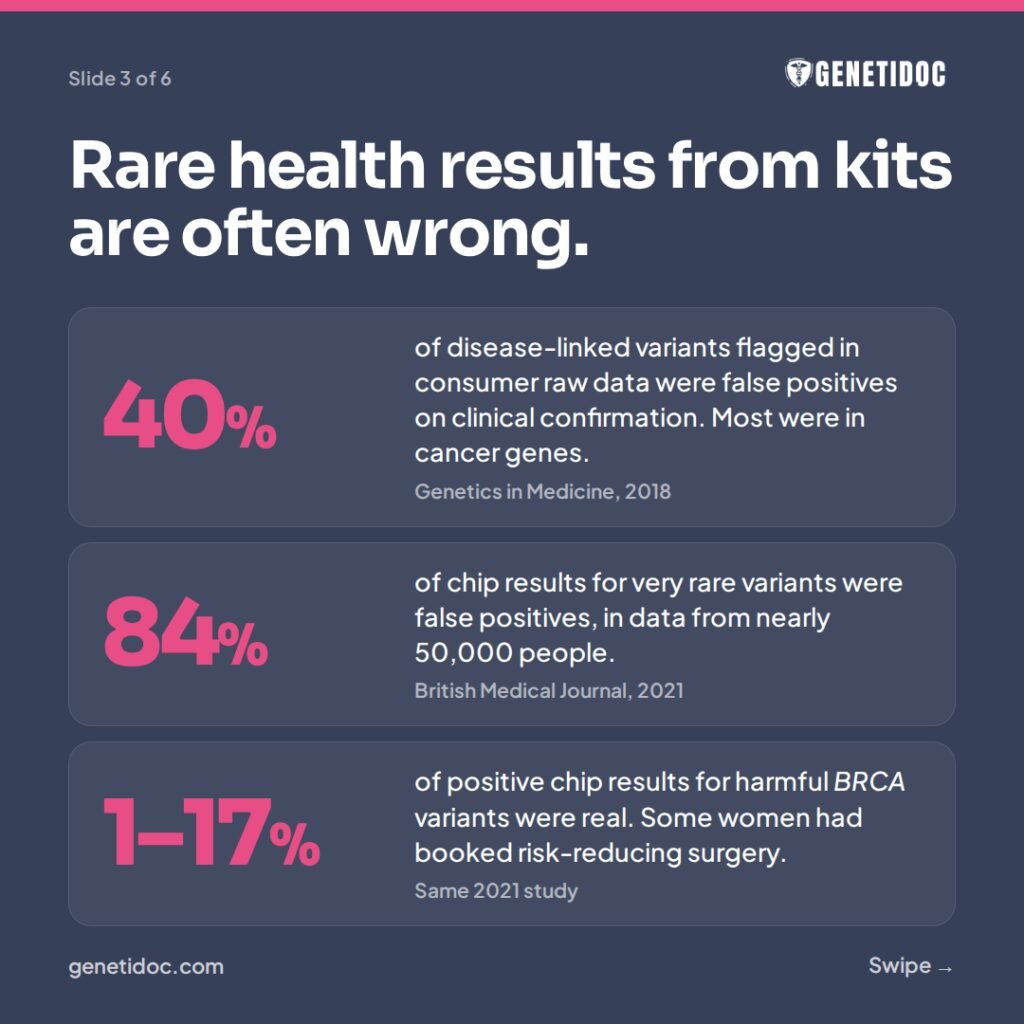
- Four in ten flagged variants were false. A 2018 study in Genetics in Medicine looked at people whose DTC raw data showed a disease-linked variant and who then had clinical confirmation testing. Forty percent of those variants were false positives. Most involved cancer genes, particularly BRCA1 and BRCA2.
- Very rare chip results were mostly wrong. A 2021 study in the BMJ (Weedon and colleagues, University of Exeter), using data from nearly 50,000 people, found that for very rare variants (seen in fewer than 1 in 100,000 people), 84 percent of chip results were false positives. For harmful BRCA variants, only 1 to 17 percent of positive chip results were real. Twenty of 21 people who had used commercial kits had at least one false positive.
The researchers behind the 2021 study raised concern that women had been booking risk-reducing surgery after receiving these results.
“Unlike a standard blood test, which tells you a value is high or low, a DTC report often gives a number or a flag that most people can’t interpret properly. That causes a lot of unnecessary worry. In the BRCA example, people were frightened enough to plan surgery such as mastectomy, and when they were tested properly, they turned out not to carry the variant at all,” says Team Genetidoc.
The problem of false reassurance
False positives cause fear. False negatives can be even more dangerous, because they stop people from acting.
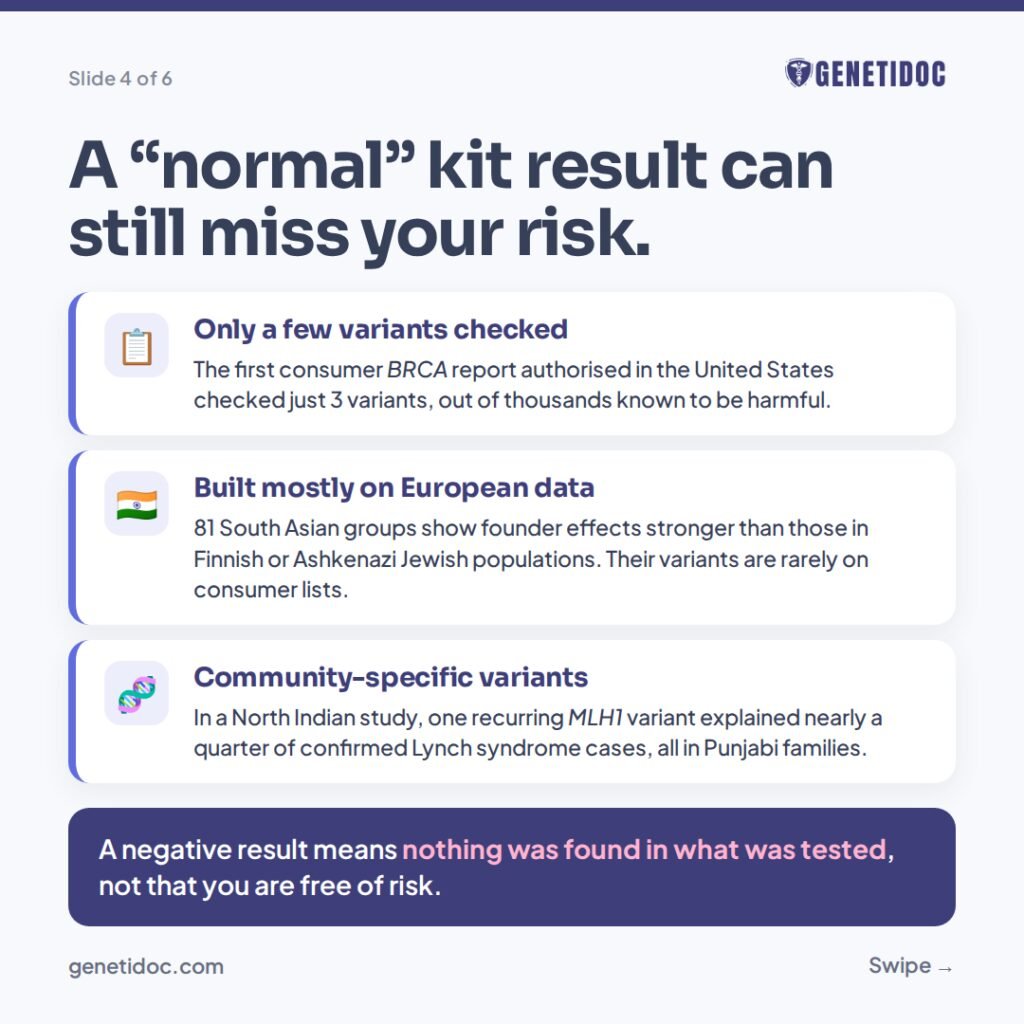
When the United States Food and Drug Administration (FDA) first authorized 23andMe’s consumer BRCA report in 2018, it checked only three variants, all common in people of Ashkenazi Jewish ancestry. The list was later expanded, but it still covers only a small fraction of the thousands of known harmful BRCA1 and BRCA2 variants. A woman of Indian ancestry with a strong family history of breast and ovarian cancer could receive a “no variants detected” result and still carry a serious hereditary risk.
That is why a negative result from any test must be read as “no reportable finding in what was tested,” never as “you will never develop this condition.”
Why the Indian Context Matters
Most DTC health panels are built around variants that were discovered and validated in people of European ancestry. India’s genetic landscape is very different.
India is home to thousands of communities, many of which have married largely within the group for generations. This creates founder variants: disease-causing changes that are common in one community because they trace back to a small number of shared ancestors. A 2017 study in Nature Genetics identified 81 South Asian groups, 14 of them with more than a million people, whose founder effects are stronger than those seen in Finnish or Ashkenazi Jewish populations — two groups famous in genetics for exactly this reason.
A few examples of how this plays out:
- Lynch syndrome: a recent North Indian study found a single recurring MLH1 variant behind nearly a quarter of confirmed Lynch syndrome cases, seen only in families of Punjabi ancestry.
- Beta-thalassemia: the variants most common in India differ from those most common in Mediterranean populations, which is why carrier testing needs to be matched to the Indian spectrum.
- Hereditary cancer and rare diseases: many community-specific variants have simply never been studied in enough Indian patients to appear on a pre-set consumer list.
“Most DTC panels are built around variants validated in Caucasian populations. Almost every community has its own founder variants, and to our knowledge, no DTC package is designed to screen for Indian founder variants specifically. A clinical test that reads through the full gene doesn’t depend on someone having put that variant on a list in advance,” says Team Genetidoc.
Interpretation: Why a Result Is Not the Same as an Answer
Finding a DNA change is only the first step. The harder question is: does this change actually cause disease?
How clinical laboratories classify variants
Clinical laboratories follow the American College of Medical Genetics and Genomics (ACMG) guidelines, which sort every variant into one of five groups:
- Pathogenic — causes disease
- Likely pathogenic — very probably causes disease
- Variant of uncertain significance — not enough evidence either way yet
- Likely benign — very probably harmless
- Benign — harmless
Each classification comes with rules about what can and cannot be done with it. For example, a variant of uncertain significance should not be used on its own to make medical decisions such as surgery.
“DTC kits only check for the variants they target. In clinical testing, what we often find are variants that aren’t on any list — new variants that may or may not cause disease. That’s exactly why they are classified carefully using ACMG guidelines, and why the report has to be explained, not just handed over,” says Team Genetidoc.
The role of genetic counseling
In clinical testing, genetic counseling happens both before and after the test. Before testing, you learn what the test can find, what it cannot, and what the possible results mean. After testing, a specialist explains your result against your personal and family history, what it means for your screening or treatment, and whether relatives should be tested.
A DTC app cannot do this. It does not know that your mother had ovarian cancer at 42, that you are planning a pregnancy, or that your parents are related by blood. The same variant can mean very different things in different people.
What About DTC Wellness, Medicine, and Risk Score Reports?
Diet, fitness, skin, and personality reports
Nutrition and fitness reports usually rely on common variants that each have a very small effect. Scientific reviews of consumer nutrigenetic tests have found that the evidence for most of their recommendations is limited. Your diet, activity level, weight, and medical conditions matter far more than these variants.
“For diet and fitness, you’re better off consulting a dietitian. Personality isn’t something a genetic test can detect. A wellness report isn’t something we would use in clinical practice, unless it is about something that genuinely affects health, such as a heart condition — and that belongs in a proper clinical test,” says Team Genetidoc.
Medicine response (pharmacogenomic) reports
Pharmacogenomics looks at how your genes affect the way you process certain medicines. It can be genuinely useful. But when the FDA authorized the first consumer pharmacogenetic report in 2018, it required a warning that people should not use the results to stop or change any medicine, and stated that results should be confirmed with independent pharmacogenetic testing before any medical decision is made.
Team Genetidoc takes the same view: the accuracy of a DTC medicine report has to be established before anyone acts on it. Never stop or change a medicine based on a kit result. Discuss it with your doctor, who can arrange clinical pharmacogenomic testing if it is relevant to your treatment.
Polygenic risk scores
Some kits report a “genetic risk score” for conditions such as type 2 diabetes or heart disease. A polygenic risk score adds up the small effects of many common variants to estimate whether your risk is somewhat higher or lower than average.
A few things to understand about these scores:
- They describe probability, not destiny. A “higher” score does not mean you will get the disease, and a “lower” score does not mean you won’t.
- They are less accurate for Indian users. Most scores were developed using data from people of European ancestry, and research shows they predict less well in other populations, including South Asians.
- They are different from a single high-risk variant. A pathogenic BRCA1 variant can change medical care on its own. A polygenic score usually shifts risk only modestly.
- Lifestyle and family history still matter most. Blood pressure, blood sugar, cholesterol, weight, smoking, and who in your family was affected, and at what age, remain the foundation of risk assessment.
When patients bring these scores to Genetidoc, the team explains what the score implies, what it does not, and how accurate it is for that person.
Privacy: Who Else Can See Your DNA?
Your DNA does not only say something about you. It also says something about your parents, siblings, and children, and it cannot be changed like a password.
Two recent events show why privacy matters:
- The 2023 data breach: attackers accessed 23andMe accounts, and information linked to about 6.9 million users was exposed.
- The 2025 bankruptcy: 23andMe filed for bankruptcy and was sold, raising public questions about what happens to customers’ genetic data when a company changes hands.
In India, the Digital Personal Data Protection Act, 2023 now governs personal data, and its rules were notified in November 2025 and are being phased in. There is still no law written specifically for consumer genetic testing, so what happens to your data depends heavily on each company’s own policy.
“I wouldn’t recommend anyone get their genome tested without a clear assurance that it will remain confidential and that their DNA and genetic data won’t be shared with anyone else. In clinical testing, the consent clearly states how long your DNA will be stored, whether it can be used for research, and that you can withdraw from any research at any time,” says Team Genetidoc.
Before buying any kit, read the privacy policy and check: Is your data shared or sold? Is it used for research by default? Can you delete your data and have your sample destroyed? What happens if the company is sold?
When a DNA Kit Is the Wrong Choice: Red Flags for Clinical Testing
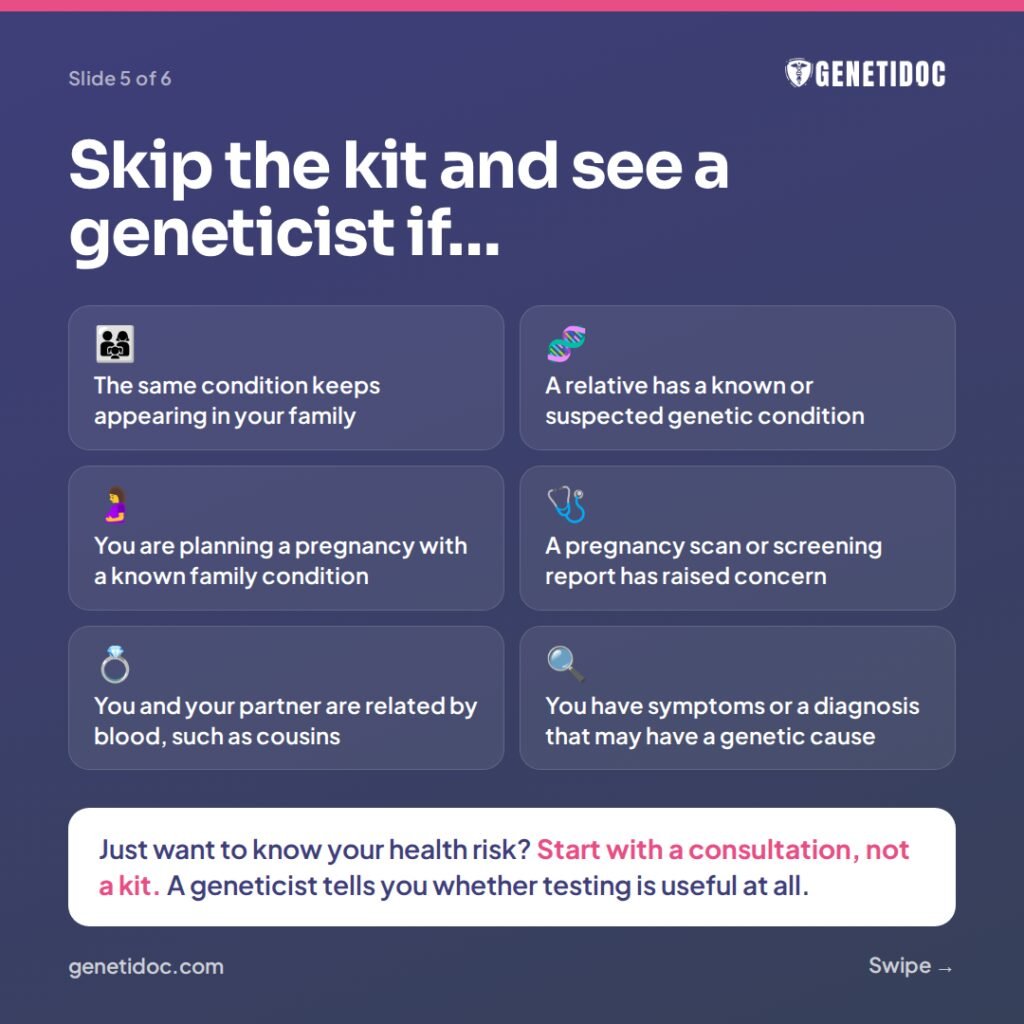
If any of the following apply to you, skip the kit and go straight to a clinical geneticist:
- The same condition appearing repeatedly in your family — for example, several relatives with the same type of cancer, heart problem, or other illness
- A family member with a known or suspected genetic condition
- Planning a pregnancy, especially with a known family condition
- A pregnancy scan or screening report that has raised concern
- Consanguinity — when partners are related by blood, such as cousins
- Any personal symptoms or diagnosis where a genetic cause is suspected
Even without any of these red flags, if your main reason for buying a kit is to find out your health risk, a consultation with a clinical geneticist is the better first step. A geneticist starts with your personal and family history, tells you whether testing is useful at all, and if it is, chooses the right test and explains what the result means for you. A DTC kit gives you a report, but not an assessment of your risk.
“For any of these concerns, you don’t need a DTC test at all. Go straight to clinical testing, where you get a consultation, the right test for your situation, and a proper interpretation of the report,” says Team Genetidoc.
Is a DTC kit ever reasonable?
If your interest is purely in ancestry and you have no health concerns, a kit can satisfy curiosity, as long as you understand its limits. Even then, Team Genetidoc does not actively recommend it, mainly because of the privacy risks. And if a curiosity kit shows a health finding you did not expect, treat it as a question to bring to a specialist, not as an answer.
Already Have a DTC Result? What to Do Next
If a kit or a raw-data website has flagged a health risk, here is a practical sequence:
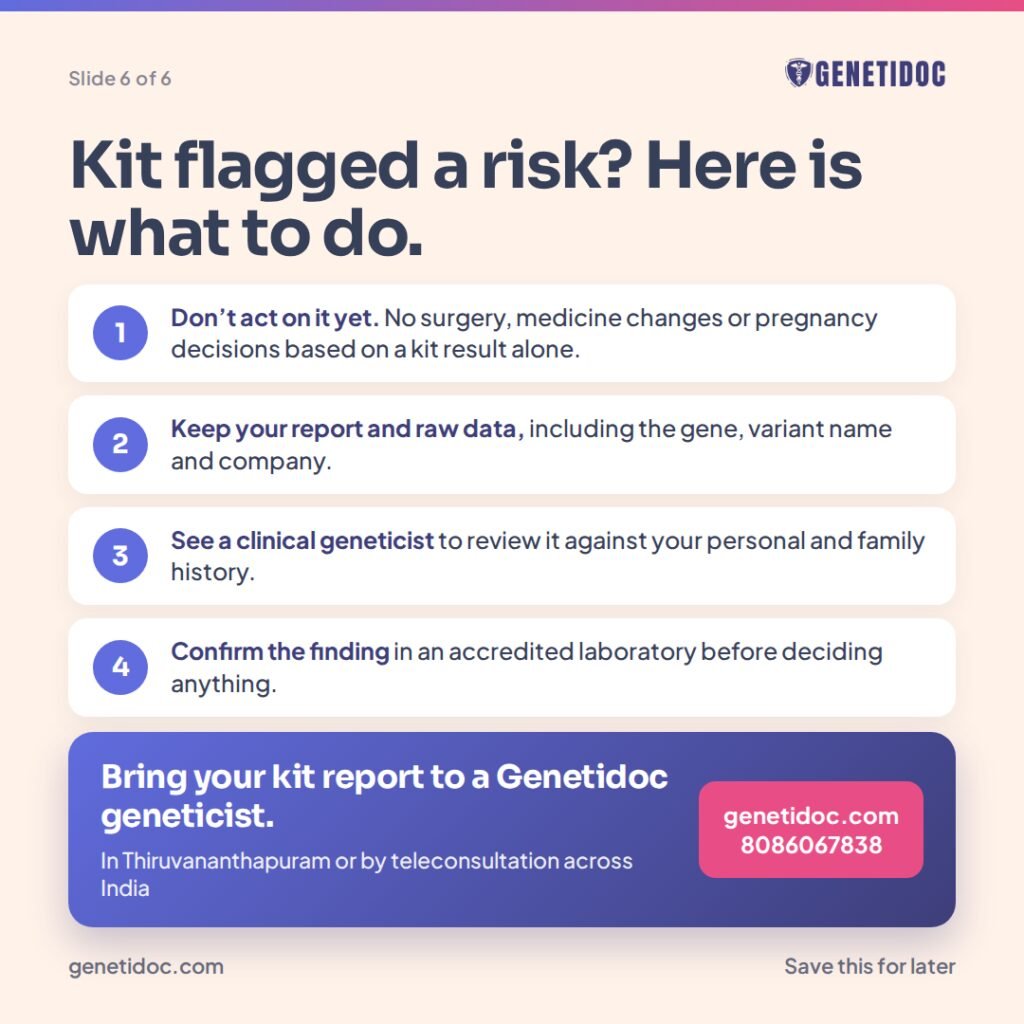
- Don’t act on it yet. Do not book surgery, change medicines, or make pregnancy decisions based on a kit result alone.
- Keep your report and raw data. Note the exact variant name, gene, and company if they are listed.
- Book a consultation with a clinical geneticist. They will review the finding against your personal and family history.
- Get the finding confirmed. At the very least, the specific variant should be tested in an accredited clinical laboratory.
- Consider whether broader testing makes sense. If your history suggests it, or you would like a fuller picture, a full panel may be offered.
- Understand the result before deciding anything. Genetic counseling explains what a confirmed positive, or a negative, can and cannot tell you.
“If a DTC result flags a disease-causing variant, we should at least do targeted testing of that variant, and most of the time that’s definitely needed. We also check how the variant has been reported in the published literature, and explain what the confirmation result means — what it can and can’t rule out. If the patient wishes, we can do a full panel as well. What matters is getting a professional opinion rather than assuming what the result means,” says Team Genetidoc.
You can also share your DTC result (with personal details removed) on the Direct-to-Consumer Genetic Testing forum to ask general questions before your consultation.
What about the cost?
A DTC kit may look cheaper at first. But if it flags a health risk, you will need clinical confirmation anyway, and if it misses something, the cost of false reassurance can be far higher than any test. Clinical testing costs vary with the type of test and the number of genes involved. Your genetic counselor can explain which options suit your situation before any sample is taken.
Choosing the Right Test and the Right Laboratory
The value of genetic testing does not come from the report alone. It comes from choosing the right test for the question, running it in a laboratory that confirms what it reports, and having a specialist turn the result into a plan you can act on.
When comparing options, ask:
- Is the laboratory accredited (for example, NABL or CAP)?
- Does the test read the full gene, or only check selected spots?
- Are important findings confirmed before they are reported?
- Are variants classified using ACMG guidelines?
- Is genetic counseling included before and after the test?
- Is it clear how your sample and data will be stored and used?
Have a question about a DNA kit result or which genetic test is right for you? Post it on the Genetic Testing forum or the Direct-to-Consumer Genetic Testing forum on the Genetidoc Rare Disease Forum, where genetic counselors and consultants review the responses. For questions about testing a healthy person for future risk, see the Predictive Genetic Testing forum, and for hereditary cancer questions, the Hereditary Cancer Syndrome forum.
Frequently Asked Questions
Are home DNA tests accurate?
For common variants and ancestry estimates, genotyping chips are generally accurate. For rare, health-related variants, they are much less reliable: studies have found that a large share of rare disease-linked variants reported from consumer chip data are false positives.
Can a DTC kit tell me if I have a BRCA mutation?
Only for the small number of variants it checks. Consumer BRCA reports cover a fraction of known harmful variants, mostly those common in European or Ashkenazi Jewish populations. A negative kit result does not rule out a hereditary cancer risk.
My DNA kit says I carry a harmful variant. What should I do?
Don’t make any medical decisions yet. Book a consultation with a clinical geneticist, who will arrange confirmation of that specific variant in an accredited laboratory and explain what the confirmed result means for you.
Can I use my ancestry raw data for health information?
It is not recommended. Raw data files are unconfirmed chip readings, and third-party websites that interpret them often report rare variants that turn out to be false. Any health finding needs clinical confirmation.
What is the difference between genotyping and sequencing?
Genotyping checks a fixed list of pre-chosen spots in your DNA. Sequencing reads through whole genes letter by letter, so it can find changes that were not on any list.
Do DTC kits work well for Indian people?
Their health panels are largely built on European-ancestry data. Many Indian communities carry their own founder variants, which consumer kits are not designed to detect, and polygenic risk scores are less accurate for South Asians.
Is a negative DTC result reassuring?
Not for health purposes. It means only that the specific variants checked were not detected. If you have a personal or family history that suggests a genetic condition, you need a clinical test.
Can I change my medicines based on a DTC pharmacogenomic report?
No. Never stop or change a medicine based on a kit result. Discuss it with your doctor, who can arrange confirmatory clinical testing if it is relevant.
Are DNA diet and fitness reports useful?
The evidence behind most consumer diet and fitness recommendations is limited. A dietitian who considers your full health picture will give more useful advice.
Is my genetic data safe with a DTC company?
It depends on the company’s policy, which can change if it is sold. Check whether your data is shared or used for research, and whether you can delete it and have your sample destroyed.
When should I choose clinical genetic testing instead of a kit?
Whenever there is a health reason: the same condition appearing repeatedly in your family, a relative with a genetic condition, pregnancy planning, a concerning scan, consanguinity, or symptoms that suggest a genetic cause. If you simply want to know your health risk, start with a consultation with a clinical geneticist rather than a kit.
Key Takeaways
- DTC kits mostly use genotyping chips that check a fixed list of spots; clinical tests read through whole genes
- Chips are accurate for common variants but often wrong for rare, health-related ones
- A negative kit result can give false reassurance, especially for Indian users, whose founder variants are rarely on consumer lists
- Clinical laboratories confirm reportable findings and classify variants using ACMG guidelines
- Interpretation and genetic counseling are what turn a result into a safe, personal plan
- Never make surgical, medicine, or pregnancy decisions from a kit result without clinical confirmation
- Check privacy policies carefully; your DNA also carries information about your family
Has a home DNA kit or a raw-data website flagged a health risk, or do you have a family history that a kit can’t answer?
Bring your report to a Genetidoc clinical geneticist. We will review the finding, arrange confirmation in an accredited laboratory where needed, and explain what it really means for you and your family, in person in Thiruvananthapuram or by teleconsultation anywhere in India.
Book a free genetic consultation today from best genetic clinic in India.
References
- Tandy-Connor S, et al. False-positive results released by direct-to-consumer genetic tests highlight the importance of clinical confirmation testing for appropriate patient care. Genetics in Medicine, 2018;20:1515–1521. org/10.1038/gim.2018.38
- Weedon MN, et al. Use of SNP chips to detect rare pathogenic variants: retrospective, population based diagnostic evaluation. BMJ, 2021;372:n214. org/10.1136/bmj.n214
- Richards S, et al. Standards and guidelines for the interpretation of sequence variants: a joint consensus recommendation of the American College of Medical Genetics and Genomics and the Association for Molecular Pathology. Genetics in Medicine, 2015;17:405–424.
- Nakatsuka N, et al. The promise of discovering population-specific disease-associated genes in South Asia. Nature Genetics, 2017;49:1403–1407.
- Martin AR, et al. Clinical use of current polygenic risk scores may exacerbate health disparities. Nature Genetics, 2019;51:584–591.
- United States Food and Drug Administration. FDA authorizes, with special controls, direct-to-consumer test that reports three mutations in the BRCA breast cancer genes. Press release, March 2018.
- United States Food and Drug Administration. FDA authorizes first direct-to-consumer test for detecting genetic variants that may be associated with medication metabolism. Press release, October 2018.
- Floris M, et al. Direct-to-consumer nutrigenetics testing: an overview. Nutrients, 2020;12:566.
- Government of India, Ministry of Electronics and Information Technology. Digital Personal Data Protection Rules, 2025 (notified November 2025).
Related Reading on Genetidoc
- Understanding the Genetic Causes of Male Infertility
- Lynch Syndrome: When Colorectal Cancer Runs in the Family
- BRCA and Beyond: What a “Positive” Hereditary Cancer Result Actually Means for Your Family
- Family History of a Genetic Condition? Here’s What to Ask Before You Conceive
- What Does “Variant of Uncertain Significance” Mean — And Why It’s Not a Diagnosis
- NGS Panel Testing Explained: How Gene Sequencing Finds Inherited Diseases