
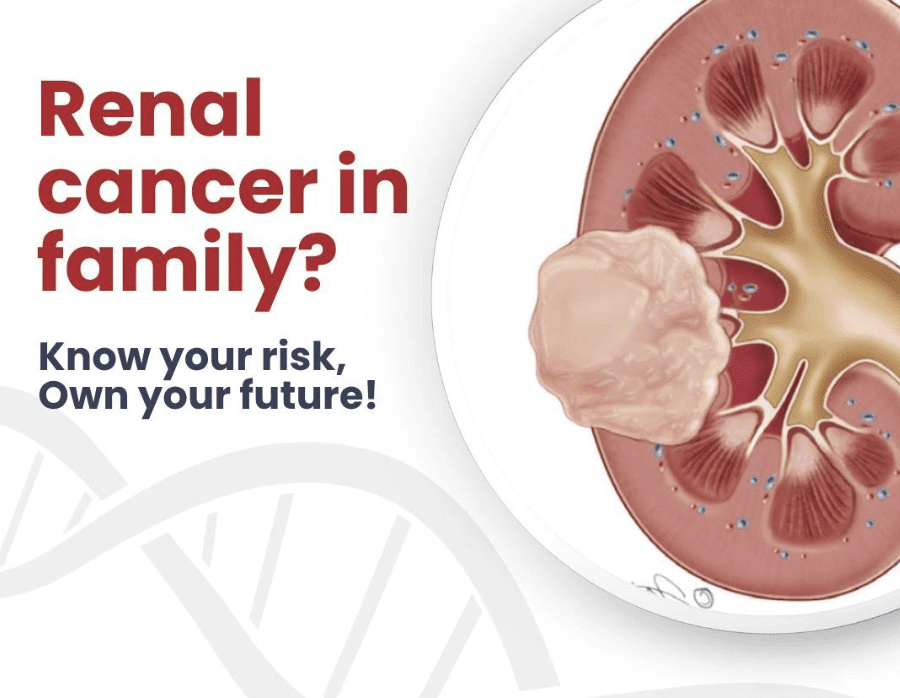
👨⚕️ “Doctor, My Brother Had Kidney Cancer at 40. Should I Get Checked?”
This is a question that comes up more often than people realize.
While most kidney cancers occur by chance, a small but important proportion (5–8%) are hereditary, passed down through families.
Knowing whether kidney cancer in your family is genetic can help detect it early, prevent advanced disease, and even save lives.
1️⃣ How Common Is Hereditary Kidney Cancer?
Kidney cancer (also called renal cell carcinoma) accounts for about 2–3% of all cancers.
Most cases are sporadic, meaning they occur by chance, but about 1 in 12 are due to inherited genetic syndromes.
The key hereditary causes include:
-
VHL (Von Hippel–Lindau syndrome)
-
FH (Hereditary Leiomyomatosis and Renal Cell Cancer)
-
FLCN (Birt–Hogg–Dubé syndrome)
-
MET (Hereditary Papillary Renal Carcinoma)
-
SDHB/SDHD (Paraganglioma syndromes)
-
TSC1/TSC2 (Tuberous Sclerosis Complex)
Each syndrome carries different risks and associated tumors — but all share one principle: early detection saves kidneys and lives.
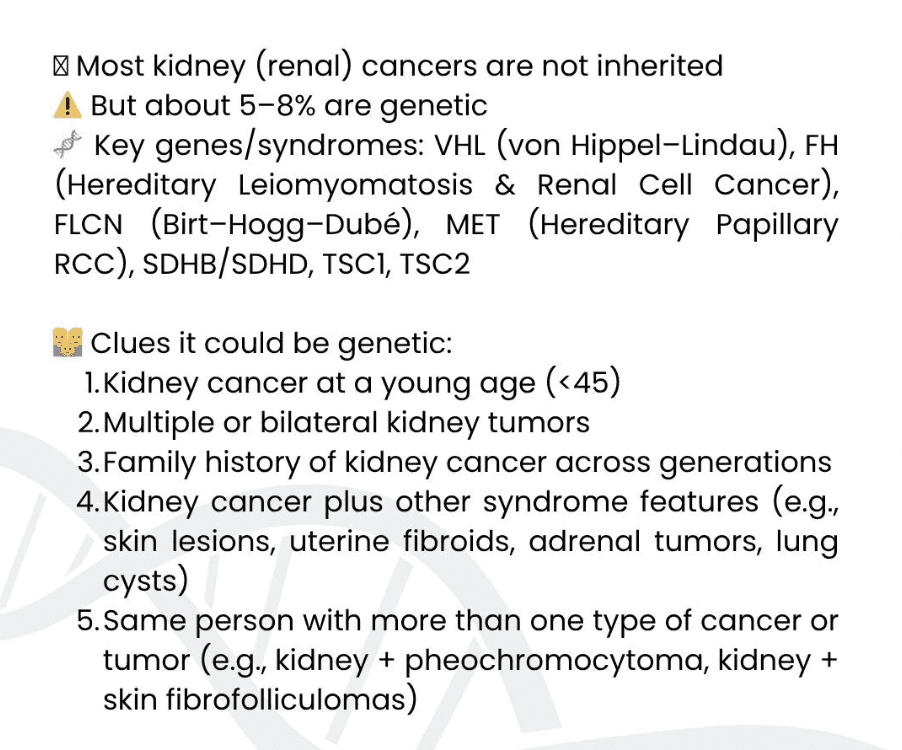
2️⃣ What Are the Clues That It Might Be Genetic?
There are certain “red flags” that suggest a hereditary form of kidney cancer.
You or your doctor should consider genetic testing if you notice any of the following:
-
Kidney cancer diagnosed before age 45
-
Multiple or bilateral kidney tumors (in both kidneys or multiple in one)
-
Family history of kidney cancer in multiple generations
-
Kidney cancer plus other features (skin lesions, uterine fibroids, adrenal tumors, or lung cysts)
-
One person with multiple tumor types, such as kidney + pheochromocytoma or kidney + skin fibrofolliculomas
If these patterns sound familiar, don’t wait — consult a genetic counselor or clinical geneticist.
3️⃣ Understanding the Main Hereditary Kidney Cancer Syndromes
1. Von Hippel–Lindau (VHL) Syndrome
Caused by mutations in the VHL gene, this condition leads to:
-
Multiple kidney tumors (often clear-cell type)
-
Cysts in kidneys and pancreas
-
Tumors in the brain, eyes, and adrenal glands
With early screening, VHL-related tumors can often be treated before they cause damage.
2. Hereditary Leiomyomatosis and Renal Cell Cancer (HLRCC)
Due to mutations in the FH gene, this condition can cause:
-
Very aggressive kidney cancers
-
Painful skin and uterine fibroids
Because HLRCC-related cancers grow rapidly, early MRI surveillance is critical.
3. Birt–Hogg–Dubé Syndrome (BHD)
Caused by changes in the FLCN gene, this syndrome is known for:
-
Skin growths (fibrofolliculomas)
-
Lung cysts and risk of spontaneous collapse (pneumothorax)
-
Multiple kidney tumors, often slow-growing but recurring
4. Tuberous Sclerosis Complex (TSC)
Caused by TSC1 or TSC2 mutations, TSC leads to:
-
Kidney tumors (angiomyolipomas)
-
Skin patches and brain lesions
-
Often detected in children or young adults
5. MET Gene Mutation (Hereditary Papillary RCC)
This causes type 1 papillary kidney cancers, sometimes in multiple family members.
Cancers are often detected early through targeted genetic screening.
4️⃣ What Is Genetic Counseling and Why It’s Essential
Before testing, you’ll meet a genetic counselor or specialist who will:
-
Review your personal and family history
-
Explain how genetic testing works and which genes to test
-
Discuss what results might mean for you and your family
-
Offer emotional support and medical planning guidance
This session transforms anxiety into clarity — helping you make informed, confident decisions.
5️⃣ How Does Genetic Testing Work?
Genetic testing involves a simple blood or saliva sample analyzed for renal cancer–related genes such as VHL, FH, FLCN, MET, SDHB, SDHD, TSC1, and TSC2.
The results can be:
-
Positive – confirms a known mutation and higher risk
-
Negative – no harmful mutation found
-
Uncertain (VUS) – change detected but significance unclear
If you test positive, your doctor will outline a personalized surveillance plan with early imaging and possible preventive measures.
6️⃣ What Happens If My Test Is Positive?
Testing positive means you carry a gene change that increases your risk, but it doesn’t mean you already have cancer.
Your care team may suggest:
-
Regular kidney imaging (MRI or CT) starting at a younger age — sometimes from childhood in certain syndromes
-
Ultrasound screening for small cysts or tumors
-
Timely surgical removal of small tumors to preserve kidney function
-
Lifestyle changes – maintaining healthy weight, avoiding smoking, and controlling blood pressure
🎯 Goal: Detect kidney tumors early and prevent advanced disease in high-risk families.
7️⃣ What If My Test Is Negative?
A negative test can be reassuring but doesn’t rule out all risk.
If your family history is strong, your doctor might still recommend periodic kidney imaging, since new or undiscovered genes may be involved.
Even in non-genetic cases, maintaining a healthy lifestyle — no smoking, regular exercise, and blood pressure control— reduces kidney cancer risk.
8️⃣ How Does Family Screening Work?
If you test positive, each of your first-degree relatives (parents, siblings, children) has a 50% chance of carrying the same mutation.
Testing them helps:
-
Identify who truly needs regular kidney scans
-
Reassure those who test negative
-
Guide medical care for the whole family
This “cascade testing” approach saves lives across generations.
9️⃣ Can Hereditary Kidney Cancer Be Prevented?
While not always preventable, hereditary kidney cancers are highly manageable when detected early.
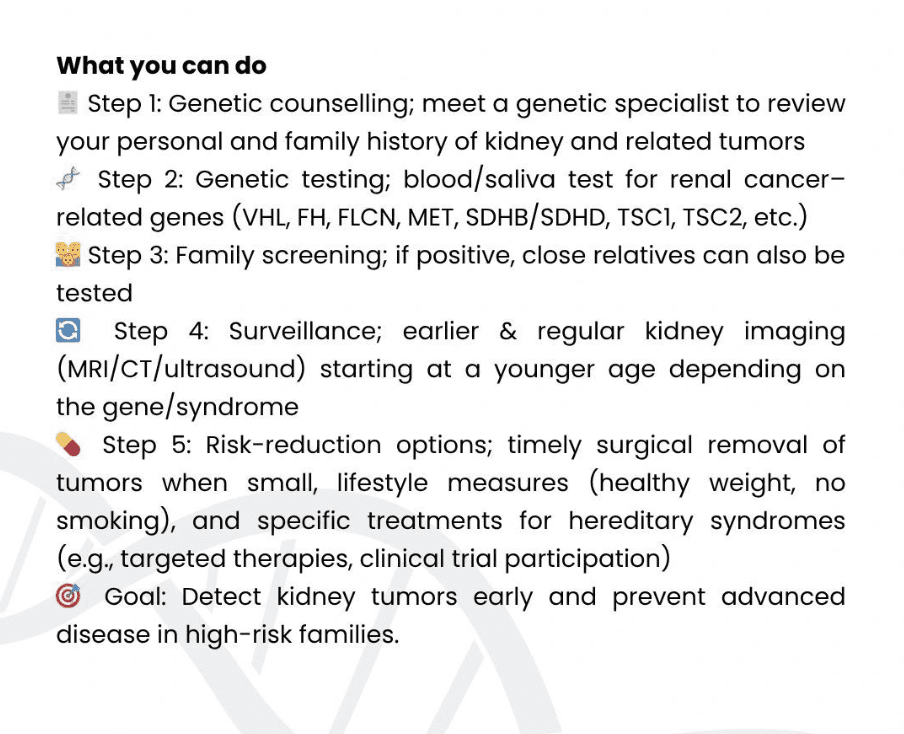
At Genetidoc Genetic Clinic and DNA Testing Lab, the 5-step approach ensures proactive care:
-
Genetic counseling – review family and personal history
-
Genetic testing – identify hereditary syndromes
-
Family screening – test and guide relatives
-
Surveillance – regular MRI/CT scans starting early
-
Risk-reduction options – timely surgery, targeted therapy, lifestyle changes
🩺 Goal: Prevent metastatic disease by catching tumors when small and treatable.
🌷 Real-World Example
A 32-year-old woman underwent kidney surgery for a small tumor.
Her doctor suggested genetic testing since her father had kidney cancer at 45.
Results revealed a VHL mutation, confirming Von Hippel–Lindau syndrome.
This discovery allowed:
-
Regular eye and brain screening to prevent complications
-
Her siblings to get tested (one tested positive and began early kidney monitoring)
-
Her young daughter to be followed proactively, ensuring no late surprises
One test transformed care for three generations.
💬 Frequently Asked Questions
Can hereditary kidney cancer skip generations?
Sometimes. Mutations can remain silent until triggered by environmental or random factors, but each child of a carrier still has a 50% risk.
Can lifestyle influence genetic kidney cancer?
Yes. Avoiding smoking, maintaining healthy weight, controlling blood pressure, and staying active help reduce risk — even in mutation carriers.
Are hereditary kidney cancers always severe?
Not necessarily. Some grow slowly and are detected early with proper surveillance. Others, like FH-related cancers, can be aggressive — making early testing vital.
Do both men and women get affected?
Yes. These syndromes can affect any gender, though expression and tumor types may vary.
Is testing expensive?
Genetic testing costs have dropped sharply in recent years. Targeted multi-gene panels are now affordable and available across major centers.
🌼 Emotional Impact and Support
Learning you have a hereditary condition can feel overwhelming.
But remember — knowledge gives power, not panic.
Families who test positive gain years of foresight to prevent advanced disease and preserve kidney function.
Counseling, family support, and proper follow-up turn fear into confidence.
🌸 Awareness Saves Lives
Hereditary kidney cancer is not rare — it’s just rarely recognized.
But awareness is growing.
Every family that identifies a gene mutation not only saves lives today but also rewrites their genetic story for tomorrow.
If kidney cancer runs in your family, don’t wait for symptoms — early testing can protect you and your loved ones.
💚 Take Action — Know Your Risk, Own Your Future
A consultation and simple blood test can reveal more than any scan alone.
Genetic awareness transforms uncertainty into prevention.