
When a parent is diagnosed with Parkinson’s disease, one of the first questions their children ask is: “Will this happen to me too?”
When the diagnosis comes at 35 or 40 instead of 70, the questions get harder. Why did this happen so young? Did I inherit it? Could I pass it to my children?
The honest answer is that for most people, Parkinson’s disease is not directly inherited. But for a meaningful group of families, genetics plays a real role, and knowing this can change how the condition is understood, managed and planned for. This guide explains when genetics matters in Parkinson’s disease, which genes are involved, who should think about genetic testing, and what a result actually means for you and your family.
Quick answer: Is Parkinson’s disease genetic?
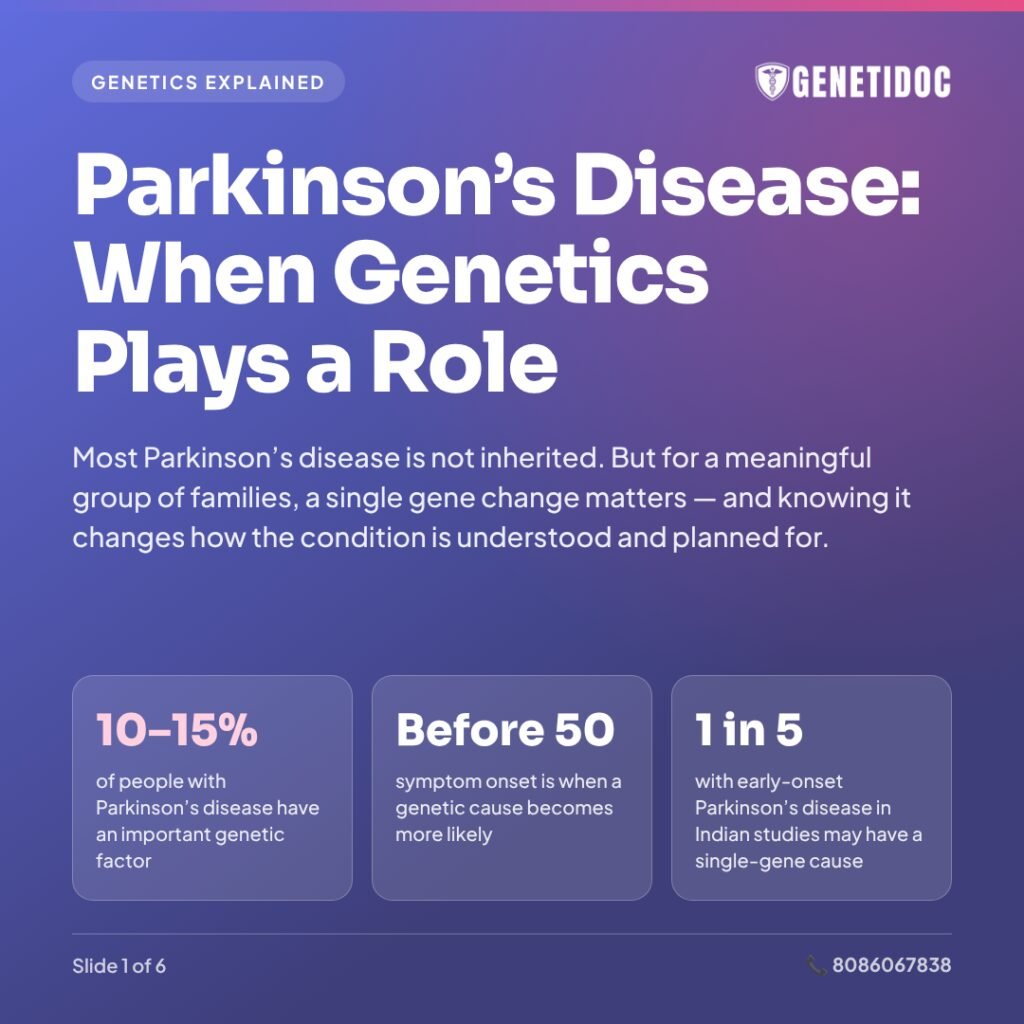
Most Parkinson’s disease is not caused by a single inherited gene. It usually develops from a mix of ageing, many small genetic influences and environmental factors. In roughly 10–15% of people with Parkinson’s disease, a specific gene change plays an important role. A genetic cause is more likely when symptoms start before the age of 50, when several close relatives are affected, or when parents are related by blood.
What Is Parkinson’s Disease?
Parkinson’s disease is a long-term condition of the brain. It happens when nerve cells in a small area of the brain, called the substantia nigra, slowly stop working and die. These cells make dopamine, a chemical messenger that helps the brain control smooth, coordinated movement.
As dopamine levels fall, movement symptoms appear:
- Tremor – shaking, often in one hand, usually when the hand is at rest
- Slowness of movement – everyday tasks such as buttoning a shirt take longer
- Stiffness – the muscles of the arms, legs or neck feel tight
- Balance problems – usually later in the condition
Parkinson’s disease also causes “non-motor” symptoms that have nothing to do with movement. These include loss of smell, constipation, sleep problems, low mood, anxiety and, in some people, changes in memory and thinking. Some of these can start years before the tremor.
Most people are diagnosed after the age of 60. When symptoms begin before 50, doctors call it early-onset Parkinson’s disease (also called young-onset Parkinson’s disease). This is where genetics becomes especially important.
How Much of Parkinson’s Disease Is Genetic?
Large international screening studies estimate that genetic factors play an important role in roughly 10–15% of all people with Parkinson’s disease. The rest is usually called “sporadic” or “idiopathic” Parkinson’s disease, which simply means no single clear cause can be found.
Even in sporadic Parkinson’s disease, genes are not completely irrelevant. Hundreds of common gene variations each nudge the risk up or down by a tiny amount. Together with age and environment, they shape who develops the condition. But none of these small variations on its own causes Parkinson’s disease, and none of them can be “tested” to predict it reliably.
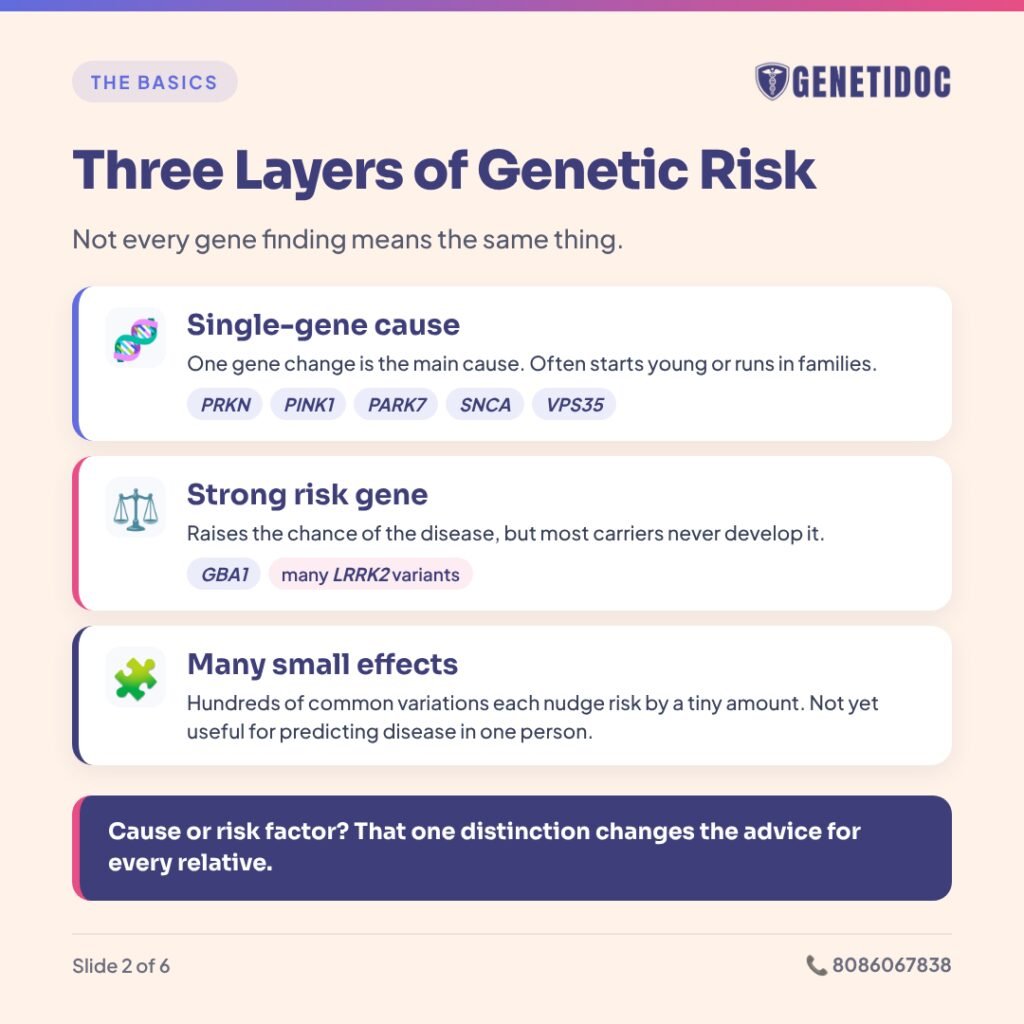
It helps to think of genetic influence in Parkinson’s disease in three layers.
| Type of genetic influence | What it means | Examples |
| Single-gene (monogenic) Parkinson’s disease | One gene change is the main cause. Often starts young or runs clearly in families. | PRKN, PINK1, PARK7, SNCA, VPS35, some LRRK2 variants |
| Strong risk genes | The gene change raises the chance of Parkinson’s disease, but most carriers never develop it. | GBA1, many LRRK2 variants |
| Many small genetic effects | Many common variations each add a very small amount of risk. | Studied as “polygenic risk scores”; not yet useful for individual diagnosis |
This distinction matters a great deal. A single-gene cause and a risk gene lead to very different conversations about family members, future children and prognosis.
“One of the first things we explain to families is the difference between a gene that causes Parkinson’s disease and a gene that only raises the risk. The two lead to very different conversations about children, brothers and sisters.”
— Dr. Roshan Daniel, Clinical Geneticist, Genetidoc
The Main Genes Linked to Parkinson’s Disease
More than 20 genes have been linked to Parkinson’s disease, but a small number account for most genetic cases. Here are the ones families are most likely to hear about.
Genes that cause recessive Parkinson’s disease
In recessive conditions, a person develops the disease only when both copies of a gene are faulty, one inherited from each parent. The parents usually have one faulty copy each, feel completely healthy, and have no idea they are carriers.
- PRKN (also called parkin) – the most common single-gene cause of early-onset Parkinson’s disease worldwide and in India. Symptoms often begin in the 20s, 30s or 40s. People usually respond very well to levodopa (the main Parkinson’s medicine) and the condition tends to progress slowly. Involuntary extra movements caused by medicine (dyskinesias) can appear early, so dosing needs care.
- PINK1 – similar to PRKN, with early onset and slow progression.
- PARK7 (also called DJ-1) – a rarer cause of early-onset recessive Parkinson’s disease.
- PLA2G6 – can cause early-onset parkinsonism, often with dystonia (sustained, twisting muscle contractions) and other neurological features. Indian studies have found it more often than studies from many other countries.
Genes that cause dominant Parkinson’s disease
In dominant conditions, a single faulty copy is enough to raise the risk. Each child of a person carrying the change has a 50% chance of inheriting it.
- LRRK2 – one of the best-studied Parkinson’s genes. LRRK2 Parkinson’s disease usually looks very similar to typical Parkinson’s disease and often begins at the usual age. Importantly, many people who carry an LRRK2 change never develop the condition (see “Reduced penetrance” below). The best-known variant, called G2019S, is common in some North African and Ashkenazi Jewish populations but appears to be rare in Indian patients studied so far.
- SNCA – this gene makes alpha-synuclein, the protein that clumps inside brain cells in Parkinson’s disease. Changes in SNCA are rare but often cause earlier onset and a more rapid course, sometimes with early memory and thinking problems.
- VPS35 – a rare cause of dominant Parkinson’s disease that typically resembles the usual form.
GBA1: the most common genetic risk factor
GBA1 deserves its own section, because it is the most common genetic finding in Parkinson’s disease worldwide and in India.
The GBA1 gene makes an enzyme called glucocerebrosidase. This enzyme works inside the lysosomes, the cell’s “recycling centres”, helping to break down a type of fatty substance. When the enzyme works less well, waste can build up inside brain cells, and this appears to make it easier for alpha-synuclein to clump together.
Around 10–15% of people with Parkinson’s disease worldwide carry a GBA1 variant. A 2025 review of Indian genetic studies estimated that up to 10% of Indian patients carry one, and research from India has identified GBA1 variants that appear specific to South Asian populations.
Three points help families make sense of a GBA1 result:
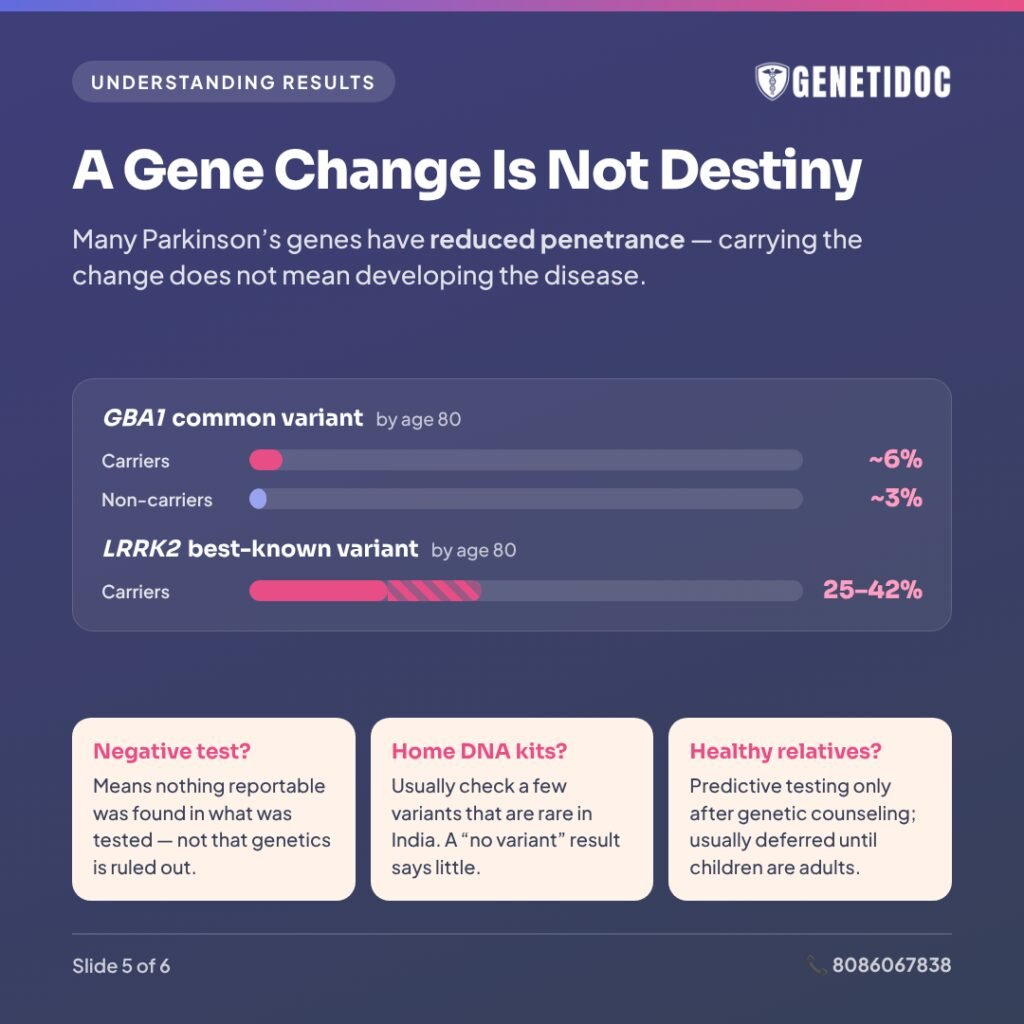
- It is a risk factor, not a certainty. Most people who carry one GBA1 variant never develop Parkinson’s disease. In one large study of people carrying a common GBA1 variant, about 6% had developed Parkinson’s disease by age 80, compared with about 3% of non-carriers. Risk differs between variants, with some “severe” variants carrying more risk than others.
- It can shape the course of the condition. People with GBA1-related Parkinson’s disease, on average, have a somewhat earlier onset and a higher chance of memory and thinking problems over time. This is an average, not a prediction for any one person.
- Two faulty copies cause a different condition. When a person inherits two faulty GBA1 copies, they have Gaucher disease, a lysosomal storage disorder that can affect the spleen, liver, bones and blood. This matters for family planning: if both partners carry a GBA1 variant, each pregnancy has a 25% chance of Gaucher disease.
“A GBA1 result is information, not a verdict. Most people who carry a GBA1 variant never develop Parkinson’s disease. What the result does is help us plan follow-up more thoughtfully and, for couples, think about Gaucher disease in future pregnancies.”
— Dr. Roshan Daniel, Clinical Geneticist, Genetidoc
Parkinson’s Disease Genetics in India
For a long time, almost everything known about Parkinson’s genetics came from studies of European and American patients. That is changing, and Indian research is showing a picture that is partly similar and partly different.
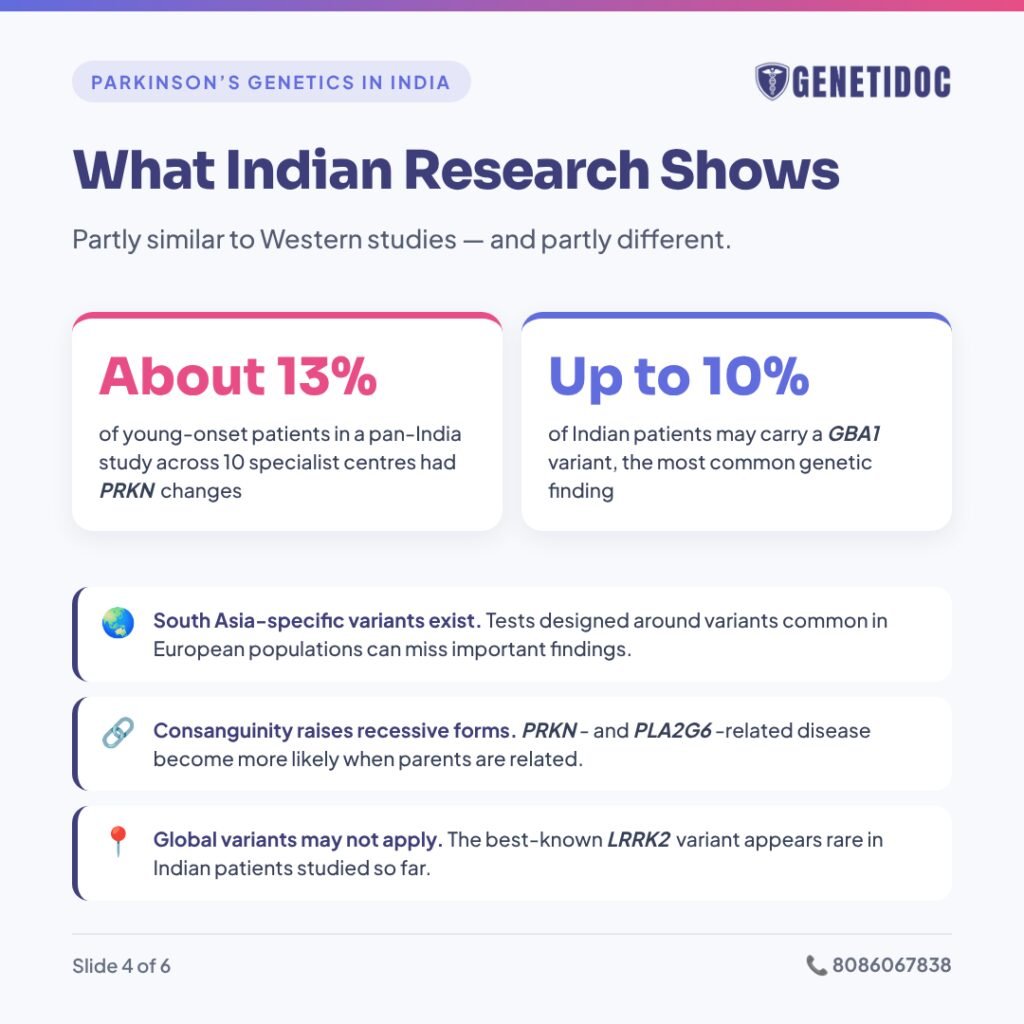
- Young-onset Parkinson’s disease is a major focus. The Genetics of PAN-India Young Onset Parkinson Disease project, run with the Parkinson’s Research Alliance of India across 10 specialist centres, found changes in PRKN in about 13% of young-onset patients studied, along with changes in GBA1, PINK1 and LRRK2.
- About one in five people with early-onset Parkinson’s disease may have a single-gene cause. A 2024 study of 230 patients from an Indian tertiary care hospital found that GBA1, PRKN and PLA2G6 were the most common genetic causes in the early-onset group.
- Some variants appear specific to South Asia. This is one reason why tests designed around variants common in European populations can miss important findings in Indian patients.
- Consanguinity raises the chance of recessive forms. In communities where marriage between relatives is common, the chance that both parents carry the same rare gene change is higher. This makes recessive Parkinson’s disease, such as PRKN– or PLA2G6-related disease, more likely to appear.
Researchers have also pointed out important gaps. Many regions and communities of India are not yet well represented in genetic studies, and some variants are classified differently by different laboratories. This is why interpretation by an experienced clinical geneticist matters so much for Indian families.
Who Should Consider Genetic Testing for Parkinson’s Disease?
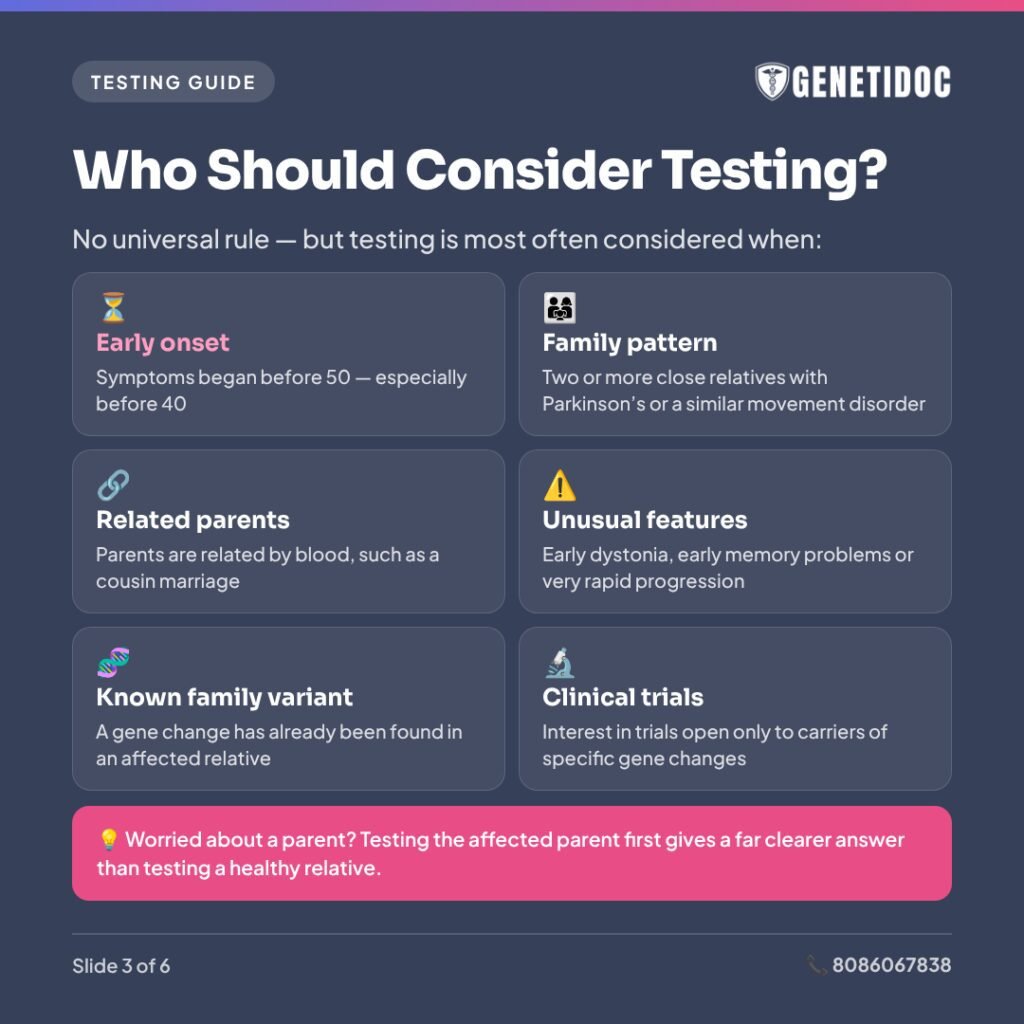
There is no single universal rule. International experts, including a task force of the International Parkinson and Movement Disorder Society, have noted that guidance on who to test is still developing. In practice, genetic testing is most often considered in the following situations:
- Symptoms began before the age of 50, and especially before 40.
- Two or more close relatives (parents, brothers, sisters, children, grandparents, aunts or uncles) have Parkinson’s disease or a similar movement disorder.
- The parents are related by blood, for example in a cousin marriage.
- The symptoms are unusual, for example dystonia at the start, early memory problems, very rapid progression, or other neurological features alongside parkinsonism.
- A gene change has already been found in a relative with Parkinson’s disease.
- A person with Parkinson’s disease is interested in clinical trials that are open only to carriers of specific gene changes.
Some experts now argue that genetic testing should be offered more widely, because a genetic cause is sometimes found even in people who started late and have no family history. Whether testing is right for you depends on your own situation and what you hope to learn.
When genetic testing may not add much
- A person diagnosed in their late 70s with typical Parkinson’s disease and no affected relatives is unlikely to have a single-gene cause, although it is not impossible.
- A healthy person who simply has one grandparent with late-onset Parkinson’s disease usually has only a slightly higher risk than average. A genetic test is unlikely to give a useful answer.
- If the main question is “Will I get Parkinson’s disease?” and there is no known gene change in the family, testing a healthy person first rarely gives a clear answer. The best starting point is usually the affected relative.
A consultation with a clinical geneticist helps sort out which of these situations applies to you.
Parkinson’s Look-Alikes: Why the Right Diagnosis Comes First
Not every tremor or slowness in a young person is Parkinson’s disease. Several other conditions, some of them genetic and some of them treatable, can look similar, especially in young adults. A good genetic evaluation keeps these in mind.
- Wilson disease – an inherited condition in which copper builds up in the liver and brain. It can cause tremor, stiffness, slowness and behaviour changes in teenagers and young adults. It is treatable, which is why doctors routinely check copper-related blood tests and look for a characteristic ring in the eye in young people with parkinsonism.
- Dopa-responsive dystonia – an inherited condition, usually starting in childhood, that responds dramatically to small doses of levodopa.
- Spinocerebellar ataxias – especially types 2 and 3, which can sometimes cause parkinsonism. These are caused by “repeat expansions”, where a short piece of DNA is repeated too many times.
- Other inherited neurodegenerative conditions – including some brain iron accumulation disorders and certain forms of dementia with parkinsonism.
The type of genetic change matters because not every test can see every kind of change. Standard gene panels and exome sequencing read the DNA letters inside genes very well. They are much less reliable at detecting repeat expansions, which need specific tests. They can also miss large deletions or duplications of whole sections of a gene, which are common in PRKN, unless the laboratory specifically analyses for them. Choosing a test that covers the right type of change is part of good test selection.
How Is Genetic Testing for Parkinson’s Disease Done?
Genetic testing is done on a blood sample (or sometimes saliva). The choice of test depends on the clinical picture and family history.
- Parkinson’s or movement disorder gene panel – looks at a selected group of genes known to cause Parkinson’s disease and related conditions. This is often the first step for early-onset or familial Parkinson’s disease. A good panel should include analysis for deletions and duplications, especially in PRKN. A multi-gene panel typically takes about three to four weeks.
- Whole exome sequencing – reads almost all the genes that make proteins. It may be chosen when the features are unusual or point to several possible conditions.
- Repeat expansion testing – needed when a spinocerebellar ataxia or another repeat-expansion condition is suspected.
- Targeted variant testing – when a relative’s gene change is already known, only that specific change is checked. This is faster and more focused.
Before testing, genetic counseling explains what the test can and cannot find, what kinds of results are possible, and what each result could mean for you and your relatives. Costs vary with the type of test, and your genetic counselor can explain the options before you decide.
What Can a Genetic Result Change?
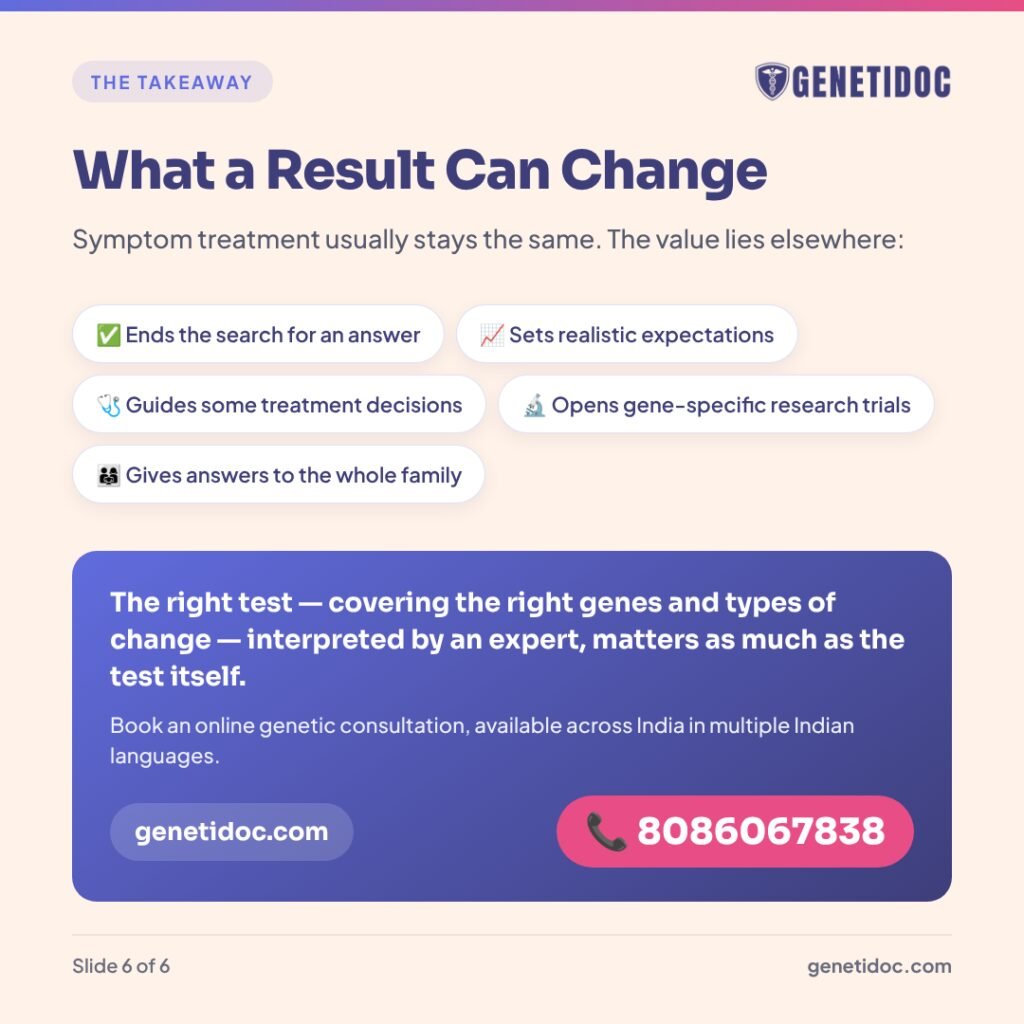
There is currently no approved medicine designed for a specific Parkinson’s gene, and treatment of symptoms is largely the same whatever the cause. So why test at all? Because a result can still change several important things.
1. It ends the search for an answer
For many young patients, a genetic diagnosis brings relief. It explains why Parkinson’s disease appeared so early, and it closes a long and often expensive search for other causes. It also removes guilt and self-blame, a burden many young patients quietly carry.
“When Parkinson’s disease begins in someone’s thirties or forties, a genetic evaluation should be part of the conversation. For many young patients, finding the cause brings relief after years of uncertainty and self-blame.”
— Dr. Roshan Daniel, Clinical Geneticist, Genetidoc
2. It helps set realistic expectations
Different genetic forms tend to behave differently. On average:
- PRKN– and PINK1-related Parkinson’s disease often progresses slowly, responds well to levodopa and is less often linked with dementia.
- LRRK2-related Parkinson’s disease often looks like typical Parkinson’s disease, with studies suggesting fewer non-motor problems such as memory and smell loss.
- GBA1-related Parkinson’s disease carries a higher average chance of memory and thinking problems over time.
These are patterns across groups of people. Your neurologist and genetic counselor will interpret them in light of your own course.
3. It can inform treatment decisions
Genetic information can feed into some treatment choices. For example, when deep brain stimulation (a surgical treatment that uses electrodes placed in the brain) is being considered, specialists may take GBA1 status into account, because some studies suggest a faster decline in thinking skills after surgery in GBA1 carriers. For people with PRKN-related disease, knowing about the tendency to early dyskinesias can guide how medicine doses are adjusted. These decisions always rest with the treating neurologist.
4. It opens the door to research and clinical trials
Gene-targeted treatments are one of the most active areas of Parkinson’s research. Two examples show both the promise and the uncertainty:
- LRRK2-targeted medicines. In May 2026, a large phase 2b trial called LUMA reported that an LRRK2-blocking drug did not slow progression in a broad group of people with early Parkinson’s disease, most of whom did not carry an LRRK2 A separate trial in people who do carry LRRK2 variants, called BEACON, is continuing.
- GBA1-targeted approaches. A phase 3 trial in the United Kingdom, called ASPro-PD, is testing whether high-dose ambroxol, a long-established cough medicine that may boost the GBA1 enzyme, can slow Parkinson’s disease. Participants’ GBA1 status must be known before they join.
Most of these trials are currently outside India, and none of these treatments is approved for Parkinson’s disease. Still, knowing your genetic status keeps future options open as research develops.
5. It gives answers to the family
This is often the most important benefit, and it is covered in detail below.
What Does a Result Mean for My Family?
If the cause is recessive (for example, PRKN)
- Each brother or sister of the affected person has a 25% chance of having inherited both faulty copies, a 50% chance of being a healthy carrier, and a 25% chance of inheriting neither.
- The affected person’s children will usually be healthy carriers, because they inherit one faulty copy from their affected parent and, in most cases, a working copy from the other parent. The risk to children is higher if the other parent also carries a change in the same gene, which is more likely in consanguineous marriages.
- Carriers of one faulty PRKN copy generally do not develop the recessive form. Whether a single copy slightly raises Parkinson’s risk is still debated.
If the cause is dominant (for example, LRRK2)
- Each child, brother or sister of the affected person has a 50% chance of carrying the same change.
- Carrying the change does not mean a person will definitely develop Parkinson’s disease.
Reduced penetrance: why a gene change is not destiny
Doctors use the word “penetrance” to describe how likely it is that a person with a gene change will actually develop the condition. Many Parkinson’s genes have reduced penetrance.
For the LRRK2 G2019S variant, for example, studies estimate that about 25–42% of carriers will have developed Parkinson’s disease by the age of 80. That means many carriers live their whole lives without it. Research also suggests that other genes and environmental factors influence who goes on to develop Parkinson’s disease, which is why the same gene change can behave very differently in two members of the same family.
Should healthy relatives be tested?
Testing a healthy relative to find out whether they carry the family’s gene change is called predictive testing. In Parkinson’s disease, this decision needs particular care, for three reasons:
- A positive result does not mean a person will get Parkinson’s disease, because of reduced penetrance.
- There is currently no proven way to prevent Parkinson’s disease in a healthy carrier. A healthy lifestyle, including regular exercise, is good advice for everyone, carrier or not.
- The emotional impact can be significant. Some people find knowing reassuring or useful for planning. Others find it a burden. Both choices are valid, and the right not to know is respected.
For these reasons, predictive testing is offered only after detailed genetic counseling, ideally after the gene change has been confirmed in the affected relative. For adult-onset conditions like Parkinson’s disease, international practice generally waits until a child reaches adulthood and can make their own decision.
For some families, especially those with early-onset recessive forms, genetic counseling can also cover options for future pregnancies once the family’s gene change is clearly identified.
“When a healthy son or daughter asks to be tested, we usually start with the affected parent. Testing a healthy person first rarely gives a clear answer, and we want every family member to understand what a result can and cannot tell them before they decide.”
— Dr. Roshan Daniel, Clinical Geneticist, Genetidoc
What If the Genetic Test Is Negative?
Most people with Parkinson’s disease who are tested will have a negative result. A negative result means no reportable finding was identified in the genes and types of change that were tested. It does not prove that genetics plays no part, because:
- Many genetic influences on Parkinson’s disease are still unknown.
- Some types of change, such as repeat expansions or certain structural changes, may not be covered by the test used.
- Many small common variations, which together add risk, are not reported on diagnostic tests.
For relatives, a negative result in the affected person usually means their own risk is only modestly higher than average. Their best protection remains general health measures and paying attention to symptoms.
Sometimes the result is a variant of uncertain significance, a gene change that cannot yet be classified as harmful or harmless. This should not be used to test healthy relatives or make medical decisions. These results can be reviewed again later as scientific knowledge grows.
What About Polygenic Risk Scores and Home DNA Kits?
Polygenic risk scores add up the effects of many common gene variations to estimate risk. In research, they help explain why some carriers of LRRK2 or GBA1 changes develop Parkinson’s disease and others do not. But they are not yet reliable enough to predict Parkinson’s disease for an individual, and most were developed using European populations. They should not be used to make personal health decisions about Parkinson’s disease today.
Direct-to-consumer DNA kits sometimes report Parkinson’s risk, but usually for only a handful of specific variants, such as LRRK2 G2019S and a few common GBA1 variants. These variants are mostly common in other populations and appear to be rare in India. A “no variant detected” result from such a kit says very little about an Indian person’s actual genetic risk, and a positive result still needs confirmation and expert counseling.
Common Situations Where Genetics Comes Up
The following scenarios are general illustrations, not individual patient stories.
The young professional with a tremor. A man in his early thirties notices his right hand shaking and his handwriting getting smaller. He is diagnosed with early-onset Parkinson’s disease. His parents are first cousins, and no one else in the family is affected. This combination of young onset and consanguinity is exactly the situation in which a recessive cause, such as PRKN, should be considered.
The worried daughter. A woman in her forties has watched her father live with Parkinson’s disease since his late sixties. No one else in the family is affected. She wants to know her own risk. In this situation, her risk is only slightly higher than average, and testing her alone is unlikely to give a useful answer. If testing is considered at all, the more informative step is usually to offer it to her father first.
The family with several affected members. A grandmother, her son and her brother all developed Parkinson’s disease in their fifties and sixties. A pattern across generations like this raises the possibility of a dominant cause, and testing an affected family member can clarify the picture for everyone.
Common Misconceptions About Parkinson’s Disease and Genetics
“My parent has Parkinson’s, so I will definitely get it.”
Not true. Most Parkinson’s disease is not inherited in a simple way. Having one affected parent raises the risk only modestly in most families.
“Parkinson’s only happens to old people, so mine can’t be genetic.”
Parkinson’s disease can begin in the 20s, 30s and 40s, and young onset is exactly when a genetic cause is most likely.
“If I carry the gene, I will definitely get Parkinson’s.”
For LRRK2 and GBA1, most carriers never develop Parkinson’s disease. A gene change raises risk; it does not guarantee disease.
“My test was negative, so genetics is ruled out.”
A negative test means nothing reportable was found in what was tested. It does not exclude every genetic influence.
“A genetic result will change my medicines straight away.”
Usually not. Symptom treatment is mostly the same. The value of a result is in understanding, planning, family decisions and research opportunities.
Why Expert Interpretation and Genetic Counseling Matter
In Parkinson’s disease, a genetic report is rarely a simple “yes” or “no”. Expert interpretation makes a real difference:
- Choosing the right test. The test needs to cover the right genes and the right types of change, such as PRKN deletions and, when relevant, repeat expansions.
- Considering look-alike conditions. Treatable conditions such as Wilson disease must not be missed.
- Telling a cause from a risk factor. A GBA1 result and a PRKN result lead to very different advice for relatives.
- Explaining reduced penetrance. Families need to understand that a gene change is not a diagnosis of future disease.
- Interpreting variants in the Indian context. Some variants seen in Indian families are rare elsewhere and need careful review.
- Supporting decisions about relatives. Predictive testing, timing and the right not to know all need thoughtful counseling.
At Genetidoc, testing is carried out through accredited partner laboratories, and results are reviewed by a clinical geneticist and explained through genetic counseling. The aim is not just a report, but a clear understanding of what the result means for you and your family. Ongoing care continues with your neurologist.
“In Parkinson’s genetics, the report is only the starting point. The real value comes from choosing the right test, ruling out treatable look-alikes, and explaining what the result means for the patient and for every relative.”
— Dr. Roshan Daniel, Clinical Geneticist, Genetidoc
What To Do If Genetics May Be Involved
- Write down your family history. Note anyone with Parkinson’s disease, tremor, dystonia, balance problems or dementia, and the age at which their symptoms started.
- Mention consanguinity. Tell your doctor if your parents or grandparents are related by blood.
- Talk to your neurologist about whether your age at onset or symptoms suggest a genetic evaluation.
- Consult a clinical geneticist before testing, so that the right test is chosen and you understand what the results can and cannot tell you.
- If a gene change is found, discuss with your genetic counselor how and when to share the information with relatives.
- Keep your report and stay in touch. Genetic knowledge in Parkinson’s disease is moving fast, and an uncertain result may be clarified later.
Frequently Asked Questions
1. Is Parkinson’s disease hereditary?
Usually not. Most Parkinson’s disease is caused by a mix of ageing, environment and many small genetic effects. In roughly 10–15% of people, a specific gene change plays an important role, and some of these forms can be passed down in families.
2. If my father has Parkinson’s disease, what is my risk?
Having one affected parent with typical, later-onset Parkinson’s disease raises your risk only modestly above the general population. The risk is higher if several relatives are affected or if your parent’s symptoms started young.
3. Which genes cause Parkinson’s disease?
The most important genes include PRKN, PINK1 and PARK7 (recessive), LRRK2, SNCA and VPS35 (dominant), and GBA1, the most common genetic risk factor. In India, PLA2G6 is also an important cause of early-onset parkinsonism.
4. Is young-onset Parkinson’s disease genetic?
Genetic causes are much more common when Parkinson’s disease begins before 50. Indian studies suggest that around one in five people with early-onset Parkinson’s disease may have a single-gene cause.
5. Who should get genetic testing for Parkinson’s disease?
Testing is most often considered when symptoms start before 50, when several relatives are affected, when parents are related by blood, when symptoms are unusual, or when a gene change is already known in the family.
6. What is GBA1 and how does it affect Parkinson’s risk?
GBA1 makes an enzyme that helps cells break down waste. Variants in GBA1 are the most common genetic risk factor for Parkinson’s disease, but most carriers never develop the condition.
7. If I carry an LRRK2 or GBA1 variant, will I get Parkinson’s disease?
Not necessarily. These variants raise risk but have reduced penetrance. For example, studies estimate that about 25–42% of LRRK2 G2019S carriers develop Parkinson’s disease by age 80.
8. Can genetic testing prevent Parkinson’s disease?
No. There is currently no proven way to prevent Parkinson’s disease in a gene carrier. Testing helps with understanding, planning, family decisions and access to research.
9. Will a genetic result change my Parkinson’s treatment?
Usually symptom treatment stays the same. But genetic information can help set expectations, inform decisions such as deep brain stimulation, and make you eligible for gene-specific clinical trials.
10. Should my children be tested?
Predictive testing of healthy relatives is a personal decision made only after genetic counseling. For adult-onset conditions like Parkinson’s disease, testing of children is generally deferred until they are adults and can decide for themselves.
11. Are home DNA tests useful for Parkinson’s risk?
Their value is limited, especially for Indian users. They usually check only a few variants that are common in other populations and rare in India, so a negative result says little about real risk.
12. Does a negative genetic test mean my Parkinson’s is not genetic?
No. It means no reportable change was found in what was tested. Some genetic influences are unknown or not covered by current tests.
Key Takeaways
- Most Parkinson’s disease is not directly inherited, but genetics plays an important role in roughly 10–15% of people.
- A genetic cause is more likely with onset before 50, several affected relatives, or consanguineous parents.
- PRKN and GBA1 are among the most important Parkinson’s genes in India.
- Many gene changes raise risk without guaranteeing disease. A positive result is not a prediction of certain illness.
- A genetic result can explain the diagnosis, shape expectations, inform some treatment decisions and open research options.
- Predictive testing for healthy relatives needs careful genetic counseling.
- Choosing the right test and having it interpreted by an expert matter as much as the test itself.
Diagnosed With Parkinson’s at a Young Age, or Worried About Parkinson’s in Your Family?
If your symptoms began before 50, several relatives are affected, or your parents are related by blood, a consultation with a clinical geneticist can help you understand whether genetics may be involved. You will learn which test, if any, fits your situation, and what a result would mean for you, your brothers and sisters, and your children.
Genetidoc offers online genetic counseling across India, with counseling available in multiple Indian languages.
Book a Parkinson’s genetics consultation
Have questions about Parkinson’s disease and genetics, or want to connect with other families? Visit the Genetidoc Rare Disease Forum.
Related Reading
- Single Gene vs Panel Testing Explained
- Why Identical Twins Are Not Always Genetically Identical
- Personalized Medicine: The Role of Genetic Testing in Your Care
- Genetic Eye Disease in Children: When to Test
- Facial Features and Genetic Syndromes: A Guide for Parents
References
- Cook L, Verbrugge J, Schwantes-An TH, et al. Parkinson’s disease variant detection and disclosure: PD GENEration, a North American study. Brain. 2024;147(8):2668–2679.
- Westenberger A, Skrahina V, Usnich T, et al. Relevance of genetic testing in the gene-targeted trial era: the Rostock Parkinson’s disease study. Brain. 2024;147(8):2652–2667.
- Pal G, Cook L, Schulze J, et al. Genetic testing in Parkinson’s disease. Mov Disord. 2023;38(8):1384–1396.
- Andrews SV, Kukkle PL, Menon R, et al. The genetic drivers of juvenile, young, and early-onset Parkinson’s disease in India. Mov Disord. 2024.
- Bhowmick SS, Desai SD. Genetic sketch of Parkinson’s disease in India. Ann Indian Acad Neurol. 2025;28(4):495–504.
- Genetic architecture of a single cohort of 230 Indian Parkinson’s disease patients. Parkinsonism Relat Disord. 2024;107157.
- Holla VV, et al. PRKN-gene-related parkinsonism: an experience from a tertiary centre and literature review of Asian cohort. Can J Neurol Sci. 2025.
- Marder K, Wang Y, Alcalay RN, et al. Age-specific penetrance of LRRK2 G2019S in the Michael J. Fox Ashkenazi Jewish LRRK2 Consortium. Neurology. 2015;85(1):89–95.
- Iwaki H, Blauwendraat C, Makarious MB, et al. Penetrance of Parkinson’s disease in LRRK2G2019S carriers is modified by a polygenic risk score. Mov Disord. 2020;35(5):774–780.
- Kmiecik MJ, Micheletti S, Coker D, et al. Genetic analysis and natural history of Parkinson’s disease due to the LRRK2 G2019S variant. Brain. 2024;147(6):1996–2008.
- Penetrance, risk and phenotypes of Parkinson’s disease in LRRK2 G2019S and GBA N370S carriers (23andMe cohort). medRxiv 2024. doi:10.1101/2024.11.15.24317402.
- Pal G, Mangone G, Hill EJ, et al. Parkinson disease and subthalamic nucleus deep brain stimulation: cognitive effects in GBA mutation carriers. Ann Neurol. 2022;91(3):424–435.
- Protocol of ASPro-PD: a phase 3 trial of ambroxol to slow progression in genetically stratified Parkinson’s disease. J Neurol. 2026. doi:10.1007/s00415-026-13683-7. ClinicalTrials.gov NCT05778617.
- Biogen and Denali Therapeutics. Update on Phase 2b LUMA study of BIIB122 (DNL151) in early-stage Parkinson’s disease. Press release, 21 May 2026. ClinicalTrials.gov NCT05348785.
- Parkinson Disease Overview. In: Adam MP, et al., eds. GeneReviews. Seattle (WA): University of Washington, Seattle. Available at: https://www.ncbi.nlm.nih.gov/books/NBK1223/
This article is for educational purposes and does not replace personal medical advice. Please consult a qualified doctor or clinical geneticist about your individual situation.