
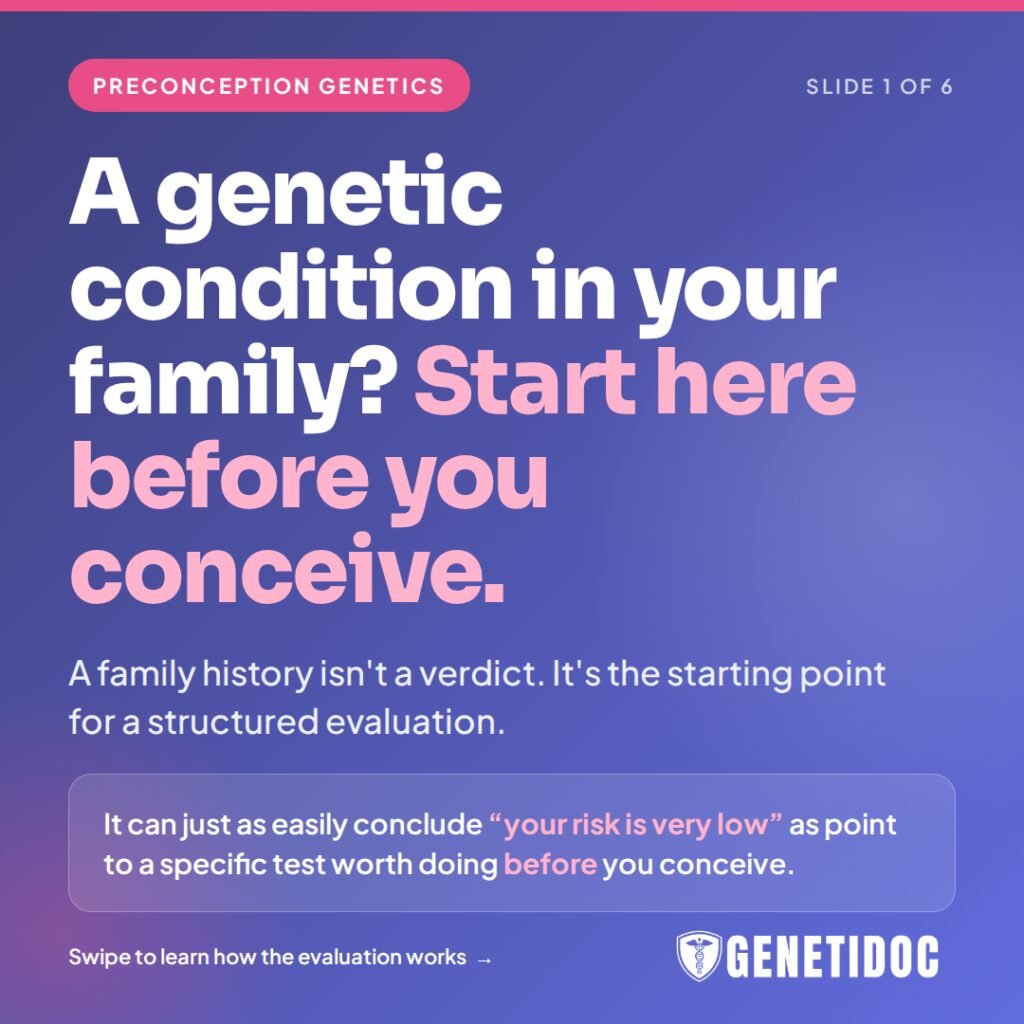
“My cousin’s child has a genetic condition — does that mean my baby is at risk too?”
This is one of the most common concerns couples bring to a genetic consultation before trying to conceive. And the honest answer is: it depends — not on how worried you are, but on specific, findable facts about the condition, the affected relative, and how the two of you are connected.
A family history of a genetic condition is not a verdict. It is a starting point for a structured evaluation — one that can just as easily conclude “your risk is very low” as it can point toward a specific test you should consider before you conceive. This article walks through exactly how that evaluation works, what questions to ask your own family first, and how to avoid the two most common mistakes couples make: panicking over something that turns out to be low-risk, and dismissing something that turns out to matter.
| Quick answer: What counts as a “significant” family history before pregnancy?
A family history is generally considered clinically significant when it includes: a confirmed genetic diagnosis in a first- or second-degree relative, a condition that has repeated across more than one family member, an early infant death without an explained cause, recurrent pregnancy loss, or a consanguineous marriage (blood relation between partners). A single distant relative with an unconfirmed or common adult-onset condition is usually much lower risk than it feels. |
Why “There’s a Genetic Condition in My Family” Isn’t One Question — It’s Four
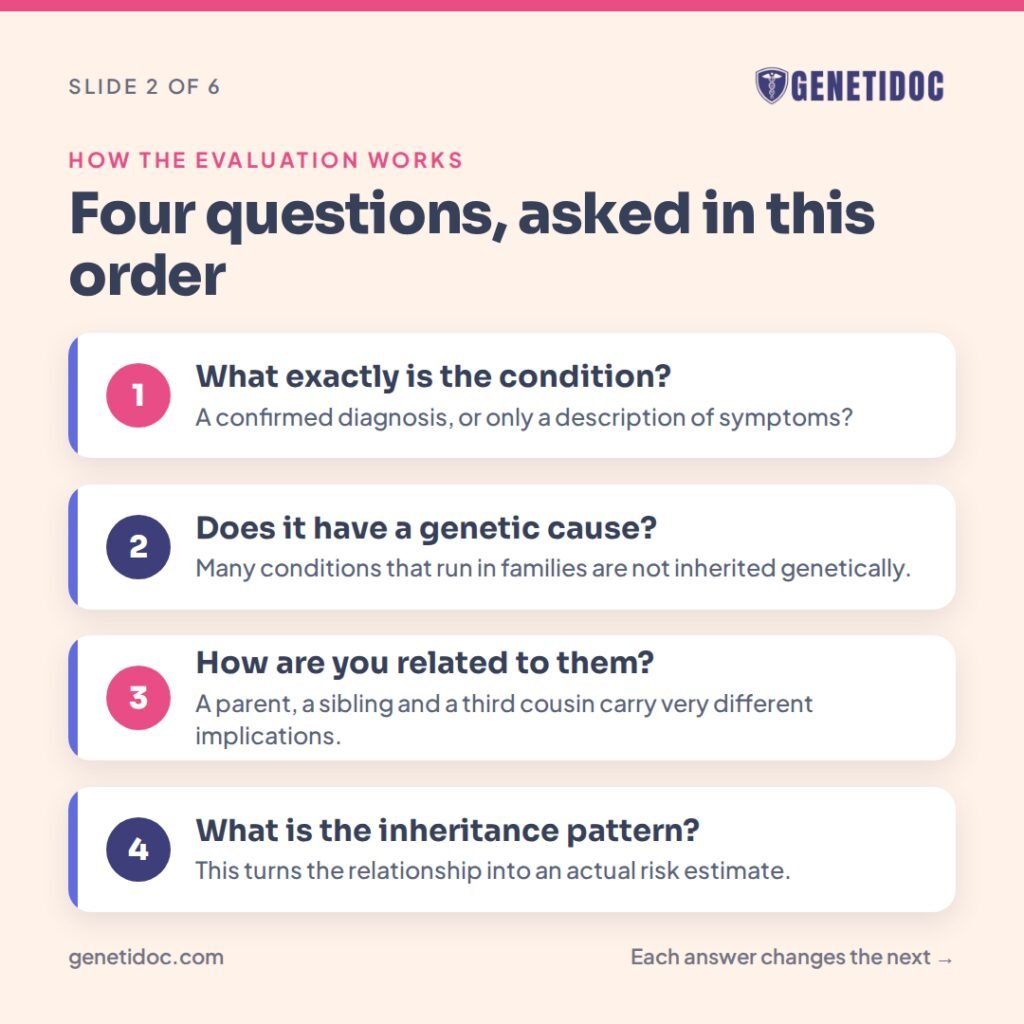
When a patient describes a genetic condition running in the family, a clinical geneticist doesn’t jump straight to ordering a test. The evaluation follows a specific sequence, and skipping steps is exactly how people end up either overestimating or underestimating their risk.
Team Genetidoc describes the process as four sequential questions, each of which changes the answer to the next:
- What exactly is the condition? Is there a confirmed diagnosis, or only a description of symptoms?
- Does it actually have a genetic cause? Many conditions that run in families are not inherited in the genetic sense at all.
- How is the affected person related to you? A parent, a sibling, and a third cousin carry very different implications, even for the same condition.
- What is the condition’s inheritance pattern? This can only be worked out once the condition itself is known — and it’s what determines how the answer to Question 3 translates into an actual number.
Only after working through all four does a meaningful risk estimate — and a testing recommendation — become possible.
Case in Point: Why Distance Matters More Than People Expect
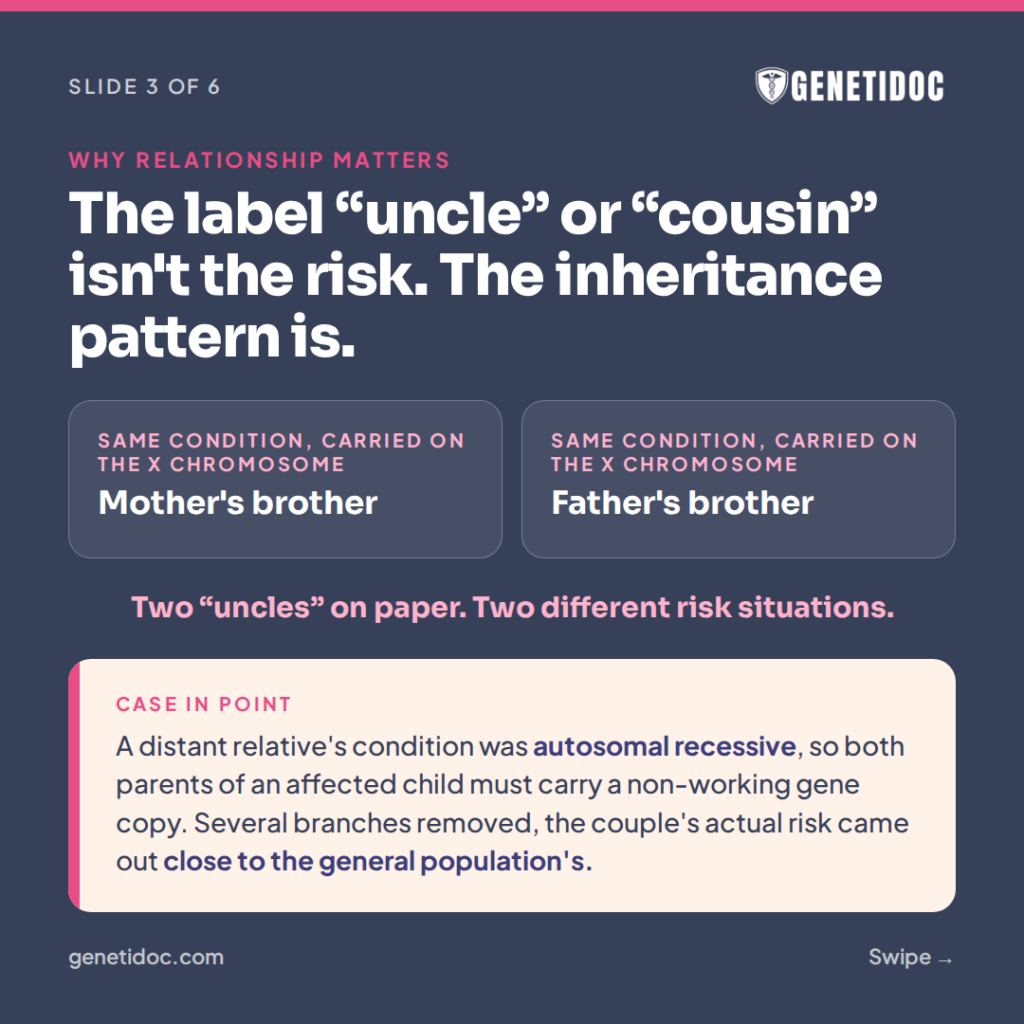
| A couple came in deeply worried about a condition diagnosed in a distant relative on one side of the family. After a detailed family history and confirmation of the diagnosis, the condition turned out to follow an autosomal recessive inheritance pattern — meaning both parents of an affected child must carry a non-working copy of the gene associated with the condition. Because the relative in question was several branches removed from the couple, the chance that either partner carried the same gene variant purely through that family connection was very low. Carrier screening was still offered, not because the family history demanded it, but as a reasonable extra reassurance step. The couple’s actual risk, once properly evaluated, turned out to be close to the general population’s. |
This is a genuinely common pattern. Cancer is the condition category that most frequently triggers this kind of family-history concern — a diagnosis in a relative, understandably, raises alarm. But most cancers are not caused by a single inherited gene variant, and even among hereditary cancer syndromes, a topic our Hereditary Cancer Syndromes forum covers in more depth, the risk to a specific relative depends heavily on exactly how closely related they are and on which side of the family the condition runs.
| “Patients often ask if any genetic condition in the family is a red flag. It isn’t the presence of a condition that matters most — it’s the relationship pattern and the way that condition is inherited. Those two facts, worked out properly, usually bring the anxiety down to a manageable, realistic number.”
— Team Genetidoc |
Building the Family Tree: Why We Ask About Three Generations
A standard preconception genetic evaluation takes a three-generation family history — you, your parents, your grandparents, and your siblings, aunts, uncles, and first cousins along the way. This is usually enough to identify a meaningful pattern.
That window widens in two situations:
- When a condition appears repeatedly in extended family members beyond the standard three generations
- When the couple is consanguineous (related by blood) — in which case the family tree needs to trace further, in the specific direction of how the couple is connected
The Relationship That Matters Isn’t the Label — It’s the Inheritance Pattern
Here is where family-history conversations most often go wrong: people assume “uncle” or “cousin” is itself the risk factor. It isn’t. What actually determines risk is the combination of how the condition is inherited and exactly how the affected relative connects to you.
For example, a maternal uncle affected by a condition carried on the X chromosome (X-linked inheritance) is a very different risk situation than a paternal uncle with the same condition — even though both are, on paper, “an uncle.” This is why a genetic counselor’s questions can feel oddly specific (“was this your mother’s brother or your father’s brother?”) — the answer genuinely changes the calculation.
| Family History Pattern | What It Usually Points To | Typical First Step |
| Multiple different conditions across multiple relatives on both sides, no confirmed diagnosis | No single clear genetic cause identifiable yet | Carrier screening of the couple |
| Consistent features pointing to one specific, named condition | A likely single genetic cause | Targeted testing of the affected relative first, if available |
| Condition known to be caused by many different possible genes | Genetic heterogeneity | A broader multi-gene panel |
| Couple is consanguineous (blood-related) | Shared recessive gene variants more likely | Duo-exome sequencing (both partners tested together) is often the preferred carrier screening approach |
When the Affected Relative Isn’t Available for Testing
Ideally, the affected family member is tested first — confirming their exact genetic diagnosis makes it possible to test the couple for that specific finding, which is faster and more affordable than broader testing. But that relative may have passed away, be estranged from the family, or simply never have been tested.
When that’s the case, the evaluation still moves forward:
- Carrier screening of the couple becomes the default starting point
- If the described symptoms clearly match a specific, recognizable condition, targeted testing for that condition is used instead
- Otherwise, screening prioritizes conditions known to have a higher carrier frequency in the relevant population
- A broader panel is used if the couple prefers a wider net, or if there is consanguinity
The Most Common Mistake: The Wrong Test for the Right Concern
Not every genetic test can detect every type of genetic change — and this is where a surprising number of testing mistakes happen, both from self-ordered tests and from well-meaning referrals.
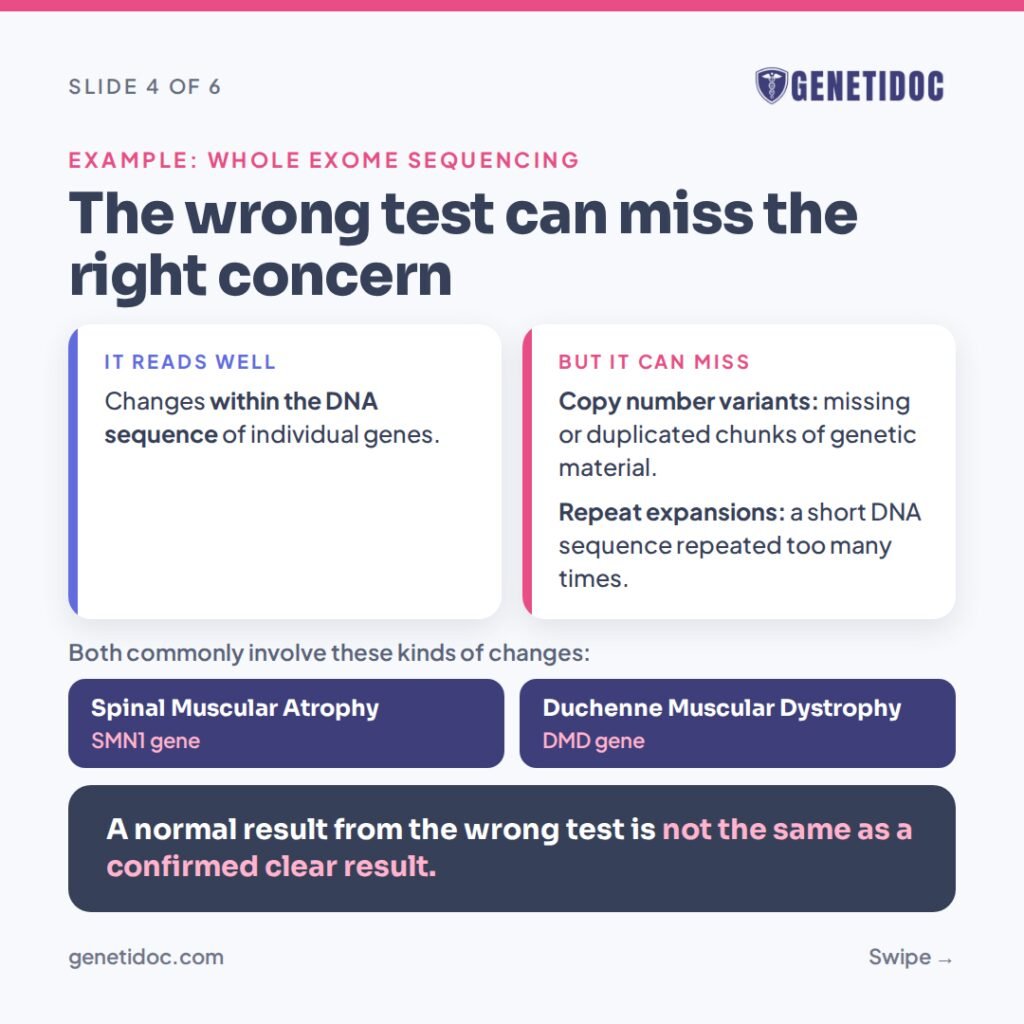
Whole exome sequencing, for instance, is excellent at finding changes within the DNA sequence of individual genes. But it is not the right tool for conditions caused by copy number variants — missing or duplicated chunks of genetic material — or by repeat expansions, a type of genetic change where a short DNA sequence is repeated too many times. Spinal Muscular Atrophy, caused by changes in the SMN1 gene, and Duchenne Muscular Dystrophy, caused by changes in the DMD gene, both commonly involve exactly these kinds of changes — which means whole exome sequencing alone can miss them entirely.
For example, whole exome sequencing has occasionally been ordered for a patient with a family history of Spinal Muscular Atrophy or Duchenne Muscular Dystrophy, only for the result to come back “normal” — not because the condition was ruled out, but because that particular test was never able to detect this type of genetic change in the first place. A normal result from the wrong test is not the same as a confirmed clear result. Our Spinal Muscular Atrophy and Duchenne Muscular Dystrophy forums go into this distinction in more detail, for anyone dealing with either condition specifically.
Another frequent confusion — one we field often on our Non-Invasive Prenatal Testing forum — is that Non-Invasive Prenatal Testing is a screening test, not a diagnostic one. A high-risk Non-Invasive Prenatal Testing result estimates probability — it does not confirm that a baby is affected. Confirming a screening result requires a diagnostic test. Treating a screening result as a final answer, in either direction, is a well-documented source of unnecessary distress or false reassurance.
What “High Risk” and “Carrier” Actually Mean
Two specific misunderstandings come up again and again in preconception counseling:
| “High risk” is not the same as “affected.” In prenatal screening, a high-risk result means the statistical probability is elevated — not that the condition has been confirmed. It’s a signal to pursue diagnostic testing, not a diagnosis in itself.
Being a “carrier” does not mean every child will be affected. A carrier has one working and one non-working copy of a gene and is typically healthy. Whether a child is affected depends on whether the partner is also a carrier of a variant in the same gene — and even then, the risk is a per-pregnancy probability, not a certainty. |
Family History Patterns in the Indian Context
Certain conditions cluster geographically and by community in India — but not necessarily along the lines people assume.
In Kerala specifically, two examples stand out:
- GJB2-related hearing loss carries a notably high carrier frequency in the Kerala population, linked to a founder genetic variant — a variant that became common in a population because it was present in an early ancestral group, based on Team Genetidoc’s clinical experience with the local population.
- Sickle cell disease has a well-documented high carrier frequency among tribal communities in the Wayanad district of Kerala, with published gene-frequency studies reporting rates as high as 18–34% in specific tribal groups — high enough that population screening and genetic counseling programs have historically been run across the district.
Importantly, Team Genetidoc’s clinical experience does not point to any broad, systematic increase in carrier frequency tied to caste or religious grouping in general. Clustering tends to be geography- or community-based rather than caste- or religion-based — the Kerala examples above are tied to specific regional and tribal populations, not to caste or religious identity as such. This is a useful myth to correct, since assumptions in either direction can lead to either unnecessary anxiety or missed screening opportunities.
Consanguineous marriage and community- or faith-based matchmaking practices, seen in parts of India including Kerala, are a separately recognized factor that can increase the chance of both partners carrying a variant in the same recessive gene — which is one reason family history and marriage patterns are both part of a complete preconception evaluation.
“I Don’t Know My Family History” — What Happens Then?
Adoption, estrangement, and simply never having asked older relatives are all common, real reasons a complete family history isn’t available. This doesn’t stop the process — it changes the reference point.
Without family-specific information, the evaluation shifts to population-level risk — the general chance of a given condition based on broader population data, including ethnicity-linked carrier frequencies where relevant, rather than a risk calculated from your specific family tree. It’s a less personalized estimate, but it’s still a meaningful and medically useful starting point.
The Emotional Side of “It Runs in the Family”
The moment someone connects their own pregnancy plans to a condition they’ve watched affect a relative is rarely a purely clinical moment. Team Genetidoc consistently sees a few emotional patterns:
- Fear of knowing that they’ll go through it — often sharper when the family has already witnessed the condition’s course and prognosis firsthand in the affected relative
- Fear of being treated differently within the family once a genetic risk becomes known
- Fear of being seen as a burden — either the couple themselves, or a future child
Some patients arrive already in a state of panic, and in those moments, absorbing detailed genetic information isn’t realistic yet. The immediate priority is helping the person settle and feel steady before moving into the technical discussion — the facts matter, but they only land once someone is in a place to actually hear them.
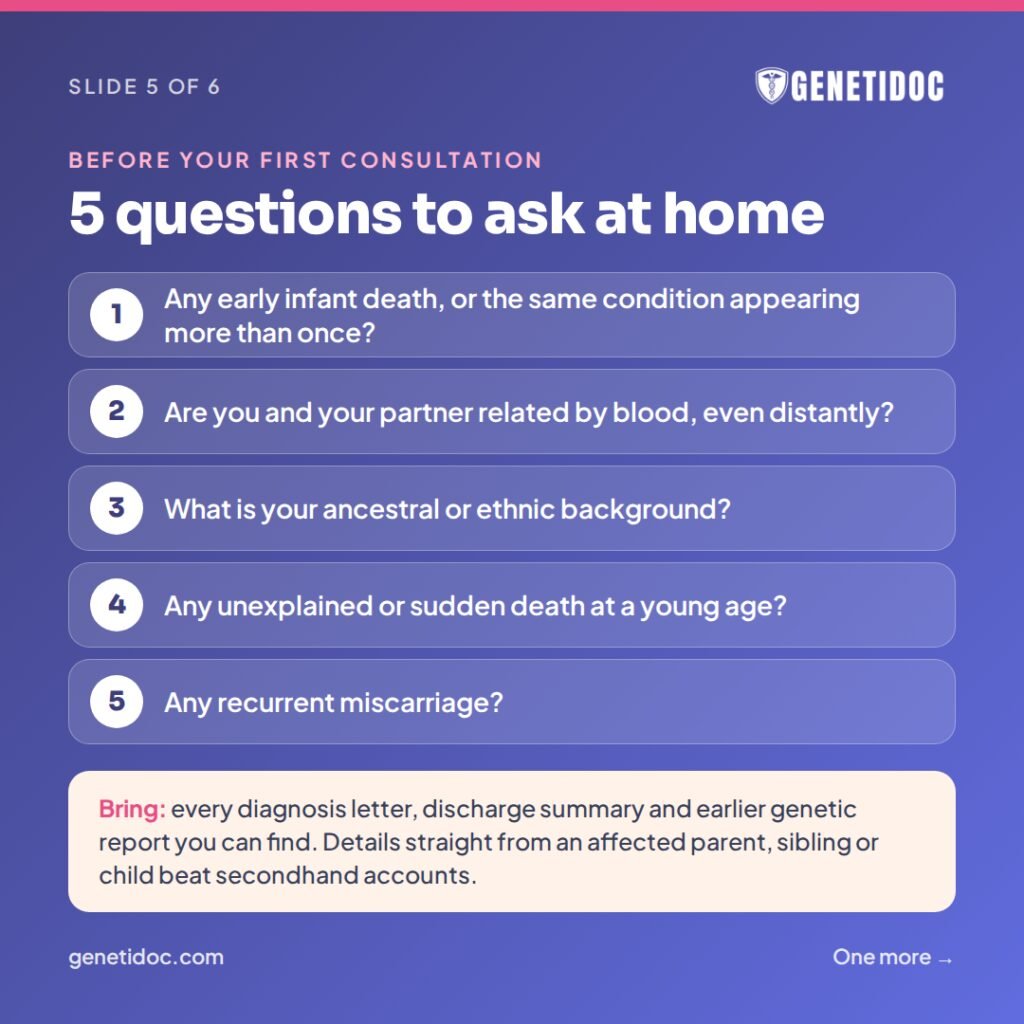
5 Questions to Ask Your Family Before Your First Consultation
Before your first preconception genetics appointment, gathering a few key facts from your family makes the consultation far more productive:
- Has anyone in the family died in early infancy, or has the same condition appeared more than once? Repetition and early deaths are both significant signals.
- Are you and your partner consanguineous (related by blood, even distantly)?
- What is your ancestral or ethnic background? Certain conditions have a well-documented higher carrier frequency in specific ethnic populations — Ashkenazi Jewish ancestry and its associated carrier frequencies are a widely cited example internationally, and there are Indian regional equivalents as discussed above.
- Has anyone in the family had an unexplained or sudden death? Sudden or unexplained deaths, particularly at a young age, can sometimes point to an underlying inherited condition worth asking about.
- Has anyone in the family experienced recurrent miscarriage? Recurrent pregnancy loss can occasionally be linked to a chromosomal or genetic factor carried by one or both partners — a topic our Recurrent Pregnancy Loss forum explores in more depth.
What to Bring to Your First Appointment
To make the first consultation as useful as possible:
- Bring every available document and report related to the family history — old diagnosis letters, discharge summaries, prior genetic test reports
- Bring as much detail about the family as you can gather in advance
- If a first-degree relative (parent, sibling, child) is affected, information gathered directly from them is preferred over secondhand family accounts, since details can shift or blur across retellings
What a Preconception Genetic Consultation Generally Involves
While the exact flow varies by clinic and by how much information is already available, a comprehensive preconception genetics visit typically includes these stages:
- Detailed history-taking — building the three-generation family tree, reviewing any existing reports, and clarifying the four-question framework described earlier in this article
- Risk assessment and discussion — explaining, in plain terms, what the family history does and doesn’t suggest
- Test recommendation and informed consent — discussing which test category fits the situation, what it can and cannot detect, and what a result would and wouldn’t mean
- Sample collection — typically a blood draw or, for some carrier screening tests, a cheek swab
- Results counseling — a follow-up session to walk through the result, its practical implications, and next steps, rather than simply sending a report
The counseling steps on either end of testing — before and after — are not a formality. They’re where a report becomes something a couple can actually use to make a decision.
What Does This Cost?
Costs vary considerably depending on which stage of testing is appropriate for your situation, and pricing should always be confirmed directly with the clinic before proceeding. In general terms:
- An initial consultation to review family history and determine the right approach is the starting point for every case
- Basic carrier screening for conditions with a known higher frequency in the relevant population (such as thalassemia, sickle cell disease, Spinal Muscular Atrophy carrier status, or the Kerala-specific GJB2 hearing loss carrier status) is typically the most accessible option
- Targeted testing for a specific, already-known family variant is usually less costly than broader testing, since it looks for one specific change rather than screening many genes
- Expanded panel testing is used when a couple wants to rule out carrier status more broadly, without one already-known variant to target specifically
Ask your clinic for a current, written cost breakdown by test category before proceeding — a credible clinic will walk you through this alongside the clinical reasoning, not just the price list.
Why the Test Is Never the Whole Answer
A genetic test result, on its own, is a set of technical findings. What makes it useful is interpretation — matching the result against the specific family history, the condition’s known inheritance pattern, and the couple’s actual reproductive plans.
This is also where low-cost, interpretation-light testing tends to fall short. A report that lists a variant without context, or a screening result presented as a final answer, can leave a family more confused or more anxious than before they tested — even when the underlying laboratory work was accurate.
| “A family history of a genetic condition rarely means a child will definitely be affected. The real risk depends on exactly how you’re related to the affected person and how that condition is inherited — and that can only be worked out properly with a detailed family history and the right test, not guesswork.”
— Team Genetidoc |
If your own family history raises something this article hasn’t covered, our Rare Disease Forum is a good place to ask it directly.
Frequently Asked Questions
- Does having a relative with a genetic condition mean my child will inherit it?
Not necessarily. It depends on how closely you’re related to that person, whether the condition is confirmed to be genetic, and its specific inheritance pattern. Distant relatives generally carry much lower implications than close ones.
- How far back should I trace my family history before trying to conceive?
A standard evaluation covers three generations — you, your parents, and your grandparents, along with siblings, aunts, uncles, and first cousins. This extends further if there’s consanguinity or a condition repeating in extended family.
- What if the affected family member has already passed away?
The evaluation still proceeds. Carrier screening of the couple becomes the default approach, refined further if the described symptoms match a known condition or if there’s consanguinity.
- Is carrier screening the same as diagnostic testing?
No. Carrier screening identifies whether you carry a gene variant that could affect a future child if your partner also carries one in the same gene. Diagnostic testing confirms whether a specific person or pregnancy is actually affected.
- My cousin’s child has an intellectual disability of unknown cause. Should I be tested?
This is exactly the kind of history worth discussing with a genetic counselor. Without a confirmed diagnosis, the first step is usually establishing whether the condition has a genetic cause at all, before deciding on a testing approach.
- Does a “high risk” prenatal screening result mean my baby has the condition?
No. A high-risk screening result reflects an elevated statistical probability, not a confirmed diagnosis. A diagnostic test is needed to confirm or rule out the condition.
- If I’m a carrier, will all my children be affected?
No. Being a carrier means you have one non-working copy of a gene alongside one working copy, and you are typically unaffected yourself. Whether a child is affected depends on your partner’s carrier status for the same gene, and even then, it’s a per-pregnancy probability, not a certainty for every child.
- What if I don’t know much about my family’s medical history?
This is common, especially with adoption, estrangement, or simply not having asked older relatives. In these cases, risk is estimated using population-level data instead of family-specific history — still a useful and medically meaningful starting point.
- Are certain communities in Kerala at higher genetic risk?
Some specific regional and tribal populations do show a higher carrier frequency for particular conditions — for example, GJB2-related hearing loss and sickle cell disease in parts of Kerala. This pattern is generally geography- and community-based rather than tied to caste or religion.
- What’s the difference between whole exome sequencing and carrier screening?
Whole exome sequencing reads the protein-coding regions of nearly all genes, scanning broadly for a wide range of possible genetic changes across the genome. Carrier screening, by contrast, tests a defined, curated list of specific conditions and known variant types, chosen for relevance to a person’s or population’s carrier risk. One is a broad exploratory tool; the other is a targeted screen — which one fits depends on what your family history actually points to.
- Should both partners get tested, or just the one with the family history?
For most recessive conditions, testing only the partner with a family history isn’t enough — risk to a child depends on whether both partners carry a variant in the same gene. Couple-based carrier screening is generally the more informative approach.
- When should we see a genetic counselor before trying to conceive?
As early as possible in your planning process — ideally before conception, since preconception counseling allows the widest range of options, from targeted testing to reproductive planning, that become more limited once a pregnancy is already underway.
Key Takeaways
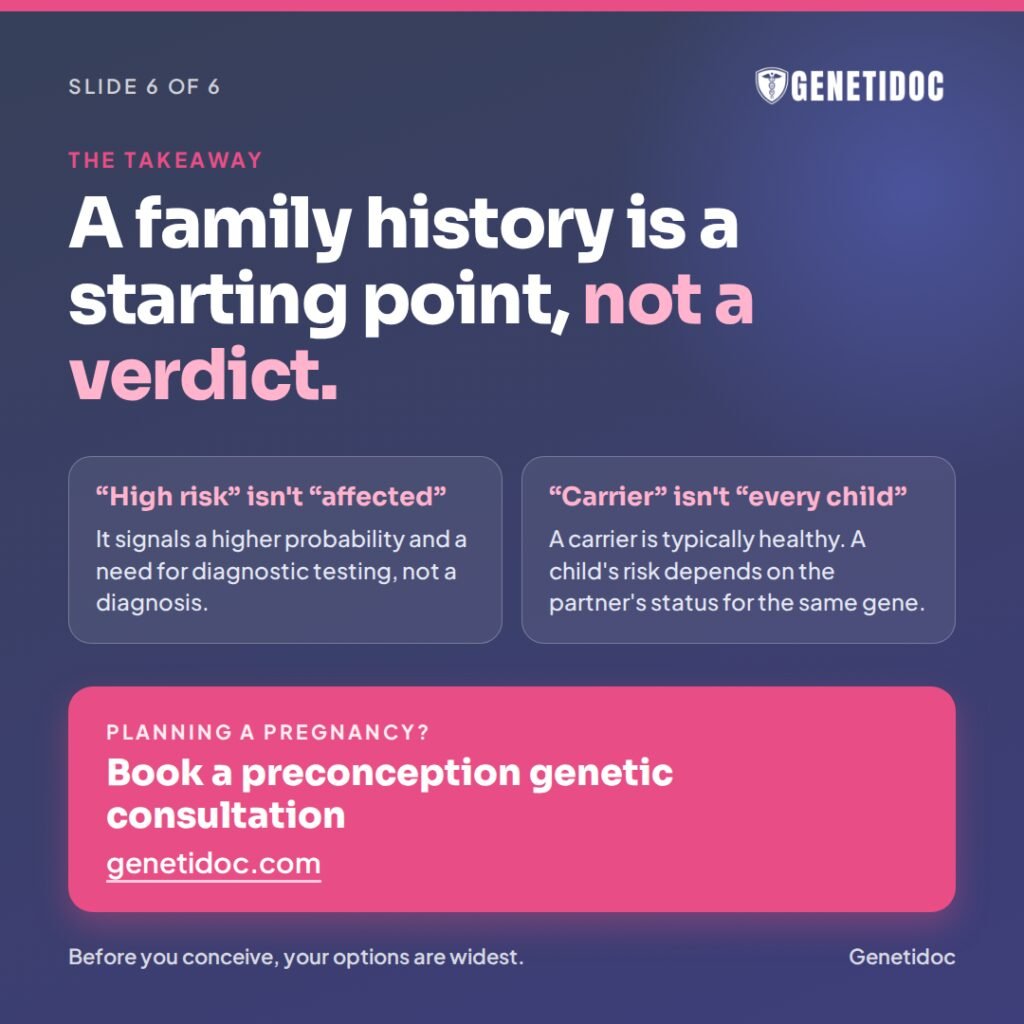
- A family history of a genetic condition is a starting point for evaluation, not a verdict on your own risk
- Risk depends on the confirmed diagnosis, its inheritance pattern, and exactly how you’re related to the affected person — not on the relationship label alone
- Distant relatives generally carry far less implication than close ones, even for the same condition
- Choosing the right test for the specific situation matters as much as testing at all — the wrong test can miss the very thing it was meant to detect
- “High risk” and “carrier” are both probability statements, not diagnoses
- An incomplete family history doesn’t stop the process — it shifts the evaluation to population-level risk
| Planning a pregnancy with a genetic condition somewhere in your family?
A structured preconception genetic consultation can turn a vague family worry into a clear, personalized next step — before you conceive, when your options are widest. Book a Preconception Genetic Consultation |
Related Reading
- Screen, Confirm, or Miss: What a Four-Case Cost Study of Biotinidase Deficiency Newborn Screening Reveals
- Genetic Counseling Online vs. In-Person: Does It Make a Difference?
- What Happens in a Genetic Counseling Session? A Step-by-Step Guide
- Biopsy Testing 101: How Doctors Choose the Right Cancer Treatment for You
- Post your genetic related doubts in our platform
References
- American College of Obstetricians and Gynecologists (ACOG). Committee Opinion: Carrier Screening in the Age of Genomic Medicine.
- American College of Medical Genetics and Genomics (ACMG). Recommendations on carrier screening for genetic conditions.
- National Society of Genetic Counselors (NSGC) — Preconception and Prenatal Genetic Counseling Practice Guidance.
- Feroze M, Aravindan KP. Sickle cell disease in Wayanad, Kerala: Gene frequencies and disease characteristics. National Medical Journal of India. 2001;14:267-70.
- Indian Journal of Medical Research. Sickle cell disease in tribal populations in India — regional prevalence review.
- Indian Journal of Medical Research. Prenatal screening for genetic disorders: Suggested guidelines for the Indian scenario. 2017.
- GeneReviews — Gene- and condition-specific reviews (University of Washington, Seattle).