
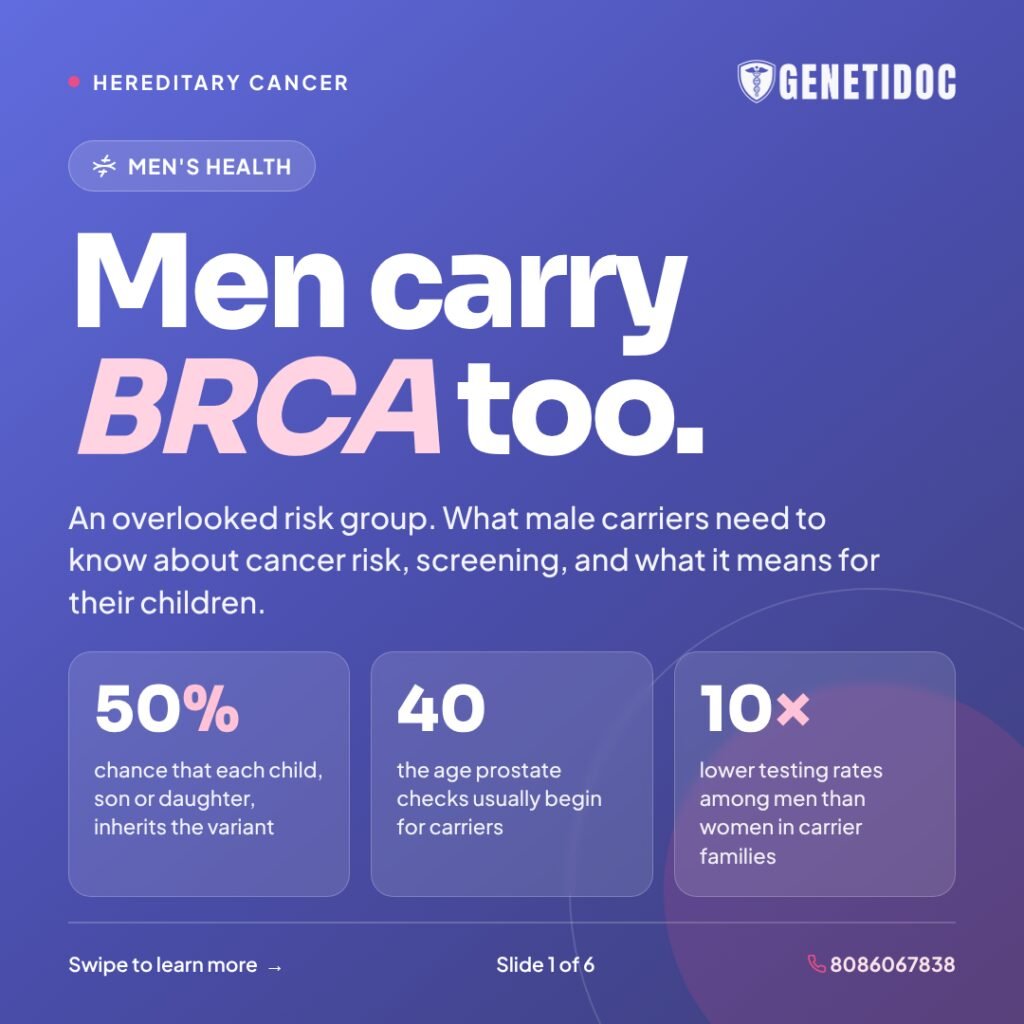
When a woman tests positive for a BRCA gene change, the conversation usually turns to her sisters and daughters. Her brothers, father, and sons are often forgotten.
That gap matters. Men inherit BRCA variants just as often as women do. They face real, manageable cancer risks of their own. And they pass the variant to their children, sons and daughters alike, at the same rate as mothers.
This guide explains what being a male BRCA carrier means, which cancers to watch for, when screening should start, and how testing works in India.
Quick answer: what does being a male BRCA carrier mean?
A male BRCA carrier is a man who has inherited a harmful change in the BRCA1 or BRCA2 gene. He has a higher lifetime risk of prostate, breast and pancreatic cancer, and possibly melanoma, especially with BRCA2. Each of his children has a 50% chance of inheriting the same change. Earlier, targeted screening, usually starting with prostate checks from age 40, helps find cancers early when they are most treatable.
What Is a BRCA Gene, and Why Does It Matter for Men?
Everyone has two copies of the BRCA1 and BRCA2 genes, one from each parent. These genes act like a repair crew for DNA. They fix the small damage that happens in our cells every day.
When one copy carries a harmful change, called a pathogenic variant, the repair crew works less well. Over time, damaged cells are more likely to turn into cancer.
The name “BRCA” comes from “breast cancer”, because the genes were first discovered in families with many breast cancers. That name is a big part of why men get overlooked. The genes themselves have nothing to do with sex. They work in every cell of the body, in men and women alike.
Germline vs tumour: two different kinds of BRCA result
You may see BRCA mentioned in two very different reports:
- A germline (inherited) result comes from a blood or saliva test. It shows a change present in every cell since birth. This change can be passed to children.
- A somatic (tumour) result comes from testing the cancer tissue itself. A change found here may have developed only inside the tumour. It may not be inherited at all.
A tumour report cannot tell you whether your family is at risk. Only a germline test can. We return to this below, because it is one of the most common points of confusion for men with prostate cancer.
Why Are Male BRCA Carriers Overlooked?
The numbers are striking. In families where a BRCA variant has been found, about 30% of close relatives go on to be tested. Among men, testing rates are more than ten times lower than among women.
Research points to a few reasons:
- Men are not always told that a variant runs in the family.
- Many believe BRCA is “a women’s gene” that does not concern them.
- They do not see why the result matters for their own health.
- They do not know where or how to get tested.
In Indian families, the first barrier is usually not the problem. Team Genetidoc finds that close-knit families tend to share results with relatives fairly readily. The real gap is follow-through. Brothers and fathers hear the news but do not come for counseling or testing. Stigma, lack of time, and underestimating how relevant the result is to them all play a part.
There is encouraging evidence too. When men do attend genetic counseling, they choose testing at the same rate as women. The hardest step is getting through the door.
“We often meet the brother or father of a BRCA carrier years after the sister was tested. That gap is the window in which screening could have helped him.”
— Dr. Roshan Daniel, Clinical Geneticist and Founder, Genetidoc
Can a Father Pass BRCA to His Daughter?
Yes. This is one of the most important facts in this article.
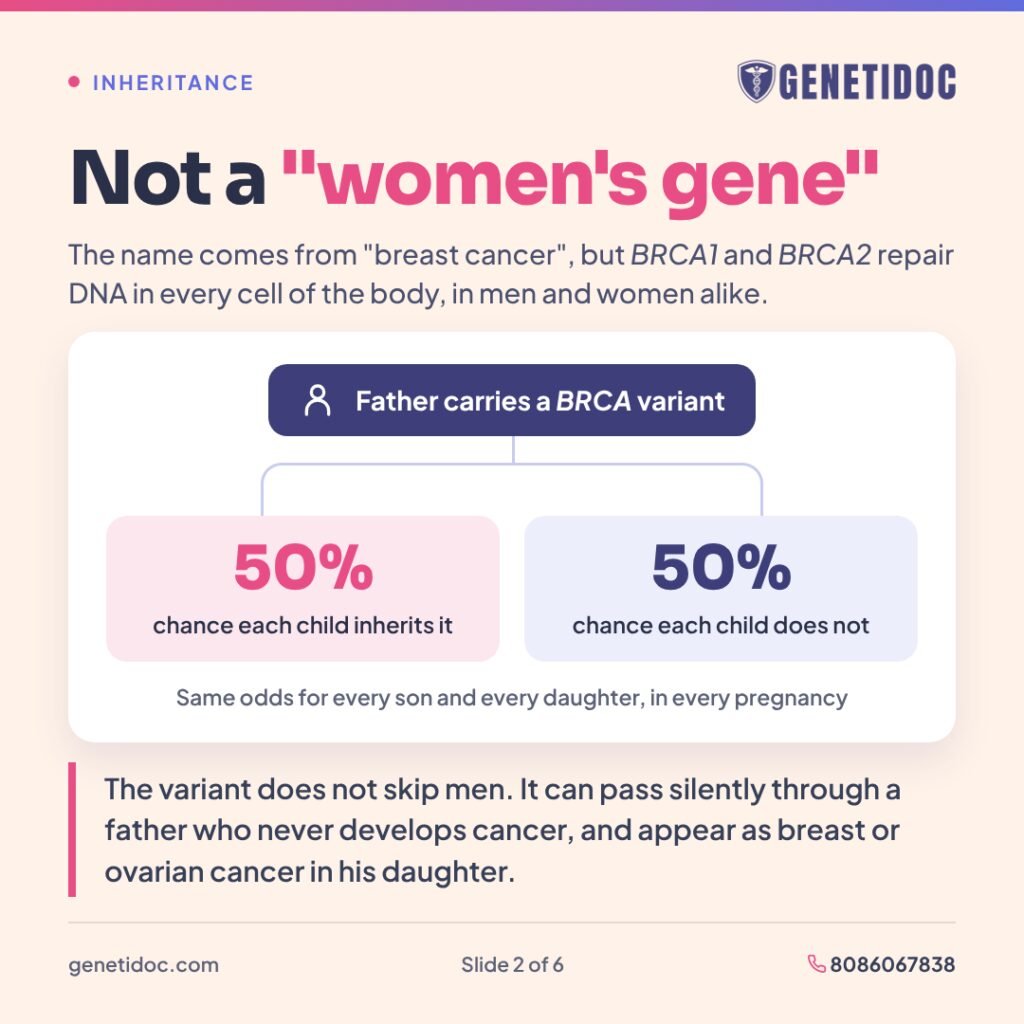
BRCA variants follow a pattern called autosomal dominant inheritance. In plain terms, one changed copy is enough to raise risk, and it can come from either parent.
If a father carries a BRCA variant, each of his children has:
- A 50% chance of inheriting it
- A 50% chance of not inheriting it
This is true for every child, son or daughter, and for each pregnancy separately. The variant does not “skip” men. It can pass silently through a father who never develops cancer, and then show up as breast or ovarian cancer in his daughter.
“BRCA is not a women’s gene. A father passes it to his daughter exactly as often as a mother does.”
— Dr. Roshan Daniel
Illustrative scenario: the family history on the “wrong” side
A composite example, not a real patient.
A 38-year-old woman is diagnosed with breast cancer. Nobody on her mother’s side has had cancer, so the family assumes it is “not genetic”.
At genetic counseling, the counselor draws a three-generation family tree. It shows that her father’s sister had ovarian cancer, and her paternal grandfather had prostate cancer at 58. A hereditary cancer panel finds a BRCA2 variant.
Her father, now 64, tests positive and starts prostate checks for the first time. Her 35-year-old brother also tests positive and begins a surveillance plan. Her younger sister tests negative and can follow routine screening. One test in one woman changed the care of three relatives, and the key history was on her father’s side all along.
What Cancers Are Male BRCA Carriers at Risk Of?
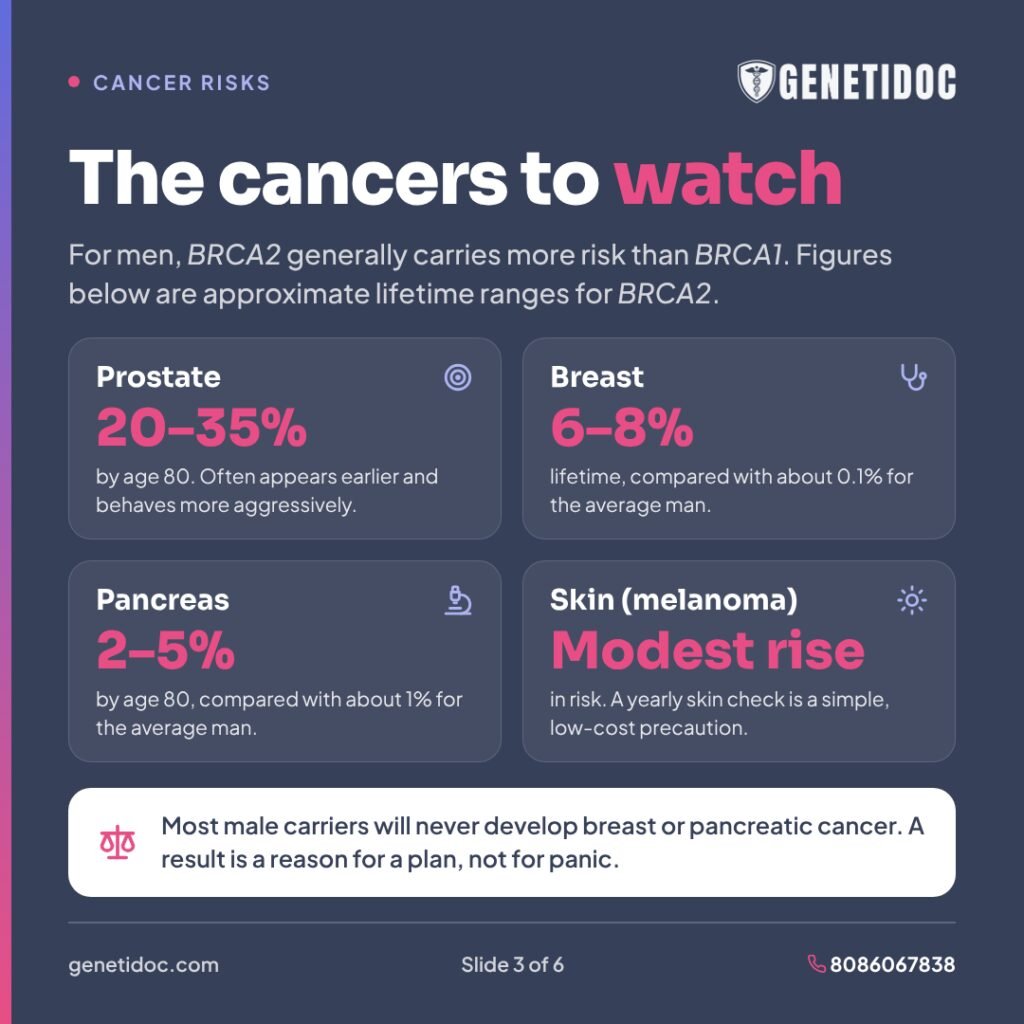
Male BRCA carriers have a higher risk of four cancers. The size of the risk depends mainly on which gene is involved. For men, BRCA2 generally carries more risk than BRCA1.
Published estimates vary between studies, so the figures below are approximate ranges, not exact predictions.
| Cancer | Men with BRCA2 | Men with BRCA1 | Average man |
| Prostate | Clearly raised: roughly 20–35% by age 80 in large studies, with some estimates higher. Tends to appear earlier and behave more aggressively. | Modestly raised; estimates vary | Lower |
| Breast | About 6–8% lifetime | About 1–2% lifetime | About 0.1% |
| Pancreas | About 2–5% by age 80, with some estimates higher | Slightly raised | About 1% |
| Melanoma (skin) | Modestly raised | Unclear | Baseline |
Look at these numbers the other way round too. Even with BRCA2, most men will never develop breast or pancreatic cancer, and many will never develop prostate cancer. A BRCA result is a reason for a plan, not a reason for panic.
Your own risk is never a single number from a table. Your genetic counselor works it out individually, using your specific gene, your age and your family history.
Prostate cancer: the most important risk for men
Prostate cancer is the main reason male BRCA2 carriers need a screening plan. Compared with other men, carriers tend to:
- Develop prostate cancer at a younger age, often before 65
- Have more aggressive tumours
- Have cancers that are more likely to spread if not caught early
The good news is that screening works in this group. The international IMPACT study followed more than 3,000 men, many of them BRCA carriers, with yearly prostate-specific antigen (PSA) blood tests. Screening found more clinically significant prostate cancers in BRCA2 carriers than in non-carriers, and found them early. The study supports yearly PSA screening for BRCA2 carriers and structured screening for BRCA1 carriers.
Male breast cancer: rare, but real
Men have a small amount of breast tissue behind the nipple, and cancer can start there. In the general male population it is very rare. In BRCA2 carriers, the risk rises many times over.
Signs to watch for include a painless lump near the nipple, nipple changes, discharge, or skin dimpling. Many men delay reporting these out of embarrassment. A carrier who knows his risk is far more likely to seek help early.
Pancreatic cancer and melanoma
Pancreatic cancer risk rises with both genes, especially after age 50. Screening is usually considered only for carriers who also have pancreatic cancer in the family, and it is done at experienced centres.
Melanoma, a type of skin cancer, is modestly more common in BRCA2 carriers. A yearly skin check is a simple, low-cost precaution.
BRCA in Men: What We Know About India
Most published data on male carriers come from Western countries. Indian research is growing, but still limited.
- A study from the All India Institute of Medical Sciences (AIIMS), New Delhi found inherited variants in DNA-repair genes in 8.7% of men with high-risk prostate cancer who met international testing criteria.
- A separate AIIMS study tested prostate tumour tissue. It found ATM was the most commonly altered gene, followed by BRCA1. That differs from Western and other Asian studies, where BRCA2 usually leads.
The second study looked at tumour (somatic) changes, not inherited ones. It does not tell us how common inherited BRCA variants are in Indian men. But it does suggest that the genetic picture in Indian prostate cancer may differ from Western data.
That has a practical message. For an Indian man who already has cancer, testing BRCA alone may miss important findings. A broader hereditary cancer panel, which includes ATM, CHEK2, PALB2 and other repair genes, gives a more complete answer.
Should Men Get Tested for BRCA? Who Should Consider It
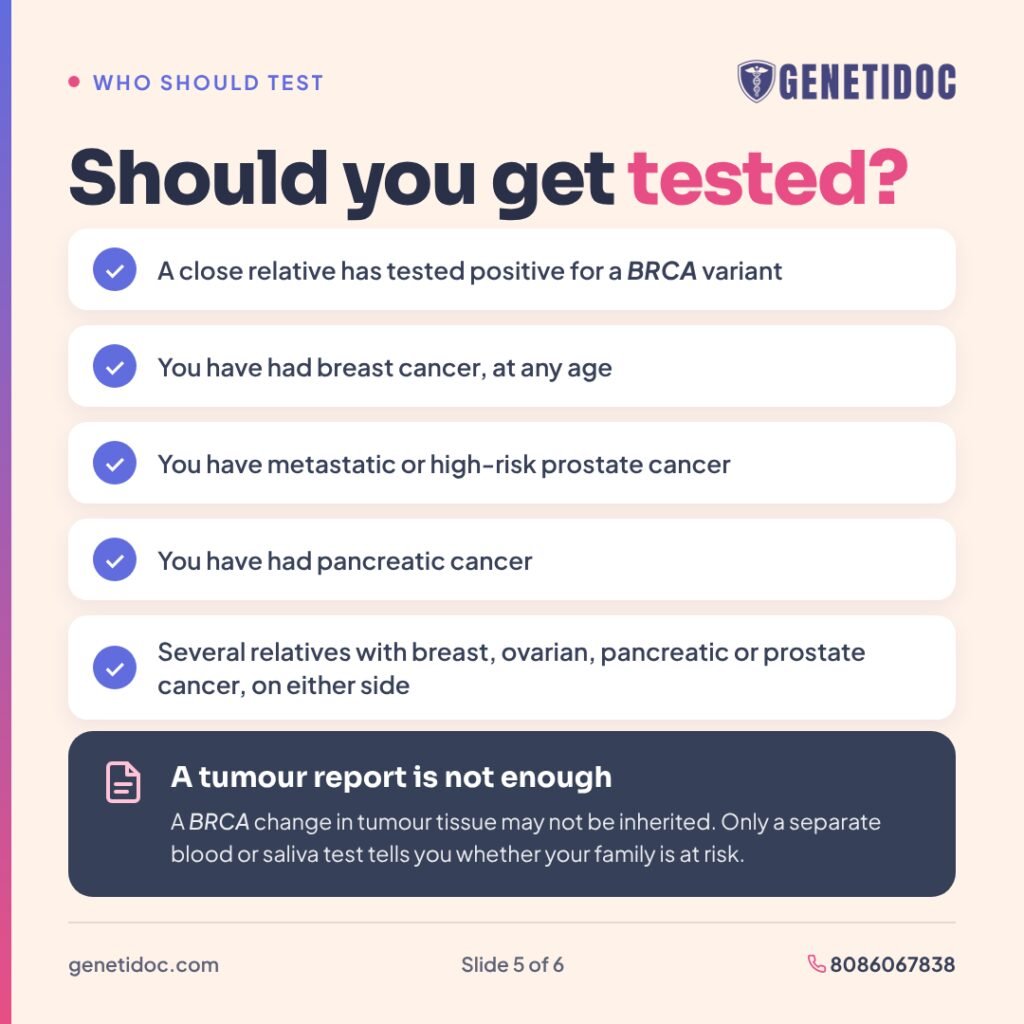
BRCA testing is worth discussing with a clinical geneticist if any of the following apply to you:
- A close relative (mother, sister, daughter, brother, father or son) has tested positive for a BRCA
- You have had breast cancer, at any age.
- You have metastatic prostate cancer, or high-risk or very high-risk prostate cancer.
- You have had pancreatic cancer.
- Your family has several relatives with breast, ovarian, pancreatic or prostate cancer, on either side.
- A relative had breast cancer at a young age, or ovarian cancer at any age.
- You have low-risk prostate cancer and are considering active surveillance, meaning regular monitoring instead of immediate treatment.
When testing may not be useful
Genetic testing is not the right first step for everyone. It may not help if:
- You are healthy with no personal or family history of these cancers. Genetidoc does not offer curiosity-driven sequencing to people with no red flags. Instead, the team takes a full family history first, and recommends targeted testing only where it is likely to change your care.
- An affected relative is alive and has not been tested. It is usually better to test the person who has had cancer first. A negative result in an unaffected man, with no known family variant, is harder to interpret.
- You are thinking of a direct-to-consumer (DTC) kit. These kits usually check only a few well-known variants, mostly ones studied in people of European ancestry. A “negative” DTC report can miss many harmful BRCA
Which BRCA Test Is Right for You?
The right test depends on your situation. A genetic counselor helps you choose.
If a relative already has a known BRCA variant
You usually need targeted testing. The lab looks only for the exact variant already found in your family. This is called cascade testing.
- It is precise and fast. Results take about 1 week.
- It needs a copy of your relative’s genetic report, so the lab knows exactly what to look for.
- A broader panel is offered only if you have your own unexplained cancer history, or if you specifically want wider testing.
If you have had prostate, breast or pancreatic cancer
You usually need a broad hereditary cancer panel. This checks BRCA1, BRCA2 and many other cancer-risk genes at once. Results take about 3 weeks, and at most 4.
If your tumour report already mentions BRCA
Many men with advanced prostate cancer have tumour tissue tested to guide treatment. If that report shows a BRCA change, you still need a separate germline (blood or saliva) test.
“A tumour report and a blood test answer different questions. One guides the cancer in front of us; the other tells us who else in the family needs to know.”
— Dr. Roshan Daniel
What about cost?
Cost depends on the type of test. Targeted testing for one known family variant is generally simpler than a full multi-gene panel. Your counselor will explain the options and their costs before you decide, so there are no surprises.
I Tested Positive. What Screening Do Men Need?
A positive result leads to a surveillance plan. Its goal is simple: find any cancer early, while it is small and most treatable.
The plan below follows National Comprehensive Cancer Network (NCCN) guidance, adapted to Indian healthcare. Your own plan may differ based on your gene and family history.
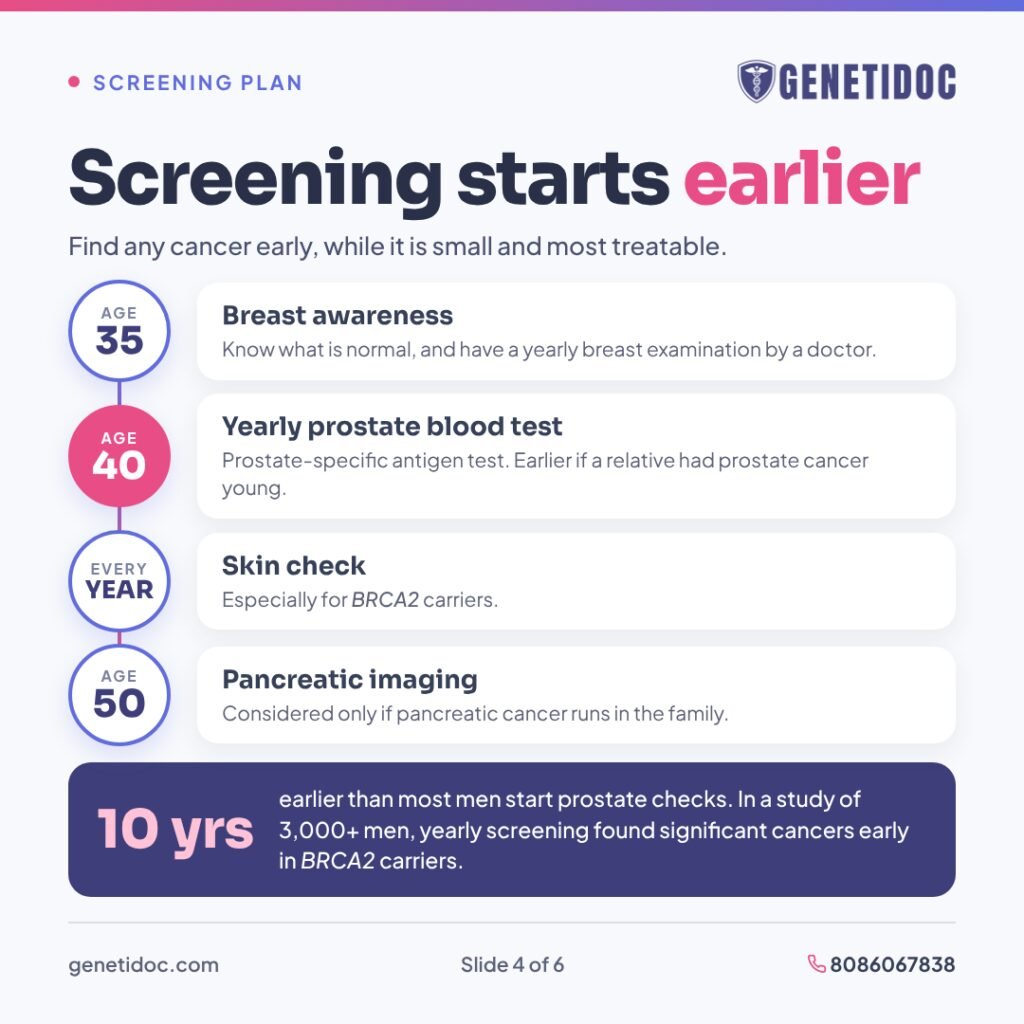
Screening timeline for male BRCA carriers
- From age 35: learn breast self-awareness, and have a yearly breast examination by a doctor. Report any lump or nipple change promptly.
- From age 40: start yearly PSA blood tests for prostate cancer. This is recommended for BRCA2 carriers and should be discussed for BRCA1 Start earlier if a relative had prostate cancer young, about 10 years before their age at diagnosis.
- Yearly: a skin check, especially for BRCA2
- From age 50 (or 10 years before the earliest family case): consider pancreatic imaging, such as magnetic resonance imaging (MRI) or endoscopic ultrasound, if pancreatic cancer runs in the family. In India, this is mostly available at tertiary hospitals.
- Ongoing: follow the general population screening advice for other cancers, such as bowel cancer.
If your PSA level rises, even within the “normal” range for your age, the usual next step is a prostate MRI and a review with a urologist. Your care is coordinated between your family physician, a urologist, a breast or general surgeon, and other specialists as needed. Your genetic counselor gives you a written summary of the whole plan to take to them.
“For men, the most important number is 40. A BRCA2 carrier should be talking to his doctor about prostate checks from then, not from 50.”
— Dr. Roshan Daniel
Illustrative scenario: screening that started ten years early
A composite example, not a real patient.
A 42-year-old man learns that his sister carries a BRCA2 variant. He is reluctant at first. He feels well and assumes the result is “her problem”. After a counseling session, he chooses targeted testing and tests positive.
He starts yearly PSA tests. At 46, his level rises above his own earlier readings, though it is still “normal” for his age. An MRI and biopsy find a clinically significant prostate cancer that has not spread. He is treated with curative intent. Without the family result, he would not have started routine screening until 50.
How Does BRCA Status Change Cancer Treatment for Men?
For men who already have cancer, a BRCA result can directly shape treatment decisions. This is one of the strongest reasons to test.
- Targeted medicines: poly ADP-ribose polymerase (PARP) inhibitors, such as olaparib and rucaparib, work especially well against cancer cells that already have weak DNA repair. In advanced prostate cancer that no longer responds to hormone therapy, a BRCA change can make a man eligible for these medicines. Men with BRCA2 changes have shown particular benefit in trials.
- Active surveillance decisions: men with low-risk prostate cancer are often monitored instead of treated right away. Studies show BRCA2 carriers on this approach are more likely to see their cancer progress. Knowing a man is a carrier can change whether monitoring is still the safest choice, or how closely he is followed.
- Chemotherapy choices: in some advanced cancers, BRCA status can influence which chemotherapy is considered.
- Clinical trials: BRCA status may open access to trials of newer treatments.
These decisions are always made by your treating oncologist or urologist. The genetic result gives them important information to work with.
What If My BRCA Test Is Negative?
What a negative result means depends on the test you had.
- Negative for a known family variant: you have not inherited the change found in your relative. Your risk from that variant is ruled out, and you can usually follow general population screening. Your children cannot inherit that variant from you.
- Negative on a panel, with no known family variant: this means no reportable finding in the genes tested. It lowers the likelihood of a strong inherited cause, but it does not mean you will never develop cancer. Your family history still guides your screening.
What is a variant of uncertain significance?
Sometimes a test finds a variant of uncertain significance (VUS). This is a DNA change that science cannot yet classify as harmful or harmless.
A VUS is not treated as a positive result. Your screening is based on your personal and family history, not on the VUS. Relatives are not tested for it. Over time, as more data gather, many VUS results are reclassified, most often as harmless. Keep your report and stay in touch with your clinic, so you hear if the classification changes.
What a Positive Result Means for Your Family
A man’s BRCA result carries information for many people.
- Daughters: each has a 50% chance of carrying the variant, with significant breast and ovarian cancer risks if she does.
- Sons: each also has a 50% chance, with the same male risks described here.
- Brothers and sisters: each has a 50% chance.
- Parents: one of them is likely to carry it too, and that side of the family may need testing.
When should children be tested?
BRCA-related cancers start in adulthood, and no screening is needed in childhood. For this reason, children are offered testing after they turn 18, when they can make their own informed choice with counseling support.
Telling your relatives
After your consultation, you receive an individualized written summary, prepared by your genetic counselor and cross-checked by the clinical geneticist. It explains your result and the screening guidance. Many patients share it with relatives to open the conversation.
If you would rather not inform a relative yourself, Genetidoc can offer that relative a private counseling session. The session does not reveal your result unless you consent. And if you decide a relative should not be told at all, that decision is yours to make.
“Most men don’t test for themselves. They test when we explain what it means for their children, and that is a perfectly good reason.”
— Dr. Roshan Daniel
The Emotional Side: What Men Often Feel
A BRCA result can stir up strong feelings, and men often keep them to themselves. Common reactions include:
- Guilt about possibly passing the variant to a child, especially a daughter
- Discomfort with the idea of a “breast” cancer risk
- Avoidance, putting off testing because not knowing feels safer
- A sense of duty: research shows men often frame the decision around protecting their family rather than themselves
In many Indian families, men are the main earners and decision-makers. Taking time off for appointments can feel like a burden, and prostate or breast symptoms are rarely discussed openly. Seeing testing as a way to protect the family often helps men take the first step.
Genetic counseling makes room for these feelings. Nobody chooses which genes they pass on, and no parent is to blame. Knowing your status is what allows you, and your children, to act early.
Why the Right Test, Lab and Interpretation Matter
A genetic report is only as useful as the decisions it leads to. Several things make a real difference:
- Choosing the right test. A targeted test, a broad panel and a tumour test each answer different questions. The wrong one can give false reassurance.
- An accredited laboratory. Reliable labs confirm reportable findings, classify variants against current evidence, and update classifications over time.
- Expert interpretation. A clinical geneticist interprets the result alongside your personal and family history. The same report can mean different things for different families.
- Genetic counseling before and after testing. Counseling helps you understand what the test can and cannot tell you, and turns a result into a practical plan for you and your relatives.
Low-cost testing without interpretation often leaves men with a report they do not understand, and relatives who never hear about it. The value of genetics lies in actionable answers, not just in a sheet of results.
Your Sister Just Tested BRCA-Positive. What Should You Do This Month?
- Ask for a copy of her genetic report. The exact variant name is what makes your test fast and precise.
- Book a genetic counseling session. Most sessions run online, and you can usually be matched to a doctor who speaks your preferred language.
- Have targeted testing for the family variant. Your sample can be collected from home, and results take about 1 week.
- If you test positive, follow your written surveillance plan, starting with prostate checks from 40, and discuss testing for your children once they are adults.
- If you test negative for the family variant, follow general population screening, and tell your doctor about any new personal or family cancer history.
Key Takeaways
- Men inherit and pass on BRCA variants just as often as women do.
- Male carriers, especially with BRCA2, have higher risks of prostate, breast and pancreatic cancer, and possibly melanoma.
- Prostate screening with PSA usually starts at 40 for carriers, ten years earlier than for most men.
- A tumour report is not the same as an inherited (germline) test.
- For men with cancer, BRCA status can change treatment, including access to PARP inhibitors.
- Testing is most useful when a family variant is known, or when a man already has a related cancer.
- The right test, an accredited lab, expert interpretation and genetic counseling together turn a result into real protection.
Has a woman in your family tested BRCA-positive?
Her result may hold important information for her brothers, father and sons. Our clinical geneticists can review your family history, confirm whether testing for the family variant is right for you, and build a screening plan if you need one.
Online consultations are available across India in 15+ languages, with home sample collection.
Book a genetics consultation today
Have questions first? Join the discussion in our Hereditary Cancer Syndrome forum.

Frequently Asked Questions
Can men carry the BRCA gene mutation?
Yes. Men inherit BRCA1 and BRCA2 variants as often as women do. A male carrier has higher risks of prostate, breast and pancreatic cancer, and can pass the variant to his children.
Can a father pass a BRCA mutation to his daughter?
Yes. Each child of a carrier father, son or daughter, has a 50% chance of inheriting the variant. BRCA does not skip men. A daughter who inherits it from her father has the same risks as one who inherits it from her mother.
What cancers do men with BRCA mutations get?
The main risks are prostate cancer, male breast cancer and pancreatic cancer. BRCA2 carriers also have a modestly higher risk of melanoma. Risks are generally higher with BRCA2 than with BRCA1.
Is BRCA1 or BRCA2 worse for men?
For men, BRCA2 generally carries more risk. It is linked to higher, earlier and more aggressive prostate cancer, and a male breast cancer risk of about 6–8%. BRCA1 raises these risks more modestly.
When should a male BRCA carrier start prostate screening?
Yearly PSA screening is usually recommended from age 40 for BRCA2 carriers, and should be discussed for BRCA1 carriers. It may start earlier if a relative had prostate cancer at a young age.
Do men with BRCA need mammograms?
Routine mammograms are not usually advised for male carriers. Instead, men should learn breast self-awareness and have a yearly clinical breast exam from age 35. A mammogram is done if a lump or other change appears.
Should men get tested for BRCA?
Testing is recommended for men with a known family BRCA variant, male breast cancer, pancreatic cancer, or metastatic or high-risk prostate cancer, and for those with a strong family history. A clinical geneticist can tell you whether testing suits your situation.
How long does BRCA testing take in India?
At Genetidoc, targeted testing for a known family variant takes about 1 week. A full hereditary cancer panel takes about 3 weeks, and at most 4.
Is a BRCA result from a prostate tumour report enough?
No. A tumour report shows changes inside the cancer, which may not be inherited. A separate germline blood or saliva test is needed to know whether the change can be passed on, and whether relatives need testing.
Can a home DNA kit tell me if I carry BRCA?
Not reliably. Most direct-to-consumer kits check only a few well-known variants, mostly ones studied in people of European ancestry. A negative kit result can miss many harmful BRCA changes. Clinical testing with counseling is the safer route.
At what age should my children be tested if I carry BRCA?
BRCA-related cancers begin in adulthood, so children are usually offered testing after age 18. They can then decide for themselves, with genetic counseling support.
Does a negative BRCA test mean I will never get cancer?
No. A negative result for a known family variant rules out that inherited risk, but you still share the general population’s cancer risk. A negative panel result means no reportable finding in the genes tested.
References
- National Comprehensive Cancer Network. NCCN Clinical Practice Guidelines in Oncology: Genetic/Familial High-Risk Assessment: Breast, Ovarian, Pancreatic, and Prostate. org
- National Comprehensive Cancer Network. NCCN Clinical Practice Guidelines in Oncology: Prostate Cancer Early Detection. org
- Petrucelli N, Daly MB, Pal T. BRCA1- and BRCA2-Associated Hereditary Breast and Ovarian Cancer. GeneReviews. nlm.nih.gov/books/NBK1247
- Page EC, et al. Interim Results from the IMPACT Study: Evidence for Prostate-specific Antigen Screening in BRCA2 Mutation Carriers. European Urology. 2019;76(6):831–842. PMC6880781
- IMPACT Study Collaborators. Targeted Prostate Cancer Screening in Carriers of BRCA1 or BRCA2 Pathogenic Germline Variants Detects Clinically Relevant Disease: 5-year Results from the IMPACT Study. European Urology. Publication record
- Cheng HH, et al. BRCA1, BRCA2, and Associated Cancer Risks and Management for Male Patients: A Review. JAMA Oncology. 2024. Summary: Fred Hutch Cancer Center
- Giri VN, et al. Implementation of Germline Testing for Prostate Cancer: Philadelphia Prostate Cancer Consensus Conference 2019. Journal of Clinical Oncology. 2020;38(24):2798–2811.
- de Bono J, et al. Olaparib for Metastatic Castration-Resistant Prostate Cancer. New England Journal of Medicine. 2020;382:2091–2102.
- Carter HB, et al. Germline Mutations in ATM and BRCA1/2 Are Associated with Grade Reclassification in Men on Active Surveillance for Prostate Cancer. European Urology. 2019;75(5):743–749.
- Ongaro G, et al. A Multi-Level Analysis of Barriers and Promoting Factors to Cascade Screening Uptake Among Male Relatives of BRCA1/2 Carriers: A Qualitative Study. Psycho-Oncology. 2025. PMC12081208
- Ongaro G, et al. Can Family Motivation Enhance Men’s Uptake of Cascade Screening for Familial BRCA1/2 Mutations? American Journal of Men’s Health. 2025. PMC12332350
- Prevalence of mutations associated with NCCN criteria for hereditary prostate cancer testing in an Indian population. American Society of Clinical Oncology abstract (All India Institute of Medical Sciences, New Delhi). ASCO abstract
- Prevalence and spectrum of homologous recombination repair mutations in patients with metastatic prostate cancer from India. All India Institute of Medical Sciences, New Delhi. UroToday abstract
- Macmillan Cancer Support. BRCA2 and cancer risks for men and people assigned male at birth. org.uk
Related Reading from Genetidoc
- Cowden Syndrome and the PTEN Gene: Signs, Cancer Risks, Testing and Screening Explained
- Autism Spectrum Disorder and Genetic Testing: A Guide for Indian Families
- Marfan Syndrome: Symptoms, Diagnosis and Genetic Testing Explained
- Li-Fraumeni Syndrome: When Many Different Cancers Run in One Family
- Genetic Data Reanalysis: Why Your Genetic Testing Result Can Change Over Time