
One of the first questions many parents ask is about screening. Does the double marker test work the same way for twins? Can you do Non-Invasive Prenatal Testing (NIPT) with two babies? What happens if a result comes back “high risk” and you do not know which baby it refers to?
These are good questions. Genetic screening in a twin pregnancy follows the same basic idea as in a single pregnancy. But the details are different, and those details matter.
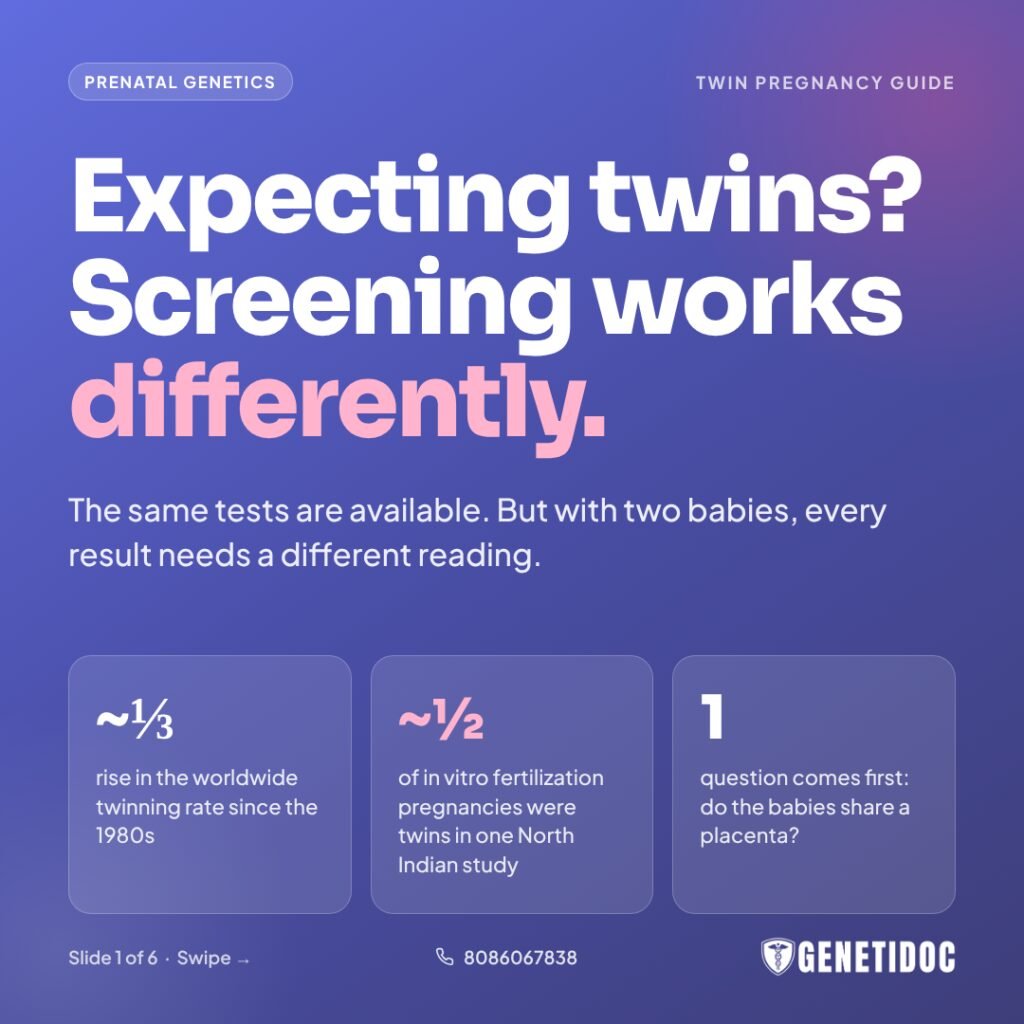
Twin pregnancies are also becoming more common. Worldwide, the twinning rate has risen by about a third since the 1980s, driven largely by fertility treatment and later motherhood (Monden and colleagues, 2021). In India, wider use of in vitro fertilization (IVF) means more couples are now facing these decisions. One study from a North Indian tertiary hospital found that close to half of the pregnancies conceived through IVF embryo transfer were twins.
This guide explains, in plain language, how screening works for twins, what each test can and cannot tell you, and how to make decisions you feel confident about.
| Quick answer: Can you have genetic screening in a twin pregnancy?
Yes. Parents expecting twins can have a first-trimester scan with nuchal translucency measurement, the double marker test, and NIPT. NIPT is the most accurate screening test for Down syndrome in twins. However, twin results are more complex to interpret. The type of twins, whether the babies share a placenta, and any history of a “vanishing twin” all affect what a result means. Screening tests give a risk estimate, not a diagnosis. Expert genetic counseling helps you understand your results and decide on next steps. |
Why Twin Pregnancies Need a Different Screening Approach
In a single pregnancy, there is one baby, one placenta and one set of DNA to think about. With twins, every one of those things can change.
Before choosing any test, your doctor needs to know two things:
- What kind of twins are they? Identical or non-identical.
- How many placentas are there? One shared placenta, or one for each baby.
| “With twins, the first question is not ‘which test should we do?’ It is ‘what kind of twins are these?’ Whether the babies share a placenta shapes almost every screening decision that follows.”
— Dr. Roshan Daniel, Clinical Geneticist and Founder, Genetidoc |
Identical Twins and Non-Identical Twins
Identical twins (doctors call them monozygotic twins) come from one fertilized egg that splits into two. They share the same DNA. So if one baby has a chromosome condition like Down syndrome, the other baby almost always has it too.
Non-identical twins (dizygotic or fraternal twins) come from two separate eggs fertilized by two separate sperm. Genetically, they are like any two siblings. One baby can have a chromosome condition while the other does not.
Most twins conceived through IVF are non-identical, because two embryos are often transferred. But identical twins can happen with IVF too, even when only one embryo is transferred, because that embryo can split.
One Placenta or Two
Doctors use the word chorionicity to describe how many placentas the twins have.
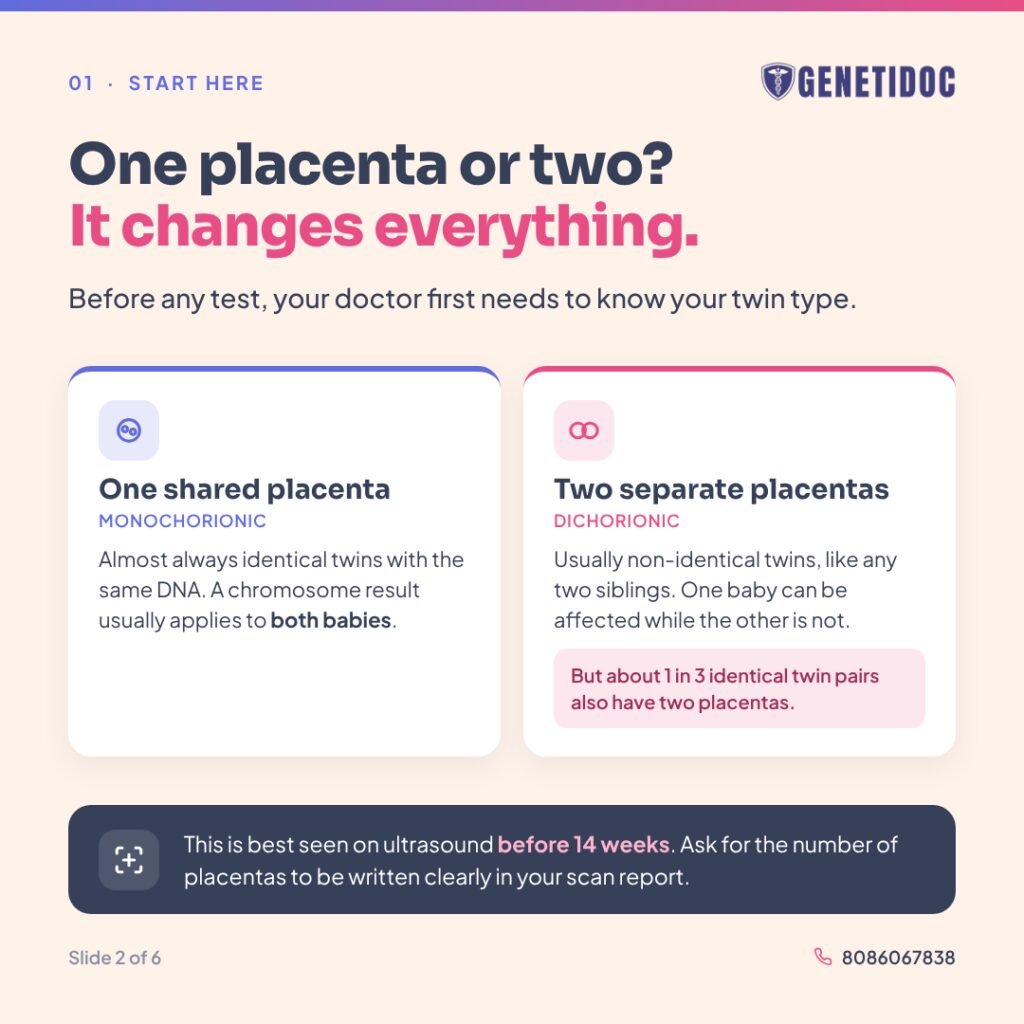
- Monochorionic twins share one placenta. These twins are almost always identical.
- Dichorionic twins each have their own placenta. Most dichorionic twins are non-identical, but not all.
This second point surprises many parents. About one in three identical twin pairs also have two separate placentas. This happens when the embryo splits very early, in the first few days after fertilization. So “two placentas” does not prove your twins are non-identical.
Chorionicity is best seen on an ultrasound scan in the first trimester, ideally before 14 weeks. After that, it becomes much harder to tell. This is one of the most important scans of a twin pregnancy.
| Feature | Twins sharing one placenta (monochorionic) | Twins with two placentas (dichorionic) |
| Type of twins | Almost always identical | Usually non-identical; about a third of identical twins also fall here |
| Chromosome result | Usually applies to both babies | Can differ between the babies if non-identical |
| Diagnostic testing | One sample is often enough if both babies look alike on scan | Usually each baby needs to be tested separately |
| Extra scan monitoring | Frequent scans for shared-placenta complications | Regular twin growth scans |
Why This Changes Your Screening Plan
Here is a simple way to think about it. With identical twins, you are really screening one set of DNA. With non-identical twins, you are screening two different sets of DNA, but the blood test sees them mixed together.
That mixing is the root of most of the challenges in twin screening. It affects how accurate blood tests are, how results are reported, and which diagnostic tests are needed if a result is concerning.
Is the Risk of Down Syndrome Higher in Twin Pregnancies?
This is one of the most common questions parents ask. The honest answer depends on the type of twins.
- Identical twins: The chance that the pregnancy is affected is about the same as in a single pregnancy at the same maternal age. If the pregnancy is affected, both babies usually are.
- Non-identical twins: Each baby has its own chance, roughly the same as a single baby at that maternal age. Because there are two babies, the chance that at least one is affected is higher for the pregnancy as a whole, roughly double.
Maternal age matters in both cases. Women expecting twins are, on average, slightly older, and many have conceived through fertility treatment. That said, most twins are born healthy. A higher chance is still a small chance for most families.
The key point is this: the type of twins changes how a risk figure should be read. That is why a result needs expert interpretation, not just a number on a page.
Screening Options in a Twin Pregnancy
Screening tests estimate the chance that a baby has a chromosome condition. They cannot confirm it. Here is how each option works when you are expecting twins.
1. The First-Trimester Scan and Nuchal Translucency
Between 11 weeks and 13 weeks 6 days, your doctor will do a detailed scan. During this scan, the sonologist measures the nuchal translucency, a small pocket of fluid at the back of each baby’s neck. A thicker measurement can be a sign of a chromosome condition, a heart problem or another issue.
In twins, this scan does several important jobs at once:
- It confirms how many placentas there are.
- It measures the neck fluid for each baby separately.
- It checks early anatomy for each baby.
- It labels the babies (often “Twin A” and “Twin B”) by their position, so they can be tracked through the pregnancy.
The nuchal translucency measurement is especially valuable in twins because it gives information about each baby individually. Blood tests cannot do that as well.
In twins who share a placenta, a big difference in neck fluid or size between the two babies can also be an early sign of complications related to the shared placenta, not just genetic conditions. Your obstetrician or fetal medicine specialist will look at this carefully.
2. The Double Marker Test in Twins
The double marker test (also called the first-trimester combined test) measures two substances in the mother’s blood:
- Free beta-human chorionic gonadotropin (beta-hCG), a pregnancy hormone made by the placenta.
- Pregnancy-associated plasma protein A (PAPP-A), a protein made by the placenta that tends to be lower when a baby has certain chromosome conditions.
These values are combined with the mother’s age and the nuchal translucency measurement to calculate a risk.
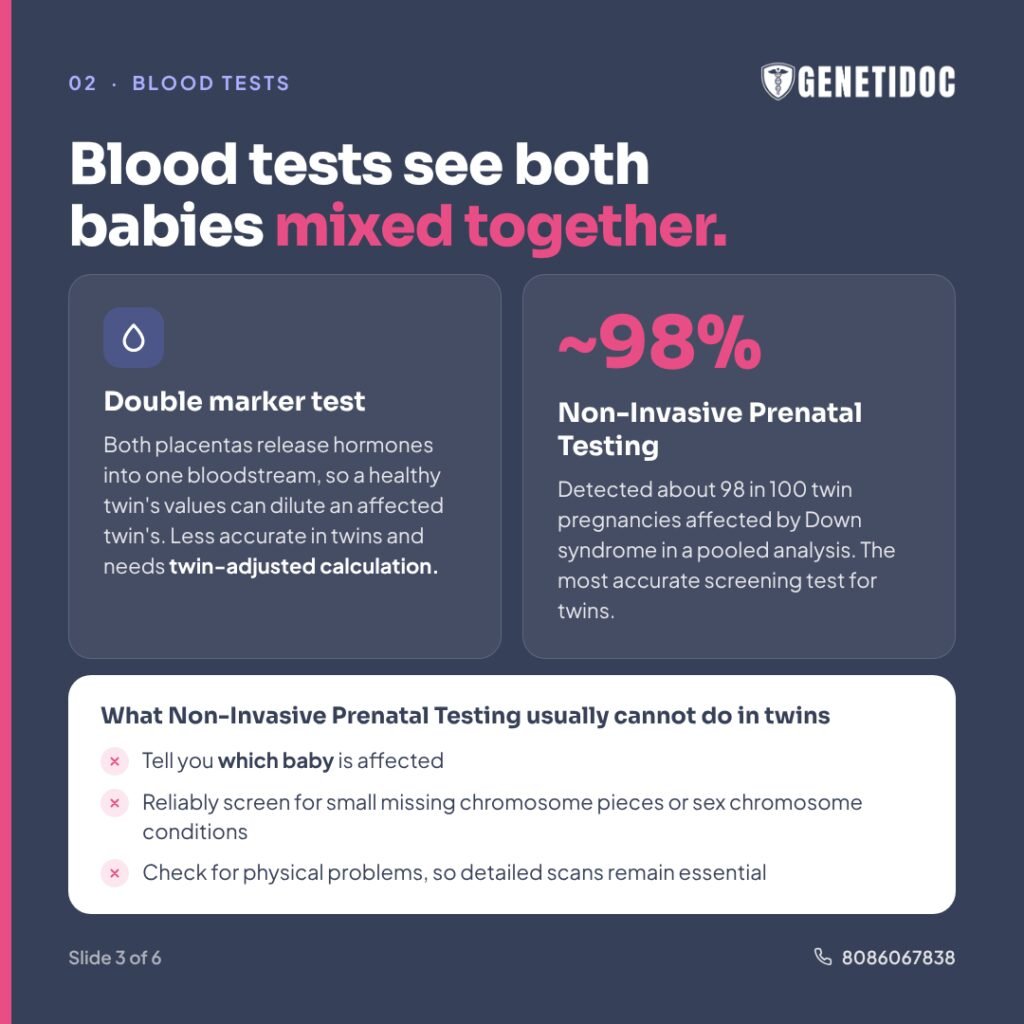
Here is the challenge in twins. Both placentas release these substances into the same bloodstream. If one baby has Down syndrome and the other does not, the normal baby’s values can “dilute” the abnormal ones. So the blood markers become less useful.
For this reason, the double marker test is less accurate in twins than in single pregnancies. The risk must be calculated with software adjusted for twin pregnancies. IVF pregnancies can also change these blood values, so the method of conception should be taken into account as well.
| Practical tip
If your double marker report gives a single risk figure without mentioning that it is a twin pregnancy, ask your doctor whether twin-adjusted calculation was used. If you are unsure, a genetic counselor can review the report with you. |
3. Non-Invasive Prenatal Testing (NIPT) for Twins
NIPT is a blood test that looks at small fragments of DNA in the mother’s blood. Some of these fragments come from the placenta, which usually reflects the baby’s DNA. NIPT can be done from about 10 weeks of pregnancy.
Major professional bodies, including the American College of Obstetricians and Gynecologists and the International Society for Prenatal Diagnosis, recognize NIPT as an option for screening twin pregnancies for the common chromosome conditions.
How accurate is NIPT in twins?
For Down syndrome (trisomy 21), NIPT works very well in twins. In a pooled analysis of twin studies, it detected about 98 percent of affected pregnancies, with very few false alarms (Gil and colleagues, 2019). A 2024 review reached a similar conclusion: performance for trisomy 21 in twins is close to that in single pregnancies, and better than the double marker test.
There is much less data for Edwards syndrome (trisomy 18) and Patau syndrome (trisomy 13) in twins, simply because these conditions are rare and fewer twin cases have been studied.
What NIPT cannot tell you in twins
This is where twin NIPT differs most from single pregnancies:
- It usually cannot tell you which baby is affected. In non-identical twins, a high-risk result means one or both babies may be affected. Only diagnostic testing can say which.
- Not every test method can tell identical from non-identical twins. Some laboratory methods can estimate this; others report one combined result for the pregnancy.
- Some conditions are not reliably screened in twins. Screening for small missing pieces of chromosomes (microdeletions) and for sex chromosome conditions is generally less reliable or not offered in twin pregnancies.
- It does not check for structural problems. NIPT does not detect spina bifida, heart defects or other physical differences. Your regular scans remain essential.
Why twin NIPT sometimes gives “no result”
NIPT needs enough placental DNA in the mother’s blood. This is called the fetal fraction. In twins, the total amount of placental DNA is usually higher. But in non-identical twins, each baby contributes only part of it. One baby’s share can be too low to analyze reliably, even when the total looks fine.
As a result, studies show “no result” outcomes are more common in twins than in single pregnancies. A no-result report does not mean something is wrong. Often a repeat blood sample a little later in pregnancy solves the problem. Your genetic counselor will advise whether a redraw or a different approach makes more sense.
At Genetidoc, NIPT results are usually available in about two weeks, and a repeat sample is offered when fetal fraction is too low.
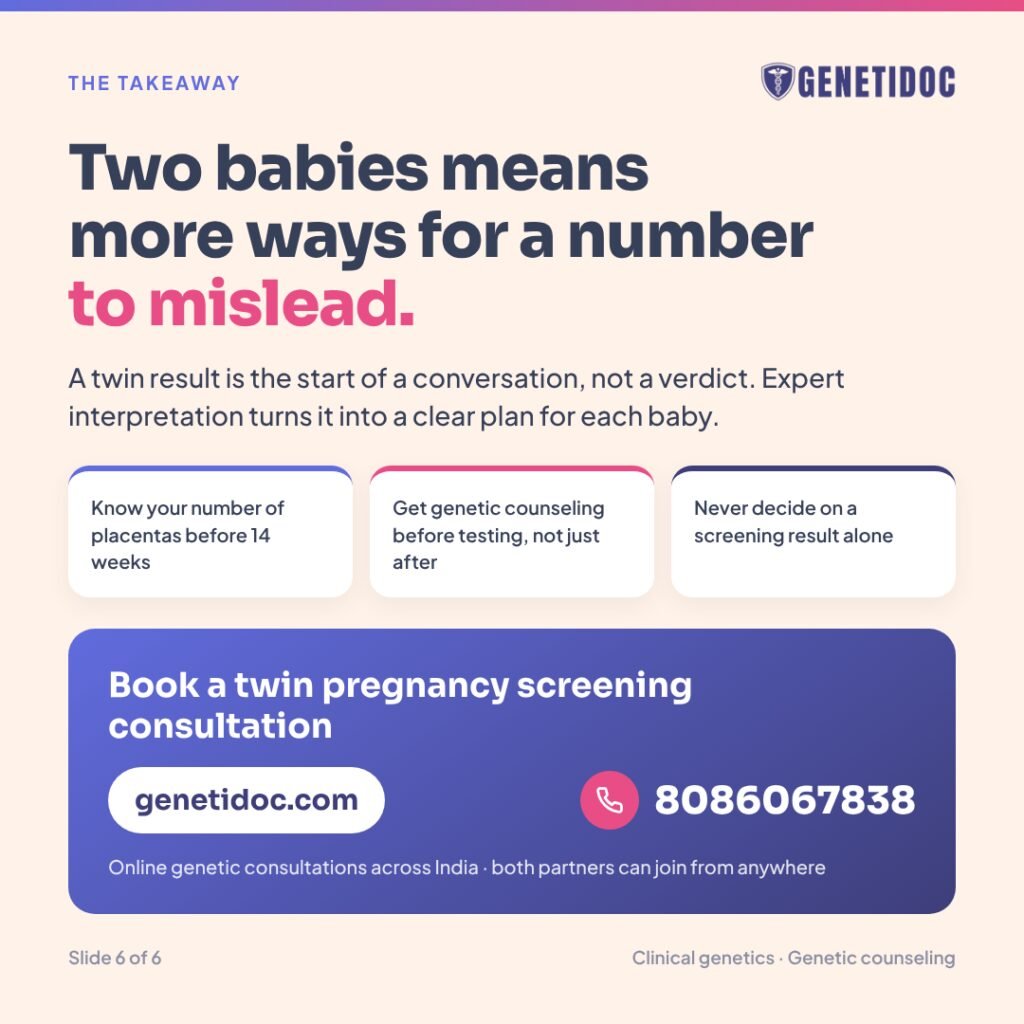
| “A screening result in a twin pregnancy is the start of a conversation, not a verdict. With two babies, there are simply more ways for a number to mislead if nobody interprets it carefully.”
— Dr. Roshan Daniel |
4. Second-Trimester Blood Tests
The quad marker test (a second-trimester blood test) is used in some single pregnancies. In twins, it has the same “mixing” problem as the double marker test, and is generally considered less reliable. Most twin pregnancies are better served by first-trimester screening, NIPT, and detailed scans.
5. The Anomaly Scan and Twin Monitoring Scans
The detailed anomaly scan at around 18 to 22 weeks checks each baby’s organs and body structure. This scan matters even if your NIPT was low risk, because NIPT does not check physical development.
Twins who share a placenta also need frequent scans, often every two weeks from around 16 weeks. These look for complications like twin-to-twin transfusion syndrome, where blood flow between the babies becomes unbalanced. This is not a genetic problem, but it is an important part of twin pregnancy care.
The Vanishing Twin: Why It Matters for NIPT
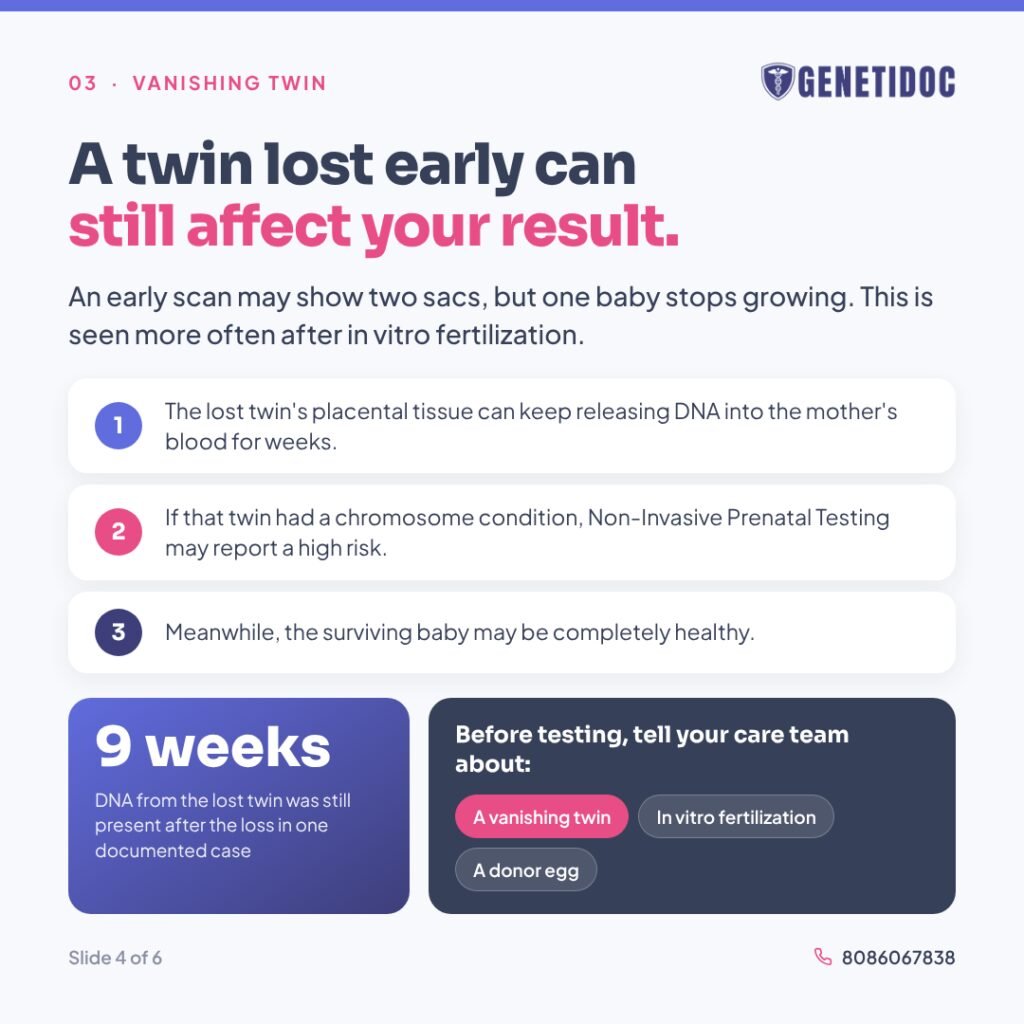
Sometimes an early scan shows two pregnancy sacs, but one baby stops growing in the first few weeks. Doctors call this a vanishing twin. It is more common than many people realize, and it is seen more often in IVF pregnancies, where very early scans are routine.
Here is why it matters. Even after the lost twin stops developing, its placental tissue can keep releasing DNA into the mother’s blood for weeks. If that twin had a chromosome condition, NIPT may pick up its DNA and report a high risk, even though the surviving baby is healthy.
Published reports show this leftover DNA can persist for several weeks. In one documented case, it was still present nine weeks after the loss. Researchers have not agreed on a safe waiting period after which NIPT becomes fully reliable.
| “If your early scan showed a second sac that did not continue, please tell us before your NIPT. It is one of the most important details we need to interpret your report correctly.”
— Dr. Roshan Daniel |
| Illustrative scenario (composite example; details changed)
A 34-year-old woman conceived through IVF. Her 7-week scan showed two sacs, but by 9 weeks only one baby was growing. At 11 weeks, she asked about NIPT. During counseling, the genetic team explained that DNA from the lost twin could still be in her blood and could cause a misleading result. Together they agreed on a plan: a careful first-trimester scan, and if NIPT was done, any high-risk result would be confirmed with diagnostic testing before any decision was made. Knowing this in advance spared her the shock of an unexplained “high-risk” report. |
IVF Twins: Do You Still Need Prenatal Screening?
Many couples who conceive through IVF ask whether further testing is needed, especially if their embryos were tested before transfer.
Preimplantation genetic testing for aneuploidy (PGT-A) checks a few cells taken from the outer layer of the embryo. These cells eventually form the placenta, not the baby. Sometimes the tested cells do not perfectly represent the baby. For this reason, embryo testing is considered a screening step, not a final diagnosis. Professional guidance recommends that prenatal screening or diagnostic testing still be offered during pregnancy.
There are other reasons IVF twin pregnancies need careful screening:
- A vanishing twin is more often detected in IVF pregnancies.
- IVF can change the double marker blood values.
- Pregnancies using a donor egg need special consideration. Some NIPT methods cannot be used with donor-egg pregnancies, especially twins. Always tell your doctor and the laboratory if a donor egg was used.
| “Couples who have waited years for an IVF pregnancy often feel they cannot afford a single wrong step. Our job is to give them clear and honest information, so their decisions come from understanding, not fear.”
— Dr. Roshan Daniel |
Step-by-Step: Genetic Screening Timeline for a Twin Pregnancy
- 6 to 10 weeks: Early scan to confirm twins. Note any second sac that stops growing.
- From 10 weeks: Genetic counseling before NIPT, especially after IVF, a donor egg or a vanishing twin.
- 10 weeks onwards: NIPT blood sample, if chosen after counseling.
- 11 weeks to 13 weeks 6 days: First-trimester scan to confirm the number of placentas and measure nuchal translucency for each baby. Double marker test, if done, with twin-adjusted calculation.
- From 16 weeks (shared placenta): Regular scans, often every two weeks.
- 18 to 22 weeks: Detailed anomaly scan of each baby.
- Any time a result is high risk: Post-test genetic counseling, then diagnostic testing if you choose it.
What Happens If a Screening Result Is High Risk?
First, take a breath. A high-risk screening result does not mean your baby or babies definitely have a condition. It means further testing is recommended to find out.
Two of the most common misunderstandings we see in prenatal screening are treating a screening result as a diagnosis, and assuming a high-risk result is a confirmed problem. Both can cause unnecessary distress, and sometimes rushed decisions.
Diagnostic Testing in Twins
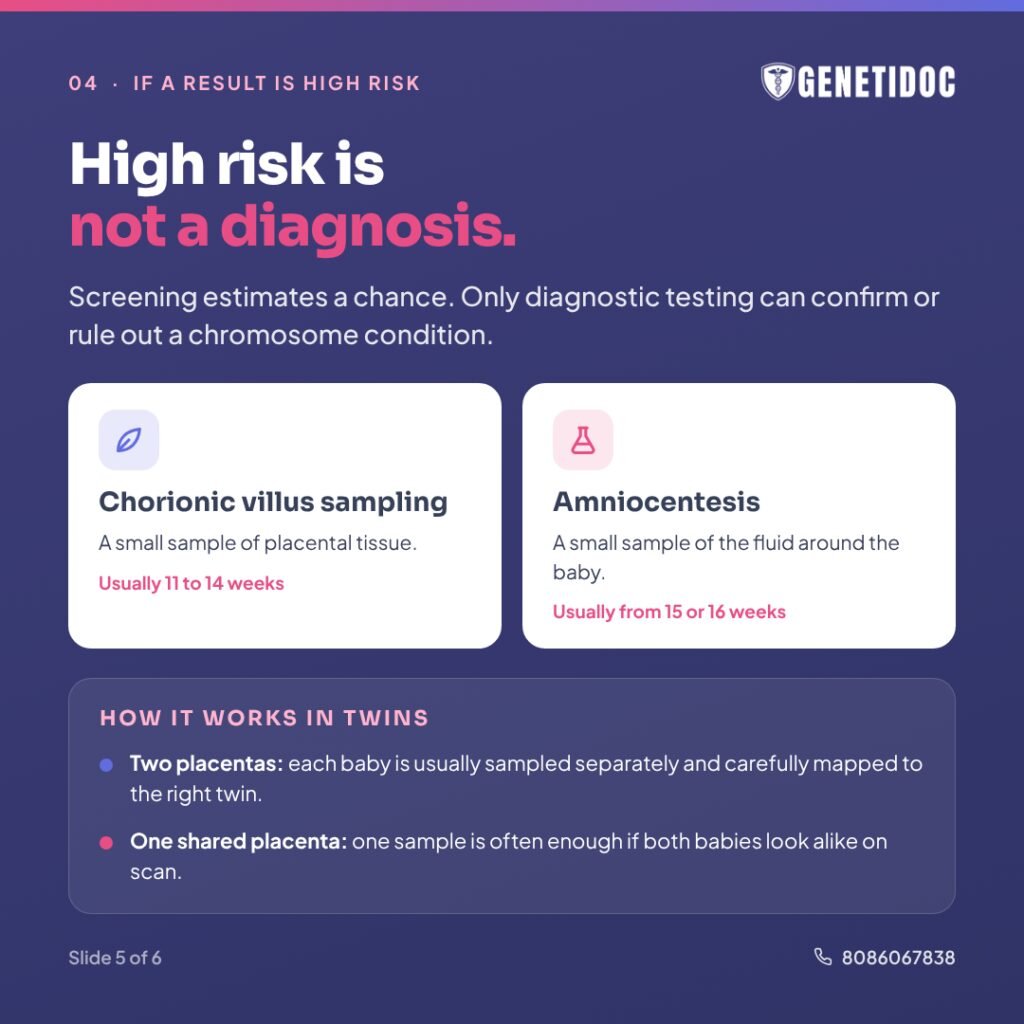
Diagnostic tests examine cells from the pregnancy directly and can confirm or rule out a chromosome condition. The two main options are:
- Chorionic villus sampling (CVS): A small sample of placental tissue, usually taken between 11 and 14 weeks.
- Amniocentesis: A small sample of the fluid around the baby, usually taken from 15 or 16 weeks.
The cells are then studied using karyotyping (a picture of all the chromosomes) or chromosomal microarray analysis (a more detailed test that can find smaller missing or extra pieces of chromosomes).
In twins, these procedures need extra care and experience:
- Twins with two placentas: Usually each baby is sampled separately. The specialist carefully maps which sample came from which baby, so that results can be matched to the right twin.
- Twins sharing one placenta: One sample is often enough when the babies look alike on scan, because they are almost always genetically identical. If one baby has a problem on scan and the other does not, both may be sampled.
The risk of pregnancy loss after an invasive procedure is slightly higher in twins than in single pregnancies. These procedures should be done by a fetal medicine specialist experienced with twins.
Genetidoc does not perform these procedures itself. Our team works alongside your obstetrician or fetal medicine specialist to explain your options, choose the right laboratory test, and interpret the results with you.
| Illustrative scenario (composite example; details changed)
A couple expecting twins who shared one placenta received a high-risk NIPT result for Down syndrome. They assumed only one baby might be affected. During counseling, they learned that twins sharing a placenta are almost always identical, so the result most likely applied to both. Their fetal medicine specialist performed amniocentesis, and the genetic team explained the confirmed result, what it meant for each baby, and the support available. The family said that understanding why both babies were involved helped them make sense of a very difficult moment. |
When Only One Twin Is Affected
In non-identical twins, it is possible for one baby to have a chromosome condition while the other is healthy. This is one of the hardest situations a family can face.
Options may include continuing the pregnancy with additional planning and support, or, in some situations, a procedure called selective reduction. Whether such a procedure is possible, and how safe it is for the healthy twin, depends on whether the twins share a placenta and on the stage of pregnancy. These procedures are only done at specialized fetal medicine centres.
Indian law also sets time limits and conditions for pregnancy-related procedures, with additional requirements later in pregnancy. Your fetal medicine team will explain what applies to your situation. This is another reason early screening and early counseling matter.
| “When only one twin is affected, there is no single right answer. We lay out the options, the risks and the timelines clearly, and then we support whatever the family decides. The decision belongs to them.”
— Dr. Roshan Daniel |
When Screening May Not Be Useful, and Its Limitations
Good care means being honest about what tests cannot do. Screening may have limited value, or need a different approach, when:
- There was a recent vanishing twin. NIPT results may be misleading for some weeks.
- The pregnancy used a donor egg. Some NIPT methods cannot be used.
- There are three or more babies. Evidence for NIPT in triplets is very limited.
- A scan already shows a major structural problem. In this case, diagnostic testing is usually more useful than another screening test.
- The family would not act on the result in any way and prefers not to know. Screening is always a choice, never an obligation.
Other limitations to keep in mind:
- No screening test detects every condition.
- A low-risk result lowers the chance of the conditions tested, but does not guarantee healthy babies.
- Placental mosaicism, where the placenta’s cells differ from the baby’s, can occasionally cause misleading NIPT results in any pregnancy.
| “No test can tell you everything. Good counseling tells you what was tested, what was not, and what to watch for next. That honesty is what makes a result useful.”
— Dr. Roshan Daniel |
Fetal Sex and Twin NIPT in India
Some NIPT methods used internationally can report the sex of each twin. In India, the Pre-Conception and Pre-Natal Diagnostic Techniques (PCPNDT) Act, 1994, prohibits disclosing the sex of a baby before birth.
Genetidoc does not report fetal sex from NIPT, for twins or for single pregnancies. Screening is done only to look for medical conditions that affect the health of your babies.
Common Myths About Twin Pregnancy Screening
Myth: “Two placentas means my twins are not identical.”
Fact: About one in three identical twin pairs also have two placentas.
Myth: “Our embryos were tested during IVF, so we do not need screening.”
Fact: Embryo testing samples cells that become the placenta. Prenatal screening or diagnosis is still recommended.
Myth: “A high-risk NIPT result means my baby has Down syndrome.”
Fact: NIPT is a screening test. Only diagnostic testing can confirm a condition.
Myth: “NIPT can tell which twin is affected.”
Fact: In most cases it cannot. Diagnostic testing of each baby is needed.
Myth: “A normal NIPT means my twins do not need detailed scans.”
Fact: NIPT does not check physical development. Anomaly scans and twin monitoring scans remain essential.
Why the Right Test, Laboratory and Interpretation Matter More in Twins
A twin result has more ways to be misread than a single-pregnancy result. A report may not reflect whether the twins are identical. It may not account for a vanishing twin. A low fetal fraction for one baby may be missed. A double marker risk may not be adjusted for twins.
Low-cost testing without proper interpretation can lead in two harmful directions. It can lead to unnecessary invasive procedures and anxiety after a misleading high-risk result. Or it can give false reassurance when a result is not as reliable as it looks.
The real value of genetic screening comes not from the report alone, but from what it means for your pregnancy. At Genetidoc, testing is done through accredited partner laboratories, and every result is reviewed by clinical geneticists and explained through genetic counseling. Before testing, we ask about your conception method, early scans, any vanishing twin and your family history. After testing, we explain what the result means for each baby and what the next sensible step is.
Genetic counseling is not a one-time formality. It runs through the whole journey: choosing the right test, preparing you for possible results, and helping you understand and act on what you learn.
Practical Advice for Parents Expecting Twins
- Make sure the number of placentas is recorded before 14 weeks. Ask your doctor to note it clearly in your scan report.
- Have the first-trimester scan at a centre experienced with twins. Accurate neck fluid measurements for each baby are crucial.
- Tell your care team about IVF, a donor egg or a vanishing twin. These details change how results are read.
- Get genetic counseling before NIPT, not just after. Knowing what a result can and cannot say prevents shock and confusion later.
- Do not make decisions on a screening result alone. Confirm with diagnostic testing first.
- Keep all your reports together. Scan reports, blood test reports and NIPT results make interpretation faster and more accurate.
- Keep up with your regular scans, whatever your screening results.
Genetidoc consultations are available online across India, with counseling in many Indian languages. Partners in different cities can join the same session, and blood samples can be collected from home.
You can also read and ask questions in our community forums on Non-Invasive Prenatal Testing, first-trimester screening and amniocentesis.
Frequently Asked Questions
Can NIPT be done in a twin pregnancy?
Yes. NIPT can be done in twin pregnancies from about 10 weeks. It is recognized by major professional bodies as an option for screening twins for common chromosome conditions such as Down syndrome. Genetic counseling before the test helps you understand what it can and cannot tell you.
Is NIPT accurate for twins?
For Down syndrome, NIPT in twins detects about 98 percent of affected pregnancies, similar to single pregnancies. Data for trisomy 18 and trisomy 13 in twins is more limited. “No result” outcomes are slightly more common in twins.
Can NIPT tell which twin has Down syndrome?
Usually not. In non-identical twins, a high-risk result means one or both babies may be affected. Diagnostic testing, such as amniocentesis or chorionic villus sampling of each baby, is needed to find out.
Is the double marker test reliable in twin pregnancy?
It is less accurate in twins than in single pregnancies, because both placentas release the measured substances into the same blood. The nuchal translucency measurement for each baby carries more weight, and the risk must be calculated with twin-adjusted software.
Are twins at higher risk of Down syndrome?
For identical twins, the chance for the pregnancy is similar to a single pregnancy at the same maternal age. For non-identical twins, each baby has its own chance, so the chance that at least one baby is affected is roughly double.
Does a vanishing twin affect NIPT results?
Yes, it can. The lost twin’s placental tissue may keep releasing DNA for several weeks. If that twin had a chromosome condition, NIPT may show a false high-risk result for the healthy surviving baby. Always tell your doctor about a vanishing twin.
Can amniocentesis be done in twins?
Yes. In twins with two placentas, each baby is usually sampled separately. In twins sharing one placenta, one sample is often enough. The procedure should be done by a fetal medicine specialist experienced with twins.
Do IVF twins need genetic screening if the embryos were tested?
Yes. Embryo testing checks cells that form the placenta, which may not perfectly reflect the baby. Prenatal screening or diagnostic testing is still recommended in pregnancy.
Can NIPT tell if my twins are identical?
Some NIPT methods can estimate whether twins are identical or non-identical, but not all can. The first-trimester scan showing the number of placentas also helps, though two placentas do not rule out identical twins.
Can NIPT tell the gender of twins in India?
No. Under the PCPNDT Act, 1994, disclosing a baby’s sex before birth is prohibited in India. Genetidoc does not report fetal sex from NIPT.
When should genetic screening be done in a twin pregnancy?
NIPT can be done from 10 weeks. The first-trimester scan with nuchal translucency is done between 11 weeks and 13 weeks 6 days. The anomaly scan follows at 18 to 22 weeks. Early counseling helps you plan the right order.
Does a low-risk NIPT mean my twins are healthy?
A low-risk result greatly lowers the chance of the conditions screened, but it is not a guarantee. NIPT does not check for physical problems, so regular scans remain essential.
Key Takeaways
- Genetic screening is possible and useful in twin pregnancies, but results are more complex to interpret.
- Knowing whether your twins share a placenta, ideally before 14 weeks, shapes every screening decision.
- NIPT is the most accurate screening test for Down syndrome in twins, but it usually cannot say which baby is affected.
- The double marker test is less reliable in twins and must use twin-adjusted calculation.
- A vanishing twin, IVF or a donor egg can change how results should be read.
- A high-risk result needs diagnostic testing before any decision is made.
- Genetic counseling before and after testing turns a result into a clear, personal plan.
| Expecting twins and unsure which screening is right for you?
Whether you are planning NIPT, trying to understand a double marker report, or have had a vanishing twin or IVF pregnancy, Genetidoc’s clinical geneticists can help you choose the right test and understand what your results mean for each baby. Online consultations are available across India, and both partners can join from anywhere.
|
Book a twin pregnancy screening consultation.
Related Reading
- Chimerism: When One Person Carries Two Sets of DNA
- Male BRCA Carriers: An Overlooked Risk Group
- Cowden Syndrome and the PTEN Gene: Signs, Cancer Risks, Testing and Screening Explained
- Autism Spectrum Disorder and Genetic Testing: A Guide for Indian Families
- Marfan Syndrome: Symptoms, Diagnosis and Genetic Testing Explained
- Li-Fraumeni Syndrome: When Many Different Cancers Run in One Family
References
- American College of Obstetricians and Gynecologists; Society for Maternal-Fetal Medicine. Screening for Fetal Chromosomal Abnormalities. Practice Bulletin No. 226. Obstetrics & Gynecology. 2020;136(4):e48–e69.
- Palomaki GE, Chiu RWK, Pertile MD, et al. International Society for Prenatal Diagnosis Position Statement: cell free (cf)DNA screening for Down syndrome in multiple pregnancies. Prenatal Diagnosis. 2021;41(10):1222–1232.
- Gil MM, Galeva S, Jani J, et al. Screening for trisomies by cfDNA testing of maternal blood in twin pregnancy: update of The Fetal Medicine Foundation results and meta-analysis. Ultrasound in Obstetrics & Gynecology. 2019;53(6):734–742.
- Boo HY, Han YJ. Cell-free DNA screening in twin pregnancies. Obstetrics & Gynecology Science. 2024;67(2):160–168. doi:10.5468/ogs.23135
- Khalil A, Rodgers M, Baschat A, et al. ISUOG Practice Guidelines: role of ultrasound in twin pregnancy. Ultrasound in Obstetrics & Gynecology. 2016;47(2):247–263.
- Spencer K. Screening for trisomy 21 in twin pregnancies in the first trimester: does chorionicity impact on maternal serum free beta-hCG or PAPP-A levels? Prenatal Diagnosis. 2001. doi:10.1002/pd.152
- American College of Obstetricians and Gynecologists. Preimplantation Genetic Testing. Committee Opinion No. 799. Obstetrics & Gynecology. 2020;135(3):e133–e137.
- Khanjani S, Hantoushzadeh S, Sahebi L, et al. When Is Non-Invasive Prenatal Testing Reliable in Pregnancies with a Vanishing Twin? A Systematic Review of Case Reports. International Journal of Pediatrics (Mashhad University of Medical Sciences).
- Discordant NIPT result in a viable trisomy-21 pregnancy due to prolonged contribution to cfDNA by a demised trisomy-14 cotwin. Case report, PubMed Central PMC5930198.
- Monden C, Pison G, Smits J. Twin Peaks: more twinning in humans than ever before. Human Reproduction. 2021;36(6):1666–1673.
- Gouru P, Dubbewar AP, Hiremath RN, et al. Maternal and fetal outcome following post in vitro fertilization and embryo transfer pregnancy: a prospective observational study. Journal of Marine Medical Society. 2024. doi:10.4103/jmms.jmms_73_23
- Government of India. The Pre-Conception and Pre-Natal Diagnostic Techniques (Prohibition of Sex Selection) Act, 1994.
- Government of India. The Medical Termination of Pregnancy (Amendment) Act, 2021.
This article is for educational purposes and does not replace personalized medical advice. Please speak with your obstetrician, fetal medicine specialist or a clinical geneticist about your own pregnancy.